
Ask a Georgian what they eat for breakfast and you'll probably get a confused look. Not because they don't eat in the morning — they do — but because the concept of "breakfast food" as a distinct category barely exists here. There's no Georgian pancake house, no equivalent of the English fry-up, no sacred morning ritual built around a specific set of dishes. Instead, there's bread, cheese, tea, whatever's left from last night, and a general attitude that mornings are for function, not ceremony.
That said, once you understand what actually happens in a Georgian kitchen between 8 and 11 AM, you'll find a morning food culture that's quietly brilliant — built on fresh dairy, seasonal produce, and a relationship with bread that borders on spiritual. This guide covers all of it: the everyday reality, the special-occasion dishes, and the things you'll only find if someone's grandmother invites you in.
Two breakfast dishes deserve more attention than they usually get: borano from Adjara, which turns sulguni and butter into a hot pan of dairy excess, and kikliko, Georgia's egg-fried bread that sits somewhere between French toast and practical leftover management. Borano is not an everyday morning thing in every Georgian home, but in the west it absolutely belongs in the breakfast conversation. Kikliko is the opposite: ordinary, fast, and much more widespread than food writing usually admits.
The Truth About Georgian Breakfast
Here's something most food blogs won't tell you: Georgia doesn't have a strong breakfast tradition in the way that, say, Turkey or England does. There's no designated "morning meal" with a fixed lineup of dishes. Historically, rural Georgians ate two main meals — a large lunch and a large dinner — with morning being a quick, practical affair before heading to the fields or the vineyard.
What you get for breakfast in Georgia depends entirely on context. A village grandmother will put out a different spread than a Tbilisi professional grabbing something before work. A guesthouse in Svaneti operates on a different logic than a café on Aghmashenebeli Avenue. And all of them are "Georgian breakfast."
The common thread is simplicity. Most Georgian mornings revolve around some combination of bread, cheese, butter, eggs, and tea. Not because Georgians lack imagination — anyone who's been to a supra knows that's absurd — but because mornings here are about sustenance, not spectacle. The real cooking happens later in the day.
The tea thing
Georgians drink an enormous amount of tea, usually black, always with sugar (often 2-3 spoonfuls). Turkish-style coffee exists but takes patience most mornings don't offer. Instant coffee was the default for decades. Specialty coffee is a very recent Tbilisi phenomenon — don't expect it outside the capital.
The Everyday Georgian Breakfast
If you could peek into a hundred Georgian kitchens at 9 AM on a Tuesday, you'd see remarkable consistency. The daily breakfast has a few standard components that get mixed and matched:
| Component | What It Is | Notes |
|---|---|---|
| Bread | Tonis puri or shotis puri, bought fresh that morning | Bread is bought daily — sometimes twice. Yesterday's bread is for toast. |
| Cheese | Sulguni, imeruli, or whatever's local | Always sliced, never grated. Sometimes with butter on bread, sometimes alone. |
| Butter | Unsalted, often homemade in villages | Spread on bread first, then topped with cheese or jam. Always butter first. |
| Eggs | Scrambled or fried, often with tomatoes | Scrambled eggs with tomato and cheese is probably the closest thing to a national breakfast dish. |
| Tomato & Cucumber | Sliced, raw, with salt | In season (May–October). Georgians eat these at every meal, including breakfast. |
| Jam / Honey | Homemade preserves — walnut, fig, cherry, rose petal | Muraba (preserves) are a Georgian art form. Every grandmother has a signature. |
| Tea | Black tea, strong, sugared generously | The default morning drink for most of the country. |
That's it. That's the baseline. A Georgian breakfast is bread with cheese and tea. Some mornings there are eggs. If it's summer, there are tomatoes. If grandmother made preserves last autumn, there's jam. There's nothing wrong with this simplicity — when the bread is 20 minutes old and the cheese was made yesterday, you don't need a lot of ceremony.
The Bread-and-Sugar Childhood Breakfast
Ask a Georgian about their childhood breakfast and many will mention buterbrod — a slice of bread spread with butter and sprinkled with sugar on top. It's the Georgian equivalent of toast with Nutella, minus the Nutella. Simple, fast, sweet enough to appeal to kids, and genuinely nostalgic for anyone who grew up in the Soviet or post-Soviet era. You won't find it in restaurants, but you'll find it in memories.
Matsoni: Georgia's Secret Weapon
If there's one thing that separates a Georgian morning from a generic Eastern European one, it's matsoni (მაწონი). This fermented milk product sits somewhere between yogurt and kefir — thicker than drinking yogurt, thinner than Greek yogurt, tangier than both, and absolutely central to Georgian food culture.
Matsoni isn't just a breakfast item. It's a sauce base (for tolma, for example), a marinade ingredient, a cooking medium, and a stand-alone snack. But at breakfast, it gets the spotlight. The classic way to eat it: a bowl of matsoni with a generous drizzle of honey, eaten with a spoon alongside bread. In villages, the matsoni is homemade, which makes the supermarket version taste like a distant cousin. If you want to make it properly at home, start with our homemade matsoni recipe — it is simpler than most people assume.
Matsoni with Honey
The classic breakfast combination. Thick, tangy matsoni drizzled with local honey — wildflower, chestnut, or alpine meadow depending on the region. Eaten with a spoon, sometimes with bread for dipping.
Matsoni with Muraba
Swirl in a spoonful of homemade preserves — walnut jam (ნიგვზის მურაბა), fig preserve, or cherry jam. The tartness of the matsoni against the sweetness of the muraba is excellent.
Finding real matsoni
Supermarket matsoni is fine but pale compared to village-made. At Tbilisi's Dezerter Bazaar, homemade versions sold in reused bottles are usually thicker, tangier, and noticeably better. If you're staying at a family guesthouse in the countryside, the matsoni is often homemade. If you're nowhere near Georgia, the next best move is to make your own — our matsoni recipe walks through the temperature and texture cues that matter.
Chirbuli: Georgia's Answer to Shakshuka
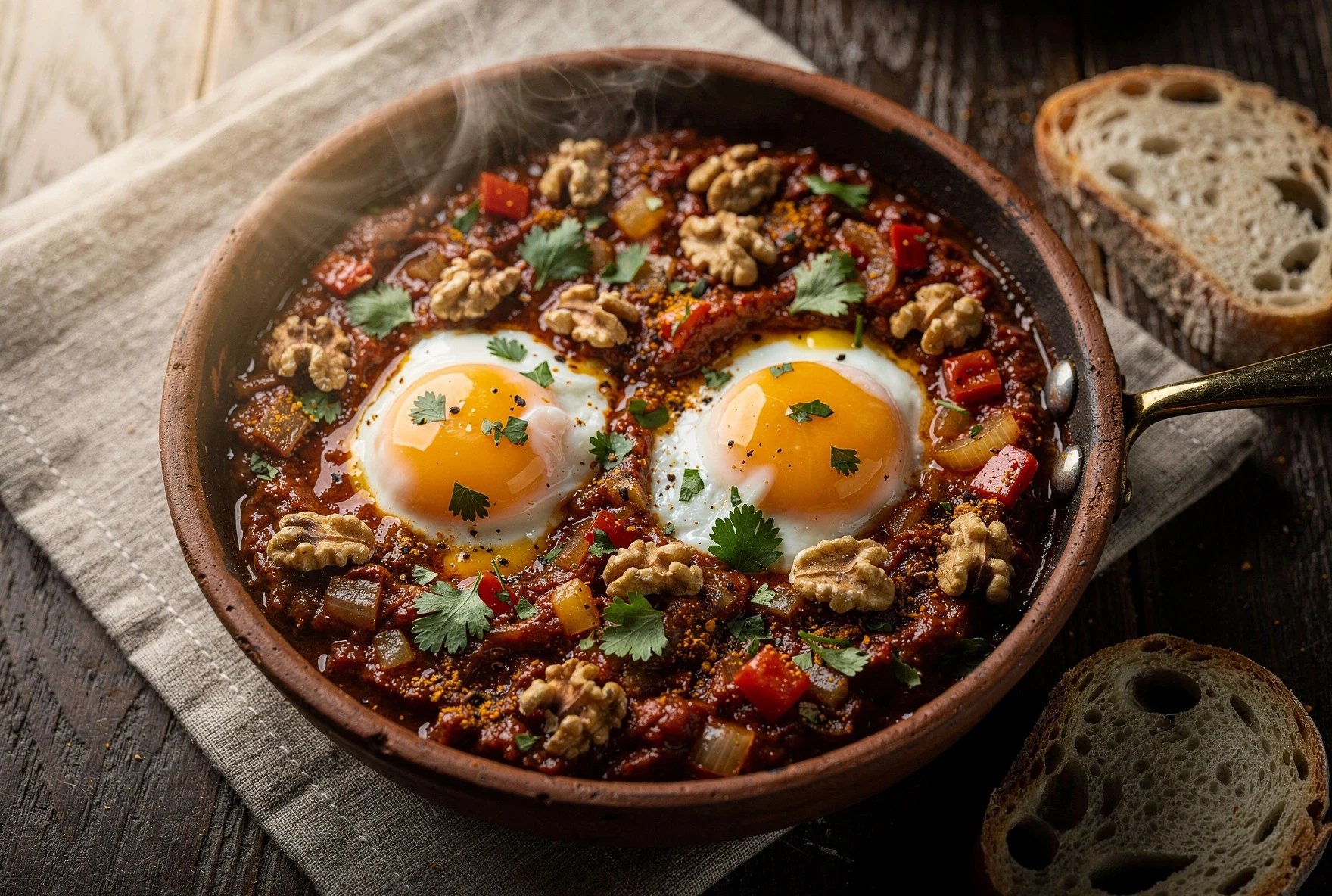
If Georgian breakfast has a showpiece dish, it's chirbuli (ჩირბული). Eggs cooked in a rich, spiced tomato sauce with walnuts — it's Georgia's version of shakshuka, except it predates the global shakshuka trend by centuries and includes ground walnuts, which changes everything.
Chirbuli is credited to Adjara, the Black Sea coastal region whose cuisine carries strong Turkish and Middle Eastern influences. The name likely derives from the same root as "shakshuka" — meaning "mixture" — but got filtered through Adjaran dialect rather than being borrowed directly.
| Element | Chirbuli | Shakshuka |
|---|---|---|
| Base | Tomatoes, onion, garlic | Tomatoes, onion, garlic, peppers |
| Signature ingredient | Ground walnuts | Cumin, paprika |
| Spices | Coriander, fenugreek, marigold, red pepper | Cumin, paprika, sometimes harissa |
| Eggs | Poached or scrambled in sauce | Poached in sauce |
| Texture | Thicker, nuttier — the walnuts add body | Saucier, more liquid |
| Served with | Tonis puri or shotis puri | Challah or pita |
The walnuts are the key difference. They give chirbuli a richness and body that straight-up shakshuka can't match. The sauce is thicker, nuttier, and more complex. Topped with chopped fresh cilantro and served in the pan with torn bread, it's genuinely one of the best egg dishes in the world. Not hyperbole.
That said, chirbuli is more of a weekend or special-occasion breakfast than an everyday affair. Making the sauce takes 20-30 minutes, and most Georgian mornings don't have that kind of patience. When you see it on restaurant menus, it's usually under "breakfast" — but in homes, it's a lazy Saturday thing.
Kikliko: Georgian French Toast
Every culture has a version of "dip bread in egg and fry it," and Georgia's is called kikliko (კიკლიკო). It's essentially French toast — sliced bread dipped in beaten egg (sometimes with a splash of milk), fried in butter until golden. Simple, cheap, loved by children.
Kikliko doesn't appear on restaurant menus. It doesn't get photographed for food blogs. It's not fancy enough to be "Georgian cuisine" and not exotic enough to be interesting to tourists. But ask a Georgian what they ate for breakfast growing up, and kikliko will be in the top three answers, right alongside bread-and-cheese and scrambled eggs.
The name might come from the Georgian word for "golden" or "cock" (rooster), though nobody seems entirely sure. What everyone agrees on is the technique: yesterday's bread works better than fresh (it absorbs the egg without falling apart), and butter is non-negotiable. Some families add sugar to the egg mixture, others keep it savory. Both camps are correct.
Making kikliko at home
Beat 2 eggs with a pinch of salt (add 1 tbsp sugar and a splash of milk if you want the sweet version). Slice day-old bread into 1cm slices. Dip each slice in the egg, letting it soak for 5 seconds per side. Fry in butter over medium heat until golden, about 2 minutes per side. Serve immediately — with jam for the sweet version, or cheese for the savory. That's it. The entire thing takes 10 minutes. If you want the full version with ratios, texture cues, and serving options, use our dedicated kikliko recipe.
Eggs with Tomato and Cheese
If there's a dish that comes closest to being Georgia's universal breakfast, it's scrambled eggs with tomato. Not a formal recipe — nobody follows a recipe for this — just eggs scrambled in a pan with chopped ripe tomatoes, sometimes with sulguni cheese thrown in during the last minute so it gets half-melted and stretchy.
This is the dish that Georgian university students make in their dormitories. It's what hungover 25-year-olds eat at noon. It's what grandmothers make when the grandchildren are visiting and she hasn't had time to prepare anything elaborate. It takes five minutes, requires zero skill, and tastes considerably better than it has any right to — mostly because Georgian tomatoes in summer are some of the best in the world.
| Variation | What Changes | Region / Context |
|---|---|---|
| Basic | Eggs + tomato + salt | Everywhere, everyday |
| With cheese | Add sulguni or imeruli cheese at the end | Western Georgia especially |
| With herbs | Add cilantro, basil, or tarragon | Summer, when herbs are abundant |
| With peppers | Add roasted green peppers | Kakheti and eastern regions |
Khachapuri for Breakfast (Yes, Really)
Westerners tend to think of khachapuri as a meal in itself — and it is. But for many Georgians, leftover khachapuri from last night is perfectly acceptable breakfast food. Slice it, warm it on a dry pan or in the oven, and eat it with tea. Nobody considers this unusual.
The round Imeretian style reheats best — it was designed to be eaten throughout the day. Adjarian (the boat-shaped one with the egg) really needs to be eaten fresh, since the liquid center doesn't survive reheating gracefully.
In some families, particularly in western Georgia, a fresh Imeretian khachapuri is the breakfast — made first thing in the morning and served hot from the pan. When sulguni cheese is cheap and plentiful, there's no reason not to. This is especially common in Samegrelo and Imereti, where cheese production is a way of life.
The Legendary Guesthouse Breakfast
If you're traveling through Georgia and staying in family-run guesthouses (which you should be), you'll encounter the most generous version of Georgian breakfast. Guesthouse owners treat breakfast as a performance — a chance to show what their kitchen can do. The typical spread includes:
| Item | Details |
|---|---|
| Fresh bread | Tonis puri, shotis puri, or homemade bread. Always fresh that morning. |
| 2-3 types of cheese | Sulguni, imeruli, sometimes smoked or cottage cheese. Almost always homemade. |
| Butter | Homemade, bright yellow, extraordinary. |
| Eggs | Boiled, scrambled, or fried. Often from the house's own chickens. |
| Tomatoes & cucumbers | Sliced, from the garden. In summer, these alone justify the trip. |
| Matsoni | Homemade, with honey from the host's bees. Life-changing. |
| Jams & honey | 3-5 varieties: walnut, fig, cherry, rose petal, quince. All homemade. |
| Fresh herbs | Tarragon, basil, cilantro, dill — a whole plate of them. |
| Tea | Strong black tea, unlimited refills. |
This is, genuinely, one of the best breakfast experiences in the world. Not because any single element is extraordinary (though the homemade butter often is), but because everything was made by hand, probably that morning, from ingredients grown within walking distance. The matsoni is from yesterday's milk. The honey is from the hives out back. The jam was put up last autumn with fruit from the garden.
A guesthouse breakfast costs nothing extra — it's included in the 60-100₾ ($20-35) room rate. Which means you're eating better than most luxury hotels in Europe for a fraction of the price.
Don't fill up at breakfast
Guesthouse breakfasts look deceptively manageable, but the same hosts are going to serve you an enormous dinner. Pace yourself. The real performance is the evening meal — breakfast is just the opening act.
How Seasons Change the Plate
| Season | Breakfast Additions | Notes |
|---|---|---|
| Spring | Jonjoli (pickled bladderwort), fresh tarragon, green onions | First fresh produce appears. Jonjoli is a spring ritual. |
| Summer | Incredible tomatoes, cucumbers, stone fruit, berries | Peak season. Breakfast is 50% raw produce. The tomatoes alone are worth visiting for. |
| Autumn | Persimmons, fresh walnuts, grapes, new churchkhela | Harvest season. Fresh churchkhela (soft, not the dried tourist version) appears at markets. |
| Winter | Pickles, preserved jams, dried fruit, stored cheese | Breakfast gets simpler. Bread, cheese, jam, tea. Soviet-era porridge (kasha) appears more often. |
The seasonal shift matters more than most guides acknowledge. A Georgian breakfast in July and a Georgian breakfast in January are almost different meals. Summer mornings overflow with raw produce — sliced tomatoes so good they need nothing but salt, cucumbers still cold from the well, herbs in bunches bigger than your hand. Winter mornings are sparser: bread, butter, cheese, tea, maybe a boiled egg, definitely pickles.
Regional Differences
Western Georgia (Samegrelo, Imereti)
More cheese, more corn. Elarji (stretchy cornmeal-cheese) or mchadi (cornbread) might appear instead of wheat bread. Ghomi (plain cornmeal porridge) with cheese is a common morning staple. Sulguni dominates.
Eastern Georgia (Kakheti, Kartli)
More bread-centric. Tonis puri with butter and imeruli cheese. The produce is slightly different — more walnuts, more dried fruit, more grapes. Chikhirtma (egg-lemon soup) sometimes serves as a morning-after-supra revival meal.
Adjara (Black Sea coast)
Chirbuli territory. The Turkish influence shows — stronger tea, sometimes boiled eggs in ways that echo Turkish breakfast, more butter usage. Adjarian khachapuri fresh from the oven is the ultimate regional breakfast.
Svaneti (Mountains)
Heavier, calorie-dense. Kubdari (meat bread) might be breakfast if there's leftover from the night before. More dairy, more bread, less fresh produce due to altitude and short growing season. Svanetian salt on everything.
Muraba: The Art of Georgian Preserves
No discussion of Georgian breakfast is complete without muraba (მურაბა) — Georgian preserves that make European jam look like an afterthought. Where Western jam is about pectin-thickened fruit paste, Georgian muraba preserves whole fruits or large pieces in thick sugar syrup, maintaining their shape and texture. The result is closer to a compote than a spread.
| Variety | Description | Season |
|---|---|---|
| Walnut (ნიგვზის მურაბა) | Young green walnuts soaked for weeks, then simmered in syrup with cloves and cinnamon. Dark, complex, slightly bitter. | Made in June from unripe walnuts |
| Fig (ლეღვის მურაბა) | Whole small figs in honey-like syrup. Soft, sweet, intensely figgy. | Late summer |
| Rose Petal (ვარდის მურაბა) | Fragrant, floral, almost perfume-like. A thin layer on buttered bread is extraordinary. | Spring rose season |
| Cherry (ბალის მურაბა) | Sour cherries in syrup — the most "normal" by Western standards, and probably the most popular. | Early summer |
| White Cherry (თეთრი ბალი) | Rare, delicate, prized. White cherries in light syrup — more expensive, more special. | Early summer, limited |
| Quince (კომშის მურაბა) | Slow-cooked until deep amber. Firm texture, honey-apple flavor. | Autumn |
The walnut muraba deserves special mention. Making it is a weeks-long process that starts with picking green, unripe walnuts in June, soaking them in water for days (changing the water twice daily to remove bitterness), then simmering in sugar syrup with spices. The result is a dark, almost coffee-colored preserve with a complex bitterness and deep sweetness. It's considered a delicacy, and grandmothers who make it well are local celebrities.
Modern Tbilisi Breakfast
Tbilisi's breakfast scene has changed dramatically since 2018, when a café called Kikliko became the first dedicated breakfast spot in the city, opening at the then-unthinkable hour of 8 AM. Before that, finding breakfast in Tbilisi before 10 or 11 was genuinely difficult — restaurants opened late, cafés focused on coffee and pastries, and most people just ate at home.
Now there's a proper café breakfast culture, mostly concentrated in the Vera, Vake, and Mtatsminda neighborhoods. The menus are a mix of international and Georgian:
| Dish | Price Range | Notes |
|---|---|---|
| Chirbuli | 12-18₾ | The go-to Georgian breakfast order at cafés |
| Scrambled eggs + cheese | 8-14₾ | Often with sulguni, sometimes with tomato |
| Khachapuri | 10-20₾ | Available all day at any restaurant — Imeretian is fastest |
| Avocado toast | 14-22₾ | Yes, it's arrived. More expensive than chirbuli, less satisfying. |
| Granola / açaí bowls | 16-25₾ | The expat-driven health food wave. Quality varies. |
| Specialty coffee | 6-12₾ | Flat whites and pour-overs now easily available in central Tbilisi |
Timing matters
Even in modern Tbilisi, breakfast hours are late by Western standards. Most cafés open at 9 or 10 AM. Traditional restaurants might not serve until 11 or noon. If you're an early riser, hotel breakfast or a bakery grab (fresh tonis puri) might be your only option before 9.
What to Order for Breakfast as a Visitor
If you're visiting Georgia and want the authentic morning experience, here's what to prioritize — roughly ranked by "how Georgian" it actually is:
The Authentic Experience (What Locals Actually Eat)
The Special Occasion Upgrade
Common Mistakes Visitors Make
Expecting a huge breakfast
Georgian hospitality peaks at dinner, not breakfast. Morning is simple on purpose — save your appetite.
Looking for breakfast before 9 AM
Georgia runs late. Bakeries open early, but restaurants and cafés rarely serve before 10. Plan accordingly.
Skipping the matsoni
Especially homemade matsoni at guesthouses. It's not just yogurt — it's a different product entirely. Try it with honey before you dismiss it.
Ordering khachapuri as a starter
Adjarian khachapuri alone is 800+ calories. It's a full meal, not a side dish. Don't order it alongside a full breakfast.
Visiting markets too early
Tbilisi's Dezerter Bazaar is open early, but many food vendors arrive at 9-10 AM. Go before noon for the best selection.
Ignoring the bread
Georgian bread — especially fresh tonis puri — is special. It's not just a vehicle for cheese. Eat it while it's still warm from the oven. The texture window is about 2 hours.
Frequently Asked Questions
Do Georgian hotels serve breakfast?
Most hotels include breakfast — usually a buffet with both Georgian (cheese, bread, eggs, matsoni) and international options (cereal, pastries, fruit). Quality varies wildly. Boutique hotels in Tbilisi tend to do it better than chains.
Is Georgian breakfast vegetarian-friendly?
Extremely. The default Georgian breakfast is already vegetarian — bread, cheese, eggs, vegetables, yogurt, honey, jam. Meat at breakfast is unusual. Vegans will struggle with the dairy dominance, though.
What about coffee in Georgia?
Tea is traditional, but Tbilisi now has excellent specialty coffee (Mokarabia, Prospero's Books, the Coffee Lab). Outside the capital, expect instant coffee or Turkish-style (called "Eastern" coffee in Georgian). The specialty coffee scene is young but growing fast.
Where's the best breakfast in Tbilisi?
For Georgian breakfast: any traditional restaurant that opens before noon (Machakhela, Samikitno are reliable chains). For café breakfast: the Vera neighborhood has the highest concentration of quality breakfast spots. For the guesthouse experience: stay in a family-run place in Old Town.
Can I buy Georgian breakfast items to take home?
Muraba (preserves) and honey travel well and make excellent gifts. Sulguni and other cheeses can survive a short flight in checked luggage. Matsoni won't survive the journey. Fresh bread is obviously impossible — but you can find Georgian flour blends online for making your own shotis puri.
Written by The Georgian Eats Team
We've eaten more guesthouse breakfasts across Georgia than we can count — from Svaneti to Kakheti, Adjara to Tusheti. The matsoni-and-honey combination at a village guesthouse remains one of our favorite food experiences anywhere, and a properly hot pan of borano in Adjara is not far behind.
Last updated: March 2026.
Related Articles
20 Dishes You Need to Try
The definitive guide to Georgian cuisine.
Georgian Cheese: Every Variety Worth Knowing
From stretchy sulguni to pungent guda.
Adjarian Khachapuri
The boat-shaped cheese bread that ruins all other bread.
Chikhirtma: Egg-Lemon Chicken Soup
Georgia's hangover cure and morning-after-supra revival.