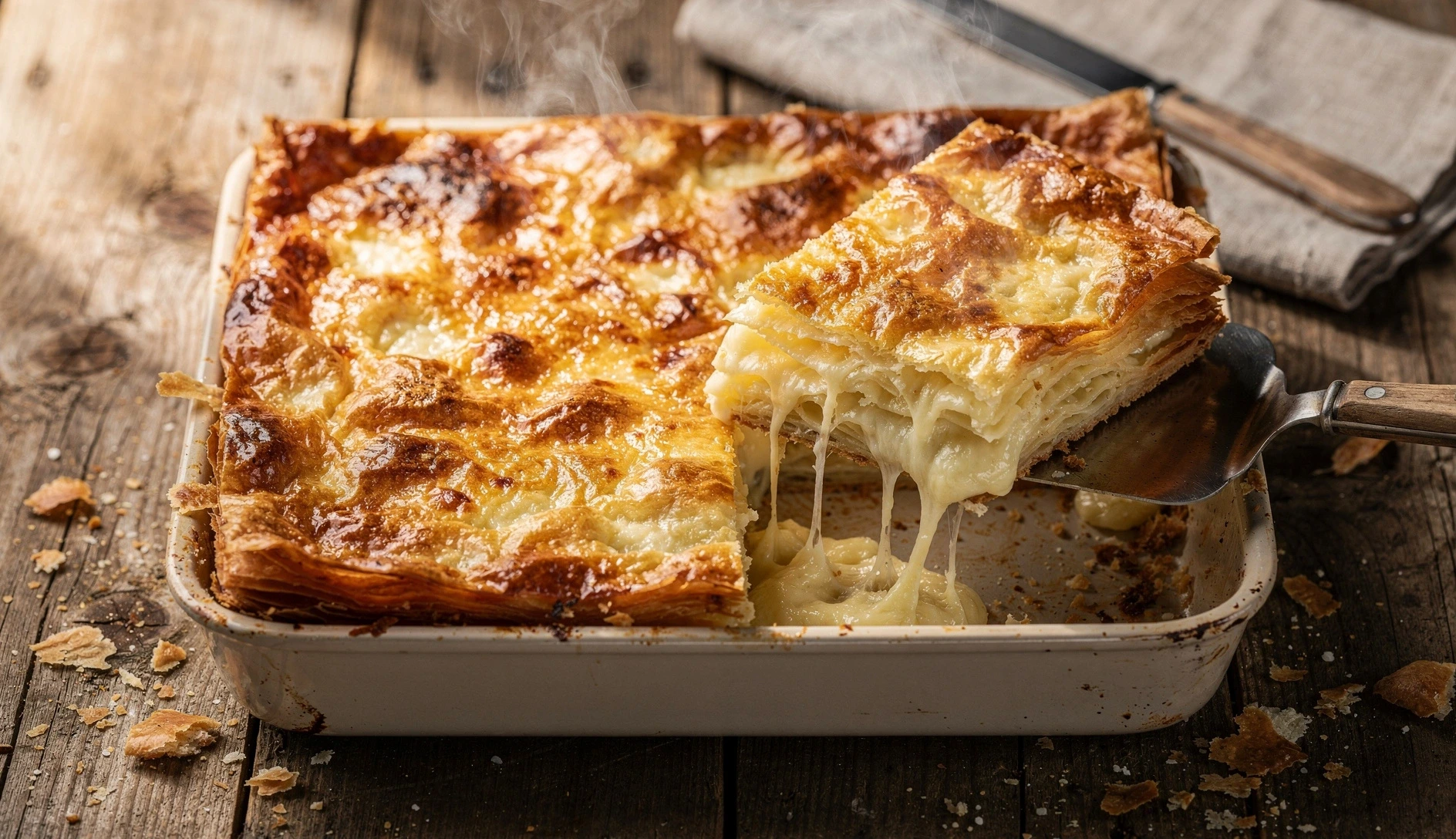
Everyone knows khachapuri. But ask a Georgian what they actually want to eat at a family dinner, and achma comes up just as fast. This Adjarian layered cheese pie — sheets of boiled dough stacked with sulguni and drenched in butter — is one of those dishes that's absurdly simple in concept and absolutely devastating in execution. Think of it as Georgia's answer to lasagna, except there's no meat, no tomato sauce, and it's somehow better. Crispy golden top, soft molten interior, individual layers you can pull apart. It's the kind of thing you eat standing over the pan, telling yourself you'll stop after one more piece.
Achma Quick Facts
- Georgian name: აჩმა (ACH-ma)
- Origin: Adjara and Abkhazia regions
- Type: Layered cheese pie (a type of khachapuri)
- Key technique: Dough sheets are boiled before layering
- Active time: ~1 hour (rolling + boiling + assembly)
- Total time: 2–2.5 hours
- Serves: 8–10
- Cost in Georgia: 8–12 GEL (~$3–4)
What Is Achma, Exactly?
Achma is technically a variety of khachapuri — but calling it that doesn't do it justice. Where most khachapuri is bread-dough encasing cheese, achma is something entirely different: paper-thin sheets of dough, boiled like pasta, then layered with grated sulguni cheese and melted butter in a deep baking dish. The whole thing goes in the oven until the top is shattering-crisp and the interior is a molten, layered mess of cheese and tender dough.
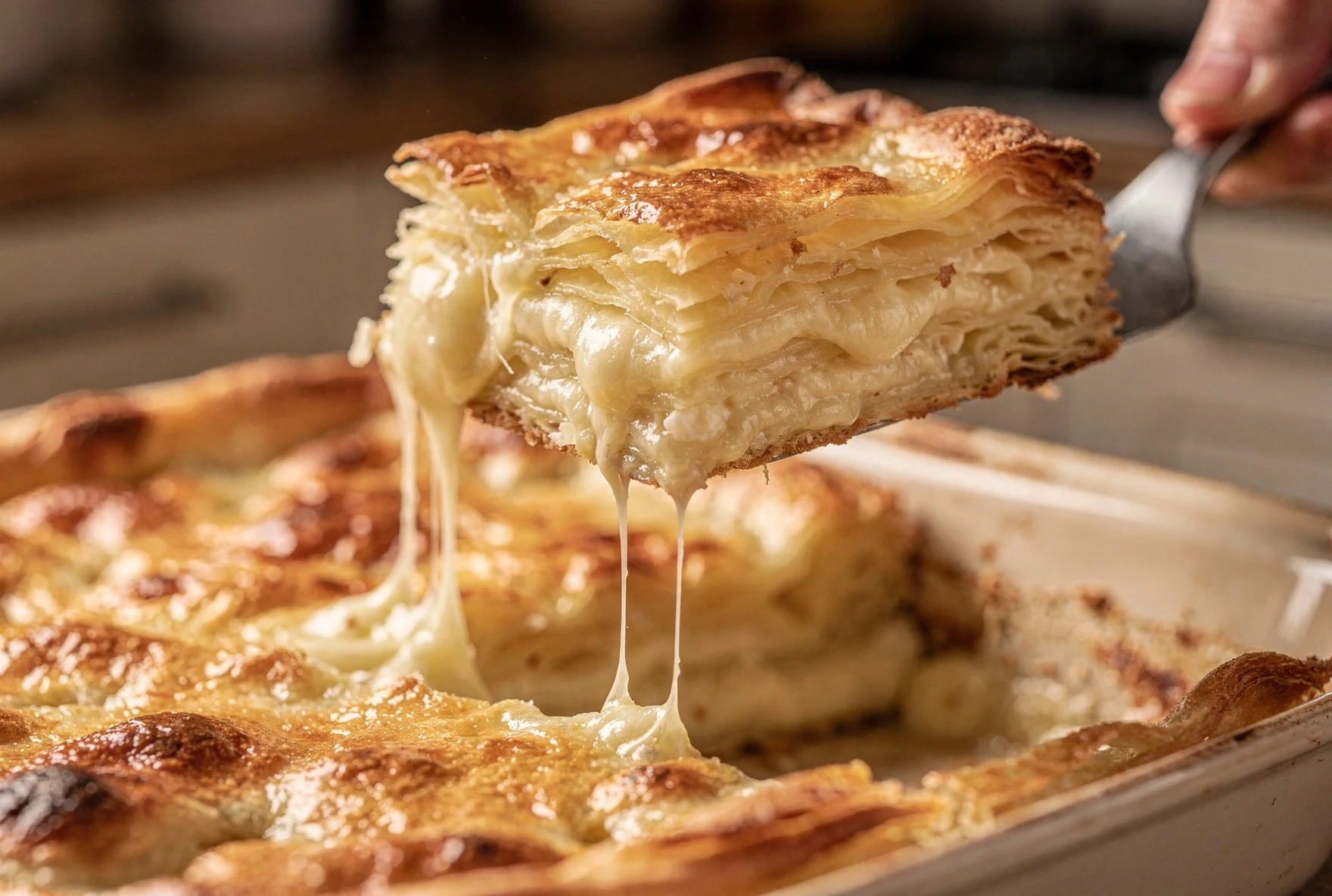
The technique is closer to Turkish börek or Greek bougatsa than to any bread. The boiling step is what makes achma unique in the khachapuri family — it gives the dough layers that soft, almost silky texture that you can't get any other way. When you cut into a properly made achma, you should see 8–10 distinct layers, each one slicked with butter and melted cheese.
Achma vs. Other Khachapuri
Georgia has at least a dozen regional varieties of khachapuri. Achma stands apart from all of them because of the boiled dough technique. Here's how it compares to the ones you probably know:
| Variety | Region | Dough | Texture |
|---|---|---|---|
| Achma | Adjara/Abkhazia | Boiled sheets, layered | Crispy top, soft silky layers |
| Adjarian | Adjara | Yeasted bread | Boat-shaped, egg on top |
| Imeretian | Imereti | Yeasted or kefir dough | Round flat pie, chewy |
| Megrelian | Samegrelo | Yeasted dough | Double cheese (inside + top) |
| Kubdari | Svaneti | Yeasted dough | Meat-filled, no cheese |
The key thing to understand: achma is the only member of the khachapuri family that treats dough like pasta rather than bread. That's why people call it "Georgian lasagna" — the comparison isn't perfect, but the technique of boiling thin sheets before baking is the same idea.
Ingredients & What to Buy
Achma is a short-ingredient-list dish. Flour, eggs, cheese, butter. That's essentially it. But the cheese choice matters enormously.
| Ingredient | Amount | Notes |
|---|---|---|
| All-purpose flour | 400g | Standard white flour. Don't use bread flour — too much gluten makes the layers tough. |
| Eggs | 2 large + 2 yolks | 2 whole eggs for dough, 2 yolks for brushing the top |
| Sulguni cheese | 500g | The traditional choice. Briny, stretchy, melts beautifully. |
| Butter | 150g | Unsalted. Melted. You'll use every gram. |
| Water | 100ml | Room temperature, for the dough |
| Salt | 1 tsp + extra | For dough + generously for boiling water |
The Cheese Question
Sulguni is the traditional cheese for achma, and there's a good reason for that. It's briny, semi-hard, and melts into long stretchy strands without turning greasy. When it hits the oven between those dough layers, it creates pockets of molten cheese that stay cohesive rather than separating into oil and solids.
Some Georgian cooks mix sulguni with Ossetian cheese (a saltier, crumblier variety) for a more complex flavor. The traditional Abkhazian version tends to use more sulguni, while the Adjarian version sometimes incorporates imeruli (Imeretian cheese) for a milder, creamier result.
| Cheese | Melt | Flavor | Verdict |
|---|---|---|---|
| Sulguni | Stretchy, cohesive | Briny, tangy | The real deal |
| Low-moisture mozzarella + feta | Good stretch + crumble | Mild + sharp | Best substitute (60/40 ratio) |
| Fresh mozzarella | Too wet | Bland | Avoid — too much moisture, soggy layers |
| Halloumi | Barely melts | Salty, squeaky | Wrong texture entirely |
| Bulgarian feta + Ossau-Iraty | Mixed | Complex, sharp | Interesting variation for advanced cooks |
If You Can't Find Sulguni
Mix 300g low-moisture mozzarella (grated) with 200g feta (crumbled). The mozzarella gives you the stretch, the feta gives you the salt and tang. It's not identical to sulguni, but it's close enough that the achma will still be excellent. Whatever you do, don't use pre-shredded cheese — the anti-caking starch prevents proper melting.
Making the Dough
The dough for achma is almost identical to fresh pasta dough — flour, eggs, a little water, salt. No yeast, no baking powder, nothing that would make it rise. You want thin, pliable sheets that will boil quickly and layer smoothly.
Combine the flour, eggs, water, and salt in a bowl and bring it together into a shaggy mass. Then turn it out onto a floured surface and knead for a solid 8–10 minutes. You're developing gluten here — the dough needs to be smooth, elastic, and spring back when you poke it. It should feel like a firm pasta dough, not a bread dough.
Cover it with plastic wrap and let it rest for at least 30 minutes. This relaxes the gluten and makes rolling infinitely easier. Skip this step and you'll be fighting the dough the entire time you're trying to roll it thin.
After resting, divide the dough into 8–10 equal pieces. Roll each piece as thin as you can — on a floured surface, with a floured rolling pin. A pasta machine makes this much easier if you have one (roll to the second-thinnest setting). The sheets should be roughly the size of your baking dish. They don't need to be perfect rectangles — you can trim or fold edges.
Time Management Tip
The assembly is the time-consuming part of achma — easily 45 minutes to an hour of rolling, boiling, draining, and layering. Don't rush it. Put on some music, pour yourself a glass of wine, and treat it as the main activity of the afternoon. Some Georgian cooks roll all sheets first, stack them with flour between, then boil and assemble in one go. Others roll-boil-layer one at a time. Both work — find your rhythm.
The Boil: What Makes Achma Different
This is the step that separates achma from every other cheese pie in the world. You boil the dough sheets before layering them. It sounds strange, but it's what gives achma its signature texture — that soft, almost silky quality in the interior layers, completely different from the dry crunch of phyllo or the chew of yeasted bread.
Here's the process: bring a large pot of well-salted water to a rolling boil. Have a big bowl of ice water standing by. Drop in one dough sheet at a time. It'll sink, then float after 1–2 minutes — that's when it's done. Fish it out with a slotted spoon or tongs and plunge it immediately into the ice water. This stops the cooking and firms up the texture so the sheets don't turn to mush.
Lay each boiled sheet flat on a clean kitchen towel to drain. They should feel slippery and slightly translucent — like cooked lasagna noodles, which is essentially what they are.
| Stage | What Happens | Visual Cue |
|---|---|---|
| Drop in | Sheet sinks to bottom | Dough looks opaque and pale |
| 30 seconds | Edges start curling slightly | Surface becomes slippery |
| 1 minute | Sheet begins floating | Turning slightly translucent |
| 1.5–2 minutes | Fully floating, cooked through | Translucent, soft, pliable — done |
Assembly: Building the Layers
Here's where it all comes together. You need your baking dish (roughly 25×35cm / 10×14 inches, at least 8cm deep), your melted butter, your grated cheese, and your stack of boiled dough sheets.
The critical detail that most English-language recipes miss: the bottom sheet goes in raw. Unboiled. This is deliberate — it creates a sturdier base that holds everything together and crisps up on the bottom during baking. Every other sheet is boiled.
The layering order:
Bottom Layer (Raw)
Roll the largest dough piece thin. Lay it in the greased dish with edges hanging over the sides. Brush generously with melted butter.
Middle Layers (Boiled)
Boiled sheet → butter → cheese → repeat. Use about 50–60g of cheese per layer. Don't skimp on butter between layers.
Top Layer (Boiled)
Final boiled sheet on top. Fold the raw bottom edges over to seal. Brush with butter and egg yolk.
Score Before Baking
Cut through the top 2–3 layers in a diamond or square pattern. This prevents the top from puffing up and makes serving clean.
Be generous with the butter. Every single layer should be glistening. The butter does two things: it prevents the sheets from sticking together into a solid mass, and it creates steam pockets during baking that keep the interior fluffy. If you're thinking "that's a lot of butter," you're right. This is not health food. This is achma.
Baking & Serving
Bake at 180°C (350°F) for 40–50 minutes. You're looking for a top that's deep golden brown — not pale gold, not "starting to color," but properly bronzed. The edges should be pulling away from the dish slightly, and if you press the center gently, it should feel firm but still give a little.
When it comes out of the oven, immediately brush the top with one final layer of melted butter (this is the butter that makes the top glisten), then cover with a clean kitchen towel and let it rest for 15 minutes.
This resting step is non-negotiable. If you cut into achma straight from the oven, the cheese is still liquid and the layers will slide apart into a chaotic mess. Fifteen minutes lets the cheese firm up just enough that the layers hold together when you cut — while still being molten enough that strings of cheese stretch between the pieces.
Serve achma warm, never cold. It's traditionally cut into squares or diamonds and served as a main dish or hearty side. In Adjara, it often appears alongside grilled meat or alongside a big pot of lobio. But honestly, achma with a simple green salad and a glass of white wine from Kakheti is a perfect meal.
The Lavash Shortcut (And Why It Works)
Here's something Georgian home cooks won't always admit to visitors: plenty of them use store-bought lavash instead of making dough from scratch. It's called "lazy achma" (ზარმაცი აჩმა), and it's a legitimate weeknight version of the dish.
The idea is simple: instead of making, rolling, and boiling dough sheets, you use thin lavash flatbread. Dip each sheet briefly in milk or water to soften it, then layer with butter and cheese the same way. It bakes faster (30–35 minutes) and the result is surprisingly close to the original — the lavash layers become soft and tender, mimicking the boiled dough.
Is it the same? No. The from-scratch version has a more delicate texture and better flavor from the egg in the dough. But the lavash version is 80% of the taste in 30% of the time. No shame in it.
Common Mistakes
🚫 Thick Dough Sheets
If you can't nearly see through the sheet, it's too thick. Thick layers = heavy, doughy achma instead of light, flaky layers.
🚫 Skipping the Ice Bath
Without the cold shock, the sheets keep cooking and become mushy. You want tender, not disintegrating.
🚫 Not Enough Butter
Butter between every layer, no exceptions. Dry layers stick together and create a dense, gummy block instead of distinct flaky layers.
🚫 Cutting Too Soon
15 minutes rest minimum. Cut immediately and you get a cheese avalanche. The layers need time to set just enough to hold together.
🚫 Using Fresh Mozzarella
Too much moisture. Your achma will be waterlogged and the bottom will be soggy. Low-moisture mozzarella is the substitute you want.
🚫 Skipping the Score
If you don't score the top before baking, trapped steam will puff up the top layer and create air pockets. Score into squares — it also makes serving easier.
Variations Worth Trying
Cottage Cheese Achma
Mix 250g cottage cheese (or Georgian nadughi) with the sulguni for a creamier, less stretchy filling. Common in home cooking when you want to stretch the expensive cheese further.
Sour Cream Enriched
Add 200g sour cream to the cheese mixture. This creates a richer, more custardy filling between the layers. Some families swear by it, others consider it heresy.
Mixed Cheese
Half sulguni, half Ossetian cheese (or feta). The combination gives a more complex, sharper flavor while keeping the right melt texture. Traditional in some Abkhazian households.
Herb Achma
Scatter finely chopped dill, cilantro, or green onion between cheese layers. Not traditional, but popular in modern Georgian restaurants. The herbs add freshness that cuts through the richness.
Storage & Reheating
Achma is best fresh, within the first hour of baking. That said, it reheats better than most cheese pies thanks to the boiled dough layers, which stay tender rather than drying out.
| Method | Duration | How |
|---|---|---|
| Room temperature | Same day | Cover with a towel. Good for 4–5 hours. |
| Refrigerator | 3–4 days | Wrap tightly in foil or plastic. Texture holds well. |
| Reheat (oven) | 15–20 min | 160°C covered with foil. Add a pat of butter on top. |
| Reheat (microwave) | 2–3 min | Works but the top loses its crispness. Oven is better. |
| Freeze | Up to 1 month | Wrap portions individually. Thaw in fridge overnight, reheat in oven. |
What to Serve with Achma
| Pairing | Why It Works |
|---|---|
| Green salad | Acidity and freshness cut through the butter and cheese |
| Tkemali | Sour plum sauce adds a sharp contrast. Surprisingly good drizzled on top. |
| Lobio | Bean stew is a classic Adjarian companion. Protein + carbs + cheese = Georgian comfort. |
| Matsoni (yogurt) | Cool, tangy, and refreshing alongside the rich cheese layers |
| Dry white wine | A Tsinandali or Kakhuri pairs well — the acidity matches the cheese |
Frequently Asked Questions
Can I use store-bought pasta sheets instead of making dough?
Yes, and it works surprisingly well. Fresh lasagna sheets (not the dry no-boil kind) are the closest substitute. Boil them for 1 minute, ice bath, and layer as normal. The texture won't be quite as delicate as handmade, but the flavor is very close.
Why does my achma come out dense and heavy?
Two likely reasons: dough sheets rolled too thick, or not enough butter between layers. The sheets should be nearly translucent, and every layer needs a generous brush of melted butter. The butter creates steam pockets that keep the layers separate and airy.
Can I make the dough ahead of time?
Yes. The dough keeps in the fridge for up to 24 hours, wrapped in plastic. Let it come to room temperature for 30 minutes before rolling — cold dough is stiff and will fight you.
Is achma the same as börek?
Similar concept — layered dough with cheese — but different in execution. Turkish börek usually uses yufka (phyllo-like sheets) that aren't boiled. Achma's boiled dough gives it a softer, more pasta-like texture. They're cousins, not twins.
How many layers should achma have?
8–10 layers is the sweet spot. Fewer and it feels like a cheese sandwich; more and the interior stays too wet. Every other layer gets cheese, so that's 4–5 cheese layers — plenty.
Written by The Georgian Eats Team
We've eaten achma in homes across Adjara and Batumi, from grandmothers who wouldn't dream of using lavash to weeknight cooks who swear by the shortcut. This recipe reflects the traditional from-scratch method — because once you taste the difference, you'll understand why people bother.
Last updated: February 2026.
Related Articles
Adjarian Khachapuri
The boat-shaped cheese bread with egg — achma's more famous cousin from the same region.
Imeretian Khachapuri
The round, flat cheese pie that Georgians eat more than any other variety.
Georgian Cheese Guide
Everything you need to know about sulguni, imeruli, and the other cheeses of Georgia.
Lobiani
Bean-filled flatbread — another Georgian pie that proves you don't need meat to make comfort food.