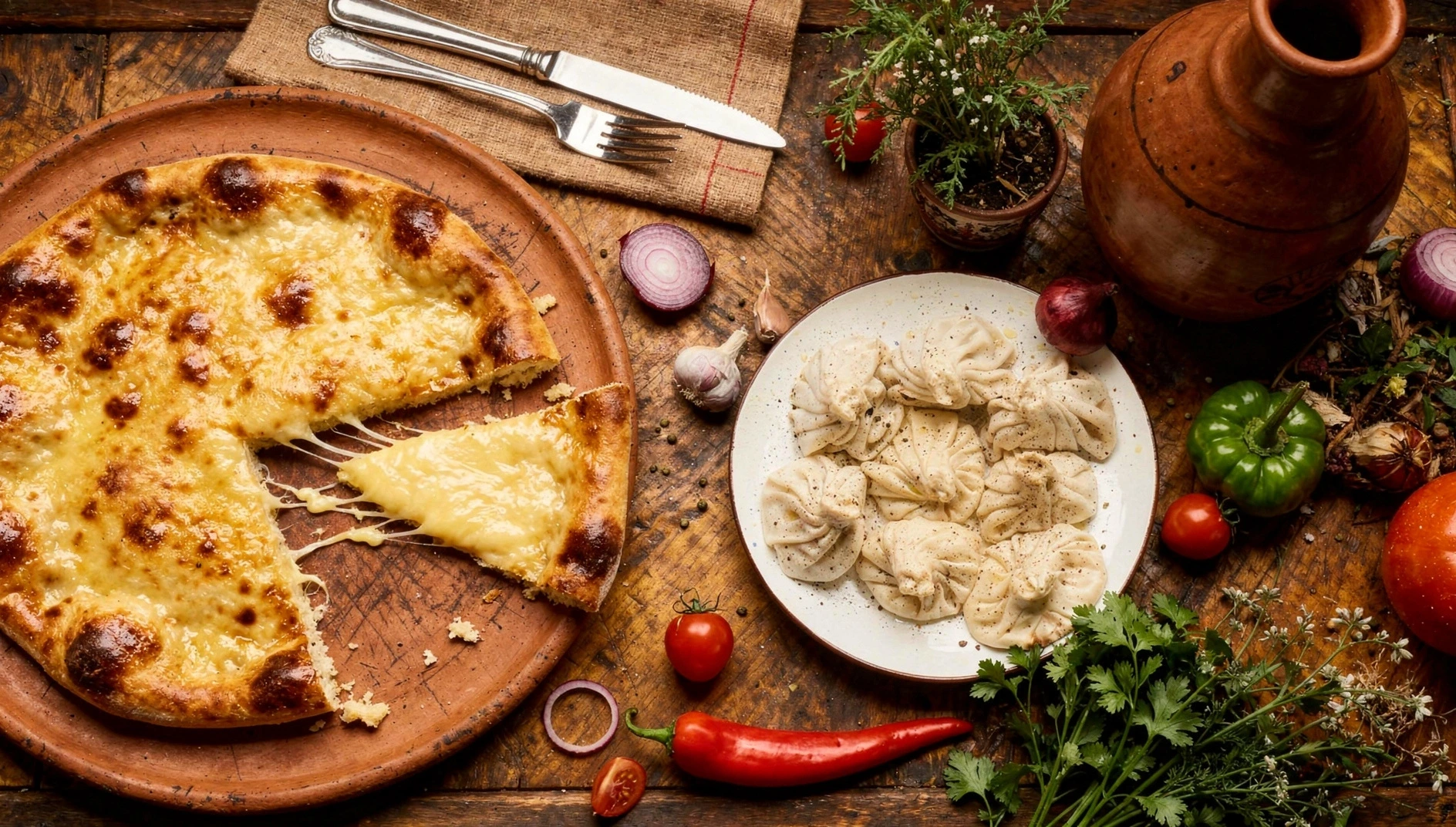
If Imeretian khachapuri is the everyday workhorse and Adjarian is the dramatic showpiece, Megrelian khachapuri is the indulgent middle ground that people in Samegrelo will tell you is the only one worth eating. It's essentially an Imeretian khachapuri with a layer of melted sulguni blanketed across the top — cheese inside, cheese outside, cheese as the entire point. Think of it as a Georgian double-cheese pizza, except better, because the dough-to-cheese ratio is more aggressive and the cheese is actually good.
Megruli Khachapuri Quick Facts
- Georgian name: მეგრული ხაჭაპური (meh-GROO-lee kha-cha-POO-ree)
- Meaning: "Khachapuri from Samegrelo (Megrelia)"
- Origin: Samegrelo region, western Georgia
- Key feature: Cheese inside AND melted on top
- Key cheese: Sulguni — Georgia's stretchy, brined cheese
- Prep time: 15 minutes active (+ 1-1.5 hour rise)
- Cook time: 12-15 minutes
- Serves: 2-3 people
- Cost in Georgia: 7-12 GEL (~$3-4) at a bakery
Why Megrelian Khachapuri Exists
Samegrelo — the western Georgian region also known as Megrelia — is the dairy heartland of Georgia. This is where sulguni cheese comes from. This is where elarji (the absurdly stretchy cheese-cornmeal dish) was invented. Megrelians treat cheese the way Italians treat olive oil — it goes in everything, on everything, and there's never enough.
So of course their version of khachapuri has extra cheese on top. It's not a gimmick or an upgrade. It's a Megrelian inevitability. The cheese topping melts into a golden, bubbly crust that adds a completely different texture — slightly crisp, slightly caramelized — to the soft, molten interior. The two layers of cheese create a contrast that neither the Imeretian version nor the Adjarian boat can match.
The Khachapuri Family: How Megrelian Fits In
Georgia has at least a dozen regional khachapuri variants. Here are the three you'll encounter most, and why Megrelian occupies its own niche.
| Feature | Imeretian | Megrelian | Adjarian |
|---|---|---|---|
| Shape | Round, sealed | Round, sealed + cheese top | Open boat |
| Cheese position | Inside only | Inside + melted on top | Exposed pool in center |
| Egg | In filling (mixed) | In filling (mixed) | Raw yolk on top |
| Butter | Brushed after baking | Brushed on edges | Slab on top, stirred in |
| Key cheese | Imeretian | Imeretian + sulguni top | Sulguni + Imeretian blend |
| Region | Imereti (central-west) | Samegrelo (far west) | Adjara (southwest coast) |
| Difficulty | Easy | Easy | Medium (shaping) |
| Best for | Everyday eating | When you want MORE cheese | Impressive presentation |
The naming debate
You'll see it spelled Megruli, Megrelian, or Mingrelian — all refer to the same thing. Megruli (მეგრული) is the Georgian adjective. Megrelian is the English version. Mingrelian is the older anglicization from Russian. Use whichever you like — Georgians will know what you mean.
The Cheese — Two Roles, Two Textures
What makes Megrelian khachapuri different isn't just "more cheese" — it's that the cheese plays two distinct roles. The filling cheese is a blend of Imeretian cheese and sulguni, mixed with egg into a soft, cohesive mass. When baked, it melts into a gooey, stretchy interior. The topping cheese is pure sulguni, grated and scattered across the surface. It melts, bubbles, and develops golden-brown spots — a completely different texture from the cheese inside.
The interior is soft and yielding. The top is slightly crisp and caramelized. When you cut a wedge, you get both textures in every bite. That contrast is the entire point.
Choosing Your Cheese
| Cheese | Role | Amount | Substitute |
|---|---|---|---|
| Imeretian cheese | Filling (base) | 200g | 130g feta + 70g low-moisture mozzarella |
| Sulguni | Filling (stretch) | 150g | Low-moisture mozzarella |
| Sulguni | Topping | 80-100g | Low-moisture mozzarella |
| Egg | Filling binder | 1 large | No substitute needed |
Finding Georgian cheese outside Georgia
Check Eastern European and Turkish grocery stores — sulguni is increasingly available internationally. If you can't find it, low-moisture whole-milk mozzarella is the best stand-in. For Imeretian cheese, crumbled feta mixed with mozzarella gives you the right balance of salt and stretch. Avoid pre-shredded cheese — the anti-clumping coating prevents proper melting. See our Georgian cheese guide for more on sourcing.
The Dough
The dough is identical to Imeretian khachapuri — a simple yeasted milk dough. Nothing fancy. It should be soft, pliable, and slightly tacky without being sticky. The goal is a dough that stretches thin enough to act as a container for the cheese without tearing.
| Ingredient | Amount | Notes |
|---|---|---|
| All-purpose flour | 250g | Regular AP, not bread flour |
| Warm milk | 120ml | 40-45°C — warm bath temp |
| Active dry yeast | 5g (1 tsp) | Or 3g instant yeast (skip proofing) |
| Sugar | 5g (1 tsp) | Feeds the yeast |
| Salt | 3g (½ tsp) | Less than normal bread — cheese is salty |
| Egg | 1 large | Room temperature |
| Sunflower oil | 1 tbsp | Any neutral oil works |
A note on the reduced salt: the filling and topping have about 430g of brined cheese. If your dough were salted like normal bread, the whole thing would be too salty. Half a teaspoon is enough to give the dough structure without competing with the cheese.
Step-by-Step Instructions
Step 1: Make the Dough (10 minutes + 1 hour rise)
Dissolve the sugar in warm milk, stir in the yeast, and set aside for 5-10 minutes until it foams. In a large bowl, whisk the flour and salt. Make a well in the center and add the egg, oil, and yeast mixture. Mix until a shaggy dough forms.
Turn onto a lightly floured surface and knead for 5-7 minutes. You want smooth, soft, slightly tacky dough — not stiff, not sticky. Add flour only if it's sticking to your hands after 3 minutes of kneading. Place in an oiled bowl, cover with a damp towel or plastic wrap, and let rise in a warm spot for 1-1.5 hours until doubled.
No-yeast shortcut
Replace the milk and yeast with 150ml of matsoni (Georgian yogurt) or Greek yogurt plus ½ tsp baking soda. No rising time — mix, shape, and bake immediately. The result is slightly tangier and denser, but many Georgian home cooks use this method for weeknight khachapuri.
Step 2: Prepare Two Cheese Mixtures
This is where Megrelian diverges from Imeretian. You need two separate cheese preparations:
Filling: Grate the Imeretian cheese and 150g of sulguni on the large holes of a box grater. Add one egg and mix with your hands until the cheese clumps into a cohesive, slightly sticky mass. If using the feta-mozzarella substitute, crumble the feta first, then mix with grated mozzarella and egg.
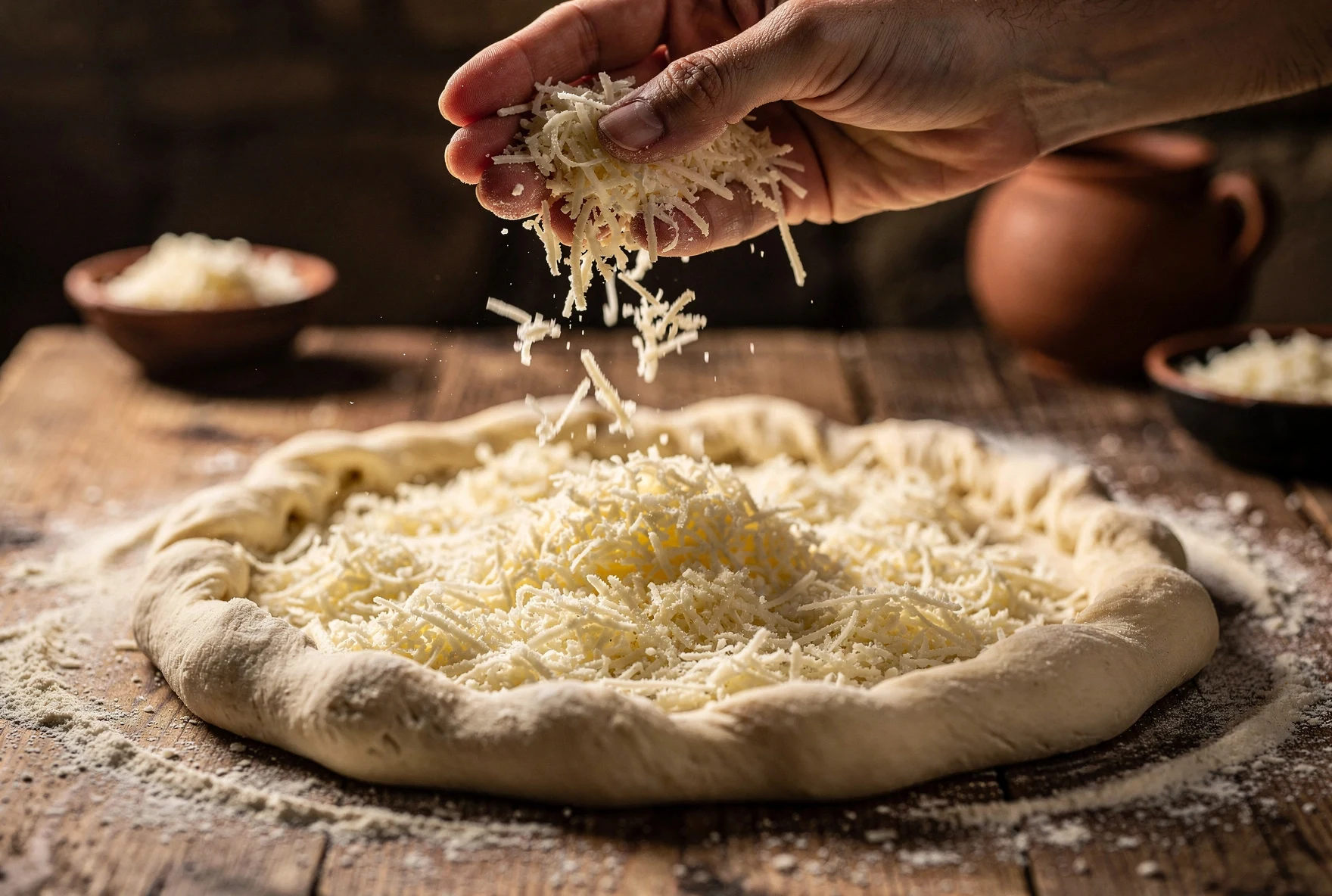
Topping: Grate the remaining 80-100g of sulguni separately. Set aside. This goes on top, unwashed by egg — you want it to melt into an uninterrupted cheese crust.
Step 3: Shape the Khachapuri
Preheat your oven to 220°C (430°F) with a baking sheet inside — a hot pan gives a crispier bottom crust.
Punch down the risen dough and roll it out on a lightly floured surface into a circle about 30cm (12 inches) in diameter. The dough should be thin but not translucent. Pile the cheese filling in the center, leaving a 6-8cm border of bare dough around the edges.
Gather the dough edges up and over the filling, pleating and pinching as you go. The goal is a sealed pouch with no gaps where cheese can escape. Twist the gathered top gently and tuck it under. Flip the whole thing seam-side down.
Now gently press and roll it out to about 25-28cm (10-11 inches) — a flat round disk about 2-3cm thick. Don't be aggressive or you'll tear the dough and cheese will leak. Cut a small steam vent in the center with a knife tip.
Step 4: Add the Cheese Top (The Megrelian Move)
Scatter the reserved grated sulguni evenly across the entire top surface. Press it down gently so it adheres to the dough. You want full, even coverage — not patches. Some people brush the dough surface with beaten egg yolk before adding the cheese to help it stick; this is optional but effective.
Step 5: Bake
Transfer the khachapuri to the hot baking sheet (on parchment paper) and bake for 12-15 minutes. You're looking for:
| Visual Cue | What It Means |
|---|---|
| Top cheese fully melted and bubbling | Getting close — 1-2 more minutes |
| Golden-brown spots on cheese surface | Perfect — pull it now |
| Visible crust edge is deep golden | Dough is cooked through |
| Steam escaping from center vent | Interior is molten — good sign |
| Large dark brown patches on cheese | Overshot — still edible but bitter spots |
Brush any exposed dough edges with butter immediately after removing from the oven. Let it rest for 3-5 minutes — the cheese inside is volcanic right out of the oven. Cut into wedges and serve.
Stovetop Method
Many Georgian cooks make this on the stove rather than in the oven. The process is the same through shaping, but instead of baking, you cook it in a dry or lightly oiled heavy skillet (cast iron is ideal) over medium heat.
Cook the bottom side for 5-6 minutes until deeply golden. Flip carefully with a wide spatula. For the Megrelian topping, you have two options: either add the cheese to the raw top before flipping (so it melts against the pan on the second side), or after flipping, scatter cheese on the now-upward cooked side and finish under a broiler for 2-3 minutes until bubbly.
The stovetop method gives a crispier, more bread-like crust. The oven method gives a softer, puffier result with more evenly melted topping. Both are legitimate.
Megrelian Khachapuri in Context: Samegrelo's Cheese Obsession
Samegrelo is to Georgian cheese what Emilia-Romagna is to Italian cheese — the region that takes it more seriously than anywhere else. Sulguni originates here. So does elarji, the cornmeal porridge stretched with so much sulguni that it becomes a cheese delivery system you eat with your hands. Megrelians also make gebzhalia — rolls of fresh cheese soaked in a mint-cream sauce — and sulguni in butter, which is exactly what it sounds like.
The Megrelian khachapuri is part of this tradition. More cheese is not just a preference in Samegrelo — it's a worldview. If you order "khachapuri" at a restaurant in Zugdidi (Samegrelo's capital), you'll get the Megrelian version by default. They don't consider it a variant. It's just khachapuri, and everyone else is doing it wrong.
Serving and Pairing
| Pairing | Why It Works |
|---|---|
| Lobio (bean stew) | The classic Georgian combo. Earthy beans + rich cheese = perfect |
| Badrijani nigvzit | Cold walnut-stuffed eggplant as a counterpoint |
| Ajapsandali | Georgian ratatouille — something light alongside something heavy |
| Georgian white wine | Tsinandali or Kakhuri amber wine cuts through the richness |
| Tkemali sauce | Sour plum sauce is a revelation dipped on the side |
| Fresh herbs + tomato-cucumber salad | Freshness against all that melted cheese |
Tips and Common Mistakes
❌ Cheese leaking out
Your dough wasn't sealed properly or you rolled it too thin after sealing. Pinch aggressively — err on the side of over-sealed. And don't flatten it past 25cm. A slightly thicker khachapuri is better than one that bursts in the oven.
❌ Top cheese doesn't brown
Your oven isn't hot enough, or you need to finish under the broiler for 1-2 minutes. Watch it closely — broilers go from golden to burnt in seconds. This step is what gives Megrelian khachapuri its signature look.
❌ Too salty
Georgian cheeses vary wildly in salt content. Taste your cheese before assembling. If it's very salty, soak grated cheese in cold water for 20-30 minutes, then drain and squeeze dry. This is a standard Georgian trick for brined cheeses.
❌ Soggy bottom
Preheat the baking sheet. A cold pan means condensation beneath the dough. If you're using a pizza stone, even better. The bottom crust should be crisp and golden, not damp and pale.
❌ Using pre-shredded cheese
Pre-shredded cheese is coated in anti-clumping agents (cellulose, potato starch) that prevent proper melting. Grate your own from blocks. Takes 2 extra minutes and the difference is enormous — especially for the topping, where smooth melting is everything.
❌ Cutting too soon
Give it 3-5 minutes after pulling from the oven. The interior cheese is genuinely dangerous right out of the oven (250°F+ molten cheese will burn your mouth badly), and it firms up slightly as it rests, making cleaner cuts. Patience pays off.
Storage and Reheating
🧊 Fridge (3 days)
Wrap in foil and refrigerate. Reheat in a dry skillet over medium heat (3-4 minutes per side) or in a 180°C oven for 8-10 minutes. The top cheese won't re-bubble as dramatically, but the interior melts back nicely.
🧊 Freezer (2 months)
Freeze shaped but unbaked khachapuri (without the topping cheese) on a parchment-lined tray, then wrap tightly in plastic. Bake from frozen at 200°C for 20-25 minutes, adding topping cheese halfway through. The yeasted dough freezes beautifully.
Nutrition
Look — this is a cheese-filled, cheese-topped bread. It is not health food. But it's also not a daily indulgence for most Georgians (despite what Instagram food accounts suggest). One large Megrelian khachapuri realistically feeds 2-3 people as part of a meal with vegetables and salad.
| Nutrient | Per Serving (⅓) |
|---|---|
| Calories | ~780 kcal |
| Carbohydrates | ~55g |
| Protein | ~38g |
| Fat | ~42g |
| Calcium | ~650mg (50% DV) |
| Sodium | ~1,200mg |
Frequently Asked Questions
What's the difference between Megrelian and Imeretian khachapuri?
The dough and basic filling are the same. The difference is that Megrelian khachapuri has a layer of grated sulguni cheese melted on top, giving it a golden, bubbly cheese crust. Imeretian is sealed dough on all sides, brushed with butter. Megrelian uses about 80-100g more cheese total.
Can I make it without sulguni?
Yes. Low-moisture whole-milk mozzarella is the best substitute for both the filling and topping. It melts and stretches similarly. For the Imeretian cheese portion, use crumbled feta mixed with mozzarella. The flavor won't be identical, but it'll be very good — better than most versions served outside Georgia.
Can I use a pizza stone?
Absolutely — and it's arguably the best method. Preheat the stone at 220°C for at least 30 minutes, slide the khachapuri on via parchment paper, and bake as directed. The stone gives the crispiest bottom crust of any method.
How do I know when the inside is done?
If the top cheese is golden-brown and bubbling, and the exposed crust edge is deep golden, the inside is done. The steam vent will also be releasing visible steam. You don't need a thermometer — the visual cues are reliable. Underbaking by 1-2 minutes is better than overbaking, since the inside will continue cooking from residual heat.
Why is it spelled "Megruli" sometimes and "Megrelian" other times?
Megruli (მეგრული) is the Georgian-language adjective meaning "from Megrelia/Samegrelo." Megrelian is the standard English adaptation. Mingrelian is an older English spelling borrowed from Russian. All three refer to the same thing — the cheese-topped khachapuri from western Georgia's Samegrelo region.
Written by The Georgian Eats Team
Based in Tbilisi, where the Megrelian vs. Imeretian khachapuri debate is a reliable way to start an argument at any dinner table. We've tested this recipe with Georgian cheeses and international substitutes, and the feta-mozzarella blend genuinely holds its own.
Last updated: February 2026.
Related Articles
Imeretian Khachapuri
The everyday version — the same base, without the cheese top.
Adjarian Khachapuri
The boat-shaped showpiece with egg and butter.
Georgian Cheese Guide
Everything about sulguni, Imeretian, and beyond.
Elarji
Another Megrelian cheese classic — cornmeal stretched with sulguni.