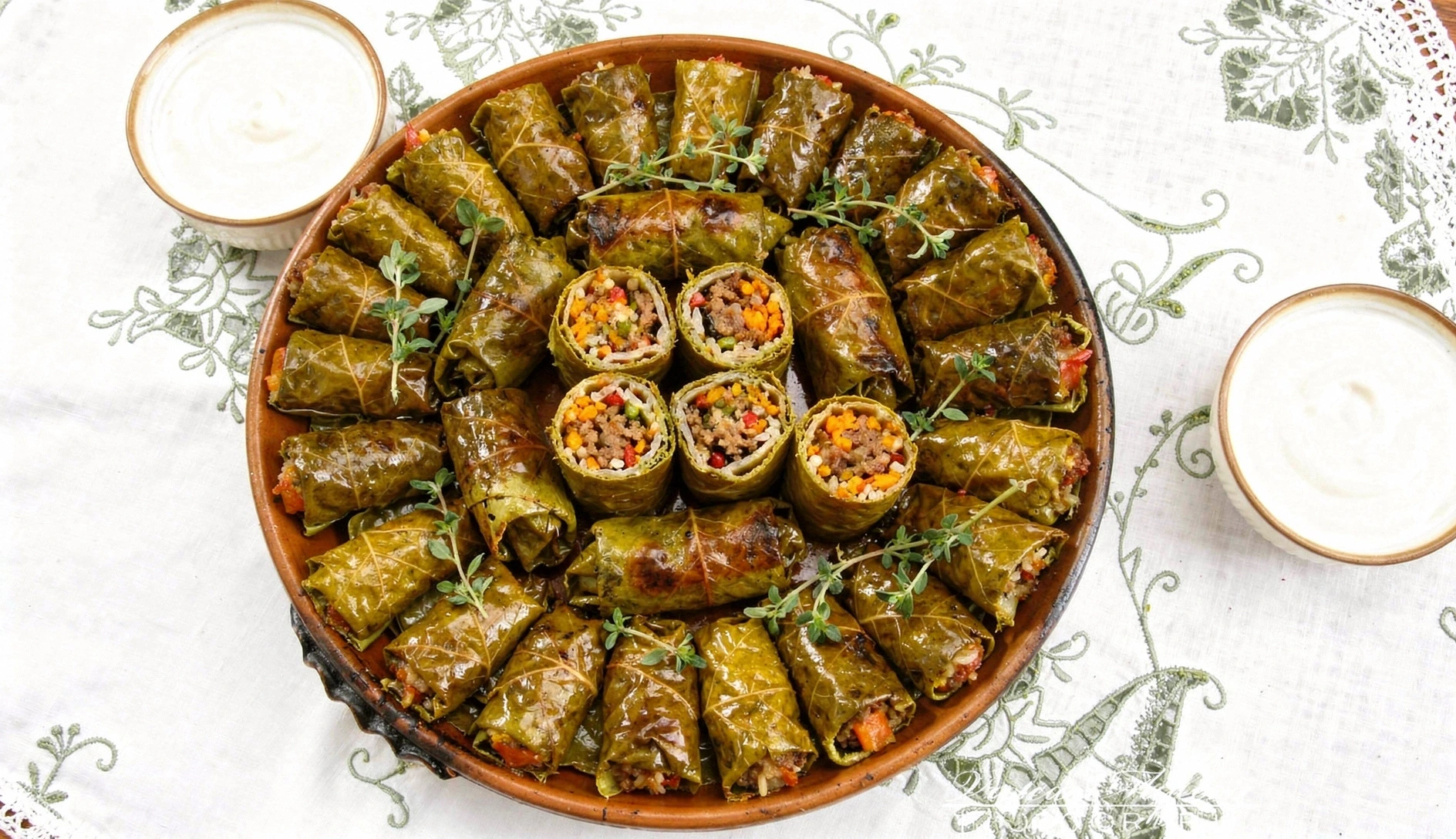
Tolma is one of those dishes that every country in the region claims as their own. Turks call it dolma. Armenians call it tolma. Azerbaijanis, dolma again. Georgians call it tolma (ტოლმა) and have been making it for centuries — stuffing grape leaves, cabbage, peppers, and anything else that holds still long enough. The grape leaf version is the one that matters most, and the Georgian take has a specific character: a beef-pork filling heavy on fresh herbs, rolled tight, simmered slow, and eaten with a cold matsoni sauce spiked with garlic and a whisper of cinnamon.
Tolma Quick Facts
- Georgian name: ტოლმა (TOL-ma)
- Origin: Pan-Caucasian, with deep roots across Georgia
- Key feature: Fresh herb-heavy filling, matsoni-garlic-cinnamon sauce
- Prep + cook time: 45 min prep, 50 min cooking
- Cost in Georgia: 10–16 GEL in restaurants (~$3.50–5.50 USD)
- Difficulty: Easy — the rolling is meditative, not technical
- Yield: About 50 pieces (feeds 5–6 people generously)
Why Georgian Tolma Is Different
Every Caucasian and Middle Eastern kitchen has some version of stuffed grape leaves, and the debates about who does it best could fill a library. But Georgian tolma has a few traits that set it apart from the Turkish, Armenian, and Greek versions you might already know.
First, the meat. Georgian tolma almost always uses a mix of beef and pork — a combination that gives you the depth of beef with the fattiness of pork. This is a meaningful distinction. Armenian and Turkish dolma are typically lamb or beef only (pork being forbidden in many traditions). The pork makes Georgian tolma juicier, richer, and more forgiving — it's harder to dry out.
Second, the herbs. The filling is loaded with fresh cilantro, dill, and mint. Not a pinch of dried herbs as an afterthought — we're talking a fistful of each, chopped fine and mixed right into the meat. When you bite through the vine leaf and hit the filling, the herb flavor is immediate and intense. It's what makes tolma taste like Georgia and not Greece.
Third, the sauce. Greek dolmades get lemon-egg avgolemono. Turkish dolma gets yogurt or nothing. Georgian tolma gets matsoni — the tangy cultured milk that's been a staple in the Caucasus for millennia — mixed with raw garlic and a pinch of cinnamon. The cinnamon is the secret. It sounds bizarre but the warmth of cinnamon against the cold, sharp garlic and sour matsoni creates something genuinely special.
Grape Leaves: Fresh vs. Jarred
This is where most people outside the Caucasus hit their first obstacle. Fresh grape leaves are ideal — young, tender leaves picked in late spring when they're about the size of your palm. In Georgia, everyone knows someone with a grapevine. In the rest of the world, you're probably using jarred leaves, and that's completely fine. Here's what to know about each option.
| Type | Prep Needed | Flavor | Notes |
|---|---|---|---|
| Fresh (young, spring) | Blanch 2–3 min in salted boiling water | Bright, slightly tart, tender | Best option. Pick leaves the size of your palm. |
| Fresh (late summer) | Blanch 4–5 min, remove tough veins | Stronger, slightly bitter | Workable but tougher. Blanch longer. |
| Jarred (brined) | Rinse well, soak 10 min in warm water | Salty, softer, darker green | Most common outside Georgia. Reduce added salt. |
| Frozen | Thaw overnight, blanch 1 min | Closest to fresh | Available at Middle Eastern stores. Good option. |
Salt Warning for Jarred Leaves
Jarred grape leaves are packed in brine. If you don't rinse them thoroughly and soak for at least 10 minutes, your tolma will be painfully salty. Taste a leaf after rinsing — it should be mildly salty, not aggressively so. If it's still too salty, change the soaking water and soak another 10 minutes. Also reduce the salt in your filling by half.
Ingredients
The Filling
| Ingredient | Amount | Notes |
|---|---|---|
| Ground beef + pork | 500g (50/50 or 60/40) | Don't use lean — you need 15–20% fat minimum |
| Short-grain rice | 120g | Parboil 5 min first. Arborio works great. |
| Onions | 2 medium, finely diced | Yellow or white. Dice small — no big chunks. |
| Garlic | 4 cloves, minced | More is fine. Less is not. |
| Fresh cilantro | Large bunch (~30g) | Non-negotiable. Stems included, chopped fine. |
| Fresh dill | Large bunch (~20g) | Fronds only, no thick stems. |
| Fresh mint | Small bunch (~10g) | Leaves only. Adds brightness. |
| Spices | 1 tsp coriander, 1 tsp paprika, ½ tsp red pepper, ½ tsp black pepper | Ground coriander is essential. Paprika for color. |
The Matsoni Sauce
| Ingredient | Amount | Notes |
|---|---|---|
| Matsoni (or plain yogurt) | 400g | Full-fat. Greek yogurt thinned with a splash of water works. |
| Garlic | 3 cloves, crushed | Crushed or microplaned for maximum punch. |
| Cinnamon | Pinch | Tiny amount. You should barely taste it, just sense warmth. |
| Sugar (optional) | 1 tsp | Balances acidity if matsoni is very sour. |
Equipment
Essential
Large heavy-bottomed pot (at least 4L), cutting board for rolling, plate that fits inside the pot (for weighing down tolma)
Helpful
Small ice cream scoop for portioning filling, large tray for staging rolled tolma, fine mesh strainer for rinsing jarred leaves
Step-by-Step Recipe
Step 1: Prepare the Grape Leaves
If using fresh leaves, bring a large pot of salted water to a rolling boil. Drop the leaves in batches of 8–10, pressing them down gently. Blanch for 2–3 minutes — they should turn a deeper green and become pliable. Transfer immediately to a bowl of ice water. Drain and lay flat on a clean towel.
If using jarred leaves, dump them into a colander and rinse under cold running water for a full minute, gently separating the leaves. Then soak in a bowl of warm water for 10 minutes. Taste one — it should be mildly salty, not aggressively briny. If still too salty, change the water and soak another 10 minutes.
Either way: trim the stems flush with the leaf using a small knife or kitchen scissors. Lay the prepared leaves smooth-side down (vein-side up) on your work surface. Set aside any torn or very small leaves — these will line the bottom of your pot later.
Step 2: Make the Filling
Parboil the rice: bring a small pot of water to a boil, add the rice, cook for exactly 5 minutes, then drain and rinse with cold water. The rice should be about half-cooked — still firm with a white chalky center when you bite one. It will finish cooking inside the tolma. Skip this step and your rice will be crunchy. Overcook it and you'll get mush.
In a large bowl, combine the ground meat with the parboiled rice. Add the finely diced onions, minced garlic, all the chopped herbs (cilantro, dill, mint), and the spices. Mix with your hands for about 2 minutes. You want everything evenly distributed — no pockets of pure rice or clumps of herb. The mixture should look green-flecked and smell intensely aromatic.
Season Correctly
Take a tiny pinch of the raw filling and fry it in a small pan. Taste for salt and spice. The filling should taste well-seasoned on its own — the grape leaves and cooking liquid will dilute it slightly. This is the most reliable way to avoid bland tolma, and Georgian grandmothers do it every time.
Step 3: Roll the Tolma
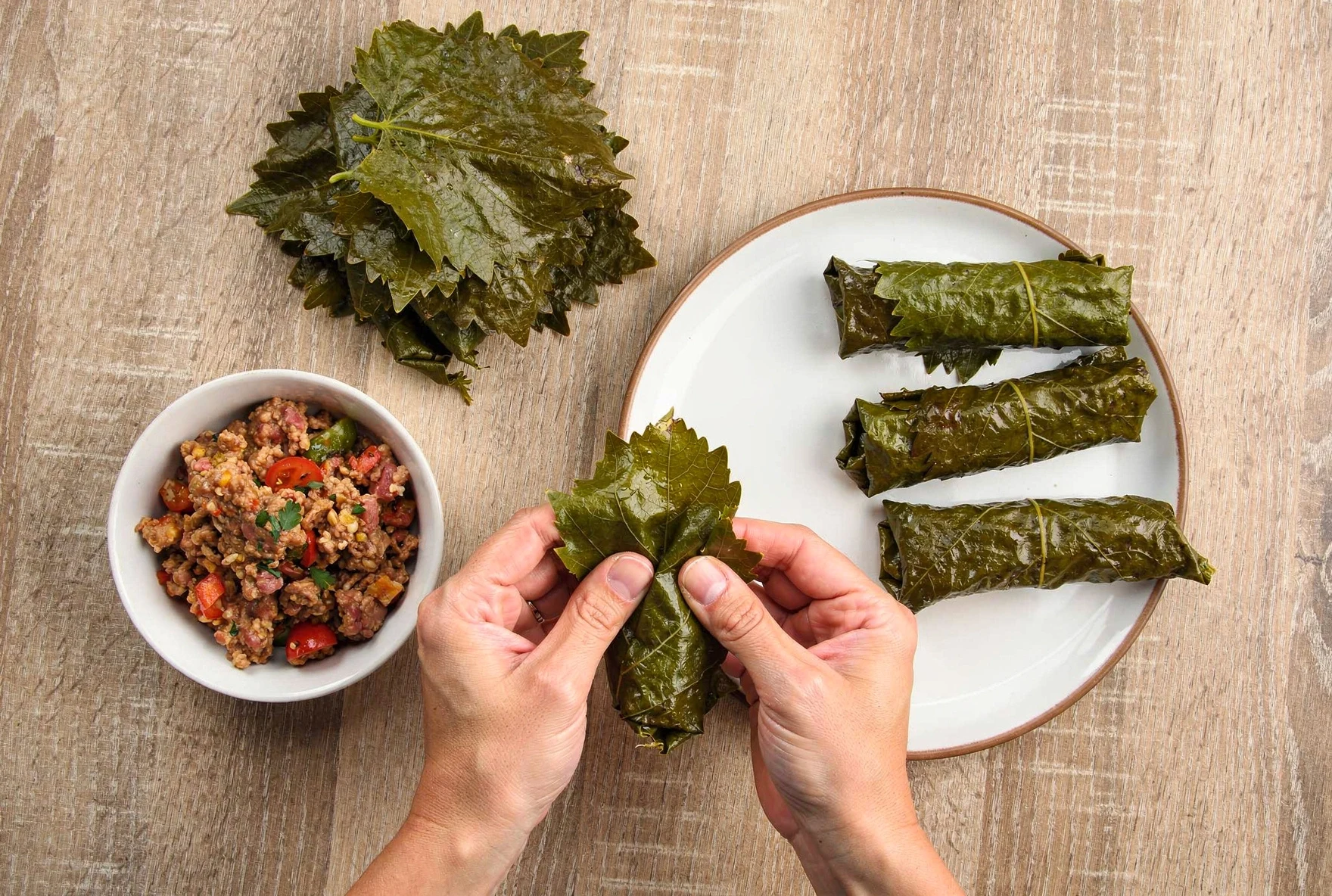
This is the meditative part. Put on some music, pour some wine, and settle in — you've got about 50 rolls to make.
Place a grape leaf on your cutting board, smooth side down (rough veiny side facing up), with the stem end pointing toward you. Place about 1 tablespoon of filling near the base of the leaf, shaping it into a short log. Fold the bottom of the leaf up and over the filling. Fold both sides inward like an envelope. Then roll away from you, keeping it snug but not strangling-tight. The rice expands during cooking, so you need a little give. Think of it like swaddling — firm but not suffocating.
| Visual Cue | What It Means |
|---|---|
| Filling bursting out the sides | Too much filling. Use less — about 1 tablespoon, not 2. |
| Roll feels hard and tight | Too tight. Loosen slightly — rice needs expansion room. |
| Roll is floppy and loose | Too loose. They'll unravel while cooking. Re-roll firmer. |
| About thumb-sized, slight give when squeezed | Perfect. The Goldilocks zone. |
Step 4: Cook
Line the bottom of a heavy pot with 4–5 flat grape leaves — use your torn or damaged ones here. This prevents the bottom layer of tolma from sticking and burning. Some cooks add a few slices of tomato or potato on the bottom too — either works.
Arrange the rolled tolma seam-side down in tight, concentric circles. Pack them close together — they should be snug, supporting each other. Build upward in layers if needed, offsetting the rows slightly like brickwork. Place a plate that fits inside the pot directly on top of the tolma and weigh it down with something heavy (a can of beans, a stone, whatever you have). The plate pressure keeps them from unraveling as the rice expands.
Pour in enough hot water to just reach the bottom of the plate — not above it. You're steaming the tolma more than boiling them. Bring to a gentle boil over medium heat, then reduce to low and cover. Simmer for 45–50 minutes. The water should barely be moving — aggressive boiling will tear the leaves.
The Plate Trick Is Non-Negotiable
Every Georgian grandmother uses a plate and weight. Without it, the rice expands, the rolls shift, some open up, and you get a chaotic mess instead of neat parcels. The plate also creates a gentle pressure that keeps the filling compact and the leaves tight. Don't skip this.
Step 5: Make the Matsoni Sauce
While the tolma simmer, stir together the matsoni, crushed garlic, a pinch of cinnamon, a pinch of salt, and the optional teaspoon of sugar. Refrigerate until ready to serve.
If you can't find matsoni, full-fat plain yogurt is the closest substitute. Greek yogurt works too, but thin it with a tablespoon of water — you want a pourable consistency, not a thick paste. Sour cream is the traditional Georgian alternative (many families use it interchangeably with matsoni), though it's richer and less tangy.
Step 6: Serve
Carefully remove the plate weight. The tolma should be sitting in a small amount of flavorful cooking liquid — don't discard it, you can spoon a little over the platter. Transfer the tolma to a serving dish with a spatula, keeping them seam-side down. Serve warm with the cold matsoni sauce on the side. Garnish with fresh dill if you want to be fancy about it.
What to Serve with Tolma
| Pairing | Why It Works | Type |
|---|---|---|
| Matsoni-garlic sauce | Cold, tangy, cuts through the richness of the meat filling | Essential |
| Mchadi (cornbread) | Crunchy, golden, soaks up the cooking juices | Bread |
| Badrijani nigvzit | Cool walnut-stuffed eggplant, great textural contrast | Appetizer |
| Pkhali | Vegetable-walnut patties, lightens a heavy meal | Side |
| Tkemali sauce | Sour plum sauce — an alternative to matsoni for dipping | Sauce |
| Dry amber wine | A Rkatsiteli amber wine pairs beautifully | Drink |
Georgian Tolma Family
Grape leaf tolma is the most well-known, but Georgian kitchens produce several variations — often served together at a supra.
| Variation | Wrapper | Filling | Notes |
|---|---|---|---|
| Vine leaf tolma (this recipe) | Grape leaves | Beef-pork, rice, herbs | The classic. Most common. |
| Cabbage tolma | Cabbage leaves | Same filling, larger rolls | Winter version — heartier, bigger portions. |
| Pepper tolma | Bell peppers | Meat-rice, sometimes with tomato sauce | Baked in the oven. Especially popular in Kakheti. |
| Tomato tolma | Hollowed tomatoes | Meat-rice, sometimes with the tomato pulp mixed in | Summer only. The tomato becomes the sauce. |
| Vegetarian tolma | Grape or cabbage leaves | Rice, walnuts, herbs, dried fruit | Lenten version. Surprisingly good. |
Georgian Tolma vs. Turkish Dolma vs. Armenian Tolma
| Feature | Georgian | Turkish | Armenian |
|---|---|---|---|
| Name | Tolma (ტოლმა) | Dolma (sarma for rolls) | Tolma (տdelays) |
| Meat | Beef + pork mix | Lamb or beef (no pork) | Beef or lamb |
| Herbs | Cilantro, dill, mint (heavy) | Parsley, mint, dill (lighter) | Basil, cilantro, mint |
| Spices | Coriander, paprika | Allspice, cinnamon, cumin | Red pepper, allspice |
| Sauce | Matsoni + garlic + cinnamon | Yogurt or lemon wedges | Matsun (yogurt) or tomato broth |
| Vegetarian version | Yes (Lenten) | Yes (zeytinyağlı — olive oil, rice, currants) | Less common |
Common Mistakes
❌ Skipping the Rice Parboil
Raw rice in the filling won't cook through in 50 minutes of gentle simmering. You'll get crunchy bits. Five minutes of parboiling solves this completely.
❌ Rolling Too Tight
The rice swells as it cooks. Rolls that are rock-hard before cooking will burst their leaves. Leave just a little give — firm, not tight.
❌ Too Much Water
The water should reach the plate, not cover it. Too much water dilutes the cooking liquid and makes the tolma taste washed out. Less is more.
❌ Not Using the Plate Weight
Without a weight, the rolls shift, open, and turn into a mess. An inverted plate with a heavy object on top is essential — every Georgian kitchen does this.
❌ Using Lean Meat
Extra-lean ground beef makes dry, tough tolma. The pork in the mix provides essential fat. If using all beef, choose 80/20 at minimum.
❌ Skipping the Cinnamon
The pinch of cinnamon in the matsoni sauce is what makes it Georgian, not generic. It's barely perceptible but adds warmth that ties everything together.
Pro Tips
🏆 Batch and Freeze
Roll double the amount and freeze half uncooked on a parchment-lined tray. Once frozen, bag them up. Cook from frozen — just add 10 minutes to the simmer time. Future you will be grateful.
🏆 Make Them the Day Before
Tolma are one of those rare dishes that actually improve overnight. The flavors meld, the leaves soften further, and the filling sets. Reheat gently or serve at room temperature.
🏆 Save the Cooking Liquid
The liquid at the bottom of the pot is concentrated meat-herb broth. Spoon it over the tolma when serving, or save it — it makes an excellent soup base the next day.
🏆 The Assembly Line Method
Prep all leaves first, lay out 5–6 at a time, portion filling onto each, then roll all 5–6 in sequence. It's faster than doing them one at a time and you develop a rhythm quickly.
Where to Eat Tolma in Tbilisi
Barbarestan
Upscale, based on a 19th-century cookbook. Their tolma is refined, delicate, and expensive — but it's the version that shows what tolma can be at its peak.
Shavi Lomi
Modern Georgian kitchen that takes classics seriously. Their tolma rotates seasonally — grape leaf in summer, cabbage in winter. Always well-spiced.
Salobie
Affordable, traditional, and consistently good. Their tolma comes in generous portions with proper matsoni sauce. Great lunch spot in the old town.
Any Georgian Grandmother
The honest answer. The best tolma in Georgia isn't served in restaurants — it's served at home, at a supra, made by someone who's been rolling them for 40 years.
Nutrition
| Nutrient | Per Serving | % Daily Value |
|---|---|---|
| Calories | 380 kcal | 19% |
| Fat | 20g | 26% |
| Protein | 24g | 48% |
| Carbohydrates | 22g | 8% |
Storage & Reheating
🧊 Refrigerator
Store cooked tolma in their cooking liquid in an airtight container. They keep 4–5 days and taste better on day 2. Reheat gently in a covered pan with a splash of their liquid, or serve at room temperature.
❄️ Freezer (Cooked)
Freeze cooked tolma in a single layer, then bag. Keeps 3 months. Thaw overnight in the fridge and reheat gently. The texture holds up well — rice may be slightly softer.
❄️ Freezer (Uncooked)
Roll the tolma, freeze on a parchment-lined tray, then bag once solid. Cook from frozen — no need to thaw. Add 10–15 minutes to the cooking time. This is the best meal-prep strategy.
🍶 The Sauce
Matsoni sauce keeps 3–4 days refrigerated. The garlic flavor intensifies over time — if that bothers you, add the garlic fresh each time you serve.
Frequently Asked Questions
Can I make tolma without meat?
Yes — the Georgian Lenten version uses rice, chopped walnuts, dried currants or barberries, fresh herbs, and spices. The filling is bound with a little olive oil. It's genuinely delicious, not just a compromise. Cook time drops to about 30 minutes since there's no meat to cook through.
Can I use all beef instead of a beef-pork mix?
You can, but choose 80/20 ground beef at minimum. The pork provides fat that keeps the filling moist. All-lean-beef tolma tend to be dry and crumbly. If you want to skip pork, lamb is a better alternative — it adds its own fat and richness.
How do I know when tolma are done?
After 45–50 minutes, carefully pull one out and cut it in half. The rice should be fully tender (no chalky center), and the meat should be cooked through with no pink remaining. The grape leaves should be soft and slightly translucent.
What's the difference between tolma and sarma?
In Turkish cuisine, "dolma" technically means stuffed (vegetables), while "sarma" means wrapped (in leaves). Georgians and Armenians use "tolma" for all versions — stuffed peppers, cabbage rolls, and grape leaf rolls. It's the same family of dishes, different naming conventions.
Can I bake tolma instead of simmering?
Simmering is the traditional Georgian method and produces the most tender result. Baking works for stuffed pepper tolma but tends to dry out grape leaf rolls. If you want to try it: arrange in a baking dish, add 1 cup of broth, cover tightly with foil, and bake at 180°C (350°F) for about 1 hour.
Written by The Georgian Eats Team
We've eaten tolma at supras, bought them from market vendors, and spent hours rolling them alongside Georgian cooks who've been doing it since before we were born. The matsoni-garlic-cinnamon sauce is the hill we'll die on — don't skip the cinnamon.
Last updated: February 2026.
Related Articles
Satsivi: Walnut Sauce Chicken
Georgia's other great walnut-based dish — cold chicken in creamy walnut sauce.
Badrijani Nigvzit
Walnut-stuffed eggplant rolls — the perfect cold appetizer alongside tolma.
Chakapuli: Spring Lamb Stew
Another herb-forward Georgian classic — tarragon lamb with sour plums.
The Georgian Supra
The traditional feast where tolma takes its place among dozens of dishes.