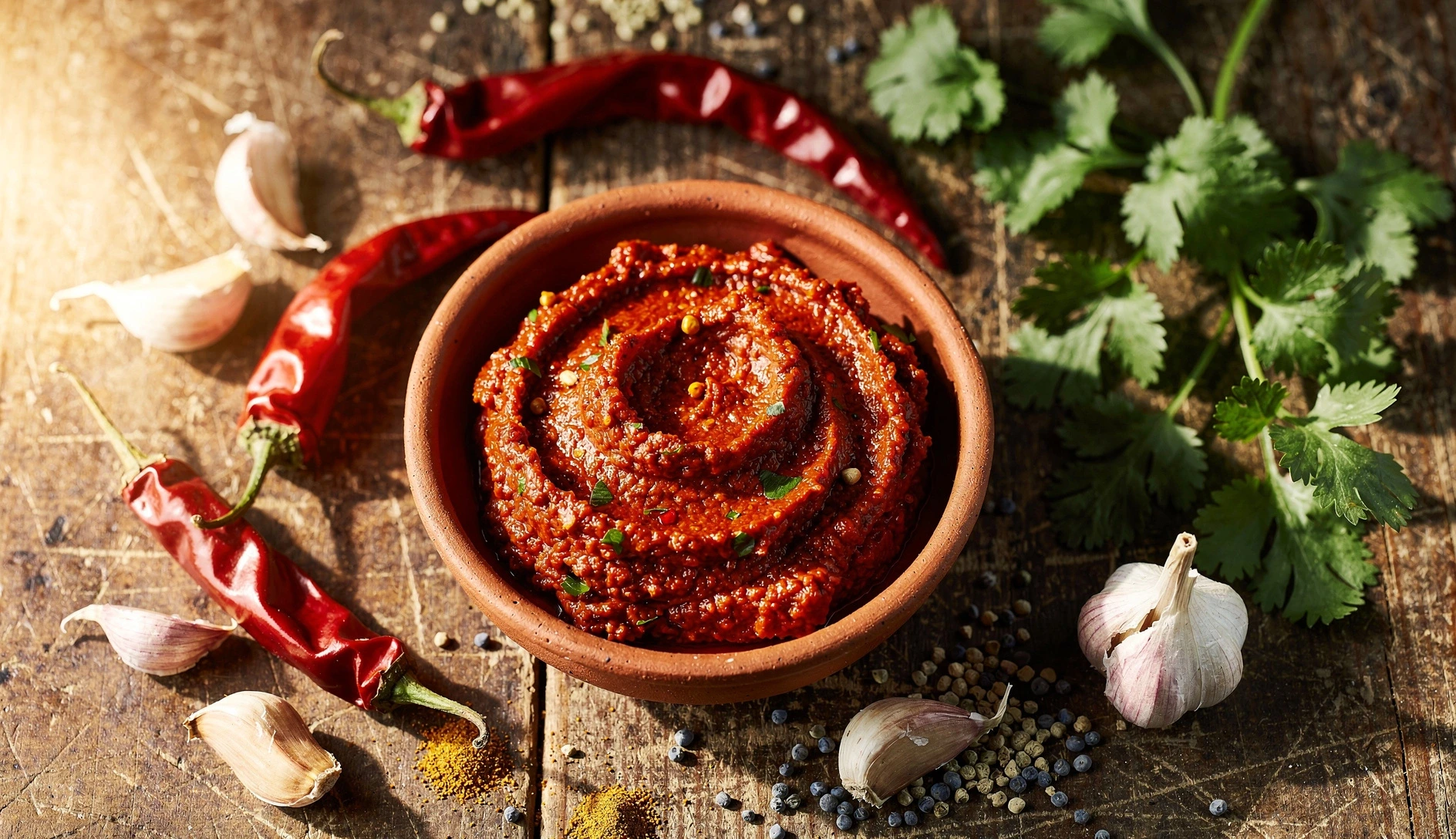
Adjika is the backbone of western Georgian cooking. It's not a sauce. It's not a salsa. It's a raw chili paste — thick, salty, punchy — made from peppers ground with garlic, fresh herbs, and the holy trinity of Georgian spices: blue fenugreek, coriander, and marigold. A jar in your fridge transforms everything it touches. Rub it on chicken before roasting. Stir a spoonful into a beef stew. Spread it on bread with cheese. Once you have adjika, you'll find reasons to use it daily.
Adjika Quick Facts
- Georgian name: აჯიკა (a-JI-ka)
- Origin: Samegrelo and Abkhazia — western Georgia
- Key ingredients: Hot peppers, garlic, herbs, blue fenugreek, salt
- Type: Raw chili paste (no cooking involved)
- Prep time: 20 minutes
- Shelf life: Months in the fridge — salt and chili preserve it
- Difficulty: Effortless — it's just a food processor and 8 ingredients
- Heat level: Hot (adjustable by seed removal)
What Adjika Actually Is (And What It Isn't)
First, let's clear something up, because adjika has an identity crisis outside Georgia. If you search for adjika recipes online, you'll find two completely different things sharing the same name.
In Russia, Ukraine, and across the post-Soviet world, "adjika" usually means a cooked tomato-based sauce — sometimes with carrots, sometimes with horseradish — that's closer to Balkan ajvar or a spiced ketchup. It's fine. It's not adjika.
Real adjika — the Abkhazian and Megrelian original — contains no tomatoes. None. It's a raw paste made from peppers ground with garlic, fresh herbs, and spices. The texture is thick and granular, like a rough pesto made with chilies instead of basil. The color is deep brick red (or bright green, if made with green peppers and herbs). The taste is intensely hot, deeply aromatic from the blue fenugreek and coriander, and salty enough that a little goes a long way.
The word itself likely comes from the Abkhaz word meaning "salt" — which tells you how fundamental this paste is to western Georgian cooking. Before refrigeration, adjika was one of the primary ways people preserved the heat and flavor of summer peppers to use all year.
Red Adjika vs Green Adjika
In western Georgia, you'll find two versions: red and green. Both use the same technique and the same spice base — the difference is the peppers and the herbs.
| Feature | Red Adjika (წითელი აჯიკა) | Green Adjika (მწვანე აჯიკა) |
|---|---|---|
| Base peppers | Red bell + red hot chilies | Green bell + green hot chilies |
| Dominant herbs | Cilantro, purple basil, parsley | Cilantro, dill, tarragon, green basil |
| Heat profile | Deeper, rounder heat that builds | Sharper, fresher, more immediate bite |
| Season | Late summer/autumn (red pepper harvest) | Early summer (green pepper season) |
| Shelf life | Longer — higher capsaicin in ripe chilies | Shorter — best used within 2–3 months |
| Best for | Stews, meat rubs, roasting, year-round use | Fresh dishes, salads, fish, spring cooking |
| Popularity | More common, the "default" adjika | Seasonal specialty, harder to find |
This recipe is for red adjika — the one you'll see in every Megrelian kitchen, the one that gets rubbed on the New Year's Eve suckling pig, the one that transforms a simple pot of beans into something worth fighting over.
Adjika vs Other Chili Pastes
If you cook with harissa, gochujang, or sambal oelek, adjika occupies a unique position. It's raw (unlike cooked harissa), not fermented (unlike gochujang), and herb-forward in a way that no Asian chili paste is. The blue fenugreek and marigold give it a distinctly Caucasian character that you won't find anywhere else.
| Paste | Origin | Method | Key Difference |
|---|---|---|---|
| Georgian Adjika | Georgia / Abkhazia | Raw, ground | Fresh herbs + Georgian spice trinity |
| Harissa | Tunisia / North Africa | Cooked, often oil-packed | Smoky, cumin-caraway base |
| Gochujang | Korea | Fermented (months) | Sweet, umami, fermented funk |
| Sambal Oelek | Indonesia | Raw, minimal | Just chilies + vinegar — no herbs |
| Zhug | Yemen | Raw, blended | Closest cousin — cilantro-forward, but cardamom |
Yemeni zhug is actually the closest relative — both are raw, cilantro-heavy, garlic-loaded chili pastes. If you like zhug, you'll love adjika. The Georgian spice blend just takes it in a completely different aromatic direction.
Ingredients Breakdown
| Ingredient | Amount | Notes |
|---|---|---|
| Red bell peppers | 4 large | Provide bulk and sweetness to balance the heat |
| Hot red chilies | 100g (~8–10) | Fresno, cayenne, or Georgian tsveni. Adjust quantity for heat preference |
| Garlic | 8–10 cloves | Fresh only. Generous — this isn't subtle |
| Fresh cilantro | ~30g (large bunch) | Stems and leaves — stems have more flavor |
| Purple basil | ~15g (bunch) | Thai basil works. Avoid sweet Genovese basil — wrong flavor profile |
| Flat-leaf parsley | ~15g (bunch) | Fresh and green. Adds balance to the cilantro |
| Fine salt | 1.5 tbsp | Seems like a lot — it is. This is what preserves the paste |
| Blue fenugreek | 2 tsp | utskho suneli — the irreplaceable Georgian spice |
| Ground coriander | 1.5 tsp | Toast whole seeds and grind for best flavor |
| Ground marigold | 1 tsp | imeruli shaphrani — earthy, floral, golden color |
| Sunflower oil | 2 tbsp | Emulsifies the paste and helps preservation |
Finding Georgian Spices Outside Georgia
Blue fenugreek (utskho suneli) and ground marigold (imeruli shaphrani) are the two hard-to-find ingredients. Order them online from Georgian spice vendors — they're cheap and last a long time. Amazon carries both. In a pinch, you can substitute regular fenugreek for blue fenugreek (use half the amount — it's stronger), and a tiny pinch of saffron for the marigold (different flavor, but similar golden color). But if you're serious about Georgian cooking, just buy the real stuff once. A $10 investment covers a year of cooking. For a deeper dive, see our Georgian spices and herbs guide.
Equipment: Three Ways to Make Adjika
Traditionally, adjika was made by pounding everything in a stone mortar or running it through a hand-cranked meat grinder — you'll still see both methods in village kitchens across Samegrelo. A food processor works perfectly and cuts the time to minutes.
🔌 Food Processor
Best option. Fast, consistent texture. Pulse — don't purée to mush.
Time: 5–10 minutes
🥩 Meat Grinder
The traditional Georgian method. Gives a coarser texture some people prefer. Pass through twice.
Time: 15–20 minutes
🪨 Mortar & Pestle
The original way. A workout, but gives you maximum control over texture. Work in small batches.
Time: 30–40 minutes
Step-by-Step Instructions
Step 1: Prepare the Peppers
Cut bell peppers in half, remove seeds and ribs, and chop roughly into 2–3cm pieces. For the hot chilies, slice them open and decide how much heat you want: remove all seeds and ribs for milder adjika, leave some in for medium, or keep everything for the full Megrelian experience. Roughly chop the chilies and peel your garlic cloves.
Wear Gloves
You're about to handle a lot of hot chilies. Wear food-safe gloves — capsaicin oil stays on your fingers for hours and will make your eyes burn if you touch your face. Learn from the mistakes of others.
Step 2: Process the Peppers and Garlic
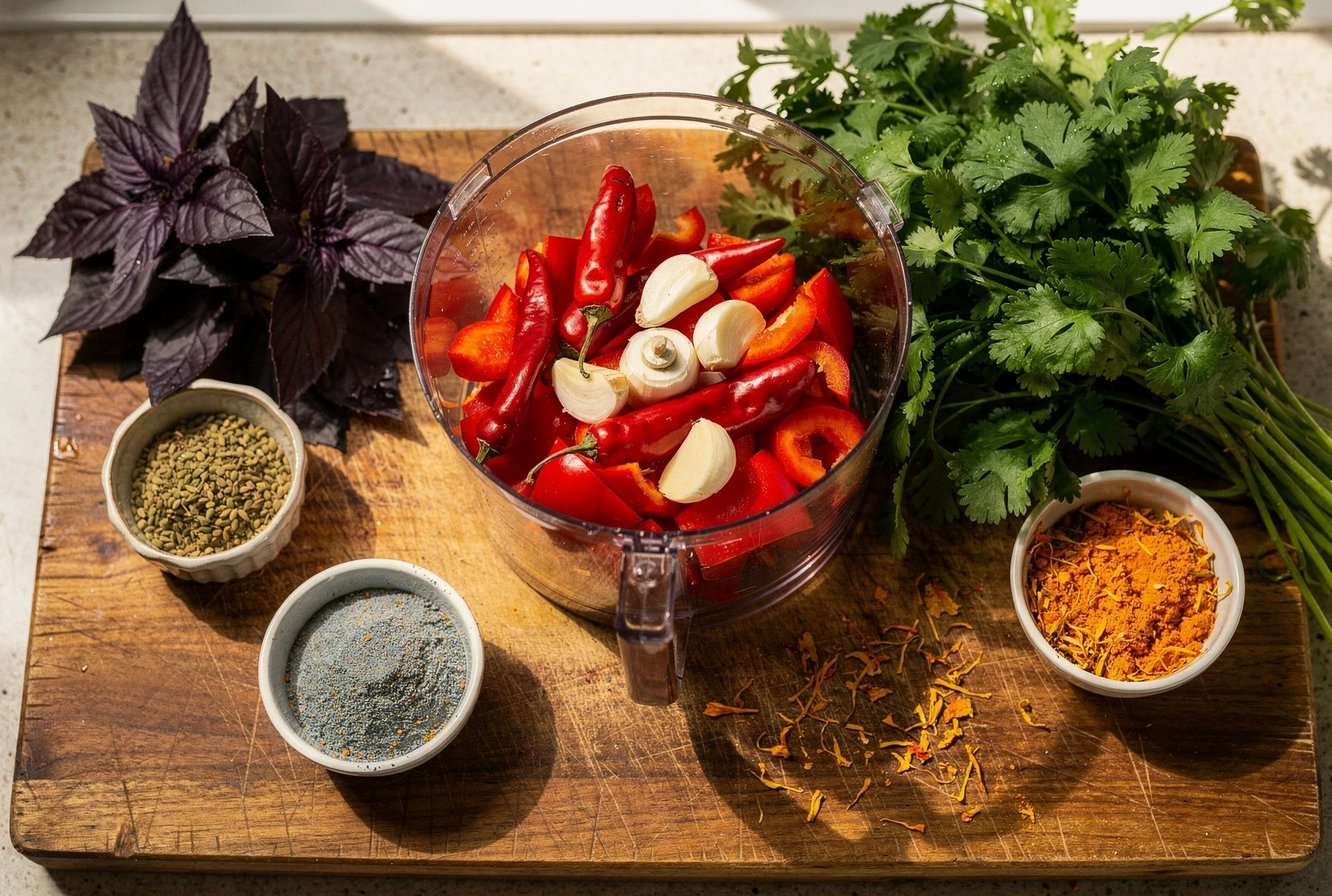
Add all the peppers and garlic to your food processor. Pulse 15–20 times until everything is very finely chopped and uniform in texture. You want a coarse paste — think the consistency of chunky salsa, not a smooth purée. Scrape down the sides between pulses.
Step 3: Add the Herbs
Roughly tear the cilantro (stems included — don't throw those away, they have more flavor than the leaves), purple basil, and parsley. Add all the herbs to the food processor. Pulse another 10–15 times until the herbs are finely chopped and evenly distributed through the pepper mixture. The color should shift from pure red to a deeper, flecked red-green.
Step 4: Add Salt and Spices
Add the salt, blue fenugreek, ground coriander, and ground marigold. Pulse a few more times to combine. The 1.5 tablespoons of salt looks aggressive — it's supposed to be. Traditional adjika is very salty because that's what preserves it. When you use it in dishes, cut back on any additional salt accordingly.
Step 5: Emulsify with Oil
With the food processor running continuously, slowly drizzle in the sunflower oil over about 15 seconds. Process until the paste is cohesive and slightly glossy. Don't overprocess — you want texture, not baby food.
Step 6: Drain and Jar
Transfer the adjika to a fine-mesh strainer set over a bowl. Let it drain for 10–15 minutes — the peppers release a lot of water, and you want a thick paste, not a sauce. Discard the liquid. Pack the drained paste firmly into clean glass jars, pressing down to eliminate air pockets. Top with a thin layer of oil if storing long-term.
Controlling the Heat
The heat level of your adjika depends almost entirely on two decisions: which chilies you use, and whether you keep the seeds and ribs.
| Heat Level | Chili Choice | Seeds/Ribs | Who It's For |
|---|---|---|---|
| Mild 🌶️ | Fresno or Anaheim | All removed | Heat-sensitive, kids at the table |
| Medium 🌶️🌶️ | Fresno or cayenne | Half removed | Most people — a good kick without pain |
| Hot 🌶️🌶️🌶️ | Cayenne or serrano | All kept | The Megrelian default — this is how it's meant to be |
| Volcanic 🌶️🌶️🌶️🌶️ | Habanero or Thai | All kept + extra chili flakes | Show-offs and those with Megrelian grandmothers |
Start with medium if you're making adjika for the first time. You can always add more heat later — you can't take it away.
How Georgians Actually Use Adjika
Adjika isn't a condiment you put on the table like hot sauce. It's a cooking ingredient — something you add during preparation, not at the table. Here are the most common ways Georgians use it:
| Use | Amount | When to Add | Recipes |
|---|---|---|---|
| Meat rub | 2–3 tbsp | Rub on 1–24 hours before cooking | Chicken tabaka, roast pork, kupati |
| Stew base | 1–2 tbsp | With the aromatics, early in cooking | Chashushuli, chakhokhbili, chanakhi |
| Bean enhancer | 1–2 tsp | Stirred in at the end | Lobio |
| New Year's pig | Half a jar | Rubbed inside and out before roasting | The iconic Megrelian New Year's tradition |
| Bread spread | Thin layer | On fresh shotis puri with cheese | The simplest and arguably best use |
| Grilled meat dip | 1–2 tsp per person | On the table alongside tkemali | Mtsvadi, grilled chicken |
Remember: Adjika Is Very Salty
When adding adjika to any dish, cut back on other salt. A tablespoon of adjika carries about a teaspoon of salt with it. Taste as you go — you can always add more, but you can't unsalt a stew.
Beyond Georgian: Adjika in Your Everyday Cooking
Once you've got a jar of adjika, it starts infiltrating everything you cook — not just Georgian dishes. Here are some non-traditional but excellent uses:
🍕 Pizza & Flatbreads
Thin layer under the cheese on pizza. Better than chili flakes. Seriously.
🥚 Eggs
Mix a teaspoon into scrambled eggs or spread on toast under a fried egg.
🍝 Pasta
Stir into aglio e olio or use as a base for a spicy tomato sauce. Georgian arrabiata.
🥩 Marinades
Mix with yogurt for a quick lamb marinade. The herb-chili-garlic combination is already perfect.
Storage and Shelf Life
🧊 Refrigerator
Keeps 4–6 months easily. The high salt and capsaicin content are natural preservatives. Use a clean spoon every time — don't contaminate the jar with food particles. Top with a thin layer of oil after each use to create an oxygen barrier.
❄️ Freezer
Freeze in ice cube trays, then transfer to a bag. Each cube ≈ 1 tablespoon. Perfect for adding to stews and soups. Keeps up to a year. Thaw in the fridge or drop directly into hot dishes.
Dry Adjika: The Shelf-Stable Spice Blend
There's a second form of adjika that's worth knowing about: dry adjika (მშრალი აჯიკა, mshrali adjika). This is a powdered spice blend — dried red peppers, blue fenugreek, coriander, marigold, garlic powder, and salt — that you'll find in every Georgian spice stall. It's not a substitute for fresh adjika; it's a different product entirely, used as a table condiment and seasoning sprinkle.
Dry adjika is what you'll see in the small bowls on Georgian restaurant tables next to the salt and pepper. Sprinkle it on everything — eggs, soups, grilled meat, salads. If you can't find the Georgian spices for fresh adjika, start with a dry adjika blend to get familiar with the flavor profile. Our Georgian spices guide covers where to buy both versions.
Common Mistakes
❌ Adding Tomatoes
If your adjika has tomatoes, it's the Russian version — a different product entirely. Traditional Megrelian and Abkhazian adjika is pure peppers, herbs, and spices.
❌ Over-Processing
You want a coarse paste, not a smooth purée. Pulse the food processor — don't let it run continuously. Texture matters.
❌ Skipping the Drain
Bell peppers release a lot of water. If you don't drain the paste, you'll get soup instead of paste — and it won't keep as long.
❌ Using Sweet Basil
Genovese (Italian) basil is too sweet and delicate. Purple basil or Thai basil have the right anise-peppery punch for adjika.
❌ Being Shy with Salt
1.5 tablespoons seems like a lot. It is. But it's what preserves the paste for months. Under-salted adjika spoils quickly and tastes flat.
❌ Skipping Blue Fenugreek
Without utskho suneli, it's just a generic chili paste. Blue fenugreek is what makes adjika taste Georgian. Order it online if you can't find it locally.
Where to Buy Adjika in Georgia
If you're visiting Georgia, you can buy excellent adjika everywhere — but quality varies wildly. Here's where to look:
🏪 Dezerter Bazaar (Tbilisi)
The spice stalls in the main market sell both fresh (paste) and dry adjika. Taste before buying — every vendor's recipe is slightly different. Best prices in the city.
👵 Roadside Vendors
The women selling jars along the highway in western Georgia — especially between Zugdidi and Senaki — often have the best homemade adjika you'll ever taste. 3–5 GEL per jar.
🛒 Supermarkets
Kula and Goodwill carry jarred adjika from brands like Kakhuri. Fine in a pinch, but not as good as market or homemade versions.
🏔️ Samegrelo Region
If you're traveling through western Georgia, every guesthouse will serve their own adjika. Ask to buy a jar — most will happily sell you one.
Frequently Asked Questions
Can I make adjika without a food processor?
Absolutely — that's how it was made for centuries. Use a meat grinder (the traditional Georgian method) or a large mortar and pestle. The mortar will take 30–40 minutes of pounding, but some people prefer the slightly chunkier texture it produces. A blender works in a pinch, but you risk over-processing into a smooth purée.
What's the difference between adjika and satsebeli?
Adjika is a raw chili paste — concentrated, intensely salty and spicy, used as a cooking ingredient. Satsebeli is a cooked tomato-based sauce — thinner, less spicy, served at the table as a dipping sauce. They're complementary, not interchangeable. Many Georgian meals feature both.
Is adjika very spicy?
Traditional Megrelian adjika is seriously hot — Samegrelo is known for being Georgia's spiciest region. But you control the heat entirely through your choice of chilies and how many seeds you keep. See the heat control table above for guidance.
Can I substitute the Georgian spices?
In order of importance: blue fenugreek is the most irreplaceable — use half the amount of regular fenugreek as a rough substitute. Ground coriander is easy to find everywhere. Ground marigold can be replaced with a tiny pinch of turmeric (for color) plus a pinch of saffron (for aroma), but the result won't be the same. Best to just order the real spices online.
How do I know when adjika has gone bad?
Properly salted adjika keeps for months. Signs it's past its prime: mold on the surface (scrape it off — the paste below is usually fine), significant color change from red to brown, fermented or sour smell, or a slimy texture. If you see any mold, make sure you're using a clean spoon and topping with oil after each use.
Written by The Georgian Eats Team
We keep a jar of adjika in the fridge at all times — the homemade kind, from a Megrelian friend's mother who insists we're not using enough. After years of eating our way through Georgia's western regions, we've come to agree with her.
Last updated: February 2026.
Related Articles
Georgian Spices & Herbs Guide
Blue fenugreek, marigold, khmeli-suneli — the complete guide to sourcing and using Georgian spices.
Tkemali: Sour Plum Sauce
Georgia's other essential condiment — the tart, herby plum sauce that goes with everything grilled.
Chashushuli: Spicy Beef Stew
The perfect dish to use your fresh adjika in — fiery beef braised in no-water tomato sauce.
Chakhokhbili: Chicken Stew
Another classic that benefits from a spoonful of adjika stirred in with the aromatics.