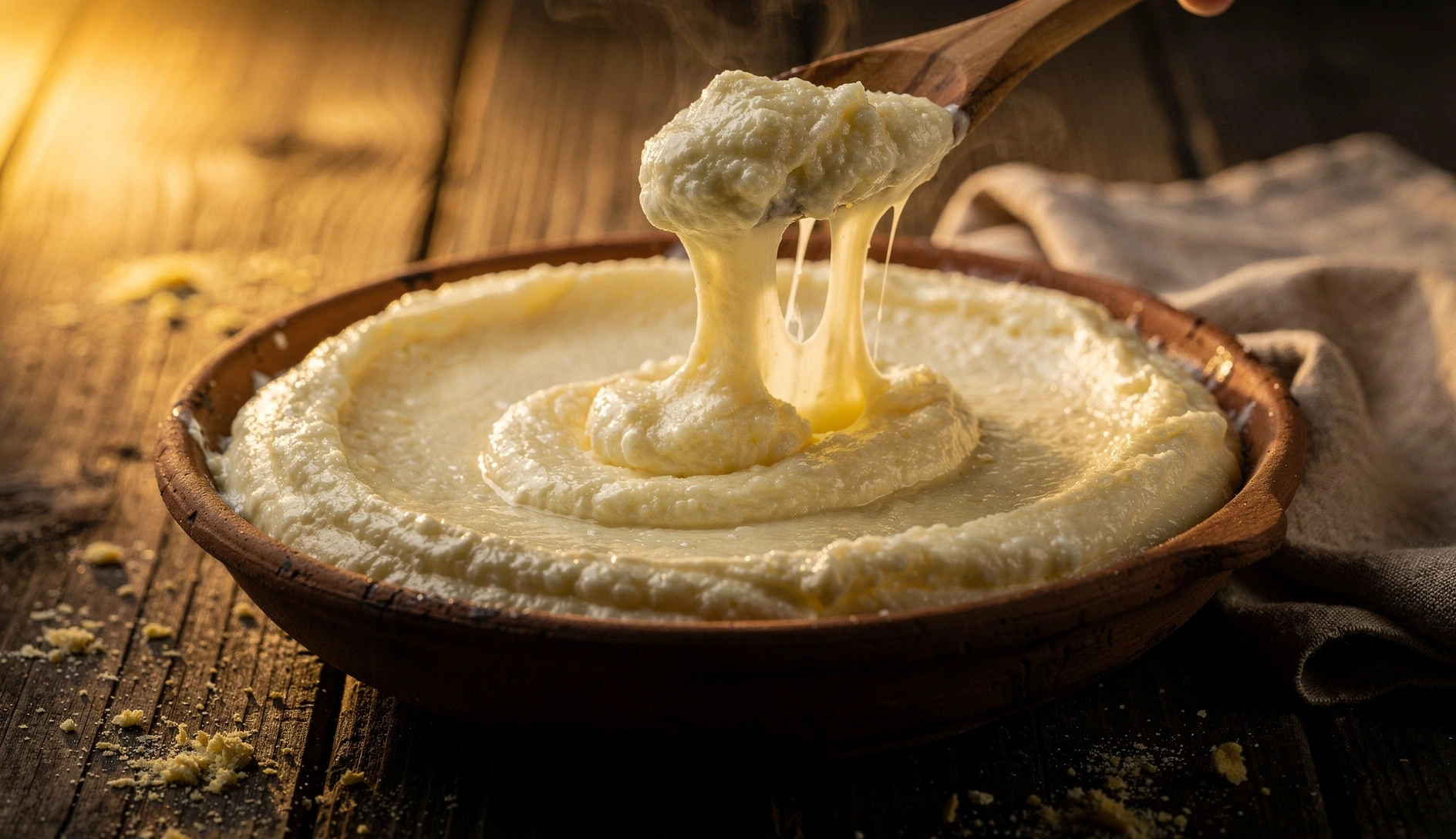
Elarji (ელარჯი) is the dish that breaks everyone's brain the first time they see it. You're sitting in a restaurant in western Georgia, and the waiter brings what looks like a smooth white mound of something on a plate. Then someone digs a spoon in, lifts, and the whole thing stretches upward in long, gooey strings — like mozzarella on steroids. It's cornmeal cooked with so much sulguni cheese that the two become inseparable. Not cheese on porridge. Not cheesy polenta. Something else entirely — a single elastic mass where you can't tell where the grain ends and the dairy begins. It's absurdly simple, impossible to mess up if you know the ratio, and the most satisfying thing you'll eat this month.
Elarji Quick Facts
- Georgian name: ელარჯი (eh-LAR-jee)
- Origin: Samegrelo region, western Georgia
- Key ingredients: Coarse white cornmeal, cornflour, sulguni cheese
- Texture: Thick, elastic, extremely stretchy
- Traditional pairing: Bazhe (walnut-garlic sauce)
- Cost in Georgia: 8–14 GEL (~$3–5 USD)
- Difficulty: Easy — it's all about the ratio and the stirring
Why Elarji Matters
Samegrelo — the lush, subtropical region in western Georgia between the mountains and the Black Sea — has the most intensely flavored cuisine in the country. Where eastern Georgia uses mild brined cheeses and subtle herbs, Samegrelo goes hard: walnut sauces, chili paste, and more cheese per square meter than anywhere else on earth. Elarji is the purest expression of this philosophy. It takes just two real ingredients — cornmeal and cheese — and through sheer quantity and technique, creates something that feels like it shouldn't be physically possible.
The ratio is what makes elarji elarji. One kilogram of cheese to 200 grams of cornmeal. That's not a typo. The cheese isn't a topping or a mix-in — it's the majority of the dish. When you eat elarji, you're eating cheese that happens to be held together by cornmeal, not the other way around.
The Cheese Question
This is where most recipes outside Georgia fall apart. Elarji needs fresh sulguni — the stretchy, mildly salty brined cheese that's sold in every market in Georgia. Sulguni melts into long elastic strings without breaking or becoming oily. It's the mechanical backbone of the whole dish.
The Cheese Makes or Breaks It
If you can find Georgian sulguni at a local Eastern European store, use it. If not, low-moisture mozzarella is the best substitute — it has similar stretch and melt properties. Fresh mozzarella has too much water and will make the elarji soupy. Avoid cheddar, Gouda, or any cheese that melts into a smooth pool rather than stretching into strings.
| Cheese | Stretch | Flavor | Verdict |
|---|---|---|---|
| Fresh sulguni | Excellent — long strings | Mild, slightly salty, tangy | The real deal |
| Low-moisture mozzarella | Very good | Mild, less tang | Best substitute |
| Fresh mozzarella | Okay when drained | Mild, milky | Too watery — drain very well |
| Oaxaca / quesillo | Good | Mild, buttery | Decent alternative |
| Provolone | Moderate | Sharper, smokier | Works in a pinch, stronger flavor |
Ingredients
Serves 4 — Yes, it's really just this. That's the beauty.
| Ingredient | Amount | Notes |
|---|---|---|
| Coarse white cornmeal | 200g | NOT fine polenta or yellow cornmeal — coarse white |
| Fine cornflour | 4 tbsp (~30g) | Acts as thickener — corn starch works |
| Fresh sulguni cheese | 1 kg | Or low-moisture mozzarella |
| Water | 1 liter | For cooking the cornmeal |
| Salt | To taste | Go easy — sulguni is already salty |
White Cornmeal, Not Yellow
Georgian cornmeal is white and coarse-ground. If all you can find is yellow polenta, the taste and texture will be different — more Italian, less Georgian. Look for white cornmeal (sometimes labeled "white corn grits") at Latin American, Southern US, or Eastern European grocery stores. The coarser the better.
Equipment
🍲 Heavy-Bottomed Pot
A thick pot prevents scorching during the long cook. Cast iron, enameled cast iron, or heavy stainless steel all work. Avoid thin pots — the cornmeal will stick and burn on the bottom.
🥄 Wooden Spoon (Strong One)
The mixture becomes incredibly thick and heavy toward the end. You need a sturdy wooden spoon or a thick wooden paddle. Flimsy utensils will snap. This is an arm workout.
Step by Step
Step 1: Rinse the Cornmeal (5 minutes)
Put the coarse cornmeal directly into your cooking pot. Cover with cold water, swirl it around, and carefully pour off the cloudy water along with any husks, debris, or discolored bits that float to the surface. Repeat two or three times until the water runs mostly clear.
This step isn't optional. Georgian cornmeal — and most coarse cornmeal worldwide — contains fine debris and husks that will affect the final texture. Rinsing also removes some of the starch dust, which helps prevent the base from becoming gluey.
Step 2: Cook the Cornmeal (30-35 minutes)
Add 1 liter of fresh water to the rinsed cornmeal. Set over medium-high heat and bring to a boil, stirring occasionally so it doesn't clump. Once boiling, drop to low heat and cook for 30-35 minutes, stirring every few minutes.
You're looking for the cornmeal to fully absorb the water and lose any raw, gritty taste. It should be thick and pulling away from the sides slightly, but still stirrable. If it gets too thick too early, add a splash of water — better slightly loose at this stage than too dry.
Step 3: Add the Cornflour (15 minutes)
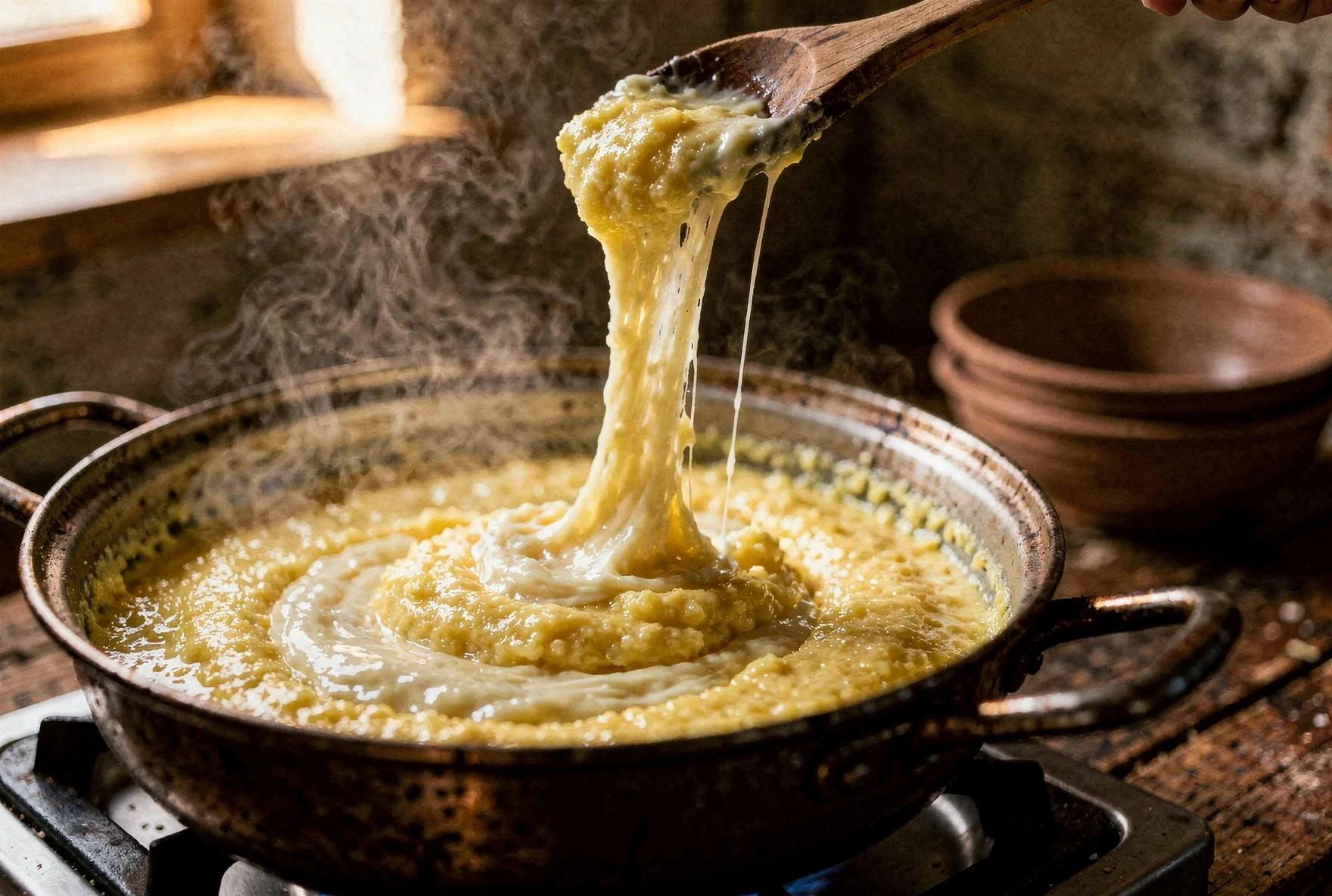
Sprinkle in the 4 tablespoons of fine cornflour while stirring constantly. This is the thickening stage. Keep stirring — vigorously — on low heat for about 15 minutes. The mixture will tighten significantly, becoming harder to stir. This is normal and correct.
The cornflour does two things: it adds body and it creates the sticky matrix that will hold the cheese. If you skip it, the elarji will be too loose and the cheese won't integrate properly.
The Arm Workout
This is the part nobody warns you about. Stirring thick cornmeal with cornflour for 15 minutes is genuinely hard work. Switch hands. Use your body weight. Some Georgian grandmothers use a special long wooden paddle called a khveti and lean into it with both hands. Don't be a hero — take breaks if you need to.
Step 4: Add the Cheese (2-3 minutes)
This is the moment. Slice all your sulguni into thin strips or rough chunks — the thinner the slices, the faster they'll melt. Add the entire kilogram to the pot at once. Now stir and mash with your wooden spoon, pressing the cheese into the cornmeal base.
Within 2-3 minutes, the cheese should be completely melted and incorporated. The mixture transforms — going from thick porridge to a single, unified, elastic mass. When you lift the spoon, the elarji should stretch in long, dramatic strings. If it doesn't stretch, your cheese wasn't the right type or wasn't fresh enough.
Step 5: Shape and Serve (immediately)
Elarji waits for no one. Wet a wooden spoon (or your hands) with cold water to prevent sticking, and scoop portions onto plates. Shape each serving into a smooth mound. In Samegrelo, elarji is often presented as an elegant dome shape — the wet spoon technique gives you that smooth surface.
Serve immediately. Elarji is best eaten hot, within 10-15 minutes. As it cools, it firms up and loses the stretch. It's still edible cold (some people like it), but the magic happens when it's still warm and pulling.
How to Serve Elarji
In Samegrelo, elarji almost always comes with bazhe — a thick, pale sauce made from ground walnuts, garlic, coriander, fenugreek, and vinegar. The cool, tangy, nutty bazhe against the hot, stretchy, mild elarji is one of the great Georgian food pairings. It's the contrast that makes it work — the cheese is rich and heavy, the bazhe is sharp and light.
| Pairing | Why It Works |
|---|---|
| Bazhe (walnut sauce) | The classic — cool, tangy, nutty. Cuts through the richness perfectly. |
| Tkemali (plum sauce) | Sour punch that balances the heaviness. Red or green both work. |
| Grilled meat (mtsvadi) | The cheesy starch with smoky pork is a Megrelian feast classic. |
| Fresh herbs and scallions | Freshness against richness. Simple and effective. |
| Adjika (chili paste) | Megrelian adjika adds serious heat. A small spoonful goes a long way. |
| Cold beer or white wine | Crisp Tsinandali or a cold lager. You need the liquid to offset the density. |
Elarji vs. Ghomi
People confuse these constantly, so let's settle it. Ghomi (ღომი) is the plain cornmeal porridge — no cheese at all. It's cooked the same way (coarse cornmeal, water, cornflour) but served as a neutral starchy base, usually with cheese on the side and stews or sauces spooned over it. Think of ghomi as the Georgian equivalent of polenta or ugali.
Elarji is ghomi's dramatic older sibling — the cheese gets stirred into the porridge until they become one entity. The cheese isn't a side, it's the co-star.
| Feature | Ghomi | Elarji |
|---|---|---|
| Cheese | Served on the side | Mixed in (1kg per batch) |
| Texture | Smooth porridge | Thick, elastic, stretchy |
| Region | All of western Georgia | Specifically Samegrelo |
| Richness | Light, neutral | Very rich, heavy |
| Serving role | Base for stews | Standalone dish |
Variations
| Variation | What Changes | Notes |
|---|---|---|
| Classic elarji | Nothing — pure sulguni + cornmeal | The original and best |
| With tchkhinti | Use tchkhinti cheese instead of sulguni | Sharper, more complex — traditional in some villages |
| Mixed cheese | 50/50 sulguni and imeruli | Softer texture, less stretch, milder |
| With butter | Knob of butter stirred in with cheese | Extra richness — some restaurants do this |
| Leftover elarji (fried) | Sliced and pan-fried next day | Crispy outside, gooey inside — excellent |
Common Mistakes
❌ Using yellow polenta
Yellow polenta gives a completely different flavor and color. Georgian elarji uses white cornmeal — it's a different product. Coarse grind matters too.
❌ Not enough cheese
The 5:1 ratio feels insane, but it's correct. If you halve the cheese, you get cheesy porridge — not elarji. Don't chicken out on the quantity.
❌ Skipping the cornflour
Without cornflour, the base is too loose to properly bind with the cheese. It acts as the glue. Just 4 tablespoons makes all the difference.
❌ Letting it cool on the stove
Elarji must be served immediately. It hardens as it cools. Have plates ready, serve the second it's done, eat within 10 minutes.
❌ Wrong cheese type
Cheddar, Swiss, or any cheese that melts smooth won't work. You need a stretching cheese — sulguni, low-moisture mozzarella, or Oaxaca.
❌ Undercooking the cornmeal
The full 30-35 minutes matters. Undercooked cornmeal tastes raw and gritty, and the final texture will be grainy instead of smooth.
Pro Tips
🥄 Wet Your Tools
Dip your spoon or hands in cold water before scooping. Elarji is extremely sticky when hot — water prevents it from gluing to everything.
🧂 Salt Carefully
Sulguni is already salty. Taste the cornmeal base before adding the cheese, and add just a pinch. You can always add salt at the table, but you can't take it out.
🔥 Keep the Heat Low
High heat during the cheese stage makes it seize and become rubbery instead of stretchy. Low and steady wins. The residual heat from the cornmeal does most of the melting.
🍳 Fry the Leftovers
Leftover elarji firms into a sliceable block in the fridge. Cut into thick slabs and pan-fry in butter until golden and crispy outside, molten inside. Better than the original, some say.
Where to Eat Elarji in Georgia
🏠 Any Home in Samegrelo
Seriously. If you visit Zugdidi, Senaki, or anywhere in the Samegrelo region and get invited into someone's home, the elarji they make will be better than any restaurant version.
🍽️ Salobie Bia (Tbilisi)
This Old Town favorite specializes in western Georgian cuisine. Their elarji with bazhe is the closest you'll get to the real thing without leaving Tbilisi. Always busy — go early.
🍷 Samegrelo Restaurants (Zugdidi)
Any restaurant in Zugdidi will have elarji on the menu. It's the local staple. Ask for it with bazhe and mtsvadi — the Megrelian power combo.
🏔️ Guesthouses on the Road to Svaneti
The drive from Zugdidi to Mestia passes through Samegrelo. Roadside guesthouses along this route serve excellent elarji as part of their dinner spread.
Nutrition
| Nutrient | Per Serving |
|---|---|
| Calories | ~520 kcal |
| Protein | ~38g |
| Carbohydrates | ~42g |
| Fat | ~28g |
Storage
🧊 Fridge
Keeps 2-3 days in an airtight container. It will firm up into a solid block — that's normal. Slice and fry for the best reheated version.
♨️ Reheating
Microwave in short bursts with a splash of water, stirring between. Or better: slice cold and pan-fry in butter until crispy outside.
❄️ Freezing
Not recommended. The cheese texture changes after freezing and never stretches the same way. Elarji is a cook-fresh dish.
📏 Scaling
Halve or double the recipe proportionally. The 5:1 cheese-to-cornmeal ratio is sacred. Don't mess with it.
Frequently Asked Questions
Can I use regular polenta instead of white cornmeal?
You can, but the result will taste and look different — more like Italian polenta with cheese than Georgian elarji. Yellow cornmeal has a different flavor profile. If it's all you have, it works, but seek out white cornmeal for the authentic version.
Is elarji gluten-free?
Yes — naturally gluten-free. Cornmeal and cheese contain no gluten. Just check that your cornmeal isn't processed in a facility with wheat if you have celiac disease.
Why does my elarji not stretch?
Almost always a cheese problem. The cheese needs to be a stretching variety (sulguni, mozzarella, Oaxaca). Aged cheeses, crumbly cheeses, and pre-shredded cheese with anti-caking coating won't stretch. Use block cheese, and make sure it's fresh.
What's bazhe and do I need it?
Bazhe is a cold walnut sauce (ground walnuts, garlic, coriander, fenugreek, vinegar, water) that's the traditional accompaniment to elarji. You don't need it, but it transforms the dish — the cool, tangy sauce against hot stretchy cheese is the whole point for Megrelians. Tkemali works as a simpler alternative.
Can I make elarji ahead of time?
Not really. It's a serve-immediately dish. You can cook the cornmeal base in advance and reheat it before adding cheese, but the cheese must go in at the last moment and be served within minutes. The stretch is temporary.
Written by The Georgian Eats Team
Based in western Georgia, where elarji is a weekly staple and bazhe is a religion. We've eaten more cornmeal-based dishes in Samegrelo guesthouses than we'd care to admit — and we'd do it all again.
Last updated: February 2026.
Related Articles
Khinkali
Georgia's iconic soup dumplings — the complete technique.
Adjarian Khachapuri
The boat-shaped cheese bread that ruins all other bread.
Shkmeruli
Garlic cream chicken — another western Georgian masterpiece.
Georgian Cheese Guide
Sulguni, imeruli, and the rest of Georgia's incredible cheeses.