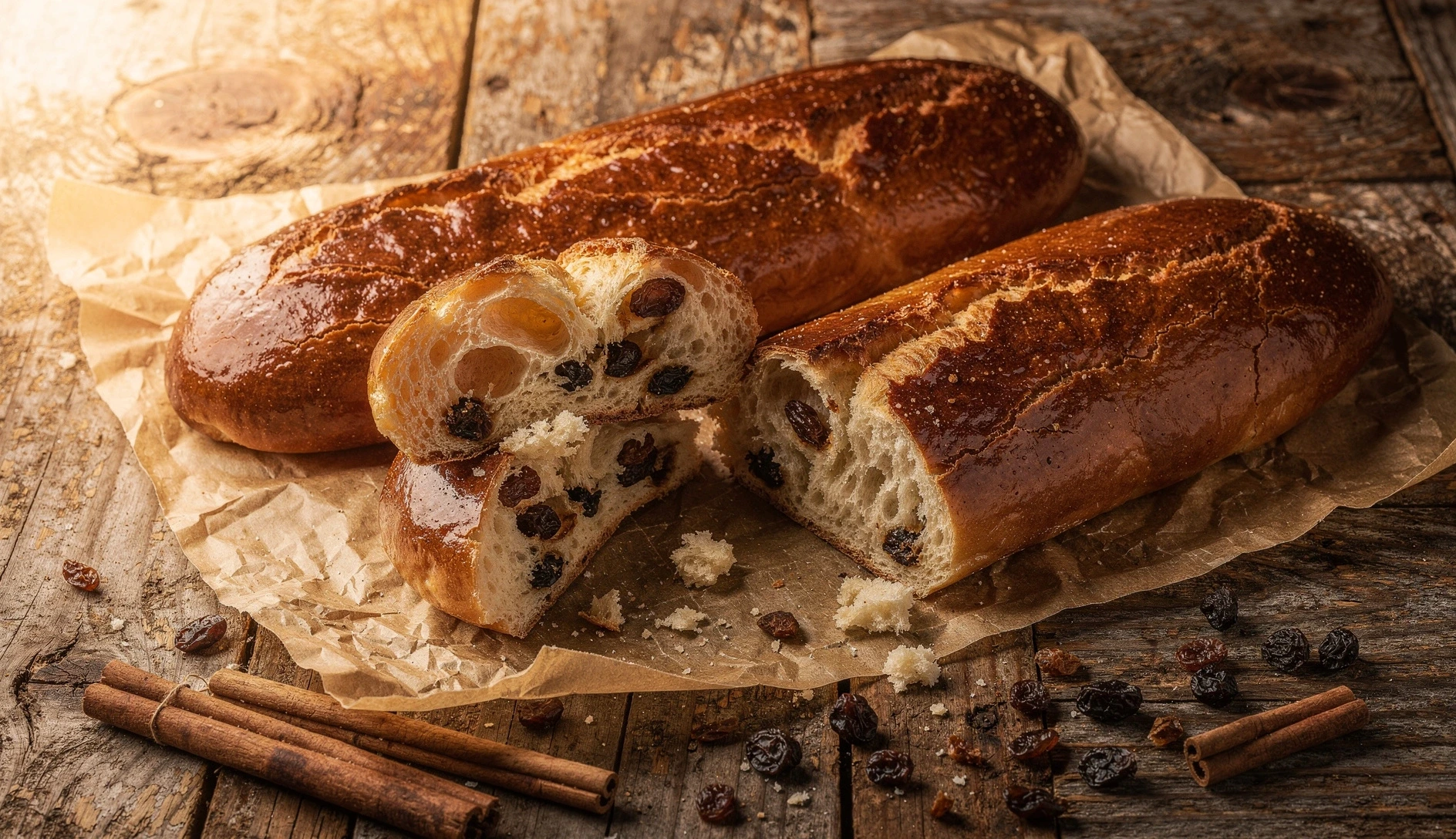
If you've ever driven between Tbilisi and Kutaisi, you know the moment. Somewhere around the small town of Surami, the highway is lined with wooden huts — dozens of them, one after another, all selling the same thing: glossy, dark-golden loaves of sweet bread studded with raisins and fragrant with cinnamon and cloves. This is nazuki, and those roadside stands have been selling it around the clock for decades. Drivers stop, buy a few loaves, tear off a piece while it's still warm, and the car smells incredible for the next hundred kilometers. It's the road trip bread of Georgia, and once you've had a fresh one straight from a tone oven, you'll understand why nobody drives past Surami without stopping.
Nazuki Quick Facts
- Georgian name: ნაზუქი (na-ZU-ki)
- Meaning: From Persian — "exquisite" or "delicate"
- Origin: Kartli region, especially Surami
- Type: Enriched sweet bread with spices and raisins
- Active time: 30 minutes
- Total time: ~3 hours (including rising)
- Difficulty: Easy — basic bread skills. The hardest part is waiting for it to rise.
- Traditional oven: Tone (cylindrical clay oven), but a conventional oven works great
What Is Nazuki?
Nazuki is an enriched sweet bread — loaded with butter, eggs, sugar, and warm spices, with raisins folded through the dough. If you've had Portuguese sweet bread, Italian panettone, or Eastern European babka, you're in the neighborhood. But nazuki has its own character: less sweet than most Western sweet breads, heavier on the spice (cinnamon and cloves are the backbone), and with that distinctive glossy, almost lacquered egg-washed crust that catches the light like polished wood.
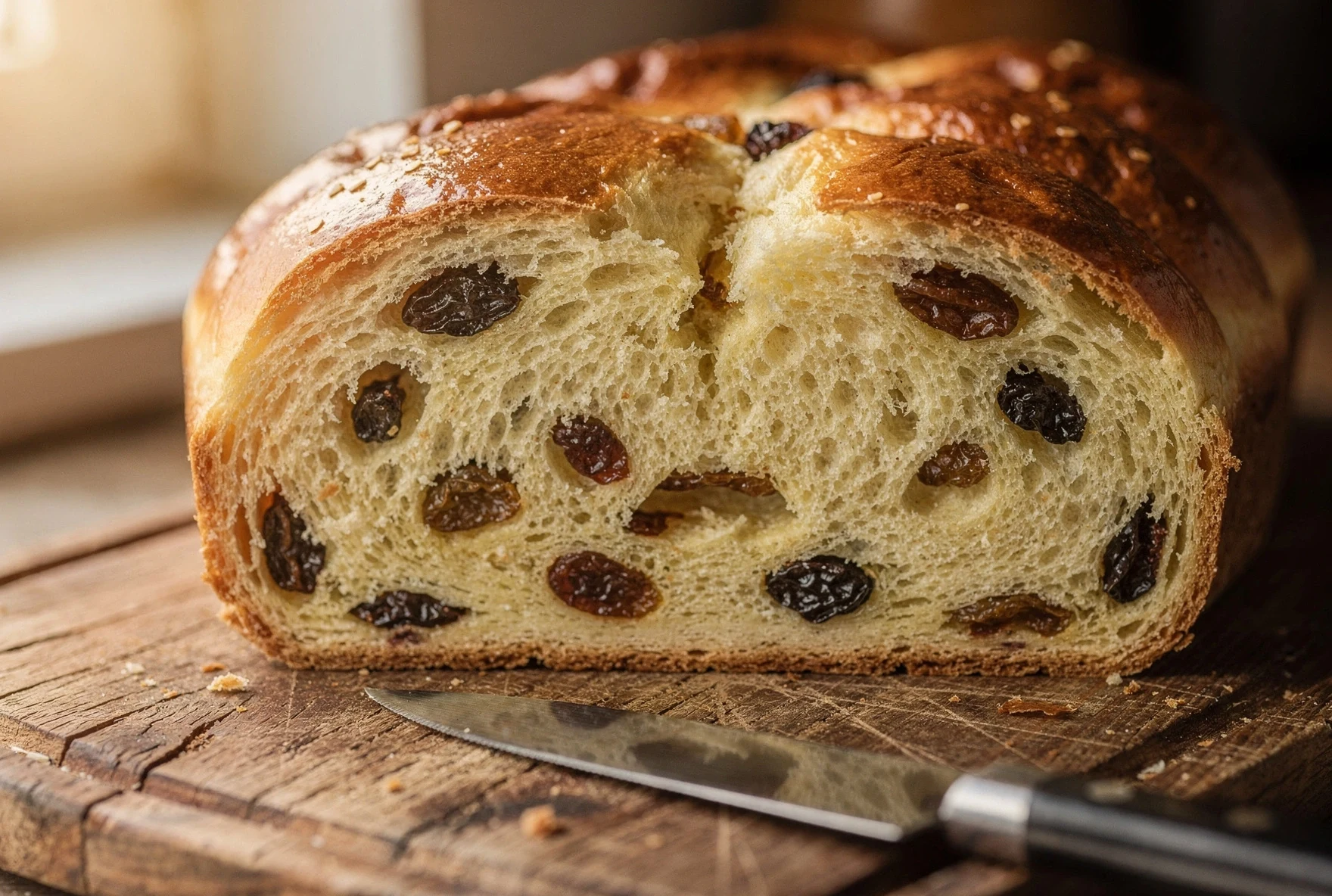
The texture falls somewhere between brioche and challah. The crumb is soft and slightly pull-apart, not dense or cakey. A good nazuki has enough structure to tear cleanly but enough richness to melt in your mouth. The raisins provide little bursts of sweetness that contrast with the warm spice, and the crust — when fresh — has a thin crackle before yielding to the soft interior.
It's not a dessert, exactly. Georgians eat it with tea, with coffee, as a road snack, as a breakfast bread, or just whenever it's around. It doesn't need butter or jam — it's already rich enough on its own. Though nobody will judge you for spreading some fresh honey on a warm slice.
The Surami Story
You can buy nazuki in bakeries across Georgia, but Surami owns it. This small town in the Shida Kartli region sits on the main highway between Tbilisi and western Georgia, and for a roughly 3-kilometer stretch, the road is flanked by wooden huts — over 50 of them — each one selling fresh nazuki. Some operate around the clock. The local name for this stretch is simply "Nazukebi" — the plural of nazuki. That's how central this bread is to the town's identity.
The tradition started during the economic collapse of the 1990s, when Georgian families were desperate for income after the Soviet Union fell apart. People in Surami built small tone ovens and started baking nazuki to sell to passing drivers. What started as survival became a regional economy. Today, nazuki is Surami's main industry, and the roadside stands are a genuine landmark — every Georgian knows them.
The tone oven makes a real difference. These are the same cylindrical clay ovens used to bake shotis puri — the dough is slapped onto the scorching inner walls and bakes in intense, radiant heat. A tone oven hits temperatures that a home oven can't touch, which gives the crust its particular depth of color and the interior an almost steamed quality. The home oven version is still excellent, but if you ever get the chance to eat one fresh from a tone — take it.
The Surami Rule
If you're driving between Tbilisi and western Georgia (Kutaisi, Batumi, Zugdidi, Mestia), Surami is roughly the halfway point. Stop. Buy nazuki. It's not optional — Georgians consider it bizarre to drive past Surami without stopping. A fresh loaf costs 2–4 GEL (about $1–1.50), and most stands will let you watch it come out of the tone oven.
History and Cultural Meaning
The word "nazuki" comes from Persian and translates roughly to "exquisite" or "delicate" — which tells you something about how Georgians regard this bread. Ethnographer Tedo Sakhokia wrote that it symbolizes prosperity, softness, and delicacy. It's not just food; it's a cultural marker.
Nazuki has been part of Georgian cuisine for centuries, particularly in the Kartli, Kakheti, and Meskheti regions. It traditionally serves as a festive bread — the Georgian equivalent of what paskha (Easter bread) is in Russian Orthodox tradition. In Kartli, nazuki IS the Easter bread, baked specifically for the holiday table and given as gifts to neighbors and family. But unlike many festival breads around the world that only appear once a year, nazuki broke free of its seasonal role. The Surami roadside industry made it an everyday bread, available year-round, and now it's as likely to be a Tuesday afternoon snack as an Easter centerpiece.
| Tradition | When | Role |
|---|---|---|
| Easter (Kartli) | April/May | Ritual bread replacing paska — central to the Easter table |
| Weddings | Year-round | Offered as a symbol of prosperity and sweetness |
| Supra feasts | Year-round | Sweet bread served alongside other breads at celebrations |
| Road trips | Year-round | The unofficial highway snack — bought fresh at Surami |
| Daily eating | Year-round | Tea bread, breakfast, afternoon snack |
Nazuki vs. Other Georgian Breads
Georgia has an absurdly rich bread tradition — from the canoe-shaped Adjarian khachapuri to the cornbread mchadi of western Georgia. Nazuki occupies a unique niche as the only widely known Georgian sweet bread. Here's how it fits in:
| Bread | Type | Sweet? | Key Feature |
|---|---|---|---|
| Nazuki | Enriched wheat | Yes — spiced, with raisins | Glossy crust, cinnamon-clove aroma |
| Shotis Puri | Lean wheat | No | Torpedo-shaped, baked in tone oven |
| Mchadi | Cornmeal | Slightly — from the corn | Dense, pan-fried, paired with cheese/beans |
| Lobiani | Filled wheat | No | Bean-filled flatbread |
| Chvishtari | Cheese-corn | Slightly | Cornbread with sulguni cheese inside |
| Kubdari | Filled wheat | No | Svan meat pie, heavily spiced |
Ingredients
Nazuki uses ingredients you likely already have. The only thing that might require a trip to the store is enough raisins. Here's the full breakdown for 6 loaves:
| Ingredient | Amount | Notes |
|---|---|---|
| Bread flour | 800g | Minimum 12% protein. All-purpose works but gives a softer, less structured crumb. |
| Whole milk | 300ml | Warmed to ~38°C. Semi-skimmed is fine — there's plenty of fat from the butter. |
| Unsalted butter | 200g | Melted and slightly cooled. This is what makes the crumb tender. |
| Sugar | 80g | Demerara or light brown for depth. White works but tastes flatter. |
| Eggs | 2 whole + 1 yolk | 2 eggs go in the dough. The extra yolk + milk makes the glaze. |
| Raisins | 200g | Dark or golden — your choice. No need to soak; they hydrate in the dough. |
| Sunflower oil | 50ml | Helps keep the dough workable. Olive oil works too. |
| Cinnamon | 5g (~1 tsp) | The dominant spice. Use good-quality ground cinnamon. |
| Ground cloves | 2.5g (~½ tsp) | Potent — don't overdo it. Provides warmth and complexity. |
| Vanilla extract | 6g (~2 tsp) | Real extract preferred. A vanilla pod split and scraped is even better. |
| Yeast | 10g fresh / 4g dry / 3g instant | Fresh yeast is traditional. Any type works — adjust proofing time accordingly. |
| Fine sea salt | 2g | A small amount that balances the sweetness. Don't skip it. |
Understanding the Spices
The cinnamon-clove combination is what makes nazuki smell the way it does — warm, slightly exotic, a little bit like Christmas in countries that use those spices for holiday baking. But in Georgia, this isn't a holiday flavor. It's just what nazuki tastes like, year-round.
Cinnamon is the lead player. It's doing most of the aromatic heavy lifting. If you're using good-quality cinnamon (Ceylon or Vietnamese), you'll get a more complex, slightly floral note. Cheaper cassia cinnamon works fine — it's actually what most Georgian bakers use — and gives a stronger, more straightforward cinnamon punch.
Cloves are the supporting actor that makes everything interesting. They add a warm, slightly numbing quality that deepens the flavor. But cloves are aggressive — use too much and your bread will taste like a dentist's office. Start with half a teaspoon and taste-test after mixing the dough. You can always add more; you can't take it out.
Optional: Nutmeg
Some recipes add a pinch of nutmeg. It works — adds a subtle woody sweetness — but purists from Surami will tell you it's not traditional. If you want to try it, grate a tiny amount of fresh nutmeg (maybe 1/4 teaspoon) into the spice mixture. It shouldn't be identifiable on its own, just adding background warmth.
Step-by-Step Instructions
Step 1: Activate the Yeast
Warm the milk to about 38°C — a few degrees above body temperature. It should feel comfortably warm on the inside of your wrist, not hot. Pour it into a bowl, crumble in the fresh yeast (or sprinkle the dry yeast), and let it sit for 5 minutes. You're looking for the surface to get foamy and bubbly. If nothing happens after 10 minutes, your yeast is dead — start over with fresh yeast.
Step 2: Mix the Wet Ingredients
In a large bowl, combine the melted butter, sugar, salt, 2 beaten eggs, oil, cinnamon, cloves, and vanilla. Whisk until smooth. Pour in the activated yeast-milk mixture and stir everything together. The mixture will be fragrant and look like spiced custard — that's right.
Step 3: Build the Dough
Add the flour in three batches, stirring with a wooden spoon until it gets too thick to stir. Turn the shaggy mass out onto a floured surface and knead by hand for 8–10 minutes. The dough will be wetter and stickier than regular bread dough because of all the butter and eggs — that's normal. Resist adding too much extra flour. Use a light coating of oil on your hands instead.
You're done kneading when the dough is smooth, elastic, and springs back slowly when poked. It should feel like a baby's cheek — soft and slightly tacky but not sticking to your fingers.
Step 4: Add the Raisins
Flatten the dough into a rough rectangle, scatter the raisins over it, then fold and gently knead until they're evenly distributed — about 1–2 minutes. Some raisins will poke through the surface, and a few will try to escape. That's fine. They'll settle during rising.
Step 5: First Rise
Shape the dough into a ball, rub a thin film of oil over it, place it in a clean bowl, and cover with a damp kitchen towel or plastic wrap. Put it somewhere warm — near a window in summer, on top of the fridge, or in an oven with just the light on. Let it rise for 1.5–2 hours until it has doubled in size.
Don't Skip the Second Rise
Many traditional nazuki recipes skip the second proof because they're designed for a scorching-hot tone oven that compensates with rapid oven spring. In a home oven at 200°C, you absolutely need the second rise. Skip it and you'll get dense, heavy bread. The second rise is what gives nazuki its characteristic light, pull-apart texture.
Step 6: Shape
Punch down the risen dough to release the gas. Divide it into 6 equal pieces — each should weigh roughly 220–240g. Shape each piece into a flattened oval, about 15cm long, 8cm wide, and 2–3cm thick at the center. Traditional Surami nazuki are elongated half-moons — think of a flattened bean shape, tapered at both ends. Some bakers score a few shallow lines across the top for decoration, but this is optional.
Place the shaped loaves on baking sheets lined with parchment paper. Leave at least 5cm between them — they'll expand during the second rise and baking.
Step 7: Second Rise
Cover the shaped loaves with a towel and let them rise for 30–45 minutes. They should puff up noticeably — maybe 50% larger — but shouldn't double. While they rise, preheat your oven to 200°C (390°F). Put the rack in the middle position.
Step 8: Glaze and Bake
Beat the remaining egg yolk with 1 tablespoon of milk and a tiny pinch of salt (the salt helps the wash go on smoothly). Brush generously over each loaf. Don't be shy — this is what creates nazuki's signature glossy, chestnut-brown crust. For extra shine, do two coats, letting the first one set for a minute before applying the second.
Bake for 25–30 minutes. You're looking for a deep golden brown — the color of dark honey or well-stained oak. Not pale yellow, not burned. If the tops are browning faster than the sides, tent loosely with foil for the last 5–10 minutes. The loaves are done when they sound hollow when tapped on the bottom.
Step 9: Cool (If You Can)
Transfer to a wire rack and let cool for at least 10 minutes. The interior needs a few minutes to set, and the crust develops its final texture during cooling. But honestly? Tearing into a warm nazuki straight from the oven is half the experience. In Surami, nobody waits.
Visual Doneness Cues
| What to Look For | What It Means |
|---|---|
| Pale yellow, no shine | Underbaked — needs more time. The egg wash hasn't caramelized yet. |
| Golden with a glossy sheen | Getting close — another 5–8 minutes for full flavor development. |
| Deep golden-brown, lacquered look | Perfect. This is the classic Surami color. Pull them out now. |
| Dark brown, starting to blacken at edges | Overbaked — still edible, but the crust will be bitter. Reduce temp next time. |
Tone Oven vs. Home Oven
Let's be honest: a home oven will never replicate a tone oven perfectly. The tone hits 350–400°C+ and cooks from radiant heat on the clay walls, giving the bread a char pattern and a slightly smoky, steamed quality that convection heat can't match. But the good news is that nazuki is more forgiving than shotis puri in this regard. Since it's an enriched dough (butter, eggs, sugar), the browning and crust development happen readily even at lower temperatures.
| Factor | Tone Oven | Home Oven |
|---|---|---|
| Temperature | 350–400°C+ | 190–200°C |
| Bake time | 8–12 minutes | 25–30 minutes |
| Crust character | Slightly charred, smoky, crisp-to-chewy | Even golden-brown, tender crust |
| Interior | Slightly steamed, extremely soft | Soft and fluffy, a bit drier |
| Second rise needed? | No — explosive oven spring compensates | Yes — essential for light texture |
Pizza Stone Trick
If you have a pizza stone or baking steel, preheat it in the oven and bake the nazuki directly on it (on parchment paper). The extra bottom heat mimics some of the tone oven's intensity, giving you a crispier base and better oven spring. Not essential, but it helps.
Common Mistakes
🥛 Hot Milk Kills Yeast
Milk over 45°C will kill your yeast before it can do anything. Warm, not hot. Test on your wrist — it should feel comfortable, not scalding.
🍞 Adding Too Much Flour
Enriched doughs are supposed to be sticky. Adding flour until it feels like regular bread dough will give you dense, dry nazuki. Use oil on your hands instead.
⏩ Skipping the Second Rise
In a home oven, skipping the second proof means dense bread. The dough needs that 30–45 minutes to relax and aerate after shaping.
🎨 Skimping on Egg Wash
The glaze is half the experience. A thin, half-hearted brush gives you pale bread. Go thick and do two coats for that signature glossy crust.
🌡️ Too Low Temperature
Baking at 170°C because you're afraid of burning gives you a thick, tough crust with no color. Start at 200°C and adjust down only if needed.
🫐 Over-Kneading with Raisins
Fold them in gently. Over-kneading crushes the raisins and stains the dough purple. A few turns is enough — they'll distribute during rising.
Variations
Matsoni Nazuki
Some traditional recipes replace part of the milk with matsoni (Georgian yogurt). This adds a subtle tang and makes the crumb even more tender. Replace half the milk with matsoni at room temperature.
Honey-Glazed
Instead of egg wash, some bakers brush warm honey mixed with a tablespoon of water over the loaves immediately after baking. This gives a sticky, sweet exterior instead of the traditional egg shine.
Walnut-Stuffed
In Kakheti, some bakers add a line of crushed walnuts down the center along with the raisins. Press a tablespoon of roughly chopped walnuts into the center before folding the dough over.
Mini Nazuki
Instead of 6 large loaves, divide into 12–15 smaller portions. These bake faster (15–18 minutes), make better individual servings, and are closer to the small roadside pieces sold at Surami.
Serving and Pairing
Nazuki doesn't need accompaniment — it's complete on its own. But if you want to build a spread around it, here's what works:
| Pairing | Why It Works |
|---|---|
| Black tea | The classic pairing. Strong Georgian black tea cuts through the richness perfectly. |
| Coffee | Especially Turkish-style. The bitterness balances the sweet spice. |
| Mountain honey | Spread on a warm slice. Gilding the lily, but nobody's judging. |
| Fresh butter | More is more. A cold pat of butter melting into warm nazuki is obscene in the best way. |
| Semi-sweet Kindzmarauli | The berry sweetness of this red wine echoes the raisins. A surprising but excellent match. |
Storage and Reheating
| Method | Duration | Tips |
|---|---|---|
| Room temperature | 3–5 days | Wrap in a clean cloth or place in a bread box. Plastic bags trap moisture and soften the crust. |
| Refrigerator | Don't | Refrigeration accelerates staling in enriched breads. Room temp or freezer — skip the fridge. |
| Freezer | Up to 3 months | Wrap tightly in foil, then in a freezer bag. Thaw at room temperature. Refresh in a 150°C oven for 8 minutes. |
| Reheating | 8–10 min | 150°C oven, loosely wrapped in foil to prevent the crust from over-browning. Or 20 seconds in the microwave if you're in a hurry. |
Frequently Asked Questions
Can I use all-purpose flour instead of bread flour?
Yes, but the results will be slightly different. Bread flour (12%+ protein) gives nazuki its characteristic chewy-soft structure. All-purpose flour produces a softer, more cake-like crumb. It's still good — just a different texture. If using all-purpose, reduce kneading time by 2–3 minutes.
Can I make the dough the night before?
Absolutely. After mixing the dough and adding raisins, cover and refrigerate overnight. The slow cold rise actually develops more flavor. Take it out 1–2 hours before shaping to let it come to room temperature, then continue from Step 6.
Why are the Surami roadside ones so much better?
Three reasons: the tone oven (extreme heat gives a unique crust and interior), the freshness (you're eating it minutes after baking), and the fact that they've been making the same recipe thousands of times. Practice matters in bread. Your home version will be excellent — just different.
Is nazuki similar to Armenian nazook?
They share a name (both from Persian) and both are sweet breads, but they're quite different. Armenian nazook is a laminated, rolled pastry with a butter-sugar filling — closer to a Danish or rugelach. Georgian nazuki is a yeasted bread with spices and raisins mixed into the dough. Different technique, different texture, different flavor profile.
Can I add chocolate chips or other modern additions?
You can, and it'll taste fine, but it won't be nazuki anymore. The beauty of this bread is its simplicity — flour, butter, eggs, spices, raisins. That's it. Adding chocolate or orange zest or whatever makes it a different (possibly good) sweet bread. But not nazuki.
Written by The Georgian Eats Team
We've stopped at the Surami nazuki stands more times than we can count and have been making this bread at home for years. The tone oven version is still the gold standard, but the home oven recipe we've developed here comes remarkably close — especially fresh out of the oven with a cup of strong Georgian tea.
Last updated: February 2026.
Related Articles
Shotis Puri
Georgia's torpedo-shaped bread, baked in the same tone ovens as nazuki.
Gozinaki
Georgia's honey-walnut brittle — another traditional sweet treat, made for New Year's.
Churchkhela Guide
Everything about Georgia's ancient walnut candy — history, varieties, and how it's made.
Georgian Food Guide
The complete guide to Georgian cuisine — every dish, every region, every flavor.