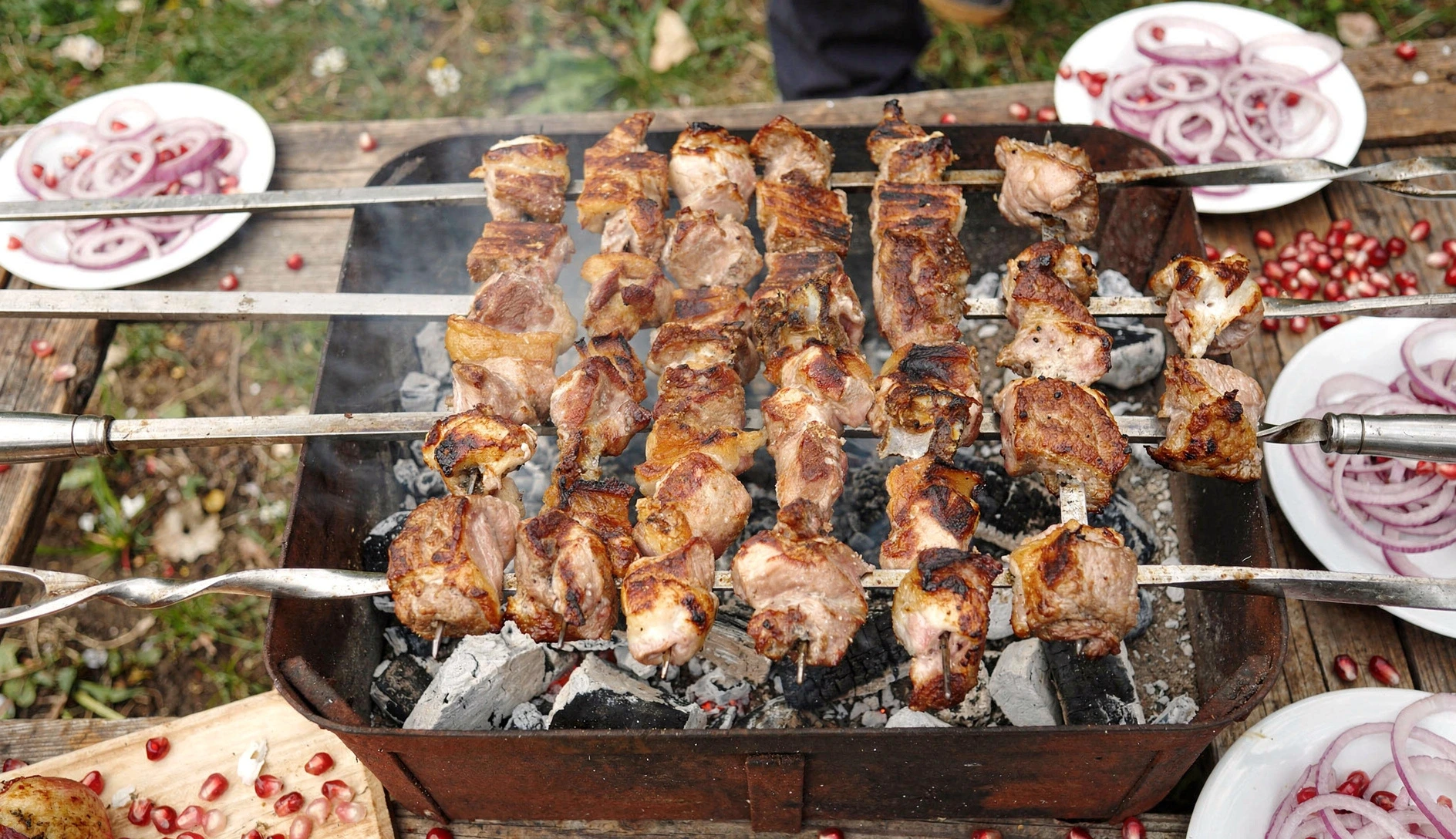
Mtsvadi is not a recipe. It's a ritual. In Georgia, grilling meat over coals isn't something you do on a Tuesday because you feel like barbecue — it's the centerpiece of every gathering worth attending. Birthdays, funerals, harvest time, the first warm Saturday in spring, the excuse you invented to drink wine with your neighbors. The mangal goes out, the coals get lit, and someone — usually the most opinionated man within a fifty-meter radius — takes charge of the meat. The technique is absurdly simple. The results, when done right, are the best grilled pork you will ever eat.
Mtsvadi Quick Facts
- Georgian name: მწვადი (mts-VAH-dee)
- Also known as: Shashlik (Russian name, same technique)
- Origin: Universal across Georgia — not regional, just Georgian
- Key ingredients: Pork shoulder, onions, salt, pomegranate juice
- Prep + cook time: 20 min active, 3-5 hours marinating, 20 min grilling
- Cost in Georgia: 14–22 GEL per skewer in restaurants (~$5–8 USD)
- Difficulty: Easy — the fire is the only tricky part
Why Mtsvadi Matters
Every country has grilled meat. Georgia has mtsvadi, and the difference is philosophical. American BBQ is about smoke and time and rubs. Argentinian asado is about whole sides of beef and patience. Georgian mtsvadi is about pork, fire, and the conviction that the meat should taste like meat — not like a spice rack.
The marinade is onion and salt. That's it. No soy sauce, no Worcestershire, no "secret blend." Georgians consider marinating pork in anything elaborate an admission that you bought bad pork. The onion releases juice as it sits with the meat, tenderizing it gently while adding sweetness. The salt does what salt does. Everything else — the char, the smoke, the pomegranate finish — comes from technique and timing.
At every supra (feast), mtsvadi arrives hot off the grill, usually carried to the table by the grillmaster with unmistakable pride. It's eaten immediately — mtsvadi that sits for ten minutes is mtsvadi that's already diminished. You pull pieces off the skewer onto lavash bread, pile on the pomegranate-soaked onions, tear some herbs over it, and eat with your hands. Wine is mandatory.
The Pork: Getting It Right
This is where most non-Georgian recipes fail. They call for "pork loin" or "tenderloin" because those sound premium. They are wrong. You want pork shoulder — specifically, the well-marbled, collagen-rich part that's cheap in every butcher shop in the world. Bone-in is even better because you'll get more flavor from the pieces near the bone.
In Georgia, the best mtsvadi includes pieces of pork tail fat (კუდის ქონი, kudis koni) threaded between the meat chunks. These melt over the coals, basting the meat in rendered fat as they cook. If your butcher has pork back fat or belly, cut it into 2cm cubes and alternate it with the shoulder chunks. It's not optional in the traditional version — it's the reason the meat stays juicy.
Cut the pork into generous chunks — 4 to 5 centimeters on each side. Not cubes necessarily, but big enough that the exterior chars while the inside stays pink and juicy. Too small and you get dried-out meat. Too big and the center will be raw when the outside burns. This is the single most important knife decision you'll make.
The Fat Rule
Don't trim the fat. Seriously. Every piece of pork should have at least some fat attached. In Georgia, a skewer of lean pork is considered a cooking error, not a health choice. The fat renders over the coals, creating flare-ups that char the surface while the fat bastes the meat from within. If someone tells you to trim it, they don't understand mtsvadi.
Ingredients
This recipe serves 6 people with generous portions — about 2 skewers per person. Scale up freely; mtsvadi is almost always made in large quantities.
| Ingredient | Amount | Notes |
|---|---|---|
| Pork shoulder | 2 kg | Bone-in preferred, well-marbled. Don't trim the fat. |
| White onions | 4 large | 2 for marinade, 2 for the pomegranate side |
| Coarse salt | 1 tablespoon | Kosher or sea salt — never table salt |
| Black pepper | 1 teaspoon | Freshly cracked, coarse grind |
| Pomegranates | 2–3 large | For juice and seeds. Bottled juice works in a pinch. |
| Pork tail fat (optional) | 200–300g | Traditional. Melts and bastes the meat. Pork belly works too. |
| Fresh herbs | 1 large bunch | Flat-leaf parsley, cilantro, basil — whatever's fresh |
| Lavash or shotis puri | For serving | Any good flatbread works |
What NOT to Add
No vinegar, no wine, no lemon juice, no soy sauce, no garlic, no paprika, no cumin. Georgian mtsvadi is not a kebab and not a shish. The marinade is onion juice and salt — anything else means your pork isn't good enough to stand on its own. If you feel the urge to add Worcestershire sauce, buy better pork instead.
Equipment
The Mangal (მანგალი)
A simple metal trough for charcoal, with notches to rest skewers across the top. Every Georgian household owns one. You can use any charcoal grill — Weber, kamado, even a disposable — but the key is direct heat over coals, not gas. Gas grills don't produce the flare-ups you need for proper char.
Flat Metal Skewers
Wide, flat, stainless steel skewers — not round bamboo sticks. Flat skewers keep the meat from spinning when you turn them. About 40–50cm long and 1cm wide. Cheap and available at any bazaar in Georgia. Amazon sells them as "Turkish kebab skewers."
Step 1: The Marinade
Cut the pork shoulder off the bone (save the bone for stock) and into 4–5cm chunks. Leave the fat. Slice two of the onions into thin rings — you want them thin enough to release their juice.
In a large bowl, alternate layers of pork and onion rings. Season each layer with salt and pepper as you go. When everything is layered, press down firmly with your hands — you want the onion in full contact with the meat, releasing juice. Some Georgian cooks squeeze the onion into the pork by hand, almost kneading it.
Cover with a plate (not plastic wrap — you want the plate to press down on the meat) and refrigerate. Minimum 3 hours. Overnight is better. The onion juice tenderizes the pork and the salt pulls moisture to the surface, which will help with charring.
When you're ready to grill, pull the meat from the fridge 30 minutes before cooking. Cold meat on hot coals cooks unevenly.
Step 2: The Fire
This is where most people ruin mtsvadi, and it has nothing to do with the meat. The fire is everything.
Build your charcoal fire 30–45 minutes before you plan to grill. You need white-hot coals with no visible flames. If you see flames, you're not ready. Flames mean uneven heat and soot on the meat. You want radiant heat from coals that have a uniform white-gray ash coating.
In Georgia, the gold standard is grape vine cuttings (ვაზის შეშა) instead of charcoal briquettes. Vine prunings burn hot and fast, producing intense heat with a subtle smoky sweetness that's impossible to replicate. If you have access to any fruit wood — grape, cherry, apple — mix it with your charcoal. Hardwood lump charcoal is the next best option. Briquettes are acceptable. Lighter fluid is never acceptable.
Vine Cuttings: The Secret Weapon
In wine country — Kakheti especially — mtsvadi is always grilled over dried grape vine cuttings. Every vineyard produces prunings in late winter, and families stockpile them for grilling season. The vine burns intensely hot but briefly, so the technique is different: you build a larger fire, let it collapse to coals, and grill quickly. If you grow grapes, save your cuttings. If you don't, any fruit wood adds a similar dimension.
Step 3: Threading the Skewers
Remove the meat from the marinade. Discard the onions — they've done their job. Thread the pork onto flat metal skewers, packing the pieces snugly together so they're touching but not compressed. If you're using tail fat or belly fat, thread a piece between every 2–3 chunks of meat.
Each skewer should hold 5–7 pieces. Leave about 5cm empty at each end for handling. Don't overload them — a crowded skewer steams instead of grilling.
Pat the skewered meat dry with a paper towel. Wet meat steams. Dry meat chars. This matters more than you think.
Step 4: Grilling
Set the skewers across the mangal, about 7–10cm above the coals. Close enough for intense heat, far enough that the fat drips cause flare-ups without incinerating the meat. The flare-ups are part of the process — they char the surface in bursts, creating that distinctive smoky crust.
Turn the skewers every 3–4 minutes. Don't fidget with them constantly — let each side develop real color before rotating. You're looking for a deep brown-black crust with visible char marks, not pale gray meat that's been anxiously flipped every 30 seconds.
Total cook time is 15–25 minutes, depending on the size of your chunks and the heat of your coals. The meat is done when the exterior is well-charred and the interior is just past pink — slightly rosy at the center is perfect. Georgians cook mtsvadi more thoroughly than a Western medium-rare, but never to dry, gray well-done.
| Visual Cue | What It Means | Action |
|---|---|---|
| Fat is dripping, causing flare-ups | Fat is rendering properly | Good — let it happen, but rotate to avoid burning one spot |
| Deep brown crust forming | Maillard reaction in full swing | Turn to the next side |
| Meat feels firm but springs back | Medium to medium-well — Georgian sweet spot | Pull it off now |
| Juice runs clear when pressed | Fully cooked | Remove immediately — another minute means dry meat |
| Meat is blackened and rigid | Overcooked | Too late. More pomegranate juice helps, but start practicing. |
Step 5: The Pomegranate-Onion Side
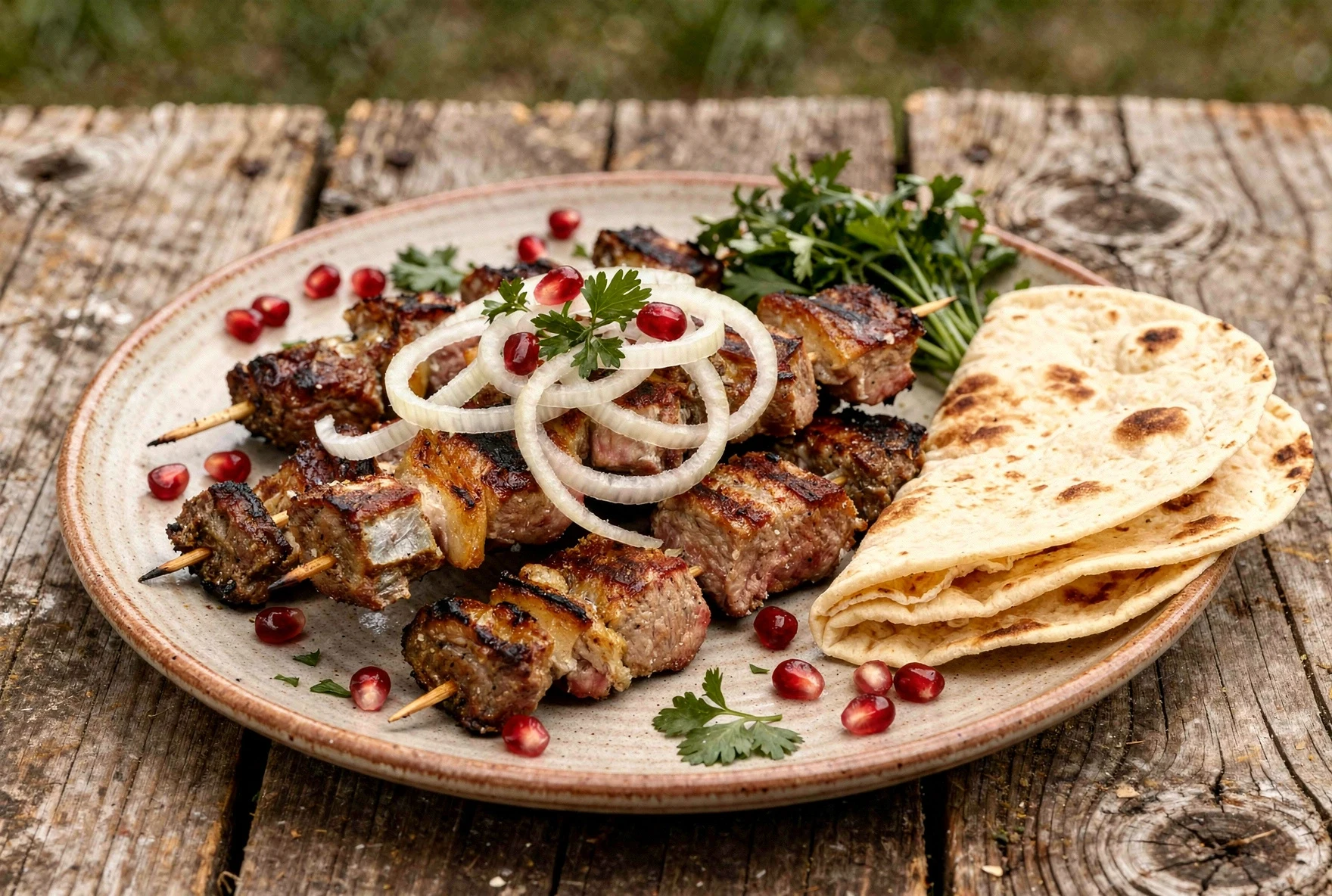
While the meat grills, prepare the most important condiment in Georgian BBQ. This isn't a garnish — it's a co-star. Every bite of mtsvadi should include a forkful of these onions.
Slice the remaining two onions into thin half-moons. Halve the pomegranates and juice them directly over the onions — you want both the juice and the seeds that fall out. Add a generous pinch of salt and toss with your hands. Tear fresh parsley and cilantro over the top.
The pomegranate juice turns the onions a beautiful pink-red, softens their raw bite, and adds a tart sweetness that cuts through the rich pork fat. This combination — charred fatty pork, sharp sweet onions, sour pomegranate — is one of the greatest flavor combinations in all of grilling. It doesn't need improvement.
The Tkemali Option
Some Georgians serve mtsvadi with tkemali (sour plum sauce) instead of or alongside the pomegranate onions. The two are not interchangeable — tkemali is tangy and herbal, while pomegranate is sweet-tart and fruity. If you have both, put both on the table. But if you're making one, the pomegranate onions are the more traditional mtsvadi companion.
How to Serve
Mtsvadi is served immediately. Not in five minutes. Not after the salad is ready. Now. The moment the skewers come off the fire, they go to the table.
The traditional method: lay a sheet of lavash bread on the plate, slide the meat off the skewer onto the bread (use another piece of bread to grip and push), pile the pomegranate onions on top. The bread soaks up the juices and becomes part of the meal.
At the table, you should also have:
| Side | Why |
|---|---|
| Lavash or shotis puri | Wraps the meat, soaks up juices — non-negotiable |
| Fresh herb platter | Whole sprigs of cilantro, parsley, basil, tarragon — eaten by the handful |
| Sliced tomatoes and cucumbers | The Georgian equivalent of a side salad — simple, ripe, salted |
| Tkemali (sour plum sauce) | The acidity cuts through the fat |
| Dry red or amber wine | Saperavi is the classic pairing — tannic enough to handle the char |
| Adjika (optional) | Hot pepper paste for those who want heat |
Variations
Pork shoulder is the default mtsvadi, but it's not the only version you'll encounter in Georgia.
| Variation | Meat | Notes |
|---|---|---|
| Classic mtsvadi | Pork shoulder | The standard. What people mean when they say mtsvadi. |
| Lamb mtsvadi | Leg or shoulder of lamb | Common in eastern Georgia (Kakheti) and mountains. Stronger flavor. |
| Veal mtsvadi | Veal shoulder | Delicate, lean — needs more fat threaded alongside. Restaurant favorite. |
| Chicken mtsvadi | Bone-in thighs or whole spatchcocked | Lighter option. Often butterflied and grilled flat, not skewered. |
| Kupati (sausage) | Spiced pork sausage | Not technically mtsvadi but always grilled alongside it. Spicier. |
| Abkhazura | Spiced meatballs | Walnut-studded meat patties, often grilled on the same mangal. |
Common Mistakes
Grilling over flames
Flames mean your coals aren't ready. You get soot and uneven cooking. Wait for white-hot coals with no visible fire. Patience is the hardest ingredient.
Cutting meat too small
Small cubes dry out fast. You need 4–5cm chunks minimum so the exterior can char while the interior stays juicy. Bigger is almost always better.
Using lean meat
Pork loin, tenderloin, or trimmed shoulder produces dry, disappointing mtsvadi. You need the fat. It renders, bastes, and keeps everything moist.
Over-marinating with acid
Wine, vinegar, or citrus marinades break down the meat's texture, making it mushy. Onion and salt is all you need. Trust the simplicity.
Letting it rest too long
Unlike a steak, mtsvadi doesn't benefit from resting. The thin char cools fast and the meat stiffens. Serve it the second it leaves the coals.
Skipping the pomegranate onions
Mtsvadi without the pomegranate-onion side is like a burger without a bun. The acidity and crunch are what make the whole thing work.
Pro Tips
The Onion Fan
Georgian grillmasters fan the coals with a piece of cardboard or a newspaper to control heat. A burst of air raises the coal temperature for a final sear. Some use half an onion on a fork to baste the skewers while fanning — the dripping onion juice creates aromatic smoke.
Two-Zone Fire
Push coals to one side for intense direct heat, leave the other side cooler. Start skewers over high heat for char, move to the cooler side if they're browning too fast. This gives you control without lifting skewers off the grill.
The Bread Test
Not sure if coals are ready? Hold your hand 10cm above them. If you can hold it for 2 seconds before pulling away, you're at the right temperature. One second = too hot. Three seconds = not ready yet.
Night Before Marinade
The overnight marinade makes a real difference. The onion enzymes have time to fully break down the connective tissue, and the salt penetrates deeper. Morning prep for evening grilling is the Georgian way.
Where to Eat Mtsvadi in Georgia
Mtsvadi is everywhere — every restaurant, every roadside stop, every family gathering. But some places do it notably well.
| Place | Location | Why Go | Price |
|---|---|---|---|
| Shavi Lomi | Tbilisi | Modern Georgian take, excellent pork quality | 18–22 GEL |
| Roadside mangals (Gombori Pass) | Kakheti highway | Grilled to order over vine cuttings. The real deal. | 12–16 GEL |
| Tsiskvili | Tbilisi (chain) | Consistent, generous portions, outdoor seating with mangal view | 14–18 GEL |
| Any village supra | Everywhere | The best mtsvadi is never in a restaurant. Get invited to a family gathering. | Free (bring wine) |
Nutrition
| Nutrient | Amount |
|---|---|
| Carbohydrates | 6g (from onions and pomegranate) |
| Saturated fat | 10g |
| Sodium | 580mg |
| Iron | 2.8mg (16% DV) |
Storage
Refrigerator
Leftover mtsvadi keeps 3–4 days in an airtight container. Reheat in a hot skillet (not the microwave — you'll lose the char). Add a squeeze of pomegranate juice to refresh it.
Freezer
Cooked mtsvadi freezes well for up to 3 months. Thaw overnight in the fridge, then reheat in a hot skillet. The texture won't be as good as fresh, but it's still respectable.
Marinated (raw)
Pork in the onion marinade keeps 2 days in the fridge. Longer marination actually improves the result — the meat becomes more tender and flavorful.
The Pomegranate Onions
Make these fresh every time. They don't store well — the onions get waterlogged and the pomegranate loses its brightness. Takes 5 minutes.
Frequently Asked Questions
Can I make mtsvadi in the oven or on a gas grill?
You can, but it won't be mtsvadi. The whole point is charcoal — the flare-ups, the smoke, the uneven char. An oven broiler gets you close on the char, but you lose the smoke entirely. A gas grill is better than an oven but still lacks the character of real coals. If charcoal isn't an option, use the highest heat your gas grill produces and add soaked wood chips for smoke.
What's the difference between mtsvadi and shashlik?
The words describe the same technique — meat on skewers over coals. "Shashlik" is the Russian term used across the former Soviet Union. "Mtsvadi" is the Georgian word. The Georgian version tends to be simpler (onion-salt marinade vs the vinegar or wine marinades common in Russian shashlik) and always includes the pomegranate-onion accompaniment.
No pomegranates available — what's the substitute?
Pomegranate molasses diluted with a little water works well. Pure pomegranate juice from the store is acceptable (make sure it's 100% juice, not cocktail). In a real pinch, sumac-dusted onions with a squeeze of lemon captures a similar sweet-tart profile, though it's not the same.
How much meat per person?
Plan 300–350g of raw pork per person (it shrinks about 25% during cooking). In Georgia, that's roughly 2 skewers per person, but at a supra with many other dishes, 1–2 skewers is plenty.
Can I marinate with wine instead of onions?
You can, but a Georgian would tell you that you're making shashlik, not mtsvadi. Wine marinades are more common in Russian and Armenian traditions. The Georgian approach insists on onion-and-salt simplicity. If your pork is good enough, it doesn't need wine. If it's not, wine won't save it.
Written by The Georgian Eats Team
We've stood around more mangals than we can count, argued about coal temperature with opinionated uncles, and eaten mtsvadi on every highway stop between Tbilisi and Telavi. This recipe comes from years of watching, eating, and occasionally being told we're doing it wrong.
Last updated: February 2026.
Related Articles
Tkemali: Georgia's Sour Plum Sauce
The tangy condiment that belongs next to every plate of mtsvadi.
Adjarian Khachapuri
The cheese bread boat that starts (or ends) every Georgian feast.
The Georgian Supra
Understanding the feast where mtsvadi takes center stage.
Georgian Grape Varieties
Why Saperavi is the perfect wine for grilled pork.