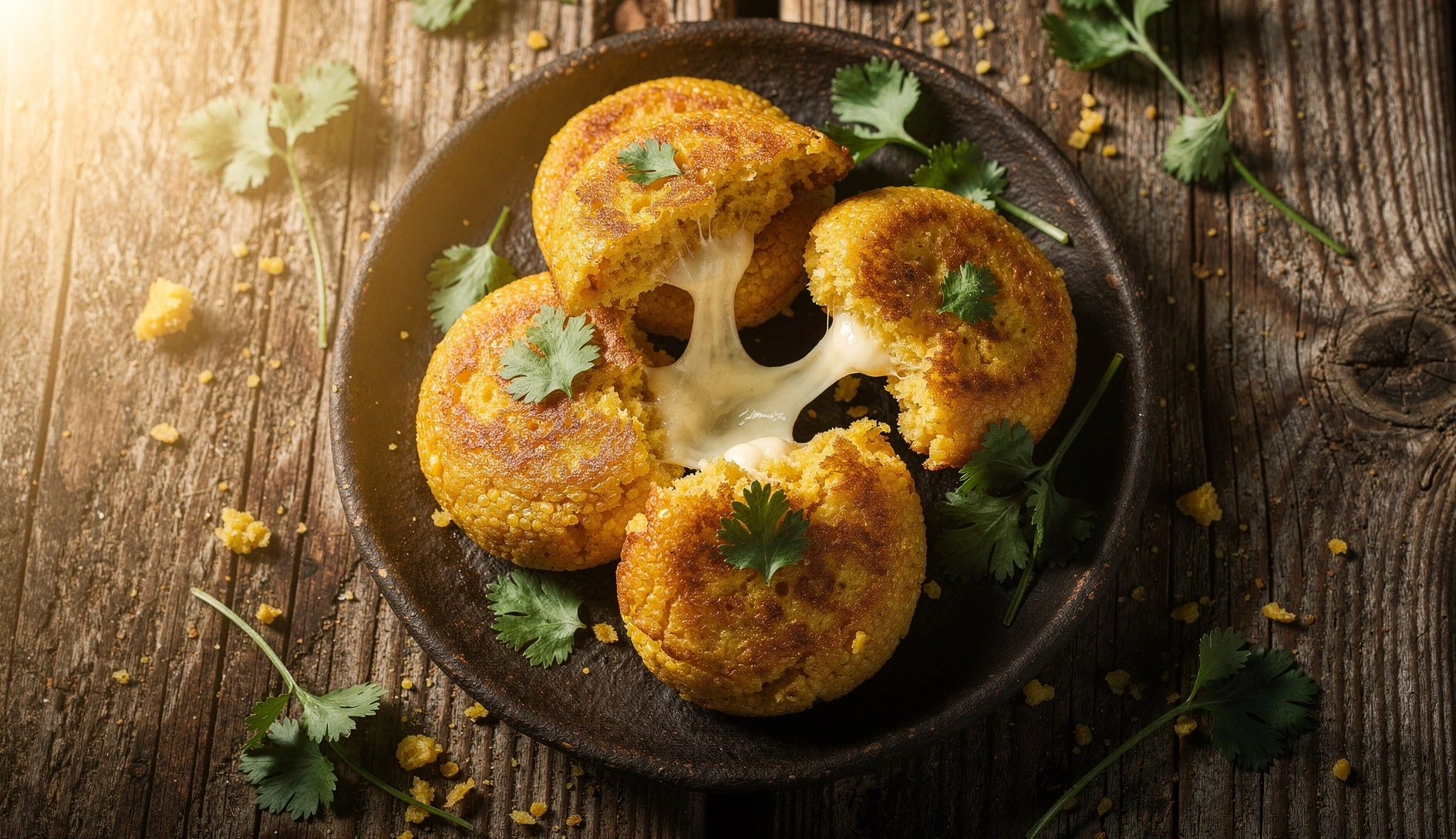
If mchadi is Georgia's plain cornbread, chvishtari is its indulgent Svan cousin — same cornmeal base, but packed with so much sulguni cheese that it melts and stretches when you tear one open. These come from Svaneti, the remote mountain region in northwestern Georgia where people have been making cornbread this way for centuries. The idea is dead simple: mix cheese into cornmeal dough, shape into patties, fry until the outside is crispy and the inside is a molten cheese situation. Six ingredients. Thirty minutes. The kind of food that makes you wonder why you'd ever bother with anything more complicated.
Chvishtari Quick Facts
- Georgian name: ჩვიშტარი (chvish-TAH-ree)
- Origin: Svaneti (northwestern Georgian highlands)
- Key ingredients: Cornmeal + sulguni cheese
- Prep time: 15 minutes
- Cook time: 12–15 minutes
- Makes: 6–8 pieces
- Cost in Georgia: 2–3 GEL per piece (~$0.80)
- Naturally gluten-free: Yes (cornmeal base)
- Related to: Mchadi (without cheese), Elarji (stirred, not fried)
Chvishtari vs. Mchadi: What's the Difference?
If you already know mchadi, you're 80% of the way to understanding chvishtari. Both are cornbread. Both are pan-fried. Both use stone-ground white cornmeal as the base. The difference is that mchadi is a pure, austere thing — cornmeal, water, salt — while chvishtari takes that same concept and stuffs it with sulguni cheese, adds eggs and milk for richness, and becomes something closer to a cheese-filled corn fritter.
Mchadi is from western Georgia broadly — Imereti, Samegrelo, everywhere. Chvishtari belongs specifically to Svaneti, though you'll find it on restaurant menus across the country now. In Svaneti, chvishtari was (and is) a practical mountain food: cornmeal grows well at altitude, cheese is everywhere because every family keeps cows, and when you combine them you get something calorie-dense enough to fuel a day of herding livestock through mountain passes.
| Feature | Mchadi | Chvishtari |
|---|---|---|
| Origin | Western Georgia (Imereti, Samegrelo) | Svaneti |
| Cheese | None (served alongside) | Mixed into the dough (lots) |
| Eggs | Never | Usually 1–2 |
| Liquid | Water only | Milk or water |
| Texture | Dense, crumbly, austere | Richer, cheese-stretchy inside |
| Vegan | Yes | No |
| Diet | Fasting food | Non-fasting |
There's also elarji from Samegrelo — another cornmeal-and-cheese combination, but stirred on the stove rather than shaped and fried. Think of it as a spectrum: mchadi is the ascetic monk, elarji is the flamboyant cousin, and chvishtari sits in the comfortable middle.
Ingredients
| Ingredient | Amount | Notes |
|---|---|---|
| Stone-ground white cornmeal | 400g | Coarse polenta works; avoid fine-ground corn flour |
| Sulguni cheese | 300g | Diced or shredded into 1–2cm chunks |
| Eggs | 2 large | Bind the dough; some recipes skip these |
| Warm milk | ~350ml | Or warm water — milk adds richness |
| Salt | ½ tsp | Only if your cheese isn't salty — taste first |
| Vegetable oil | For frying | Sunflower or any neutral oil, 4–5mm in pan |
The Cheese Situation
The cheese is the point. In Svaneti, it's always sulguni — the elastic, salty Georgian cheese that melts into stretchy strands. The ratio matters: 300g of cheese to 400g of cornmeal means nearly equal parts. This isn't cornbread with a little cheese mixed in. This is cheese held together by cornbread.
If you can't get sulguni, your best substitute is low-moisture mozzarella. It has the same stretchy melt quality without the saltiness, so you'll want to add a bit more salt. Fresh mozzarella is too wet — it'll make the dough soggy. Feta works in a pinch for flavor but crumbles rather than stretches, so you lose the cheese-pull experience. Halloumi gives you the salt but doesn't melt at all.
| Cheese | Melt | Stretch | Salt | Verdict |
|---|---|---|---|---|
| Sulguni | Great | Excellent | Medium-high | The real deal |
| Low-moisture mozzarella | Great | Excellent | Low | Best substitute — add salt |
| Fresh mozzarella | Good | Good | Low | Too wet — makes dough soggy |
| Feta | Crumbles | None | High | Good flavor, wrong texture |
| Halloumi | Minimal | None | High | Stays as chunks — not ideal |
For more on Georgian cheeses and where to find them, see our complete Georgian cheese guide.
How to Cut the Cheese
Dice sulguni into roughly 1–2cm chunks, or shred it coarsely on a box grater. Don't crumble or mash it — you want distinct pieces that melt into pockets inside the cornbread. Each chvishtari should have 5–6 visible cheese chunks when you shape it.
Choosing Cornmeal
The same cornmeal rules apply here as with mchadi: you want stone-ground, coarse white cornmeal. In Georgia this is sold everywhere as სიმინდის ფქვილი. Outside Georgia, look for coarse white polenta — Bob's Red Mill "Corn Grits" or Italian polenta bramata both work. The key word is coarse. Fine corn flour (like masa harina or cornstarch) won't give you the right texture — you'll end up with something gummy instead of that satisfying gritty-crisp bite.
Yellow cornmeal works but isn't traditional — white is standard in western Georgian cooking. The flavor difference is minimal; the color just looks different.
Step-by-Step Instructions
Step 1: Prepare the Cheese
Dice or coarsely shred 300g of sulguni. Set aside. If your sulguni is the brined kind (sitting in liquid), drain it well and pat dry with paper towels — excess moisture will make your dough too wet.
Step 2: Mix the Dough
In a large bowl, combine 400g cornmeal with salt (if using). Crack in 2 eggs. Add warm milk (not hot — you don't want to cook the eggs) gradually, mixing with your hands or a wooden spoon. The dough should come together into a thick, slightly sticky mass — wetter than mchadi dough, more like thick cookie dough. If it's crumbly, add more milk a tablespoon at a time. If it's running through your fingers, you've added too much — sprinkle in more cornmeal.
Step 3: Add the Cheese
Fold in the cheese chunks. Don't knead aggressively — you want the cheese distributed evenly but still in distinct pieces. Think of it like folding chocolate chips into cookie dough: gentle, purposeful, don't crush them.
Step 4: Shape
Wet your hands (this prevents sticking) and take a portion about the size of a tennis ball. Shape it into an oval patty, roughly 10cm long, 7cm wide, and 2cm thick. The thickness matters — too thin and the cheese escapes during frying, too thick and the center stays raw while the outside burns. Aim for that 2cm sweet spot.
As you shape each one, make sure you can feel cheese chunks throughout. If you grabbed a cheese-free section of dough, redistribute. Each chvishtari should have 5–6 pieces inside.
Step 5: Fry
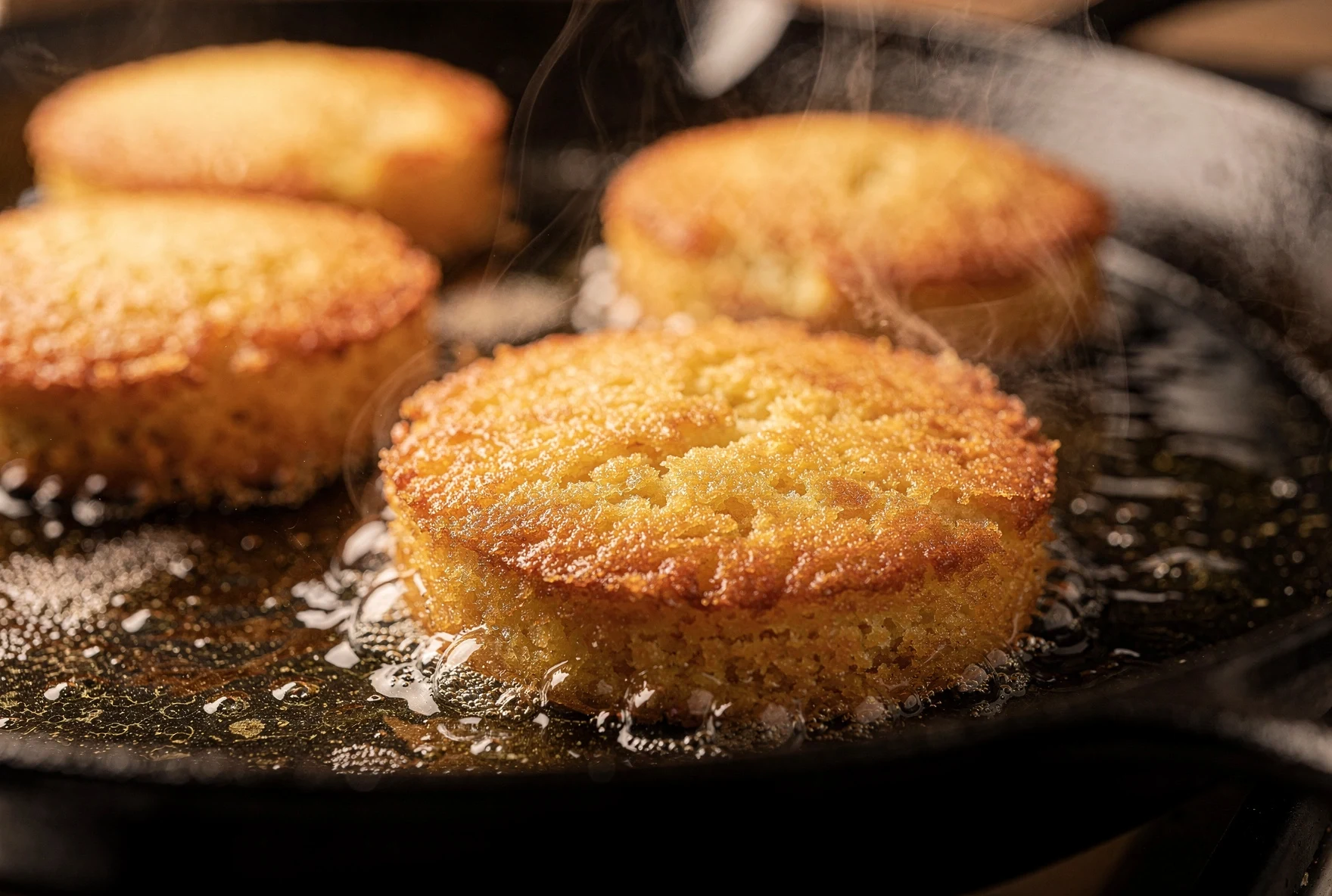
Heat 4–5mm of vegetable oil in a heavy skillet (cast iron is ideal) over medium heat. The oil should shimmer but not smoke. Place chvishtari in the pan — don't crowd them, leave at least 2cm between each one.
Reduce heat to medium-low, cover the pan, and cook for 5–6 minutes. The cover is important: it traps steam, which helps cook the thick center while the bottom crisps up. After 5–6 minutes, the bottom should be deep golden brown.
Flip carefully with a spatula — they're fragile when the cheese is molten. Cook uncovered for another 5–6 minutes. You'll know they're done when both sides are golden-brown and you can see cheese just starting to bubble at the edges.
Step 6: Serve Immediately
Chvishtari have a 5-minute window of perfection. Hot from the pan, the outside is shatteringly crispy, the inside is tender corn with pockets of molten, stretchy cheese. After 10 minutes, the cheese firms up and the magic fades. After 20, you're eating cold corn hockey pucks. Make them, eat them, don't wait.
Visual Doneness Cues
Deep golden-brown on both sides (not pale yellow — that's underdone). Cheese possibly bubbling or oozing at the edges. Surface feels firm when tapped, not squishy. A toothpick into the center comes out with melted cheese clinging to it, not wet dough.
Variations
Classic Svan (Simplest)
Just cornmeal, cheese, and water. No eggs, no milk. The most traditional version — austere and pure. Crumblier texture but maximum corn-cheese contrast.
With Matsoni
Replace milk with matsoni (Georgian yogurt). Adds tanginess and a slightly softer crumb. Some Megrelian versions do this. Works well with regular yogurt too.
Baked Version
Shape and bake at 200°C (390°F) for 20–25 minutes instead of frying. Less crispy, less oil, arguably healthier. Not traditional but common in modern Georgian cooking.
Megrelian Style
In Samegrelo, they make a similar version but use even more cheese (nearly 1:1 ratio) and sometimes mix in corn kernels for extra texture. Practically elarji's crispy cousin.
Tips That Actually Matter
🌡️ Temperature Control
Medium-low is non-negotiable. Too high and the outside burns before the inside cooks. You're not stir-frying — this is a gentle, patient fry.
💧 Wet Hands
Keep a bowl of water nearby. Wet your hands before shaping each one. Cornmeal dough is sticky and will cling to dry hands like concrete.
🧊 Don't Pre-Shape
Shape each chvishtari right before it goes in the pan. If they sit around, the dough absorbs moisture from the cheese and gets soggy.
🔄 One Flip Only
Resist the urge to fiddle. One flip, that's it. Every extra flip risks breaking the crust and letting cheese escape. Trust the process.
🧀 Salt Check
Taste your cheese before salting the dough. Brined sulguni can be very salty — you might not need extra salt at all. Better undersalted than oversalted.
🍳 Cast Iron
A heavy cast iron skillet holds heat evenly and gives the best crust. Non-stick works but won't give you the same golden crispness.
Common Mistakes
❌ Too Thin
Making them like pancakes. Chvishtari need to be 2cm thick so the cheese has somewhere to melt into. Thin ones are just crispy cornmeal with cheese that's already escaped.
❌ Too Hot
Cranking the heat to speed things up. You'll get black outside, raw inside. Medium-low, covered, patience. The cover does the work.
❌ Wrong Cornmeal
Using fine corn flour or masa harina instead of coarse cornmeal. The texture will be gummy and dense rather than gritty and satisfying.
❌ Mashing the Cheese
Overworking the dough until the cheese becomes a paste. Fold gently — you want distinct pockets of melted cheese, not uniform cheesiness.
❌ Letting Them Cool
Waiting for everyone to sit down before serving. Chvishtari are a "come to the stove" food. The cheese solidifies fast and the crust softens.
❌ Too Much Liquid
Dumping in all the milk at once. Add gradually — you might need less than 350ml depending on your cornmeal. The dough should hold shape, not pour.
What to Serve with Chvishtari
In Svaneti, chvishtari are typically eaten on their own or with a simple accompaniment. They're rich enough that they don't need much. That said, here are the traditional pairings:
| Pairing | Why It Works |
|---|---|
| Lobio (bean stew) | The classic. Smoky beans cut through the richness of all that cheese and butter. |
| Tkemali sauce | Sour plum cuts fat. A tablespoon on the side is the move. |
| Fresh herbs | Tarragon, cilantro, basil. The bitterness and freshness balance the heavy corn-cheese. |
| Matsoni (yogurt) | A bowl of cold matsoni alongside hot chvishtari. The temperature and flavor contrast is perfect. |
| Pickled vegetables | Jonjoli, pickled peppers, or any Georgian pickles. Acidity and crunch against rich, soft bread. |
The Svaneti Connection
Svaneti is Georgia's wildest, most remote region — medieval stone towers, glaciers, villages that until recently were snowed in for half the year. The food reflects this isolation: calorie-dense, preserved-cheese-heavy, built for survival. Chvishtari fits perfectly into this context.
Corn arrived in Georgia from the Americas in the 17th century and quickly became the dominant grain in western Georgia, where the climate was too wet for wheat. In Svaneti, where growing anything at 2,000+ meters is a challenge, corn adapted well. Combined with the ubiquitous sulguni (every Svan family made — and still makes — their own cheese), chvishtari became a staple: a one-item meal that provides carbs, fat, and protein from two ingredients you could produce entirely at home.
Today you'll find chvishtari on restaurant menus across Georgia, but the best ones are still in Svaneti itself — in Mestia and Ushguli guesthouses where someone's grandmother makes them fresh from her own cornmeal and her own cheese.
Nutrition
Let's be honest: chvishtari are not diet food. Between the cheese, eggs, oil for frying, and cornmeal, you're looking at a solid 280 calories per piece. But they're also genuinely filling — two chvishtari with some lobio on the side and you're done for hours. The protein from the cheese and eggs gives them more staying power than plain cornbread. And they're naturally gluten-free, which makes them one of the few traditional Georgian foods that works for celiac diets without any modification at all.
Frequently Asked Questions
Can I bake them instead of frying?
Yes. 200°C (390°F) for 20–25 minutes on a parchment-lined baking sheet. Brush with a little oil for color. They won't be as crispy but they'll still be good.
Can I make them ahead?
You can shape them and refrigerate for up to 2 hours. But fry just before serving — reheated chvishtari lose their soul. If you must, reheat in a dry skillet, not the microwave.
Are they really gluten-free?
Yes, as long as your cornmeal isn't cross-contaminated with wheat (check the label). Cornmeal is naturally gluten-free and sulguni cheese contains no gluten.
Can I freeze them?
You can freeze the uncooked shaped patties. Lay them on a baking sheet, freeze until solid, then bag them. Fry from frozen — add a couple extra minutes per side.
Why does my dough fall apart?
Not enough liquid, or your cornmeal is too coarse. Add milk a tablespoon at a time until the dough holds when squeezed. The eggs also help bind — don't skip them.
Written by The Georgian Eats Team
We've eaten our way through Svaneti's guesthouses and Tbilisi's western Georgian restaurants, and chvishtari remains one of those dishes that never gets old. The best version we've had was in a Mestia guesthouse — made with cornmeal ground that morning and cheese from the cow in the yard.
Last updated: February 2026.
Related Articles
Mchadi: Georgia's Golden Cornbread
The plain version — just cornmeal, water, and salt.
Elarji: Stretchy Cheesy Cornmeal
Samegrelo's other corn-and-cheese masterpiece — stirred, not fried.
The Complete Georgian Cheese Guide
Everything about sulguni, Imeretian, and the rest.
Lobio: Georgia's Smoky Bean Stew
The perfect partner for any Georgian cornbread.