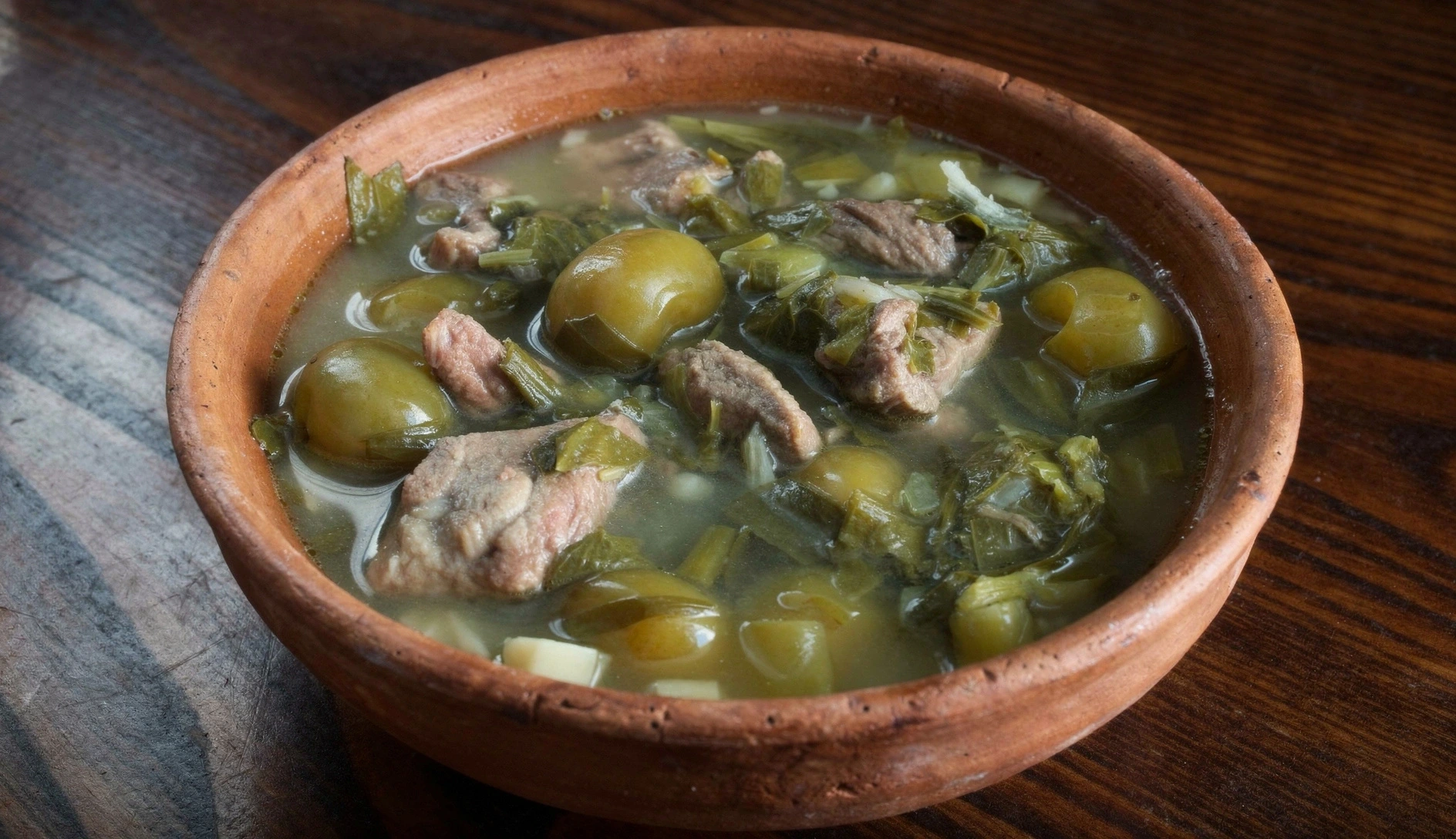
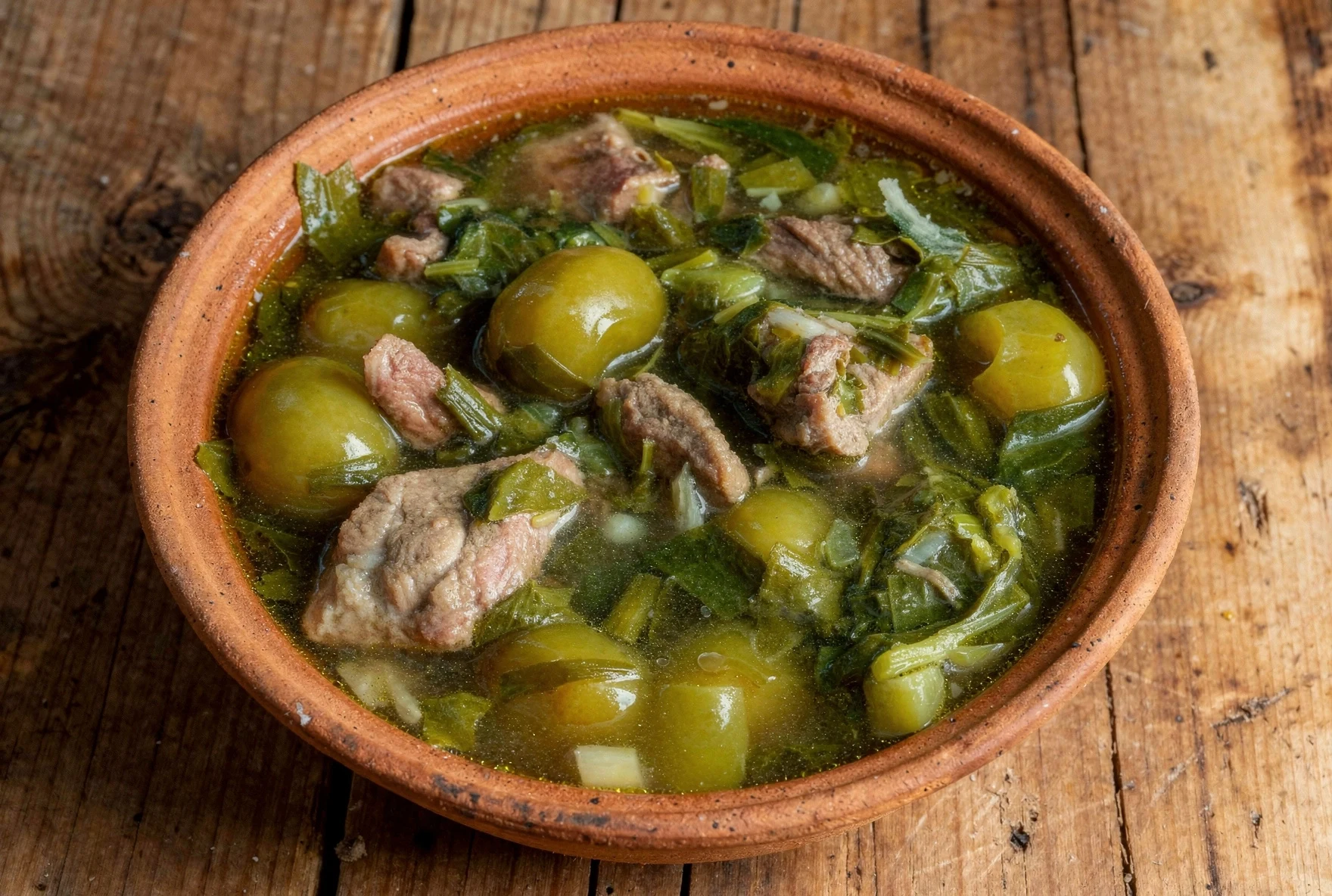
Chakapuli is the dish Georgians wait all year for. When spring arrives and the first shoots of tarragon push through the soil, when the plum trees are heavy with hard green fruit too sour to eat raw — that's when chakapuli season begins. It's lamb simmered low and slow with white wine, a mountain of fresh tarragon, unripe sour plums, and whatever green herbs the garden offers. The result is a stew that tastes nothing like the heavy, brown braises you know. It's bright. It's tart. It's herbaceous in a way that makes you wonder why every stew recipe on earth doesn't call for a full bunch of tarragon.
Chakapuli Quick Facts
- Georgian name: ჩაქაფული (cha-ka-POO-lee)
- Origin: Eastern Georgia, traditionally an Easter dish
- Key ingredients: Lamb, tarragon, unripe plums (tkemali), white wine
- Season: Spring (April–June), when tarragon and green plums are available
- Prep + cook time: 20 min prep, 2 hours cooking
- Cost in Georgia: 15–25 GEL in restaurants (~$5.50–9 USD)
- Difficulty: Easy — patience matters more than technique
Why This Dish Matters
In a cuisine packed with stews — kharcho, chanakhi, ostri, chashushuli — chakapuli stands alone. It's the one that announces the season. While most Georgian stews are rich and warming, built for cold months, chakapuli is the opposite. It's a celebration of green things. Of sourness and freshness. Of the moment when winter finally loses its grip and the Caucasus mountains start turning emerald again.
The timing is everything. Chakapuli is Easter food, and Georgian Easter usually falls in April or May. That's exactly when tarragon is young and tender, when the plum trees have set their tiny, marble-hard fruit, and when spring onions are at their best. Making chakapuli in December with dried tarragon and bottled tkemali sauce is technically possible, but it misses the point entirely — like making a caprese salad with January tomatoes.
What makes chakapuli unusual compared to Western stews is the cooking method. There's no browning, no mirepoix, no building layers of fond. Everything goes in the pot together and simmers until the lamb is falling off the bone and the herbs have melted into a bright, fragrant broth. The sourness from the plums cuts through the lamb fat in a way that feels almost medicinal — in the best sense.
Ingredients
Serves 4–6. The ingredient list is deceptively long, but most of it is fresh herbs that get roughly chopped and thrown in. Don't stress about exact herb ratios — the tarragon and plums are the stars, everything else is supporting cast.
| Ingredient | Amount | Notes |
|---|---|---|
| Lamb shoulder or chops | 1 kg (2.2 lbs) | Bone-in, cut into large chunks. Veal is the traditional alternative. |
| Fresh tarragon | 2–3 large bunches (100g+) | The single most important ingredient. Must be fresh, not dried. |
| Unripe green plums (tkemali) | 200g (about 15–20) | Hard, sour, marble-sized. Or 3 tbsp green tkemali sauce. |
| Dry white wine | 250ml (1 cup) | Georgian amber wine is ideal. Any dry white works. |
| Spring onions | 6–8 stalks | Both white and green parts, roughly chopped. |
| Fresh cilantro | 1 large bunch | Stems and all. Roughly chopped. |
| Fresh flat-leaf parsley | 1 bunch | Roughly chopped. |
| Fresh mint | Small handful | Optional but traditional. 8–10 leaves. |
| Fresh dill | Small handful | Optional. Some families add it, some don't. |
| Garlic | 4–5 cloves | Minced or sliced. Added near the end. |
| Salt | To taste | Start with 1 tsp, adjust after cooking. |
| Black pepper | ½ tsp | Freshly ground. |
The Sour Plum Problem
Finding unripe green plums (ტყემალი — tkemali) outside Georgia is the biggest challenge. Your best substitutes: green tkemali sauce (available online or at Eastern European shops), unripe green grapes, green gooseberries, or a combination of lemon juice and green apple. None are perfect, but the stew will still be excellent. If you live near a plum tree, raid it in late April before the fruit ripens.
Equipment
Heavy-bottomed pot or Dutch oven
4–5 liter capacity. The traditional method uses a clay pot (კეცი), but any heavy pot works. Even heat distribution is what matters.
Sharp knife + cutting board
You'll be chopping a lot of herbs. A sharp knife makes the difference between a 5-minute prep and a 20-minute one.
Step-by-Step Recipe
Step 1: Prep the Meat
Cut the lamb into large chunks — about 5–6 cm (2 inches). Leave the bones in. They add flavor and body to the broth. Pat the meat dry with paper towels and season generously with salt and pepper.
A note on the browning debate: traditional Georgian chakapuli does not brown the meat. Everything goes in raw and simmers together. Some modern recipes (including the excellent one from Carla Capalbo's Tasting Georgia) recommend browning for deeper flavor. Both approaches work. The traditional method gives you a lighter, more herbaceous stew. Browning gives you more depth. This recipe follows the traditional method — if you want to brown, sear the lamb in batches in a bit of oil before proceeding to Step 2.
Step 2: Layer the Pot
Place the lamb chunks in the bottom of your pot in a single layer. Scatter half the spring onions over the meat. Add about a third of the chopped herbs — tarragon, cilantro, parsley. Lay the green plums (or add 2 tablespoons of tkemali sauce) on top.
Pour the white wine over everything, then add enough water to barely cover the meat — roughly 200–300ml. You want this to be a concentrated stew, not a soup.
On the Wine
If you can get Georgian amber wine (ქვევრის ღვინო — qvevri wine), use it. The tannins from skin-contact whites add a dimension you won't get from a standard Sauvignon Blanc. If not, any dry white with some body works. Avoid anything too sweet or too oaky. A dry Rkatsiteli is the classic Georgian choice.
Step 3: Slow Simmer
Bring the pot to a boil over medium heat, then immediately reduce to the lowest possible flame. Cover tightly and let it simmer for about 1.5 hours. Resist the urge to stir — the meat should cook undisturbed in the wine-herb bath.
Check once at the 45-minute mark to make sure there's still liquid. If it's getting dry, add a splash of water. The lamb should be mostly submerged but not swimming.
Step 4: Add the Remaining Herbs and Garlic
After 1.5 hours, the lamb should be very tender — a fork should slide in easily. Now add the remaining two-thirds of the fresh herbs. Yes, all of them. It will look like an absurd amount of green matter. This is correct.
Add the minced garlic, the remaining spring onions, and the mint and dill if using. If you held back some tkemali sauce, add the final tablespoon now. Taste the broth and adjust salt.
Give everything a gentle stir — the first and only time you stir the whole pot. Cover again and cook for 10–15 more minutes, just until the fresh herbs wilt but still have color.
Step 5: Rest and Serve
Turn off the heat and let the chakapuli rest, covered, for 5–10 minutes. This allows the flavors to settle and the sauce to thicken slightly as it cools.
Serve in bowls with plenty of the herby broth. The traditional accompaniment is shotis puri (შოთის პური) — the long, canoe-shaped bread baked in a tone oven. You tear off pieces and use them to soak up the sauce. Leftover chakapuli is even better the next day, once the herbs have had time to fully infuse the broth.
Tips for the Best Chakapuli
🌿 Don't skimp on tarragon
Tarragon is not a flavoring here — it's a main ingredient. Two bunches is the minimum. Three is better. The anise-like sweetness of tarragon is what makes chakapuli taste like chakapuli.
🔥 Keep the heat low
This is a gentle simmer, not a boil. High heat toughens lamb and destroys the delicate herb flavors. If you can see big bubbles, your heat is too high.
⏰ Add herbs in stages
Adding all the herbs at the start would make them cook to mush. The two-stage method gives you deep herb flavor from the first batch and bright freshness from the second.
🥩 Use bone-in meat
Boneless lamb works but you'll lose a lot of body in the broth. The gelatin from bones gives the sauce its silky richness. Lamb shoulder or neck is ideal.
Common Mistakes
| Mistake | Why It's a Problem | What to Do Instead |
|---|---|---|
| Using dried tarragon | Completely different flavor. Dusty and bitter vs. sweet and anise-like. | Fresh only. If you can't find it, make a different stew. |
| Too much liquid | The stew becomes soup. The flavors dilute. The sauce won't coat the meat. | Barely cover the meat. Wine + 200ml water max. |
| Stirring too much | Breaks up the meat and bruises the herbs. Makes it look murky. | Stir once when adding the second batch of herbs. That's it. |
| Skipping the sour element | Without acidity, chakapuli is just a lamb and herb soup. The sourness is structural. | Green plums, tkemali sauce, or green grapes. Something sour must be in there. |
| Cooking on high heat | Tough lamb, bitter herbs, burned bottom. Everything wrong at once. | Lowest setting on the stove. Or 160°C/320°F in the oven. |
Variations
Chakapuli is adaptable. The core idea — protein simmered in wine with tarragon and sour plums — stays the same, but the protein changes depending on what's available, what region you're in, or what holiday it is.
| Variation | Protein | Notes |
|---|---|---|
| Classic lamb | Lamb shoulder or chops | The standard. Bone-in for best results. |
| Veal chakapuli | Veal ribs or shoulder | Equally traditional. Milder flavor, more tender texture. |
| Beef chakapuli | Beef chuck or short ribs | Less traditional but works. Needs 30+ min extra cook time. |
| Mushroom chakapuli | Mixed mushrooms | Vegetarian version. Use king oyster and shiitake for meatiness. Cook time drops to 40 min. |
| Chicken chakapuli | Chicken thighs | Modern adaptation. Lighter, cooks faster (1 hour). Use bone-in thighs. |
When to Eat Chakapuli
In Georgia, chakapuli is inseparable from Easter. It's the centerpiece of the სააღდგომო სუფრა (Easter supra) alongside dyed red eggs, paska bread, and satsivi. But it also appears at any spring gathering — birthdays, supras, Sunday lunches — basically any excuse to celebrate the fact that winter is over.
Seasonality matters more than occasion, though. Restaurant menus in Tbilisi typically list chakapuli from March through June, then it disappears. Some places offer it year-round using tkemali sauce instead of fresh plums, but purists will tell you that's not real chakapuli. They have a point.
Georgian Easter Timing
Georgia follows the Orthodox calendar, so Easter falls later than in Western countries — usually in April or May. The exact date changes yearly. If you're visiting Georgia in spring and Easter happens to coincide, you're in for one of the best food experiences of your life. Every family makes chakapuli.
What to Serve Alongside
| Accompaniment | Why It Works |
|---|---|
| Shotis puri (შოთის პური) | The long Georgian bread, perfect for soaking up the herby broth. Non-negotiable. |
| Fresh cheese (სულგუნი) | Sulguni or imeruli cheese. The mild saltiness complements the tart stew. |
| Pkhali | Walnut-herb vegetable bites. A cold starter before the warm main. |
| Badrijani nigvzit | Eggplant rolls with walnut paste. Another cold starter that pairs beautifully. |
| White wine | A dry Rkatsiteli or Mtsvane. The acidity mirrors the sourness in the stew. |
Where to Eat Chakapuli in Tbilisi
Shavi Lomi
Modern Georgian with seasonal focus. Their chakapuli is textbook — bright, herby, with the right amount of sour. Around 22–28 GEL.
Barbarestan
Upscale, based on a 19th-century Georgian cookbook. Their chakapuli is a faithful recreation. Expect to pay 30+ GEL.
Café Littera
In the Writers' House. Refined version, beautiful presentation. One of Tbilisi's best dining experiences overall.
Sakhachapure N1
No-frills, local favorite. Their version is homestyle — generous portions, moderate price (15–20 GEL). Seasonal only.
Nutrition
| Nutrient | Per Serving |
|---|---|
| Fat | ~22g (mostly from lamb) |
| Fiber | ~3g (from herbs and plums) |
| Iron | ~4mg (lamb is an excellent source) |
| Vitamin C | ~25mg (from fresh herbs and plums) |
Storage and Leftovers
🧊 Fridge
3–4 days in an airtight container. Reheat gently on the stove — microwaving works but dulls the herb flavors. Day-two chakapuli is arguably better than fresh.
❄️ Freezer
Freezes well for up to 3 months. The herbs lose some brightness after thawing, but the core flavors hold up. Thaw overnight in the fridge, reheat on the stove.
🍚 Leftover ideas
Shred the lamb and serve over rice or polenta. The broth makes an incredible base for risotto. Or just eat it with more bread — no one's judging.
⚠️ Don't reheat repeatedly
Each reheat degrades the fresh herb flavors. Portion out what you need and refrigerate the rest undisturbed.
Frequently Asked Questions
Can I make chakapuli without wine?
You can, but you'll lose a significant flavor dimension. Replace with a mix of chicken stock and a tablespoon of white wine vinegar. It won't be the same, but it'll still be good.
What if I can't find fresh tarragon?
Honestly? Make a different stew. Dried tarragon in chakapuli is like using instant coffee in espresso — technically possible, fundamentally wrong. Wait until you can find fresh, or grow your own (it's a hardy perennial).
Is chakapuli spicy?
Not at all. Georgian food in general isn't spicy-hot. Chakapuli's character is sour and herbaceous, not fiery. Some people add a green chili pepper for a mild kick, but it's optional and non-traditional.
Can I use a slow cooker?
Yes. Set it to low for 6–8 hours with the first batch of herbs, then add the remaining herbs in the last 30 minutes. The result is very tender but slightly less bright than stovetop.
How do I pronounce chakapuli?
cha-ka-POO-lee. All vowels are short and clear. Stress on the third syllable. Say it confidently in any Tbilisi restaurant and you'll earn immediate respect.
Written by The Georgian Eats Team
Based in Tbilisi, where chakapuli season is something people genuinely get excited about. We've eaten this dish at supras, in restaurants, and at Georgian mothers' kitchens where the recipe is never written down.
Last updated: February 2026.
Related Articles
Shkmeruli: Garlic Chicken in Milk Sauce
Another iconic Georgian main — chicken, garlic, and milk.
Khinkali: Georgia's Soup Dumplings
The legendary dumplings with the unwritten rules.
20 Dishes You Need to Try
The definitive guide to Georgian food.
Georgian Grape Varieties: 15 Grapes to Know
What to drink with your chakapuli.