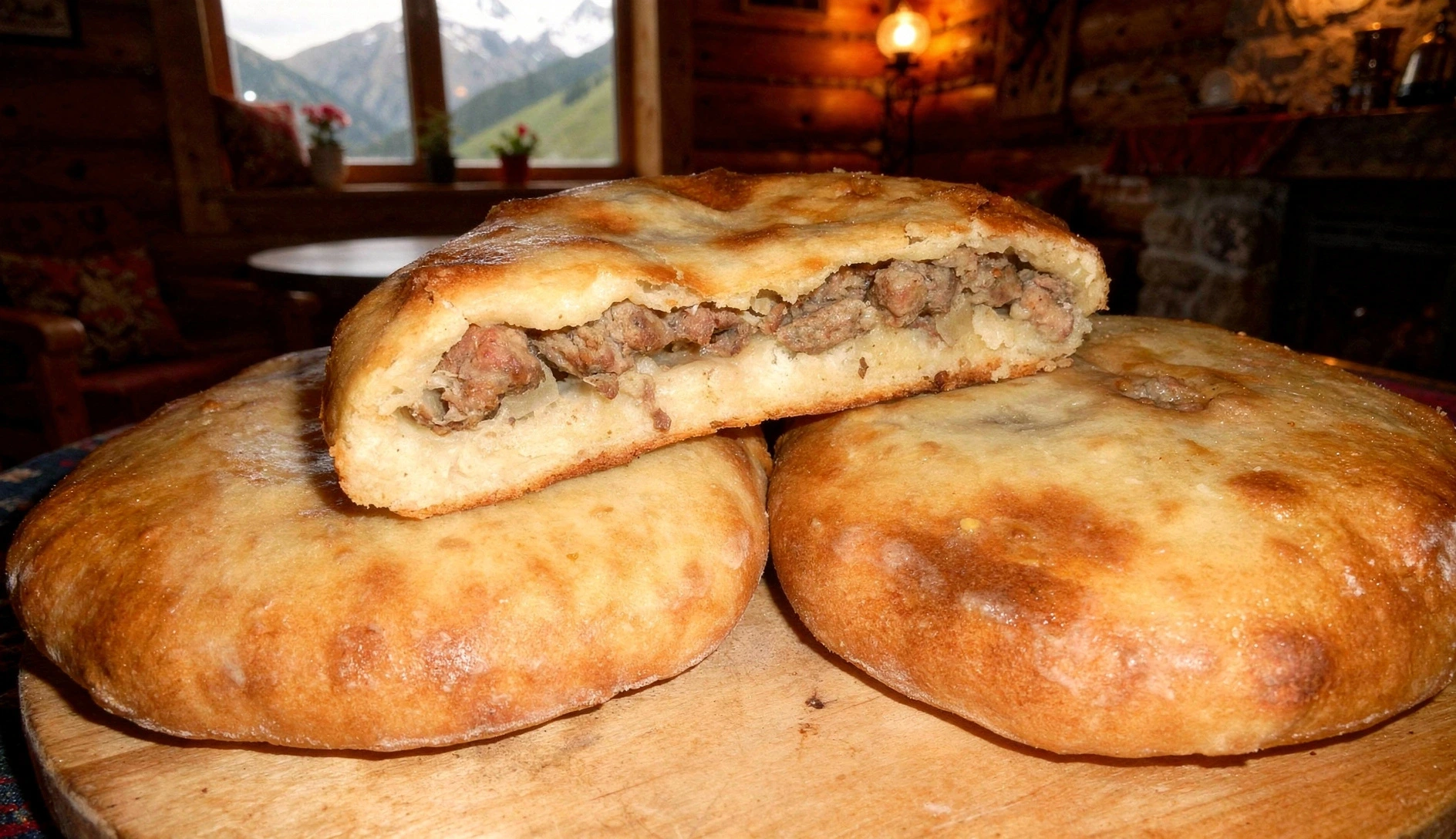
Kubdari (კუბდარი) is what you eat when you've spent the morning hiking through Svaneti's 3,000-meter passes and need something that will physically anchor you to the table. It's a round bread stuffed with hand-chopped beef and pork, seasoned with a spice mix that hits every note — cumin, coriander, fenugreek, dill — and baked until the crust goes golden and the meat inside steams in its own juices. No sauce. No sides needed. Just bread and meat and centuries of mountain cooking wisdom.
Kubdari Quick Facts
- Georgian name: კუბდარი (koob-DA-ree), also called კუპტაარი (kuptaari) in Svaneti
- Origin: Svaneti, Georgia's highest inhabited region
- Key spices: Cumin, coriander, blue fenugreek (უცხო სუნელი), dill
- The rule: Hand-chopped meat, never minced
- Total time: ~3 hours (mostly dough rising)
- Cost in Georgia: 8–14 GEL in bakeries (~$3–5 USD)
- Difficulty: Medium — the assembly takes practice
Why This Bread Matters
Every region in Georgia has its bread, but Svaneti's kubdari stands apart from all of them. While Imeretian khachapuri fills its dough with cheese and Adjarian khachapuri pools butter and egg into a boat shape, kubdari goes in a completely different direction. The filling is raw spiced meat — no cheese, no egg, no dairy at all. The bread seals around it, and everything cooks together in the oven, the meat steaming inside its dough shell until the juices soak into the crust from the inside out.
This isn't a meat pie in the Western sense. There's no gravy, no pre-cooked filling, no crimped pastry edge. The dough is a yeasted bread dough — substantial and chewy, not flaky. And the meat isn't ground — it's hand-chopped, which gives it a texture that's coarser and more satisfying than anything that's been through a grinder. The pieces stay distinct, and you can taste the difference between the beef and pork in each bite.
Kubdari was mountain survival food. Svaneti, wedged between the Greater Caucasus peaks at altitudes where farming is marginal, bred a cuisine built around calories and preservation. Kubdari packs protein and carbohydrates into a single portable package. You could carry it on a hike. You could bake several and they'd keep for days. The generous spicing wasn't decorative — it was preservation and flavor compensation for tough mountain meat.
The Meat Rule: Chop, Don't Grind
This is the hill to die on with kubdari. The meat must be hand-chopped into small pieces — about 5mm, roughly the size of a pea. Not minced. Not ground. Not pulsed in a food processor. Chopped with a knife on a cutting board.
There's a reason every Svan grandmother insists on this: ground meat compacts into a dense mass when it cooks. Hand-chopped pieces keep their individual structure, creating pockets of juice between them. When you bite into a properly made kubdari, the filling has texture — you can feel distinct pieces of beef and pork, each one coated in spice, swimming in the juices that collected during baking. Ground meat gives you a uniform paste. That's not kubdari. That's a meat pie.
The traditional mix is beef and pork in roughly equal parts. The beef brings flavor depth and the pork brings fat and juiciness. Some versions use only pork, some add veal, and historically goat was common when that's what you had. But the beef-pork combination is the standard you'll find across Svaneti today, and it's the one that works best.
The Chopping Method
Use a heavy chef's knife and work in batches. Slice the meat into thin strips, then cross-cut into small pieces. It takes about 15 minutes for 1kg of meat. Yes, it's slower than a grinder. The result is worth every minute. If you absolutely must use a grinder, use the coarsest plate and pulse briefly — but you'll lose the authentic texture.
Ingredients
The Filling
| Ingredient | Amount | Notes |
|---|---|---|
| Beef chuck or shoulder | 500g | Hand-chopped into 5mm pieces |
| Pork shoulder | 500g | Hand-chopped, keep the fat |
| Onions | 2 medium | Finely diced, not grated |
| Garlic | 4 cloves | Minced |
| Ground cumin | 1 tsp | Svaneti's signature spice |
| Ground coriander | 1 tsp | Dried coriander seed, not cilantro |
| Blue fenugreek | ½ tsp | უცხო სუნელი — the defining Georgian spice |
| Ground dill seed | ¼ tsp | Unusual but essential to kubdari |
| Red pepper flakes | 1 tsp | Georgian red pepper preferred |
| Salt | 1 tsp | Or use Svaneti salt for all-in-one |
| Black pepper | ½ tsp | Freshly ground |
The Dough
| Ingredient | Amount | Notes |
|---|---|---|
| All-purpose flour | 900g + 150g for kneading | Kubdari dough is firmer than most |
| Warm water | 400ml (35°C) | Bath-warm, not hot |
| Instant yeast | 7g (1 packet) | Or 1 tbsp active dry yeast |
| Sugar | 1 tsp | Feeds the yeast, adds golden color |
| Salt | 1 tsp | For the dough structure |
| Egg (optional) | 1 | Enriches the dough slightly |
| Butter | 30g | For glazing after baking |
The Svaneti Salt Shortcut
If you have Svaneti salt (სვანური მარილი), you can simplify the filling spicing. Svaneti salt already contains garlic, coriander, blue fenugreek, dill, and red pepper in a pre-mixed blend. Use 2 tablespoons of Svaneti salt instead of the individual spices plus regular salt. It's how many Svans actually make it at home — the elaborate spice list is essentially Svaneti salt, unpacked.
Equipment
Essential
Large mixing bowl, rolling pin, heavy chef's knife, baking tray, cling film. A bench scraper helps for dividing dough.
Alternative: Stovetop Method
Some cooks use a large cast iron skillet on medium heat instead of the oven. Cook 7-8 minutes per side, covered. Gives a crispier crust but requires more attention.
Step-by-Step Recipe
Step 1: Make the Dough (10 min active + 2 hours rising)
Dissolve the yeast and sugar in 400ml warm water — it should feel like a comfortable bath, around 35°C. If it's too hot, the yeast dies. Too cold, and it barely activates. Let it sit for 5 minutes until slightly foamy.
In a large bowl, combine 900g flour with 1 tsp salt. Make a well in the center and pour in the yeast water (and the egg, if using). Mix with your hands or a wooden spoon until a shaggy dough forms. Turn it out onto a floured surface and knead for 5-6 minutes until smooth and elastic. The dough should be soft but not sticky — kubdari dough is firmer than pizza dough but not as stiff as pasta.
Shape into a ball, place in a lightly oiled bowl, cover with cling film, and leave in a warm spot for 2 hours. It should roughly double in size.
Step 2: Prepare the Filling (15 min)
While the dough rises, prepare the meat. Take your beef chuck and pork shoulder and chop them by hand into small pieces — about 5mm, the size of a small pea. This is the most time-consuming step and the one you absolutely cannot shortcut.
Put the chopped meat into a large bowl. Add the finely diced onions, minced garlic, and all the spices: cumin, coriander, blue fenugreek, dill seed, red pepper, salt, and black pepper. Now mix with your hands — and not gently. You want to squeeze and knead the mixture for a solid 2-3 minutes, pressing the spices into the meat, releasing the onion juices, creating a wet, fragrant mass. The filling should be visibly moist. If it looks dry, the kubdari will be dry.
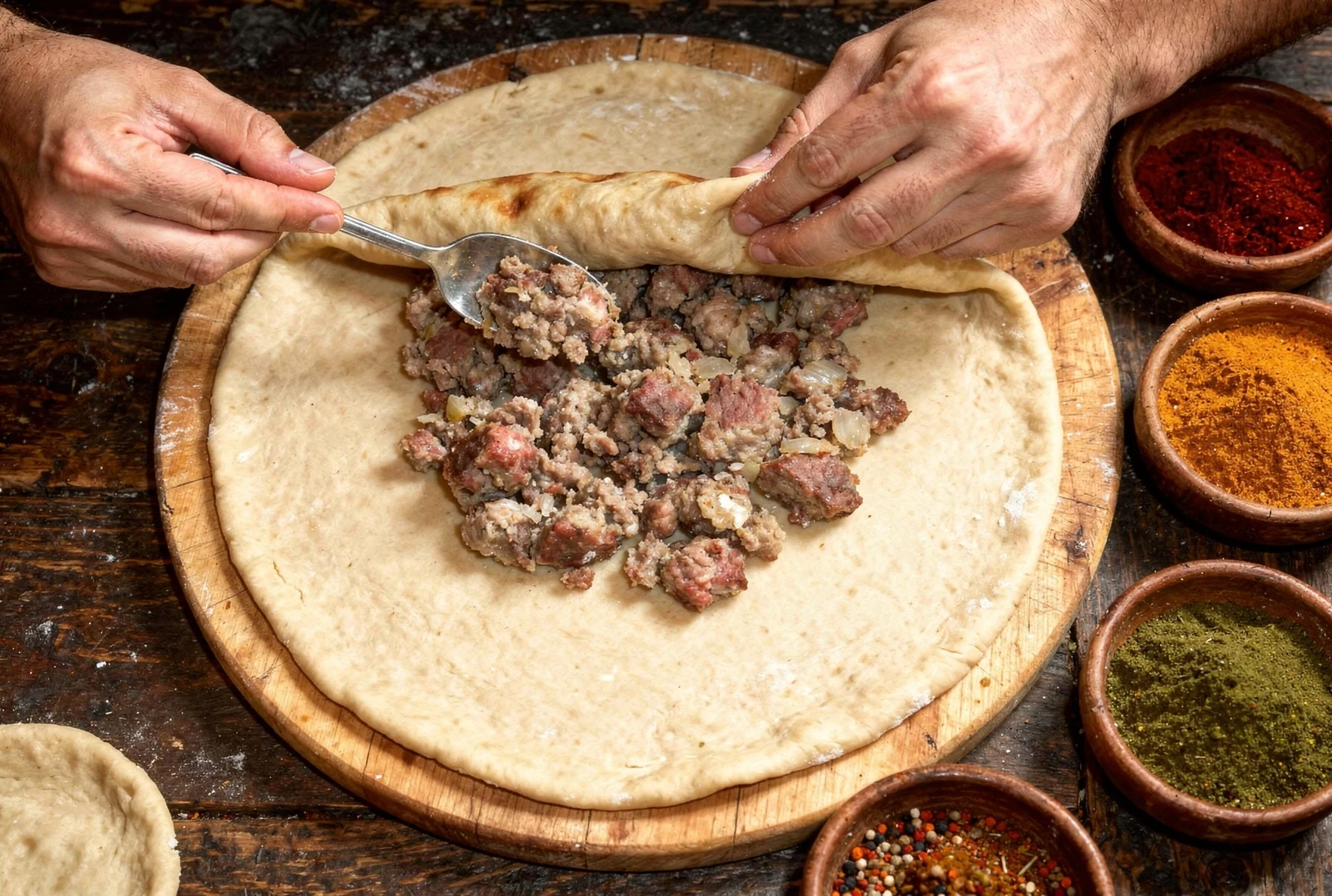
Step 3: Assemble (15 min)
Once the dough has doubled, punch it down and turn it onto a floured surface. Knead in about 150g more flour — the second kneading makes the dough firmer and easier to handle with the wet filling. Divide into 4 equal pieces (each about 350g) and roll each into a ball. Cover with a towel and let them rest 10 minutes.
Take one ball and roll it into a circle about 25cm across and about 5mm thick. Don't worry about perfection — this is mountain bread, not patisserie. Pile a quarter of the meat filling in the center, leaving about 5cm of dough border. Now comes the technique that takes practice: gather the edges of the dough upward around the filling, pleating and pinching them together at the top, like you're making a giant dumpling. Squeeze the top knot tightly to seal.
Flip the sealed kubdari seam-side down. Gently press and flatten it with your palms into a disc about 20cm across and 2-3cm thick. Be careful — push too hard and the filling bursts through. Too little and it won't cook evenly. Poke a small hole in the center with your fingertip or a skewer. This lets steam escape and prevents the dough from puffing up and separating from the filling.
The Sealing Matters
If the top isn't pinched tight enough, juices will leak out during baking and you'll get dry meat and a soggy, burnt bottom. If you've never done this before, use slightly less filling on your first attempt. A well-sealed kubdari traps all the juices inside, creating a self-basting effect that's the whole point of the dish.
Step 4: Bake (25-30 min)
Preheat your oven to 200°C (400°F). Place the kubdari on a flour-dusted baking tray (or lined with parchment paper). You can fit two on a standard tray if you don't crowd them.
Bake for 25-30 minutes until the top is golden brown and the bottom has firm color too. The meat inside cooks entirely in its own juices — you're essentially steaming the filling inside a bread oven. You'll know it's done when the crust is evenly golden and you can hear a faint sizzle if you put your ear close (the juices bubbling inside).
Step 5: Butter and Serve (5 min)
This step is not optional. The moment the kubdari comes out of the oven, brush the entire top surface generously with butter. The hot crust absorbs it instantly, creating a glossy, rich finish that softens the top crust just slightly. Let it rest for 5 minutes — the filling is lava-hot and needs time to settle.
Cut into wedges like a pizza. The first cut should release a rush of meaty, spice-scented steam. If it does, you've done it right.
| Visual Cue | What It Means |
|---|---|
| Pale top, soft bottom | Under-baked — needs 5-10 more minutes |
| Golden top, firm bottom | Perfect. Pull it now. |
| Dark spots on bottom, pale top | Oven too hot on bottom — lower rack next time |
| Juice leaking onto tray | Seal broke. Still edible, but drier than ideal. |
| Top puffed up into a dome | Forgot the steam hole. Pop it and it's fine. |
The Spice Mix Explained
Kubdari's spicing is what separates it from every other meat bread in the Caucasus and Central Asia. Where Uzbek samsa relies on cumin alone and Turkish lahmacun goes heavy on red pepper, kubdari uses a complex blend that's distinctly Svan. Each spice plays a specific role:
Cumin (ზირა)
The backbone. Gives kubdari its warm, earthy base note. Svaneti uses more cumin than any other Georgian region.
Blue Fenugreek (უცხო სუნელი)
Georgia's national spice — nutty, slightly bitter, totally unique. You can't skip this and call it kubdari.
Ground Dill Seed (კამა)
The secret weapon. Not fresh dill — dried seed, ground. Adds a subtle anise note that lifts the heavy meat.
Coriander Seed (ქინძი)
Bridges the cumin and fenugreek. Provides citrusy brightness to cut through the fat.
What to Eat With Kubdari
In Svaneti, kubdari is often the whole meal. It's complete — protein, carbs, fat, flavor. But if you're serving it as part of a larger spread, these pairings work well:
| Pairing | Why It Works |
|---|---|
| Fresh herb platter | Tarragon, cilantro, basil — the brightness cuts through the rich meat |
| Tkemali sauce | The sour plum sauce adds acid that balances the fat |
| Pickled vegetables | Pickled peppers, jonjoli — acidity and crunch |
| Fresh tomato-cucumber salad | The Georgian standard. Keeps things light. |
| Georgian red wine | Saperavi or Mukuzani — tannins match the meat |
| Lemonade (ლიმონათი) | Tarragon or pear — traditional Georgian soft drinks |
Variations
| Variation | What Changes | Verdict |
|---|---|---|
| All pork | Juicier, fattier, one-note flavor | Good for pork lovers |
| Lamb | Stronger flavor, traditional in some villages | Excellent, but gamier |
| Goat | The oldest version — lean, intense | Hard to find, worth trying |
| Stovetop method | Cooked in skillet, crispier crust | Different but legitimate |
| Tbilisi style | Often uses ground meat, less spice | Easier but inauthentic |
Common Mistakes
Using Ground Meat
The #1 mistake. Ground meat compacts into a dense puck. Hand-chop for texture and juice pockets.
Skimping on Spices
Kubdari should be aggressively seasoned. The dough absorbs flavor, so the filling needs to be intense.
Weak Seal
If the dough isn't pinched tight at the top, juices escape during baking. Squeeze harder than you think.
Too Thin
Rolling too flat means the dough tears under the weight of the filling. Keep it 2-3cm thick.
Skipping the Butter
The butter glaze isn't decoration. It softens the crust and adds richness. Do it immediately while hot.
Cutting Too Soon
The filling is 200°C+ liquid when it comes out. Wait 5 minutes or burn your mouth and lose all the juices.
Pro Tips
Marinate Overnight
Mix the meat and spices the night before and refrigerate. The flavors develop dramatically. Make the dough fresh the next day.
Toast the Cumin
30 seconds in a dry pan before grinding. The aroma deepens significantly — Svan cooks do this instinctively.
Freeze Extras
Kubdari freezes well unbaked. Assemble, freeze on tray, then wrap. Bake from frozen at 190°C for 35-40 minutes.
Test with One First
If it's your first time, bake one kubdari before the rest. Check the filling is cooked through and adjust timing.
Where to Eat Kubdari in Georgia
Mestia, Svaneti
The source. Any guesthouse or small restaurant in Mestia serves the real thing. The ones near the Laghami neighborhood are particularly good. Expect 8-12 GEL.
Ushguli
Europe's highest continuously inhabited village. The kubdari here tends to be smaller and spicier. Worth the trek.
Zugdidi
Gateway town to Svaneti. The market area has bakeries that make kubdari for travelers. Quality varies — look for hand-chopped filling.
Tbilisi
Several Svaneti-focused restaurants serve decent kubdari. Sakhinkle on Maidan does a credible version. But honestly, it's always better in the mountains.
Nutrition
| Nutrient | Per Kubdari |
|---|---|
| Fat | ~28g (12g saturated) |
| Fiber | ~3g |
| Sodium | ~800mg |
| Iron | ~6mg (35% DV) |
Storage & Reheating
Room Temperature
Good for 6-8 hours, wrapped in a towel. This is how Svans carried them on mountain trips.
Refrigerator
3-4 days wrapped in foil. The dough firms up but the flavor actually improves. Reheat before eating.
Freezer
Up to 3 months. Wrap tightly in foil, then plastic. Reheat from frozen at 180°C for 15-20 minutes.
Reheating
Oven at 180°C for 8-10 minutes, loosely covered in foil. Never microwave — it makes the dough rubbery and sad.
Frequently Asked Questions
What's the difference between kubdari and khachapuri?
Khachapuri is filled with cheese (and sometimes egg and butter). Kubdari is filled with spiced meat. They use similar yeasted doughs but are completely different dishes from different regions — khachapuri is associated with Imereti and Adjara, kubdari with Svaneti.
Can I use ground meat instead of hand-chopped?
You can, but it won't be authentic kubdari. Ground meat compacts into a dense mass during baking, while hand-chopped pieces stay distinct and create juice pockets. If you must use a grinder, use the coarsest plate and pulse briefly.
What is blue fenugreek and where can I find it?
Blue fenugreek (უცხო სუნელი / utskho suneli) is a dried herb from the fenugreek family, widely used in Georgian cooking. It has a nutty, slightly bitter flavor. Find it at Georgian or Eastern European grocery stores, or order online. Regular fenugreek is not a good substitute — they taste quite different.
Can I make kubdari ahead of time?
Yes. Mix the filling and refrigerate it overnight (the flavor improves). Make the dough fresh the next day. You can also assemble kubdari fully and freeze them unbaked — bake from frozen at 190°C for 35-40 minutes.
How do I know when the meat inside is fully cooked?
At 200°C for 25-30 minutes, the meat will be fully cooked (internal temp 75°C+). Insert an instant-read thermometer through the steam hole if unsure. Golden brown crust on both top and bottom is a reliable visual cue.
Written by The Georgian Eats Team
We've eaten kubdari in Svaneti guesthouses, Tbilisi restaurants, and our own kitchen. The version above is based on traditional Svan methods with measurements precise enough to work on your first attempt.
Last updated: February 2026.
Related Articles
Adjarian Khachapuri
The boat-shaped cheese bread that defines Georgian cuisine.
Lobiani
Bean-stuffed bread from Racha — kubdari's meatless cousin.
Khinkali
Georgia's soup dumplings — another mountain dish with its own rules.
Mtsvadi (Georgian BBQ)
The sacred art of grilled pork — simplicity taken seriously.