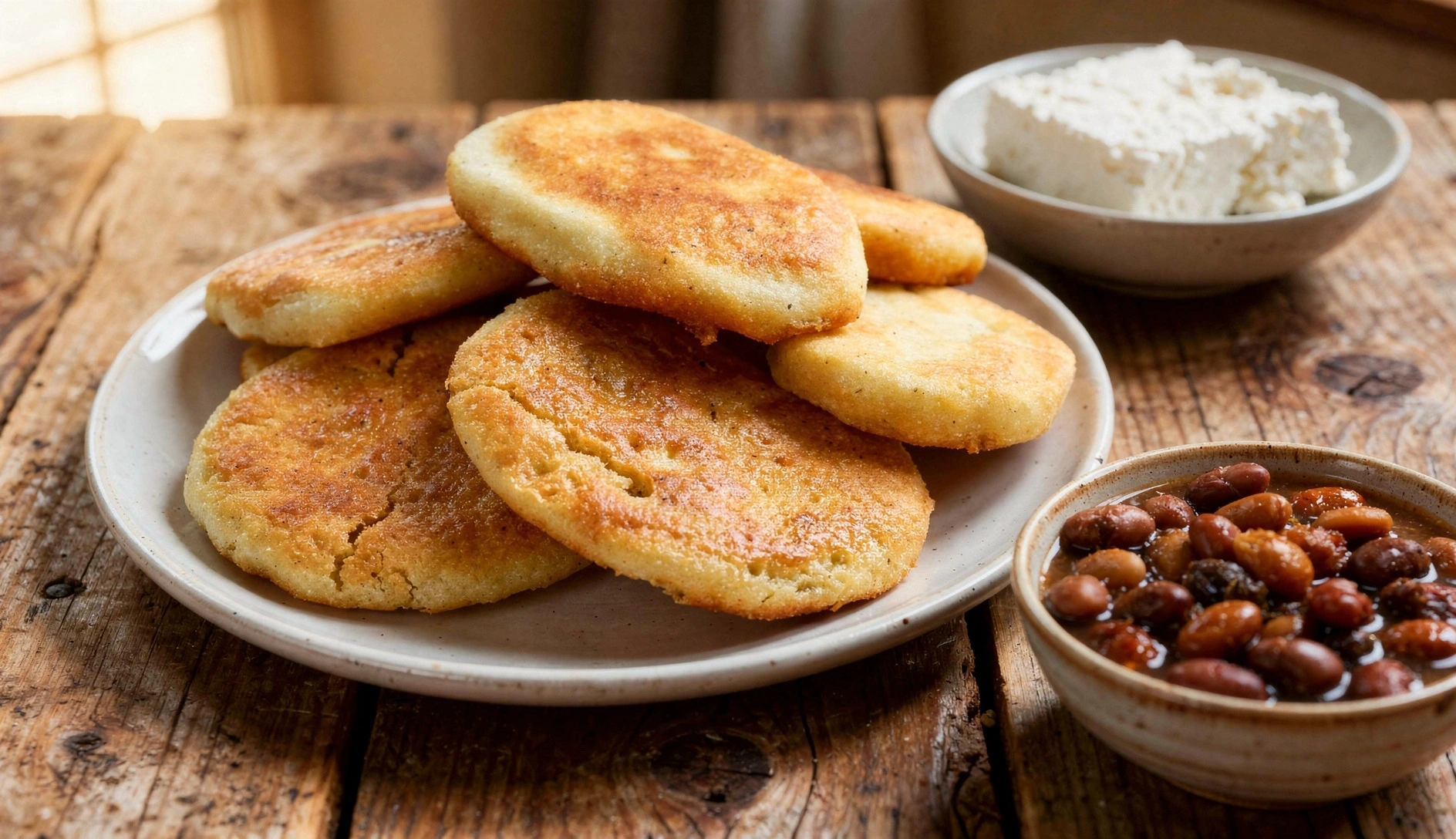
Three ingredients. No yeast, no eggs, no dairy, no waiting. Mchadi is the most honest bread in Georgia — just cornmeal, water, and salt, shaped by hand and fried until the outside shatters and the inside stays dense and warm. It's the thing you tear apart at the table and stuff with cheese. The thing that makes lobio a complete meal. The bread that's been feeding Georgians since long before wheat flour showed up in every kitchen. This is how you make it.
Mchadi Quick Facts
- Georgian name: მჭადი (m-CHA-dee)
- Meaning: Cornbread — from the word for corn/maize
- Origin: Western Georgia, especially Samegrelo and Imereti
- Key ingredient: Stone-ground white cornmeal
- Prep time: 10 minutes
- Cook time: 12–15 minutes
- Makes: 6–8 pieces
- Diet: Naturally vegan and gluten-free
- Cost in Georgia: 1–2 GEL per piece (~$0.40)
- Always serve with: Lobio, Imeretian cheese, pickles
Why Mchadi Is Georgia's Most Underrated Bread
Every tourist knows shotis puri — the long, canoe-shaped wheat bread pulled from a tone oven. It's spectacular, photogenic, and utterly impractical to make at home. Mchadi is the opposite. No special oven, no skill ceiling, no rising time. A skillet and ten minutes of your life.
But here's why it matters beyond convenience: mchadi is the original Georgian bread. Corn arrived in Georgia from the Americas in the 16th–17th century, and western Georgians — Megrelians, Imeretians, Gurians — adopted it with an enthusiasm that still defines their cuisine. In these regions, corn became the staple grain, not wheat. Mchadi, ghomi (corn porridge), and elarji (corn with cheese) are the backbone of western Georgian cooking.
Walk into any traditional restaurant in Tbilisi, order lobio, and mchadi will appear alongside it without being asked. The pairing is non-negotiable — like bread and butter, except more interesting. The crispy, slightly sweet cornbread against the smoky, earthy beans is one of those combinations that just works at a chemical level.
Getting the Right Cornmeal
This is the only decision that really matters. Everything else is just mixing and frying.
In Georgia, mchadi is made with stone-ground white cornmeal — coarse, gritty, nothing like the fine corn flour you'd use for tortillas. The coarseness is the whole point. It gives mchadi its characteristic crunch on the outside and that slightly grainy, dense interior that soaks up cheese and bean juices.
| Cornmeal Type | Works? | Notes |
|---|---|---|
| Stone-ground white cornmeal | ✅ Best | The authentic choice. Look in Eastern European or specialty stores. |
| Coarse polenta | ✅ Great | Most widely available substitute. Yellow color, same texture. |
| Stone-ground grits (US) | ✅ Great | Essentially the same product. NOT instant or quick-cooking grits. |
| Fine cornmeal / corn flour | ⚠️ Okay | Will work but loses the gritty texture. More like a fritter than mchadi. |
| Masa harina | ❌ No | Treated with lime (nixtamalized). Completely different product. |
| Instant polenta | ❌ No | Pre-cooked, too fine. Won't hold shape properly. |
White vs. Yellow — Does It Matter?
Traditional mchadi uses white cornmeal, which gives a paler, slightly milder result. Yellow polenta works just as well — the mchadi will just be more golden. The taste difference is minimal. Use whatever you can find.
Ingredients
This is the full list. Yes, it's absurdly short.
| Ingredient | Amount | Notes |
|---|---|---|
| Stone-ground cornmeal | 400g (~2.5 cups) | Coarse, not fine. White preferred, yellow works. |
| Cold water | ~1 cup (240ml) | Add gradually. You may need more or less. |
| Salt | ½ tsp | Essential. Unseasoned mchadi is miserable. |
| Oil for frying | 3-4mm in pan | Sunflower or vegetable oil. Not olive oil. |
Equipment
🍳 Heavy Skillet
Cast iron is ideal — holds heat evenly and gives the best crust. Any heavy-bottomed pan works. Non-stick is fine but you won't get the same crunch.
🥄 Wet Spoon
For smoothing the patties in the pan. Dip the back of a spoon in water and press the top flat. Prevents sticking and gives a cleaner shape.
The Recipe — Step by Step
Step 1: Mix the Dough
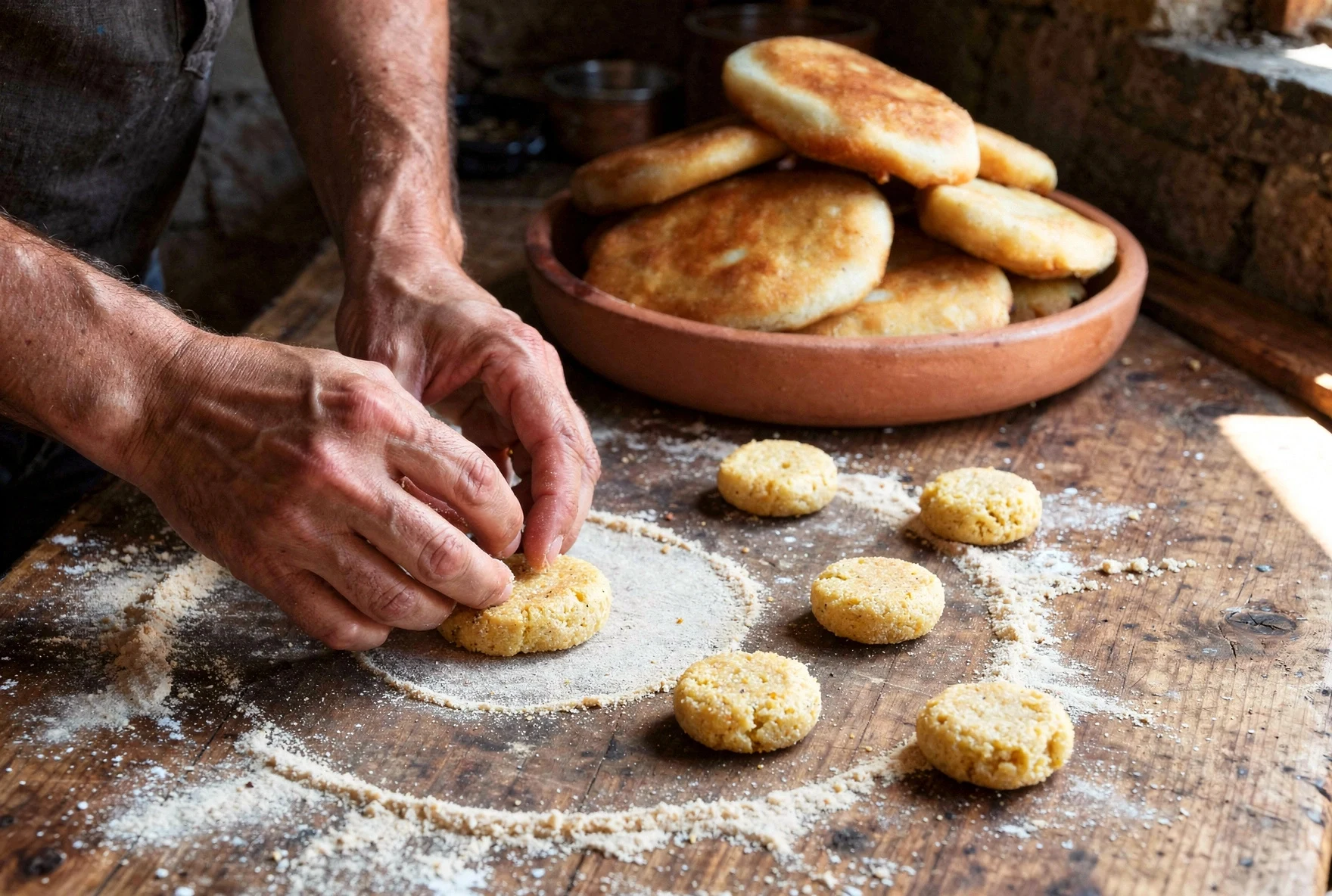
Put the cornmeal and salt in a bowl. Add water in small splashes — maybe a quarter cup at a time — stirring with a fork after each addition. You're looking for a specific consistency: wet sand that holds together when squeezed. If you grab a fistful and press, it should compact into a solid mass without crumbling. If water squeezes out between your fingers, you've added too much.
This is the only tricky part of the entire recipe, and even this isn't really tricky. Different cornmeals absorb water at different rates, so ignore exact measurements and go by feel. You can always add more water. Taking it out is harder.
| Dough Texture | Status |
|---|---|
| Dry and crumbly, won't hold shape | Too dry — add more water |
| Holds together when squeezed, like wet sand | ✅ Perfect |
| Sticky, clings to hands, water visible | Too wet — add more cornmeal |
Step 2: Shape the Patties
Grab a tennis-ball-sized piece of dough. Roll it between your palms into a ball, then flatten it into a thick oval patty — about 8–10cm long and 2cm thick. Don't go thinner than 1.5cm or they'll dry out. Don't go thicker than 2.5cm or the middle won't cook through.
Wet your hands between patties to prevent sticking. You should get 6–8 mchadi from 400g of cornmeal, depending on how generous you are.
Step 3: Heat the Oil
Pour enough oil into your skillet to cover the bottom by about 3–4mm. This isn't deep frying — it's shallow frying. Set over medium heat and wait until the oil shimmers. Test with a small crumb of dough: it should sizzle immediately on contact.
Temperature Matters
Medium heat is the sweet spot. Too high and the outside burns before the inside cooks. Too low and the mchadi absorbs oil and turns greasy instead of crispy. If the oil smokes, pull the pan off heat and let it cool slightly.
Step 4: Fry — Covered, Then Uncovered
Gently place the patties in the hot oil. If they crack or break slightly, just press them back together with a spatula — the dough is forgiving. Use the back of a wet spoon to smooth the tops flat.
Cover the pan and cook for 5–6 minutes. The lid traps steam, which helps cook the thick interior. After 5 minutes, peek at the bottom — it should be deep golden brown, not just pale yellow.
Flip carefully with a spatula (they're more fragile than wheat bread). Cook uncovered for another 5–6 minutes. No lid this time — you want the crust to stay crispy, not steam.
Step 5: Serve Immediately
Transfer to a plate lined with paper towel for 30 seconds to drain excess oil, then serve hot. Mchadi is best within 10 minutes of leaving the pan — the crust softens as it cools, and reheating never fully restores the crunch.
How to Eat Mchadi (The Georgian Way)
Mchadi is never eaten alone. It's always part of a trio or quartet on the table. Here's what goes with it:
| Pairing | Why It Works | How to Eat It |
|---|---|---|
| Lobio (bean stew) | The defining pairing. Smoky beans, crunchy bread. | Tear mchadi into pieces, dip into lobio |
| Imeretian cheese | Salty, mild cheese melts slightly on hot mchadi | Slice cheese, press into warm mchadi like a sandwich |
| Sulguni cheese | Stretchy, briny — more aggressive than Imeretian | Same as above, or crumbled on top |
| Pickled vegetables | Acid cuts through the starchy density | Pickled peppers, jonjoli, or pickled cabbage on the side |
| Tkemali sauce | Sour plum sauce adds brightness | Drizzle over or use as a dipping sauce |
| Fresh herbs | Cilantro, tarragon, basil — any mix | Tear and scatter, eat between bites |
The Classic Trio
Lobio + mchadi + cheese is one of the most iconic food combinations in Georgia. It's the equivalent of bread, soup, and salad — a complete meal that costs almost nothing and satisfies completely. If you're making lobio, always make mchadi too. One doesn't exist properly without the other.
Mchadi vs. Chvishtari — What's the Difference?
You'll sometimes see "chvishtari" on menus, especially in Svaneti-focused restaurants. It's essentially mchadi's rich cousin — cornbread stuffed or mixed with cheese before frying. If mchadi is a blank canvas, chvishtari is the painting.
| Feature | Mchadi | Chvishtari |
|---|---|---|
| Cheese | None (served alongside) | Mixed into the dough or stuffed |
| Origin | Western Georgia (general) | Svaneti specifically |
| Texture | Crispy outside, dense inside | Crispy outside, gooey cheese inside |
| Richness | Lean, vegan | Rich, cheesy |
| Best with | Lobio, cheese on the side | On its own or with tkemali |
Think of it this way: if you're having lobio, make mchadi. If you want bread that IS the main event, make chvishtari. Both are worth knowing.
Variations Worth Trying
| Variation | What Changes | Verdict |
|---|---|---|
| Baked mchadi | 200°C oven, 20–25 min, brush with oil | Healthier but no crust. Loses the point. |
| With butter | Fry in butter instead of oil | Richer, nuttier. Not traditional but excellent. |
| Cheese-stuffed (chvishtari) | Stuff with sulguni or mozzarella | Different dish entirely. Also great. |
| Mini mchadi | Smaller, thinner patties | Crispier, faster cooking. Good for appetizers. |
| With herbs in dough | Mix in chopped cilantro or dill | Not Georgian, but adds flavor. Worth trying. |
Common Mistakes
❌ Using Fine Corn Flour
Fine-ground corn flour makes a soft, cakey result — not the gritty, crunchy mchadi you want. Coarse is everything.
❌ Adding Too Much Water
Wet dough = soggy mchadi that falls apart in the pan. Go slowly. You can always add more — you can't take it back.
❌ Oil Too Hot
If the oil smokes, your mchadi will burn on the outside while staying raw inside. Medium heat, patience.
❌ Patties Too Thin
Under 1.5cm and they dry out into crispy wafers. Nice for crackers, terrible for mchadi. Keep them thick.
❌ Forgetting the Lid
The lid on the first side traps steam that cooks the center. Skip it and the middle stays raw while the bottom overcooks.
❌ Serving Cold
Room-temperature mchadi is just dense cornmeal. All the magic is in eating it hot, when the crust is still audibly crispy.
Pro Tips
💧 The Wet Hands Trick
Keep a bowl of water nearby. Wet your hands before shaping each patty. The dough won't stick, and the surface smooths out beautifully.
🧈 The Cheese Sandwich
While the mchadi is screaming hot, split it open and press a thick slab of sulguni or feta inside. The cheese softens into the hot cornbread. This is the move.
🔊 The Sound Test
Properly fried mchadi makes a hollow sound when you tap it. If it thuds, the inside is still too dense. Give it another minute per side.
📏 Batch Sizing
Don't crowd the pan — leave at least 2cm between each mchadi. Crowding drops the oil temperature and you get steamed, greasy bread instead of fried.
Where to Eat Great Mchadi in Tbilisi
Sakhachapure N1
Cheap, packed, legendary. Their lobio-mchadi combo is the benchmark. Multiple locations around Tbilisi.
Machakhela
Reliable chain with consistently good mchadi. Not the most exciting, but solid every time. Touristy but the mchadi doesn't suffer for it.
Samikitno (Dezerter Bazaar)
The canteen-style restaurants near Dezerter Bazaar serve mchadi the way it should be — fresh, hot, and cheap. No frills.
Any Western Georgian Restaurant
Restaurants specializing in Megrelian or Imeretian cuisine will always have great mchadi. Look for menus heavy on elarji and ghomi.
Nutrition
| Nutrient | Per Piece | % Daily Value |
|---|---|---|
| Calories | 145 kcal | 7% |
| Fat | 5g | 6% |
| Carbohydrates | 28g | 10% |
| Fiber | 2g | 7% |
Storage & Reheating
🕐 Same Day
Best eaten within an hour. Room temperature is okay for 3-4 hours but the crust softens significantly.
❄️ Fridge
Will keep 2-3 days wrapped in foil. They'll be dense and chewy — fine for eating with hot soup or stew.
🔥 Reheating
Re-fry in a dry skillet for 2-3 minutes per side to restore some crunch. Microwave makes them rubbery — don't.
🧊 Freezing
Freeze uncooked patties on parchment, then bag. Fry from frozen, adding 1-2 minutes per side. Works surprisingly well.
Frequently Asked Questions
Is mchadi gluten-free?
Yes — traditional mchadi contains zero wheat flour. It's just cornmeal, water, and salt. If you're celiac, verify your cornmeal isn't processed on shared equipment with wheat, but the recipe itself is naturally gluten-free.
Can I bake mchadi instead of frying?
You can, at 200°C for 20–25 minutes on an oiled baking sheet. But the result is drier and lacks the signature crispy crust. Traditional mchadi is always pan-fried. If you're avoiding oil for health reasons, baking works — just know it's a different experience.
Why did my mchadi fall apart in the pan?
Almost always a water issue — the dough was either too dry (crumbles apart) or too wet (spreads and breaks). Aim for wet sand consistency. Also, don't flip too early — let the bottom set fully before turning.
What's the difference between mchadi and American cornbread?
American cornbread typically includes flour, eggs, milk, butter, sugar, and leavening — it's a soft, cakey bread. Mchadi has none of those. It's denser, crunchier, more savory, and entirely vegan. They share corn as an ingredient but are fundamentally different foods.
How many mchadi per person?
Plan 2-3 per person as a side dish with lobio and cheese. If mchadi is the only bread on the table, bump to 3-4. They're small — people always eat more than they expect.
Written by The Georgian Eats Team
Based in Tbilisi, where mchadi shows up at every table alongside lobio without anyone needing to order it. We've eaten hundreds of them — from Dezerter Bazaar canteens to mountain guesthouses in Svaneti — and made plenty more at home when the craving hits.
Last updated: February 2026.
Related Articles
Lobio: Georgia's Smoky Bean Stew
The essential companion dish. Mchadi without lobio is just cornbread — with it, it's a meal.
Elarji: Stretchy Cheese-Cornmeal
Mchadi's indulgent cousin — same cornmeal base, but with ridiculous amounts of cheese stirred in.
Pkhali: Walnut-Herb Vegetable Rolls
Another vegan Georgian classic. Serve alongside mchadi and lobio for a fully plant-based feast.
Tkemali: Georgia's Sour Plum Sauce
The tangy condiment that goes with everything — including mchadi. A few drops transforms plain cornbread.