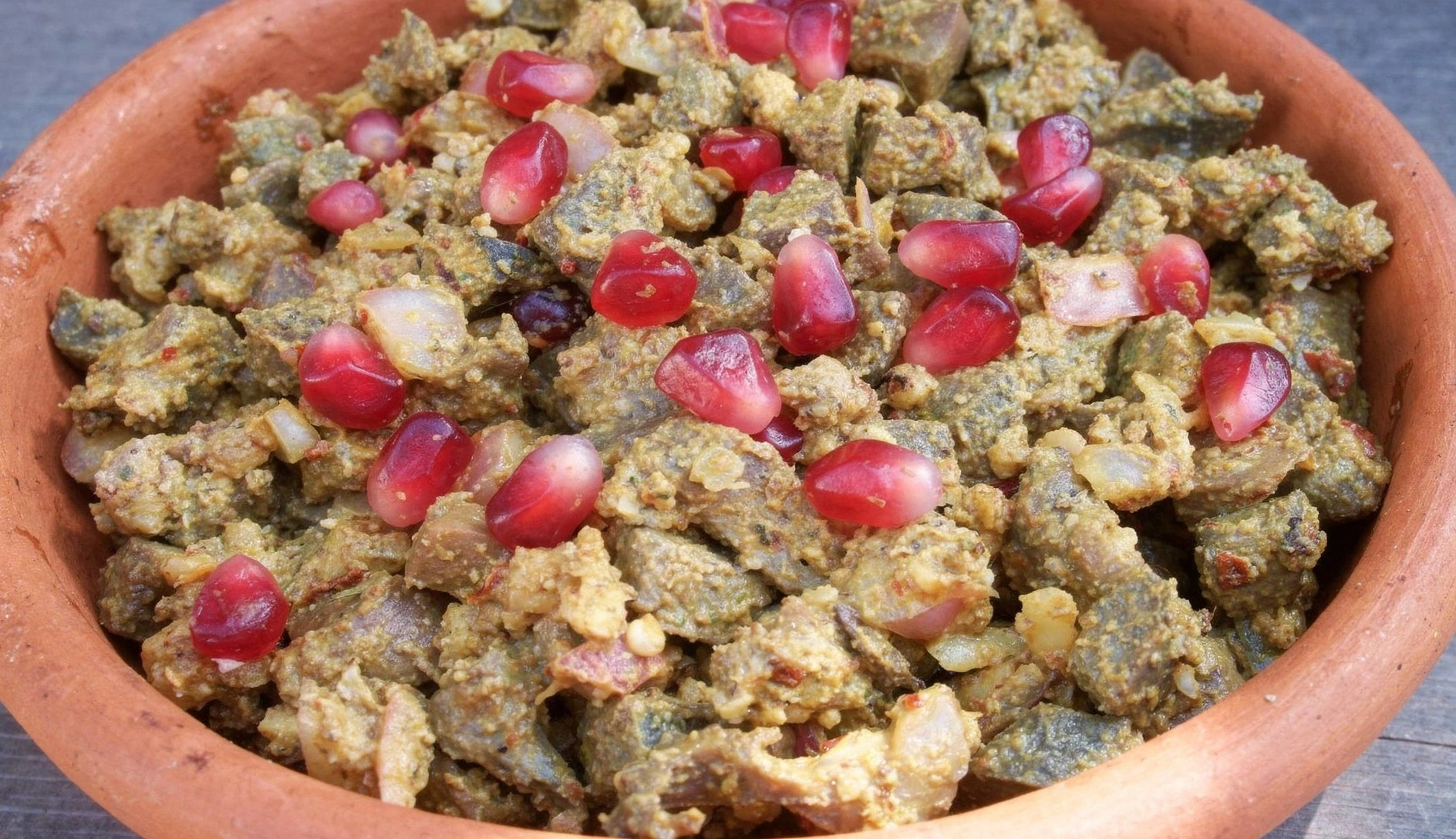
Kuchmachi is one of those dishes that sorts people immediately. You either see a plate of glistening chicken livers, hearts, and gizzards studded with pomegranate and walnuts and think yes, absolutely — or you need convincing. If you're in the second camp, consider this: kuchmachi is served at every Georgian New Year's table. It's the opening act at most supras. Grandmothers who disagree on everything agree that a celebration without kuchmachi is not a celebration. There's a reason for that. When it's done right — livers seared hard enough to get a crust but still pink inside, gizzards braised tender, the whole thing hit with vinegar, garlic, and a fistful of walnuts — it's one of the most satisfying things you'll eat in Georgia. And that's a country with serious competition.
Kuchmachi Quick Facts
- Georgian name: კუჭმაჭი (kooch-MAH-chee)
- Origin: All regions — every Georgian family has their version
- Key spices: Blue fenugreek, coriander, marigold (Imeretian saffron)
- Protein: Chicken is most common; pork and veal also traditional
- Prep + cook time: 20 min prep, 40 min cooking
- Cost in Georgia: 8–14 GEL in restaurants (~$3–5 USD)
- Difficulty: Easy — just don't overcook the livers
- When to serve: New Year's Eve, supra feasts, or any time you want to impress
Why Kuchmachi Matters
Organ meats are having a moment in the West. Nose-to-tail restaurants charge premium prices for offal prepared by trained chefs. Georgian grandmothers have been doing this for centuries — not because it's trendy, but because wasting food is a moral failure and because organ meats, when you know what you're doing with them, taste incredible.
Kuchmachi sits at the crossroads of frugality and sophistication. The ingredients are cheap. Chicken livers and hearts cost a fraction of breast meat. But the technique — searing livers hot enough to caramelize without overcooking, braising gizzards until tender but still with some chew, balancing richness with acid and crunch — produces something that tastes far more complex than the sum of its parts.
It's also the dish that tells you whether a Georgian restaurant is serious. Chain restaurants and tourist traps rarely bother with it. The places where grandmothers cook, where the menu hasn't changed since 1995, where the ketsi arrives so hot you can hear the sauce still bubbling — those places have kuchmachi.
Chicken vs. Pork vs. Veal
The traditional recipe uses whatever organ meats are available — pig heart, liver, kidneys, spleen, even lungs. Veal is considered the most refined. But chicken kuchmachi has become the most popular version for good reason: chicken livers and hearts cook faster, have a milder flavor that works for organ-meat newcomers, and are available everywhere.
This recipe uses chicken. If you want to go traditional with pork or veal, the approach changes significantly — whole organs need long braising (2+ hours) before being chopped and mixed with the spice-walnut dressing, often served cold rather than warm.
| Version | Organs Used | Cook Time | Serving Temp | Notes |
|---|---|---|---|---|
| Chicken | Livers, hearts, gizzards | 40 min | Warm or room temp | Most popular; milder, faster |
| Pork | Heart, liver, kidneys, spleen, lungs | 2+ hours | Cold | Traditional; strongest flavor |
| Veal | Heart, liver, kidneys | 1.5-2 hours | Cold | Most refined; delicate |
| Mixed | Combination of any above | Varies | Either | Common at supras — use what you have |
Ingredients
The organ meats are the star, but the supporting cast does heavy lifting. Walnuts add richness and body. Pomegranate seeds bring tartness and crunch — they're not just decoration. Wine vinegar cuts through the richness. And the Georgian spice trio of coriander, blue fenugreek, and marigold gives kuchmachi its distinctive warmth.
| Ingredient | Amount | Role |
|---|---|---|
| Chicken livers | 500g | Rich, creamy, cooks fast — the star |
| Chicken hearts | 500g | Meaty, chewy — structural contrast |
| Chicken gizzards | 300g (optional) | Dense, chewy — adds textural variety |
| Walnuts | 150g, roughly chopped | Richness, crunch, body |
| Pomegranate seeds | 1 large pomegranate | Tartness, crunch, visual drama |
| White wine vinegar | 2 tbsp | Acid to balance richness |
| Blue fenugreek | 1 tsp | Warm, earthy, uniquely Georgian |
| Ground coriander | 1.5 tsp | Citrusy warmth |
| Dried marigold petals | 1 tsp | Mild floral, golden color |
Finding Blue Fenugreek Outside Georgia
Blue fenugreek (utskho suneli) is a different species from common fenugreek. Don't substitute one for the other — common fenugreek is much more bitter. Look for it at Eastern European or specialty spice shops, or order online (Burlap & Barrel, Savory Spice Shop). In a pinch, use a small amount of khmeli suneli — the blend already contains blue fenugreek along with other Georgian spices.
Step-by-Step Instructions
Step 1: Clean the Organs
This is the step most recipes skip, and it's the difference between kuchmachi that tastes clean and kuchmachi that tastes metallic. For livers: look for any greenish spots (bile) and trim them off completely — even a small amount will make everything bitter. Remove any connective tissue or fat. Halve any livers that are unusually large so they cook evenly.
For hearts: trim the fat cap off the top and cut away the tough valve end (the hard bit where the vessels connect). You'll lose about 15-20% of the weight. For gizzards: peel off the tough yellowish inner membrane. Most store-bought gizzards are already cleaned, but check — any remaining membrane will be chewy in a bad way.
Step 2: Boil the Tough Cuts
Gizzards and hearts need a head start. Bring salted water to a boil with a bay leaf, drop in the gizzards first. They need 30-40 minutes of gentle simmering to become tender. Hearts go in after 20 minutes — they only need 10 minutes. Don't boil aggressively; a lazy simmer keeps them from toughening.
Save about 100ml of the cooking liquid. It's pure concentrated poultry flavor that you'll use later to build the sauce.
Don't Boil the Livers
This is the most common kuchmachi mistake. Livers that are boiled turn grainy, chalky, and grey. They need high-heat searing — not boiling. The contrast between creamy seared livers and chewy braised hearts is what makes the dish work.
Step 3: Sear the Livers
Pat the livers very dry — moisture is the enemy of a good sear. Get your heaviest skillet screaming hot with butter foaming. Lay the livers in a single layer (work in batches rather than crowding) and don't touch them for 2 minutes. Flip once. Another 2 minutes. You want a dark brown, almost caramelized crust on both sides, with the center still slightly pink.
If you cut one open and it's uniformly grey throughout, your heat was too low or you cooked too long. They'll still work in the dish, but you've lost the best part — that creamy, almost pâté-like center that melts against the crunchy walnut and pomegranate.
Step 4: Build the Base
In the same skillet with all those beautiful browned bits, cook diced onions until soft and golden — about 8-10 minutes on medium heat. The onions will deglaze the pan naturally. Add garlic in the last minute. This is your flavor foundation.
Step 5: Combine Everything
Cut the boiled hearts and gizzards into bite-sized pieces (1-1.5cm cubes). Cut the seared livers into similar pieces — they'll break down slightly, which is fine. That's where the sauce gets its body. Add everything to the skillet with the onions.
Now add the spices: coriander, blue fenugreek, marigold, summer savory, both peppers, and salt. Splash in the vinegar and a few tablespoons of reserved cooking liquid. Stir gently over medium heat for 3-4 minutes. You're not cooking further — you're building a glaze. The liquid should reduce until everything is coated in a glossy, fragrant sauce.
Step 6: Finish and Serve
Off the heat, fold in roughly chopped walnuts and half the pomegranate seeds. Taste for salt — organ meats can take more salt than you'd expect. Transfer to a clay ketsi if you have one (it keeps everything warm at the table), or any wide shallow dish. Top with the remaining pomegranate seeds and a generous heap of fresh cilantro.
| Visual Cue | What It Means |
|---|---|
| Livers: dark brown crust, pink center | Perfect — creamy inside, caramelized outside |
| Livers: uniformly grey throughout | Overcooked — still usable, but chalky texture |
| Gizzards: easily pierced with a fork | Done — tender with pleasant chew |
| Sauce: glossy and clinging to meat | Reduction is right — time to add walnuts |
| Sauce: watery, pooling at bottom | Needs more time — keep reducing |
How to Serve Kuchmachi
Kuchmachi is an appetizer, not a main course. At a supra, it arrives early — usually alongside pkhali, badrijani nigvzit, and an assortment of cheeses. You eat it with bread, tearing off pieces of shotis puri or mchadi and scooping up the meat, walnuts, and sauce together.
| Pairing | Why It Works |
|---|---|
| Shotis puri | The standard — tear and scoop |
| Mchadi | Cornbread's crunch against the rich glaze |
| Badrijani nigvzit | Classic supra pairing — eggplant lightens the richness |
| Pkhali | Vegetable-walnut bites for balance |
| Saperavi wine | Bold red stands up to the organ meats |
| Raw onion and fresh herbs | Georgian tables always have a fresh herb plate |
The New Year's Connection
Kuchmachi and satsivi are the twin pillars of the Georgian New Year's table. Satsivi (cold chicken in walnut sauce) is the main event; kuchmachi is the first dish you eat while waiting for everyone to arrive. Together with gozinaki (honey-walnut candy), they form the holy trinity of Georgian New Year's food. You'll see kuchmachi on every table from December 31st through at least January 2nd.
Warm vs. Cold: The Great Debate
Chicken kuchmachi is best served warm or at room temperature — the butter glaze seizes up when it's cold, and the livers lose their creamy texture. But the traditional pork or veal version is specifically a cold dish. The long-braised organs are chopped fine, mixed with the walnut-spice dressing, and left to set. The fat solidifies slightly, holding everything together almost like a terrine.
If you're making the chicken version and plan to eat it later, pull it from the fridge 30 minutes before serving. A few seconds in a warm skillet will restore the glaze without recooking the livers.
🔥 Serve Warm When...
Using chicken organs. The butter glaze and seared livers are at their best warm. Most restaurants serve it this way — often still sizzling in a clay ketsi.
❄️ Serve Cold When...
Using pork or veal. The traditional cold version is more like a composed salad — cubed organs dressed with spiced walnut paste, vinegar, and pomegranate. Set it in the fridge for 2+ hours before serving.
Variations Worth Trying
| Variation | What Changes | Result |
|---|---|---|
| Livers only | Skip hearts and gizzards | Faster, richer, less textural contrast |
| With adjika | Add 1 tbsp wet adjika to the spice stage | Samegrelo-style — spicier, more complex |
| Ground walnut sauce | Grind walnuts to paste instead of chopping | Thicker, more cohesive sauce — closer to satsivi texture |
| With barberries | Add 1 tbsp dried barberries with the pomegranate | Extra tartness — works beautifully |
| Turkey kuchmachi | Use turkey livers and hearts | Milder flavor, slightly larger pieces — good for beginners |
Equipment
🍳 Heavy Skillet
Cast iron is ideal — it holds heat for the liver sear and doubles as a serving vessel. A heavy stainless steel pan works too. Avoid non-stick; you need the fond (browned bits) for flavor.
🏺 Clay Ketsi (Optional)
The traditional serving vessel. It keeps kuchmachi warm at the table and looks spectacular. Any wide, shallow dish will work if you don't have one. In Georgian restaurants, it arrives still sizzling.
Storage and Leftovers
🧊 Fridge: 3-4 Days
Store in an airtight container. The flavors actually improve after a day — the spices meld and the walnut oils infuse everything. Bring to room temp before serving, or gently warm in a skillet.
❌ Don't Freeze
Livers don't freeze well — they become grainy and lose their creamy texture. Make what you'll eat within a few days. The good news: kuchmachi disappears fast. Leftovers are rarely a problem.
Common Mistakes
Boiling the livers
The #1 error. Boiled livers are grey, chalky, and disappointing. High heat sear only — 2 minutes per side. The contrast between creamy interior and brown crust is the entire point.
Skipping the cleaning
Any bile residue on livers = bitter metallic taste that no spice can fix. Trim green spots ruthlessly. Better to lose 10% of the liver than ruin the whole batch.
Crowding the pan
Livers release moisture. If they're touching, they steam instead of searing. Work in batches — the extra 3 minutes of effort is worth the crust.
Substituting common fenugreek
Common fenugreek and blue fenugreek are different species. Common fenugreek is intensely bitter and will overpower the dish. If you can't find blue fenugreek, use khmeli suneli blend instead.
Under-salting
Organ meats need more salt than you think. Taste after adding spices and again after adding walnuts. The walnuts absorb salt, so the dish often needs a final adjustment.
Pomegranate as afterthought
Don't just throw a few seeds on top. Fold half into the dish so their juice bursts during eating, providing acid in every bite. The top layer is for looks and crunch.
Where to Eat Kuchmachi in Tbilisi
The best kuchmachi rarely comes from the famous tourist restaurants. Look for small family-run places where the menu is short and the clay ketsi is dark from years of use. A few reliable options:
Shavi Lomi
Modern Georgian kitchen in Vera neighborhood. Their kuchmachi is served hot in a ketsi with a generous walnut-pomegranate topping. One of the better versions in the city.
Ezo
Hidden courtyard restaurant in Old Town. Traditional preparations, including a classic warm kuchmachi. The setting alone makes it worth a visit.
Sakhachapure N1
Multiple locations. Affordable and consistent. Good entry point if you're trying kuchmachi for the first time — not the best in the city, but reliably decent.
Any grandmother's table
Seriously. If you're invited to a Georgian home for New Year's or a supra, the kuchmachi will almost certainly be better than any restaurant version. Accept every invitation.
Nutrition
Organ meats are among the most nutrient-dense foods on the planet. Chicken liver alone contains more vitamin A, B12, and iron per gram than almost any other food. Combined with walnuts (omega-3s, healthy fats) and pomegranate (antioxidants, vitamin C), kuchmachi is essentially a superfood — centuries before that word existed.
| Nutrient | Per Serving | % Daily Value |
|---|---|---|
| Vitamin B12 | 15 mcg | 625% |
| Vitamin A | 6,500 IU | 130% |
| Folate | 290 mcg | 72% |
| Fat | 16g | Mostly from walnuts |
Frequently Asked Questions
Can I make kuchmachi without gizzards?
Absolutely. Livers and hearts alone make an excellent kuchmachi. Gizzards add textural variety but aren't essential. Many home cooks skip them for a simpler, faster version.
Is kuchmachi safe to eat with pink livers?
Chicken livers should be cooked to an internal temperature of 74°C/165°F. At that temperature, they can still appear slightly pink inside — the sear is fast and hot enough to reach safe temps while keeping the interior creamy. If you're uncomfortable with any pink, cook them a bit longer — they'll be drier but still safe.
What if I can't find pomegranate?
Pomegranate seeds add tartness and crunch. In a pinch, you can substitute dried barberries for the acid element and skip the garnish. Some cooks use a splash of pomegranate molasses in the sauce instead. But honestly — most supermarkets carry pomegranates. It's worth the search.
Can I use just livers?
Yes — liver-only kuchmachi is common and delicious. Reduce the total to about 700g of chicken livers and skip the boiling step entirely. The dish will be richer and cook in about 15 minutes total.
How do I convince someone to try organ meats?
Make this dish. Seriously. The combination of walnuts, pomegranate, garlic, and spices means kuchmachi doesn't taste like "organ meat" — it tastes like a rich, complex, savory-tart dish that happens to have organs in it. The sear gives the livers a texture closer to steak than to the pâté most people imagine. Start with the chicken version — it's the most approachable.
Written by The Georgian Eats Team
Based in Tbilisi, eating kuchmachi at supras and neighborhood restaurants since before it became a nose-to-tail trend. We've tried more versions of this dish than we can count — from the traditional cold pork style at family gatherings to chef-modern takes in Vera.
Last updated: February 2026.
Related Articles
Satsivi: Cold Chicken in Walnut Sauce
Kuchmachi's New Year's Eve partner. Poached chicken in thick spiced walnut sauce.
Badrijani Nigvzit: Eggplant Walnut Rolls
Another walnut-pomegranate Georgian classic that pairs perfectly alongside kuchmachi.
The Georgian Supra
The feast tradition where kuchmachi shines. Toasting, tamada, and how the courses flow.
Georgian Spices & Herbs Guide
Everything about blue fenugreek, marigold, and the spice blends that define Georgian cooking.