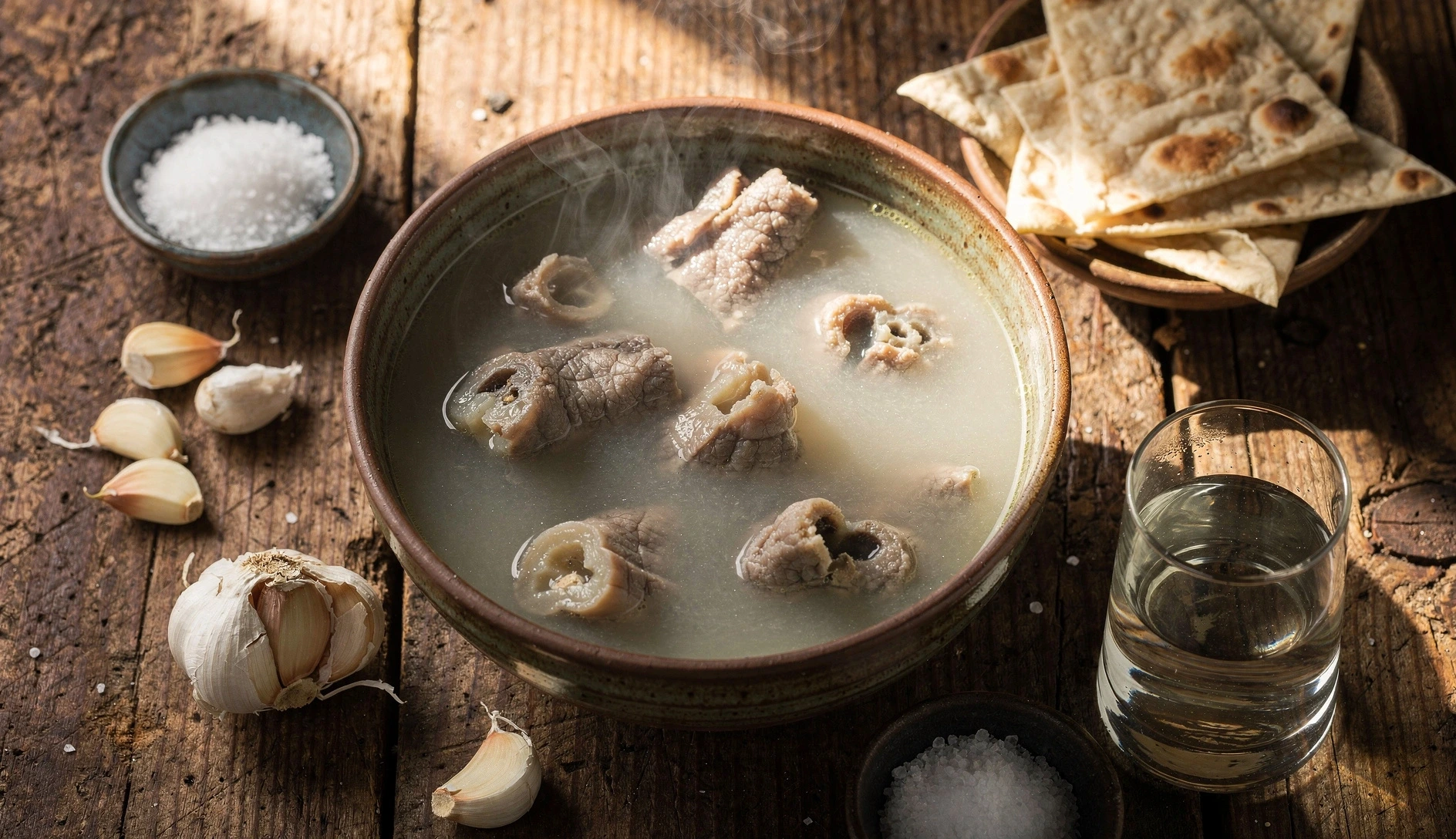
Khashi is not a recipe you stumble into. You either know what it is and you've been looking for this, or someone told you about it and you're here out of morbid curiosity. Either way: this is a soup made from cow's feet and tripe, simmered overnight until the broth turns milky white and thick with gelatin. You eat it at 6 AM with fistfuls of raw garlic and a shot of chacha. It's Georgia's oldest hangover cure, a winter morning ritual, and arguably the most polarizing dish in a cuisine full of strong opinions.
Khashi Quick Facts
- Georgian name: ხაში (KHA-shi)
- Origin: Ancient Caucasian — found across Georgia, Armenia, Azerbaijan, Turkey
- Key ingredients: Cow's feet, tripe, garlic, salt, dried bread
- Type: Gelatinous bone broth soup, eaten at dawn
- Prep time: 4-6 hours soaking + 6-8 hours simmering (overnight)
- Cost in Georgia: 8–15 GEL in khashi restaurants (~$3–5 USD)
- Difficulty: Easy technique, extreme patience required
What Is Khashi, Really?
Strip away the romanticism and khashi is peasant food in the truest sense. When livestock were slaughtered — typically for weddings or feasts — the meat went to the wealthy. The feet, stomach, and offal went to the people who couldn't afford cuts. They cleaned everything meticulously, boiled it through the night, and by morning had a soup so rich in collagen and gelatin that it was practically medicine.
The name likely comes from the Turkish haşlamak (to boil), and versions of this soup exist across the entire Caucasus and Middle East. Armenians call it khash. Azerbaijanis eat it too. But the Georgian version — ხაში — has its own distinct character: no spices in the pot, garlic and salt added only at the table, and always eaten in the morning. Always.
That last part is non-negotiable. Ordering khashi at dinner would be like ordering breakfast cereal at a steakhouse. It's a morning dish — specifically an early morning dish, traditionally served between 6 and 8 AM. The restaurants that specialize in it (and there are dozens in Tbilisi alone) often stop serving by noon.
The Morning Ritual
To understand khashi, you need to understand the scene. It's a cold winter morning in Tbilisi. You've been at a supra the night before — hours of toasts, wine, chacha, more toasts. You wake up at 5:30 AM feeling like you've been hit by a marshrutka. Your friend calls. "Khashi?" The only correct answer is yes.
You drag yourself to a khashi restaurant — often a basement or hole-in-the-wall that's been operating since Soviet times. The room is full of men (traditionally, khashi is a male affair, though this is changing). Everyone looks rough. The air is thick with garlic and steam. A massive bowl of milky white soup arrives, along with a plate of dried bread, a bowl of garlic cloves, coarse salt, and — critically — a shot of chacha or vodka.
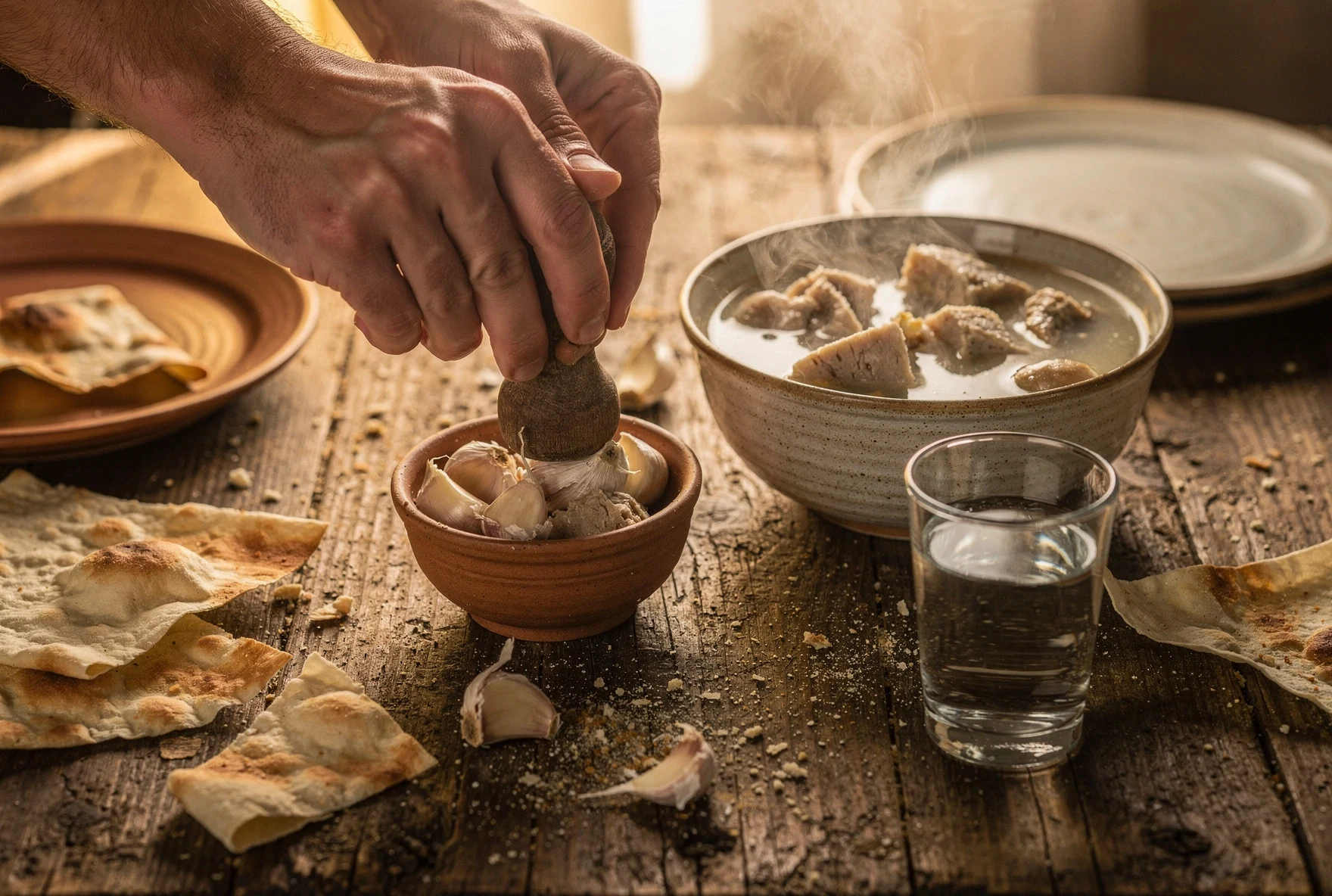
The ritual goes like this: crush the garlic directly into the hot broth. Add salt. Tear the dried bread into pieces and drop them in. Take a shot of chacha. Eat. The gelatin coats your stomach. The garlic burns through the fog. The chacha hits your bloodstream. By the second bowl, you feel human again.
The Garlic Is Not Optional
Khashi without garlic is hot water with tripe in it. The raw garlic is the seasoning — it dissolves into the hot broth and transforms it. Don't be timid. Three cloves is the minimum. Five is standard. Georgians who really mean business use more. Your breath will be destroyed for 24 hours. This is accepted.
Hangover Cure — Or Myth?
The science actually backs this up, at least partially. The gelatin from the slow-cooked collagen is genuinely soothing to the stomach lining. The broth replaces lost fluids and electrolytes. The garlic has antimicrobial and anti-inflammatory properties. The fat slows alcohol absorption if you're still drinking (the chacha). The bread absorbs excess acid.
Is it the world's best hangover cure? Probably not — that's water, sleep, and time. But is it better than lying in bed feeling sorry for yourself? Absolutely. The ritual itself — getting up, going out, sitting with friends in the same miserable state — is half the cure. Misery loves company, and company loves khashi.
Khashi vs. Chikhirtma: Georgia's Two Hangover Soups
| Feature | Khashi | Chikhirtma |
|---|---|---|
| Base | Cow's feet + tripe | Chicken broth |
| Texture | Thick, gelatinous, milky | Silky, egg-thickened |
| Flavor profile | Mild broth + raw garlic punch | Tangy, lemony, herb-forward |
| Cook time | 8+ hours overnight | 45 minutes |
| When to eat | 6-8 AM only | Any time |
| Hangover level | Severe (you need intervention) | Moderate (you can still function) |
| Accompaniment | Chacha + dried bread | Fresh bread |
| Polarizing? | Extremely — tripe is a dealbreaker for many | Universally loved |
Both are legitimate hangover cures, but they serve different needs. Chikhirtma is gentle — silky egg-lemon broth, easy on the stomach, acceptable at any hour. Khashi is the nuclear option. If chikhirtma is aspirin, khashi is an IV drip. You reach for khashi when gentle isn't going to cut it.
Choosing Your Ingredients
Khashi has almost no ingredients. This means every one matters enormously.
🦶 Cow's Feet (ფეხი)
The foundation. Ask your butcher to split them lengthwise — you need the marrow and connective tissue exposed for maximum gelatin extraction. Two feet for 8 servings. They should smell clean, not off. If your butcher doesn't carry them, try ethnic markets — Middle Eastern, Latin American, or Asian butchers almost always have them.
🫁 Tripe (ფაშა)
Honeycomb tripe is the best — it has more surface area, holds more broth, and has a better texture. You can use blanket tripe (flat, smooth) but honeycomb is worth seeking out. About 1kg. In Georgia, the entire stomach lining goes in, including the third and fourth chambers. Outside Georgia, use whatever beef tripe you can find.
| Ingredient | Amount | Notes |
|---|---|---|
| Cow's feet | 2 (about 2kg total) | Split by the butcher. Essential for gelatin. |
| Beef tripe | 1kg | Honeycomb preferred. Pre-cleaned saves hours. |
| Cold water | 5-6 liters | To cover everything by 10cm. Add hot water as it reduces. |
| Garlic | 2 whole heads | Served raw at the table. 3-5 cloves per person. |
| Coarse salt | To taste | Added at the table, never during cooking. |
| Dried bread | Lavash or shotis puri | Must be dried/stale — fresh bread goes soggy. |
| Milk | Optional, small splash | Some Georgians add it. Others consider this heresy. |
| Chacha or vodka | For drinking alongside | Traditional pairing. Beer also common. |
Nothing Goes in the Pot
This is the most important rule. No onions, no bay leaves, no peppercorns, no herbs, no salt. Traditional Georgian khashi is meat, water, and time. That's it. All seasoning happens at the table. If you put anything in the pot, you've made stock, not khashi.
Cleaning the Tripe (The Hardest Part)
This is where most people fail or give up. Tripe cleaning is tedious, unglamorous work. In Georgia, women traditionally spend hours on this — soaking in lime water to soften the inner membrane, scraping, rinsing, repeating. If you're working with pre-cleaned tripe from a butcher (common outside Georgia), you've skipped the worst of it, but you still need to prep it properly.
| Step | What to Do | Time |
|---|---|---|
| 1. Soak the feet | Submerge in cold water, change water 2-3 times | 4-6 hours |
| 2. Scrub tripe | Rinse under cold running water, scrub with coarse salt | 15 minutes |
| 3. Blanch tripe | Boil for 5 minutes in fresh water, drain, rinse | 10 minutes |
| 4. Scrape membrane | Use a knife to scrape off any dark or slimy membrane | 10-15 minutes |
| 5. Final rinse | Rinse until water runs completely clear | 5 minutes |
| 6. Cut | Cut tripe into 5-7cm pieces (they'll shrink during cooking) | 5 minutes |
The smell during cleaning is... honest. If you're sensitive to it, a splash of vinegar in the soaking water helps. But don't over-vinegar — you don't want acid flavor in your final soup.
Step-by-Step Instructions
The beauty of khashi is that there's almost nothing to do. The technique is about patience and restraint — keeping the simmer gentle, skimming thoroughly, and leaving the pot alone.
Step 1: Assemble and Cover (10 minutes)
Place the cleaned, split cow's feet and cut tripe in your largest stockpot. You need a pot that holds at least 8 liters. Cover everything with cold water — at least 10cm above the meat. Starting with cold water is essential for extracting maximum gelatin.
Step 2: Bring Up and Skim (30 minutes)
Bring to a boil over high heat. Within minutes, grey foam will start rising. Skim this aggressively with a large spoon or fine mesh strainer. Keep skimming until the foam stops forming — this usually takes 20-30 minutes. This is the single most important step for a clean, milky broth. Skip it and your khashi will be grey and murky.
Step 3: The Long Simmer (6-8 hours)
Reduce heat to the absolute lowest setting. You want the surface to barely tremble — an occasional bubble, no more. A rolling boil will emulsify the fat in a bad way, making the soup greasy and opaque rather than milky and clean.
This is when most people start cooking: around 10 PM, before bed. Set the stove to its lowest setting. If you have a gas stove with an unreliable low setting, use a diffuser plate. If you're nervous about leaving a stove on overnight, a slow cooker on low works — it won't be quite as good (the temperature is slightly too high), but it's safe and produces a respectable result.
Step 4: Check and Top Up
If you're awake during the simmer (or in the morning), check the water level. It will reduce significantly. Add hot water (never cold — it shocks the gelatin) to keep everything submerged. A 6-liter pot might need 1-2 liters of top-up over 8 hours.
Step 5: The Finish (15 minutes)
After 6-8 hours, the khashi is done when:
- The meat falls off the cow's feet bones with zero resistance
- The tripe is very tender (but still has some chew — it shouldn't be mush)
- The broth is milky white and viscous — it should coat the back of a spoon
- The kitchen smells like a warm, meaty cloud
Remove the large bones (the hooves). Leave the meat that fell off. Some people strain and remove all solids, then serve just the broth with garlic. Others (the majority) serve everything — tripe, foot meat, broth, all in the bowl. The foot meat between the joints is surprisingly good — soft, gelatinous, and rich.
Step 6: Serve the Ritual
Ladle the hot khashi into deep bowls. Set the table with:
- A bowl of peeled garlic cloves and a garlic press (or just a fork)
- Coarse salt
- Dried lavash or shotis puri — torn into pieces
- Optional: a small pitcher of milk
- A bottle of chacha or vodka with small glasses
Each person seasons their own bowl. This is the ritual. This is the point.
The Milk Debate
Ask ten Georgians about putting milk in khashi and you'll get ten passionate opinions. Here's the breakdown:
🥛 Pro-Milk Camp
A splash of cold milk cools the broth to eating temperature and adds a subtle creaminess. Some say it helps the garlic dissolve. This is more common in Tbilisi. The milk should be cold — it creates a nice temperature contrast in the hot soup.
🚫 Anti-Milk Camp
Adding milk masks the flavor of a properly made broth. If your khashi needs milk, your khashi isn't good enough. This tends to be the more traditional position. The broth itself should already be milky-white from the gelatin extraction — additional milk is just... wrong.
Our take: try it both ways. The milk version is gentler and slightly more approachable. The pure version is more intense and, if the broth is good, arguably more satisfying. Neither side is going to convince the other.
Tripe Soups Around the World
Khashi isn't alone. Tripe soups are one of those dishes that independently evolved everywhere humans kept cattle. Comparing them reveals what makes the Georgian version distinct.
| Dish | Country | Key Difference | Seasoning |
|---|---|---|---|
| Khashi (ხაში) | Georgia | No spices in the pot — garlic/salt at table | Raw garlic, salt |
| Khash (խաշ) | Armenia | Very similar, served with lavash and vodka | Garlic, vinegar/lemon |
| Shkembe chorba | Bulgaria/Turkey | Milk and vinegar added during cooking | Garlic, vinegar, chili |
| Menudo | Mexico | Red chili broth with hominy | Guajillo chili, oregano, lime |
| İşkembe çorbası | Turkey | Egg-lemon thickened, similar to avgolemono | Vinegar, garlic, paprika butter |
| Pho (with tripe) | Vietnam | Star anise, cinnamon, rice noodles | Hoisin, sriracha, herbs |
What makes Georgian khashi unique is its austerity. While Mexican menudo is a complex red chili broth and Turkish işkembe gets an egg-lemon treatment, khashi is deliberately, stubbornly plain. The broth is just meat and water. The idea is that if your ingredients are good and your cooking is patient, you don't need to add anything. The gelatin IS the flavor.
Where to Eat Khashi in Tbilisi
Making khashi at home is a commitment. For most people — even Georgians — it's a restaurant dish. Tbilisi has dedicated khashi restaurants, many of which have been operating for decades.
🏪 Maspindzelo
In Abanotubani, near the sulfur baths. Open 24/7. Great khashi and excellent khinkali. The go-to for many Tbilisians after a long night.
🏪 Samikitno
Multiple locations. The chain that everyone knows. Consistent quality, reasonable prices. The Rustaveli location is convenient but the Saburtalo one is less touristy.
🏪 Neighborhood Spots
Every neighborhood has its own unlabeled khashi hole. Ask any Georgian man over 40 where he goes for khashi, and he'll direct you to a basement with no sign. These are usually the best.
⏰ Timing
Go between 6-9 AM for the authentic experience. Some places serve until noon or 1 PM. By afternoon, most khashi restaurants are closed or out of stock. It's a morning dish — they make one batch overnight and when it's gone, it's gone.
Critical Cooking Tips
| Rule | Why |
|---|---|
| Start with cold water | Hot water seals the surface and traps gelatin inside. Cold water extracts it slowly. |
| Skim aggressively | The grey scum makes the broth murky and gives it an off taste. |
| Never boil — barely simmer | A rolling boil emulsifies fat and makes the soup greasy instead of milky. |
| Add only hot water | Cold water shocks the gelatin and can make it separate. |
| No salt during cooking | Salt at the table lets each person season to taste. It's part of the ritual. |
| Serve immediately | Khashi sets into jelly as it cools. It must be served blazing hot. |
Slow Cooker Alternative
If leaving a stove on overnight sounds like a bad idea (fair), a slow cooker produces a very good khashi with zero fire risk.
Slow Cooker Method
Do the initial boil-and-skim step on the stovetop (this is essential — you can't skim properly in a slow cooker). Then transfer everything to the slow cooker on LOW for 10-12 hours. The slightly higher temperature means it may be done sooner, but a longer cook won't hurt. The broth won't be quite as clean as stovetop, but it's close — and you can sleep soundly.
Storing and Reheating
🧊 Refrigerating
Khashi will set into a solid jelly in the fridge. This is expected — that's the gelatin. It keeps for 3-4 days. To serve, reheat gently in a pot until fully liquid and hot. Don't microwave — it heats unevenly and you'll get hot spots in the jelly.
❄️ Freezing
Freezes well for up to 3 months. Portion into containers (about 500ml per serving). Thaw overnight in the fridge, then reheat on the stovetop. The texture holds up perfectly after freezing — the gelatin is resilient.
Health Benefits (Real Ones)
Khashi has been used medicinally in Georgia for centuries. Some of these claims hold up:
| Claim | Evidence |
|---|---|
| Joint health | High in collagen and gelatin, which may support cartilage. Plausible. |
| Bone healing | Traditionally prescribed for broken bones. The calcium and minerals from bones are real, but the amounts are modest. |
| Stomach soothing | Gelatin is genuinely soothing to the digestive tract. Well-supported. |
| Cold remedy | Hot broth + garlic for colds — similar to chicken soup anywhere. Hydration and warmth help. |
| Hangover cure | Fluid replacement, electrolytes, stomach coating. Partially supported. The ritual and community help too. |
Common Mistakes
❌ Adding Spices to the Pot
No bay leaves, no peppercorns, no onion. Georgian khashi is meat and water. Seasoning happens at the table. Adding anything during cooking is a different soup entirely.
❌ Boiling Instead of Simmering
A rolling boil breaks up the fat into tiny droplets that make the broth greasy and grey. The lowest simmer possible — barely moving — gives you a clean, milky-white result.
❌ Skipping the Skim
That grey foam in the first 30 minutes is impurities and blood proteins. If you don't remove it, your broth will taste slightly metallic and look muddy.
❌ Not Enough Garlic
One clove of garlic in a bowl of khashi is pointless. The garlic IS the seasoning. Three cloves is minimum, five is normal. Don't be precious about it.
❌ Using Fresh Bread
Fresh bread turns to paste in the hot broth. You need dried or stale bread that holds its structure. Dry your lavash in the oven if needed — 100°C for 20 minutes until crisp.
❌ Serving It at Dinner
Khashi is a morning dish. This isn't a suggestion — it's a cultural rule. If you serve khashi at 8 PM, Georgians will look at you the way Italians look at someone ordering cappuccino after lunch.
Nutrition Information
| Nutrient | Per Serving |
|---|---|
| Calories | ~280 kcal |
| Protein | ~25g (high in glycine and proline) |
| Fat | ~15g |
| Carbs | ~5g (from bread) |
Frequently Asked Questions
Can I make khashi with just tripe (no feet)?
You can, but you'll miss the gelatin that makes khashi khashi. The cow's feet provide the thick, milky, gelatinous texture that distinguishes khashi from ordinary tripe soup. Without them, you'll have thin broth with tripe in it. If you absolutely can't find feet, add pig's trotters as a substitute — they're loaded with gelatin too.
Why is khashi only eaten in the morning?
The tradition dates back centuries. When animals were slaughtered for feasts, the offal was cleaned and boiled overnight, ready by morning. It became associated with the morning after celebrations — a recovery meal. Over time, the timing became cultural law. There's also a practical reason: the heavy gelatin and garlic are genuinely better suited to an empty morning stomach than a full evening one.
Is khashi really a men-only dish?
Traditionally, yes — khashi restaurants were male spaces, and the preparation and early-morning consumption were male social rituals. But this is changing. Women increasingly eat khashi in Tbilisi, and the strict gender divide is fading with younger generations. The only people who still insist it's men-only are the ones who also think women shouldn't make barbecue (mtsvadi). Don't listen to them.
Can I use a pressure cooker?
Yes. A pressure cooker cuts the cooking time to 2-3 hours. Soak and clean as normal, do the initial skim on the stovetop, then pressure cook on high for 2.5 hours. The broth will be slightly less clear than the overnight method, but the gelatin extraction is excellent. Modern electric pressure cookers (Instant Pot) work well — use the "Meat/Stew" setting for 150 minutes.
What does khashi taste like?
Honestly? Before you add garlic and salt, it tastes like... warm nothing. Rich, meaty nothing. The broth has body and depth but is deliberately unseasoned. That's the point — the garlic and salt you add at the table provide all the flavor. The tripe has a mild, slightly chewy texture. The foot meat is soft and gelatinous. It's a textural experience as much as a flavor one. If you're expecting bold, spicy, or complex flavors, khashi will confuse you. Its power is in its simplicity.
Written by The Georgian Eats Team
We've eaten khashi at 6 AM in Tbilisi basements more times than we'd like to admit. The garlic breath lasts longer than the hangover — but that's the deal.
Last updated: February 2026.
Related Articles
Chikhirtma: Egg-Lemon Chicken Soup
Georgia's other hangover cure — silky, tangy, and much easier to make.
Kharcho: Spiced Beef and Walnut Soup
Beef simmered with walnuts and sour plum — Georgia's most famous soup.
Kuchmachi: Organ Meats with Walnuts
Another offal masterpiece — chicken livers and hearts with pomegranate.
The Georgian Supra
The feast that creates the hangover that requires the khashi.