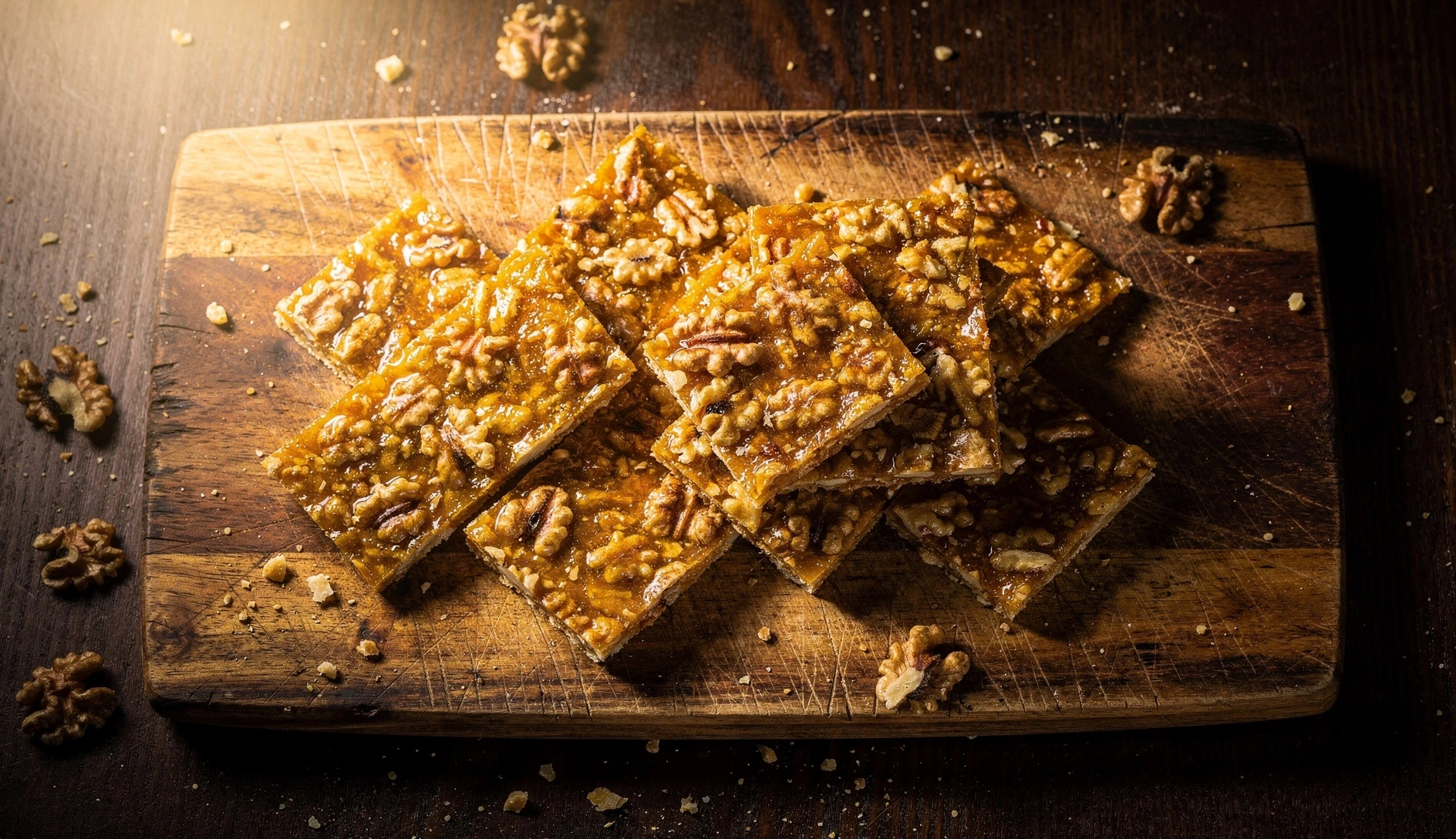
If you're in Georgia on New Year's Eve, you'll smell gozinaki before you see it. That deep, slightly burnt honey aroma pouring out of every kitchen in the country. It's the smell of December 31st here — as universal as pine trees or champagne corks elsewhere. Gozinaki is two ingredients: honey and walnuts. That's it. No flour, no butter, no eggs. Just caramelized honey holding together shards of toasted walnut in a crunchy, sticky, deeply satisfying candy that every Georgian grandmother makes slightly differently and insists her version is the correct one.
Gozinaki Quick Facts
- Georgian name: გოზინაყი (go-zi-NA-ki)
- Meaning: From "gozi" (გოზი), an old Georgian word for walnut
- Type: Confection / candy / dessert
- Active time: 15 minutes
- Cook time: 25 minutes
- Difficulty: Easy technique, but timing matters — honey goes from perfect to burnt in seconds
- Diet: Gluten-free, dairy-free, naturally vegan (check your honey source)
Why Gozinaki Matters
Georgia doesn't really do desserts the way the rest of the world does. There's no Georgian chocolate cake tradition, no pastry shops on every corner, no multi-course dessert menus. Georgian meals end with fruit, churchkhela if you're lucky, and the assumption that you're already too full to consider anything sweet. The exception is New Year's, when every household in the country makes gozinaki.
This isn't some obscure regional specialty. Gozinaki is THE Georgian confection — the one that appears on every supra table between December 31st and January 14th (Old New Year). It's served alongside churchkhela on festive tables, brought as gifts when visiting friends, and stacked in massive pyramids at bazaars across the country. If churchkhela is Georgia's everyday sweet, gozinaki is the one reserved for celebration.
The Mekvle Tradition
Gozinaki isn't just food. It's part of a New Year ritual called mekvle — the tradition of the "lucky first visitor." Georgians believe the first person to cross your threshold after midnight on New Year's Eve determines your luck for the entire year. This person, the mekvle, is carefully chosen: usually someone considered lucky, kind-hearted, or prosperous.
The night before, families prepare baskets filled with gozinaki, churchkhela, fruit, and other sweets. Right after midnight, the chosen mekvle is sent outside. He knocks on the door. Someone inside asks, "Who's there?" He answers, "The mekvle!" "What do you bring?" And he replies three times: "I bring happiness, health, and prosperity." Then the door opens, and the contents of the basket are ceremonially scattered on the floor to bless the house.
There's something genuinely lovely about a culture where candy carries that much symbolic weight. Gozinaki on the New Year's table isn't decorative — it's a promise of sweetness in the year ahead.
Ingredients: Less Is More
The beauty of gozinaki is that there's nowhere to hide. Two real ingredients, one optional. The quality of each one matters enormously.
| Ingredient | Amount | Notes |
|---|---|---|
| Walnuts (shelled) | 500g | Fresh, light-colored halves. Dark or bitter walnuts ruin everything. |
| Honey | 250g | Good wildflower or mountain honey. Not cheap supermarket honey. |
| Sugar (optional) | 1 tbsp | Helps honey caramelize evenly. Some purists skip it. |
On Honey
Georgia produces extraordinary honey. Mountain honey from Tusheti, wildflower honey from Kakheti, chestnut honey from Adjara — each gives gozinaki a different character. The ideal is a medium-bodied wildflower honey: floral enough to taste interesting, but not so strongly flavored that it overpowers the walnuts after caramelization. Chestnut honey makes a darker, more bittersweet gozinaki that's an acquired taste. Acacia honey is too mild — it gets lost.
Avoid cheap blended honey or anything labeled "honey product." When you cook honey down for 20 minutes, the flavor concentrates. Bad honey becomes aggressively bad honey.
On Walnuts
Georgia is one of the world's great walnut countries. The walnuts here are oily, fresh, and taste nothing like the stale, bitter specimens you find vacuum-packed in many Western supermarkets. For gozinaki, you want fresh walnut halves — light-colored, sweet, with no bitter aftertaste when you eat one raw. If your walnuts taste bitter, no amount of honey will save the finished product.
Chop them into coarse, irregular pieces. Not walnut dust, not perfect cubes. You want pieces about the size of a fingernail — big enough to give each bite structural crunch, small enough that the honey can hold them together.
The Walnut Skin Debate
Some Georgian cooks insist on removing the thin brown skin from each walnut piece after toasting — it can add bitterness, especially with older walnuts. If your walnuts are fresh and sweet, don't bother. If they're slightly bitter, toast them, wrap in a kitchen towel, rub vigorously, and most of the skins will flake off. It's tedious but makes a difference.
The Honey Is Everything
Here's the truth about gozinaki: the walnuts are easy. Toast them, chop them, done. The entire recipe lives or dies in how you cook the honey. Get this right and you'll have shatteringly crunchy candy with deep caramel flavor. Get it wrong and you'll have either a sticky, chewy mess (undercooked) or an acrid, burnt disaster (overcooked). The margin between perfect and ruined is about 2 minutes.
What Happens When You Cook Honey
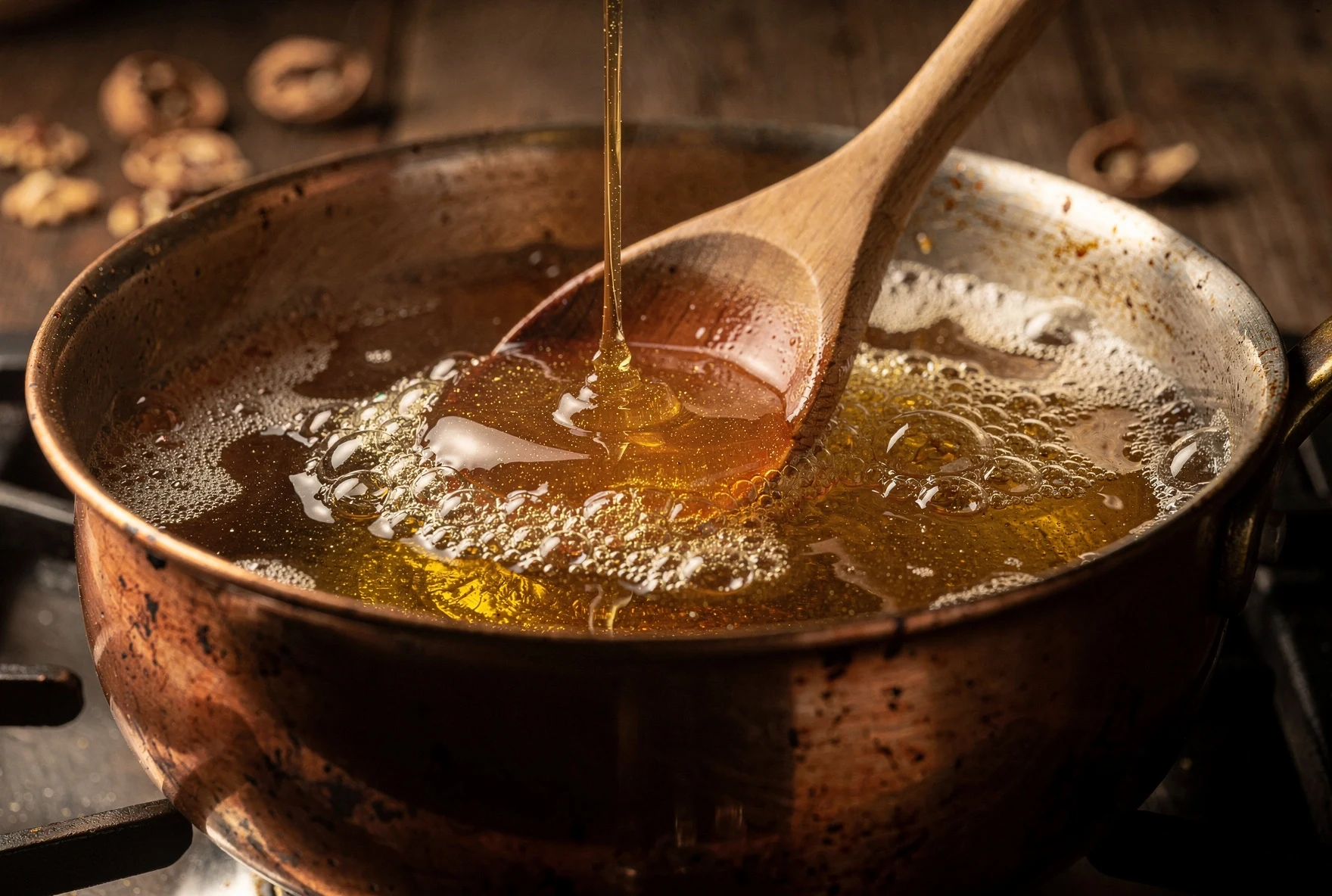
Raw honey is about 80% sugars (mostly fructose and glucose) and 17% water. When you heat it:
- First 5 minutes: The honey thins out and becomes more liquid as it warms. Water starts evaporating.
- 5–10 minutes: It begins to foam as moisture escapes. The color starts shifting from golden to deeper amber.
- 10–15 minutes: The foaming becomes vigorous and even. The sugars are caramelizing now — this is where the deep, complex flavor develops.
- 15–20 minutes: The honey reaches the "hard ball" stage (around 130°C / 265°F). It's dark amber and the foam has a consistent, fine texture.
- Past 20 minutes: Danger zone. The honey can go from perfect to burnt in under 60 seconds.
| Visual Cue | What It Means | Action |
|---|---|---|
| Thin, runny, light gold | Just warming up | Keep stirring, low heat |
| Foaming, medium amber | Water evaporating, caramelization starting | Add sugar now if using |
| Even foam, dark amber, thickening | Approaching readiness | Start testing with cold water |
| Drops hold shape in cold water | Done — hard ball stage reached | Add walnuts immediately |
| Smoking, very dark, bitter smell | Burnt — start over | Throw it out. No saving this. |
The Cold Water Test
This is the traditional Georgian method and it works better than a candy thermometer for beginners. Keep a glass of cold water next to the stove. Every 2 minutes once the honey is dark amber, drop a small spoonful into the water. If the drop dissolves and spreads — keep cooking. If the drop sinks to the bottom and holds its shape as a firm, slightly flexible ball — you're there. Pull it off the heat immediately.
If you prefer precision: you're aiming for 130–135°C (265–275°F). This is the "hard ball" stage in candy-making terms. Above 140°C and you'll get something too hard — more like toffee than brittle. Below 125°C and it'll stay sticky and chewy forever.
Step-by-Step Instructions
Step 1: Toast the Walnuts
Spread the walnut halves in a single layer in a dry skillet over medium-low heat. Toast for 5–7 minutes, shaking the pan every minute or so, until they smell distinctly nutty and have darkened slightly. Don't walk away — walnuts go from toasted to scorched fast.
Transfer them to a plate to cool (they'll keep cooking in a hot pan). Once cool enough to handle, chop each half into 3–4 irregular pieces. Set aside.
Step 2: Cook the Honey
Pour 250g of honey into a heavy-bottomed saucepan. A thick-bottomed pan is non-negotiable — thin pans create hot spots that burn the honey before the rest has caramelized. Use the lowest heat setting on your stove. Stir constantly with a wooden spoon.
After about 5 minutes of gentle heating, the honey will start to foam. If you're using sugar, add it now and stir until dissolved. Continue stirring over low heat for another 10–15 minutes. The honey will darken progressively. Never stop stirring — caramelizing honey on the bottom of the pan is the number one failure point.
Step 3: Test for Readiness
Once the honey is a consistent dark amber and the foam is fine and even, start the cold water test. Drop a small amount into cold water every 2 minutes. When it forms a firm ball that holds its shape, move immediately to the next step. This whole window — from "not quite ready" to "perfect" to "burnt" — is about 4 minutes. Stay alert.
Step 4: Add the Walnuts
Dump all the toasted walnuts into the caramelized honey at once. Stir vigorously with a wooden spoon for 1–2 minutes until every piece is coated. The mixture will be extremely hot and very sticky. There should be just enough honey to bind the nuts — if you see liquid honey pooling at the bottom, you've used too much honey relative to nuts.
Step 5: Shape and Cut
This is where speed matters. Wet a wooden cutting board (the moisture prevents sticking) or line a baking sheet with oiled parchment paper. Turn the hot mixture out onto the surface. Wet your hands — seriously, they need to be wet or you'll burn yourself and stick to everything — and press the mixture into a rough rectangle about 1 cm thick. You can use a wet rolling pin to even it out.
Wait 2–3 minutes until it's firm enough to cut but still warm. Cut diamond shapes with an oiled knife: make parallel lines 4–5 cm apart in one direction, then cut diagonal lines across them. You need to work fast. Once gozinaki cools completely, it becomes rock-hard and trying to cut it will shatter the whole slab.
Step 6: Cool and Store
Let the pieces cool completely at room temperature — about 30 minutes. Don't refrigerate. Once fully set, separate the diamonds and store in an airtight container with parchment paper between layers to prevent sticking. Properly made gozinaki keeps for 2–3 weeks at room temperature.
The Cutting Window
You have roughly a 3-minute window to cut gozinaki. Too soon and the shapes deform as the mixture is still too soft. Too late and it's set hard. If you miss the window, place the whole slab in a 100°C oven for 5 minutes to soften slightly, then try again. Or just break it into rustic irregular pieces and call them "traditional."
Common Mistakes
🔥 Cooking Honey Too Fast
High heat burns honey before it caramelizes. Always use the lowest setting. Patience is the entire technique. It should take 15–20 minutes, not 8.
🥄 Stopping Stirring
Honey on the bottom of the pan burns silently. You won't know until you taste it. Stir constantly from the moment you turn on the heat. No exceptions.
🔪 Cutting Too Late
The mixture goes from "soft enough to cut" to "concrete slab" in about 3 minutes. Have your knife oiled and your cutting plan ready before you pour it out.
🍯 Using Bad Honey
Cheap, blended, or "honey-flavored" products won't caramelize properly and taste terrible when concentrated. Use real, good-quality honey. It's 50% of the recipe.
🌰 Not Toasting Walnuts
Raw walnuts in gozinaki taste flat and slightly rubbery. Five minutes of toasting transforms them — brings out oils, adds crunch, deepens flavor. Don't skip it.
📏 Rolling Too Thin
Thinner than 0.5 cm and it shatters into crumbs. Thicker than 1.5 cm and it's a jaw workout. Aim for about 1 cm — enough to snap cleanly with a satisfying crack.
Variations
Traditional gozinaki is walnut and honey. Full stop. But Georgia being Georgia, every region has opinions about what else belongs in there.
Hazelnut Gozinaki
Common in Imereti and Racha. Hazelnuts give a different crunch — more snappy, less oily. Toast them a bit longer than walnuts and rub off the skins.
Mixed Nut
A 50/50 walnut-hazelnut split is a popular modern take. Some cooks add almonds or even pumpkin seeds. Unorthodox but genuinely good.
Sesame Seed Gozinaki
Technically a different candy (closer to Middle Eastern brittle), but you'll see it sold alongside gozinaki at markets. All sesame, no nuts. Delicate and crunchy.
Food52's Version
Some Western adaptations add pomegranate molasses or rum extract. These make a different (and good) candy, but calling it gozinaki would get you some looks in Tbilisi.
Gozinaki vs. Churchkhela
These two get compared constantly because they're both walnut-based Georgian sweets. But they're fundamentally different:
| Feature | Gozinaki | Churchkhela |
|---|---|---|
| Binder | Caramelized honey | Thickened grape must (tatara) |
| Shape | Flat diamond pieces | Long, candle-shaped strings |
| Texture | Hard, crunchy, snaps when bitten | Chewy, dense, sometimes gummy |
| Season | New Year (December–January) | Grape harvest (September–October) |
| Shelf life | 2–3 weeks | Months to over a year |
| Difficulty | Easy (30 min total) | Complex (multi-day process) |
Think of gozinaki as the quick, crunchy, honey-forward one and churchkhela as the slow, chewy, grape-forward one. Both use walnuts, but the resemblance ends there. Interestingly, in parts of western Georgia (Racha, Imereti), "churchkhela" was historically used to refer to both — which is confusing and still causes arguments at dinner tables.
Serving and Pairing
Gozinaki is not a plated dessert. It's set out on the table in a pile and people grab pieces throughout the evening. It pairs well with:
| Pairing | Why It Works |
|---|---|
| Strong black tea | The tannins cut through the sweetness. This is the classic Georgian pairing. |
| Turkish coffee | Bitter and sweet, crunchy and liquid. A natural match. |
| Semi-sweet amber wine | A Tsolikouri amber or a Khvanchkara with gozinaki is a revelation. |
| Fresh fruit | Mandarins and persimmons are the traditional table companions. |
| Chacha (grape brandy) | A small glass of chacha between pieces. This is how Georgians actually eat it. |
Buying vs. Making
You can buy gozinaki at any bazaar in Georgia from about mid-December. Market vendors stack it in huge trays, often with different nut combinations. The quality varies wildly — some is excellent, some is oily and stale. The problem with market gozinaki is you don't know when it was made or what honey was used.
Supermarket gozinaki (the kind in plastic packaging) is consistently mediocre. It's often too sweet, uses cheap honey, and the walnuts taste stale. Avoid it.
Homemade is better. Always. The 30-minute investment is worth it, and the smell of honey caramelizing in your kitchen is worth the recipe existing in the first place.
Troubleshooting
| Problem | Cause | Fix |
|---|---|---|
| Sticky and chewy, won't harden | Honey undercooked — didn't reach hard ball stage | Return mixture to pan, cook another 3–5 minutes, re-test |
| Bitter taste | Honey burnt or walnuts were rancid | No fix — start over with fresh ingredients, lower heat |
| Falls apart, won't hold together | Too many nuts relative to honey | Use a 1:2 honey-to-nut ratio. 250g honey per 500g nuts. |
| Rock hard, tooth-cracking | Honey overcooked past hard ball into hard crack stage | Pull honey off heat earlier. Use the cold water test religiously. |
| Uneven color | Hot spots in the pan or inconsistent stirring | Use a heavier pan. Stir in figure-eight patterns, not circles. |
| Sticking to everything | Surfaces and hands not wet enough | Wet the board, wet your hands, oil the knife. Water is your friend. |
Nutrition
Gozinaki is not health food and doesn't pretend to be. It's honey and nuts. Per piece (roughly 15g):
The silver lining: walnuts are rich in omega-3 fatty acids, and honey has trace minerals and antioxidants. But let's be honest — nobody eats gozinaki for the omega-3s. It's a celebration food. Eat it joyfully and move on.
Frequently Asked Questions
Can I use a candy thermometer?
Absolutely. Aim for 130–135°C (265–275°F). But the cold water test is more reliable for small batches because thermometers can be slow to respond in shallow pans.
Can I use pecans or almonds?
You can, and it'll taste good, but it won't be gozinaki. Georgian tradition specifically uses walnuts. Hazelnuts are the only other nut with traditional precedent.
Why did my honey crystallize?
You didn't stir enough or your honey was already partially crystallized. The tablespoon of sugar actually helps prevent this by disrupting crystal formation. Stir more constantly.
Should I refrigerate gozinaki?
No. Room temperature, airtight container. Refrigeration can introduce moisture that makes it sticky. A cool, dry pantry is perfect.
Is gozinaki actually ancient?
Honey and nut confections have been made across the Caucasus and Middle East for thousands of years. Georgia's specific gozinaki tradition is centuries old but exact origins are unclear. What's certain: it predates refined sugar in the region.
Written by The Georgian Eats Team
We've eaten our way through dozens of New Year's tables in Georgia and made gozinaki in our own kitchen more times than we can count. The smell of honey caramelizing in December is one of those things that makes Tbilisi feel like home.
Last updated: February 2026.
Related Articles
Churchkhela: Georgia's Ancient Walnut Candy
The grape must and walnut candy that's been fueling Georgians for centuries.
Georgian Spices and Herbs Guide
The essential flavors behind Georgian cooking — from blue fenugreek to dried marigold.
Georgian Wine for Beginners
Everything you need to know about 8,000 years of winemaking tradition.
What to Eat in Georgia
The comprehensive guide to Georgian cuisine — every dish worth knowing.