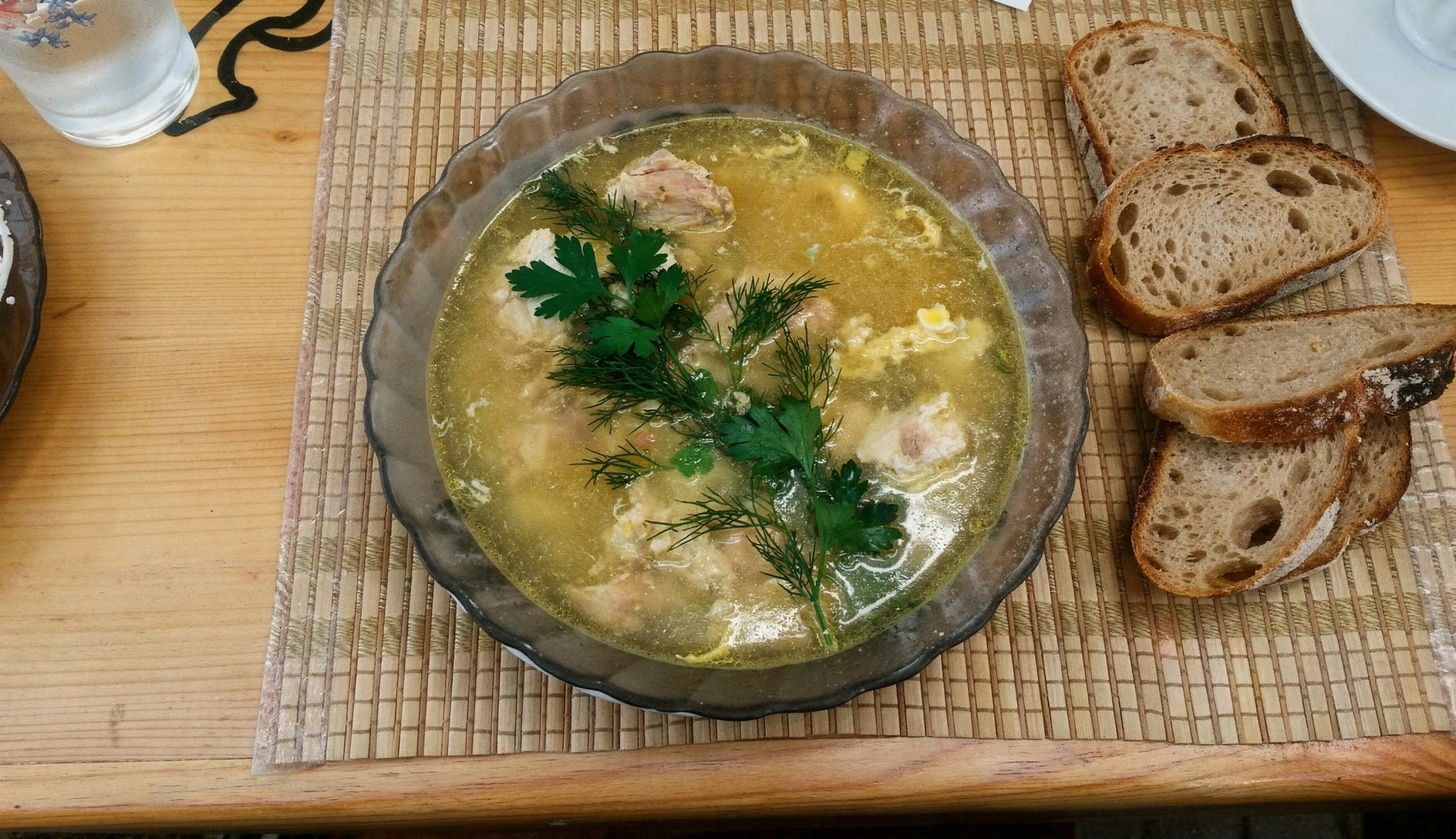
Every culture has its chicken soup. Georgia's version makes most of them look lazy. Chikhirtma is a chicken soup with no noodles, no vegetables bobbing around, no rice — just pure concentrated chicken broth, enriched with beaten egg yolks until it turns silky and golden, then hit with enough lemon to make the whole thing sing. It's lighter than it sounds, more sophisticated than it looks, and it's the dish every Georgian grandmother will tell you cures hangovers, colds, heartbreak, and most other afflictions of the human condition. They're not entirely wrong.
Chikhirtma Quick Facts
- Georgian name: ჩიხირთმა (chikh-IRTH-ma)
- Origin: Pan-Georgian, but especially popular in eastern Georgia
- Key technique: Egg yolk tempering — thickens broth without scrambling
- Famous for: Georgia's hangover cure (alongside khashi)
- Prep + cook time: 20 min prep, 70 min cooking
- Cost in Georgia: 8–14 GEL in restaurants (~$3–5 USD)
- Difficulty: Moderate — the tempering step requires patience
Why This Soup Matters
Chikhirtma occupies a strange and beloved corner of Georgian cuisine. It's not a supra dish — you won't find it at a feast table groaning with khinkali and khachapuri. It's more personal than that. It's the soup you eat the morning after a long night of toasting. The soup your mother makes when you're sick. The soup that proves a cook understands restraint, because there's nowhere to hide when the ingredient list is this short.
What makes chikhirtma unusual — and what separates it from every other chicken soup tradition — is the near-total absence of vegetables. No carrots. No celery. No potatoes. The broth is the point, and the egg yolks transform it from a light liquid into something with body and richness that coats the back of a spoon. The lemon (or vinegar, depending on the family) provides the essential counterbalance — without it, the egg-enriched broth would be one-dimensional. With it, the soup becomes bright, restorative, almost medicinal in the best sense.
The technique has clear parallels with Greek avgolemono and Turkish terbiyeli tavuk çorbası. Some food historians trace all three back to a shared Caucasian-Anatolian-Mediterranean tradition of egg-thickened soups. But chikhirtma distinguishes itself through its herb profile — the combination of cilantro and dill gives it a character that's unmistakably Georgian — and its stripped-down purity. Where avgolemono usually includes rice, chikhirtma insists on nothing but broth, chicken, and eggs.
The Hangover Cure Reputation
Georgian drinking culture is built around the supra — elaborate multi-course feasts with a tamada (toastmaster) who leads round after round of wine toasts. After a proper supra, which can stretch past midnight with dozens of toasts, the morning after demands something restorative. Georgia has two answers: khashi (a heavy tripe soup eaten at dawn, usually with vodka — hair of the dog, Georgian style) and chikhirtma.
Chikhirtma is the gentler option. The protein from the egg yolks, the electrolytes from the broth, the vitamin C from the lemon, the anti-inflammatory properties of the herbs — it's practically an IV drip in soup form. Restaurants in Tbilisi's old town that cater to the post-supra crowd often have chikhirtma as a morning special. The really good ones use broth they started the night before.
Chikhirtma vs Khashi
Both are traditional hangover cures, but they're for different people. Khashi is beef tripe soup — rich, heavy, and eaten at 6 AM with a shot of chacha. It's for the hardcore. Chikhirtma is the civilized alternative: lighter, more elegant, and doesn't require you to enjoy tripe at sunrise. Most visitors (and plenty of Georgians) prefer chikhirtma.
Ingredients
The beauty of chikhirtma is that the ingredient list reads like a pantry raid. No specialty items, no obscure spices, nothing you need to order online. The only thing you might not have is the patience to make proper broth — and if you cut that corner, the soup suffers noticeably.
The Broth
| Ingredient | Amount | Notes |
|---|---|---|
| Whole chicken | 1.5–1.8kg | Or 4 leg-thigh pieces for faster cooking |
| Water | 1.5 litres | Cold — start cold for clearer broth |
| Cilantro stems | 1 large bunch | Stems in broth, leaves for garnish |
| Dill stems | 1 large bunch | Same — stems in, leaves saved |
| Bay leaf | 1 | Remove after cooking |
| Black peppercorns | 5–6 whole | Whole, not ground |
The Soup
| Ingredient | Amount | Notes |
|---|---|---|
| Butter | 15g (1 tbsp) | For the onion base |
| Onion | 1 large, finely diced | The only vegetable in the soup |
| Garlic | 3–4 cloves, minced | Not optional |
| All-purpose flour | 15g (1 tbsp) | For body — some cooks skip this |
| Egg yolks | 3 large | Room temperature — temper slowly |
| Lemon juice | Juice of 1 lemon | Or 2 tbsp white wine vinegar |
| Ground coriander | ½ tsp | Essential Georgian spice |
| Saffron or turmeric | Pinch | Optional — for golden color |
Lemon vs Vinegar
This is the great chikhirtma debate. Lemon juice is more common in modern recipes and gives a cleaner, brighter acidity. White wine vinegar is the older tradition — sharper, more assertive, and arguably more "Georgian." Both are correct. Use whatever you prefer, but start with less than you think — you can always add more acidity at the end, but you can't take it back.
Equipment
Large Heavy Pot
A Dutch oven or heavy stockpot, at least 4 litres. You need room for the whole chicken plus water. Enameled cast iron is ideal — it holds heat evenly and the light interior lets you monitor the broth color.
Fine-Mesh Strainer
Non-negotiable. Chikhirtma's elegance depends on a clean, clear broth. A fine-mesh strainer catches the spent herb stems, peppercorns, and any scum that escaped skimming. Cheesecloth over a colander works too.
The Recipe: Step by Step
Step 1: Build the Broth (60–70 minutes)
Place the whole chicken in a large pot and cover with 1.5 litres of cold water. Starting cold is important — it extracts more gelatin and protein from the bones, giving you a richer, more full-bodied broth. Add the cilantro and dill stems (tied in a bundle if you want easy removal), the bay leaf, and the whole peppercorns.
Bring to a boil over medium-high heat. As soon as it boils, you'll see a raft of grey foam rise to the surface. Skim this aggressively with a spoon — it's coagulated protein and will cloud your broth if left in. Reduce heat to a bare simmer. You want lazy bubbles breaking the surface, not a rolling boil. Cover partially and let it cook for 60–70 minutes.
The chicken is done when a thigh joint wiggles freely and the meat pulls away from the bone with no effort. Remove the chicken to a plate. Strain the broth through a fine-mesh sieve into a clean container. Discard the spent herbs, bay leaf, and peppercorns. You should have 1.2–1.5 litres of clear, golden-tinted broth.
Shortcut: Use Existing Stock
If you have homemade chicken stock on hand, you can skip the hour-long simmer. Use 1.2 litres of stock, poach chicken thighs in it for 25–30 minutes, then continue from Step 2. Store-bought stock works in a pinch but the difference is noticeable — chikhirtma is basically dressed-up broth, so the broth quality is everything.
Step 2: Shred the Chicken
While the chicken cools enough to handle, shred the meat into bite-sized pieces. Use your hands — it's faster and gives you more control over piece size than forks. Discard the skin (it's given everything to the broth at this point) and the bones. You want roughly 300–400g of shredded meat. Set aside.
Step 3: The Onion-Flour Base (10 minutes)
Wipe out the pot or use a clean one. Melt the butter over medium heat. Add the diced onion and cook for 6–8 minutes, stirring occasionally, until completely soft and translucent. Don't rush this — raw onion in the finished soup would be harsh. Add the minced garlic and cook for 1 minute until fragrant.
Sprinkle the flour over the onions and stir constantly for 2 minutes. You're making a very light roux — it should stay pale, not take on any brown color. This isn't about flavor; it's about giving the broth a touch more body. Some traditional recipes skip the flour entirely and rely solely on the egg yolks for thickening. Both approaches work, but the flour version is slightly more forgiving for beginners.
Step 4: Add the Broth
Gradually ladle the strained broth into the pot, stirring constantly to prevent lumps from the flour. Add the ground coriander and the optional saffron or turmeric (just a pinch — you want warmth and color, not saffron risotto). Bring to a gentle simmer and cook for 10 minutes to let the flavors meld.
Step 5: The Tempering — The Critical Step
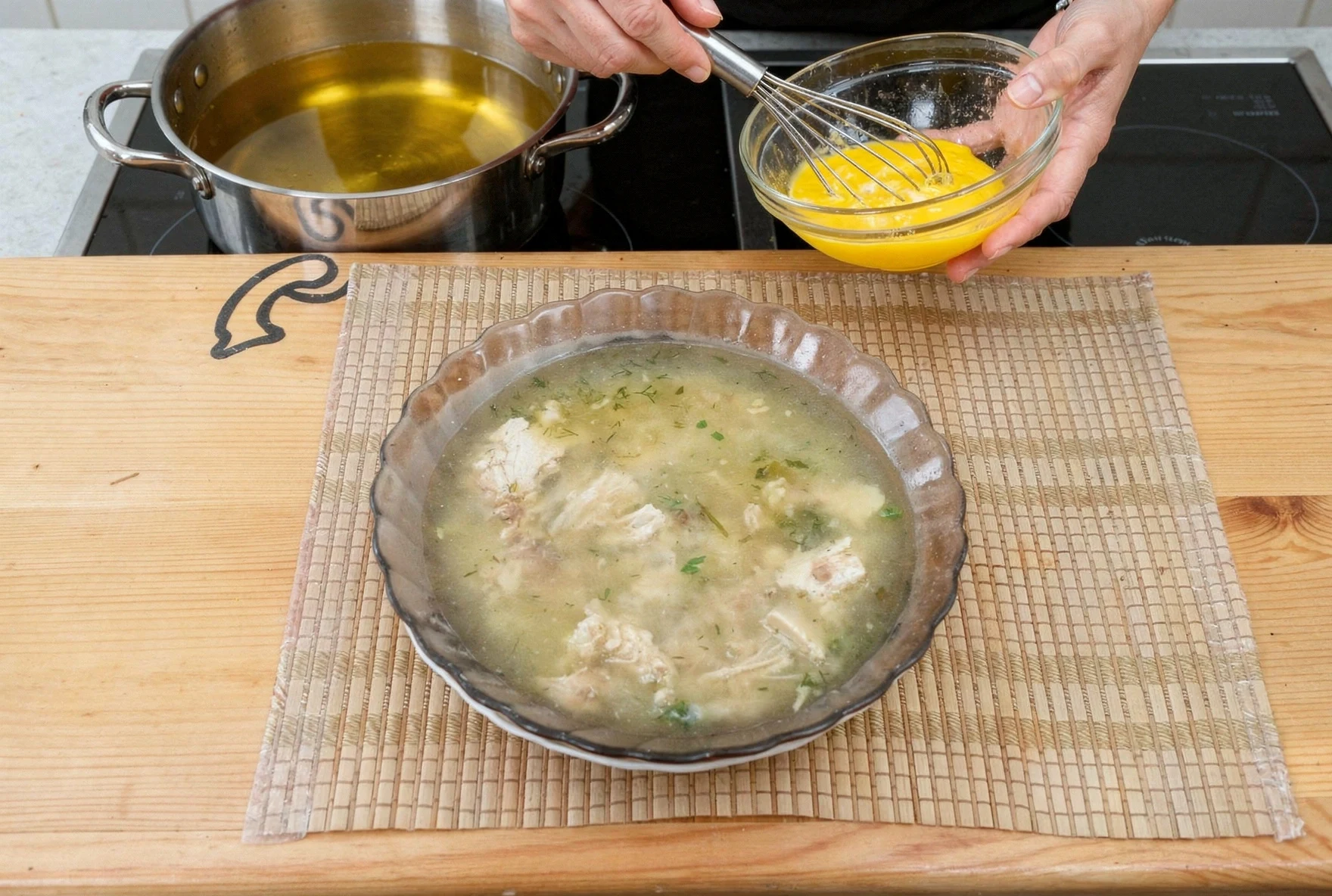
This is where chikhirtma succeeds or fails. In a separate bowl, whisk the 3 egg yolks with the lemon juice until completely smooth and slightly frothy. Now comes the tempering:
With one hand whisking the yolk mixture constantly, use the other hand to ladle in about 250ml (1 cup) of the hot broth, one small ladle at a time. The goal is to gradually raise the temperature of the yolks so they don't scramble on contact with the hot soup. Each addition should be small — maybe 60ml at a time — and you should whisk thoroughly between additions.
Once the yolk mixture is warm and well-combined with the broth, pour it back into the pot in a thin stream, stirring the pot constantly. The soup should turn visibly silkier and more golden within seconds.
| Visual Cue | What It Means |
|---|---|
| Thin, watery, clear | Before tempering — just broth |
| Golden, slightly opaque, coats spoon | Perfect — eggs incorporated smoothly |
| White wisps or lumps floating | Eggs scrambled — too much heat too fast |
| Thick, almost custard-like | Too many eggs or overcooked — still edible |
The Golden Rule
Once the egg yolks are in the soup, never let it boil again. Not even a simmer. If it boils, the yolks will curdle and you'll have scrambled egg bits floating in otherwise beautiful soup. Keep it below 80°C/175°F. If you have a thermometer, use it. If not, the soup should steam but never bubble.
Step 6: Finish and Serve
Return the shredded chicken to the pot. Heat gently for 2–3 minutes — just enough to warm the chicken through without boiling the soup. Taste and adjust: more salt, more pepper, more lemon juice if it needs brightness. The acidity should be noticeable but not dominant — a gentle tartness that makes you want the next spoonful.
Ladle into deep bowls (chikhirtma is meant to be a generous bowl of soup, not a delicate cup). Finish with a lavish shower of chopped fresh cilantro and dill. Some cooks add a grind of black pepper on top. Serve immediately — chikhirtma is best straight from the pot.
Serving and Pairings
| Pairing | Why It Works |
|---|---|
| Shotis puri (შოთის პური) | Tear it and dip — the crusty bread soaks up the silky broth perfectly |
| Mchadi (მჭადი) | Cornbread crumbled into the soup adds a satisfying textural contrast |
| Dry white wine | A crisp Tsinandali or Kakhuri complements the lemony broth |
| Pickled vegetables | Jonjoli (pickled bladdernut) or pickled peppers cut the richness |
| Fresh herbs on the side | Extra cilantro, dill, or tarragon for adding at the table |
| Lemon wedges | Let everyone adjust acidity to their taste |
Variations
| Variation | What Changes | Notes |
|---|---|---|
| Turkey chikhirtma | Turkey replaces chicken | Traditional — darker, richer broth. Common in some regions. |
| Lamb chikhirtma | Lamb broth and shredded lamb | Richer, gamier. Less common but exists in old cookbooks. |
| Whole-egg version | Whole eggs instead of just yolks | Lighter color, slightly different texture. Some families prefer it. |
| No-flour version | Skip the roux entirely | More traditional. Thinner body, relies purely on eggs. Trickier to get right. |
| Marigold version | Add dried marigold petals | Common in western Georgia. Adds subtle earthy-floral notes and golden color. |
Chikhirtma vs Avgolemono
People inevitably compare these two, and fair enough — both are egg-lemon chicken soups. But they're more different than they look.
| Feature | Chikhirtma | Avgolemono |
|---|---|---|
| Base | Pure broth, no starch | Usually includes rice or orzo |
| Herbs | Cilantro and dill (heavy) | Minimal — maybe dill |
| Acid | Lemon or vinegar | Always lemon |
| Onion/garlic | Sautéed into the base | Usually absent |
| Texture | Silky, clean, light body | Thicker from starch |
Common Mistakes
Scrambled Eggs
The #1 failure. Either the broth was added too fast to the yolks, or the soup was boiled after tempering. Slow down. Whisk harder. Keep the heat low.
Weak Broth
Store-bought stock makes a mediocre chikhirtma. The egg yolks amplify whatever's in the broth — if the base is bland, the finished soup is bland with a slightly eggy tint. Make your own.
Skipping the Skim
That grey foam at the start of cooking isn't seasoning — it's coagulated blood proteins. If you don't skim it, the broth stays cloudy and murky. Chikhirtma should look golden and clean.
Not Enough Acid
Without sufficient lemon or vinegar, chikhirtma tastes flat and eggy. The acid is structural — it cuts the richness and gives the soup its distinctive brightness. Don't be shy.
Too Many Vegetables
Adding carrots, celery, and potatoes turns this into generic chicken soup. Chikhirtma's identity is its purity — the only vegetable should be onion (and some purists skip even that).
Reheating at High Heat
Leftover chikhirtma needs gentle reheating. Boiling it will curdle the egg yolks retroactively. Low heat, stir often, and stop as soon as it's warm.
Pro Tips
Room-Temperature Yolks
Take the eggs out of the fridge 30 minutes before cooking. Cold yolks are more likely to seize when hot broth hits them. Room temperature narrows the thermal gap.
Double-Strain the Broth
For restaurant-quality clarity, strain the broth twice — once through a mesh strainer, then through the same strainer lined with a damp paper towel. The difference is visible.
Make Broth the Night Before
Cook and strain the broth, refrigerate overnight. The fat solidifies on top and lifts right off — giving you an even cleaner base. Shred the chicken while it's still warm, refrigerate separately.
Finish With Good Butter
A tiny knob of cold butter stirred into each bowl right before serving adds a glossy richness that takes the soup from good to exceptional. Optional, but recommended.
Where to Eat Chikhirtma in Tbilisi
Machakhela
Multiple locations across Tbilisi. Reliable, affordable chikhirtma that's consistently well-made. A safe bet for your first bowl. 8–12 GEL.
Shavi Lomi
Modern Georgian restaurant on Zubalashvili Street. Their chikhirtma uses turkey — richer, darker, more complex. One of the better versions in town. 15–18 GEL.
Salobie Bia
Old Town institution. Traditional preparation, generous portions. The bread basket alone is worth the visit — perfect for dipping into the soup. 10–14 GEL.
Kakhelebi
Near Dry Bridge. Specializes in eastern Georgian cuisine, where chikhirtma has its deepest roots. Honest, homestyle preparation. 8–10 GEL.
Nutrition
| Nutrient | Per Serving (approx.) |
|---|---|
| Calories | 320 kcal |
| Protein | 35g |
| Carbohydrates | 6g |
| Fat | 16g |
Storage and Leftovers
Fridge
Keeps for 2–3 days in an airtight container. The soup will thicken as it cools (the egg yolks set slightly). Reheat very gently — never boil.
Freezer
Not recommended. The egg yolks don't freeze well — they'll break and give the thawed soup a grainy, split texture. Freeze the broth and chicken separately, then temper fresh yolks when reheating.
Reheating
Low heat, stirring constantly. Add a splash of water or stock if it's thickened too much. A squeeze of fresh lemon when reheated brightens it back up.
Batch Prep
Smart move: make a big batch of broth with shredded chicken. Refrigerate or freeze it. When you want chikhirtma, warm the broth and temper fresh yolks — takes 15 minutes.
Frequently Asked Questions
Can I use whole eggs instead of just yolks?
Yes — some Georgian families use whole beaten eggs. The result is lighter in color and slightly different in texture. Yolks-only gives a richer, more golden soup, which is why most recipes call for them. If using whole eggs, you'll need 2 instead of 3 yolks.
What do I do with the leftover egg whites?
Freeze them for later (they freeze perfectly), use them in meringue, add them to an omelet the next morning, or make a batch of langos. They keep in the fridge for 2–3 days.
My eggs scrambled. Can I save it?
Sort of. If there are just a few small wisps, strain the soup through a fine sieve and most people won't notice. If it's fully curdled, you have a chicken soup with egg drop texture — not chikhirtma, but still edible. Next time, temper more slowly and keep the heat lower.
Is chikhirtma gluten-free?
The flour-free traditional version is naturally gluten-free. If you include the tablespoon of flour for the roux, substitute rice flour or skip it entirely. The soup works fine either way.
Can I make chikhirtma with rotisserie chicken?
You can use rotisserie chicken for the meat, but you still need good homemade broth. Shred the rotisserie chicken and add it at the end. The broth is what matters most — the chicken is almost secondary in this soup.
Written by The Georgian Eats Team
Based in Tbilisi, where chikhirtma is the first thing friends suggest when you mention feeling rough. We've had it at dawn after supras, at lunch on cold winter days, and made it ourselves more times than we can count. The tempering step gets easier every time.
Last updated: February 2026.
Related Articles
Kharcho: Georgia's Spiced Beef and Walnut Soup
The other iconic Georgian soup — richer, spicier, and completely different.
Satsivi: Cold Walnut Chicken
Another masterclass in Georgian poultry — walnut sauce meets poached chicken.
Chakapuli: Spring Lamb with Tarragon and Plums
Georgia's most aromatic stew — herbs, sour plums, and tender lamb.
Chicken Tabaka: Crispy Pressed Chicken
When you want Georgian chicken that's crispy instead of soupy.