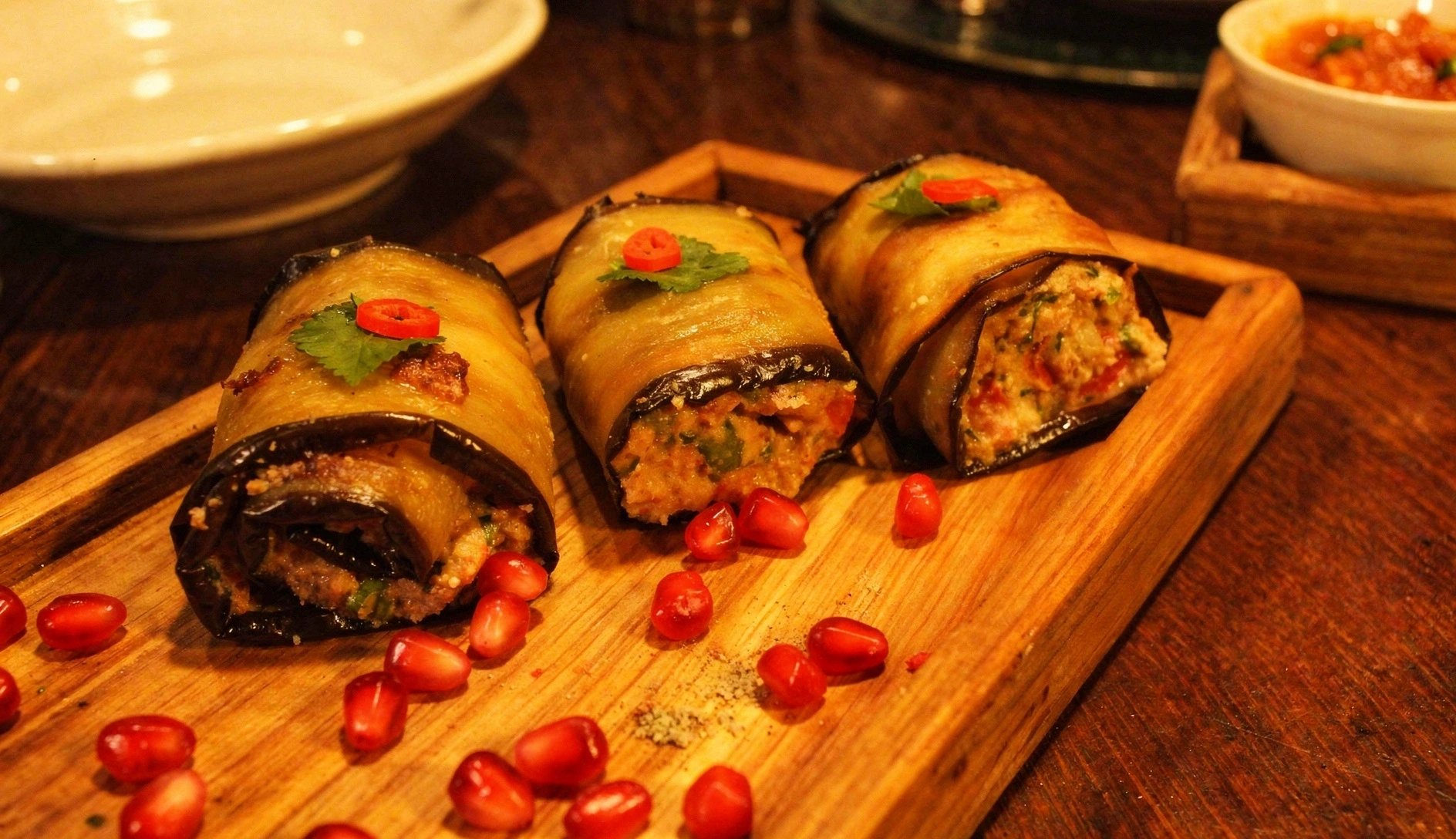
Every Georgian feast starts with cold appetizers, and badrijani nigvzit is usually the first thing to disappear from the table. Thin slices of fried eggplant, rolled around a punchy walnut-garlic paste, topped with pomegranate seeds — it's one of those dishes that looks like it took hours but is actually straightforward once you know the rhythm. It's also entirely vegan, which Georgia manages without ever making it feel like a compromise.
Quick Facts
- Georgian name: ბადრიჯანი ნიგვზით (bad-ri-JA-ni nig-VZIT)
- Literal meaning: "Eggplant with walnuts"
- Category: Cold appetizer (მხარე / mkhare)
- Prep time: 20 minutes + 30 minutes salting
- Cook time: 15 minutes
- Serves: 4–6 as an appetizer (about 20 rolls)
- Diet: Naturally vegan and gluten-free
- Cost in Georgia: 8–14 GEL per plate (~$3–5 USD)
Why Every Georgian Table Has Badrijani
Walk into any restaurant in Georgia — from a polished Tbilisi wine bar to a roadside kitchen in Kakheti — and badrijani nigvzit will be on the menu. It's not a trendy item or a chef's special. It's a permanent fixture, as fundamental as bread and wine.
The dish sits at the intersection of everything Georgian cooking does well: walnuts as a base (they're in everything here), strong garlic without apology, warm spice from khmeli-suneli, and produce treated simply but with precision. Eggplant is cheap, walnuts are abundant, and the result looks impressive enough to open a supra.
There's no "authentic family secret" version — the recipe is remarkably consistent across the country. What separates a great badrijani from a mediocre one comes down to three things: how thin you slice the eggplant, how well you drain the oil, and the texture of your walnut paste.
Ingredients
Georgian cooking relies on a small pantry of staples used in endlessly different ways. If you've got walnuts, garlic, and khmeli-suneli, you're halfway to half the dishes in the country.
For the Eggplant
| Ingredient | Amount | Notes |
|---|---|---|
| Eggplant (aubergine) | 3 large | Long, narrow Italian-type works best |
| Salt | 2 tsp | For salting/sweating |
| Sunflower oil | For frying | ~150ml; neutral oil, not olive |
For the Walnut Paste
| Ingredient | Amount | Notes |
|---|---|---|
| Walnuts | 200g (1½ cups) | Fresh, not rancid — taste them first |
| Garlic | 4–5 cloves | Raw. Don't be shy. |
| Khmeli-suneli | 1 tsp | Georgian spice blend — essential |
| Ground coriander | ½ tsp | Not fresh cilantro — dried seed |
| Blue fenugreek (utskho-suneli) | ½ tsp | Subtle maple-like aroma; sub with regular fenugreek if needed |
| Cayenne pepper | ¼ tsp | Adjust to taste |
| White wine vinegar | 1 tbsp | Brightens the paste; red wine vinegar works too |
| Water | 3–6 tbsp | To reach spreadable consistency |
| Salt | ½ tsp | Adjust after tasting |
For Garnish
| Ingredient | Notes |
|---|---|
| Pomegranate seeds | The classic topping — adds color and acid pop |
| Fresh cilantro | Finely chopped; or flat-leaf parsley if you're anti-cilantro |
On Khmeli-Suneli
This is Georgia's signature spice blend — a mix of blue fenugreek, coriander, marigold petals, dill, savory, and sometimes more. If you can't find it, combine equal parts ground coriander, fenugreek, and a pinch of dried marigold or turmeric. But honestly, order the real thing. It keeps for months and you'll use it in everything.
Equipment You'll Need
🔪 Sharp Knife or Mandoline
You need thin, even slices (~5mm). A mandoline makes this effortless.
🥣 Food Processor
For grinding walnuts to a paste. Mortar and pestle works but takes longer.
🍳 Wide Skillet
For frying eggplant slices in batches. Non-stick or cast iron both work.
📄 Paper Towels
You'll go through a lot. Essential for draining excess oil from the eggplant.
Step-by-Step Recipe
Step 1: Slice and Salt the Eggplant
Cut the top off each eggplant and slice lengthwise into strips about 5mm (¼ inch) thick. You want them thin enough to roll easily but thick enough to hold together during frying. Discard the outer slices that are mostly skin.
Lay the slices in a single layer on a cutting board or sheet pan. Sprinkle generously with salt on both sides. Set aside for at least 30 minutes. You'll see beads of moisture forming on the surface — that's what you want. This step removes excess water (which prevents soggy rolls) and reduces any bitterness.
After 30 minutes, pat each slice thoroughly dry with paper towels. Press firmly. The drier they are, the less oil they'll absorb during frying.
Step 2: Make the Walnut Paste
While the eggplant salts, make the filling. Add the walnuts to a food processor and pulse until you get a fine, crumbly texture — somewhere between coarse sand and smooth paste. You want some texture, not baby food.
Add the garlic (pressed or finely grated), khmeli-suneli, ground coriander, blue fenugreek, cayenne, salt, and white wine vinegar. Pulse a few more times to combine.
Now add water, one tablespoon at a time, pulsing between additions. You're aiming for a thick but spreadable consistency — it should hold its shape on a spoon but spread easily when pressed. Usually 3–6 tablespoons does it, depending on how oily your walnuts are.
Taste the paste. It should be garlicky, slightly tangy, with a warm spice backbone. Adjust salt, garlic, or cayenne. Remember: it'll be wrapped in mild eggplant, so the paste should be boldly seasoned.
Step 3: Fry the Eggplant
Heat sunflower oil in a wide skillet over medium-high heat — enough to cover the bottom by about 3mm. You're shallow-frying, not deep-frying.
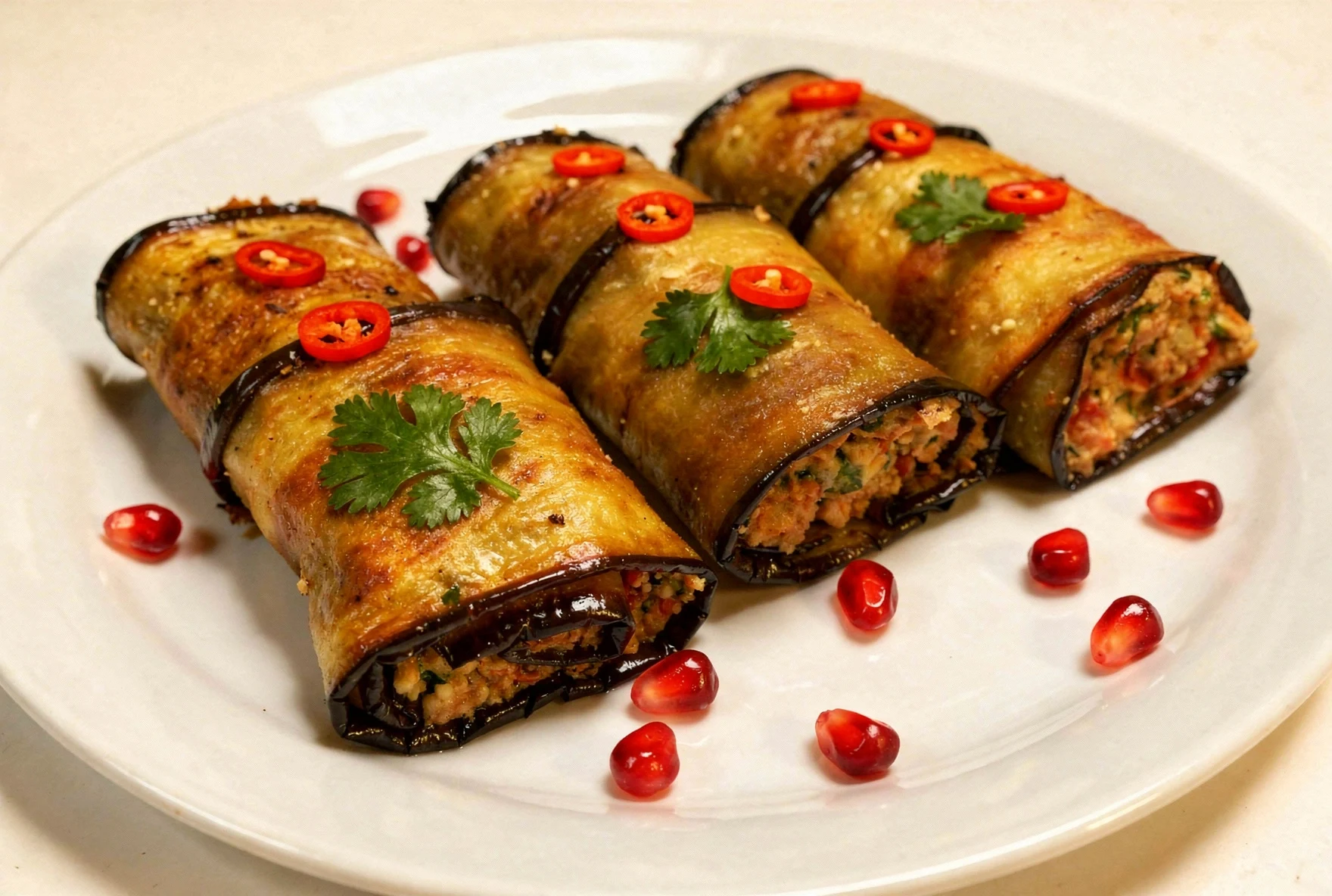
Working in batches (don't crowd the pan), fry the eggplant slices for about 2–3 minutes per side until golden brown and softened. They should be pliable enough to roll without cracking.
Transfer each batch to a plate lined with paper towels. Let them drain for at least a few minutes. Then — and this is important — blot the top side with more paper towels. Eggplant is a sponge. The less oil you leave on it, the better the final dish tastes.
Baked Alternative
If you want to skip the frying, brush eggplant slices with oil on both sides and bake at 200°C (400°F) for 15–20 minutes, flipping halfway. They'll be lighter but won't have the same rich golden color. Many Georgian home cooks do this for everyday meals and save the fried version for guests.
Step 4: Roll and Assemble
Once the eggplant slices are cool enough to handle (warm is fine, just not burning hot), it's assembly time.
Place a heaped teaspoon of walnut paste at the wider end of each eggplant slice. Spread it slightly, then roll the slice up into a tight cylinder. Place seam-side down on your serving platter.
Repeat with all slices. Arrange them in neat rows or a circular pattern — presentation matters here because this is traditionally the first dish guests see on the table.
Step 5: Garnish and Serve
Scatter pomegranate seeds generously over the rolls. They're not just decorative — the tart, juicy burst cuts through the rich walnut paste perfectly. Add finely chopped fresh cilantro on top.
Serve at room temperature or slightly chilled. Badrijani actually improves after sitting for a few hours, as the flavors meld together.
Make-Ahead Friendly
Badrijani nigvzit is ideal make-ahead food. Assemble the rolls, cover, and refrigerate for up to 24 hours. Bring to room temperature 30 minutes before serving. The flavors actually deepen overnight. This is why it's a supra staple — you can make it the day before and focus on hot dishes the day of.
Tips for Perfect Badrijani
Choose the Right Eggplant
Long, narrow varieties (Italian or Japanese) work best. Globe eggplants give slices that are too wide to roll neatly. Look for firm, glossy skin with no brown spots.
Don't Skip the Salt
30 minutes minimum. This step is the difference between great badrijani and a soggy, oil-logged mess. You can salt up to 2 hours ahead if you're prepping in advance.
Control the Oil Temperature
Medium-high, not screaming hot. If the oil smokes, it's too hot and your eggplant will char before it softens. If it's too cool, the eggplant absorbs oil like a towel.
Taste Your Walnuts
Rancid walnuts ruin everything. Taste one before you start. Good walnuts are mildly sweet and creamy. Bitter or sharp-tasting walnuts need to go in the bin.
Common Mistakes to Avoid
| Mistake | What Happens | Fix |
|---|---|---|
| Slicing too thick | Slices crack when rolled | Aim for 5mm; use a mandoline |
| Not draining oil | Greasy, heavy rolls | Double-blot with paper towels |
| Paste too dry | Crumbly filling, falls out | Add water 1 tbsp at a time until spreadable |
| Paste too wet | Runny, won't stay in roll | Add more ground walnuts to thicken |
| Serving too cold | Oil congeals, muted flavors | Bring to room temp 30 min before serving |
Walnut Paste Variations
The base walnut paste (called nigvzis sartsikhi or bazhe depending on consistency) is one of the cornerstones of Georgian cuisine. The same foundation appears in half a dozen dishes, each with subtle tweaks:
| Dish | Base | Variation |
|---|---|---|
| Badrijani nigvzit | Eggplant | Thick paste, rolled inside |
| Pkhali | Spinach, beet, or cabbage | Mixed into cooked greens, formed into balls |
| Satsivi | Chicken or turkey | Thinned to sauce with egg yolk, served cold |
| Bazhe | As a sauce | Very thin, pourable; served with fish or chicken |
| Nigvziani lobio | Beans | Walnut paste stirred into cooked beans |
If you make the walnut paste for badrijani, you already know the foundation for all of these. Georgian cooking is modular like that — learn five base preparations and you can cook the entire cuisine.
Where to Eat Badrijani in Georgia
Honestly? Everywhere. It's harder to find a Georgian restaurant that doesn't serve badrijani than one that does. But here are some standouts:
🏆 Shavi Lomi (Tbilisi)
Modern Georgian with a refined take. Their badrijani uses slightly charred eggplant for a smoky twist. Reservations essential.
🍷 Barbarestan (Tbilisi)
Based on a 19th-century Georgian cookbook. Their version is traditional, beautifully plated, and comes with a glass of amber wine.
🏠 Culinarium (Tbilisi)
Home-style cooking in a cozy space. Generous portions, honest flavors, and they'll teach you the recipe if you ask nicely.
🏔️ Any Village Supra
If you get invited to a family feast, that's where the best badrijani lives. Accept every supra invitation. Every single one.
Nutrition Information
Per serving (4–5 rolls), approximate values:
| Nutrient | Per Serving |
|---|---|
| Calories | ~280 kcal |
| Fat | 22g (mostly unsaturated) |
| Carbohydrates | 14g |
| Fiber | 6g |
| Protein | 7g |
Storage and Leftovers
🧊 Refrigerator
Assembled rolls keep 3–4 days in an airtight container. Bring to room temperature before serving — cold walnut paste is dense and muted.
❄️ Freezer
Not recommended. The eggplant becomes mushy when thawed. If you must, freeze the walnut paste separately (it freezes well for 2 months).
🍽️ Reheating
Don't. This is a cold dish. If you've refrigerated them, just let them sit at room temperature for 20–30 minutes. That's it.
📋 Prep Ahead
Fry eggplant and make paste separately, store in fridge. Assemble up to 4 hours before serving. This is the restaurant approach.
Sourcing Georgian Spices
The hardest part of making authentic Georgian food outside Georgia is finding the spices. Regular supermarket spice racks won't cut it. Here's where to look:
Where to Find Khmeli-Suneli
In Georgia: Any bazaar or supermarket. It costs almost nothing.
Online: Amazon, iGourmet, or specialty spice shops carry Georgian blends. Look for brands like "Khareba" or "Georgian Kitchen."
Russian/Eastern European stores: Any shop catering to post-Soviet communities will stock it.
DIY: Mix equal parts ground coriander, blue fenugreek, dried marigold petals, dried dill, and dried basil. Add a pinch of black pepper and bay leaf powder.
Frequently Asked Questions
Can I use a different nut?
Technically, yes — hazelnuts or pecans work in a pinch. But walnuts are the authentic choice and have the right oil content for the paste's texture. Georgia is one of the world's largest walnut producers, and the cuisine reflects that.
What if I can't find pomegranates?
Finely diced pickled red onion is the traditional off-season substitute. Some cooks use dried barberries or cranberries, but pomegranate is the move if you can find it.
Is this dish always served cold?
Always. Room temperature is ideal. Nobody in Georgia eats warm badrijani — it's a cold appetizer, full stop. The walnut paste firms up and the flavors are cleaner when not heated.
How many per person for a supra?
Plan 3–5 rolls per guest as part of a larger spread. If it's the main appetizer, go to 5–7 per person. They disappear fast — always make more than you think you need.
Can I grill the eggplant instead of frying?
Absolutely. Brush with oil and grill on a hot grill pan or BBQ. You'll get charred lines and a slightly smoky flavor. Some modern Georgian restaurants serve it this way. It's lighter and arguably more interesting.
Written by The Georgian Eats Team
We've eaten our way through Georgia's restaurants, bazaars, and family kitchens for years. Badrijani nigvzit was one of the first dishes we learned to make — and one we still never get tired of.
Last updated: February 2026.
Related Articles
Khinkali: Georgia's Legendary Soup Dumplings
The authentic recipe with pleating technique and eating rules.
Adjarian Khachapuri: Cheese-Filled Bread Boat
Georgia's most photogenic dish — step-by-step with dough recipe.
Lobio: Georgia's Smoky Bean Stew
Authentic clay pot recipe with regional variations.
The Georgian Supra: Complete Feast Guide
Everything about Georgia's legendary feast tradition.