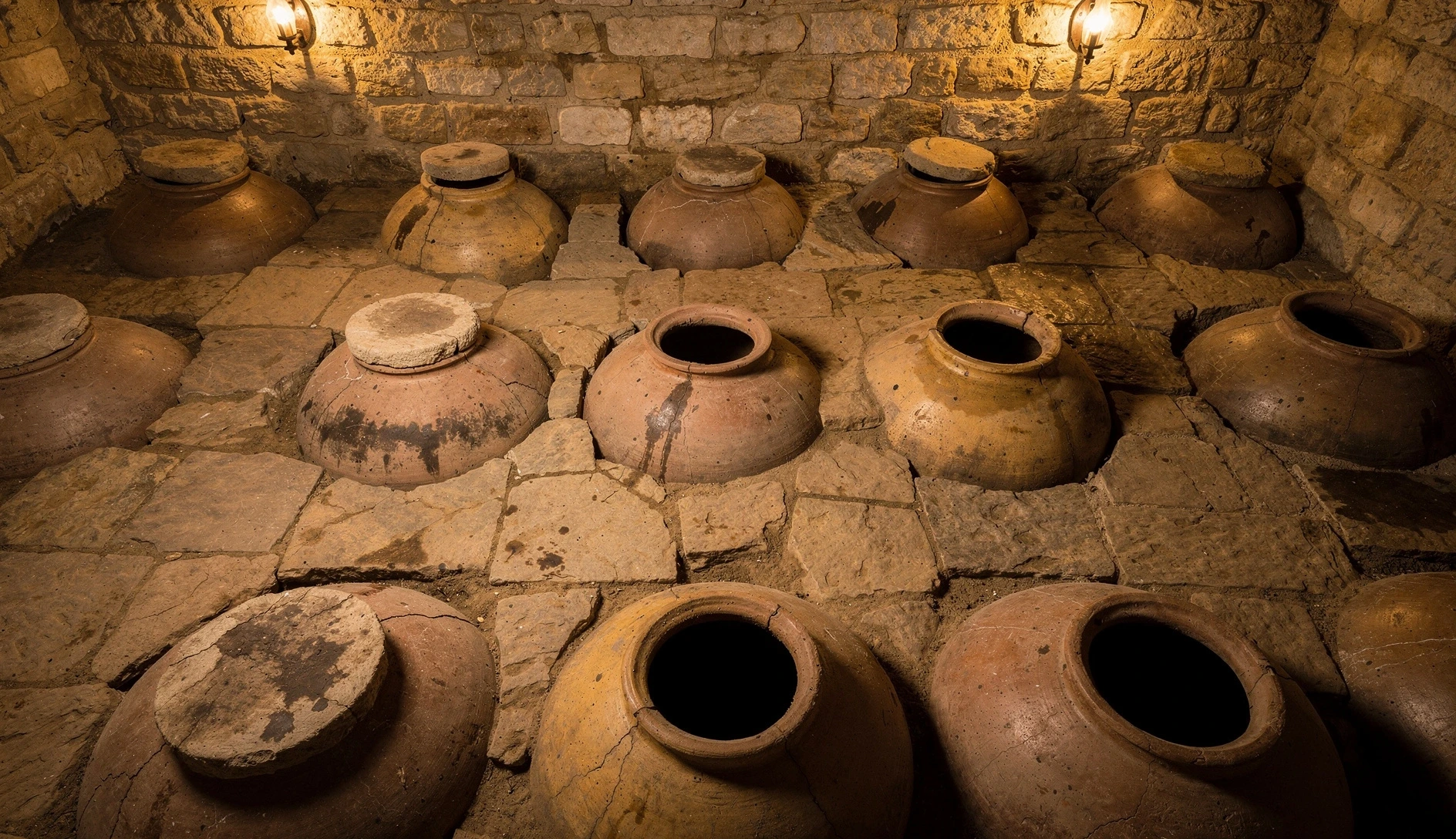
Every wine country has a story about tradition. Georgia's story is different because it's not really a story — it's an unbroken chain of practice stretching back 8,000 years to the Neolithic period. At the center of it all is the qvevri: a large, egg-shaped clay vessel buried in the ground, where grapes go in as fruit and come out as something completely unlike anything you've tasted from a glass bottle at your local wine shop.
If you've heard the term "orange wine" or "amber wine" and wondered what makes it special, the answer usually leads back here — to a clay pot in the ground in eastern Georgia. This guide covers how qvevri winemaking actually works, why it produces wines that taste nothing like their European counterparts, and where you can see it for yourself.
What Is a Qvevri?
A qvevri (ქვევრი, sometimes spelled kvevri) is a large, egg-shaped earthenware vessel used for fermenting, aging, and storing wine. The word likely comes from kveuri, meaning "that which is buried" — because that's exactly where it goes. A qvevri is buried in the floor of a marani (wine cellar) with only its rim visible at ground level. The constant underground temperature — around 14–15°C year-round — provides natural climate control that modern wineries achieve with stainless steel tanks and cooling systems.
In western Georgia, the same vessel is called a ch'uri (ჭური). The "q" in qvevri comes from the Georgian letter ქ, which maps to Q on a QWERTY-based Georgian keyboard — hence the spelling confusion in English sources.
Qvevri range from 20 liters up to a massive 10,000 liters, though most winemakers consider 1,000–1,200 liters the ideal size for fermentation. The largest ones are big enough for a person to climb inside — which is exactly what happens during cleaning.
Not an Amphora
Qvevri look similar to Greek or Roman amphorae, but they're fundamentally different. Amphorae are storage and transport vessels with handles. Qvevri are fermentation vessels with no handles, designed to be permanently buried. Other countries use clay for wine — Spain has tinajas, Portugal has talhas — but Georgia's tradition of burying the vessel underground is unique.
How Qvevri Are Made
Making a qvevri is a slow, physical craft that hasn't fundamentally changed in thousands of years. A handful of families in Kakheti, Imereti, and Guria still make them by hand, passing the skill through generations. A single 1,000-liter qvevri takes about six weeks to build — and the maker typically works on several simultaneously.
| Step | Process | Duration |
|---|---|---|
| 1. Clay preparation | Mined from local quarry, cleaned with water, mixed with river sand, ground smooth | 1–2 days |
| 2. Building | Clay logs added one layer at a time on a wooden platform, bottom-up. 2-day drying between layers. | 4–6 weeks |
| 3. Drying | Finished qvevri sits before firing | 3–4 weeks |
| 4. Firing | Baked in wood or gas kiln at 1,000–1,300°C | Up to 7 days |
| 5. Cooling | Kiln cooled gradually before opening | 3 days |
| 6. Finishing | Interior cleaned; some lined with beeswax. Exterior may get lime or cement coating. | 1–2 days |
The clay matters. Different quarries produce clay with different mineral compositions, which subtly influences the wine. This is one reason Georgian winemakers are particular about where their qvevri come from — it's terroir at the vessel level.
In 2021, qvevri were granted Protected Geographical Indication (PGI) status by Georgia's State Register — the first non-food item to receive the designation. Under PGI rules, only raw materials sourced in Georgia can be used to produce a qvevri. This was partly a response to cheap imitations being produced abroad.
The Winemaking Process
Qvevri winemaking is almost aggressively simple compared to modern winemaking. There are no temperature-controlled tanks, no yeast additions, no oak barrels, no fining agents. The process relies on the vessel, the grapes, and time.
The Basic Steps
- Harvest and crush: Grapes are picked and crushed, usually by foot in a wooden trough called a satsnakheli.
- Fill the qvevri: The juice, skins, seeds, and stems (collectively called chacha) go into the qvevri together. How much chacha stays depends on the method (see below).
- Seal: The qvevri is covered with a stone or wooden lid, sometimes sealed with clay.
- Ferment: Natural yeasts on the grape skins trigger fermentation. The underground temperature keeps it slow and steady.
- Macerate: The wine sits on its skins for 5–6 months (sometimes longer), extracting color, tannins, and flavor.
- Decant: The clear wine is drawn off into a clean qvevri for storage. The remaining chacha is distilled into chacha brandy.
- Clean: The empty qvevri is washed, sterilized with lime, and re-coated with beeswax for next year.
The whole cycle happens once a year, during the autumn harvest (rtveli). A qvevri that was filled in October won't be opened until March or April at the earliest. Many winemakers age their wine in qvevri for a year or more before bottling.
Why Burying Works
Underground temperatures in Georgia's wine regions stay around 14–15°C year-round. This is cool enough for slow fermentation (which preserves aromatics) but warm enough that fermentation doesn't stall. Modern wineries spend millions achieving this same stability with refrigeration. Qvevri winemakers solved it 8,000 years ago by digging a hole.
Three Regional Methods
Not all qvevri wine is made the same way. The critical variable is how much chacha (pomace — skins, seeds, stems) stays in contact with the juice, and for how long. This single difference produces dramatically different wines.
| Method | Region | Chacha Used | Maceration | Result |
|---|---|---|---|---|
| Kakhetian | Eastern Georgia (Kakheti) | 100% — skins, seeds, and stems | 5–6 months | Deep amber, tannic, intense |
| Imeretian | Western Georgia (Imereti) | ~10% — some skins, no stems | 1–2 months | Lighter amber, softer, more fruit |
| Kartlian | Central Georgia (Kartli) | ~30% — skins and some stems | 2–4 months | Medium amber, balanced tannin |
The Kakhetian method is the most ancient and extreme. Fermenting white grapes with 100% of their skins, seeds, and even stems for half a year produces a wine that has more in common with a light red than a conventional white. It's tannic, structured, and deeply colored — this is what people mean when they say "amber wine."
The Imeretian method is gentler. Using only about 10% of the pomace and skipping stems entirely produces a wine that's lighter in color and softer on the palate — still recognizably qvevri-made, but more approachable to European wine drinkers. Many natural wine producers outside Georgia who experiment with skin-contact whites end up closer to this style.
The Kartlian method splits the difference and gets less attention, but wines from the Kartli region can be fascinating — they have the structure of Kakhetian wines without the sometimes overwhelming tannin.
What Is Amber Wine?
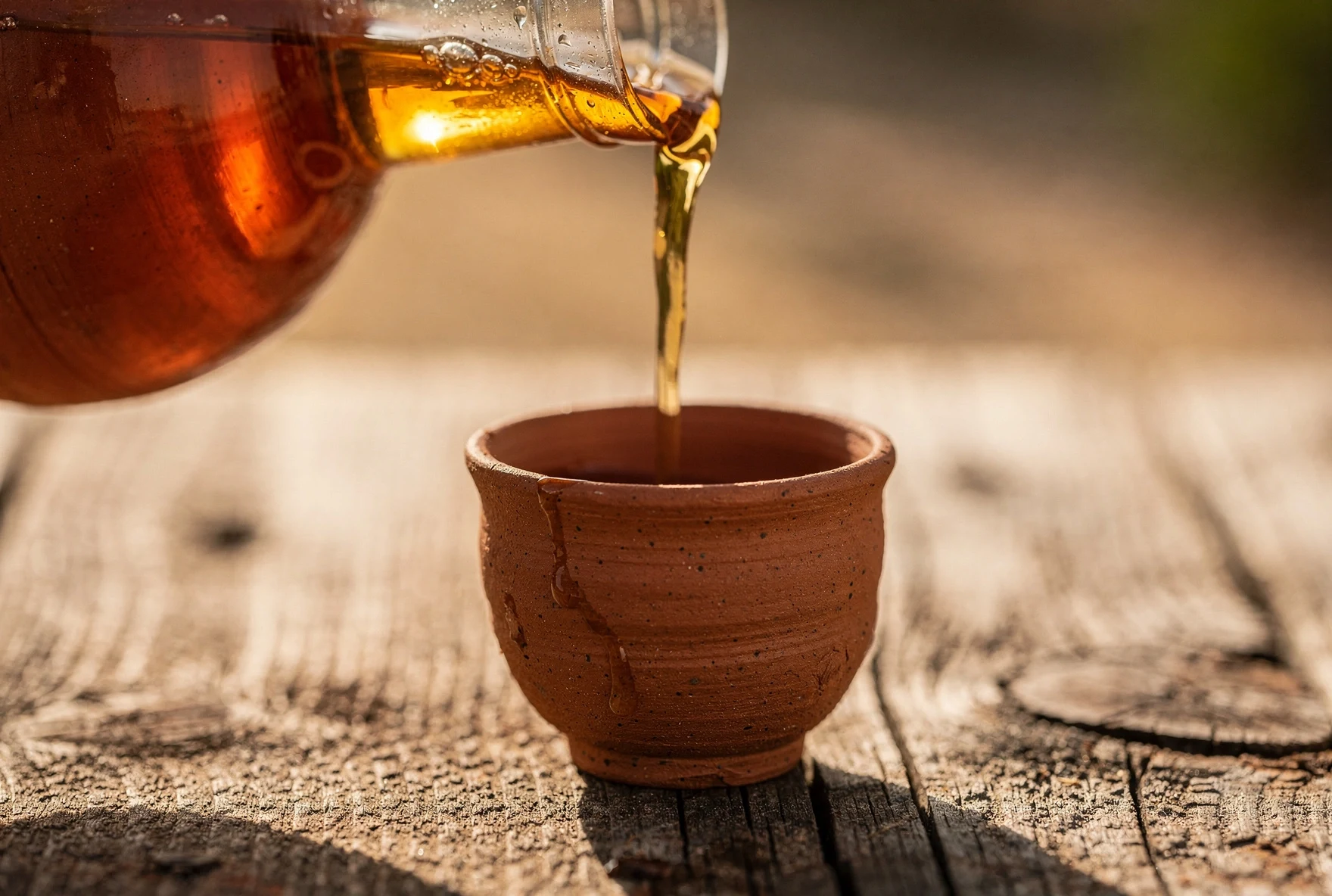
Amber wine — sometimes called orange wine internationally — is white wine that's been fermented with extended skin contact. In conventional white winemaking, the skins are removed immediately after pressing. In qvevri winemaking, they stay in the vessel for weeks or months, giving the wine its distinctive amber-to-deep-gold color.
Georgians prefer the term amber wine (ქარვისფერი ღვინო, qarvisperi ghvino) over "orange wine." The reasoning: the color is amber, not orange, and the term "orange wine" was coined by a British wine writer in 2004 to describe European skin-contact whites that were inspired by Georgian tradition.
What Does It Taste Like?
If you're used to crisp, fruity Sauvignon Blanc or buttery Chardonnay, amber wine will be a shock. The extended skin contact changes everything:
🍯 Typical Aromas
Dried apricot, honey, beeswax, walnut skin, chamomile, orange peel, dried herbs, sometimes a smoky or earthy note from the clay
👅 On the Palate
Dry, medium to full body, noticeable tannins (unusual for white wine), a long savory finish. Less acidity than conventional whites. Often has a slightly oxidative character.
🎨 Color Range
Pale gold (Imeretian method, short maceration) to deep copper-amber (Kakhetian method, 6+ months on skins). Some wines are almost tea-colored.
Serving Temperature
Don't serve amber wine as cold as you'd serve a conventional white. Around 14–16°C is ideal — closer to a light red than a white. Too cold and you'll mute the aromatics and amplify the tannins, making it taste harsh and flat.
Key Grapes for Qvevri Wine
Georgia has over 500 indigenous grape varieties, but only a handful are commonly used for qvevri winemaking. Here are the ones you'll encounter most often.
| Grape | Color | Region | In Qvevri |
|---|---|---|---|
| Rkatsiteli | White | Kakheti | The classic amber wine grape. High acidity holds up to long maceration. Golden amber, notes of quince and dried herbs. |
| Mtsvane | White | Kakheti | Often blended with Rkatsiteli. Adds floral aromatics and softer fruit — peach, green apple, citrus blossom. |
| Kisi | White | Kakheti | Rare variety making a comeback. Makes some of the most aromatic amber wines — honey, chamomile, white flowers. |
| Khikhvi | White | Kakheti | Almost extinct, now revived by a few producers. Lemongrass, honey, camomile with a dry finish. |
| Tsolikouri | White | Imereti | Western Georgia's main white. Lighter skin contact makes crisp, citrusy wines with less tannin. |
| Saperavi | Red | Kakheti | Georgia's great red grape. In qvevri: inky, tannic, dark fruit, leather. One of the few teinturier grapes — red flesh, not just red skin. |
For a deeper look at these varieties and more, see our guide to 15 Georgian grape varieties you need to know.
The Marani: Where It All Happens
The marani is the Georgian wine cellar — though "cellar" undersells it. In Georgian culture, the marani is a sacred space. Traditionally, it was the one room in the house where guests couldn't enter without the host's permission. Births, deaths, and family decisions were announced here. Some old marani have a cross carved above the entrance.
A marani can be almost anything: a standalone building, the ground floor of a farmhouse, a cave carved into rock, or an open-air structure covered by a vine canopy. What defines it is the qvevri buried in its floor.
Inside, you'll find:
- Qvevri — buried in rows, with only the round openings visible at floor level
- Satsnakheli — a wooden trough for crushing grapes by foot
- Stone or tile floor — sloped slightly so grape juice flows toward the qvevri
- Basic tools — long wooden paddles for stirring, clay or stone lids, beeswax for sealing
If you visit a family winemaker in Kakheti, you'll almost certainly be invited into their marani. Accept. This is where you'll taste wine straight from the qvevri — drawn up with a long-handled dipper — and it tastes completely different from anything in a bottle.
Qvevri vs. Modern Winemaking
Georgia produces wine both ways — in qvevri and using European-style stainless steel and oak. Here's how they compare.
| Factor | Qvevri | Modern (European) |
|---|---|---|
| Vessel | Buried clay, porous, breathes | Stainless steel or oak barrels |
| Temperature control | Natural (underground) | Mechanical refrigeration |
| Yeast | Wild/indigenous only | Usually selected commercial yeast |
| Skin contact (white) | Weeks to months | Hours (minimal or none) |
| Additives | None (or minimal SO₂) | Fining agents, sulfites, enzymes |
| Tannins | High (from extended skin contact) | Low in whites, moderate in reds |
| Stability | Natural tannins prevent turbidity | Requires fining and filtration |
Qvevri wines tend to be more oxidative, more tannic, and more texturally complex than their modern counterparts. They're also less predictable — vintage variation is real, and two qvevri sitting three meters apart in the same marani can produce noticeably different wine. That's the charm if you're a natural wine enthusiast, and the frustration if you're a consistency-minded commercial buyer.
The Soviet Hangover
Under Soviet rule, Georgia was pushed toward industrial-scale European-style production for the Russian market. Qvevri winemaking nearly disappeared. Since independence — and especially since Russia's 2006 wine embargo forced Georgia to look west — there's been a major revival. Today, qvevri wines are Georgia's most distinctive export and the backbone of its wine identity internationally.
Where to Taste Qvevri Wine in Georgia
You can find qvevri wine in Tbilisi wine bars, but the real experience is visiting a marani in the wine country. Here are the best options.
| Where | What to Expect | Price |
|---|---|---|
| Family cellars in Kakheti | The authentic experience. Tasting from the qvevri, homemade food, personal stories. Many families along the Telavi–Sighnaghi corridor welcome visitors — ask your guesthouse. | Often free (buy a bottle or two) |
| Pheasant's Tears (Sighnaghi) | American-Georgian partnership making some of the best qvevri wines in the country. Restaurant + winery visits. Rkatsiteli and Saperavi are standouts. | 30–50 GEL tasting |
| Twins Wine Cellar (Napareuli) | World's largest qvevri collection (over 800). Tours show the full process. Their Qvevri Rkatsiteli is a classic introduction to amber wine. | 20–40 GEL tasting |
| Alaverdi Monastery (Kakheti) | Monks have been making wine here since the 11th century. The marani tour includes tasting monastic qvevri wines. Spiritual and historical experience. | 15–25 GEL |
| Wine bars in Tbilisi | Vino Underground, g.Vino, Wine Gallery — all have excellent qvevri wine selections by the glass. Good for sampling before visiting wine country. | 12–30 GEL per glass |
Visit During Rtveli (September–October)
If you can time your visit with the grape harvest, do it. Families across Kakheti crush grapes and fill qvevri during this period, and many welcome visitors to participate. You'll stomp grapes, eat too much food, and drink last year's wine while this year's starts fermenting. It's the single best way to understand qvevri winemaking.
Buying Qvevri Wine: What to Look For
Qvevri wine has gone from obscure curiosity to international darling, which means there's now a wide range of quality — from transcendent bottles to mass-produced "qvevri-style" marketing exercises. Here's how to navigate it.
✅ Good Signs
"Qvevri" on the label. Single-vineyard or village-level designation. Small producer (under 50,000 bottles). Mentions specific grape variety. No added sulfites or minimal sulfites noted.
⚠️ Watch Out
"Amber wine" from large commercial producers — may be a quick skin-contact in steel, not real qvevri. Very cheap bottles (under 10 GEL) — likely industrial. No grape variety listed. Overly sweet — traditional qvevri wines are bone dry.
Price Ranges in Georgia
| Price (GEL) | What You Get |
|---|---|
| 8–15 GEL | Basic qvevri-style wines. Often from larger producers. Drinkable but rarely memorable. |
| 20–40 GEL | The sweet spot. Small to medium producers making serious qvevri wines. This is where most of the quality lives. |
| 50–100+ GEL | Premium bottles from top producers — Pheasant's Tears, Nika Bakhia, Lapati, Iago's Wine. Single-vineyard, exceptional vintages. Worth it for the experience. |
Qvevri's Influence on World Wine
Georgia's qvevri tradition didn't just get a UNESCO inscription and a few appreciative nods. It kicked off a global movement. Natural winemakers in Italy, France, Slovenia, Austria, and the United States have adopted qvevri (or qvevri-inspired clay vessels) as part of a broader push toward minimal-intervention winemaking.
The Italian natural wine scene in Friuli — particularly producers like Josko Gravner and Radikon — was among the first to embrace extended skin-contact whites in the 1990s, directly inspired by Georgian methods. Gravner actually traveled to Georgia, bought qvevri, and shipped them back to Italy. His Ribolla Gialla, fermented in buried Georgian qvevri, became one of the most talked-about wines in the world.
Today, you can find qvevri-made wines from California to Australia. The orange wine category barely existed 20 years ago; now it has its own section in wine shops. Georgia didn't just preserve an ancient method — it accidentally started a modern revolution.
Common Misconceptions
"Qvevri wine is always orange"
Qvevri are used for red wine too — Saperavi in qvevri is exceptional. And Imeretian-method whites can be light gold, not amber at all. The method doesn't dictate color.
"It's primitive or low quality"
Qvevri winemaking requires more skill than modern methods, not less. Without technology to correct mistakes, the winemaker's judgment about harvest timing, maceration length, and blending has to be perfect.
"All Georgian wine is made in qvevri"
The majority of Georgian wine production uses European-style methods. Qvevri wine is a minority — roughly 5–10% of total production — but it's the most distinctive and culturally significant.
"It should taste like regular white wine"
If you pour amber wine expecting Pinot Grigio, you'll be confused. Think of it as its own category — not white, not red, but a third path that predates both modern categories by millennia.
Frequently Asked Questions
Is qvevri wine the same as natural wine?
There's huge overlap but they're not synonymous. Most qvevri wines are made with minimal intervention (no added yeast, no fining, minimal or no sulfites), which fits the natural wine definition. But some commercial producers use qvevri while still adding sulfites or selected yeasts. And plenty of natural wine worldwide is made in steel or glass, not clay.
How long does qvevri wine last once bottled?
Good qvevri wines age exceptionally well — the tannins and low intervention mean they can develop for 10–20+ years. A well-made Rkatsiteli amber from a good vintage will be more complex at 10 years than at 2. That said, many lighter Imeretian-style wines are best within 3–5 years.
Can I buy qvevri wine outside Georgia?
Yes, increasingly. Pheasant's Tears, Lapati, Iago's Wine, Nika Bakhia, and several others export internationally. Look in natural wine shops or specialty importers. Expect to pay $20–50 USD per bottle outside Georgia — roughly double the Georgian price.
What's the difference between amber and orange wine?
Functionally, the same thing — white wine made with extended skin contact. "Orange wine" is the term used internationally (coined in 2004 by British wine writer Simon Woolf). Georgians prefer "amber wine" (qarvisperi ghvino) because the color is amber, and because the technique predates the marketing term by about 8,000 years.
Do qvevri wines contain sulfites?
Traditional qvevri wines are made with zero added sulfites — the natural tannins from extended skin contact act as preservatives. Some modern producers add small amounts of SO₂ at bottling for stability, but the quantities are typically far below European or American conventional wine levels.
Written by The Georgian Eats Team
Based in Tbilisi and regular visitors to Kakheti's family cellars. We've tasted wine straight from the qvevri at dozens of marani across eastern Georgia, and we keep going back.
Last updated: February 2026.
Related Articles
Georgian Grape Varieties: 15 Grapes You Need to Know
Tasting notes, food pairings, and what to order — from Saperavi to Ojaleshi.
Georgian Wine Regions: A Complete Guide
Kakheti, Kartli, Imereti, Racha-Lechkhumi — key appellations and where to taste.
The Georgian Supra: A Guide to the Feast
Toasts, traditions, and how to survive a Georgian feast without embarrassing yourself.
Satsivi: Georgia's Cold Walnut Sauce
The perfect pairing partner for a glass of amber wine.