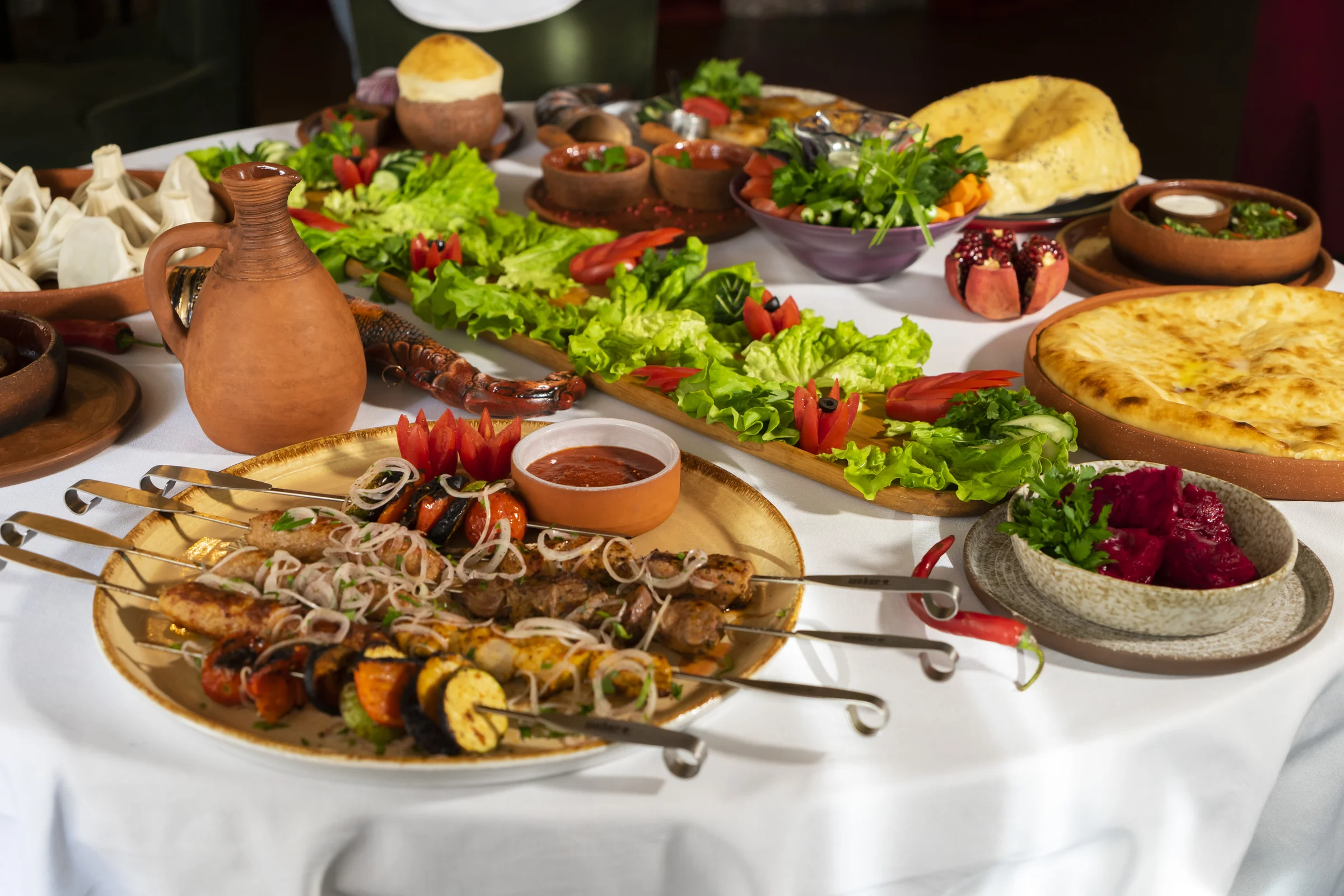
Georgian food doesn't need a marketing campaign. It sells itself the moment someone tears into their first khachapuri, burns their mouth on a khinkali, or realizes that the walnut paste they've been eating on everything is genuinely one of the best flavors on Earth. This is a cuisine built on walnuts, cheese, fresh herbs, and an almost aggressive hospitality — and it's been quietly perfecting itself for thousands of years while the rest of the world wasn't paying attention.
This guide covers the 20 dishes that define Georgian food. Not just the famous ones — though those are here too — but the dishes that locals actually eat daily, the regional specialties worth hunting down, and the things you'll never find on a tourist-oriented "Top 5 Georgian Foods" listicle. Each entry tells you what it is, how to eat it, and where it fits in the bigger picture of one of the world's great undiscovered cuisines.
What Makes Georgian Food Different
Georgia sits at a crossroads — the Caucasus mountains to the north, Turkey and Iran to the south, the Black Sea to the west. That geography created a cuisine that borrows from everywhere and tastes like nowhere else. You'll find dumplings that rival anything in China, flatbreads baked in clay ovens like in India, walnut sauces with the complexity of French cooking, and herb-heavy salads that feel almost Middle Eastern. But it all comes together in combinations that are uniquely Georgian.
Three things define the flavor profile: walnuts (ground into sauces, stuffed into vegetables, candied into desserts), fresh herbs (cilantro, tarragon, basil, and dill — always fresh, never dried), and a spice blend called khmeli suneli that shows up in almost everything savory. Add generous amounts of garlic, tart plum sauce (tkemali), and pomegranate, and you've got the Georgian palate.
The Walnut Factor
Walnuts in Georgian cooking play the role that butter plays in French cuisine — they add richness, body, and depth to almost everything. Ground walnut paste (nigvzis sakmazi) is the base for at least a dozen major dishes. If you're allergic to walnuts, Georgian food becomes significantly harder to navigate.
The Bread & Cheese
1. Khachapuri (ხაჭაპური)
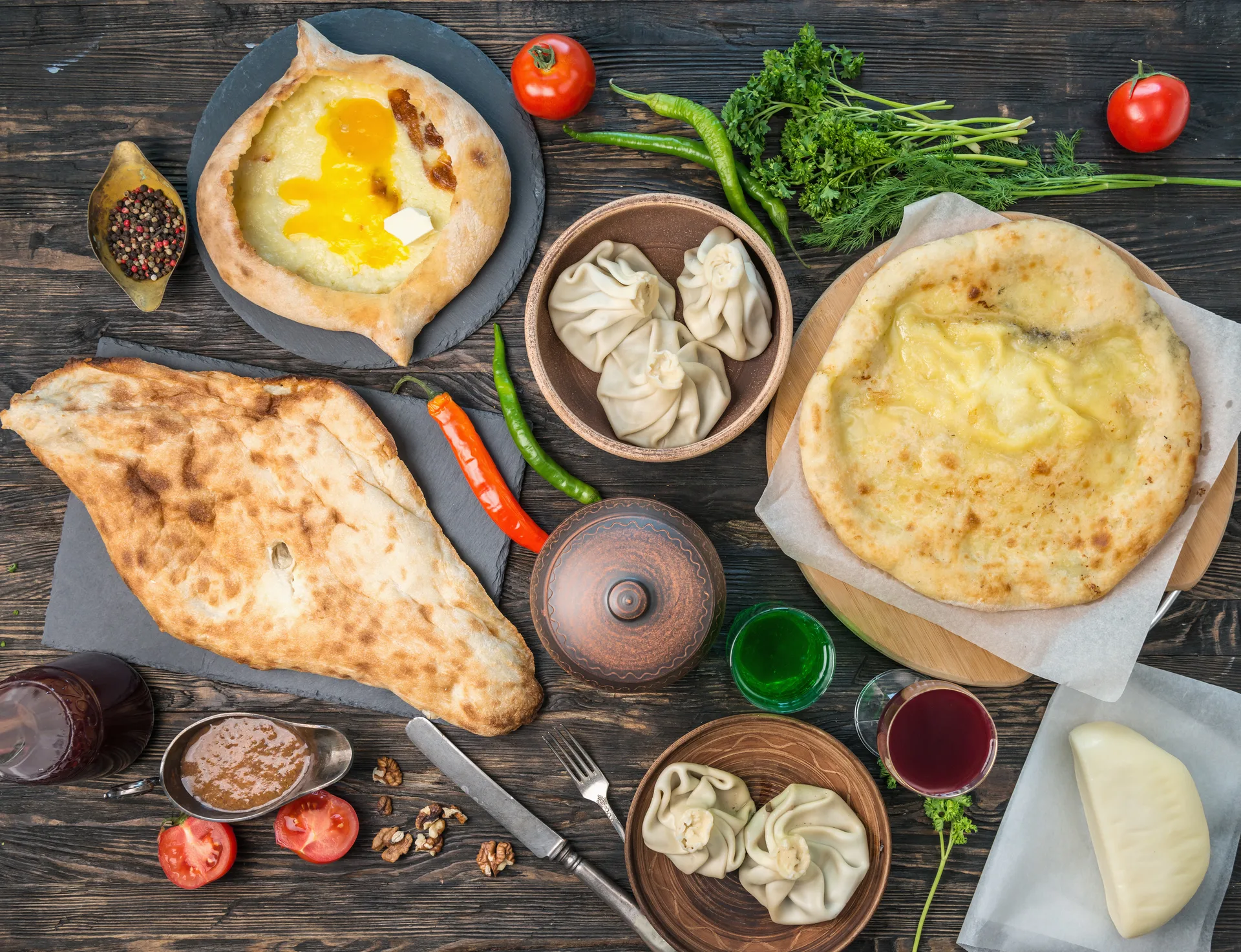
The national dish. The one thing every single person who visits Georgia remembers. At its core, khachapuri is bread filled with cheese — but that description is like calling a croissant "bread with butter." There are over 50 regional variations, but the most important ones are:
| Style | Region | What Makes It Different |
|---|---|---|
| Adjaruli | Adjara (Batumi) | Boat-shaped, open top with egg and butter melted in |
| Imeruli | Imereti | Round, closed, thin crust — the everyday version |
| Megruli | Samegrelo | Like Imeruli but with extra cheese melted on top |
| Penovani | Various | Puff pastry dough, square-shaped, flaky layers |
| Kubdari | Svaneti | Filled with spiced meat instead of cheese |
The Adjarian version gets all the Instagram attention — and deserves it — but most Georgians eat Imeruli daily. It's cheaper, faster, and when the cheese-to-bread ratio is right, equally satisfying. You tear off pieces and eat with your hands. No knife and fork. Ever.
How to eat Adjarian khachapuri: Tear off the pointed ends of the boat. Use those bread pieces to stir the raw egg into the molten cheese and butter. Keep tearing and dipping from the edges inward. Never use a fork. Never cut it. And never, ever let it get cold — cold khachapuri is a different (and worse) food entirely.
→ Get our Adjarian Khachapuri recipe
2. Shotis Puri (შოთის პური)
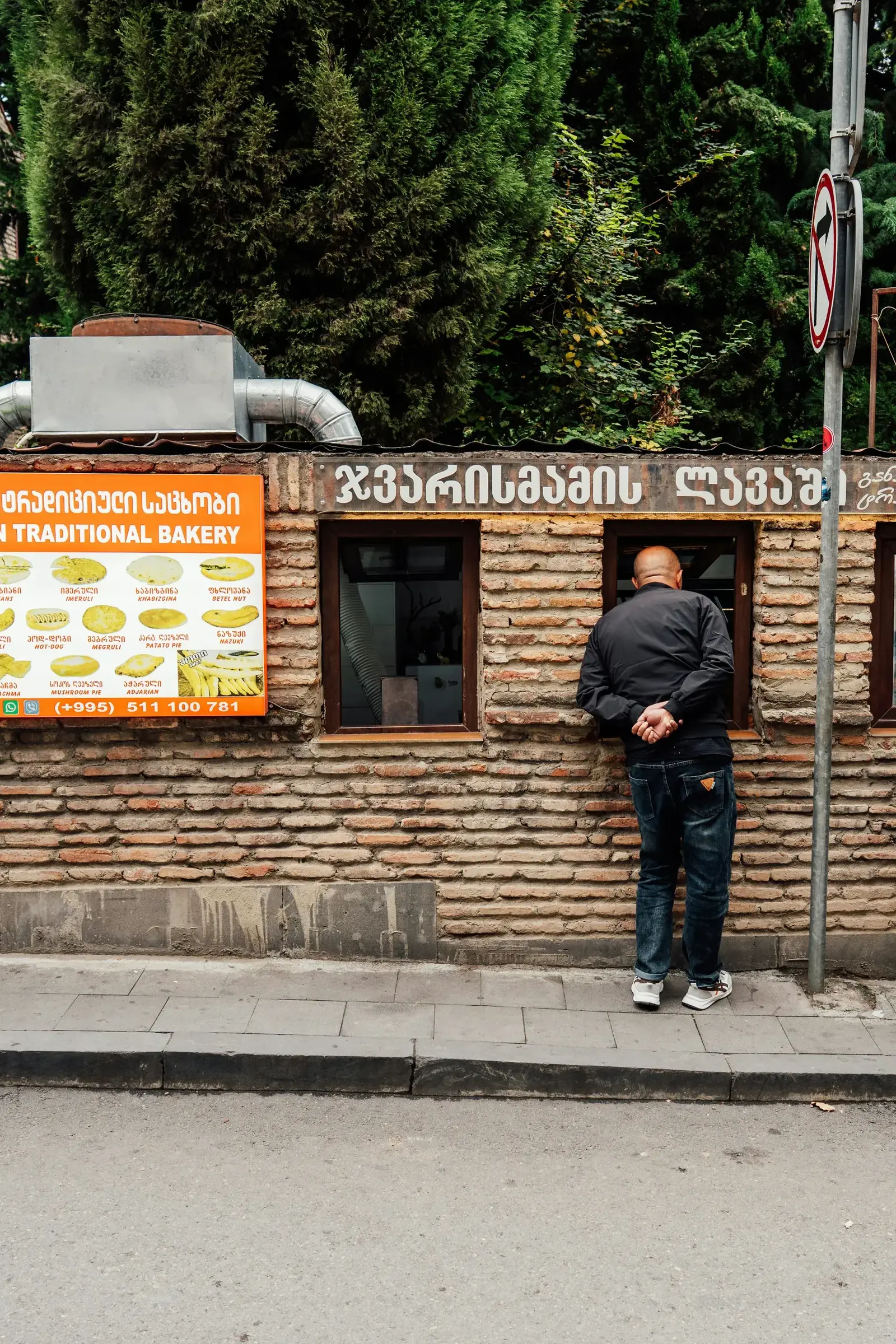
Georgia's signature bread, baked in a tone — a deep, cylindrical clay oven. The baker reaches in bare-handed (or with minimal protection) and slaps the torpedo-shaped dough against the oven's inner wall, where it bakes hanging vertically. The result is a bread with a crispy, slightly charred crust and a soft, chewy interior. It's shaped like a canoe and can be over half a meter long.
Every neighborhood in Tbilisi has a tone bakery, and fresh shotis puri costs about 1 lari (roughly $0.35). People buy it multiple times a day because, like khachapuri, it's a fundamentally different food when it's fresh versus when it's not. You'll see people walking down the street carrying it bare-handed, tearing pieces off as they go.
The Dumplings
3. Khinkali (ხინკალი)
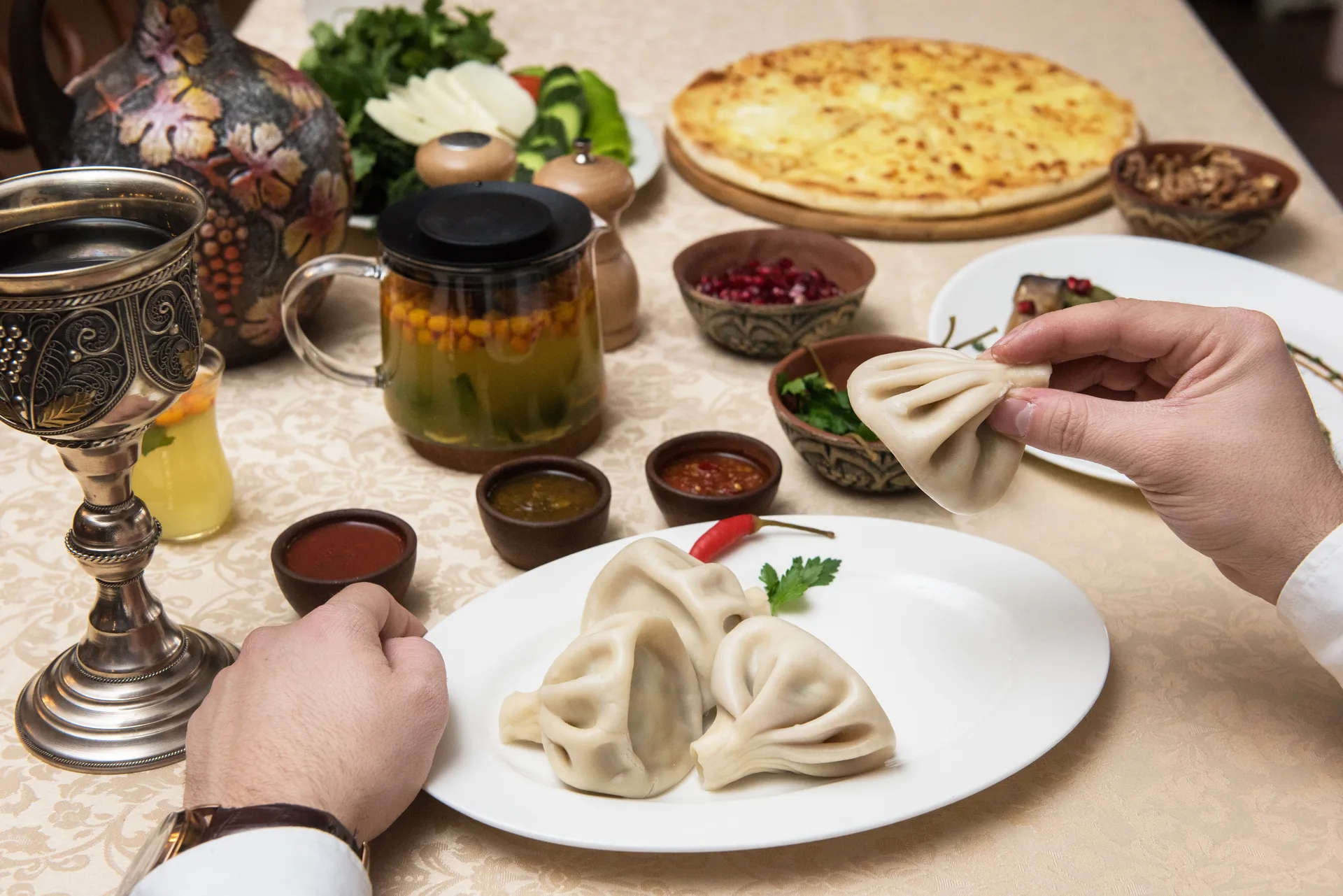
Georgia's answer to xiaolongbao, and a fierce point of national pride. These are large, pleated dumplings filled with spiced meat (traditionally beef and pork, or just beef in mountain regions), sealed at the top with a twisted knob. The filling is mixed with broth-making ingredients — onion, cumin, chili flakes — so when they cook, the meat generates its own soup inside the dumpling.
The eating ritual is non-negotiable: pick it up by the knob (which you don't eat — it's too doughy). Flip it upside down. Bite a small hole in the side. Sip the hot broth. Then eat the rest. If you use a fork, a knife, or — God forbid — ketchup, you will be judged. Silently, but thoroughly.
The Khinkali Debate
Tbilisi-style khinkali use a mix of beef and pork with herbs. Mountain-style (from Pshavi and Tusheti) use only beef or lamb, with fewer spices — letting the meat speak. Both sides are convinced they're right. The only wrong answer is ordering fewer than five.
People order them by the piece — a minimum of five is standard, ten if you're hungry. They arrive on a plate dusted with black pepper. The knobs pile up on the side of your plate as a visible scoreboard of how many you've eaten.
The Starters & Cold Dishes
4. Badrijani Nigvzit (ბადრიჯანი ნიგვზით)
Slices of fried eggplant rolled around a paste of ground walnuts, garlic, and spices, then topped with pomegranate seeds. It's on every Georgian table as a starter, and it's one of the best things in the entire cuisine. The eggplant should be silky-soft inside with just a whisper of crispness on the outside, and the walnut paste should hit you with garlic first, then a warm hum of coriander and fenugreek.
This is the dish that converts people who think they don't like eggplant. The walnut paste does something almost alchemical to the bitterness — it transforms it into richness. Every restaurant makes it, but the best versions come from home kitchens where someone's grandmother has been perfecting her walnut paste ratio for decades.
→ Get our Badrijani Nigvzit recipe
5. Pkhali (ფხალი)
Finely chopped vegetables — spinach, beetroot, or green beans — bound with a walnut paste nearly identical to what goes in badrijani. Shaped into small balls or patties, topped with pomegranate seeds. It's the Georgian equivalent of a composed salad, and it's almost always served as part of a multi-dish starter spread.
The three classic versions are usually served together on one plate: green (spinach), red (beetroot), and pale green (green beans). The contrast is beautiful, and each has a slightly different character. Spinach pkhali is the most delicate; beetroot is earthier and sweeter; green bean holds its texture the best.
→ Get our Pkhali recipe (3 variations)
6. Jonjoli (ჯონჯოლი)
Pickled bladdernut blossoms. That description probably didn't help. Think of them as Georgia's answer to capers — tiny pickled buds with a tangy, slightly sour crunch. They're served cold as a starter, sometimes dressed with raw onion and a splash of oil, and they're absolutely addictive once you get past the "what is this?" phase.
Jonjoli is one of those dishes that separates the tourist menu from the local menu. You won't find it at every restaurant, but when you do, it's a sign that the kitchen takes Georgian food seriously. It's a classic accompaniment to chacha (grape brandy) and pairs perfectly with salty cheese.
7. Georgian Salad
Not a specific recipe — more of a philosophy. Ripe tomatoes, cucumbers, red onion, fresh herbs (usually cilantro and basil), dressed with unrefined sunflower oil or walnut oil and nothing else. No vinegar. No lemon. The quality depends entirely on the tomatoes, which in Georgian summer are some of the best you'll ever taste — dense, sweet, and deeply flavored because most are still grown from heirloom varieties in backyard gardens.
In restaurants, the salad often comes with crumbled fresh cheese on top and a scattering of whole walnuts. It's the one constant on every Georgian table from May through October.
The Mains
8. Mtsvadi (მწვადი)
Georgian barbecue. Large chunks of meat — pork, beef, lamb, or chicken — threaded onto long metal skewers and grilled over grapevine embers. The grapevine part isn't decorative: it gives the meat a subtly sweet, aromatic smoke that charcoal alone can't match. The meat is usually marinated simply — sometimes just salt and onion juice, sometimes with a splash of pomegranate juice or wine.
Mtsvadi is social food. You eat it standing around the grill with friends, tearing meat off the skewer with your hands, wrapping it in lavash (thin flatbread) with raw onion slices and tkemali (sour plum sauce). It's the centerpiece of any outdoor gathering, and in summer, the smell of mtsvadi smoke is the unofficial scent of Tbilisi's residential neighborhoods.
9. Shkmeruli (შქმერული)
A whole chicken, flattened and pan-fried, then drowned in a sauce of milk, butter, and an unreasonable amount of garlic. It comes to the table in the same clay pan it was cooked in, bubbling and fragrant. The garlic isn't subtle — it's the point. The dish is named after the village of Shkmeri in Racha, where it apparently originated as peasant food, which is ironic given how luxurious it tastes.
Shkmeruli went viral in Japan in 2020 when a convenience store chain started selling a version. That says something about how universally appealing the flavor is — garlic, butter, and chicken is hard to argue with in any language.
10. Lobio (ლობიო)
Red kidney beans stewed slowly with onion, garlic, cilantro, blue fenugreek, and sometimes walnuts, served in a clay pot (lobiani — the bean-filled bread — is the portable version). It's simple, warming, and deeply satisfying in the way that only slow-cooked legume dishes can be.
The best lobio has a thick, almost creamy consistency from some of the beans breaking down during cooking, with whole beans still holding their shape for texture. It's traditionally served with pickled jalapeños and mchadi (cornbread) — the combination of smoky beans, hot peppers, and dense, crumbly cornbread is one of the great comfort food trios.
11. Chakapuli (ჩაქაფული)
A spring stew made with young lamb (or veal), tarragon, green plums, and white wine. It's a seasonal dish — you can only make the real thing in April and May when unripe tkemali plums and fresh tarragon are available. The result is bright, tart, herby, and completely unlike the heavier stews that dominate Georgian winter cooking.
Chakapuli is what Georgians cook for Easter, and it's the dish that best showcases the cuisine's lighter side. The sour plums dissolve into the sauce, creating an acidity that cuts through the richness of the lamb. If you visit Georgia in spring, this is the dish to seek out.
12. Satsivi (საცივი)
Cold chicken (or turkey) in a thick walnut sauce spiced with cinnamon, cloves, fenugreek, and saffron. Satsivi is the traditional New Year's dish — it's always served cold, and the sauce should be thick enough to coat the back of a spoon. The flavor is complex and almost dessert-like: warm spices, rich walnuts, and a gentle tang from vinegar or pomegranate.
Making satsivi well is considered a mark of a good cook. The walnut sauce can't be grainy (it must be ground to a perfectly smooth paste), and the spice balance is delicate — too much cinnamon and it tastes like a holiday candle; too little and it's just cold chicken in nut sauce.
13. Kharcho (ხარჩო)
A thick, spicy beef soup with rice, walnuts, and tart plum paste. Don't confuse it with the Russian version, which borrowed the name but made something quite different. Real Georgian kharcho is intensely flavored — spicy from adjika (chili-garlic paste), tart from tkemali, and rich from ground walnuts that thicken the broth into something halfway between a soup and a stew.
The Megrelian version is the most intense — Samegrelo (western Georgia) is known for its love of spice and heat, and Megrelian kharcho delivers on both counts. It's a hangover cure (though khashi is the undisputed champion of that category), a cold-weather staple, and one of the dishes that best demonstrates how Georgian cooking balances sour, spicy, and rich.
14. Chanakhi (ჩანახი)
A clay-pot stew of lamb, eggplant, potatoes, and tomatoes, slow-baked until everything collapses into a rich, unified mass. There's no browning, no searing, no technique — you layer everything raw into the pot, add spices, and let the oven do the work over several hours. The lamb fat renders into the eggplant, the tomatoes form the sauce, and the potatoes absorb all of it.
Chanakhi is peasant food in the best sense: cheap ingredients transformed by time and heat into something memorable. It's a winter dish, served straight from the clay pot at the table.
15. Ojakhuri (ოჯახური)
"Family-style" pan-fried meat and potatoes. That sounds basic, and it is — but when done right, with properly crisped potatoes, tender chunks of pork or beef, and a generous amount of onion and fresh herbs, it's the kind of food you want to eat every day. It comes to the table in a clay ketsi, sizzling.
Ojakhuri is the weeknight dinner of Georgian cuisine. It's fast, it's satisfying, and it uses whatever meat is available. The key is getting a good sear on the potatoes before combining everything — soggy potatoes are the mark of a lazy version.
The Sauces
Georgian sauces deserve their own category because they make or break most dishes. Three are essential:
16. Tkemali (ტყემალი)
Sour plum sauce — Georgia's ketchup. Made from unripe plums, garlic, dill, and pennyroyal mint. It comes in green (more sour, made from unripe plums) and red (sweeter, made from riper plums). It goes on grilled meat, fried potatoes, khinkali, lobio — basically everything. Every household has their own version, and arguments about whose tkemali is best can last hours.
17. Satsebeli (საწებელი)
A fresh tomato-and-herb sauce, somewhere between salsa and marinara but with cilantro, garlic, and fenugreek giving it a distinctly Georgian character. It's served at room temperature alongside grilled meats and bread. The best versions use late-summer tomatoes that are so ripe they barely need cooking.
18. Bazhe (ბაჟე)
A cold walnut sauce — white, creamy, and intensely garlicky. It's served over chicken or fish, and it's essentially the base of satsivi without the warm spices. Bazhe is one of those sauces that sounds simple (walnuts, garlic, water, vinegar, spices) but is surprisingly hard to get right. The texture must be perfectly smooth, and the garlic must be assertive without being aggressive.
| Sauce | Base | Best With | Flavor Profile |
|---|---|---|---|
| Tkemali | Sour plums | Grilled meat, potatoes, khinkali | Tart, herby, bright |
| Satsebeli | Fresh tomatoes | Bread, cheese, cold meats | Fresh, garlicky, herbaceous |
| Bazhe | Ground walnuts | Chicken, fish, eggplant | Rich, creamy, garlicky |
| Adjika | Chili peppers, garlic | Stews, grilled meat, eggs | Hot, complex, fermented |
The Sweets
19. Churchkhela (ჩურჩხელა)
Walnuts (or hazelnuts) strung on a thread, dipped repeatedly in thickened grape juice (tatara), and hung to dry. The result looks like a strange candle but tastes like a chewy, fruity, nutty candy bar that predates candy bars by a few thousand years. Churchkhela was the original energy bar — Georgian soldiers carried them on long campaigns because they're calorie-dense, portable, and last for months.
The best churchkhela is made in autumn during the grape harvest — you'll see them hanging in clusters at roadside stalls across Kakheti. Avoid the neon-colored tourist versions in Tbilisi souvenir shops; they're made with sugar and food coloring instead of real grape juice. Good churchkhela should be deep purple or dark brown, slightly flexible (not hard), and taste primarily of grape and walnut.
→ Read our complete Churchkhela guide
20. Gozinaki (გოზინაკი)
Walnuts fried in honey until golden and set into a brittle slab. It's the traditional New Year's sweet, and making it is a ritual — families gather to cook the honey to exactly the right temperature (too low and it won't set, too high and it burns bitter), fold in the walnuts, and spread it on a board to cool. The best gozinaki shatters when you bite into it, with a deep caramel note from the honey.
You'll find gozinaki year-round in bakeries, but the real experience is eating it freshly made on New Year's Eve, still slightly warm, with a glass of champagne. It's one of the simplest sweets in any cuisine and one of the most satisfying.
How to Order: A Practical Guide
Georgian restaurants serve food family-style. You don't each order a main course — you order a spread for the table. A typical meal for two to four people might look like this:
Sample Order for 2-3 People
Don't Mix Khinkali with Khachapuri
Ordering both khinkali and khachapuri at the same meal is technically fine but practically unwise — both are extremely filling carb-heavy dishes. Georgians typically pick one or the other for a given meal. If you want both, get khachapuri as a starter to share, then khinkali as the main.
Regional Differences
Georgia is roughly the size of Ireland, but the culinary variation across its regions is enormous. The country's geography — high mountains, coastal lowlands, fertile valleys — created isolated communities that developed distinct food traditions.
Western Georgia (Samegrelo, Adjara, Guria)
Spicier, heavier, more cheese. Megrelian cuisine uses adjika liberally and has multiple cheese-based sauces. Adjara brings Turkish influences — heavier use of butter and dairy. Expect more heat and richness.
Eastern Georgia (Kakheti, Kartli)
Milder, meat-focused, wine country. Kakheti is where the best mtsvadi comes from — grilled over grapevine coals alongside the vineyards. Simpler preparations, better ingredients, and an ocean of wine at every meal.
Mountain Regions (Svaneti, Tusheti, Pshavi)
Hearty, preserved, altitude-adapted. Svaneti has kubdari (meat-stuffed bread) and Svan salt (a garlic-herb-chili blend). Mountain khinkali are beef-only with minimal spicing. Food is fuel for harsh winters.
Racha
Georgia's culinary hidden gem. Shkmeruli (garlic chicken) comes from here. The region also produces Khvanchkara, a naturally semi-sweet red wine that Stalin famously loved. Smaller, less visited, arguably the best food.
For Vegetarians
Georgian cuisine is unexpectedly good for vegetarians. The walnut-based dishes (badrijani, pkhali, satsivi made with vegetables), all varieties of khachapuri, lobio, Georgian salad, eggplant with tkemali, fried mushrooms — there's a genuinely varied and satisfying vegetarian spread available at every restaurant. You won't feel like an afterthought.
Vegans have a harder time because cheese and dairy are deeply embedded in the cuisine, but walnut-based dishes are naturally vegan (just confirm no butter was added), and the bean and vegetable dishes travel well into vegan territory with minor adjustments.
| Dish | Vegetarian | Vegan | Notes |
|---|---|---|---|
| Khachapuri | ✅ | ❌ | Cheese + egg + butter |
| Badrijani Nigvzit | ✅ | ✅ | Naturally vegan |
| Pkhali | ✅ | ✅ | Naturally vegan |
| Lobio | ✅ | ✅ | Check for butter |
| Khinkali (potato/cheese) | ✅ | ❌ | Potato version sometimes vegan |
| Churchkhela | ✅ | ✅ | Naturally vegan |
What to Drink
Georgian wine is the obvious answer — the country has been making it for 8,000 years, making it the oldest wine-producing nation on Earth. The traditional method uses qvevri — large clay vessels buried underground where the wine ferments with its grape skins, producing the amber-colored "orange wine" that's become trendy worldwide.
But beyond wine, there are a few drinks you should know:
🍷 Saperavi
The king of Georgian reds. Deep, dark, tannic, and perfect with grilled meat. If you drink one Georgian wine, make it this.
🥃 Chacha
Grape brandy, similar to Italian grappa. Ranges from refined to rocket fuel depending on whether it's commercial or homemade. Handle with care.
🍋 Tarkhuna
Bright green tarragon-flavored soda. It looks radioactive but tastes like liquid licorice. A Soviet-era classic that Georgians still love.
🍵 Kompot
Fruit compote served cold as a drink. Made from whatever fruit is in season. Refreshing, lightly sweet, and available at every restaurant.
→ Read our guide to Georgian grape varieties
Georgian Food Etiquette
Georgian dining has rules, but they're mostly intuitive once you understand the spirit: food is generous, communal, and meant to be lingered over. A few things to know:
🍞 Bread is sacred
Don't throw bread away. Don't put it upside down. Don't cut it with a knife if you can tear it. Bread has near-religious significance in Georgia.
🍷 Toasts matter
At a supra (feast), the tamada leads structured toasts. Wait for the toast before drinking. Not following the tamada is the Georgian equivalent of being rude at dinner.
🥟 Khinkali rules
Hold by the knob, bite, sip the broth, eat. Don't use cutlery. Don't eat the knob. Don't let the broth spill. The plate of discarded knobs tracks your count.
🫶 Finish the bottle
An open bottle of wine should be finished. Leaving wine in a bottle is considered mildly insulting. Pace yourself accordingly — or prepare for a late night.
Invited to Someone's Home?
This is the highest compliment in Georgian culture. Bring wine or sweets. Expect to eat far more than you planned. Compliment the food — your host will beam. Don't try to leave early. And whatever you do, don't refuse food. In Georgia, feeding a guest is an expression of love, and refusing that food is refusing the love.
Frequently Asked Questions
Is Georgian food spicy?
Western Georgian food (Samegrelo, Adjara) can be quite spicy. Eastern Georgian food is milder. Overall, most dishes are well-spiced but not burn-your-mouth hot. Adjika (chili paste) is always available if you want more heat.
Is Georgian food similar to Turkish or Russian food?
Georgians would be offended by this question — and rightfully so. There are shared elements with neighboring cuisines (eggplant dishes, kebabs, dumplings — even tolma, Georgia's take on stuffed grape leaves), but Georgian food is distinctly its own tradition. The walnut-based sauces, the specific spice blends, and the winemaking traditions have no parallel.
How much should I tip?
10% is standard and appreciated. Some upscale restaurants add a service charge — check the bill. In casual spots, rounding up is fine. Tipping is becoming more common but isn't mandatory.
Can I find good Georgian food outside of Georgia?
Georgian restaurants are popping up in major cities worldwide — New York, London, Berlin, Warsaw, and especially Moscow (large Georgian diaspora). Quality varies. The best indicator is whether they make their khachapuri dough in-house and whether the walnut paste tastes freshly ground.
What do Georgians eat for breakfast?
Georgian breakfasts are hearty — cheese, eggs, bread, and often leftover dishes from the night before. Many hotels serve a full Georgian breakfast with imeretian khachapuri, fried eggs, fresh herbs, and strong coffee or tea.
What's the best city for food in Georgia?
Tbilisi has the most variety and the best restaurants. But for specific dishes, go to the source: Batumi for Adjarian khachapuri, Kakheti for mtsvadi and wine, Kutaisi for Imeretian cuisine. The best single meal you'll eat in Georgia will probably be at someone's house.
Written by The Georgian Eats Team
Based in Tbilisi for five years. We eat Georgian food daily — at restaurants, at friends' homes, and increasingly in our own kitchens. This guide is based on hundreds of meals and a genuine obsession with getting the details right.
Last updated: February 2026.
Related Articles
Adjarian Khachapuri
The boat-shaped cheese bread, step by step.
Khinkali
Georgia's legendary soup dumplings from scratch.
Georgian Grape Varieties: 15 You Need to Know
From Saperavi to rare Ojaleshi — the complete guide.
The Georgian Supra
A complete guide to Georgia's legendary feast.