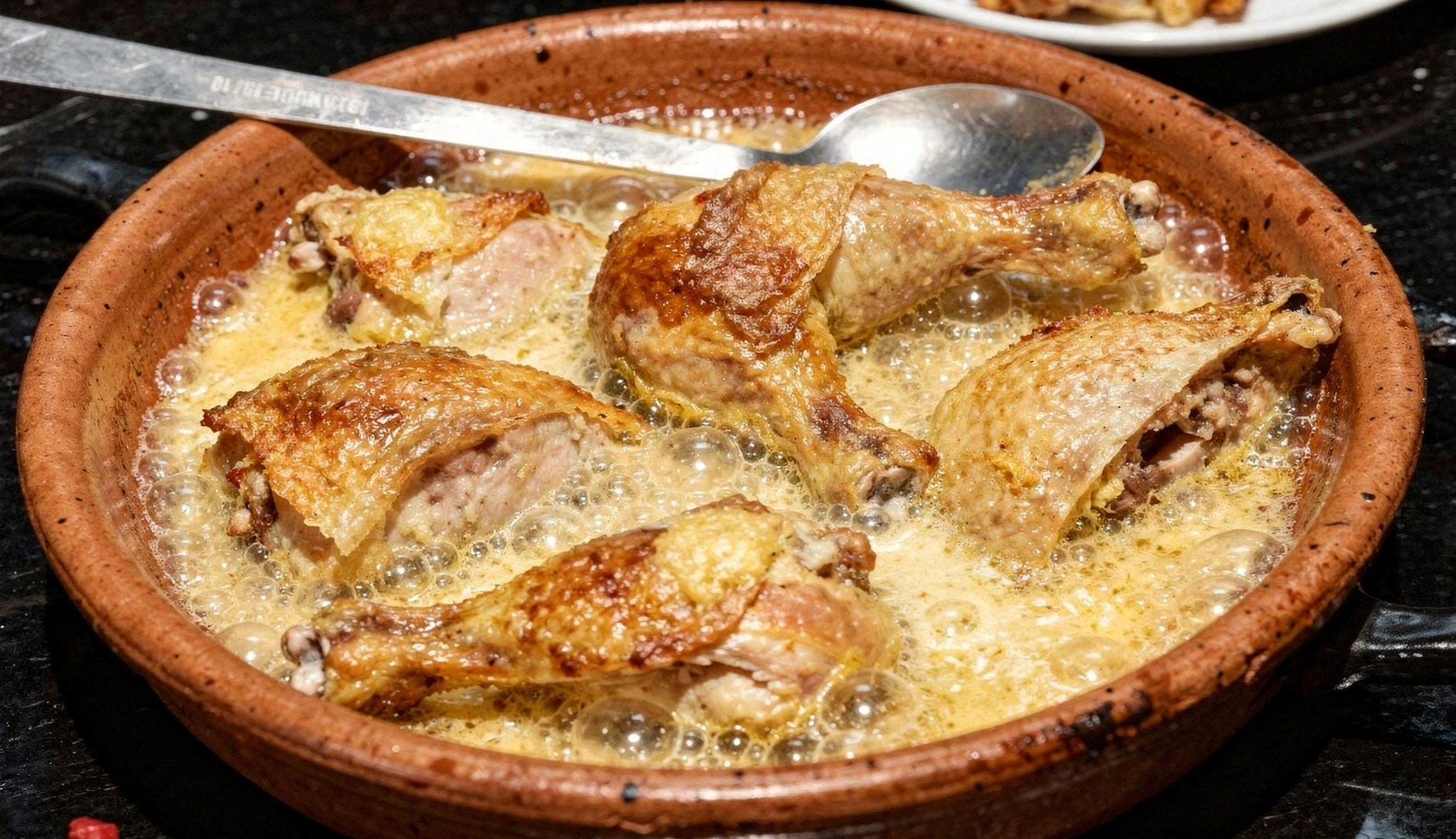
Shkmeruli is the dish that makes garlic lovers weep with joy. A whole chicken, butterflied and pan-fried until the skin is shatteringly crisp, then drowned in a sauce of milk, butter, and an almost reckless amount of garlic. It comes to your table bubbling in a clay ketsi, the sauce thickened to something between a cream and a gravy, the garlic mellowed from raw bite to sweet, nutty warmth. It's the single most comforting dish in the Georgian canon — and yes, it's the one that broke Japanese social media in 2020 and inspired a Matsumoto burger chain menu item.
Shkmeruli Quick Facts
- Georgian name: შქმერული (shk-meh-ROO-lee)
- Origin: Village of Shkmeri, Racha region, northwestern Georgia
- Key ingredients: Whole chicken, garlic (lots), milk, butter
- Served in: Clay ketsi (კეცი) — essential for the dish
- Prep + cook time: 15 min prep, 45 min cooking
- Cost in Georgia: 18–28 GEL in restaurants (~$6.50–10 USD)
- Difficulty: Easy — the technique is simple, the garlic does the work
Why This Dish Matters
Every food culture has a dish that feels like a warm hug from someone's grandmother. In Georgia, that's shkmeruli. It originates from the tiny mountain village of Shkmeri in the Racha region — Georgia's "Switzerland," a place of alpine meadows and deeply traditional cooking. The original version was almost certainly made with whatever chicken was available, an ungodly amount of garlic from the garden, and fresh milk from the family cow.
What makes shkmeruli unusual is its restraint. Georgian cooking loves complexity — walnut sauces with fourteen spices (think satsivi), elaborate herb combinations, multi-day fermentations. Shkmeruli says forget all that. Chicken. Garlic. Milk. Butter. Salt. That's it. The genius is in the technique: the chicken gets properly browned first, developing fond in the pan, and then the garlic-milk sauce deglazes everything into something far greater than its parts.
Ingredients
This recipe serves 4 people generously, or 2 very hungry ones. The ingredient list is almost comically short — don't let that fool you into thinking you can cut corners. Each one carries weight.
| Ingredient | Amount | Notes |
|---|---|---|
| Whole chicken | 1.5–1.8 kg (3.3–4 lbs) | Butterflied (spatchcocked). Skin-on, bone-in. |
| Garlic | 1.5–2 full heads | ~20–30 cloves. Fresh, firm, no green sprouts. |
| Whole milk | 400 ml (1⅔ cups) | Full-fat only. Some use half milk, half cream. |
| Butter | 50 g (3.5 tbsp) | Unsalted. For frying and sauce. |
| Salt | To taste | Generous. Season the chicken AND the sauce. |
| Black pepper | To taste | Freshly cracked. Optional but recommended. |
| Vegetable oil | 2 tbsp | For initial high-heat searing. Sunflower is traditional. |
The Garlic Question
Yes, 2 heads of garlic is correct. No, it won't be too much. The milk mellows the raw garlic bite into something sweet, creamy, and deeply savory. If you're nervous, start with 1.5 heads — but most Georgians would tell you that's already a compromise. The village grandmothers of Shkmeri would use even more.
Equipment
🍳 Heavy Oven-Safe Skillet
Cast iron is ideal. Must go from stovetop to oven. 12-inch minimum to fit a butterflied chicken.
🏺 Clay Ketsi (Optional)
Traditional serving dish. If you have one, transfer the finished dish to a pre-heated ketsi for the table. Not required but authentic.
🔪 Kitchen Shears
For spatchcocking — cutting out the backbone. Much easier than a knife for this job.
🧅 Mortar & Pestle or Press
For crushing garlic into a rough paste. A garlic press works too. Don't use a food processor — you want texture, not baby food.
Step 1: Spatchcock the Chicken
Place the chicken breast-side down. Using kitchen shears, cut along both sides of the backbone and remove it entirely. (Save it for stock.) Flip the chicken breast-side up and press down firmly on the breastbone with the heel of your hand until you hear a crack and the bird flattens out. This is spatchcocking — it ensures even cooking and maximum skin contact with the pan.
Pat the entire surface bone-dry with paper towels. This is non-negotiable for crispy skin. Season both sides generously with salt and black pepper. Let it sit at room temperature for 20 minutes while you prepare the garlic.
Shortcut: Ask Your Butcher
Most butchers and many supermarkets will spatchcock the chicken for you if you ask. In Georgia, you can buy tabaka-style (already butterflied) chicken at any market — just ask for "ტაბაკა" (tabaka).
Step 2: Prepare the Garlic
Peel all your garlic cloves. Crush them in a mortar and pestle with a pinch of coarse salt until you get a rough paste — some chunks are fine and desirable. You're looking for something between minced and pureed. The salt acts as an abrasive and draws out the garlic juices.
Divide the garlic paste into two portions: about one-third and two-thirds. The smaller portion goes into the milk for the sauce. The larger portion gets spread on the chicken during cooking. This two-stage approach gives you layers of garlic flavor — some cooked and mellow, some more assertive.
Step 3: Sear the Chicken
Preheat your oven to 200°C (400°F).
Heat oil and half the butter in your oven-safe skillet over medium-high heat until the butter foam subsides. Place the chicken skin-side down and press it flat with a heavy lid, another pan, or a foil-wrapped brick. Seriously — the weight is important. It ensures maximum skin-to-pan contact for even browning.
Sear for 8–10 minutes without moving it. You want deep golden brown, not pale yellow. Resist the urge to peek for the first 7 minutes. When you lift the weight and the skin is gorgeously bronzed and crispy, flip the chicken. Spread the larger portion of garlic paste over the skin side (now facing up). Cook for another 3–4 minutes on the bone side.
Step 4: Build the Sauce
While the chicken sears, warm the milk gently in a small saucepan (don't boil it — just bring it to steaming). Stir in the remaining one-third of the garlic paste and the rest of the butter. This is your sauce base.
Pour the garlic milk around the chicken in the skillet. It should come about halfway up the sides of the bird — not covering the crispy skin on top. The sauce will bubble immediately from the heat of the pan.
Transfer the skillet to the oven. Bake for 20–25 minutes, or until the chicken reaches 74°C (165°F) at the thickest part of the thigh. The milk sauce will reduce and thicken, absorbing the chicken juices and pan drippings into something deeply savory and slightly golden.
Don't Boil the Milk
If you pour cold milk into a screaming-hot pan, it can curdle. Warming it first prevents this. If the sauce does separate slightly in the oven, don't panic — whisk it vigorously when it comes out and it usually comes back together. A splash of cream helps too.
Step 5: Rest and Serve
Pull the skillet from the oven and let the chicken rest in the sauce for 5 minutes. The sauce will continue to thicken as it cools slightly. Taste it — it should be rich, garlicky, and just salty enough. Adjust seasoning now.
If you have a clay ketsi, warm it in the oven for 5 minutes, then carefully transfer the chicken and sauce into it. The ketsi retains heat beautifully and keeps the dish bubbling at the table for 15+ minutes.
Serve with fresh Georgian bread (shotis puri or tonis puri) for mopping up the sauce. This is mandatory, not optional. The bread-to-sauce ratio is the whole point. A simple green salad or pickled vegetables on the side balance the richness.
Variations and Adaptations
| Variation | Change | Result |
|---|---|---|
| Cream version | Replace half the milk with heavy cream | Richer, thicker sauce. Many Tbilisi restaurants do this. |
| Chicken pieces | Use bone-in thighs instead of whole bird | Faster cooking (15 min less). Less impressive presentation. |
| Japanese-style | Add a splash of soy sauce + mirin to the sauce | The version that went viral on Japanese TV. Deeper umami. |
| Sour cream finish | Stir 2 tbsp sour cream into finished sauce | Tangy, slightly thicker. Some Georgian home cooks swear by this. |
| Stovetop only | Skip oven; cover and simmer on low for 25 min | Works fine but skin loses some crispness under the lid. |
Tips from Georgian Kitchens
🔥 The Skin Is Sacred
Crispy skin is non-negotiable. Dry the chicken thoroughly, press it flat while searing, and never submerge the skin side in the milk sauce. The skin should stay above the liquid line.
🧄 Fresh Garlic Only
Pre-peeled, jarred, or powdered garlic won't work here. The dish is essentially a garlic delivery vehicle — there's nowhere to hide mediocre ingredients.
🥛 Full-Fat Milk
Low-fat milk will break and produce a thin, watery sauce. Full-fat is minimum. Many Georgian cooks use a combination of milk and cream for extra body.
🍞 Bread Is Mandatory
Georgians would never serve shkmeruli without bread. The sauce is the star, and the bread is how you eat it. Shotis puri (long, canoe-shaped bread) is traditional.
Common Mistakes
| Mistake | Why It Happens | Fix |
|---|---|---|
| Curdled sauce | Cold milk hits a scorching pan | Warm the milk before adding. Reduce pan heat slightly. |
| Soggy skin | Chicken wasn't dried, or sauce covered the skin | Pat bone-dry. Pour sauce around, not over. |
| Burnt garlic | Garlic paste added to a dry, overheated pan | Spread garlic on chicken, not directly on the pan surface. |
| Watery sauce | Too much milk or not enough oven time | Use 400ml max. Let it reduce properly — it should coat a spoon. |
| Underseasoned | Only seasoned the chicken, forgot the sauce | Season the milk separately. Taste and adjust before serving. |
How Shkmeruli Conquered Japan
In early 2020, Japan's ambassador to Georgia posted about shkmeruli on social media. Japanese food media picked it up. Then Matsumoto, a major restaurant chain, added a shkmeruli-inspired garlic chicken bowl to their menu. It became a phenomenon — #シュクメルリ trended on Twitter, cooking videos flooded YouTube, and convenience stores started selling shkmeruli-flavored products.
Why Japan specifically? The dish hits every note Japanese food culture values: umami-rich, comfort-forward, simple enough to replicate at home, and with an exotic backstory. Georgia — a country most Japanese people couldn't place on a map — suddenly had a cult food following in Tokyo. Georgian restaurants saw an uptick in Japanese tourists specifically coming to eat shkmeruli in its homeland. The dish put Georgian cuisine on the international radar in a way that years of tourism marketing hadn't managed.
Where to Eat Shkmeruli in Georgia
Shavi Lomi (Tbilisi)
Modern Georgian restaurant that does an elevated version. Slightly creamy, perfectly bronzed chicken. Book ahead — it's always packed.
~25 GEL
Barbarestan (Tbilisi)
Based on a 19th-century Georgian cookbook. Their shkmeruli follows the original Rachian recipe closely — heavy on garlic, light on cream.
~28 GEL
Racha (Road Trip)
If you're driving to Racha, stop at any roadside restaurant near Ambrolauri. The birthplace version uses local milk and truly outrageous amounts of garlic.
~15 GEL
Any Sakhli-Type Restaurant
"Sakhli" means home. These family-style restaurants across Georgia all serve shkmeruli — and the home-cooking versions are often the best.
~18 GEL
Nutrition Information
Per serving (recipe makes 4 servings):
| Nutrient | Per Serving |
|---|---|
| Carbohydrates | ~6g |
| Fiber | ~0.5g |
| Sodium | ~580mg |
| Cholesterol | ~165mg |
What to Serve Alongside
Shkmeruli is rich and garlicky, so the sides need to either soak up the sauce or cut through the richness. Here's what works:
| Side Dish | Why It Works |
|---|---|
| Shotis puri (Georgian bread) | The essential sauce-mopper. Slightly chewy, baked in a clay oven. |
| Jonjoli (pickled sprouts) | Tangy and briny. Cuts through the richness perfectly. |
| Tomato-cucumber salad | Fresh, crunchy, dressed with walnut oil and herbs. Classic Georgian. |
| Pickled vegetables | Cabbage, peppers, green tomatoes — any Georgian pickle works. |
| Dry white wine | Tsinandali or Kakhuri Mtsvane. Crisp acidity balances the cream. |
Storage and Leftovers
🧊 Refrigerator
Keeps 3–4 days. The sauce thickens as it chills — that's normal. The garlic flavor actually deepens overnight.
🔥 Reheating
Oven at 180°C for 15 minutes is best. Add a splash of milk if the sauce has thickened too much. Microwave works but skin goes soft.
❄️ Freezing
Not ideal — milk-based sauces can separate when thawed. If you must, freeze chicken and sauce separately. Whisk sauce vigorously after reheating.
🥪 Leftover Ideas
Shred the chicken into the sauce and toss with pasta. Or use as a sandwich filling with pickled onions. Both are excellent.
Frequently Asked Questions
Can I use chicken pieces instead of a whole bird?
Yes. Bone-in, skin-on thighs are the best substitute — similar fat content and they stay moist. Reduce oven time to 15–18 minutes. Boneless breast dries out; avoid it.
Is shkmeruli the same as chicken tabaka?
Related but different. Tabaka is the pressed, pan-fried chicken technique (no sauce). Shkmeruli starts as tabaka, then adds the garlic-milk sauce. Think of shkmeruli as tabaka's richer, saucier cousin.
Can I make it dairy-free?
Full-fat coconut milk works as a substitute, though it changes the flavor profile. Some cooks use chicken stock thickened with a flour roux, but that's a significant departure from the original.
How do I reduce the garlic smell afterwards?
You don't. You embrace it. But if you must: chew fresh parsley, drink lemon water, or eat an apple. The sulfur compounds metabolize in 24 hours. Worth it.
Why is my sauce not thick enough?
Either too much milk or not enough reduction time. After removing from oven, you can simmer the sauce on the stovetop for 3–5 minutes to thicken it further. Some cooks add a teaspoon of flour to the garlic paste as insurance.
Written by The Georgian Eats Team
We've eaten shkmeruli everywhere from Rachian roadside kitchens to upscale Tbilisi restaurants — and made it at home more times than we can count. This recipe is based on the traditional village method, tested and refined for home kitchens.
Last updated: February 2026.
Related Articles
Khinkali: Georgia's Legendary Soup Dumplings
The definitive guide to Georgia's most iconic dumpling.
Adjarian Khachapuri
The boat-shaped cheese bread that ruins all other bread.
The Georgian Supra
A complete guide to the world's greatest feast tradition.
Georgian Wine for Beginners
8,000 years of winemaking — everything you need to know.