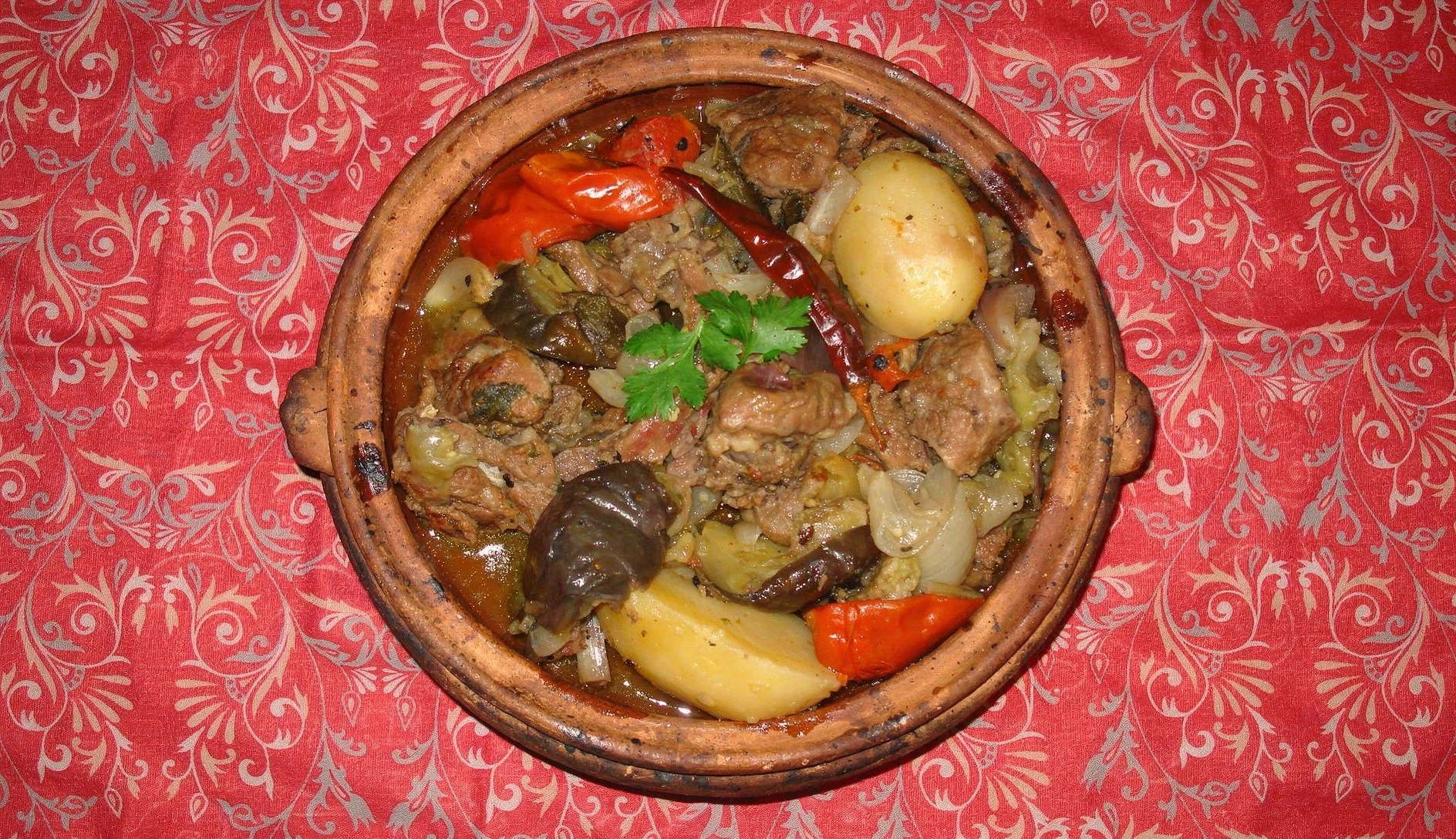
Chanakhi (ჩანახი) is what happens when you put lamb, eggplant, potatoes, tomatoes, and a fistful of herbs into a clay pot, shove it in the oven, and leave it alone for three hours. No stirring. No fussing. No checking every twenty minutes. You walk away, and the oven does something almost alchemical — the lamb fat renders into the vegetables, the tomatoes collapse into a sauce, the eggplant absorbs everything around it, and the potatoes soak up the juices until they're more flavor than starch. It's one of those dishes that rewards patience over technique, and it's been feeding Georgian families through cold winters for centuries.
Chanakhi Quick Facts
- Georgian name: ჩანახი (cha-NA-khee)
- Named after: The clay pot (chanaki) it's traditionally baked in
- Key ingredients: Lamb, eggplant, potato, tomato, fresh herbs
- Cooking method: Layered and slow-baked, never stirred
- Prep + cook time: 20 min prep, 2.5–3 hours baking
- Cost in Georgia: 15–25 GEL in restaurants (~$5.50–9 USD)
- Difficulty: Easy — the technique is assembly, not cooking
Why This Stew Matters
Georgian cooking has flashy dishes — khinkali with their intricate pleats, khachapuri in its various architectural forms, satsivi with its elaborate walnut sauce. Chanakhi is none of those things. It's peasant food in the most honest sense. No show-off techniques. No hard-to-find ingredients. Just lamb and whatever grows in the garden, cooked slowly in a clay pot until the boundaries between ingredients blur into something deeply satisfying.
The name literally comes from the cooking vessel — chanaki, individual clay pots that look like small amphoras with lids. In traditional Georgian households, each person gets their own pot, assembled in the morning and left in a wood-fired oven for hours. The pot is the plate. You eat directly from it, tearing bread to mop up the rich, herb-flecked juices at the bottom.
What makes chanakhi remarkable is its simplicity. The lamb doesn't get browned first. The vegetables don't get pre-cooked. You just layer everything raw (or close to it), add liquid, seal the pot, and trust the process. The long, slow bake does all the work — breaking down tough lamb shoulder into something spoonable, melting the eggplant into silk, and concentrating the tomato juices into a sauce that tastes like it took hours of reduction. Which, in a way, it did.
The Clay Pot Question
If you're reading this outside of Georgia, you probably don't have traditional chanaki pots. That's fine. A Dutch oven works beautifully. So does any heavy, lidded oven-proof pot — cast iron, enameled ceramic, even a deep casserole dish sealed tightly with foil. The important things are: it holds heat well, it seals moisture in, and it's oven-safe for 3 hours at moderate heat.
That said, if you can find individual clay pots (they're sold cheaply at any market in Georgia, and available online in specialty shops), the experience changes. Something about each person having their own sealed pot, cracking it open at the table, getting hit with that first rush of herb-scented steam — it turns dinner into an event. The clay also gives a subtle earthy flavor that metal can't replicate.
Clay Pot Tip
If using clay pots for the first time, soak them in water for 30 minutes before filling. This prevents cracking from thermal shock and creates steam inside the pot during cooking, keeping everything moist. Never place a cold clay pot into a hot oven — put it in while the oven preheats.
Ingredients
This recipe serves 4 people in individual portions, or makes one large pot for family-style eating. Every ingredient here is cheap and available year-round, which is exactly why chanakhi became a staple — it's peasant economics at its finest.
| Ingredient | Amount | Notes |
|---|---|---|
| Lamb shoulder or neck | 800g (bone-in) | Bone-in gives better flavor. Cut into 5cm chunks. |
| Eggplant | 2 medium (~600g) | Sliced into 2cm rounds. No need to salt/drain. |
| Potatoes | 3 medium (~500g) | Waxy or all-purpose. Peeled, cut into large cubes. |
| Tomatoes | 4 medium (~400g) | Ripe, juicy. Quartered. Canned plum tomatoes work in winter. |
| Onions | 2 medium | Sliced into thick rings. |
| Garlic | 6 cloves | Peeled, left whole. They melt into the sauce. |
| Fresh cilantro | Large bunch (~40g) | Roughly chopped, stems and all. |
| Fresh basil | Large bunch (~30g) | Georgian purple basil if available. Regular works fine. |
| Flat-leaf parsley | Large bunch (~30g) | Roughly chopped. |
| Butter | 60g | Tucked around the lamb. Adds richness. |
| Ground coriander | 1 tsp | Essential Georgian spice. Freshly ground is better. |
| Hot pepper (optional) | 1 small | Fresh green or red chili. Traditional but optional. |
| Water or lamb stock | 250ml | Just enough to start the process. Vegetables release their own liquid. |
The Lamb Rule
Use bone-in lamb with some fat. Lean lamb dries out during the long bake. Shoulder and neck are ideal — they have enough connective tissue to break down into gelatin, which gives the sauce body. Leg works but needs more butter to compensate. Never use tenderloin or loin chops — they'll turn into shoe leather in 3 hours.
Equipment
Traditional: Clay Pots
4 individual chanaki pots (500–600ml each) with lids. Soak in water 30 minutes before use. Available at Tbilisi markets for 5–10 GEL each.
Alternative: Dutch Oven
One large (4–5 liter) Dutch oven or heavy lidded casserole. Cast iron or enameled. Seal with foil under the lid if it doesn't fit perfectly tight.
Step-by-Step Recipe
Step 1: Prepare Everything
Cut the lamb into large chunks — about 5cm. You want them big enough to stay intact through 3 hours of cooking. Leave the bone in wherever possible. Season the meat generously with salt, black pepper, and ground coriander. Let it sit while you prep the vegetables.
Slice the eggplant into 2cm rounds. Cut potatoes into large cubes (about 3–4cm). Slice onions into thick rings. Quarter the tomatoes. Peel garlic cloves but leave them whole. Roughly chop all the herbs — stems included for cilantro and parsley, they soften completely during the bake.
Step 2: Layer the Pot
This is where chanakhi either works or doesn't. The order matters because each layer contributes differently to the final dish:
Bottom layer — Lamb: Arrange the seasoned meat in a single layer on the bottom of the pot. Tuck knobs of butter between the pieces. The lamb goes on the bottom because it needs the longest, most direct heat to break down. The butter melts into the meat and starts the braising liquid.
Second layer — Onions: Spread the onion rings over the lamb. They'll dissolve into sweetness over 3 hours, forming the backbone of the sauce.
Third layer — Eggplant: Lay the eggplant slices over the onions. Eggplant is a sponge — it will absorb the lamb fat and juices rising from below, becoming impossibly rich and silky.
Fourth layer — Potatoes: Scatter the potato cubes over the eggplant. They cook in the steam rising from the lower layers and absorb the concentrated flavors.
Top layer — Tomatoes: Arrange the quartered tomatoes across the top, covering everything. They create a seal that traps moisture, and their acid breaks down into the sauce as they cook. Tuck the garlic cloves and optional hot pepper between the layers wherever there's space.
Herbs: Scatter generous handfuls of chopped cilantro, basil, and parsley between every layer — not just on top. You want herbs throughout the pot so their flavor permeates everything.
Step 3: Add Liquid and Seal
Pour the water or stock gently down the side of the pot — don't pour it over the tomatoes, or you'll wash the seasoning off the layers. The liquid should barely reach the bottom layers. This might seem like not enough, but the vegetables release an enormous amount of liquid as they cook. By the end, there will be more than enough sauce.
Season the top layer with a final pinch of salt. Cover the pot tightly. If your lid doesn't seal perfectly, lay a sheet of foil over the top before placing the lid — you want as little moisture escaping as possible.
Step 4: Bake Low and Slow
Place the pot in the oven at 180°C (350°F). If using clay pots, put them in while the oven is cold and let them heat up together — this prevents thermal shock and cracking.
Bake for 2.5 to 3 hours. Do not open the lid. Do not stir. Do not peek. This is the hardest part and the most important. Every time you open the pot, you release steam that's doing critical work — breaking down the lamb, melting the eggplant, concentrating the sauce. Trust the process.
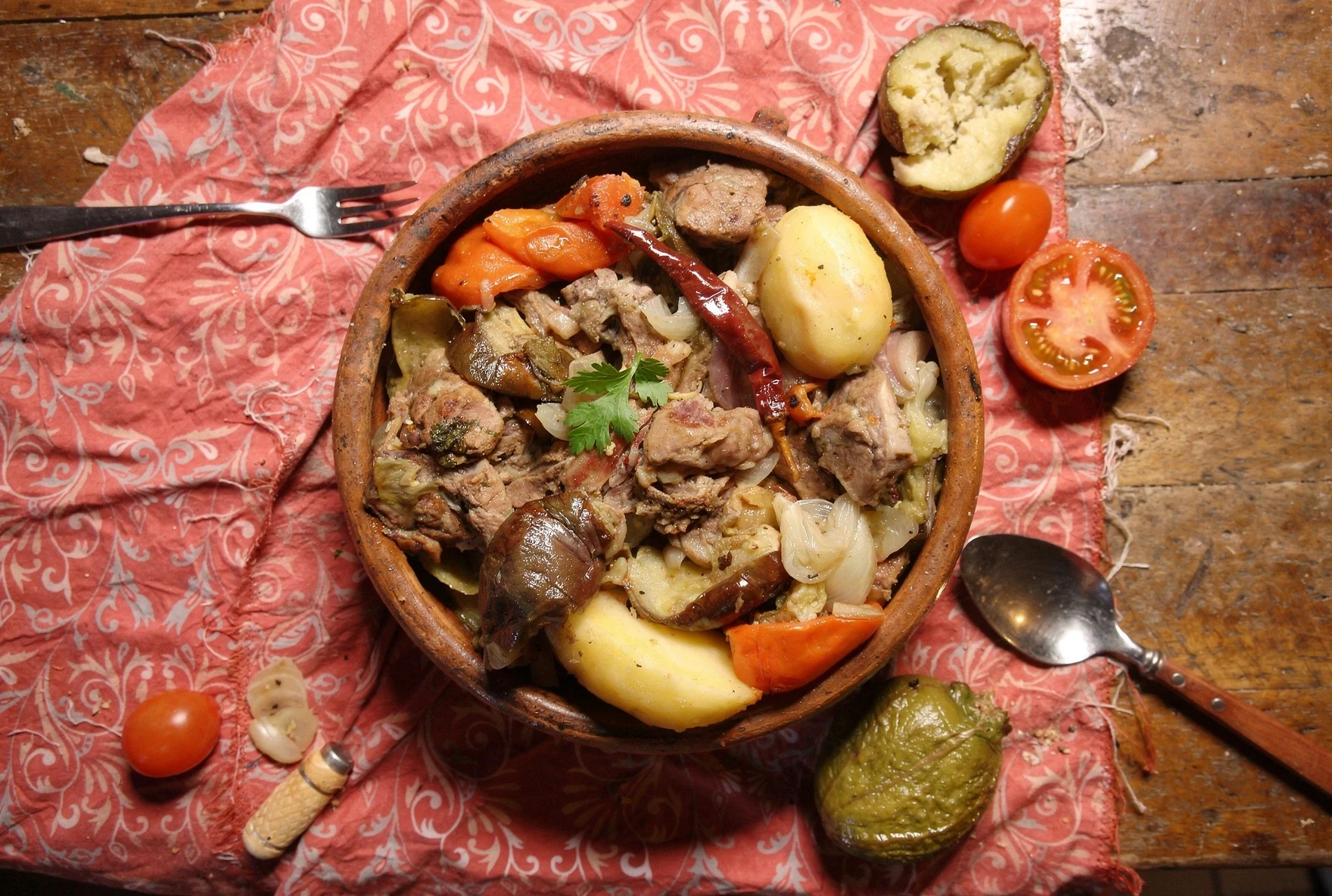
You'll know it's ready when you can smell it through the oven door. The lamb should be falling off the bone with zero resistance. The eggplant should have dissolved into the sauce. The potatoes should be tender but still holding their shape. The liquid should be reduced to a rich, herb-flecked sauce — not watery, not dry.
The Timing Window
At 2.5 hours, check the lamb. If it pulls apart easily with a fork, it's done. If there's resistance, give it another 30 minutes. Traditional Georgian recipes call for 4–5 hours at lower heat (150°C) — if you have the time, this is even better. The lamb becomes almost spreadable. Chanakhi is forgiving — you can't really overcook it, only undercook it.
Step 5: Rest and Serve
Let the pot rest for 10 minutes with the lid on. This lets the sauce settle and the temperature equalize. Then bring the whole pot to the table — chanakhi is served in its cooking vessel. Scatter a final handful of fresh herbs on top.
Serve with Georgian bread — shotis puri or tonis puri, ideally. The bread is not optional. Half the point of chanakhi is tearing off chunks of bread and soaking up the sauce at the bottom of the pot, where the lamb fat, tomato juices, and herb oils have merged into something extraordinary. A simple salad of sliced tomatoes, cucumbers, and fresh herbs on the side is traditional. Cheese — sulguni or imeruli — is welcome but not necessary.
Tips for Perfect Chanakhi
🍅 Use Summer Tomatoes
Chanakhi is best in late summer when tomatoes are at peak ripeness and eggplants are abundant. In winter, supplement with a tablespoon of tomato paste mixed into the water, or use good canned plum tomatoes.
🔥 Don't Rush the Oven
Cranking the heat to 220°C will not speed this up — it'll burn the top layer while leaving the lamb tough. Low and slow is the entire philosophy. If anything, go lower (150°C) and longer (4 hours).
🧈 Don't Skip the Butter
The butter isn't just for richness — it melts into the lamb layer first, creating an emulsified base for the sauce. Lamb fat alone can taste heavy. Butter rounds it out and adds sweetness.
🌿 Go Heavy on Herbs
When you think you've added enough herbs, add more. They cook down dramatically over 3 hours. What looks like an excessive amount of cilantro, basil, and parsley will become a subtle herbal background in the finished dish.
Common Mistakes
| Mistake | Why It Happens | How to Fix It |
|---|---|---|
| Stirring the pot | Instinct from making other stews | Fight it. The layers are intentional. Stirring turns it to mush. |
| Too much liquid | Doesn't look like enough at the start | 250ml is enough. The vegetables release a huge amount of water. |
| Using lean lamb | Trying to be healthy | Chanakhi needs fat. Use shoulder or neck, bone-in. |
| Cutting vegetables too small | Worried they won't cook through | They have 3 hours. Keep them large or they'll disintegrate. |
| Not enough salt | Under-seasoning each layer | Season every layer separately. The vegetables absorb salt as they cook. |
| Checking too early | Impatience | Don't open before 2.5 hours. Every peek costs you steam. |
Variations
| Variation | What Changes | Notes |
|---|---|---|
| Beef chanakhi | Replace lamb with bone-in beef chuck | Needs 3.5–4 hours. Less traditional but still delicious. |
| Vegetarian | Skip the meat, double the eggplant, add chickpeas | Use more butter and olive oil. Reduce cooking time to 1.5 hours. |
| Svaneti-style | Add Svaneti salt (svanuri marili) instead of regular salt | Svaneti salt adds garlic, fenugreek, and caraway flavor. Use 2 tsp. |
| Summer chanakhi | Add bell peppers, green beans, and summer squash | More vegetables, less potato. Lighter but still hearty. |
| Quick weeknight | Use lamb chops, smaller vegetable pieces | Done in 1.5 hours at 190°C. Not traditional but gets close. |
The Next-Day Rule
Like most braises, chanakhi is even better the next day. The flavors meld overnight in the fridge, and reheating gently (covered, 160°C for 30 minutes) gives the sauce another chance to concentrate. Many Georgian cooks deliberately make extra for this reason.
What to Serve Alongside
| Side | Why It Works |
|---|---|
| Shotis puri or tonis puri | Essential. You need bread to soak up the sauce. This is non-negotiable. |
| Tomato-cucumber salad | Fresh, crunchy contrast to the rich, soft stew. Dress with oil and herbs. |
| Sulguni or imeruli cheese | Salty, stretchy cheese eaten alongside. Slice thickly. |
| Tkemali sauce | The sour plum sauce adds a tart punch that cuts through the lamb fat. |
| Badrijani nigvzit | Cold walnut-paste eggplant rolls as a starter. Temperature contrast is welcome. |
| Red wine | Saperavi, ideally. The dark, tannic Georgian red stands up to lamb beautifully. |
Where to Eat Chanakhi in Tbilisi
Shavi Lomi
Updated Georgian cuisine on Zubalashvili Street. Their chanakhi comes in individual pots with a slight twist on the herb blend. Reservation recommended.
Barbarestan
Recipes from a 19th-century Georgian cookbook. Their chanakhi is as traditional as it gets — clay pot, no shortcuts, enormous portions.
Mapshalia
Rustic, no-frills Georgian food near the Dry Bridge market. Chanakhi is a staple on their menu. Cheap and honest.
Any Roadside Sasadilo
Honestly, the best chanakhi is often at roadside restaurants outside Tbilisi — particularly on the road to Kakheti. Look for clay pots in the window.
Nutrition
| Nutrient | Per Serving |
|---|---|
| Fat | 22g (including butter and lamb fat) |
| Fiber | 8g (from eggplant and potato) |
| Sodium | ~600mg (varies with salt) |
| Iron | ~4mg (from lamb) |
Storage and Reheating
Refrigerator
Keeps 4–5 days in an airtight container. The flavor improves for the first 2 days, then slowly declines.
Freezer
Freezes well for up to 3 months. The potatoes may soften slightly but the flavor remains excellent. Thaw overnight in the fridge.
Reheating
Best in the oven: covered, 160°C, 30 minutes. Microwave works in a pinch but loses the texture advantage. Add a splash of water if the sauce has thickened too much.
Don't Reheat Twice
Reheat only what you'll eat. The eggplant gets increasingly mushy with each reheat cycle. Portion it out before warming.
Frequently Asked Questions
Can I make chanakhi without eggplant?
You can, but it won't really be chanakhi anymore. Eggplant and lamb are the two non-negotiable ingredients. The eggplant absorbs the lamb fat and creates the silky texture that defines this dish. If you dislike eggplant, try zucchini as a substitute — it has similar moisture-absorbing properties, though the result will be lighter.
Why doesn't the lamb get browned first?
Traditional chanakhi uses raw lamb, layered directly into the pot. The long, slow bake renders the fat and breaks down the connective tissue without browning. Some modern recipes brown the lamb first for deeper flavor — this is fine and adds a caramelized note, but it's not how your Georgian grandmother would do it.
How do I know when chanakhi is done?
The lamb should fall off the bone with no resistance, the eggplant should be almost dissolved, and the sauce should be rich and reduced — not watery. Minimum 2.5 hours, ideally 3. If in doubt, cook longer. Chanakhi forgives overcooking far better than undercooking.
Can I use a slow cooker instead of the oven?
Yes, though the result is slightly different. Layer everything the same way, cook on low for 6–8 hours. The main trade-off is less evaporation, so use less liquid (about 150ml instead of 250ml). The oven gives better flavor concentration and slightly better texture.
What wine pairs best with chanakhi?
Saperavi is the classic pairing — the dark, tannic Georgian red matches the richness of the lamb perfectly. For something lighter, a dry Mukuzani works well. White wine drinkers should try an amber wine (orange wine) — the tannin structure from skin contact stands up to the meat surprisingly well.
Written by The Georgian Eats Team
Based in Tbilisi, where chanakhi pots appear on restaurant tables as soon as the weather turns cold. We've eaten our way through dozens of versions — from clay-pot originals at highway sasadilos to modern interpretations at Tbilisi's best restaurants — to bring you a recipe that stays true to the tradition.
Last updated: February 2026.
Related Articles
Chakapuli: Spring Lamb Stew
Georgia's other legendary lamb stew — lighter, herbier, and tied to Easter.
Kharcho: Spiced Beef and Walnut Soup
The beef-based cousin with walnuts and sour plum paste.
Ojakhuri: Family-Style Pork and Potatoes
Another clay-pot classic — this time fried, not baked.
20 Dishes You Need to Try
The complete guide to Georgian food — what to order and how to eat it.