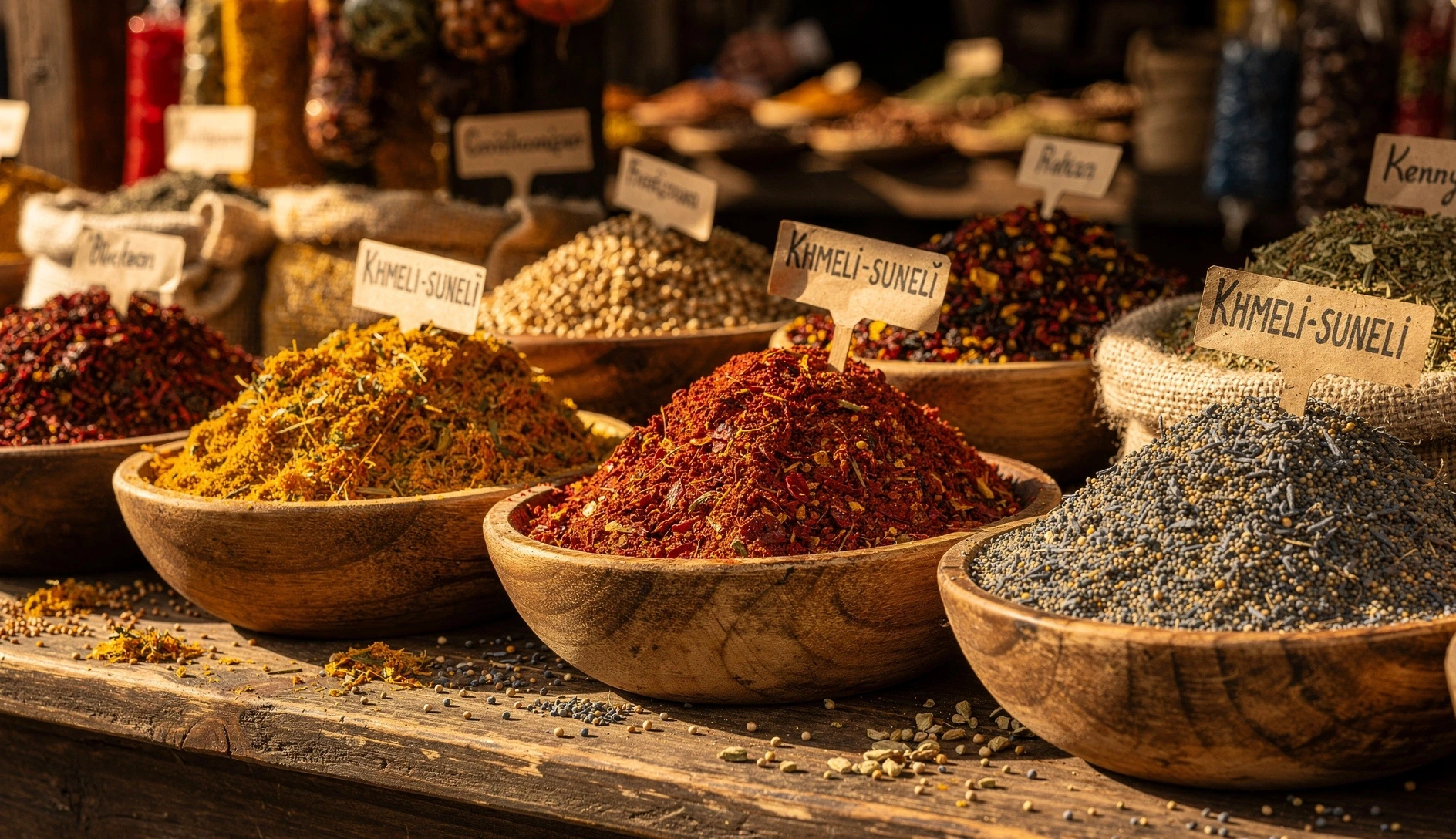
Walk through any Georgian market — Dezerter Bazaar in Tbilisi, the spice stalls in Kutaisi, a village roadside stand in Kakheti — and you'll notice something immediately: Georgians are obsessed with seasoning. Not heat for its own sake (that's more of an Abkhazian thing), but layers of flavor built from dried herbs, ground seeds, fermented pastes, and spice blends that have no real equivalent anywhere else on earth. Georgian food without its spices would be like Italian food without olive oil — technically possible, spiritually empty.
This guide covers every spice and herb you'll encounter in Georgian cooking, from the "big five" blends that every Georgian kitchen keeps on hand to the regional specialties that most visitors never learn about. Whether you're trying to replicate kharcho at home or just wondering what that greenish-yellow powder at the market actually is, this is your reference.
The Big Five: Georgian Spice Blends
These are the five seasoning blends that define Georgian cooking. Every home cook has at least three of them. Most restaurants use all five daily. If you stock nothing else, get these.
1. Khmeli Suneli (ხმელი სუნელი) — The All-Purpose Blend
If Georgian cuisine had a signature spice, this is it. Khmeli suneli (literally "dried spice") is a warm, aromatic, slightly nutty blend that goes into soups, stews, bean dishes, walnut sauces, and marinades. Think of it as Georgia's garam masala — not a single flavor, but a complex, layered warmth that makes everything taste more like itself.
The color is greenish-yellow, the texture is fine powder, and the smell is unmistakable: earthy fenugreek, bright coriander, a whisper of mint, and something floral underneath. It's not hot at all. The warmth is aromatic, not capsaicin.
| Ingredient | Georgian Name | Role in the Blend |
|---|---|---|
| Blue fenugreek | უცხო სუნელი | Nutty backbone — the dominant note |
| Coriander seed | ქინძის თესლი | Citrusy warmth, balances the earthiness |
| Dried marigold | ყვითელი ყვავილი | Floral earthiness, golden color |
| Dried basil | რეჰანი | Herbal sweetness |
| Summer savory | ქონდარი | Peppery thyme-like bite |
| Dill | კამა | Fresh, slightly anise note |
| Parsley | ოხრახუში | Green, grassy base |
| Celery seed | ნიახური | Savory depth |
| Mint | პიტნა | Cooling brightness |
| Bay leaf | დაფნის ფოთოლი | Subtle bitter-herbal undertone |
| Black pepper | შავი პილპილი | Gentle heat |
Soviet Standardization
Khmeli suneli was actually standardized during the Soviet era — equal parts of every ingredient plus 0.1% saffron (kept low because saffron was expensive). Modern versions ditch the equal-parts ratio in favor of flavor. Most good blends lead with fenugreek and coriander, with the herbs playing supporting roles.
Where to use it: Lobio, kharcho, satsivi, chanakhi, any walnut-based sauce or paste, bean soups, marinades for grilled meat, pilaf, stewed vegetables. Honestly, it's hard to go wrong. Add it in the last 5–10 minutes of cooking — prolonged heat kills the aromatics.
2. Svanuri Marili (სვანური მარილი) — Svanetian Salt
If khmeli suneli is the all-rounder, Svanetian salt is the secret weapon. From the remote mountain region of Svaneti in northwestern Georgia, this is not just salt with herbs mixed in — it's a carefully pounded blend of garlic, salt, blue fenugreek, coriander, dried marigold, caraway, and hot pepper, worked together in a wooden mortar until the garlic's moisture binds everything into a slightly damp, intensely aromatic compound. Making a kilogram takes several hours of hand-pounding.
The flavor is savory, garlicky, and complex — somewhere between flavored salt and a concentrated spice paste. It amplifies rather than dominates. Sprinkle it on roasted potatoes, stir it into scrambled eggs, rub it on meat before grilling, toss it with roasted vegetables. Anywhere you'd use regular salt, Svanetian salt makes the dish specifically, recognizably Georgian.
Svanetian Salt
Mild, aromatic, garlicky. The everyday choice. Use as a 1:1 salt replacement that adds herb depth. Originated in Svaneti's mountain villages where preserving food through winter required flavorful salt blends.
Megrelian Salt
Much hotter — heavy on chili. From the Samegrelo region, which likes things spicier than the rest of Georgia. Use for dishes where you want heat alongside seasoning: grilled meat, stews, beans.
Where to use it: Ojakhuri, kubdari, roasted potatoes, grilled meat, fried eggs, salads. It replaces regular salt in almost everything.
3. Adjika (აჯიკა) — The Hot Paste
Adjika is a hot, aromatic paste (or dried powder) from the Samegrelo and Abkhazia regions. Unlike harissa or sriracha, adjika is more complex than "just heat" — it's fermented red peppers pounded with garlic, fresh herbs, coriander, blue fenugreek, and salt into a thick, crimson paste that's simultaneously fiery, savory, and deeply herbal. The dried version is a coarse red powder with a similar flavor profile.
Good fresh adjika has a slow-building heat that doesn't overwhelm. The garlic is sharp, the fenugreek adds depth, and the fermentation gives it a slightly tangy edge. It's closer to a condiment than a spice — Georgians put it on the table next to tkemali and eat it with bread, grilled meat, or stir it into soups.
Wet vs. Dry Adjika
Wet adjika (fresh paste) is the original and more complex — it's a living, fermented product that should be refrigerated. Dry adjika is more shelf-stable and easier to ship, but loses some of the fresh garlic punch. Both are useful: wet for condiment use and finishing, dry for adding to stews and marinades during cooking.
Where to use it: As a table condiment with bread and grilled meat, stirred into kharcho or lobio, rubbed on meat before grilling, mixed into dipping sauces, added to stews. Dry adjika works well in any dish that calls for heat plus complexity.
4. Utskho Suneli (უცხო სუნელი) — Blue Fenugreek
This is the single most important individual spice in Georgian cooking, and one of the hardest to find outside the Caucasus. Utskho suneli is ground blue fenugreek — specifically, the seeds and pods of Trigonella caerulea, a plant that grows wild in Georgia's northern mountains. The name literally means "foreign spice," which is ironic because it's now more Georgian than almost anything else in the spice rack.
The flavor is nutty, slightly sweet, with a mild bitterness that's nothing like the intense bitterness of common fenugreek (Trigonella foenum-graecum). It's the backbone of khmeli suneli, the defining ingredient in satsivi and pkhali, and appears in virtually every walnut-based Georgian dish. Without it, the food tastes good but not Georgian.
| Feature | Blue Fenugreek (Utskho Suneli) | Common Fenugreek |
|---|---|---|
| Species | Trigonella caerulea | Trigonella foenum-graecum |
| Flavor | Nutty, mild, slightly sweet | Bitter, maple-like, pungent |
| Aroma | Subtle, walnut-like | Strong, curry-like |
| Color | Tan/greenish-brown powder | Yellow-brown seeds |
| Substitutable? | — | Use ¼ the amount + pinch of ground walnut |
Where to use it: Satsivi, pkhali, badrijani nigvzit, any walnut paste or sauce, bean dishes, stews, lobiani.
5. Imeretian Saffron (იმერული ზაფრანა) — Dried Marigold
This is not real saffron. It's dried, ground marigold petals (Tagetes or Calendula), and it's one of Georgia's most distinctive ingredients. Imeretian saffron gives walnut sauces their characteristic golden-orange color and adds an earthy, slightly musky flavor that you can't replicate with turmeric (which adds color but the wrong flavor) or actual saffron (which is too floral and too expensive).
You'll recognize it at markets by its bright orange-gold color and subtle, hay-like smell. It's especially important in walnut-based dishes: the color of a properly made satsivi or pkhali comes partly from marigold. It also goes into churchkhela and various holiday dishes.
Where to use it: Satsivi, pkhali, bazhe sauce, walnut pastes, chakapuli, holiday dishes, churchkhela.
Essential Fresh Herbs
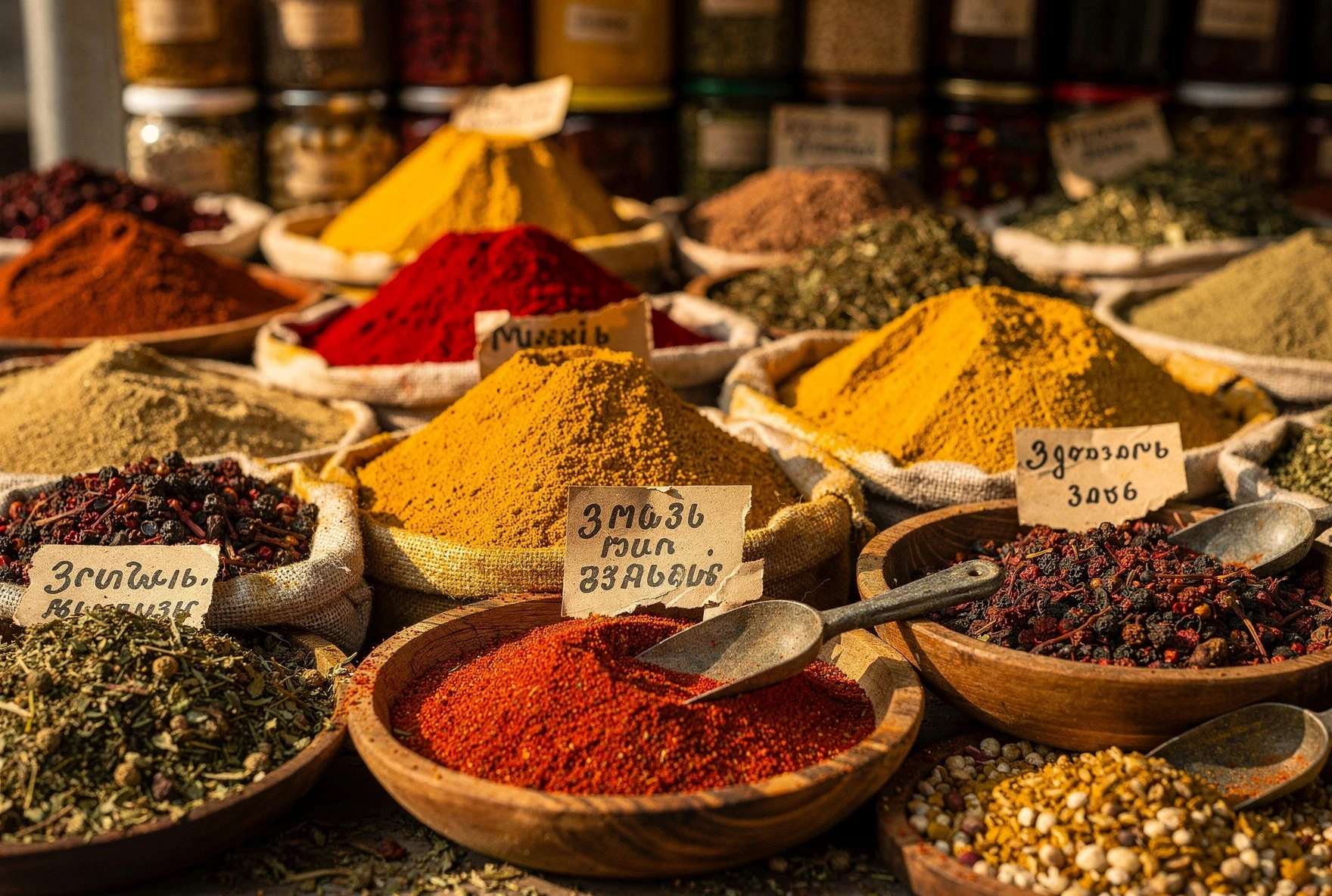
If you eat in Georgia for even a single day, you'll notice: fresh herbs are not a garnish here. They're a food group. Every meal comes with a plate of whole herbs — cilantro, basil, tarragon, dill — eaten raw, by the fistful, alongside whatever's on the table. Georgian cooking uses more fresh herbs per dish than almost any other cuisine, and the specific combination is what gives the food its character.
| Herb | Georgian | Flavor Profile | Key Dishes |
|---|---|---|---|
| Cilantro (coriander leaf) | ქინძი | Bright, citrusy, polarizing | Everything — the #1 Georgian herb |
| Purple basil | იისფერი რეჰანი | Sweet, anise-forward, more intense than green | Salads, eaten raw, tomato dishes |
| Tarragon | ტარხუნა | Anise, sweet, slightly bitter | Chakapuli (the star herb), tarkhun lemonade |
| Dill | კამა | Fresh, grassy, slightly sweet | Pkhali, salads, stews, pickles |
| Flat-leaf parsley | ოხრახუში | Clean, peppery, grassy | Salads, stews, garnish everywhere |
| Summer savory | ქონდარი | Peppery, thyme-like, slightly bitter | Bean dishes, stews, tkemali |
| Mint | პიტნა | Cool, bright, sweet | Salads, yogurt dishes, tea, tolma |
| Green onion | მწვანე ხახვი | Mild allium bite | Salads, garnish, herb plates |
The Herb Plate
At any Georgian meal — restaurant or home — you'll get a plate of fresh whole herbs alongside your food. This isn't a garnish. You pick up whole sprigs of cilantro, basil, and tarragon and eat them with bites of meat, cheese, or bread. If you've never eaten a whole sprig of purple basil with a bite of suluguni cheese, you're missing one of the great simple pleasures of Georgian food.
Individual Dried Spices
Beyond the blends and fresh herbs, these individual spices show up constantly in Georgian recipes. Most of them are familiar from other cuisines but used in distinctly Georgian ways.
| Spice | Georgian | Typical Use |
|---|---|---|
| Ground coriander | ქინძის თესლი | Soups, stews, walnut sauces, marinades — the most-used single spice after salt |
| Garlic | ნიორი | Pounded into sauces, rubbed on meat, essential in shkmeruli, adjika, svanetian salt |
| Red pepper (dried) | წითელი წიწაკა | Heat source — flakes or ground. Not as hot as you'd expect; more sweet paprika than cayenne |
| Black pepper | შავი პილპილი | Used sparingly. Georgian food gets complexity from herbs, not heat |
| Caraway / cumin | ძირა | Mountain dishes — khinkali, kubdari. More common in Svaneti, Tusheti, Pshavi |
| Bay leaf | დაფნის ფოთოლი | Bean dishes, pork stews, marinades, pickles |
| Cinnamon | დარიჩინი | Sweets, tolma sauce (with matsoni), some walnut dishes — always subtle |
| Dried barberries | კოწახური | Sour tang in meat dishes, pilaf, stews — the Georgian equivalent of sumac |
Regional Spice Profiles
Georgia is small — about the size of West Virginia — but the regional variation in seasoning is dramatic. Mountain communities developed entirely different flavor profiles from the lowlands, and western Georgia's proximity to the Black Sea gave it a different palette than the eastern wine country.
| Region | Signature Flavors | Iconic Dishes |
|---|---|---|
| Samegrelo (west) | Hot, garlicky, walnut-heavy. Adjika country. Most aggressive seasoning in Georgia. | Elarji, gebzhalia, kharcho (Megrelian version) |
| Svaneti (northwest mountains) | Caraway-forward, garlic, complex salt blends. Preservation-driven cuisine. | Kubdari, tashmijabi, Svanetian salt |
| Kakheti (east) | Walnut-centric, moderate herbs, wine-based cooking. Most "classic" Georgian flavor. | Mtsvadi, churchkhela, chakapuli |
| Imereti (central) | Mild, herb-forward, dairy-heavy. Saffron (marigold) prominent. | Imeretian khachapuri, Imeretian cheese dishes |
| Adjara (southwest coast) | Butter, dairy, subtle spicing. Turkish influence. Less walnut, more cream. | Adjarian khachapuri, borano, sinori |
| Pshavi/Khevsureti (mountains) | Caraway, wild herbs, simple seasoning. Altitude-limited ingredients. | Khinkali (the original version), dried meat |
The Walnut Connection
You can't discuss Georgian spicing without talking about walnuts. Walnuts aren't a spice in the technical sense, but in Georgian cooking they function as one — ground walnuts form the base of dozens of sauces, pastes, and fillings, and those walnut preparations are where Georgian spices do their most important work.
The classic Georgian walnut paste — the one that appears in badrijani nigvzit, pkhali, satsivi, and bazhe — is essentially ground walnuts + garlic + cilantro + utskho suneli + marigold + vinegar or pomegranate juice. The spices transform what would be plain nut butter into something complex, earthy, and distinctly Georgian. Without the utskho suneli and marigold, it's just walnut sauce. With them, it's Georgian walnut sauce — and the difference is everything.
Walnut Sauce Dishes
- Satsivi — cold chicken in walnut sauce
- Bazhe — thin walnut sauce for poultry/fish
- Badrijani — eggplant with walnut paste
- Pkhali — vegetable-walnut balls
The Essential Spice Trio
Every walnut sauce needs these three: utskho suneli (nutty depth), ground coriander (citrusy warmth), and dried marigold (color and earthiness). Miss any one of them and the sauce won't taste right.
Buying Georgian Spices
This is where things get practical. If you live outside Georgia, sourcing authentic Georgian spices requires some effort — but it's entirely doable, and the quality difference between genuine Georgian spices and generic substitutes is enormous.
| Source | Quality | Price Range | Notes |
|---|---|---|---|
| Georgian markets (in person) | Best possible | ₾1–5 per 100g | Freshest and cheapest. Dezerter Bazaar in Tbilisi has everything. |
| Georgian online shops | Excellent | $8–15 per blend | Sweet Supra, Georgian Spice Box on Amazon. Ships internationally. |
| Russian/Eastern European stores | Good to variable | $3–8 per blend | Most carry khmeli suneli and adjika. Check freshness — some sit on shelves. |
| Specialty spice shops | Good | $5–12 per blend | World Spice, Burlap & Barrel. May use slightly different formulas. |
| DIY (make your own) | Depends on ingredients | Varies | Possible for khmeli suneli if you can source blue fenugreek. |
What to Buy First
If you're starting from zero, buy these three things: (1) a bag of khmeli suneli, (2) a bag of utskho suneli (blue fenugreek), and (3) Svanetian salt. With those three plus fresh cilantro and garlic — which you can get anywhere — you can make 80% of Georgian dishes authentically.
Substitution Guide
Sometimes you can't find the real thing. These substitutions won't make the dish taste Georgian, but they'll get you in the right ballpark.
| Georgian Spice | Best Substitute | How Close? |
|---|---|---|
| Khmeli suneli | Equal parts ground coriander, dried basil, dried dill + pinch of fenugreek | 60% — misses the complexity |
| Utskho suneli (blue fenugreek) | ¼ amount regular fenugreek leaves + pinch of ground walnut | 40% — different species entirely |
| Imeretian saffron (marigold) | ½ turmeric + ½ sweet paprika (for color); or safflower | 30% — only approximates the color |
| Svanetian salt | Salt + granulated garlic + dried dill + coriander + pinch of chili | 50% — lacks the pounded-together depth |
| Adjika (paste) | Harissa + extra garlic + pinch of dried herbs | 55% — similar heat, different herb profile |
| Summer savory | Thyme (slightly sweeter but closest match) | 75% — very similar flavor families |
| Dried barberries | Dried cranberries (halved) or sumac for the sourness | 60% — cranberries are sweeter, sumac is drier |
Which Spice Goes Where
This is the practical reference — a quick lookup showing which of our recipes use which key Georgian spices.
| Recipe | Khmeli Suneli | Utskho Suneli | Marigold | Adjika | Svan. Salt |
|---|---|---|---|---|---|
| Satsivi | ✓ | ✓ | ✓ | — | — |
| Kharcho | ✓ | ✓ | — | optional | — |
| Lobio | ✓ | ✓ | — | — | optional |
| Pkhali | — | ✓ | ✓ | — | — |
| Chakapuli | — | — | — | — | — |
| Kubdari | ✓ | ✓ | — | — | ✓ |
| Shkmeruli | — | — | — | — | optional |
| Ojakhuri | — | — | — | optional | ✓ |
| Badrijani | — | ✓ | ✓ | — | — |
| Chanakhi | ✓ | — | — | — | — |
Why Chakapuli Has No Spice Blend
Notice chakapuli is all dashes — no dried spice blends at all. It's one of the few Georgian dishes that relies entirely on fresh herbs (mountains of tarragon and cilantro), sour plums, and white wine. The flavor comes from sheer volume of fresh ingredients, not from the spice shelf. It's the exception that proves how herb-forward Georgian cooking really is.
Common Mistakes
🚫 Using regular fenugreek
Common fenugreek is aggressively bitter. Blue fenugreek (utskho suneli) is mild and nutty. They're different species. If a recipe says "fenugreek" and it's Georgian, it means blue fenugreek 95% of the time.
🚫 Subbing turmeric for marigold
Turmeric adds the right color but completely wrong flavor — it tastes earthy and gingery where marigold is floral and musky. If you must substitute, use less turmeric and add a tiny pinch of sweet paprika.
🚫 Adding spices too early
Khmeli suneli and utskho suneli lose their aromatics with prolonged heat. Add them in the last 5–10 minutes of cooking. Svanetian salt is an exception — its garlic benefits from a bit of cooking.
🚫 Skipping fresh herbs
Dried spices alone don't make Georgian food. You need both: the dried blends during cooking and fresh herbs at the table. A dish with khmeli suneli but no fresh cilantro is halfway there at best.
🚫 Using stale spices
Ground spices lose potency after 6–12 months. If your khmeli suneli smells like sawdust, it's dead. Buy in small quantities and store airtight, away from heat and light.
🚫 Over-seasoning
Georgian food is well-spiced, not heavily spiced. The goal is layers of flavor, not a spice bomb. Khmeli suneli should enhance, not dominate. A teaspoon goes a long way in most dishes.
Frequently Asked Questions
What is khmeli suneli and what does it taste like?
Khmeli suneli is Georgia's signature all-purpose spice blend. It tastes warm, nutty, slightly floral, and herbal — not hot. The dominant notes are fenugreek and coriander, with supporting herbs like basil, dill, and mint. Think of it as Georgia's answer to garam masala or herbes de Provence.
Where can I buy Georgian spices online?
Amazon carries several Georgian spice brands (Sweet Supra, Georgian Spice Box). Specialty shops like World Spice and Burlap & Barrel stock khmeli suneli. Russian and Eastern European grocery stores often carry Georgian spices in the seasoning aisle. For the most authentic experience, order directly from Georgia-based online shops.
What's the difference between blue fenugreek and regular fenugreek?
They're different plant species. Blue fenugreek (Trigonella caerulea) is mild, nutty, and slightly sweet. Regular fenugreek (Trigonella foenum-graecum) is intensely bitter with a maple-like aroma. They are not interchangeable — using regular fenugreek in Georgian recipes will give an unpleasant bitter taste.
Is Georgian food spicy (hot)?
Most Georgian food is well-seasoned but not particularly hot. The Samegrelo and Abkhazia regions are the exceptions — adjika from these areas packs real heat. Generally, Georgian cuisine uses spices for flavor complexity rather than capsaicin heat. Chili flakes are available on the table at most restaurants for those who want more.
How long do Georgian spice blends last?
Stored airtight in a cool, dark place: khmeli suneli and utskho suneli stay potent for 6–12 months. Svanetian salt lasts longer (the salt preserves it) — up to 18 months. Fresh adjika paste should be refrigerated and used within 2–3 months. Dry adjika lasts 12+ months. Sniff before using — if it doesn't smell like anything, it won't taste like anything.
Written by The Georgian Eats Team
Based in Tbilisi, where we buy spices by the kilo from Dezerter Bazaar and argue about the correct ratio of coriander to fenugreek in khmeli suneli. We've been cooking Georgian food at home for years — these spices aren't abstract ingredients for us, they're what makes dinner taste right.
Last updated: February 2026.
Related Articles
Satsivi: Cold Chicken in Walnut Sauce
The ultimate showcase for utskho suneli and marigold.
Kharcho: Spiced Beef & Walnut Soup
Where khmeli suneli does its best work.
Georgian Cheese Guide
The other half of the Georgian flavor equation.
The Georgian Supra
Where all these spices come together on one table.