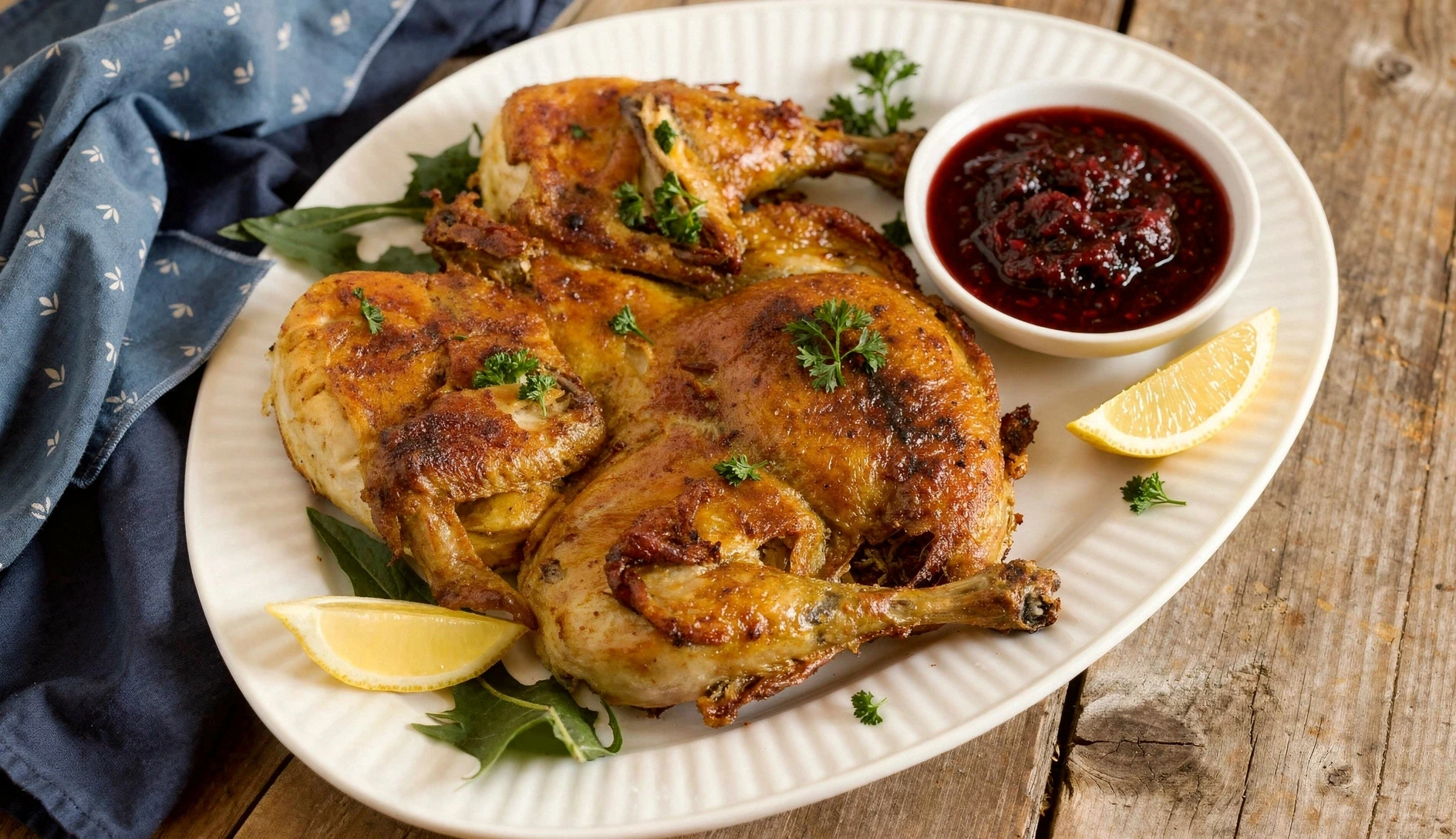
Chicken tabaka is what happens when you stop overcomplicating things. A whole young chicken, flattened, seasoned with nothing but salt and pepper, and pressed against a screaming-hot skillet under something heavy until the skin turns into a sheet of gold. No marinades. No brines. No sous vide. Just heat, fat, pressure, and patience. The result is the crispiest chicken skin you'll ever eat — audibly crispy, the kind that makes people at the next table look over — with meat so juicy it practically leaks when you cut into it. Add the punchy garlic sauce that every Georgian grandmother makes slightly differently, and you have one of the most satisfying things you can cook in a single pan.
Chicken Tabaka Quick Facts
- Georgian name: ტაბაკა (ta-BA-ka) or წიწილა ტაბაკა (tsitsila tabaka)
- Origin: Western Georgia, name comes from "tapa" — the heavy pan/lid used
- Key technique: Spatchcocked chicken fried under a weight for maximum skin contact
- Essential partner: Garlic sauce (ნიორის საწებელი)
- Prep + cook time: 15 min prep, 35–40 min cooking
- Cost in Georgia: 15–25 GEL in restaurants (~$5.50–9 USD)
- Difficulty: Easy — the technique is simple, timing is everything
Why This Dish Matters
If you've eaten in a Georgian restaurant — in Tbilisi, in Moscow, in Brooklyn — you've probably seen tabaka on the menu. It's arguably Georgia's most internationally recognized chicken dish, and the one that Soviet-era restaurants across the USSR adopted most enthusiastically. The reason is obvious: it's dead simple, uses one pan, and produces results that seem way more impressive than the effort involved.
The name comes from "tapa" (ტაფა), a traditional Georgian heavy-lidded frying pan. The original tapa had a built-in weight — the lid was deliberately heavy, designed specifically for this cooking method. You pressed the chicken flat, closed the lid, and the weight did the work. Modern cooks improvise with cast-iron presses, bricks wrapped in foil, or a second heavy skillet. The principle hasn't changed in centuries.
What sets tabaka apart from every other pressed-chicken recipe (pollo al mattone, chicken under a brick, etc.) is the garlic sauce. The chicken itself is deliberately understated — salt, pepper, maybe a whisper of red pepper. The fireworks come from the sauce: raw garlic pounded with coriander and red pepper, loosened with boiling water and enriched with a few spoons of the hot chicken fat from the pan. It's sharp, warming, and cuts through the richness of the crispy skin like nothing else.
The Right Chicken
This matters more than you think. Traditional tabaka calls for a tsitsila (წიწილა) — a young, small chicken, roughly 800g to 1.2kg. In the West, a Cornish game hen or a small poussin is the closest equivalent. The reason is practical: a smaller bird cooks through before the skin burns. A 2kg roaster is too thick when flattened — the outside chars while the inside stays raw near the bone.
If you can only find standard chickens (1.5–1.8kg), it still works. You'll just need to moderate the heat more carefully and cook a few minutes longer. Some Georgian cooks even halve a larger bird and cook each half separately, which is honestly more practical for home kitchens.
Size Rule
Under 1.2kg = perfect tabaka. 1.2–1.5kg = doable, watch the heat. Over 1.5kg = halve it or use pieces. The weight matters because it determines whether the skin crisps before the meat dries out.
Ingredients
The ingredient list is almost offensively short. That's the point. Tabaka is a technique dish, not a spice dish. The chicken and the cooking method carry everything.
| Ingredient | Amount | Notes |
|---|---|---|
| Whole young chicken | 1 (1.2–1.5kg) | Spatchcocked — backbone removed, pressed flat |
| Coarse salt | 1½ tsp | Kosher or sea salt, not table salt |
| Black pepper | 1 tsp | Freshly cracked, always |
| Hot red pepper | ½ tsp | Optional — some cooks skip it entirely |
| Vegetable oil or clarified butter | 50ml | Clarified butter adds flavor, oil has higher smoke point |
Garlic Sauce (Nioris Satsebeli)
| Ingredient | Amount | Notes |
|---|---|---|
| Garlic cloves | 8–10 large | Fresh, firm — don't even think about jarred |
| Just-boiled water | 500ml | Hot water blooms the spices and tames the raw garlic edge |
| Dried ground coriander | ½ tsp | Classic Georgian spice backbone |
| Hot red pepper | 1 level tsp | More than on the chicken — the sauce should have bite |
| Salt | To taste | Start with ½ tsp, adjust |
| Chicken pan fat | 2–3 tbsp | From the pan while chicken cooks — this is what makes it |
The Secret Ingredient
Those 2–3 tablespoons of hot chicken fat stirred into the garlic sauce are what separates a good tabaka from a great one. The fat carries flavor and gives the thin sauce body. Don't skip it.
Equipment
The Pan
A large (30cm+) heavy skillet. Cast iron is ideal. The pan needs to be bigger than the chicken when flattened — if the edges hang off, they won't crisp. Avoid nonstick for this; you want the fond.
The Weight
A cast-iron grill press is purpose-built for this. Otherwise: a foil-wrapped brick, a second heavy skillet, or a pot lid weighed down with cans of beans. You need 2–3kg of consistent pressure. The weight is the entire point of the dish.
Step-by-Step Recipe
Step 1: Spatchcock the Chicken
Place the chicken breast-side down. Using kitchen shears or a sharp knife, cut along one side of the backbone, then the other, and remove it entirely (save it for stock). Flip the bird breast-side up and press down hard on the breastbone with the heel of your hand — you'll hear it crack. The chicken should now lay mostly flat.
Some Georgian recipes cut along the breastbone instead of the backbone, opening the bird like a book. Both work. The goal is the same: a flat chicken with maximum skin surface touching the pan.
Season both sides generously with coarse salt and black pepper. If using red pepper, sprinkle it on now. Let the chicken sit at room temperature for 15–20 minutes while the pan heats — this helps it cook more evenly.
Step 2: Heat the Pan and Press
Heat the oil or clarified butter in your large skillet over medium-high heat until it shimmers but doesn't smoke. Place the chicken skin-side down. Immediately set your weight on top and press firmly for 10 seconds to establish full contact between skin and pan.
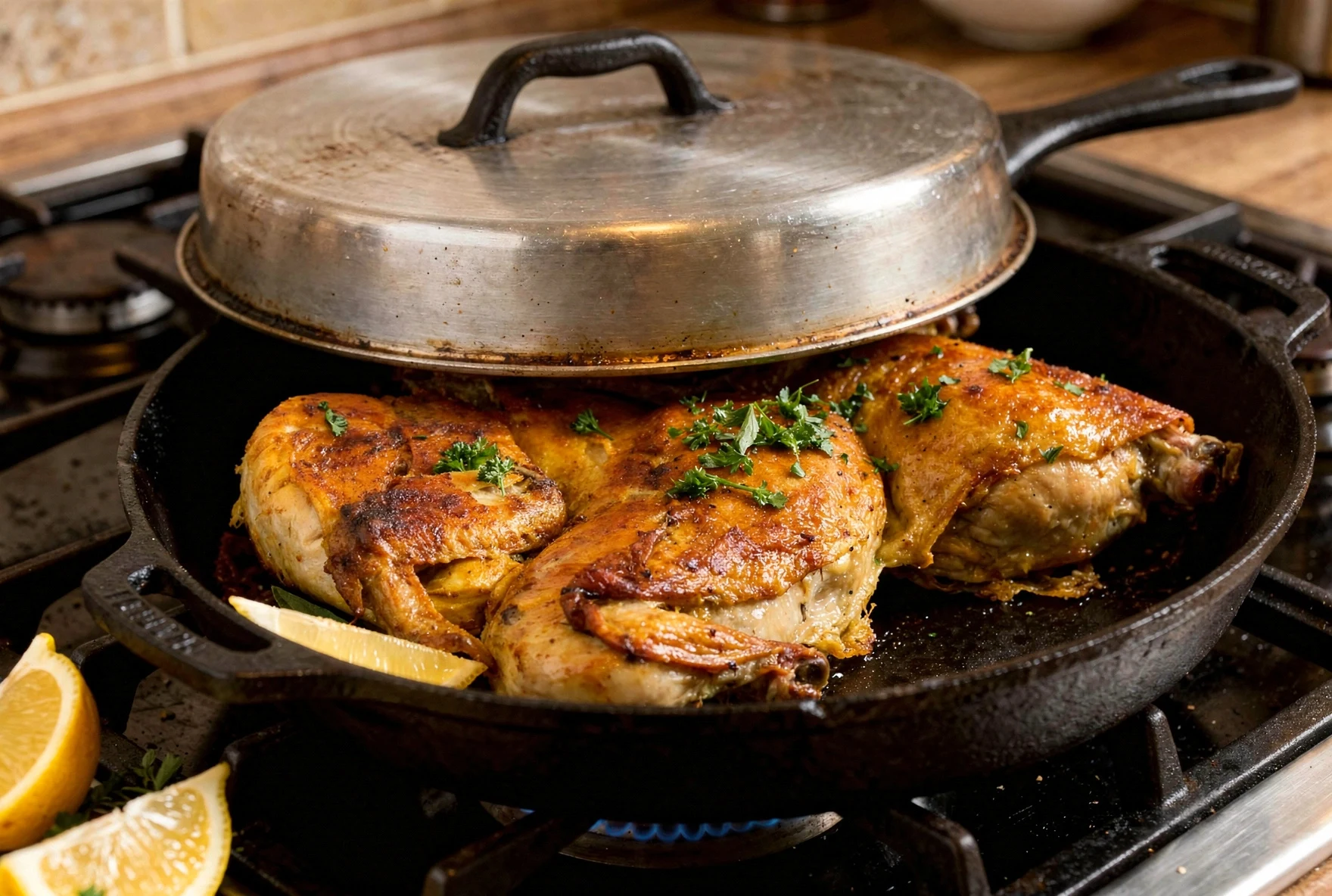
Heat Management Is Everything
After the initial sear, reduce heat to medium or medium-low. The skin should sizzle steadily but not aggressively. Too high and the skin burns before the meat cooks. Too low and the skin steams instead of crisps. Listen for a gentle, consistent sizzle — that's your indicator.
Step 3: First Side — The Skin Side (18–22 minutes)
This is where the magic happens, and also where most people get impatient. Leave the weight on. Don't peek. Don't lift. The skin needs uninterrupted contact with the hot pan to render its fat and turn crispy. You'll hear the sizzle change from aggressive to steady — that's the fat rendering out.
After 18–22 minutes (closer to 18 for a small bird, 22 for a larger one), carefully lift the weight and peek. The skin should be deeply golden brown — not pale gold, not dark brown. Think autumn leaves, not burnt toast.
| Visual Cue | What It Means | Action |
|---|---|---|
| Pale, soft skin | Not enough heat or time | Continue cooking, check in 3 min |
| Deep golden, firm | Perfect — fat rendered, skin crisp | Flip now |
| Dark brown spots | Heat too high | Flip immediately, lower heat |
| Oil pooling, no sizzle | Heat too low — steaming not frying | Increase heat, drain excess fat |
Step 4: Second Side (12–15 minutes)
Flip the chicken carefully (two spatulas help). Replace the weight. The bone side needs less time — 12–15 minutes at medium heat. The skin side is already done, so now you're just cooking the meat through.
To check doneness: pierce the thickest part of the thigh with a knife. Clear juices = done. Pink juices = give it 3 more minutes. Or use a thermometer — 74°C/165°F at the thigh joint.
Step 5: Make the Garlic Sauce While It Cooks
While the chicken fries on its first side, you have 20 minutes of hands-free time. Use it.
Crush the garlic cloves with the dried coriander using a mortar and pestle. You want a rough paste, not a smooth purée — some texture is good. Add the red pepper and a pinch of salt, pound a few more times.
Boil 500ml of water. Pour it over the garlic mixture and stir. The hot water partially cooks the garlic, softening its raw bite while keeping the heat. Now — and this is the important part — spoon 2–3 tablespoons of the hot oil from the chicken pan into the sauce. Stir. Taste. Adjust salt.
The sauce should be thin, almost broth-like, deeply garlicky, with a slow warmth from the red pepper and an unmistakable chicken-fat richness. Some cooks add a squeeze of lemon or a splash of white wine vinegar. That's not traditional, but it's not wrong either.
Serving and Pairings
Bring the chicken to the table whole, on a cutting board or platter. The visual impact matters — people should see the entire golden bird before it gets carved. Cut it into pieces at the table (or don't — in Georgia, people often tear pieces off with their hands).
Pour the garlic sauce into a bowl for dipping, or spoon it directly over the carved chicken. Both approaches have their partisans.
| Pairing | Why It Works |
|---|---|
| Garlic sauce (nioris satsebeli) | The canonical partner — sharp, spicy, cuts through the fat |
| Tkemali | Sour plum sauce adds tartness that balances the richness |
| Fresh herbs (cilantro, basil) | Brightness against the heavy, crispy chicken |
| Tonis puri (Georgian bread) | For soaking up the garlic sauce — mandatory |
| Tomato-cucumber salad | Fresh, raw, acidic — the counterpoint heavy chicken needs |
| Dry white wine (Rkatsiteli) | High acidity, mineral, cuts through fat beautifully |
Tabaka vs. Shkmeruli
These two dishes use the same first step — spatchcocked chicken, fried under a weight — which confuses people. Here's the difference:
| Feature | Tabaka | Shkmeruli |
|---|---|---|
| Cooking method | Pan-fried start to finish | Pan-fried, then baked in sauce |
| Sauce | Garlic-water sauce, served on side | Garlic-milk-butter sauce, chicken bakes in it |
| Skin texture | Shatteringly crisp | Softened by sauce |
| Origin | Western Georgia, widespread | Shkmeri village, Racha |
| Star of the dish | The crispy skin | The creamy garlic sauce |
If you want skin, make tabaka. If you want sauce, make shkmeruli. Both start the same way; they just diverge at the finish line.
Variations
| Variation | What Changes | Notes |
|---|---|---|
| Cornish hen tabaka | Smaller bird (500–700g), faster cooking | Most authentic size — 1 bird per person |
| Half-chicken tabaka | Standard chicken halved along backbone | Easier to manage, cooks more evenly |
| Herb-marinated | Rubbed with dried herbs before cooking | Not traditional, but khmeli-suneli works well |
| Oven finish | Sear skin in pan, finish at 200°C for 15 min | Safer for larger birds — prevents burning |
| Bazhe instead of garlic sauce | Thick walnut sauce replaces garlic sauce | Western Georgian variation — richer, nuttier |
Common Mistakes
❌ Chicken too big
A 2kg bird won't cook through before the skin burns. Stay under 1.5kg or halve it.
❌ Not enough weight
A lightweight lid does nothing. You need 2–3kg of real pressure pushing skin against metal. Cast-iron or brick, not a glass lid.
❌ Heat too high
Cranking to high gives you burnt skin and raw joints. Medium is the sweet spot. Patience pays off.
❌ Peeking constantly
Every time you lift the weight, you break the seal and release steam. Set it and forget it for at least 15 minutes.
❌ Skipping the pan fat in sauce
The garlic sauce without chicken fat is just garlic water. Those 2–3 tablespoons of pan drippings transform it completely.
❌ Wet skin
If the chicken is damp, pat it bone-dry with paper towels before seasoning. Moisture is the enemy of crispy skin.
Pro Tips
🔪 Score the joints
Make small cuts at the leg-thigh joints before cooking. This helps the thickest parts cook at the same rate as the breast.
🧊 Air-dry overnight
Salt the chicken and leave it uncovered in the fridge overnight. The surface dries out, giving you even crispier skin. Georgian grandmothers don't do this. You should.
🫒 Save the rendered fat
After cooking, you'll have a pool of beautiful chicken fat. Strain it and refrigerate. Use it for frying eggs, roasting potatoes, or making the next batch of garlic sauce.
🌶️ Make extra sauce
The garlic sauce keeps for 2–3 days in the fridge and improves overnight as the flavors meld. Make double — you'll use it on everything.
Where to Eat It in Georgia
Shavi Lomi, Tbilisi
Modern Georgian fine dining. Their tabaka uses smaller birds and comes with a refined garlic sauce. ~28–35 GEL.
Samikitno, Tbilisi
Huge cafeteria-style restaurant near Marjanishvili. Honest portions, honest prices. ~18–22 GEL.
Machakhela, various locations
Chain restaurant that actually doesn't disappoint for tabaka. Reliable and cheap. ~15–20 GEL.
Any countryside restaurant
The best tabaka is made by someone's grandmother in a village you've never heard of, using a cast-iron pan older than the house.
Nutrition
| Nutrient | Per Serving |
|---|---|
| Calories | ~480 kcal |
| Protein | 42g |
| Fat | 32g (saturated: 8g) |
| Carbohydrates | 3g (from garlic sauce) |
Storage & Leftovers
🥡 Refrigerator
Keeps 3–4 days, covered. The skin loses its crispness — that's inevitable. Reheat in a hot pan skin-side down to re-crisp, or eat cold (surprisingly good as a picnic food).
❄️ Freezer
Cooked tabaka freezes well for up to 2 months. Thaw in fridge overnight. Reheat at 200°C for 10 minutes to restore some crispness.
🫙 Garlic Sauce
Keeps 3–4 days refrigerated. Actually improves after sitting overnight — the garlic mellows and the flavors integrate. Don't freeze it.
💡 Leftover Idea
Shred cold tabaka into a salad with tomatoes, onion, walnuts, and fresh herbs. Dress with the leftover garlic sauce thinned with a little lemon juice. Exceptional lunch.
Frequently Asked Questions
What's the difference between tabaka and chicken under a brick?
The technique is the same. The difference is the garlic sauce. Italian pollo al mattone uses herbs and lemon; Georgian tabaka uses a garlic-coriander-red pepper sauce enriched with the chicken's pan fat.
Can I use chicken pieces instead of a whole bird?
Bone-in, skin-on thighs work well under a weight. Breast pieces dry out faster. The visual impact of a whole pressed bird is part of the experience, but pieces work for weeknight cooking.
Why isn't my skin crispy?
Three causes: wet chicken (pat dry), heat too low (skin steamed), or weight too light (no full pan contact). All three must be right.
Can I make tabaka on a grill?
Yes — oil it well, grill skin-side down with a brick on top. Use indirect heat after the initial sear. Some Georgian restaurants do this in summer. The charcoal flavor is a bonus.
Is tabaka healthy?
It's a whole chicken fried in oil — not health food. But it's high in protein, the ingredient list is just chicken/salt/oil/garlic, and there's no processed anything. You could do worse.
Written by The Georgian Eats Team
We've eaten tabaka in Tbilisi restaurants, roadside cafés in Imereti, and village homes where the cast-iron pan looked older than the house. The garlic sauce recipe here comes from watching a grandmother in Kutaisi pound garlic with a wooden pestle while her husband argued she was using too much coriander. She wasn't.
Last updated: February 2026.
Related Articles
Shkmeruli: Garlic Chicken in Cream Sauce
Tabaka's creamy cousin — same start, different finish.
Tkemali: Sour Plum Sauce
The other great sauce for tabaka.
Satsivi: Cold Chicken in Walnut Sauce
Georgia's other great chicken dish — cold, rich, and ceremonial.
Mtsvadi: Georgian BBQ Pork
Another dish where simplicity is the entire philosophy.