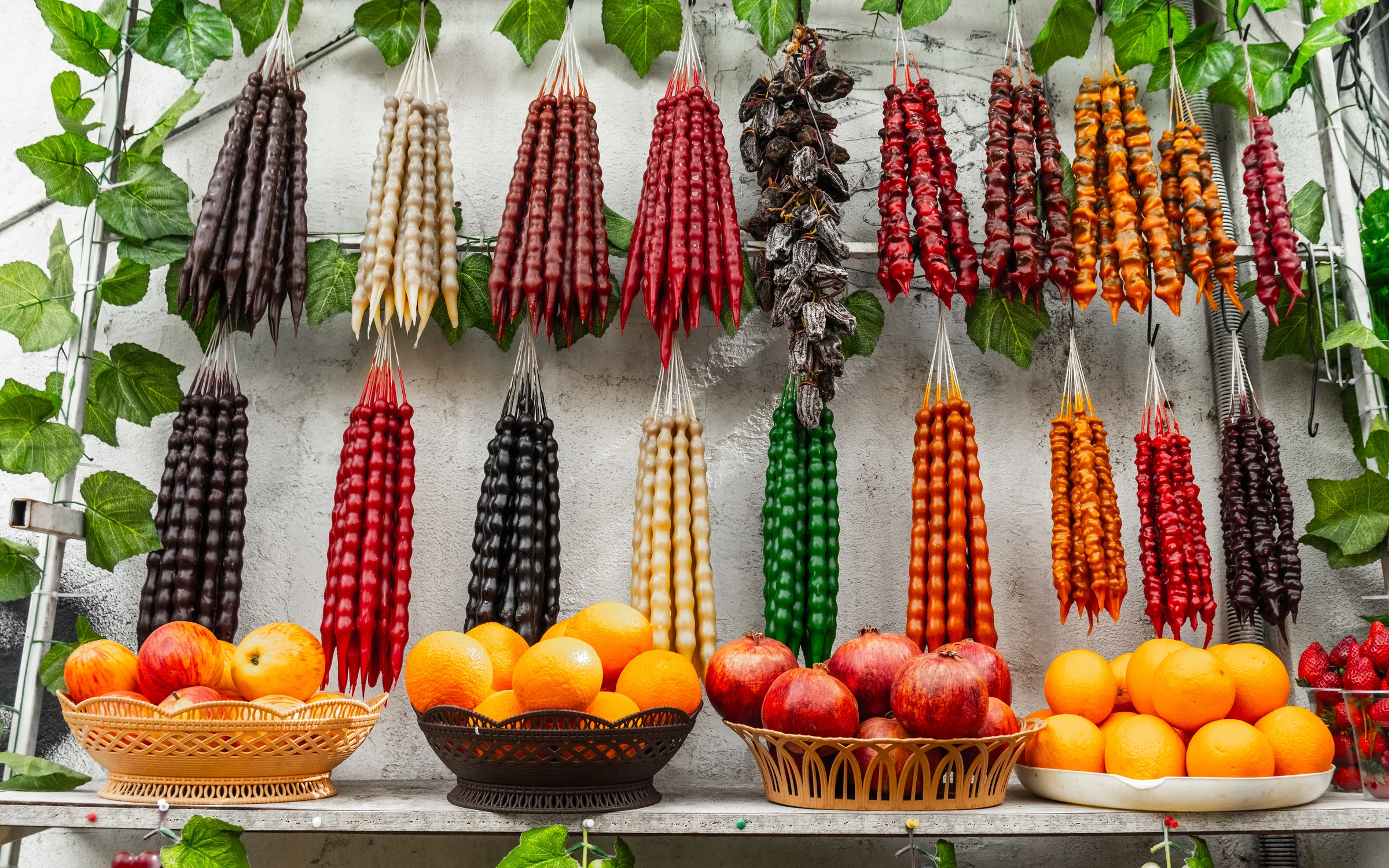
They look like candles. They smell like autumn. Tourists mistake them for sausages. Churchkhela — Georgia's ancient walnut candy — is one of the most distinctive foods you'll encounter in the Caucasus, and nothing else on earth tastes quite like it. Strings of walnuts or hazelnuts dipped repeatedly in thickened grape juice, then hung to dry for weeks until they develop a chewy, slightly waxy exterior with a sweet, tannic depth that's impossible to describe until you've tried it. Georgians have been making them for at least a thousand years, and the method hasn't changed much.
Churchkhela Quick Facts
- Georgian name: ჩურჩხელა (choor-ch-KHEH-lah)
- Meaning: Possibly from the Mingrelian word for dried fruit strings
- Origin: Kakheti (eastern Georgia), with variations across the country
- Key ingredients: Walnuts or hazelnuts + grape juice + flour
- Prep time: 2–3 hours active, 2–3 weeks drying
- Shelf life: 6+ months when properly dried
- UNESCO status: Part of Georgia's Intangible Cultural Heritage
What Exactly Is Churchkhela?
At its simplest, churchkhela is nuts on a string, dipped in thickened grape juice and dried. But that description is like calling wine "old grape juice" — technically correct and completely missing the point.
The process starts with shelled walnuts (or hazelnuts, almonds, or sometimes raisins) threaded onto a strong cotton string. This string gets dipped — repeatedly, over several hours — into tatara (the same base used for pelamushi), a thick, pudding-like mixture of grape juice and flour that's been cooked down to the consistency of warm honey. Each dip adds another layer. After 7–10 dips, the churchkhela is hung to dry in a cool, airy place for two to three weeks. The result is a firm, chewy outer shell that encases the nuts inside — sweet, tannic, and unlike any candy you've had before.
The texture is the thing that surprises people. It's not crispy, not gummy, not brittle. It's somewhere between dried fruit leather and taffy, with a slight waxiness on the outside and crunchy nut pieces breaking through with every bite. The flavor depends on the grape variety — some are deeply sweet, others slightly sour, and the best ones have a tannic complexity that's reminiscent of good wine.
A Thousand Years of Walnut Candy
Churchkhela isn't some quaint revival of a forgotten tradition — it's been in continuous production for over a millennium. The earliest written references date to the 11th century, though the technique is almost certainly older. Georgian warriors carried churchkhela on campaigns because it was the perfect field ration: high in calories, protein-rich from the walnuts, packed with natural sugars, lightweight, and shelf-stable for months without refrigeration.
Think of it as Georgia's original energy bar. A single piece contains roughly 500 calories of dense, portable nutrition. Medieval Georgian soldiers could march for days with a few churchkhela in their saddlebags. The concentrated grape sugars provided quick energy; the walnuts delivered sustained fuel from healthy fats and protein.
The tradition survived Soviet-era industrialization largely because churchkhela resists factory production. The repeated hand-dipping process, the weeks of patient drying, the judgment calls about thickness and timing — these don't scale to assembly lines. Every churchkhela you see hanging in a Georgian market was made by someone standing over a vat of hot tatara, dipping strings of nuts by hand, one at a time.
How Churchkhela Is Made (The Traditional Method)
Making churchkhela is simple in concept and demanding in execution. The process happens in three stages, and each one has details that separate good churchkhela from tourist-trap versions.
Stage 1: Preparing the Nuts
Walnuts are the classic choice in Kakheti, Georgia's main wine (and churchkhela) region. The nuts are halved or quartered — never crushed — and threaded onto strong cotton strings about 25–30 cm long, with a knot or piece of dried fruit at the bottom to keep them from sliding off. Each string gets 15–20 walnut pieces, spaced slightly apart so the tatara can coat them individually. Some makers thread hazelnuts, almonds, or dried fruit (raisins, dried apricots) instead. In Imereti, hazelnuts are more common than walnuts.
Stage 2: Making the Tatara
Tatara (also called pelamushi before it's used for dipping) is the soul of the churchkhela. Fresh grape juice — unfermented, usually from the autumn harvest — is boiled down to reduce by about a third. Then flour (traditionally wheat, sometimes corn flour in western Georgia) is whisked in gradually while the mixture cooks over low heat, stirring constantly to prevent lumps. The goal is a thick, smooth paste that coats the back of a spoon and drops in heavy ribbons.
This is where experience matters most. Too thin, and the coating won't stick. Too thick, and it cracks when it dries. The flour ratio, the cooking time, the grape variety — all affect the final consistency. Experienced makers adjust by feel, not measurement. A common mistake is adding the flour too quickly or at too high a heat, which creates lumps that make the coating uneven.
The Chemistry of Tatara
The thickening process relies on flour starches gelatinizing in the acidic grape juice. As the mixture cools between dips, each layer partially sets before the next one is applied. The natural sugars in the grape juice act as a preservative, and the tannic compounds contribute the slight astringency that keeps churchkhela from being cloying. Darker grape varieties produce more complex, tannic churchkhela; lighter ones tend sweeter and milder.
Stage 3: Dipping and Drying
The nut strings are dipped into the warm tatara, pulled out, and hung to drip-dry for a few minutes. Then they're dipped again. And again. Each pass adds about 2–3 mm of coating. After 7–10 dips (sometimes more for thick, premium churchkhela), the strings are hung in a cool, well-ventilated room — often an attic or covered porch — and left to dry for two to three weeks. During this time, the surface firms up to a slightly waxy texture while the interior stays softer.
The drying environment matters enormously. Too humid, and the churchkhela molds. Too hot, and it cracks. Too breezy, and it dries unevenly. Traditional Georgian farmhouses have specific rooms or porches designed for this purpose — the same ones used for drying herbs, curing meats, and aging wine.
Regional Varieties and Colors
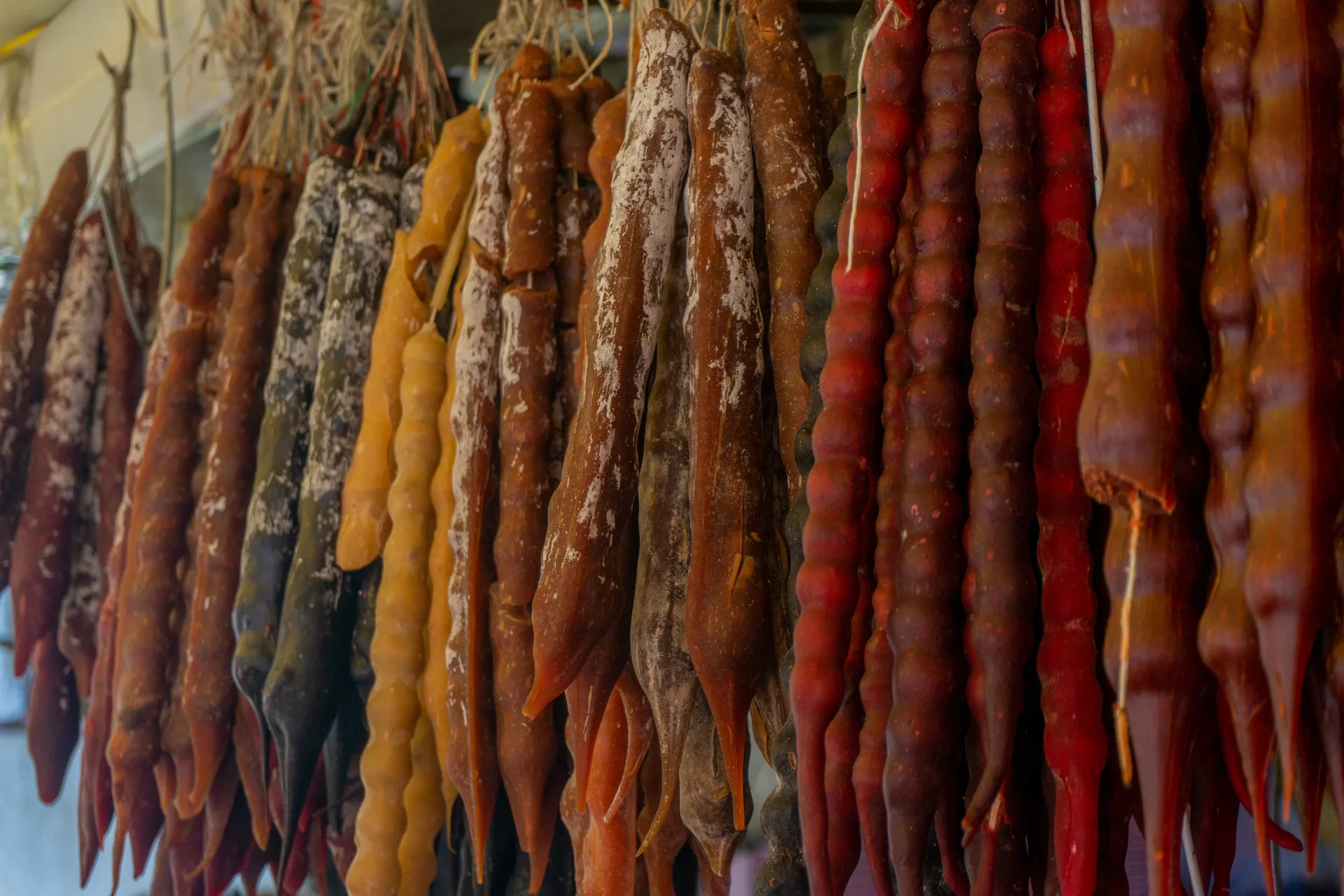
Not all churchkhela is the same. The color, flavor, and nut choice vary by region, and the differences are significant enough that Georgians will argue about whose village makes the best ones.
| Region | Primary Nut | Grape / Juice | Color | Flavor Notes |
|---|---|---|---|---|
| Kakheti | Walnut | Saperavi / Rkatsiteli | Dark brown / burgundy | Rich, tannic, complex |
| Imereti | Hazelnut | Various white grapes | Lighter brown / amber | Sweeter, milder, nuttier |
| Kartli | Walnut | Local red varieties | Deep red-brown | Balanced sweet-tannic |
| Racha-Lechkhumi | Walnut / hazelnut | Aleksandrouli | Dark ruby | Semi-sweet, fruity |
| Samegrelo | Hazelnut | Fig / mulberry juice | Dark brown / green | Unique, fruity, less tannic |
The color is your first clue about what you're buying. Dark burgundy-brown usually means Kakhetian churchkhela made with Saperavi grape juice — these are the most traditional and tend to have the most complex flavor. Lighter, honey-colored versions are typically from western Georgia and use white grape juice or hazelnut combinations. The occasional green or reddish ones use non-grape fruit juices (mulberry, pomegranate, even kiwi in modern versions).
The Connoisseur's Pick
Ask any Georgian food expert and they'll point you to Kakhetian walnut churchkhela made with Saperavi juice. The dark, tannic Saperavi grape produces the most complex flavor profile — slightly bitter, deeply fruity, never cloying. Imereti hazelnut versions are excellent too, but the Kakhetian walnut is considered the benchmark.
How to Buy Good Churchkhela
This is important, because there's a lot of bad churchkhela out there — especially in tourist areas. Here's how to tell the real thing from the factory-made imposters.
✅ Signs of Quality
- Slight surface bloom — a light dusty coating (natural sugar crystallization) means proper aging
- Firm but flexible — should bend slightly, not crack or feel rock-hard
- Visible nut pieces — you should see the nut shapes through the coating
- Matte finish — shiny usually means fresh/underdried or coated in syrup
- Even thickness — consistent coating shows careful dipping
🚩 Red Flags
- Neon colors — bright red, green, or yellow means artificial coloring
- Overly sticky — properly dried churchkhela shouldn't leave residue on your hands
- Very cheap — under 2 GEL per piece likely uses sugar syrup instead of grape juice
- Uniform factory shape — artisanal ones are always slightly irregular
- Chemical smell — should smell like dried fruit and nuts, nothing else
Where to Buy
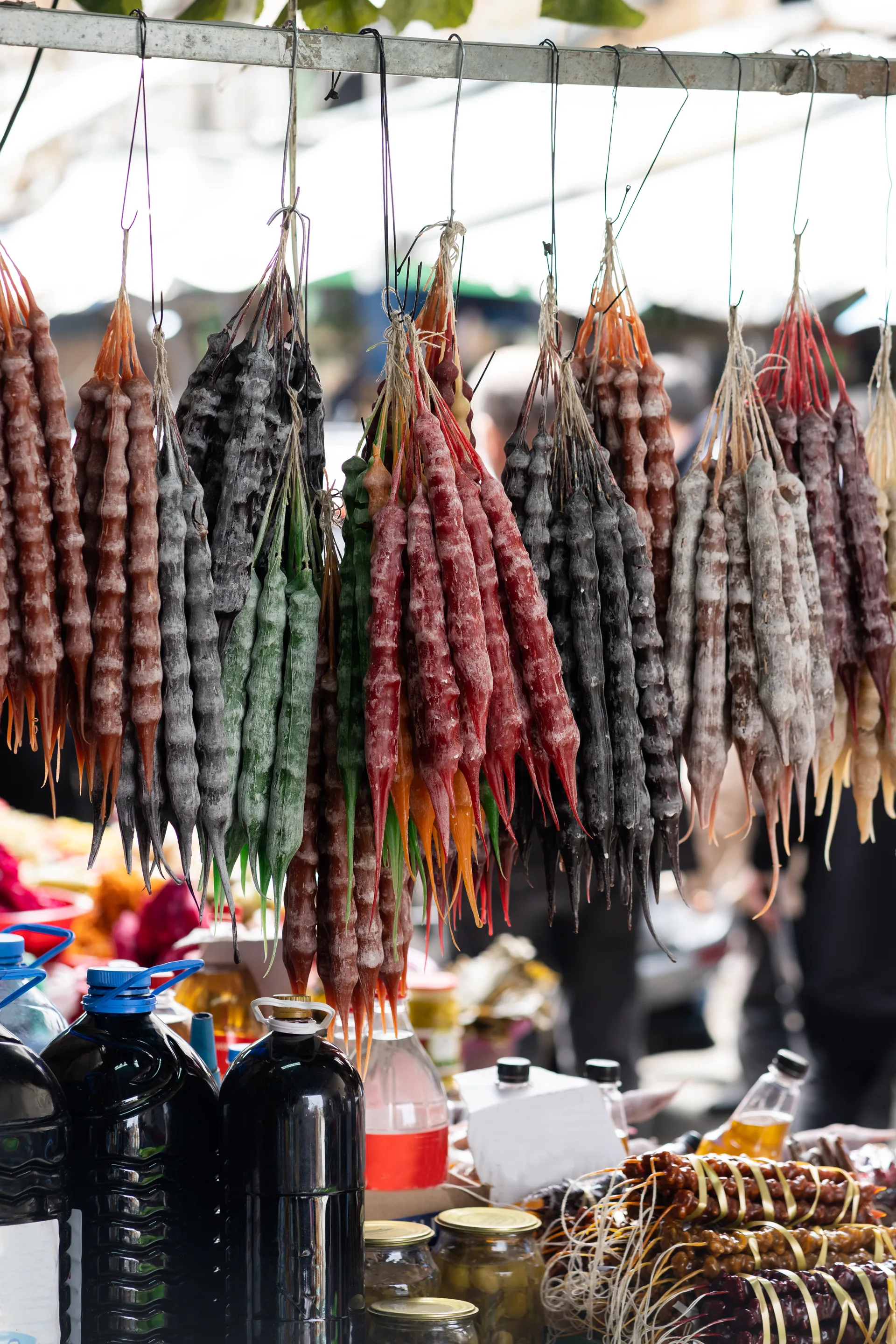
In Tbilisi, the best churchkhela comes from the Dezerter Bazaar (near the train station) and the small vendors on Dry Bridge Market. Avoid the vacuum-sealed tourist versions in souvenir shops on Rustaveli Avenue — they're overpriced and often months old. At the Dezerter Bazaar, you can taste before buying and ask which region the churchkhela came from.
If you're driving through Kakheti (the wine region), roadside sellers near Sighnaghi and Telavi often have the freshest, best churchkhela you'll find anywhere. They make it in small batches during the autumn grape harvest and sell it directly. The prices are lower than Tbilisi, and the quality is consistently better.
| Where | Price Range | Quality | Notes |
|---|---|---|---|
| Dezerter Bazaar, Tbilisi | 3–6 GEL/piece | High | Best urban selection, can taste first |
| Kakheti roadside sellers | 2–4 GEL/piece | Excellent | Freshest, direct from producer |
| Dry Bridge Market, Tbilisi | 4–8 GEL/piece | Good to high | Weekend market, part of flea market experience |
| Tourist souvenir shops | 8–15 GEL/piece | Variable | Overpriced, often vacuum-sealed old stock |
| Supermarkets | 4–10 GEL/piece | Low to medium | Factory-made, sugar syrup versions common |
How to Eat Churchkhela
There's no ceremony here — just pick it up and bite in. But there are a few things worth knowing.
Cut it into rounds about 2 cm thick for the best experience. This gives you a cross-section of the nut center surrounded by the grape coating. Eating it straight like a sausage works too, but you miss the visual appeal and tend to get uneven nut-to-coating ratios in each bite.
Churchkhela pairs beautifully with strong black tea, which is how most Georgians eat it — as an afternoon snack with a cup of tea. It also goes surprisingly well with dry red wine (the tannins complement each other), strong coffee, and aged Georgian cheese like guda. At a supra feast, churchkhela typically appears at the very end as a dessert, alongside fresh fruit and pelamushi (the grape pudding that shares its base ingredient with the churchkhela coating).
Pairing Suggestion
Try dark Kakhetian walnut churchkhela with a glass of Saperavi wine — both come from the same grape, and the flavors echo each other in a way that's almost poetic. The wine's tannins pull out the deeper notes in the grape coating while the walnut fat rounds everything out.
Storage and Shelf Life
Properly made churchkhela is designed to last. That was the whole point — medieval soldiers needed food that wouldn't spoil on long campaigns. A well-dried churchkhela keeps for six months to a year at room temperature, stored in a breathable container (paper bag, cloth wrapping) in a cool, dry place.
Do not refrigerate churchkhela. The cold humidity causes the sugar to crystallize excessively and the texture becomes gummy and unpleasant. Do not wrap it tightly in plastic — it needs air circulation to prevent mold. A paper bag in a pantry is perfect.
If the surface develops a white powdery bloom, don't worry — that's natural sugar crystallization, not mold. It's actually a sign of proper aging. Real mold appears as fuzzy spots (usually green or gray) and smells off. If you see that, discard the piece.
Making Churchkhela at Home
You can make churchkhela at home, though you'll need patience and space to hang them for drying. The recipe is forgiving — the technique matters more than exact measurements.
Ingredients
Step 1: Thread the Walnuts
Thread walnut halves onto the cotton strings using a large needle. Leave about 5 cm of empty string at the top (for hanging) and tie a knot or small piece of dried fruit at the bottom to anchor the nuts. Each string should hold about 15–20 walnut pieces. Hang the strung walnuts somewhere accessible — you'll be dipping them repeatedly.
Step 2: Make the Tatara
Pour the grape juice into a large, heavy-bottomed pot. Bring to a boil, then reduce to a simmer. Cook for about 30 minutes to reduce by roughly a third — this concentrates the flavors and sugars. While it simmers, whisk the flour with about a cup of cold grape juice (taken from the pot before heating) to make a smooth slurry. Slowly pour this slurry into the simmering juice, whisking constantly. Keep stirring over medium-low heat for another 20–30 minutes until the mixture thickens to the consistency of warm pudding. It should coat a wooden spoon heavily.
Common Mistake
Never add flour directly to the hot juice — it clumps instantly and you'll spend an hour trying to strain out lumps. Always make a cold slurry first and add it gradually while whisking. If you do get lumps, push the mixture through a fine sieve before dipping.
Step 3: Dip Repeatedly
Holding the walnut string by the top, dip it fully into the warm tatara. Pull it out slowly, let the excess drip for a few seconds, then hang it to dry for 15–20 minutes. Repeat 7–10 times. The tatara needs to stay warm (reheating gently between rounds is fine — don't let it cool to room temperature or it becomes too thick to coat evenly). Each dip should add a visible new layer.
Step 4: Dry
Hang the finished churchkhela in a cool, well-ventilated area away from direct sunlight. An attic, covered balcony, or garage works well. They need 2–3 weeks to dry properly. You'll know they're ready when the surface is firm and slightly matte with no stickiness. In humid climates, this may take longer — a dehumidifier or fan can help.
Nutritional Value
Churchkhela is genuinely nutritious — it's not empty calories. The walnuts provide omega-3 fatty acids, protein, and minerals. The grape juice coating delivers antioxidants (especially from dark grape varieties), natural sugars for energy, and small amounts of iron and potassium.
| Nutrient | Per 100g (approx.) | Notes |
|---|---|---|
| Calories | ~400–450 kcal | Dense energy source |
| Protein | 8–12 g | From walnuts |
| Fat | 20–25 g | Mostly healthy unsaturated (omega-3) |
| Carbohydrates | 45–55 g | Natural grape sugars + flour |
| Fiber | 3–5 g | From walnuts and grape solids |
It's calorie-dense, so it's best enjoyed as a snack rather than a meal accompaniment. One piece (about 100g) is satisfying — two is a full dessert. Compared to commercial candy bars, it has no added sugars (when traditionally made), no preservatives, and significantly more nutritional value.
Churchkhela in Georgian Culture
Churchkhela isn't just food — it's woven into Georgian seasonal and family traditions. The production cycle follows the grape harvest in autumn, making it inseparable from Georgia's ancient wine culture. The same grapes that go into qvevri for wine provide the juice for churchkhela. In many families, churchkhela-making is a communal autumn activity, with grandmothers overseeing the process and children helping thread the nuts.
At New Year's celebrations, churchkhela is a mandatory presence on the table alongside other symbolic foods. Strings of churchkhela are a common gift — they signal care, tradition, and a connection to the land. In rural areas, the quality of a family's churchkhela is a minor point of pride, like a French family's relationship to their local cheese or an Italian grandmother's pasta sauce.
The 2023 addition of traditional churchkhela production to Georgia's list of Intangible Cultural Heritage reflects a growing awareness that this isn't just a snack — it's a living piece of culinary history that connects modern Georgians to medieval practices, seasonal rhythms, and regional identity.
Modern Variations (And What Purists Think of Them)
Traditional churchkhela makers tend to be deeply skeptical of modern variations, and not without reason. Here's what you'll find in contemporary markets:
🍫 Chocolate-Dipped
Churchkhela coated in chocolate instead of or in addition to tatara. Popular with tourists, dismissed by traditionalists. Actually pretty good as a hybrid dessert, but it's not really churchkhela anymore.
🥝 Non-Grape Varieties
Pomegranate, kiwi, mulberry, and even tamarind juice versions exist. Samegrelo has always used non-grape juices, so this isn't entirely new — but tropical fruit versions are pure marketing.
🏭 Factory-Made
Mass-produced with sugar syrup replacing real grape juice. Cheaper, uniform, and missing the soul of the original. The packaging is pretty, the taste is not.
🌰 Mixed Nut
Almonds, pistachios, cashews, and dried fruit mixed with walnuts on the same string. A legitimate variation — the flavor combinations can be interesting, and it's gaining popularity.
Bringing Churchkhela Home from Georgia
Churchkhela is one of the best food souvenirs you can bring back from Georgia. It travels well, lasts for months, and nothing like it exists in Western supermarkets. Here's what to know:
Airport security: Churchkhela goes through X-ray machines just fine. It occasionally confuses security scanners (the dense nut core inside a coating shows up oddly on screens), but it's never a real problem. Expect the occasional "what is this?" from customs officers — they'll wave you through once they see it's food.
Packing: Wrap each piece individually in parchment or wax paper, then place in a rigid container (a cardboard box works). Don't use plastic bags — they trap moisture. The worst-case scenario is soft churchkhela in a hot suitcase that smears on your clothes. Keep them in your carry-on if possible.
How many to buy: More than you think. Everyone you give one to will want more. Budget 3–4 pieces per gift recipient, plus a few for yourself. At 3–6 GEL per piece (roughly $1–2 USD), it's absurdly affordable for the impression it makes.
Customs restrictions: Churchkhela is allowed into the EU, UK, US, Canada, Australia, and most other countries — it's a processed food product, not raw meat or produce. No special declarations needed.
Common Questions
Is churchkhela vegan?
Yes. Traditional churchkhela is entirely plant-based — nuts, grape juice, and flour. No dairy, eggs, or animal products. Some modern chocolate-dipped versions may contain dairy.
Is it gluten-free?
No. The tatara coating requires wheat flour (or sometimes corn flour in western Georgian versions). If you need gluten-free, look specifically for corn flour varieties from Imereti or Samegrelo — but verify with the seller.
Why do some look shiny and others dusty?
Dusty is better. The white bloom is natural sugar crystallization from proper aging. Shiny often means the churchkhela is very fresh (not fully cured) or has been coated with syrup for visual appeal. Properly aged churchkhela always has a matte, slightly dusty surface.
Can I buy authentic churchkhela online?
A few Georgian specialty shops ship internationally, but quality varies — shipping time and storage conditions matter. Your best bet is buying directly in Georgia or from a Georgian community near you.
Written by The Georgian Eats Team
We've bought churchkhela from roadside sellers in Kakheti, watched grandmothers dip them in Sighnaghi, and eaten our way through the Dezerter Bazaar's entire selection. This guide comes from years of tasting the good, the bad, and the factory-made.
Last updated: February 2026.
Related Articles
Georgian Wine for Beginners
Qvevri method, grape varieties, and the same grapes that make churchkhela.
The Georgian Supra
The feast where churchkhela appears as the grand finale dessert.
Georgian Cheese Guide
Another ancient tradition — pair aged guda with dark churchkhela.
Khinkali Recipe
Georgia's other iconic hand-made food — soup dumplings.