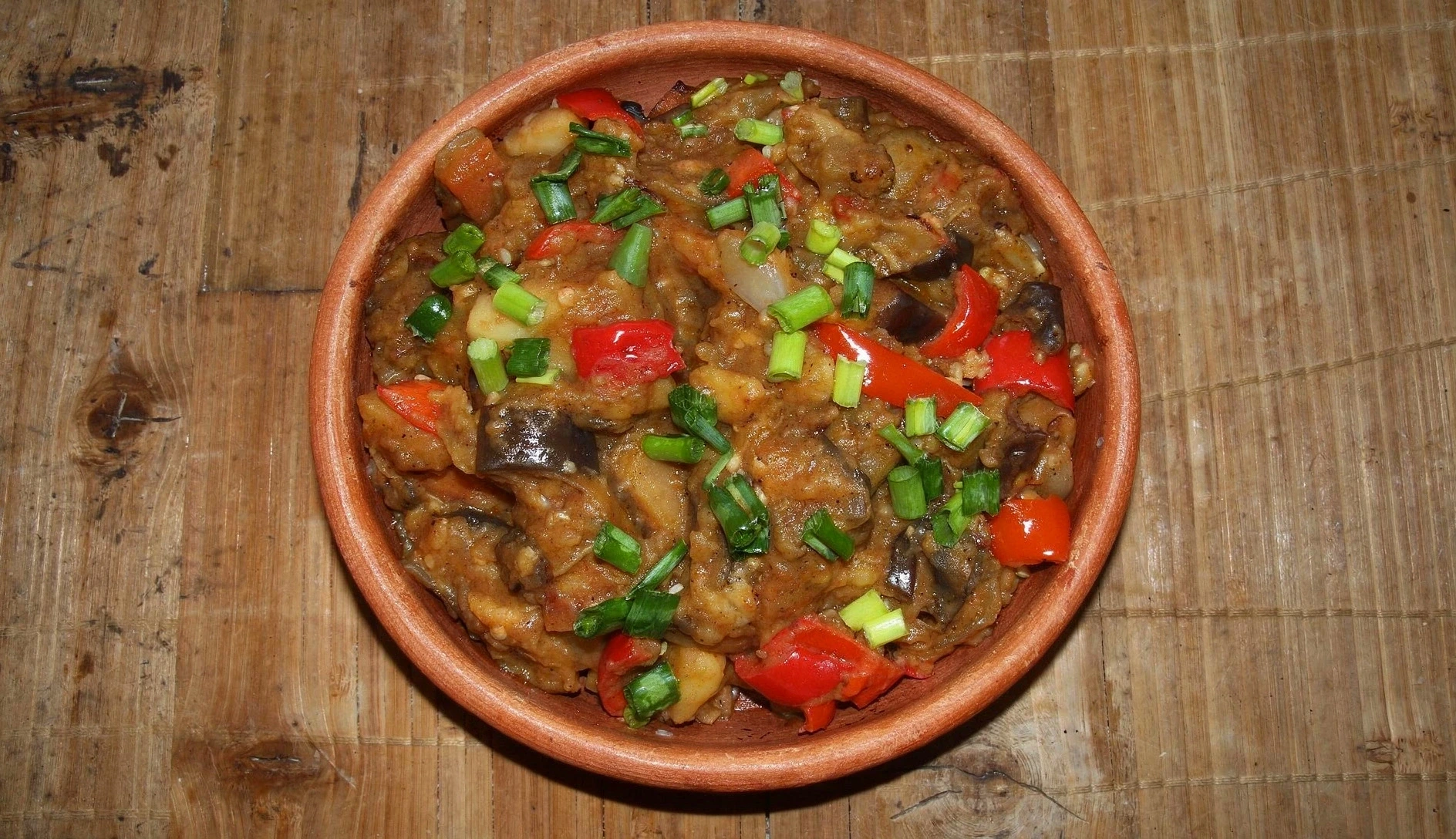
Ajapsandali is the dish that should have made Georgia famous for its vegetable cooking, not khachapuri. A one-pot stew of eggplant, peppers, tomatoes, and enough fresh herbs to fill a market bag — naturally vegan, dead simple to make, and it genuinely tastes better the day after you cook it. Think ratatouille's bolder, more opinionated cousin.
Ajapsandali Quick Facts
- Georgian name: აჯაფსანდალი (ah-jap-san-DAH-lee)
- What it is: A thick eggplant-pepper-tomato stew loaded with fresh herbs
- Origin: Nationwide — every region has a version
- Season: Late summer (peak produce), but made year-round
- Active time: 20 minutes
- Cook time: 40–50 minutes
- Serves: 4–6 people
- Diet: Vegan, gluten-free
- Served: Cold or room temperature (traditionally)
- Cost in Georgia: 6–10 GEL (~$2–3.50) at a restaurant
- Serve with: Crusty bread, mchadi, or grilled meat
Why Ajapsandali Deserves Your Attention
Georgia's fasting traditions — over 200 days a year in the Orthodox calendar — forced cooks to develop extraordinary plant-based dishes centuries before anyone started putting "V" labels on restaurant menus. Ajapsandali is one of the crown jewels of that tradition.
The dish exists at the intersection of simplicity and depth. The ingredients are ordinary: eggplant, peppers, tomatoes, onions, garlic, herbs. But the technique — slow-stewing until everything collapses into each other, then resting overnight for the flavors to marry — creates something greater than the sum of its parts. Eggplant absorbs every flavor in the pot. The tomatoes provide acid and body. The peppers give sweetness. And the herbs — cilantro, basil, sometimes dill — provide a green, aromatic top note that lifts the whole thing.
People call it "Georgian ratatouille," and while that comparison lands geographically, it sells ajapsandali short. Ratatouille is polite. Ajapsandali hits harder — more garlic, more herbs, often some chili heat, and a willingness to let the vegetables break down completely rather than keeping them in prissy little cubes.
How Every Region Does It Differently
There's no single "correct" ajapsandali. The dish shape-shifts across Georgia's regions, and arguing about the right version is a time-honored tradition in itself.
| Region | Style | Key Difference |
|---|---|---|
| Kakheti | Served cold | Drizzled with unrefined sunflower oil — adds a sesame-like nuttiness |
| Imereti | Thick, relish-like | Cooked down until almost spreadable, eaten alongside grilled meats |
| Samegrelo | Fiery hot | Loaded with adjika — will make your nose run |
| Kartli | With potatoes | Potatoes added for heartiness — makes it more of a main meal |
| Tbilisi | Standard | The "classic" version most restaurants serve — this recipe |
The Heat Question
Traditional ajapsandali has a mild-to-moderate kick, not face-melting heat. One or two green chili peppers is standard. If you want the Megrelian nuclear option, add a tablespoon of adjika paste. Start with less — you can always add heat, but you can't take it back.
The Eggplant Makes or Breaks It
Ajapsandali is an eggplant dish that happens to contain other vegetables. Get the eggplant wrong and nothing else matters.
The ideal eggplant for ajapsandali is the standard globe eggplant (the big purple ones). They're available everywhere, and their spongy texture is actually the point — eggplant absorbs the tomato, garlic, and herb flavors like nothing else. Japanese eggplants work too, though they hold their shape more.
The critical step most recipes botch: salting the eggplant first. Cut it into 2-3cm cubes, toss with a generous amount of salt, and let it sit in a colander for 15-20 minutes. You'll see beads of brown liquid forming on the surface. Squeeze the cubes gently, pat dry. This does two things: removes bitterness (especially in older, seedy eggplants) and collapses the spongy cell structure so the eggplant absorbs less oil and more flavor during cooking.
Skip the salting and your ajapsandali will be either bitter, oily, or both.
Ingredients
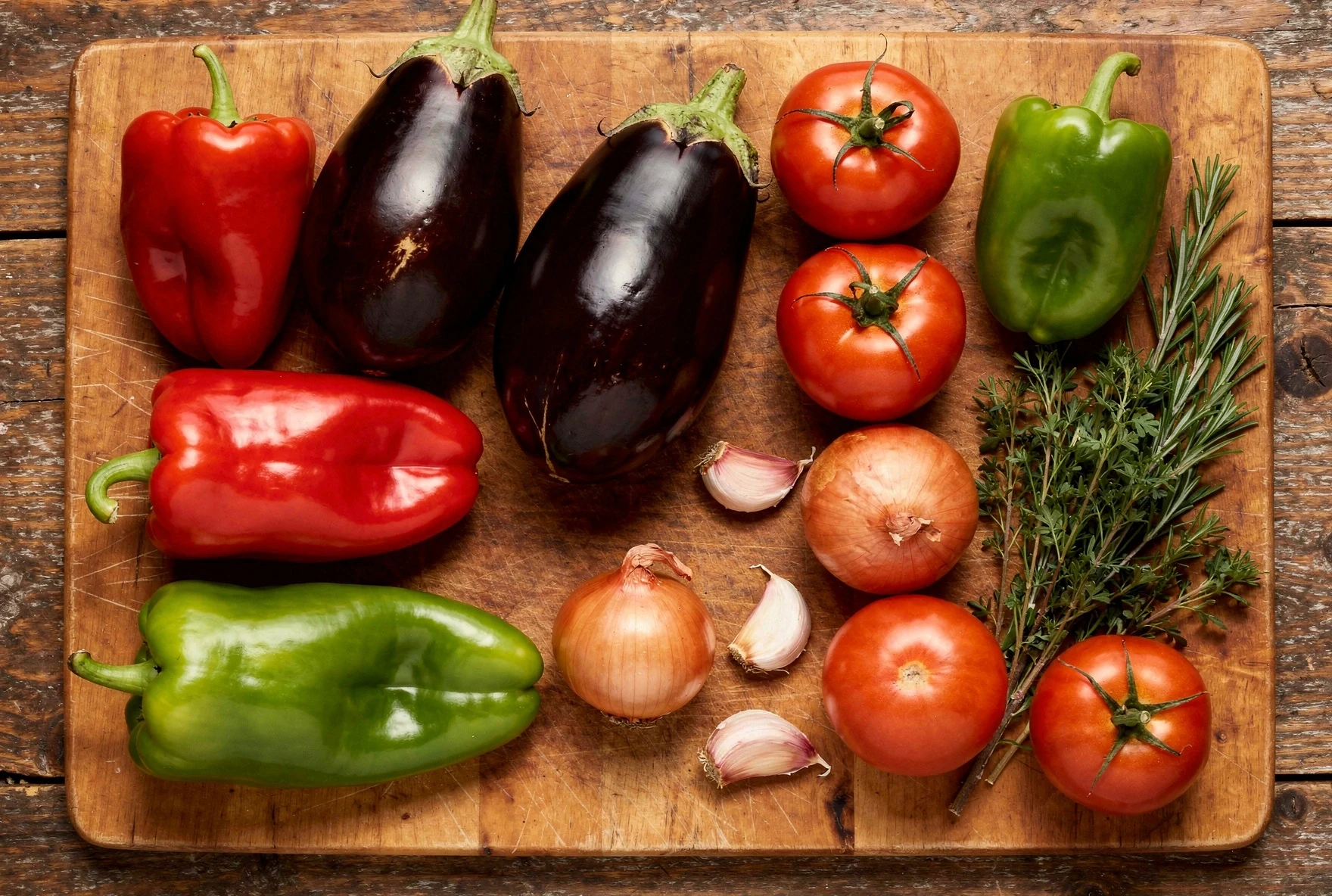
This recipe serves 4-6 and scales easily. Double it — you'll want leftovers.
The Vegetables
| Ingredient | Amount | Notes |
|---|---|---|
| Eggplant | 3 medium (~800g) | Globe eggplant, cubed 2-3cm. Salt and drain first. |
| Ripe tomatoes | 3 large | Peeled and roughly chopped. Canned whole tomatoes work in winter. |
| Red bell peppers | 2 | Diced. Adds sweetness and color. |
| Green bell peppers | 2 | Diced. Adds slight bitterness for balance. |
| Hot green chili | 1-2 | Thinly sliced. Adjust to taste — or skip entirely. |
| Onions | 2 large | Finely diced. The stew's flavor base. |
| Garlic | 5-6 cloves | Minced. Georgians don't hold back on garlic. |
| Tomato paste | 2 tbsp | Deepens the tomato flavor. Essential. |
Herbs and Spices
| Ingredient | Amount | Notes |
|---|---|---|
| Fresh cilantro | Large bunch | The dominant herb. Use stems and leaves. |
| Fresh basil | Large bunch | Purple/holy basil is traditional. Italian basil works fine. |
| Ground coriander | 1 tsp | Background warmth. Toast whole seeds and grind if possible. |
| Blue fenugreek | ½ tsp | Optional but authentic. Adds earthy, nutty depth. |
| Red chili flakes | ½ tsp | Dried. Adjust to taste. |
| Bay leaves | 3 | Remove before serving. |
| Sunflower oil | 3 tbsp | Sunflower is traditional. Any neutral oil works. |
| Salt & black pepper | To taste | Be generous. Eggplant needs salt. |
The Two-Stage Herb Trick
The secret to ajapsandali's layered freshness: add herbs in two stages. Half goes in during cooking (flavor infusion), half goes in at the very end off heat (bright, aromatic punch). Georgian chefs at restaurants like Shavi Lomi in Tbilisi swear by this. It's a small detail that makes a huge difference.
Equipment
🥘 Heavy-Bottomed Pot
Dutch oven, cast iron pot, or any large heavy pot with a lid. You need even heat distribution and the ability to cover while the vegetables stew down.
🔪 Sharp Knife
You're cubing a lot of vegetables. A dull knife on slippery eggplant is a recipe for frustration (and bandages). That's it — one pot, one knife, one cutting board.
Step-by-Step Recipe
Step 1: Salt the Eggplant (20 minutes passive)
Cube the eggplants into roughly 2-3cm pieces. Don't stress about uniformity — this isn't a French tasting menu. Toss with about a tablespoon of salt in a colander set over the sink or a bowl. Walk away for 15-20 minutes.
When you come back, the cubes will have sweated out brown, bitter liquid. Squeeze them gently in handfuls to extract more moisture, then pat dry with a clean towel. This is the most important prep step in the whole recipe.
Step 2: Build the Base (5-7 minutes)
Heat the oil in your pot over medium heat. Add the diced onions and cook, stirring occasionally, until soft and translucent — about 5 minutes. Don't rush this. Properly softened onions disappear into the stew and provide a sweet, savory foundation.
Stir in the tomato paste and cook for another 1-2 minutes. You want it to darken slightly and turn fragrant — this is called "blooming" the paste and it concentrates the tomato flavor dramatically. Two tablespoons of bloomed tomato paste does the work of six tablespoons of raw paste.
Step 3: Cook the Eggplant (8-10 minutes)
Add the drained eggplant cubes to the pot. Give everything a good stir to coat the eggplant in the onion-tomato base. Add a pinch more salt (eggplant is a salt sponge), cover the pot, and let it cook for 8-10 minutes.
The eggplant will release liquid and start to collapse. Stir every few minutes, but keep the lid on between stirs — you're steaming the eggplant in its own moisture. By the time this step is done, the cubes should look soft and somewhat deflated. That's exactly what you want.
| Visual Cue | What It Means |
|---|---|
| Cubes look firm, still pale | Not ready — keep cooking with the lid on |
| Cubes soft, releasing liquid, darker | Perfect — move to the next step |
| Total mush, no structure at all | Went too far, but it's fine — the dish still works |
Step 4: Add Everything Else (20-25 minutes)
Now add the diced peppers (red, green, and chili), the chopped tomatoes, bay leaves, ground coriander, blue fenugreek, and chili flakes. Stir to combine, cover, and reduce heat to medium-low.
Let this simmer for 20-25 minutes, stirring occasionally. The peppers will soften, the tomatoes will collapse into a sauce, and the whole thing will start to look like a cohesive stew rather than a pile of vegetables. If it seems too thick or starts catching on the bottom, add 50-100ml of water — but err on the side of thick. Ajapsandali should be a stew, not a soup.
The Patience Test
Resist the urge to keep stirring. Every time you lift the lid, you lose steam and slow the cooking. Check every 5-7 minutes, stir gently, re-cover. The vegetables should do most of the work themselves — releasing liquid, breaking down, melding together.
Step 5: The Herb Finish (5 minutes)
When the vegetables are soft and the stew is thick and aromatic, stir in the minced garlic and half of your chopped herbs (cilantro and basil). Cook for just 5 more minutes — enough for the garlic to mellow and the herbs to infuse the stew.
Remove from heat. Stir in the remaining fresh herbs. Taste for salt and pepper — you'll almost certainly need more salt than you think. Remove the bay leaves.
Step 6: The Overnight Rest
Here's the part that separates good ajapsandali from great ajapsandali: don't eat it yet.
Let it cool to room temperature, then cover and refrigerate overnight (or at least 4-6 hours). During this time, the eggplant continues absorbing flavors, the tomato and pepper juices meld, and the herbs permeate everything. Cold ajapsandali pulled straight from the fridge the next day is a revelation.
In summer, Georgians serve it cold — straight from the fridge or at room temperature. In cooler months, you can gently reheat it, but never let it boil or you'll destroy the fresh herb flavors.
Serving Suggestions
| Pairing | Why It Works | Traditional? |
|---|---|---|
| Shotis puri (bread) | Tear off a piece, scoop up the stew. The Georgian way. | ✅ Essential |
| Mchadi (cornbread) | Crispy outside, crumbly inside — perfect textural contrast | ✅ Classic |
| Mtsvadi (grilled meat) | Ajapsandali as a side dish for barbecue — the Imeretian way | ✅ Classic |
| Lobio (bean stew) | Two vegan powerhouses on the same table — a fasting season staple | ✅ Common |
| Fresh cheese (sulguni) | Sliced sulguni on the side adds creaminess against the stew's acidity | ✅ Common |
| Cold beer or amber wine | A chilled amber wine or cold beer cuts through the richness | 🍷 Perfect |
Ajapsandali vs. Ratatouille vs. Caponata
Every Mediterranean culture has a version of "stewed summer vegetables." Here's how Georgia's stacks up:
| Feature | Ajapsandali 🇬🇪 | Ratatouille 🇫🇷 | Caponata 🇮🇹 |
|---|---|---|---|
| Main veg | Eggplant, peppers | Zucchini, eggplant | Eggplant, celery |
| Herbs | Cilantro, basil, dill | Thyme, rosemary, basil | Basil, mint |
| Heat | Mild to spicy | None | None |
| Acid | Tomatoes only | Tomatoes only | Vinegar + capers |
| Texture | Thick, collapsed | Chunky, distinct pieces | Sweet-sour, chunky |
| Served | Cold or room temp | Warm | Room temp or cold |
| Garlic level | High | Moderate | Moderate |
Variations Worth Trying
| Variation | Change | Result |
|---|---|---|
| With potatoes | Add 2 diced potatoes with the eggplant | Heartier, more filling — turns it from side to main |
| With green beans | Add 200g trimmed green beans with the peppers | Extra texture, slightly more vegetal flavor |
| With zucchini | Add 1-2 diced zucchini with the peppers | Adds moisture and sweetness — popular in some families |
| Oven-roasted | Roast veg at 200°C before stewing | Deeper, smokier flavor — worth the extra effort |
| Spicy (Megrelian) | Add 1 tbsp adjika paste | Nose-running heat — the western Georgia version |
Common Mistakes
❌ Skipping the Salt-Drain
Unsalted eggplant soaks up oil like a sponge and can taste bitter. The 20-minute salting step is non-negotiable.
❌ Too Much Oil
Eggplant absorbs oil instantly. Three tablespoons is enough — the vegetables release their own liquid for cooking. If you pre-salt, even less oil is needed.
❌ Eating It Hot
Ajapsandali hot off the stove is fine. Ajapsandali after 12-24 hours in the fridge is transcendent. Make it a day ahead — your future self will thank you.
❌ Adding Herbs Too Early
Dump all the cilantro and basil in at the start and you get muted, cooked-out herb flavor. The two-stage approach (half during cooking, half off heat) is key.
❌ Making It Soupy
If your stew is too thin, cook uncovered for a few minutes to reduce. Ajapsandali should be thick enough to scoop with bread, not pour like soup.
❌ Underseasoning
Eggplant is a flavor sponge — it needs more salt than you think. Taste after cooking and be prepared to add another teaspoon. Cold food also needs more seasoning than hot food.
Pro Tips
🥄 The Bread Test
Dip a piece of bread into the stew. If the bread comes up loaded with flavor and the stew holds its shape (doesn't run off), your consistency is perfect.
🌻 Unrefined Sunflower Oil Finish
The Kakhetian trick: drizzle a tablespoon of unrefined sunflower oil over the cold stew just before serving. It has a nutty, almost sesame-like aroma that transforms the dish.
📅 Make It Sunday, Eat It All Week
Ajapsandali keeps for 5-7 days refrigerated and actually improves through day 3-4. Make a big batch on Sunday and you have lunches sorted for the week.
🥚 The Egg Hack (Not Traditional)
Some modern Georgian cooks crack eggs into hot ajapsandali like shakshuka. Not traditional, but delicious — the runny yolk adds richness to the vegan stew. Just don't call it ajapsandali to a purist.
Where to Eat Ajapsandali in Tbilisi
🏆 Shavi Lomi
Modern Georgian
Chef Meriko Gubeladze's version is refined but faithful — the herb work here is exceptional. One of Tbilisi's best restaurants overall.
🏺 Samikitno / Machakhela
Traditional Chain
Budget-friendly chains where ajapsandali costs 6-8 GEL. Not the most refined versions, but honest and consistent. Available at most branches around the city.
🍷 Culinarium Khasheria
Wine Bar + Georgian
Excellent wine list to pair with seasonal ajapsandali. Their version changes based on what's fresh at the market — worth asking about.
🏠 Any Home Kitchen
Best Version
Honestly? The best ajapsandali is always homemade. If a Georgian friend invites you over and serves their grandmother's version — that's the one.
Nutrition
| Nutrient | Per Serving |
|---|---|
| Calories | ~180 kcal |
| Fat | 8g (mostly from oil) |
| Carbohydrates | 22g |
| Fiber | 8g |
Storage
🧊 Refrigerator
5-7 days in an airtight container. Best on days 2-4. The flavor continues developing in the fridge.
❄️ Freezer
Up to 3 months. Thaw overnight in the fridge. Texture softens slightly but flavor is preserved. Add fresh herbs after thawing.
🔄 Reheating
Gentle heat on the stove. Don't microwave — it makes the eggplant rubbery. Or just eat it cold, which is the traditional way.
📦 Meal Prep
Ajapsandali is one of the best meal-prep dishes in Georgian cooking. Make a double batch Sunday night, portion into containers, and eat all week.
Frequently Asked Questions
Can I eat ajapsandali hot?
Yes, and plenty of Georgians do, especially in cooler months. But the traditional serving temperature is cold or room temperature. If you've never had it cold, try it — the flavors are more distinct and the herbs more aromatic when not masked by heat.
What if I hate cilantro?
Use flat-leaf parsley and increase the basil. Dill also works. You'll lose the distinctive Georgian flavor profile, but the dish will still be delicious. Many Georgian dishes rely on cilantro though — if you're gene-level cilantro-averse, this cuisine will be a challenge.
Is ajapsandali a main dish or a side?
Both, depending on the context. On its own with bread it's a satisfying main meal — especially the potato version. On a Georgian supra table, it's one of many dishes. Alongside grilled meat, it's a side. The dish is flexible that way.
Do I have to peel the tomatoes?
Georgian cooks will tell you yes. The tomato skins can curl up and create slightly unpleasant textures in the finished stew. Score an X on the bottom, blanch for 30 seconds, and the skins slip right off. That said, the world won't end if you skip it.
Where does the name "ajapsandali" come from?
The etymology is debated. Some linguists connect it to Turkish or Persian roots. What's undisputed is that the dish has been part of Georgian home cooking for centuries, well before anyone started writing cookbooks. Every family has their version, and every family's version is "the right one."
Written by The Georgian Eats Team
We make ajapsandali every summer when the eggplants and peppers at the Dezerter Bazaar are at their peak. The batch never lasts more than three days.
Last updated: February 2026.
Related Articles
Badrijani Nigvzit
Fried eggplant rolls with walnut-garlic paste — another eggplant star of Georgian cuisine.
Pkhali
Walnut-herb vegetable pâtés — spinach, beet, and more, shaped into jewel-toned bites.
Lobio
Georgia's smoky bean stew with walnuts and blue fenugreek — the other vegan powerhouse.
Georgian Spices & Herbs
The complete guide to blue fenugreek, coriander, adjika, and every spice in the Georgian pantry.