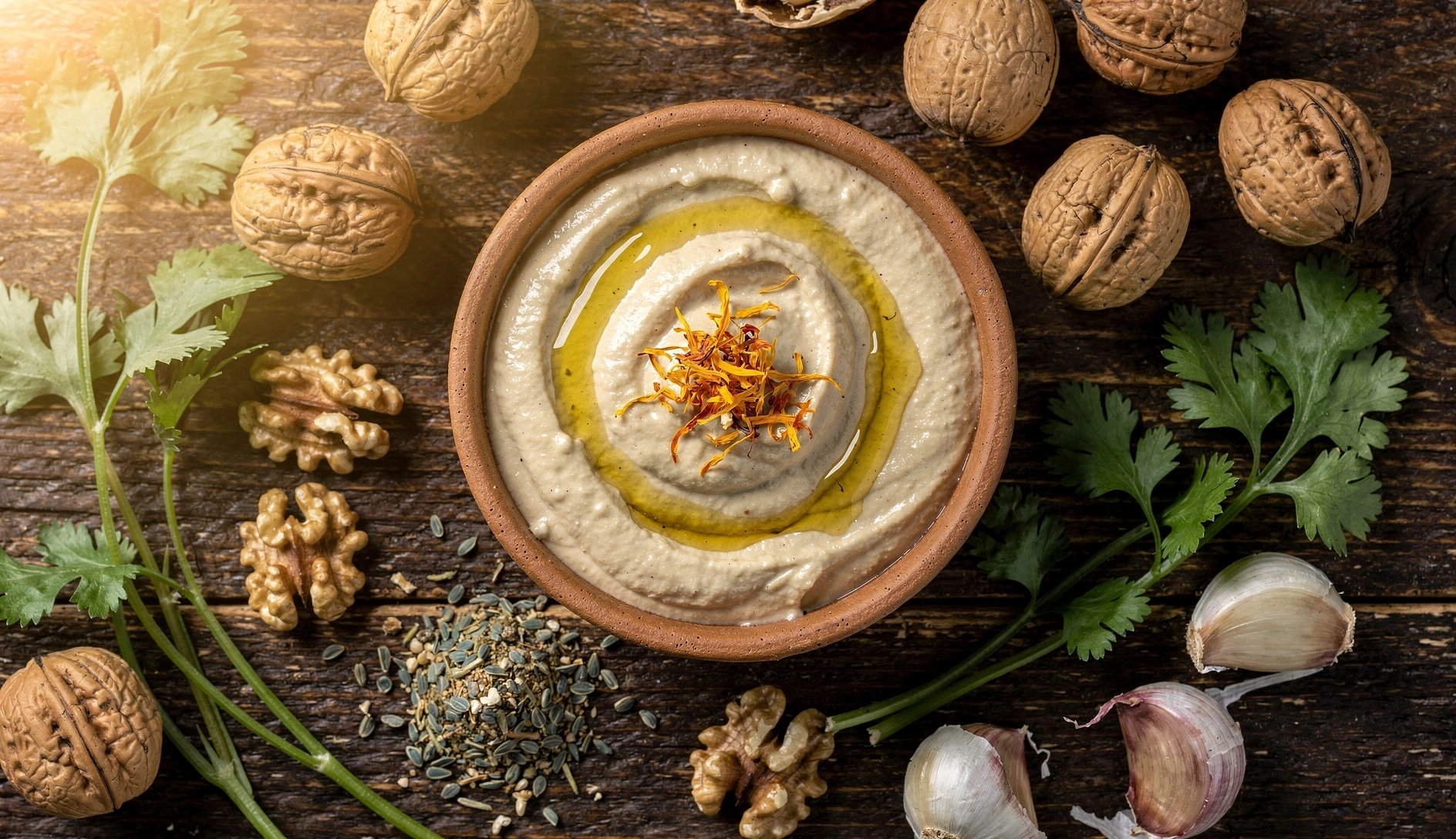
Bazhe is possibly the most important sauce in Georgian cooking, and you've almost certainly never heard of it. While tkemali, adjika, and satsebeli get the attention — they're bold, colorful, and easy to categorize — bazhe is the quiet aristocrat. A cold sauce of finely ground walnuts, garlic, and a handful of spices that are uniquely Georgian: blue fenugreek, dried marigold, ground coriander. No cooking involved. Just grinding, mixing, and adjusting until you have something that looks unremarkable and tastes extraordinary. If you've ever eaten satsivi (cold chicken in walnut sauce) or badrijani nigvzit (eggplant with walnut filling), you already know the flavor — bazhe is the mother sauce behind both.
Bazhe Quick Facts
- Georgian name: ბაჟე (BA-zheh)
- What it is: Cold walnut-garlic sauce — no cooking required
- Key ingredients: Walnuts, garlic, blue fenugreek, dried marigold, vinegar
- Prep time: 15 minutes (plus 30 min resting)
- Yield: ~400ml from 250g walnuts
- Difficulty: Very easy — grind, mix, adjust, done
- Shelf life: 3-4 days refrigerated (walnut sauces don't keep long)
- Served: Always cold or room temperature — never heated
What Is Bazhe
Bazhe (ბაჟე) is a raw walnut sauce. No cooking, no simmering, no roasting — just walnuts ground to a paste with garlic and spices, thinned with water and sharpened with vinegar. The result is silky, pale, and deceptively simple-looking. Then you taste it: rich walnut fat, the warm earthiness of blue fenugreek, a subtle floral note from dried marigold, garlic that sits right at the edge of aggressive, and enough acidity to keep everything bright.
Georgians have been growing walnut trees since at least the 6th century BC. The walnut is considered sacred across the Caucasus, and Georgian cooking reflects that reverence — walnuts appear in more dishes here than in any other cuisine on earth. Bazhe is the purest expression of that tradition: just the nut, spices, and water. Nothing to hide behind.
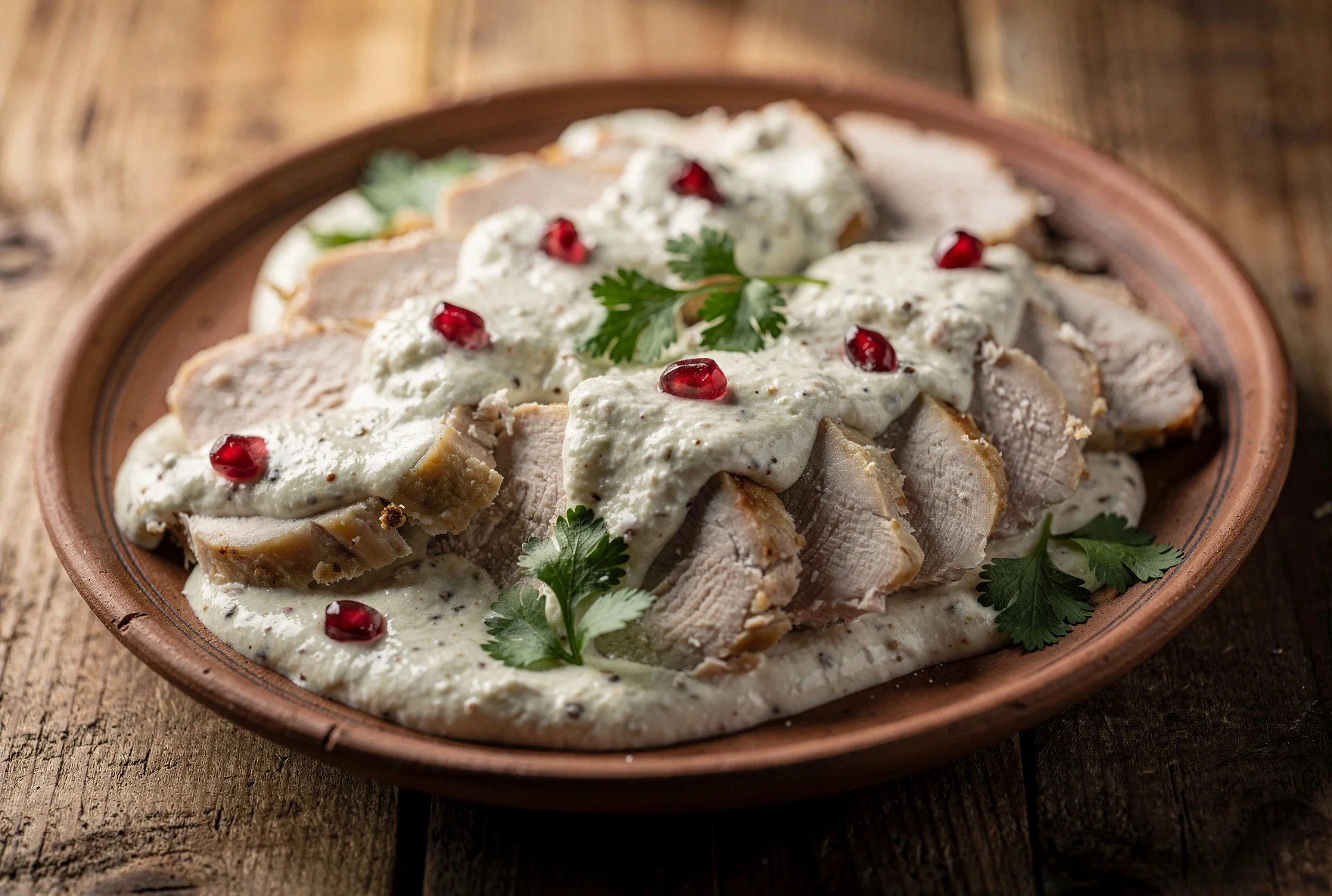
In Georgian homes, bazhe usually appears at the supra (feast table) alongside cold dishes. It gets poured over cold boiled or roasted chicken, draped over fried fish, spooned onto boiled eggs, or served alongside ghomi (Megrelian cornmeal porridge). The thicker version becomes the filling for badrijani nigvzit and the base for pkhali. The thinner version is basically satsivi's soul.
Bazhe vs. Satsivi — What's the Difference?
This confuses everyone, including some Georgians. Bazhe is the sauce. Satsivi is a specific dish — cold poultry (usually chicken or turkey) served in a bazhe-adjacent walnut sauce. But satsivi's sauce is a bit different: it's cooked with chicken broth, typically includes egg yolks for richness, uses onion as a base, and is thinner. Bazhe is raw, brothless, egg-free, and denser.
Think of it this way: bazhe is the mother sauce. Satsivi, badrijani nigvzit filling, and pkhali paste are all children — each adding or subtracting something but built on the same walnut-garlic-spice foundation.
| Feature | Bazhe | Satsivi Sauce |
|---|---|---|
| Cooking | None — raw | Simmered with broth |
| Liquid | Water + vinegar | Chicken broth |
| Egg yolks | Never | Usually (for richness) |
| Onion | Never | Yes (sautéed base) |
| Consistency | Thick cream | Thin, pourable sauce |
| Served with | Anything cold — chicken, fish, eggs, vegetables | Specifically cold chicken or turkey |
| When | Year-round, any supra | Traditionally New Year's / Christmas |
Ingredients — And Why Each Matters
Bazhe has maybe eight ingredients. There's nowhere to hide, which means every single one has to be right. Here's the breakdown:
| Ingredient | Amount | Why It Matters |
|---|---|---|
| Walnuts | 250g | The body. Must be fresh, light-colored, not bitter. Stale walnuts ruin everything. |
| Garlic | 3-4 cloves | Raw punch. Start with 3 — you can always add more. This is raw garlic, not roasted. |
| Blue fenugreek (utskho suneli) | 1 tsp | The signature flavor. Earthy, slightly sweet, maple-adjacent. Non-negotiable. |
| Ground coriander | 1 tsp | Warm citrus note. Buy whole seeds and grind fresh if possible. |
| Dried marigold (imeruli shaphrani) | ½ tsp | Floral, peppery, subtle. Often called "Georgian saffron" though it's not saffron at all. |
| Red pepper | ¼ tsp | Just a whisper of heat. Bazhe should not be spicy — it's meant to be smooth and elegant. |
| White wine vinegar | 2 tbsp | Acidity to balance the fat. Pomegranate juice is the traditional alternative. |
| Water | 150-200ml | Warm, not hot. Controls thickness. Add gradually — you can't take it back. |
| Salt | 1 tsp | Walnuts absorb salt. Season generously, then taste again after resting. |
The Walnut Quality Rule
This is the hill every Georgian grandmother will die on: the sauce is only as good as the walnuts. Fresh, light-colored walnut halves with no bitter aftertaste — that's what you need. If the walnuts taste even slightly rancid or bitter, throw them out and buy new ones. No amount of garlic or spice can rescue bad walnuts. In Georgia, families buy walnuts in autumn directly from sellers at the bazroba (market) and store them in shell. If you're buying shelled walnuts from a supermarket, taste one first.
Sourcing the Georgian Spices
The three spices that make bazhe taste specifically Georgian — blue fenugreek, dried marigold, and ground coriander — can be tricky to find outside the Caucasus. Here's how to get them:
Blue Fenugreek (Utskho Suneli)
Not the same as regular fenugreek (which is bitter). Blue fenugreek (Trigonella caerulea) is milder, slightly sweet, with maple-like notes. Available from Georgian spice shops online, Amazon, or any Indian/Middle Eastern grocery that stocks Caucasian products. In a pinch, use regular fenugreek at half the amount — but it's really not the same.
Dried Marigold (Imeruli Shaphrani)
Ground dried calendula/marigold petals. Called "Georgian saffron" or "Imeretian saffron" in some stores. It's not saffron — it's cheaper, milder, and adds a subtle yellow color and floral note. Find it at Georgian online stores or on Amazon. If you absolutely can't find it, a tiny pinch of turmeric + a pinch of saffron approximates the color but not the flavor. Better to skip it than fake it.
Khmeli Suneli (Alternative)
If you can't find the individual spices, khmeli suneli (the Georgian spice blend) already contains blue fenugreek, dried marigold, coriander, and more. Use 2 teaspoons instead of the individual spices. Not traditional for bazhe, but it'll get you close enough to understand what the sauce should taste like.
Ground Coriander
This one's easy — every supermarket has it. But if you want a meaningful upgrade, buy whole coriander seeds and toast them in a dry pan for 2 minutes before grinding. The difference in fragrance is enormous. Georgian cooks consider this a basic staple.
Step-by-Step Instructions
Step 1: Grind the Walnuts
Put 250g raw walnuts in a food processor and pulse until you get a fine, slightly oily paste. This takes about 30-40 seconds. You want a texture like wet sand — fine enough that the sauce will be smooth, but stop before you make walnut butter. If you overshoot, the sauce will be greasy instead of silky.
The traditional method is a mortar and pestle, which gives you more control and a slightly better texture (some tiny pieces stay irregular, which adds body). If you have a big mortar and the patience, it's worth it. Otherwise, the food processor is fine — just pulse, don't run continuously.
The Oil Test
When you grind walnuts, the natural oils start to release. Good walnuts will release clear, fragrant oil. If the oil smells stale or the paste tastes bitter at all, your walnuts are too old. Some Georgian cooks save a spoonful of the walnut oil that separates during grinding and drizzle it over the finished sauce — it's a beautiful finishing touch.
Step 2: Add Garlic and Spices
Mince 3-4 garlic cloves very finely (or press them). Add the garlic to the walnut paste along with 1 tsp ground coriander, 1 tsp blue fenugreek, ½ tsp dried marigold, ¼ tsp ground red pepper, and 1 tsp salt. If using a food processor, pulse 3-4 times just to combine. Don't over-process — you want to mix, not liquefy.
Step 3: Add Vinegar and Water
Transfer the paste to a bowl. Add 2 tablespoons white wine vinegar (or pomegranate juice if you have it — this is actually more traditional than vinegar). Stir well.
Now add warm water gradually. Start with about 150ml and stir until smooth. The target consistency is thick cream — it should coat the back of a spoon but still pour slowly. If you lift the spoon and the sauce falls in a steady, thick ribbon, you're there. Too thick? Add more water, a tablespoon at a time. Too thin? Unfortunately you can't really fix that, which is why you add water gradually.
Step 4: Taste and Adjust
This is where bazhe goes from good to perfect. Taste it. Does it need more salt? Almost certainly — walnuts absorb salt like sponges. More garlic? If you want it punchier. More vinegar? If it tastes flat and heavy. The acidity is what lifts the sauce and prevents it from being just walnut paste.
A good bazhe has this quality: creamy and rich from the walnuts, but bright and clean from the acidity, with the spices adding warmth without heat. It shouldn't taste like any one ingredient — everything should be in balance.
Step 5: Rest and Serve
Let the bazhe sit at room temperature for at least 30 minutes before serving. The spices need time to bloom in the liquid, and the flavors will integrate and mellow slightly. If using walnut oil as a finish, drizzle it over the top. Fresh chopped cilantro is optional but traditional.
Serve at room temperature or slightly chilled. Never heat bazhe. It's designed as a cold sauce, and heating it will make it grainy and separate the fats.
Consistency Guide — Thick vs. Thin
The right thickness depends on what you're serving bazhe with. Georgian cooks adjust this instinctively, but here's a guide:
| Use | Consistency | Water Amount | Comparison |
|---|---|---|---|
| Badrijani/pkhali filling | Very thick paste | 50-80ml | Like hummus — holds its shape |
| Dipping sauce | Thick cream | 120-150ml | Like Greek yogurt — clings to bread |
| Pouring over chicken/fish | Pourable sauce | 150-200ml | Like heavy cream — coats and drapes |
| Satsivi-style dish sauce | Thin sauce | 200-250ml | Like single cream — pools on the plate |
What to Serve Bazhe With
The traditional answer is "cold chicken." The honest answer is "practically everything that isn't sweet." Here are the classic pairings and some less obvious ones:
| Pairing | How to Serve | Notes |
|---|---|---|
| Cold boiled chicken | Sliced and covered in sauce | The classic. Every supra has this. |
| Chicken tabaka | Serve sauce alongside | Hot crispy chicken + cold walnut sauce = perfect contrast |
| Fried fish | Draped over cooled fillets | Especially trout — Georgia's favorite freshwater fish |
| Boiled eggs | Halved, sauce spooned on top | Simple, satisfying, genuinely delicious |
| Ghomi (corn porridge) | Poured generously over the top | A Megrelian staple — starchy + rich + creamy |
| Elarji | Serve alongside as dip | The cheese-corn combo loves walnut sauce |
| Bread | Spread or dip | Bazhe on shotis puri is a legitimate snack |
| Roasted vegetables | Drizzle after cooling | Especially eggplant, beets, and green beans |
Regional Variations
Bazhe is fairly standard across Georgia compared to more regional dishes, but there are subtle differences in how different areas approach it:
Western Georgia (Samegrelo)
Tends to make bazhe thicker and use it more as a standalone sauce. Megrelians are the walnut sauce masters — they use it with ghomi (cornmeal porridge) almost daily. Often heavier on garlic and marigold. Some add adjika paste for a spicier, more pungent version.
Eastern Georgia (Kakheti)
Slightly thinner consistency, more vinegar or verjuice (unripe grape juice) for acidity. Kakhetians tend to pair bazhe more with chicken and fish than with cornmeal dishes. The spice balance leans toward coriander over fenugreek.
Tbilisi / Urban
City cooks often simplify: food processor instead of mortar, white wine vinegar instead of verjuice, and sometimes the marigold gets dropped. The result is still good but loses some of the aromatic complexity. Restaurant versions tend to be thinner and more pourable.
Supra / Feast Style
For a supra, bazhe is usually made in larger quantities and thinner. It's poured generously over a whole boiled chicken that's been carved, sometimes garnished with pomegranate seeds. The presentation matters here — it should look abundant, not precious.
Common Mistakes
❌ Stale Walnuts
The #1 mistake. Walnuts go rancid. If they taste even slightly bitter, toss them. Fresh walnuts should be mildly sweet and creamy. Buy from a shop with high turnover or buy in-shell and crack them yourself.
❌ Over-Processing
Running the food processor too long turns walnuts into nut butter. You want a fine meal, not a smooth paste. Pulse in short bursts and check often. The sauce should have slight body from tiny walnut particles.
❌ Skipping the Fenugreek
Without blue fenugreek, it's walnut dip. With it, it's bazhe. This single spice is what makes the sauce taste Georgian. Order it online — it keeps for months and you'll use it in dozens of recipes.
❌ Heating the Sauce
Bazhe is a cold sauce. Period. Heating it makes the walnut fats separate and the texture goes grainy. If you want a warm walnut sauce, make satsivi instead — it's designed for heat.
❌ Adding Too Much Water at Once
You can always thin bazhe, but you can't thicken it back. Add water a couple tablespoons at a time, stirring between additions, until you reach the consistency you want.
❌ Under-Salting
Walnuts need more salt than you think. Under-salted bazhe tastes flat and heavy. Season it, let it rest, then taste again — the salt disperses and you'll usually need a bit more. Trust your palate, not the recipe.
Storage and Shelf Life
Bazhe doesn't keep long — that's just the nature of a raw nut sauce. The walnut oils oxidize, the garlic mellows past the point of usefulness, and the whole thing starts tasting stale after a few days.
| Method | Duration | Notes |
|---|---|---|
| Room temperature | Same day | Fine for a few hours during a meal or supra |
| Refrigerated | 3-4 days | Covered, in glass. Will thicken slightly — stir in a splash of water before serving |
| Frozen | Up to 1 month | Works but texture suffers. Thaw in fridge, stir vigorously, adjust seasoning |
Make It Fresh Each Time
Honestly, the best strategy is to make bazhe in small batches right before you need it. It takes 15 minutes. The ingredients keep much longer in their raw state — walnuts in the freezer, garlic in the pantry, spices in jars. Assemble when ready. Georgian grandmothers make it fresh every time, and there's a reason for that.
Frequently Asked Questions
Can I use toasted walnuts?
Traditional bazhe uses raw walnuts. Toasting adds a different flavor that some people enjoy, but it changes the character of the sauce. If you want to experiment, lightly toast them — just enough to warm the oils, not to brown them. Most Georgian cooks would not approve, but your kitchen, your rules.
What if I can't find blue fenugreek?
Your best substitute is khmeli suneli (Georgian spice blend), which already contains blue fenugreek along with other Georgian spices. Use about 2 teaspoons. Regular fenugreek (methi) is not the same — it's much more bitter and pungent. Use it at half the amount if it's all you have, but the result won't taste authentically Georgian.
Vinegar or pomegranate juice?
Pomegranate juice is more traditional and adds a subtle fruity sweetness along with the acidity. White wine vinegar is the modern shortcut — it works well but is sharper and more one-dimensional. If you have access to real pomegranate juice (not the sugary concentrate), use it. Some cooks use verjuice (unripe grape juice) — equally traditional and excellent.
Is bazhe vegan?
Yes. Bazhe is entirely plant-based — walnuts, garlic, spices, water, and vinegar. No dairy, no eggs, no animal products of any kind. This makes it one of the most useful sauces for vegan cooks exploring Georgian food. It adds richness and protein to vegetables, grains, and legumes.
How is this different from the walnut paste in badrijani nigvzit?
Same family, different branch. Badrijani nigvzit filling is essentially a very thick bazhe with more garlic, sometimes fresh herbs stirred in, and often no added water — it needs to be thick enough to hold inside a rolled eggplant slice. Think of it as bazhe's thicker, more garlicky cousin.
Written by The Georgian Eats Team
We've been eating bazhe poured over cold chicken at Georgian supras for years and have strong opinions about walnut freshness. This recipe comes from watching Megrelian cooks who consider walnut sauce a daily necessity, not a special occasion condiment.
Last updated: February 2026.
Related Articles
Satsivi: Cold Chicken in Walnut Sauce
Georgia's iconic New Year's dish — bazhe's most famous descendant.
Badrijani Nigvzit: Eggplant with Walnut Paste
Fried eggplant rolled around a thick, garlicky walnut filling.
Pkhali: Walnut-Herb Vegetable Patties
Spinach, beet, or bean purée bound with the same walnut-spice paste.
Georgian Spices: The Complete Guide
Everything about blue fenugreek, dried marigold, khmeli suneli, and more.