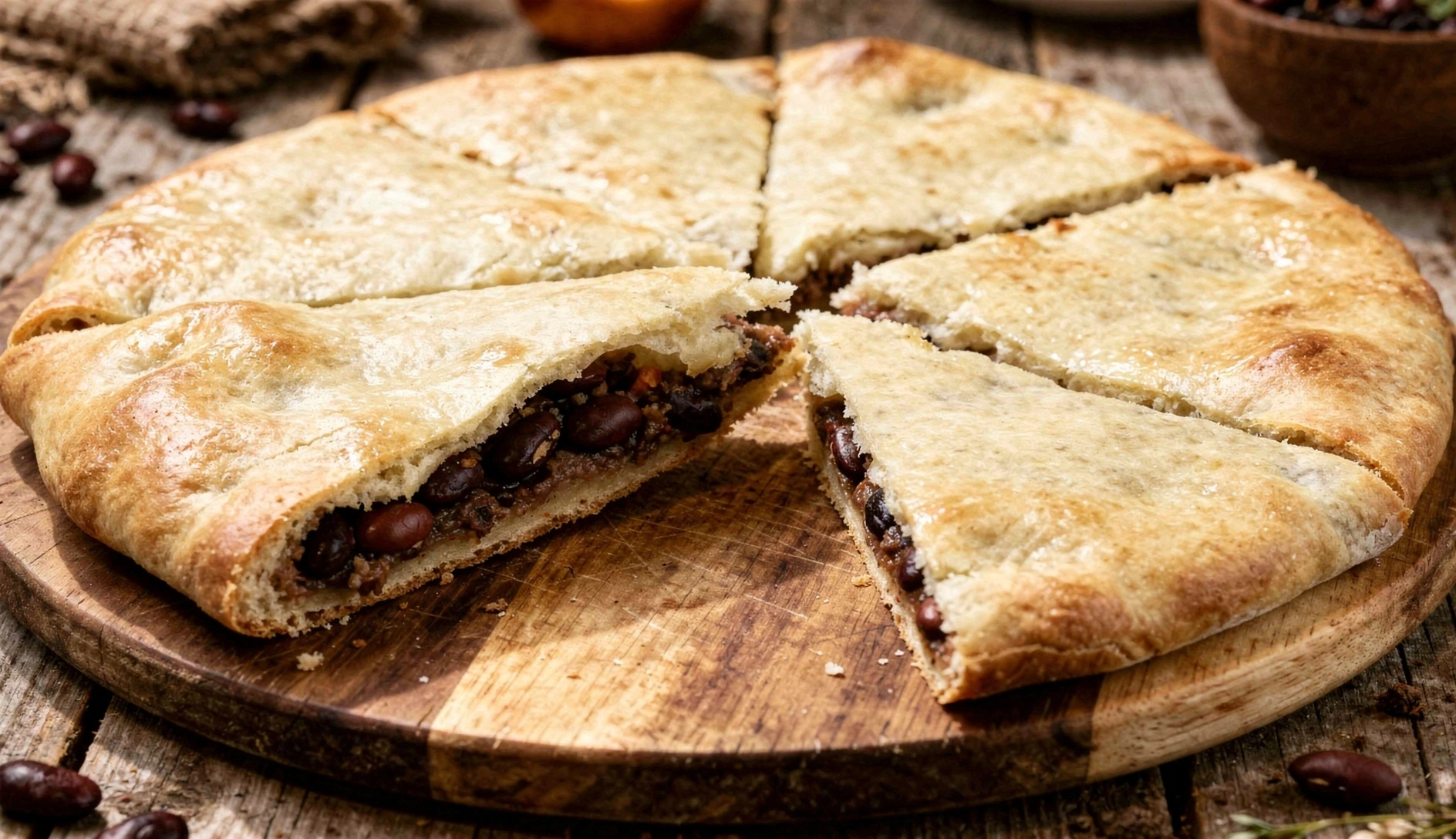
Lobiani (ლობიანი) is the bean-stuffed cousin of khachapuri that doesn't get nearly enough international attention. Where khachapuri fills bread with cheese, lobiani fills it with mashed red kidney beans — seasoned with coriander, blue fenugreek, and enough butter to make the whole thing rich and slightly obscene. You'll find it at every bakery in Georgia, sold warm from the oven in thick wedges for about 3 lari (a little over a dollar). It's the food you eat standing on a cold street corner in December, tearing off pieces with your hands while the steam rises. On Barbaroba — St. Barbara's Day, December 17th — it's practically mandatory. The rest of the year, it's just really, really good.
Lobiani Quick Facts
- Georgian name: ლობიანი (lo-bee-AH-nee)
- Meaning: "Bean thing" — from ლობიო (lobio), meaning beans
- Key ingredients: Red kidney beans, yeasted dough, butter, coriander, blue fenugreek
- Holiday: Barbaroba (St. Barbara's Day, December 17)
- Prep + cook time: 30 min active, plus overnight soak and 1 hour rise
- Cost in Georgia: 2–4 GEL in bakeries (~$0.75–1.50 USD)
- Difficulty: Moderate — basic bread-making skills required
Why This Bread Matters
Georgia has an almost irrational love of bread. Shotis puri baked in cylindrical tone ovens, mchadi cornbread cooked on clay slabs, khachapuri in a dozen regional shapes. Lobiani sits at the intersection of two Georgian obsessions: bread and beans. Lobio (bean stew) is probably the most eaten dish in the country — cheap, filling, endlessly variable. Lobiani takes that same bean filling and wraps it in yeasted dough, turning a peasant stew into something portable, satisfying, and perfect for eating while walking through a freezing Tbilisi January.
The connection to Barbaroba gives lobiani a ritual quality that most street foods lack. On December 17th, families across Georgia bake lobiani — the bean filling symbolizing fortitude and the bread symbolizing prosperity. But don't let the holiday association fool you. This isn't fruitcake, trotted out once a year and quietly ignored. Lobiani is an everyday food. Every tonе bakery has it. Every corner shop sells it. And it costs almost nothing.
What makes good lobiani isn't complexity — it's balance. The dough should be thin enough that you taste the filling first, but substantial enough to hold together when you tear off a piece. The beans should be well-mashed but not a smooth purée — you want some texture. And the seasoning needs to be assertive. Bland lobiani is a sin. The coriander and blue fenugreek are doing all the heavy lifting, supported by enough butter that the bread practically glistens.
The Racha Connection
If you want to start an argument in Georgia, tell someone their region doesn't make the best lobiani. The truth — which most Georgians will grudgingly admit — is that Racha wins this debate. The mountain region in northwest Georgia is famous for two things: exceptional ham (რაჭული ლორი, Rachuli lori) and the best lobiani in the country.
The Rachuli secret is simple: they boil the beans with smoked ham. The smoky, salty pork fat permeates the beans during cooking, giving the filling a depth that plain butter alone can't match. If you can find good smoked pork — not honey-glazed ham, but actual salt-cured, smoke-dried pork — adding it transforms this recipe from very good to extraordinary. A thick slice of bacon or pancetta works as a substitute, though purists from Racha would not approve.
The Racha Ham Trick
Boiling beans with smoked pork is what separates good lobiani from the best lobiani. The fat renders into the cooking liquid, the smoke flavor soaks into every bean. If you skip this step, increase the butter to 100g and add a pinch of smoked paprika for a hint of that smoky depth.
Ingredients
Lobiani has two components: the bean filling and the bread dough. Both are straightforward, but the filling requires an overnight bean soak (or at minimum 4 hours), so plan ahead. Don't use canned beans — the texture will be wrong and you lose the ability to control seasoning during cooking.
Bean Filling
| Ingredient | Amount | Notes |
|---|---|---|
| Dried red kidney beans | 500g | Must soak overnight — no shortcuts |
| Onion | 1 large | Finely diced |
| Garlic | 4 cloves | Minced |
| Butter | 80g | Plus extra for brushing. 100g if no pork |
| Ground coriander | 1 tsp | Essential — don't skip |
| Blue fenugreek | 1 tsp | უცხო სუნელი (utskho suneli) — the signature Georgian spice |
| Bay leaves | 4–5 | For boiling the beans |
| Smoked pork or bacon | 200g | Optional but highly recommended (Racha style) |
| Salt and black pepper | To taste | Season aggressively — beans absorb a lot |
Bread Dough
| Ingredient | Amount | Notes |
|---|---|---|
| All-purpose flour | 1 kg | Plus extra for dusting |
| Instant yeast | 10g | Or 25g fresh yeast |
| Salt | 1 tsp | |
| Sugar | 1 tbsp | Feeds the yeast |
| Egg | 1 | Makes the dough slightly richer |
| Warm water | 400ml | Body temperature — not hot |
| Vegetable oil | 2 tbsp | Keeps dough soft |
Blue Fenugreek Is Non-Negotiable
Blue fenugreek (უცხო სუნელი, utskho suneli) is the spice that makes Georgian food taste Georgian. It has a mild, slightly nutty, hay-like aroma — nothing like regular fenugreek. If you can't find it locally, order it online from a Georgian spice shop. Regular fenugreek is not a substitute — it's far too bitter and will ruin the filling.
Equipment
Essential
Large pot for beans, mixing bowl, rolling pin, large skillet or baking sheet, potato masher or fork.
Nice to Have
Stand mixer with dough hook, pressure cooker (halves bean cooking time), cast iron skillet for pan-frying method.
Step-by-Step Recipe
Step 1: Soak and Cook the Beans
The night before, cover your dried kidney beans with cold water — at least 8cm above the beans, because they'll swell considerably. Soak for a minimum of 8 hours. Don't cheat this step. Insufficiently soaked beans cook unevenly and take forever.
Drain the beans, rinse them, and add to a large pot. If using smoked pork, add it now along with the bay leaves. Cover with fresh water by about 8cm. Bring to a boil, skim any foam, then reduce to a steady simmer. Cook until the beans are completely soft and falling apart when pressed between your fingers — about 60 to 90 minutes. A pressure cooker cuts this to 30–40 minutes.
The beans should be soft enough to mash easily. If they still have any firmness, they need more time. Undercooked beans will make a filling with an unpleasant, grainy texture.
Step 2: Make the Filling
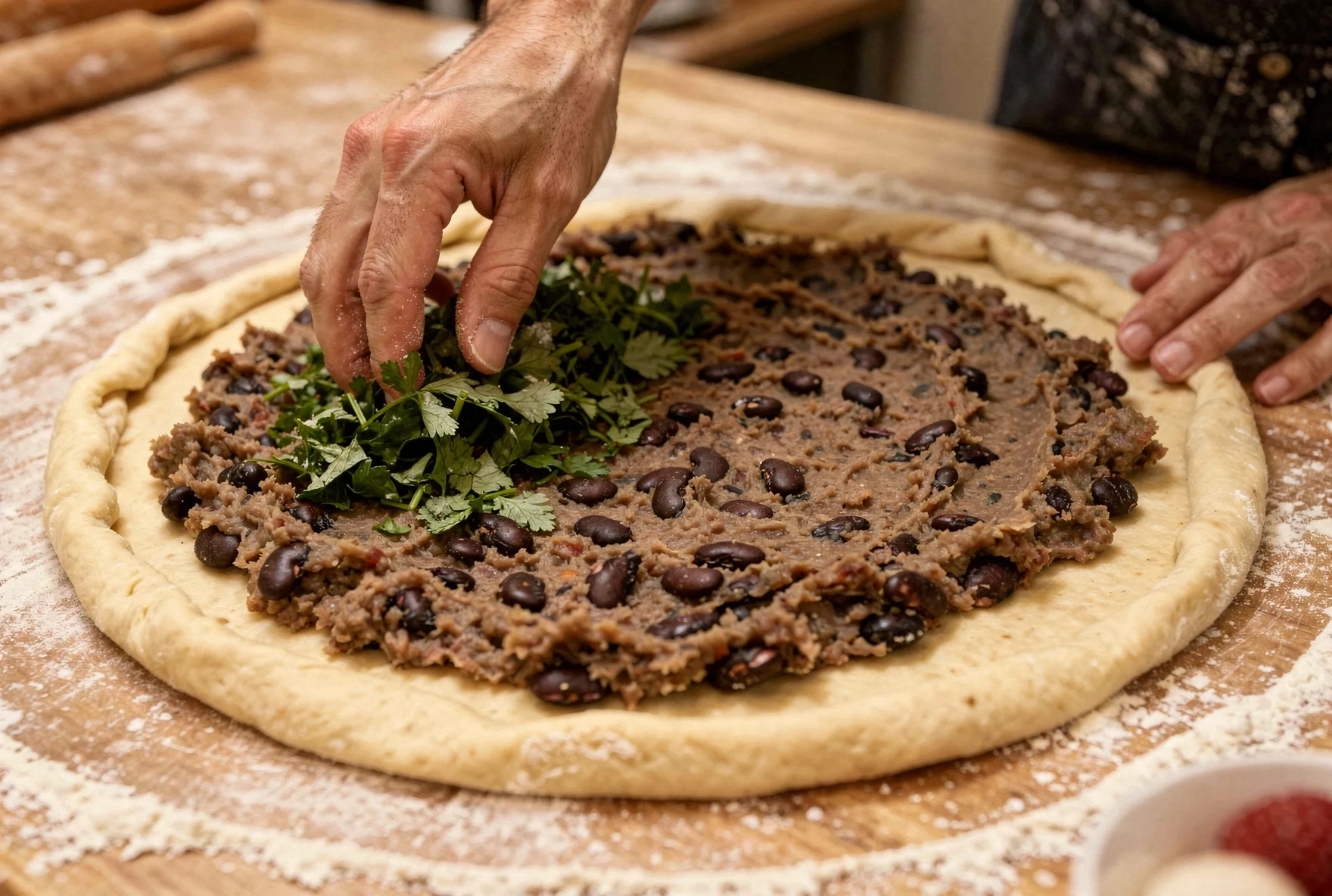
Drain the beans, reserving a cup of cooking liquid. Remove the bay leaves and any pork pieces (you can chop the pork finely and add it back if you want). Transfer beans to a large bowl and mash with a potato masher or sturdy fork. You want the texture of chunky mashed potatoes — mostly smooth with some visible bean pieces for texture. Don't use a food processor. A smooth purée makes the filling too dense and paste-like inside the bread.
Melt 80g butter in a skillet. Add the diced onion and cook over medium heat, stirring occasionally, until deeply golden — about 12 to 15 minutes. Don't rush this. Properly caramelized onions give the filling a sweetness that balances the earthiness of the beans. Add garlic in the last minute. Stir in the ground coriander and blue fenugreek and cook for 30 seconds until fragrant.
Fold the onion mixture into the mashed beans. Season aggressively with salt and black pepper. Taste it. The filling should be well-seasoned and flavorful on its own — remember, it's going inside bread, which will dilute the flavor. If it tastes "about right" now, it'll taste bland in the finished lobiani. Let the filling cool to room temperature before assembling.
Season Harder Than You Think
The most common lobiani mistake is under-seasoning the filling. Beans absorb salt like a sponge, and the bread dough further mutes flavors. What tastes "too salty" on its own will taste perfectly balanced inside the bread. Taste the filling, think "this is almost too much," and add a bit more.
Step 3: Make the Dough
While the beans cook (or while the filling cools), make the dough. Combine the flour, instant yeast, salt, and sugar in a large bowl. Make a well in the center and add the egg, vegetable oil, and warm water. Mix with a wooden spoon until a shaggy mass forms, then turn out onto a floured surface and knead for 8 to 10 minutes until the dough is smooth, elastic, and springs back when you poke it.
If using a stand mixer with a dough hook, mix on low for 2 minutes to hydrate, then medium-low for 5 to 6 minutes until the dough clears the sides of the bowl.
Shape into a ball, place in a lightly oiled bowl, cover with a clean towel or plastic wrap, and leave in a warm spot for about 1 hour until it doubles in size. The ideal spot is a turned-off oven with just the light on.
Step 4: Assemble
Punch down the risen dough and divide it into 4 equal pieces. Shape each into a ball and let rest under a towel for 5 minutes — this relaxes the gluten and makes rolling easier.
On a floured surface, roll one ball into a circle about 25cm (10 inches) across. Don't worry about perfection — this is rustic food, not patisserie. Place about a quarter of the cooled bean filling in the center. Gather the edges of the dough up and over the filling, pleating and pinching them together at the top to seal. You should have something that looks like a dumpling.
Now carefully flip it seam-side down and gently press it flat with your palms, working from the center outward, until you have a disc about 20cm (8 inches) across and roughly 2cm thick. The goal is to spread the filling evenly without tearing the dough. If the dough resists, let it rest a minute and try again.
Using a sharp knife, score 3 or 4 lines across the top. This isn't decorative — it vents steam and prevents the lobiani from puffing up like a balloon and splitting open. Some bakers also poke a few holes with a fork.
Step 5: Cook
You have two options: oven or skillet. Both are traditional.
Oven method: Preheat to 200°C (400°F). Place lobiani on a parchment-lined baking sheet. Bake for 18 to 22 minutes until deeply golden brown on top. The bottom should be firm and slightly crisp.
Skillet method (more traditional): Heat a large, dry cast iron skillet or griddle over medium heat. Place the lobiani in the pan — no oil needed. Cook for 5 to 6 minutes per side, adjusting the heat so it browns evenly without burning. The bread should have deep golden-brown spots, even some slight char in places.
The moment it comes off the heat, brush the top generously with melted butter. Don't be shy. The butter soaks into the hot bread and makes the crust impossibly good — slightly crispy, slightly greasy, deeply satisfying. Let it rest for 3 to 4 minutes before cutting. Serve warm.
The Butter Finish Is Everything
Brushing hot lobiani with melted butter is not optional. It's the difference between good bread with beans in it and actual lobiani. The butter soaks into the crust, creating a rich, slightly glossy surface. Some families use two or three coats. Nobody has ever complained about too much butter on lobiani.
Tips for the Best Lobiani
🫘 Bean Texture
Don't over-mash. A few visible bean pieces give the filling character. Completely smooth filling tastes homogeneous and boring.
🌡️ Cool the Filling
Hot filling will melt the butter in the dough and make it impossible to seal properly. Room temperature filling is critical for clean assembly.
📏 Thin Dough Wins
The best lobiani has a thin layer of bread around a generous filling. If your bread-to-bean ratio favors bread, roll thinner and use more filling.
🔥 Medium Heat
If pan-frying, resist cranking the heat. Medium gives you even browning all the way through. High heat burns the outside before the dough cooks.
Common Mistakes
| Mistake | Why It Happens | Fix |
|---|---|---|
| Bland filling | Under-seasoning beans | Season filling more aggressively than you think |
| Dough tears during flattening | Over-working or filling too hot | Let dough rest 5 min. Cool filling completely |
| Filling bursts out | Didn't score the top | Always cut vent slits before cooking |
| Using canned beans | Trying to save time | Dried beans give better texture and absorb spices |
| Too much bread, not enough filling | Thick dough or skimping on beans | Roll dough thin. Be generous with filling |
| Skipping the butter brush | Health concerns | This is not a health food. Embrace the butter. |
Variations
Lobiani is one of those dishes where every region — and every grandmother — has their own take. The core concept stays the same (beans in bread), but the details shift depending on where you are and what's available.
| Variation | What's Different | Where |
|---|---|---|
| Rachuli lobiani | Beans cooked with smoked ham (lori) | Racha — the gold standard |
| Lobiani with cheese | Sulguni or imeruli cheese mixed into filling | Common hybrid — half lobiani, half khachapuri |
| Puri-style lobiani | Baked in a tone oven, elongated shape | Bakeries across Georgia |
| Vegan lobiani | No egg in dough, oil instead of butter | During fasting periods (Lent) |
| Mini lobiani | Small individual portions, turnover shape | Party appetizers, street food stalls |
The Cheese Hybrid
Mixing crumbled sulguni into the bean filling creates a lobiani-khachapuri hybrid that's genuinely excellent — the melted cheese runs through the beans in salty streaks. About 150g of sulguni per batch works well. It's not traditional, but it's become common in Tbilisi bakeries and restaurants.
What to Serve With Lobiani
Lobiani is substantial enough to be a meal on its own, but Georgians rarely eat anything in isolation. Here's how it actually gets served.
| Pairing | Why It Works |
|---|---|
| Pickled vegetables (mzhave) | The acidity cuts through the richness of beans and butter |
| Fresh herbs and tomato-cucumber salad | Freshness balances the heaviness |
| Matsoni (Georgian yogurt) | A spoonful on the side adds tangy creaminess |
| Tkemali sauce | Sour plum sauce is the classic condiment — adds tartness and depth |
| Light red wine or beer | A young Saperavi or cold lager works perfectly |
| Lobio (bean stew) | Beans inside bread, beans on the side — Georgia doesn't shy from redundancy |
Where to Eat Lobiani in Georgia
The best lobiani in Tbilisi usually comes from no-name bakeries, not restaurants. But here are some reliable options if you want to try it without baking your own.
Tone Bakeries
Any traditional tone bakery (look for the tandoor-style oven visible from the street) will have lobiani. Quality varies, but the bread-to-filling ratio tells you everything. Best ones are stuffed thick.
Machakhela
The popular chain does a solid, consistent lobiani. Not the most authentic, but reliable and available across Tbilisi. Good enough for a quick lunch.
Samikitno (Shemoikhede Genatsvale)
The massive restaurant near the Dry Bridge serves excellent lobiani — properly thin dough, well-seasoned filling, generous butter. Bring a friend, the portions are huge.
Racha Region
If you make it to Oni or Ambrolauri, the lobiani is on another level. Rachuli ham in the filling, baked in a wood-fired tone, served with homemade pickles. Worth the trip.
Nutrition
Lobiani is hearty, filling, and not particularly light. That said, kidney beans are an excellent source of protein, fiber, and iron. The main caloric load comes from the bread dough and the butter. A single wedge (one-eighth of a full lobiani) is a satisfying snack; half a lobiani is a full meal.
| Nutrient | Per Serving (1/8) |
|---|---|
| Calories | ~380 kcal |
| Carbohydrates | ~55g |
| Protein | ~14g |
| Fat | ~12g |
Storage and Reheating
Room Temperature
Wrapped in a towel, lobiani stays good for 6–8 hours. It's designed as portable food — it holds up.
Refrigerator
Wrap tightly in foil. Keeps 3–4 days. Reheat in a skillet over medium-low heat for the best results — oven works too at 180°C for 10 minutes.
Freezer
Wrap individual lobiani tightly in plastic, then foil. Freeze up to 2 months. Thaw overnight in fridge, then reheat in oven.
Don't Microwave
Microwaving makes the bread rubbery and the filling weirdly gummy. A skillet or oven is worth the extra 5 minutes.
Frequently Asked Questions
Can I use canned beans?
You can, but the result won't be as good. Canned beans are softer and waterier, and they haven't had time to absorb the flavors of the bay leaves and smoked pork. If you're in a real pinch, drain and rinse two 400g cans and mash them, but know that the filling will be blander and the texture less interesting.
Is lobiani vegan?
The traditional recipe includes butter and egg, but a Lenten (fasting) version exists that's fully vegan. Replace butter with vegetable oil, skip the egg in the dough (add an extra tablespoon of water), and obviously leave out the smoked pork. It's less rich but still excellent.
What's the difference between lobiani and khachapuri?
Same concept, different filling. Khachapuri is stuffed with cheese; lobiani is stuffed with seasoned mashed beans. The dough is nearly identical. In Georgia, they're considered siblings — often sold side by side in bakeries.
Why is lobiani associated with Barbaroba?
Barbaroba (December 17) celebrates St. Barbara, whose feast day traditionally involves bean dishes across Georgian Orthodox practice. Lobiani is the centerpiece — families bake it in the morning and eat it throughout the day. But it's sold year-round in every Georgian bakery.
Can I make the filling ahead of time?
Yes — the filling actually improves overnight as the spices meld. Make it a day ahead, refrigerate, and bring to room temperature before assembling. This also makes the day-of process much faster.
Written by The Georgian Eats Team
We've eaten more lobiani from Tbilisi tone bakeries than we can count — and made it at home enough times to know exactly where things go wrong. This recipe reflects the Rachuli tradition, with a few practical notes for home bakers outside Georgia.
Last updated: February 2026.
Related Articles
Adjarian Khachapuri
The boat-shaped cheese bread — lobiani's famous sibling.
Lobio: Georgia's Smoky Bean Stew
The bean stew that inspired lobiani's filling.
Tkemali: Sour Plum Sauce
The perfect condiment for lobiani.
20 Georgian Dishes You Need to Try
The complete guide to Georgian food.