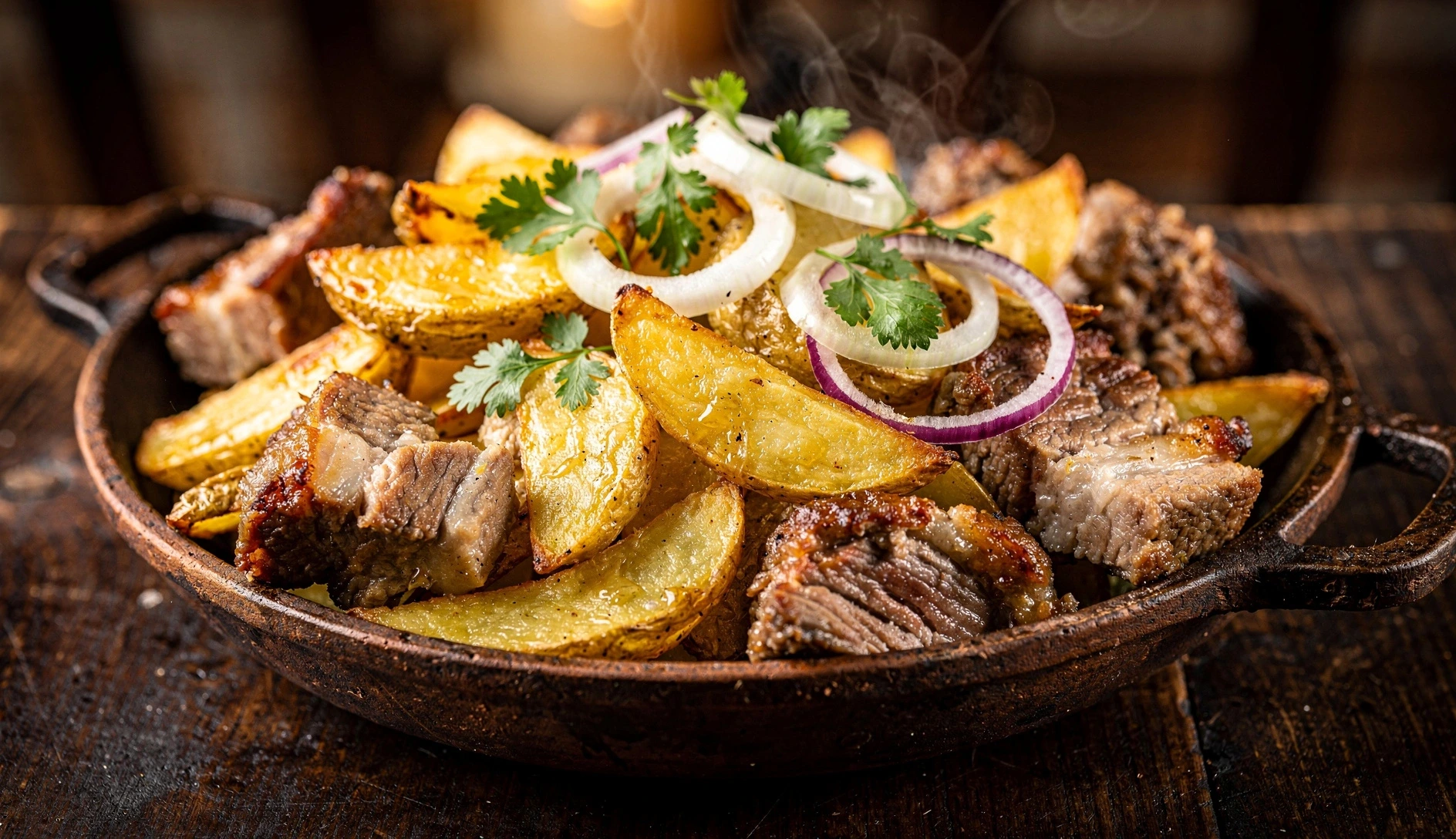
Ojakhuri (ოჯახური) literally means "family meal" in Georgian — and that tells you everything you need to know. This isn't restaurant food dressed up for tourists. It's what a Georgian grandmother makes when her kids come home on Sunday. Pork, cut into rough chunks, fried until the edges are deeply golden and almost crispy. Potatoes, done the same way — high heat, no apologies, proper crust. Onions, softened and sweet. Everything tossed together in a clay ketsi, maybe with a scatter of cilantro and a few slices of hot pepper. It arrives sizzling. You eat it with your hands, with bread, with a cold beer or a glass of Saperavi. It is, without exaggeration, the most satisfying thing you can eat on a Tuesday night in Tbilisi.
Ojakhuri Quick Facts
- Georgian name: ოჯახური (oh-jah-KHOO-ree)
- Meaning: "Family meal" — from ოჯახი (ojahi), meaning family
- Key ingredients: Pork, potatoes, onions, cilantro
- Served in: Clay ketsi (კეცი) or cast iron skillet
- Prep + cook time: 15 min prep, 30 min cooking
- Cost in Georgia: 14–22 GEL in restaurants (~$5–8 USD)
- Difficulty: Easy — but requires high heat and confidence
Why This Dish Matters
Every Georgian restaurant has ojakhuri on the menu, and every Georgian family has their own version. It's the dish that doesn't need a special occasion. No holiday, no feast day, no visiting dignitary required. Ojakhuri exists because sometimes you want meat and potatoes done really, really well — and Georgians have been perfecting that for generations.
The name itself is revealing. In a food culture obsessed with elaborate supras and multi-course feasts, calling something "the family meal" is almost humble. It's the dinner you make on a weeknight. The thing your mother threw together that somehow tasted better than anything in a restaurant. That's ojakhuri's magic — it's deceptively simple, but the technique matters more than you'd think.
What separates good ojakhuri from bad ojakhuri is one thing: the fry. The pork needs to be properly seared — not steamed in its own juices because you crowded the pan. The potatoes need real color, not sad pale cubes that collapse when you touch them. The onions need to go sweet and golden, not raw and sharp. Get those three things right and you've got a dish that punches absurdly above its ingredient list.
Ingredients
Ojakhuri is a working-class dish. The ingredients are cheap, available everywhere, and don't require a specialty shop. The key is quality pork — look for shoulder or neck with good fat marbling. Lean pork tenderloin will give you a dry, sad result. You want fat. The fat renders as it fries, bastes the meat, and creates those irresistible crispy edges.
| Ingredient | Amount | Notes |
|---|---|---|
| Pork shoulder or neck | 600 g (1.3 lbs) | Well-marbled, with some fat. NOT tenderloin. |
| Potatoes | 500 g (1.1 lbs) | Waxy or all-purpose. Russets fall apart too easily. |
| Onions | 2 large | Yellow or white. Cut into half-moons. |
| Vegetable oil | 3–4 tbsp | Sunflower is traditional. Any neutral oil works. |
| Garlic | 3–4 cloves | Roughly chopped. Added near the end. |
| Fresh cilantro | Large handful | Roughly chopped, stems and all. |
| Hot green pepper | 1 (optional) | Sliced thin. Georgian green peppers are mild-medium. |
| Salt | To taste | Season pork and potatoes separately while frying. |
| Black pepper | To taste | Freshly ground. Be generous. |
| Dried barberry (optional) | ½ tsp | Traditional. Adds subtle tartness. Sumac works as a substitute. |
The Fat Rule
Don't trim the fat off the pork. In ojakhuri, fat isn't a flaw — it's the engine of the whole dish. It renders out during frying, crisps the meat edges, and flavors the potatoes when everything comes together. Lean pork makes lean ojakhuri, and lean ojakhuri is a contradiction in terms.
Equipment
Two Large Skillets
You need two pans going simultaneously — one for pork, one for potatoes. Cast iron is ideal. If you only have one large pan, cook the potatoes first, set aside, then do the pork.
Clay Ketsi (Optional)
The traditional serving vessel. A pre-heated ketsi keeps the ojakhuri sizzling at the table. Not essential, but it transforms the presentation. Any oven-safe dish works as a substitute.
Step-by-Step Recipe
The secret to great ojakhuri is cooking everything separately at high heat, then combining at the end. This is not a one-pot dump-and-stir situation. Each component needs its own time in the pan to develop proper color and texture. Patience with the frying, boldness with the heat.
Step 1: Prep Everything
Cut the pork into roughly 3 cm (1 inch) chunks. Don't fuss over perfect cubes — irregular pieces with more surface area fry better. Peel the potatoes and cut into similar-sized pieces, maybe slightly smaller since they take longer to cook through. Slice onions into thick half-moons. Chop the garlic roughly. Chop the cilantro. Have everything ready before you start — once the pan is hot, things move fast.
Step 2: Fry the Potatoes
Heat 2 tablespoons of oil in a large skillet over high heat until it just starts to shimmer. Add the potatoes in a single layer — and here's where most people ruin it: don't touch them. Let them sit undisturbed for 3–4 minutes until the bottom side develops a golden-brown crust. Only then flip them. Continue frying for another 10–12 minutes, turning occasionally, until golden all over and cooked through. Season with salt and a pinch of black pepper. Transfer to a plate lined with paper towel.
Step 3: Fry the Pork
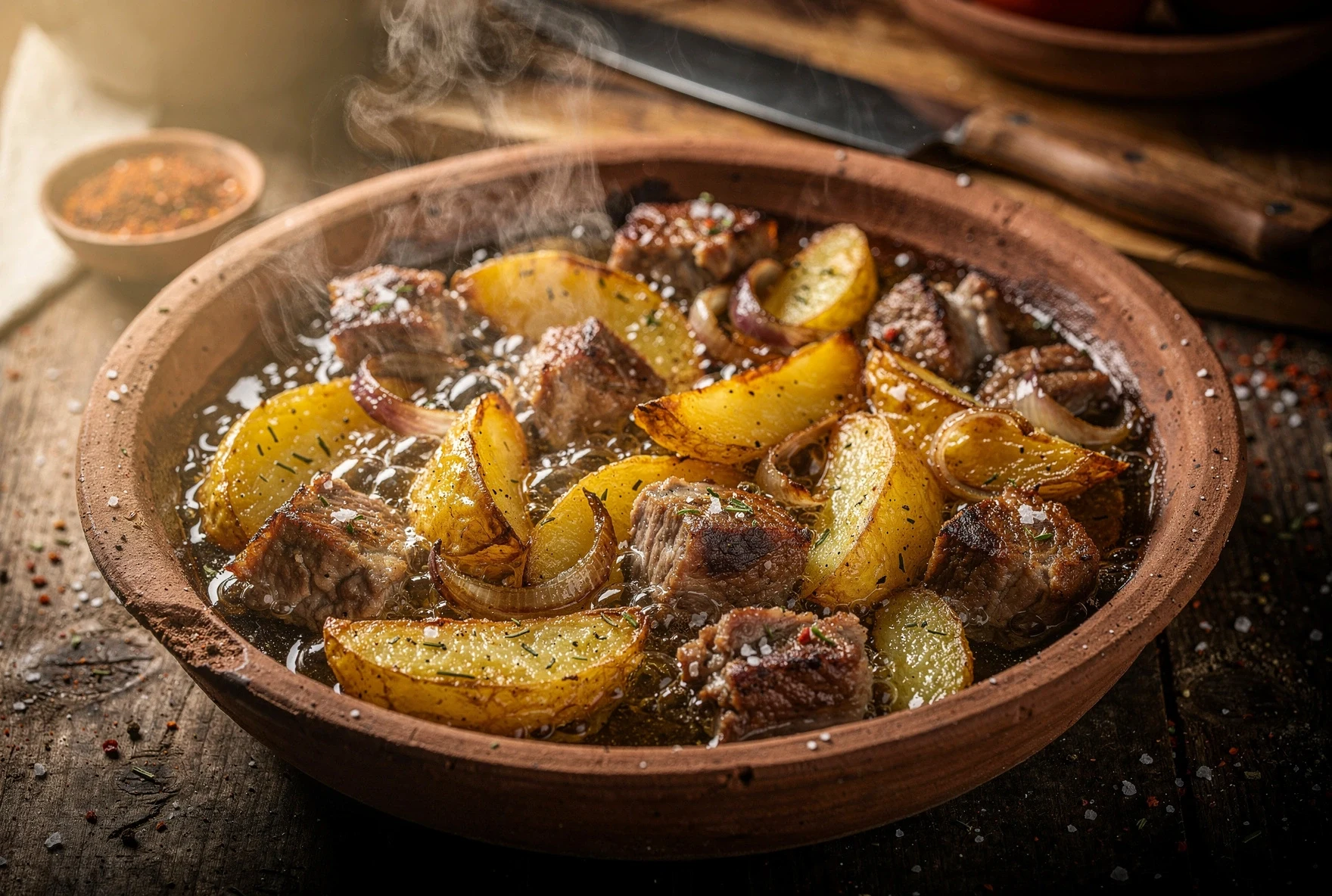
In the second skillet (or the same one, wiped clean), heat 1–2 tablespoons of oil over high heat. Add the pork pieces — again, single layer, no crowding. If your pan isn't big enough, do it in two batches. The pork should sizzle aggressively when it hits the pan. If it doesn't, your pan isn't hot enough.
Let the pork fry undisturbed for 3–4 minutes until a deep golden crust forms on the bottom. Flip and repeat on the other sides. Total frying time: about 10–12 minutes. The exterior should be crispy and caramelized, the interior just cooked through. Season with salt and pepper as you go.
Step 4: Cook the Onions and Garlic
Push the pork to one side of the pan (or remove briefly). Drop the heat to medium. Add the onion half-moons and cook for 5–6 minutes, stirring occasionally, until softened and starting to turn golden. The onions will pick up all the fond and rendered pork fat — this is where the flavor deepens significantly. Add the garlic for the last minute, stirring so it doesn't burn.
Step 5: Combine and Serve
Add the fried potatoes to the pan with the pork and onions. Toss everything together gently — you don't want to break the potatoes. Sprinkle in the barberry powder if using. Taste for salt. Transfer to a pre-heated clay ketsi or serving dish. Top with roughly chopped cilantro and sliced hot pepper. Serve immediately while everything is still sizzling.
Timing Is Everything
If you have two pans, start the potatoes first — they take slightly longer. By the time the potatoes are golden, the pork should be nearly done. The onions are quick. Everything comes together in the last 2 minutes. Ojakhuri is best served the moment it's assembled — it doesn't wait well.
Tips for Perfect Ojakhuri
🔥 Don't Fear the Heat
Ojakhuri is a high-heat dish. If your kitchen isn't getting a little smoky, your pan isn't hot enough. The Maillard reaction needs serious heat to give you those crispy, caramelized edges.
🍳 Never Crowd the Pan
This is the number one mistake. Overcrowding drops the pan temperature and steams the food instead of frying it. Cook in batches if needed. Steamed pork is not ojakhuri.
🧂 Season Each Component
Salt the potatoes while they fry. Salt the pork while it fries. Don't wait until the end — seasoning in layers builds deeper, more even flavor throughout the dish.
🫕 Pre-Heat the Ketsi
If serving in a clay ketsi, warm it in a 180°C oven for 10 minutes while you cook. Transferring hot food to a cold vessel kills the sizzle. A hot ketsi keeps everything crackling at the table.
Common Mistakes
| Mistake | What Happens | Fix |
|---|---|---|
| Using lean pork | Dry, tough meat with no crispy edges | Use shoulder or neck with visible fat marbling |
| Cooking together in one pan | Everything steams, nothing crisps | Fry pork and potatoes separately, combine at the end |
| Low heat | Pale, soggy potatoes and stewed pork | High heat for frying. If it's not sizzling, wait. |
| Moving food too often | No crust develops — just stirred mush | Leave it alone for 3–4 min before flipping |
| Using floury potatoes | Potatoes break apart and turn to mash | Use waxy or all-purpose varieties (Yukon Gold works great) |
| Skipping the garnish | Technically fine, but missing freshness | Fresh cilantro and green pepper lift the whole dish |
Variations
Every Georgian family has their version. The pork-and-potato combo is the standard, but ojakhuri is really a technique more than a fixed recipe. Here are the most common variations you'll find across Georgia:
| Variation | Meat | Notes |
|---|---|---|
| Classic (pork) | Pork shoulder/neck | The standard. Most flavorful, best crust. |
| Chicken | Bone-in thighs or legs | Lighter but still good. Use skin-on for richness. |
| Beef | Chuck or short rib | Heartier, takes longer to cook. Common in mountain regions. |
| Lamb | Leg or shoulder | Rich and gamey. Popular in eastern Georgia. |
| Mushroom (vegetarian) | King oyster or porcini | Not traditional but surprisingly good. Treat like meat — high heat, good sear. |
The Wine Variation
Some families add a splash of white wine (50–60 ml) when combining everything at the end. It deglazes the pan, adds a subtle acidity, and creates a thin sauce that coats everything. Traditional? Debatable. Delicious? Absolutely. If you try it, use a dry Georgian white — Tsinandali or Rkatsiteli.
What to Serve With Ojakhuri
Ojakhuri is a complete meal on its own — protein, starch, and vegetables all in one pan. But Georgians rarely eat a single dish. Here's what goes alongside it:
| Side | Why It Works |
|---|---|
| Shotis puri (შოთის პური) | Georgian bread baked on a tone oven wall. Perfect for scooping up juices. |
| Tkemali sauce | Sour plum sauce cuts through the richness. The classic pairing. |
| Georgian salad | Tomato, cucumber, red onion, walnut oil. Freshness against the fried heaviness. |
| Badrijani nigvzit | Eggplant rolls with walnut paste. A cold starter before the hot main. |
| Pickled peppers or jonjoli | Acidity and crunch. The pickled element every Georgian table needs. |
| Saperavi or cold beer | Red wine or beer — both pair perfectly with fried pork. No wrong choice. |
Where to Eat Ojakhuri in Tbilisi
Ojakhuri is everywhere. Literally every Georgian restaurant serves it. But some places do it better than others. Here's where to find the good stuff:
Shavi Lomi
Modern Georgian with impeccable technique. Their ojakhuri comes in a hot clay ketsi with perfectly crispy pork. Not the cheapest, but worth it. Marjanishvili area.
Machakhela
Chain restaurants don't usually make this list, but Machakhela's ojakhuri is consistently solid across all their Tbilisi locations. Reliable, generous portions, fair price.
Kakhelebi
Kakheti-style cooking — big portions, no pretense. Their ojakhuri leans heavy on the pork fat and onions. Exactly what you want after a few glasses of wine.
Any Neighborhood Spot
Honestly? Walk into any small restaurant with a Georgian-only menu and plastic tablecloths. Those places often have the best ojakhuri. No presentation, all substance.
Nutrition
Let's be honest: ojakhuri is not health food. It's fried pork and fried potatoes. That said, it's real food — whole ingredients, no processed anything, and far more satisfying than whatever sad desk lunch you had yesterday. Here's an approximate breakdown per serving:
| Nutrient | Per Serving |
|---|---|
| Carbohydrates | ~40 g (mostly potatoes) |
| Fiber | ~4 g |
| Sodium | ~600 mg (varies with salting) |
| Iron | ~3 mg (15% daily value) |
Storage and Leftovers
Refrigerator
Keeps 2–3 days in an airtight container. The potatoes will lose their crispiness, but the pork stays good. Reheat in a hot skillet (not the microwave) to recover some texture.
Freezing
Not recommended. Fried potatoes don't freeze well — they turn mealy and sad. If you must, freeze just the pork and onion mixture, then make fresh potatoes when reheating.
Best Leftover Hack
Chop leftover ojakhuri smaller, throw it into a hot pan with beaten eggs and a bit of cheese. Georgian-style hash. Better than the original? Sometimes, honestly.
The Truth
Ojakhuri is best eaten immediately. Make only what you'll eat. It's fast enough to cook that leftovers shouldn't really be a concern.
Frequently Asked Questions
What does "ojakhuri" mean?
It translates to "family meal" or "family-style" in Georgian, from ოჯახი (ojahi), meaning family or household. The name reflects its role as everyday home cooking rather than celebration food.
Can I make ojakhuri with chicken instead of pork?
Absolutely — chicken ojakhuri is common in Georgia. Use bone-in, skin-on thighs for the best result. The skin crisps up beautifully. Boneless breast will be dry and disappointing.
Do I need a clay ketsi?
No. A ketsi is traditional and keeps the food hot at the table, but any large skillet, oven-safe dish, or even a regular serving plate works. The ketsi is about presentation, not flavor.
What's the difference between ojakhuri and regular fried pork and potatoes?
Technique, mainly. The separate frying of each component, the specific combination with Georgian aromatics (cilantro, barberry, green pepper), and serving in a ketsi. Also the vibe — ojakhuri carries cultural weight that "fried pork and potatoes" doesn't.
Some recipes call for a marinade. Is that necessary?
Some families marinate the pork overnight in wine, vinegar, sour cream, and spices. It's a valid approach that adds depth. But the simpler version — fresh pork, straight to the hot pan — is equally traditional and faster. Both are "real" ojakhuri.
Written by The Georgian Eats Team
We've eaten ojakhuri at kitchen tables, hole-in-the-wall restaurants, and late-night supras across Tbilisi. After years of ordering it everywhere and burning our fingers on sizzling ketsis, we think we've figured out what separates the good from the great.
Last updated: February 2026.
Related Articles
Shkmeruli: Garlic Chicken in Cream Sauce
Georgia's other iconic one-pan dish — whole chicken drowned in garlic and milk.
Kharcho: Spiced Beef and Walnut Soup
Georgia's most complex soup — beef, walnuts, and a spice blend that takes hours to build.
Chakapuli: Spring Lamb with Tarragon
Georgia's spring celebration stew — lamb, fresh tarragon, sour plums, and white wine.
Tkemali: Sour Plum Sauce
The condiment that belongs next to every plate of ojakhuri.