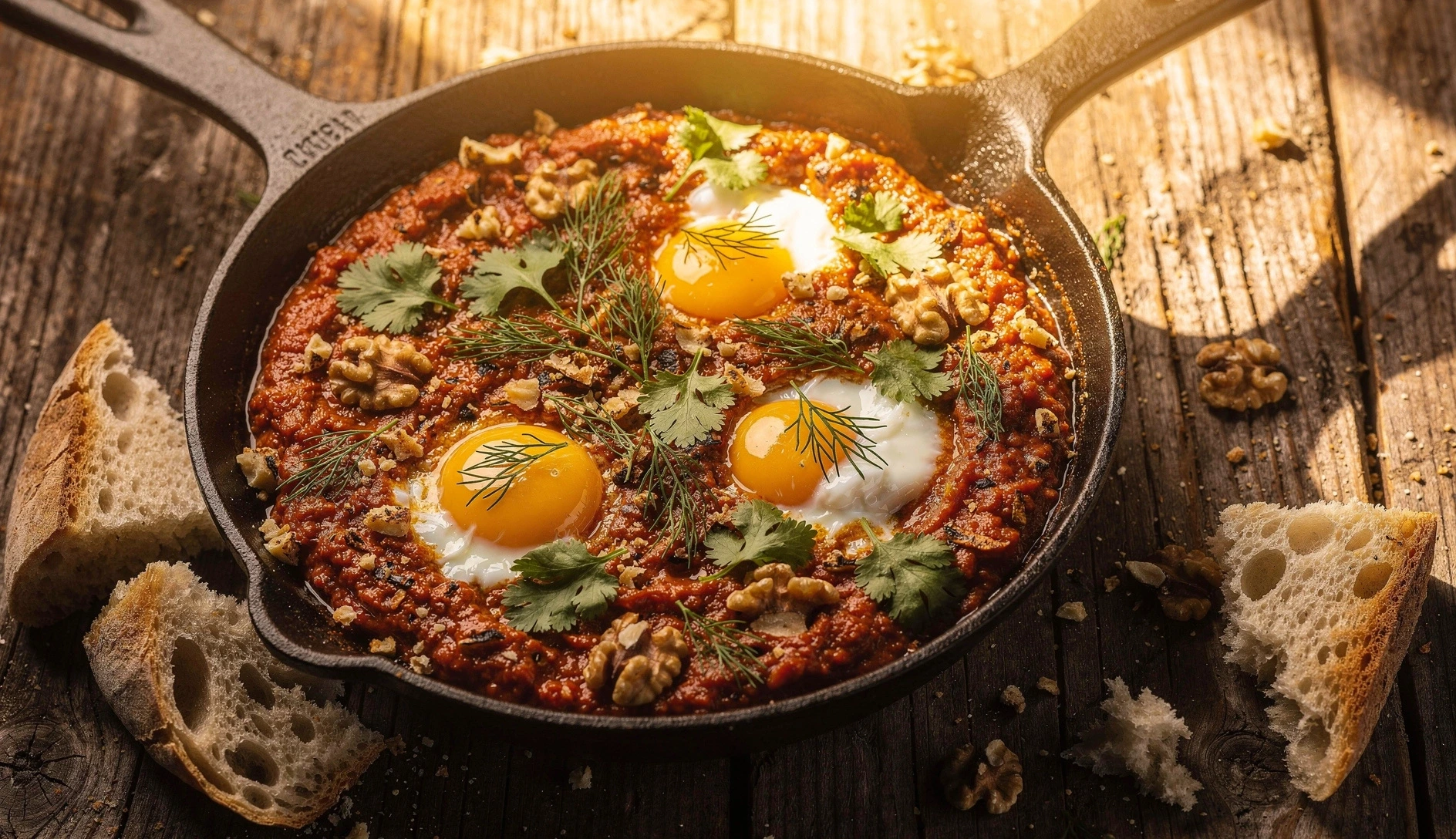
If you've eaten shakshuka, you already understand the general idea. Eggs poached in a spiced tomato sauce, scooped up with bread, eaten directly from the pan. But chirbuli isn't shakshuka. The difference is walnuts — crushed into the sauce so their oils bleed into the tomato, making the whole thing richer, nuttier, and more filling than any North African or Middle Eastern version. The other difference is the herbs. Georgian chirbuli drowns in fresh cilantro, dill, and basil. Not a garnish — a main ingredient.
Chirbuli Quick Facts
- Georgian name: ჩირბული (cheer-BOO-lee)
- Origin: Adjara region (Black Sea coast, western Georgia)
- Type: Breakfast / brunch
- Prep time: 10 minutes
- Cook time: 20 minutes
- Difficulty: Easy — one pan, no special technique
- Diet: Vegetarian, gluten-free (without the bread, if you have that kind of willpower)
What Is Chirbuli?
Chirbuli is eggs cooked in a spiced tomato sauce with crushed walnuts and fresh herbs. It's the standard Georgian breakfast in the Adjara region — the subtropical strip along the Black Sea coast — and it has spread to tables across the country. You'll find it on every guesthouse breakfast spread, at most restaurants that serve breakfast, and in any Georgian home where someone wants more than bread and cheese in the morning.
The word comes from the same root as "shakshuka" — both trace back to Arabic words meaning "mixture." But while shakshuka arrived in Adjara through centuries of trade with the Ottoman Empire and North African merchants passing through the Black Sea ports, Georgians made it their own by adding the one ingredient they put in everything: walnuts.
Chirbuli vs Shakshuka: Why They're Not the Same Dish
People who've eaten shakshuka in Tel Aviv or Istanbul sometimes see chirbuli on a Georgian menu and assume it's the same thing. It's not. They're cousins — both descended from the same Middle Eastern tradition of poaching eggs in tomato — but chirbuli has diverged enough to be its own dish entirely.
| Feature | Chirbuli | Shakshuka |
|---|---|---|
| Walnuts | Essential — crushed into the sauce | Never |
| Primary fat | Butter (lots of it) | Olive oil |
| Herbs | Cilantro, dill, basil — heavy | Parsley, sometimes cilantro — garnish |
| Spice profile | Red pepper, coriander, blue fenugreek | Cumin, paprika, sometimes harissa |
| Bell peppers | Rarely | Almost always |
| Cheese on top | Never | Feta is common |
| Served with | Shotis puri or tonis puri | Pita or challah |
The walnut thing can't be overstated. Crushing walnuts into the tomato sauce fundamentally changes the texture — it goes from a thin, slightly acidic liquid to something thicker, richer, almost creamy. The walnut oils emulsify with the butter and tomato juice into this sauce that coats the bread in a way shakshuka simply doesn't. If you've had satsivi or badrijani nigvzit, you already know what Georgian walnut sauces can do.
Regional Variations
Chirbuli isn't just one recipe. Like most Georgian dishes, it changes depending on which region (and which grandmother) you're talking to.
Adjarian Chirbuli (Classic)
The version this recipe follows. Butter-based, heavy on walnuts, lots of fresh herbs. Eggs poached directly in the sauce. This is what you'll get in Batumi and across Adjara.
Samtskhe-Javakheti Style
Uses more dried spices and less fresh herbs. Often hotter — more red pepper. Sometimes includes a pinch of dried mint. The sauce tends to be thicker and darker.
Lazuri (Laz) Chirbuli
From the Laz people of the eastern Black Sea (now mostly in Turkey). Uses hazelnut oil instead of butter, and sometimes hazelnuts instead of walnuts. Heavier on cornflour for thickness.
Modern Tbilisi Chirbuli
Restaurant versions sometimes add roasted peppers, feta-like cheese, or even adjika. Purists frown, but it's tasty. Some places scramble the eggs instead of poaching — technically a different dish but often sold as chirbuli.
Poached vs Scrambled: The Great Debate
Traditional Adjarian chirbuli has the eggs poached in the sauce — whites set, yolks runny. Some recipes and restaurants scramble the eggs into the sauce instead. Both are technically called chirbuli in Georgia, but the poached version is the original. This recipe teaches the poached method. If you prefer scrambled, just beat the eggs and stir them in at the end — cook for 2 minutes while gently folding.
Ingredients
This serves 2 people generously or 3 modestly. Everything should fit in one wide skillet (24–28cm).
| Ingredient | Amount | Notes |
|---|---|---|
| Ripe tomatoes | 4 medium | Or one 400g can whole peeled — winter tomatoes have no flavor, canned is better |
| Onions | 2 medium | Yellow or white. Finely diced — they need to dissolve into the sauce |
| Eggs | 3–4 large | Fresh as possible — the yolk quality matters when poached |
| Walnuts | 60–80g | About 10–12 whole walnuts. Must be coarsely ground — not paste |
| Butter | 70g | Unsalted. This is the traditional fat — oil works but changes the character |
| Garlic | 3 cloves | Crushed with walnuts in mortar — not minced separately |
| Red pepper flakes | 1 heaped tsp | Georgian tsitsaka, Aleppo pepper, or Korean gochugaru. Not cayenne — too sharp |
| Dried coriander | ½ tsp | Ground. A staple Georgian spice |
| Blue fenugreek | ½ tsp | Utskho suneli — optional but makes it taste Georgian. See spice guide |
| Cornflour | 1 tsp | Optional — thickens the sauce if your tomatoes are very watery |
| Fresh cilantro | 15g (½ bunch) | Non-negotiable. If you hate cilantro, chirbuli might not be your dish |
| Fresh dill | 15g | Adds freshness and an anise-like edge |
| Fresh basil | 10g | Purple basil (reyhan) is traditional. Regular basil is fine |
| Salt | To taste | Add after the walnuts — they absorb salt, so you'll need more than you think |
The Walnut Texture Matters
Don't turn the walnuts into paste. You want coarse, irregular chunks — some pieces the size of a lentil, some the size of a pea. The larger pieces give the sauce its distinctive texture, and you should be able to see walnut fragments in the finished dish. A few pulses in a food processor or 30 seconds in a mortar. That's it.
Step-by-Step Instructions
Step 1: Prepare the Walnut-Spice Mix
Put the walnuts, garlic cloves, red pepper flakes, dried coriander, and blue fenugreek (if using) into a mortar and pestle. Crush until coarsely ground — you want rough chunks, not a smooth paste. The garlic should be smashed into the walnut mixture so the oils blend. If you're using a food processor, 4–5 short pulses. Set aside.
This step is important because crushing the spices with the walnuts releases the walnut oils and allows them to absorb the spice flavors. It's the same technique used in badrijani nigvzit and pkhali — grinding everything together is a cornerstone of Georgian cooking.
Step 2: Cook the Onions Low and Slow
Melt 70g of butter in a wide skillet (24–28cm) over medium-low heat. Add the finely diced onions and cook for 5–6 minutes, stirring occasionally. The onions should be completely soft and translucent — not browned. Patience here pays off. Burnt onions will make the whole dish bitter.
If using cornflour, sprinkle it over the softened onions and stir for 30 seconds. This forms a light roux that helps the sauce come together later.
Step 3: Build the Tomato Sauce
Add the chopped tomatoes (or canned tomatoes, roughly crushed by hand). Stir and cook on medium heat for 4–5 minutes. The tomatoes should break down and release their juice. You're not making a thick pasta sauce — you want a loose, chunky liquid.
If your tomatoes are out of season and mealy, a tablespoon of tomato paste helps. But in summer, when Georgian tomatoes are at their best — blood-red, warm from the sun, splitting at the seams with juice — skip the paste. They don't need help.
Step 4: Add the Walnut Mixture
Add the crushed walnut-spice mixture and about 100ml of water. Stir everything together well. Reduce heat to low and let it simmer for 3–4 minutes. The sauce will thicken slightly as the walnuts absorb liquid and release their oils. It should look rich and orange-red, with visible walnut chunks throughout.
Taste the sauce now and add salt. Remember that the walnuts absorb salt, so it might need more than you expect. The sauce should be well-seasoned on its own — the eggs won't add any salt.
Step 5: Add the Herbs (First Round)
Stir in about two-thirds of your chopped cilantro, dill, and basil. Reserve the rest for garnish. The herbs will wilt into the sauce immediately, turning it from orange-red to a more complex, flecked green-orange. Reduce the heat to the lowest possible setting.
Step 6: Poach the Eggs
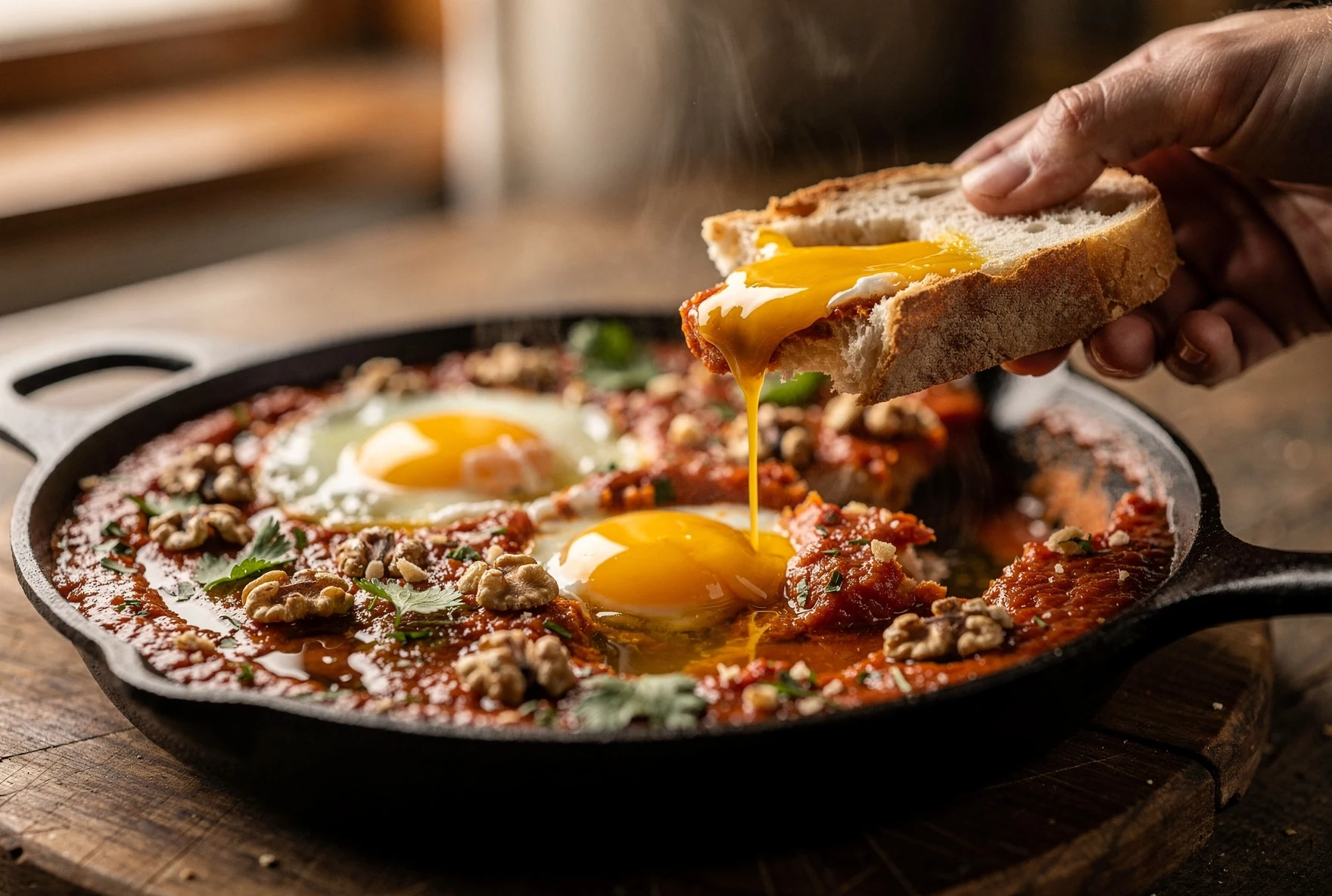
This is the only part that requires any finesse. Use the back of a spoon to make 3–4 shallow wells in the sauce. Crack an egg into each well. The sauce should come up around the whites but not cover the yolks.
Cover the skillet with a lid. Cook for 3–4 minutes on the lowest heat. Check at 3 minutes — the whites should be just set (opaque and firm to a gentle touch) but the yolks should still be liquid. If the whites are still translucent, give it another minute.
| Visual Cue | What It Means | What to Do |
|---|---|---|
| Whites translucent, yolk liquid | Not ready yet | Cover and wait 1–2 more minutes |
| Whites opaque, yolk jiggles when pan shakes | Perfect — runny yolk | Remove from heat immediately |
| Whites firm, yolk slightly thick | Medium — still good | Remove now — carry-over heat will continue cooking |
| Yolk fully set, no jiggle | Overcooked | Still tasty, but you've lost the best part — the bread-dipping yolk |
Step 7: Serve Immediately
Scatter the remaining fresh herbs over the top. Serve the chirbuli straight from the skillet — no plating, no fuss. Put the pan in the center of the table with a stack of shotis puri or mchadi and let people tear bread and scoop. The yolk should break when the bread hits it, mixing with the tomato-walnut sauce into something that's simultaneously rich, tangy, nutty, and herbal.
The Bread Is Not Optional
Chirbuli without bread is like pasta without sauce. The bread does the work of a utensil — tearing off pieces and scooping the sauce is how Georgians eat this dish. Georgian bread (shotis puri) has a thick, chewy crust that holds up to wet sauce. A good sourdough or ciabatta works as a substitute.
The Traditional Adjarian Method
In older Adjarian cookbooks and village kitchens, chirbuli was made slightly differently from the one-pan method most people use today. The eggs were poached separately — cracked into gently simmering salted water, cooked until the whites set, then lifted out with a slotted spoon and placed on top of the finished sauce. The eggs never touched the sauce during cooking.
This method gives you more control over egg doneness and cleaner-looking whites, but it adds a step and requires confident poaching technique. The modern one-pan method (poaching directly in the sauce) is how most Georgian restaurants and home cooks make it now, and it's what this recipe uses. The sauce steams the eggs from below, the lid traps heat from above, and the result is eggs that taste like the sauce because they literally cooked in it.
Common Mistakes
🚫 Over-Processing the Walnuts
Walnut paste turns the sauce muddy and thick. You want visible chunks. 4–5 pulses in a processor, max. Better to under-process than over.
🚫 Cooking Eggs Too Long
A hard-set yolk is the worst outcome. Remove from heat when whites are just set — the residual heat from the sauce keeps cooking. Better slightly underdone than overdone.
🚫 Skimping on Herbs
A few leaves of cilantro on top is garnish, not chirbuli. The herbs should be generous — half a bunch of cilantro, a good fistful of dill. They're a main ingredient, not decoration.
🚫 Using the Wrong Heat
The sauce should be barely simmering when eggs go in. If it's bubbling aggressively, the whites will break apart and the yolks will overcook on the bottom before they set on top.
🚫 Watery Sauce
If the sauce is too thin, the eggs float instead of nestle. Cook the tomatoes down until the sauce has body before adding eggs. The cornflour helps, but reduction is the real fix.
🚫 Making It in a Small Pan
You need enough surface area for 3–4 eggs to sit without touching. A 24cm pan is minimum, 28cm is ideal. A small pan forces you to stack eggs, and the ones on the bottom overcook.
Serving and Pairing
| Pairing | Why It Works |
|---|---|
| Shotis puri | The classic pairing. Thick, chewy crust holds sauce without falling apart |
| Mchadi (cornbread) | The corn flavor complements the walnut. A western Georgian combo |
| Fresh cheese (imeruli) | A thick slice of fresh Georgian cheese on the side cuts through the richness |
| Matsoni (Georgian yogurt) | A spoonful on the side adds tang and cools the heat |
| Black tea | Georgians drink strong black tea with breakfast, often with sugar |
Chirbuli is breakfast food, but nobody will judge you for eating it at any meal. In Adjara, it sometimes shows up as a late-night snack after a long evening. The tomato and walnut combination is filling without being heavy, and the whole thing comes together in 30 minutes — faster than ordering delivery.
Chirbuli as Part of a Georgian Breakfast
In a proper Georgian breakfast spread, chirbuli is the hot centerpiece. Around it, you'd typically find:
- Fresh bread — torn, not sliced, still warm
- Fresh cheese — imeruli or sulguni, sliced thick
- Sliced tomatoes and cucumbers — salted, maybe with a little oil
- Matsoni — in a small bowl, eaten plain or with bread
- Honey — often wildflower, from a relative's bees
- Strong black tea — brewed dark, with a sugar cube held between the teeth
- Fresh herbs — a whole plate of tarragon, basil, cilantro, and dill stems
If you're at a guesthouse, all of this arrives without being ordered. If you're making it at home, the chirbuli is the only thing that requires cooking — everything else is assembly.
Variations Worth Trying
🌶️ Adjika Chirbuli
Stir 1–2 teaspoons of adjika into the sauce before adding eggs. Adds serious heat and a deep fermented chili flavor. Not traditional, but increasingly common in Tbilisi.
🧀 Sulguni-Topped
Scatter grated sulguni over the eggs just before covering. The cheese melts into the sauce. Sacrilege in Adjara, standard in some Tbilisi restaurants.
🥩 With Sujuk or Kupati
Slice kupati sausage or sujuk and fry it in the butter before adding onions. The rendered fat infuses the whole sauce with smoky, spiced meat flavor.
🌿 Green Chirbuli
Replace half the tomatoes with tomatillos or green tomatoes. Double the herbs. Add a handful of spinach. Results in a tangier, greener sauce. Not traditional at all, but delicious.
Can You Save Leftover Chirbuli?
Honestly? No. Chirbuli is a cook-and-eat-immediately dish. The eggs turn rubbery when reheated, and the yolks — the best part — set completely when cooled. If you have leftover sauce (without eggs), that keeps in the fridge for 2–3 days and you can poach fresh eggs in it for a second round. But a finished chirbuli with eggs? Eat it now.
| Component | Storage | Reheat |
|---|---|---|
| Sauce (no eggs) | Fridge 2–3 days, freezer 1 month | Gentle stovetop, add fresh eggs |
| Walnut-spice mix | Fridge 5 days, freezer 3 months | Stir into fresh sauce — make a batch |
| Finished dish (with eggs) | Don't | Just eat it |
Frequently Asked Questions
Can I make chirbuli without walnuts?
You can, but then you've made shakshuka. The walnuts are what make chirbuli chirbuli. If you have a tree nut allergy, sunflower seeds offer a vaguely similar texture, but the flavor will be completely different.
Is chirbuli spicy?
Mildly. Georgian red pepper (tsitsaka) is more fruity-warm than sharp-hot. A heaped teaspoon gives noticeable warmth without burning. Adjust to your tolerance — the butter and walnuts temper the heat significantly.
What if I can't find blue fenugreek?
Skip it. Regular fenugreek seeds (toasted and ground) are a distant substitute — use just a pinch, as they're much more potent. Blue fenugreek (utskho suneli) has a milder, more complex flavor. If you can order khmeli suneli spice mix, it already contains blue fenugreek.
Can I use olive oil instead of butter?
Yes, but the dish will taste more like shakshuka than chirbuli. Butter is traditional in Adjara and gives the sauce its distinctive richness. Sunflower oil is a closer Georgian substitute than olive oil — Georgians rarely cook with olive oil.
How many eggs per person?
Plan 1.5–2 eggs per person. A 3-egg pan feeds 2 people; a 4-egg pan stretches to 3 if there's enough bread and side dishes. For a hungry crowd, make two pans rather than overcrowding one.
Written by The Georgian Eats Team
We eat chirbuli at least twice a week — the sauce changes depending on who's cooking and what herbs are in the fridge, but it's always walnuts, always butter, always more herbs than you'd think reasonable. After years of Tbilisi guesthouse breakfasts and Adjarian restaurant versions, we've settled on this recipe as the one that comes closest to what we love about the dish.
Last updated: February 2026.
Related Articles
Georgian Breakfast: The Complete Guide
What Georgians actually eat in the morning — and why it's one of the best meals of the day.
Chakhokhbili: Herb-Loaded Chicken Stew
Another tomato-based Georgian classic — same herb-heavy philosophy, different protein.
Adjarian Khachapuri
Adjara's other famous egg dish — a boat of cheese bread with a raw egg stirred in at the table.
Georgian Spices & Herbs
Everything you need to know about the spices that define Georgian cooking.