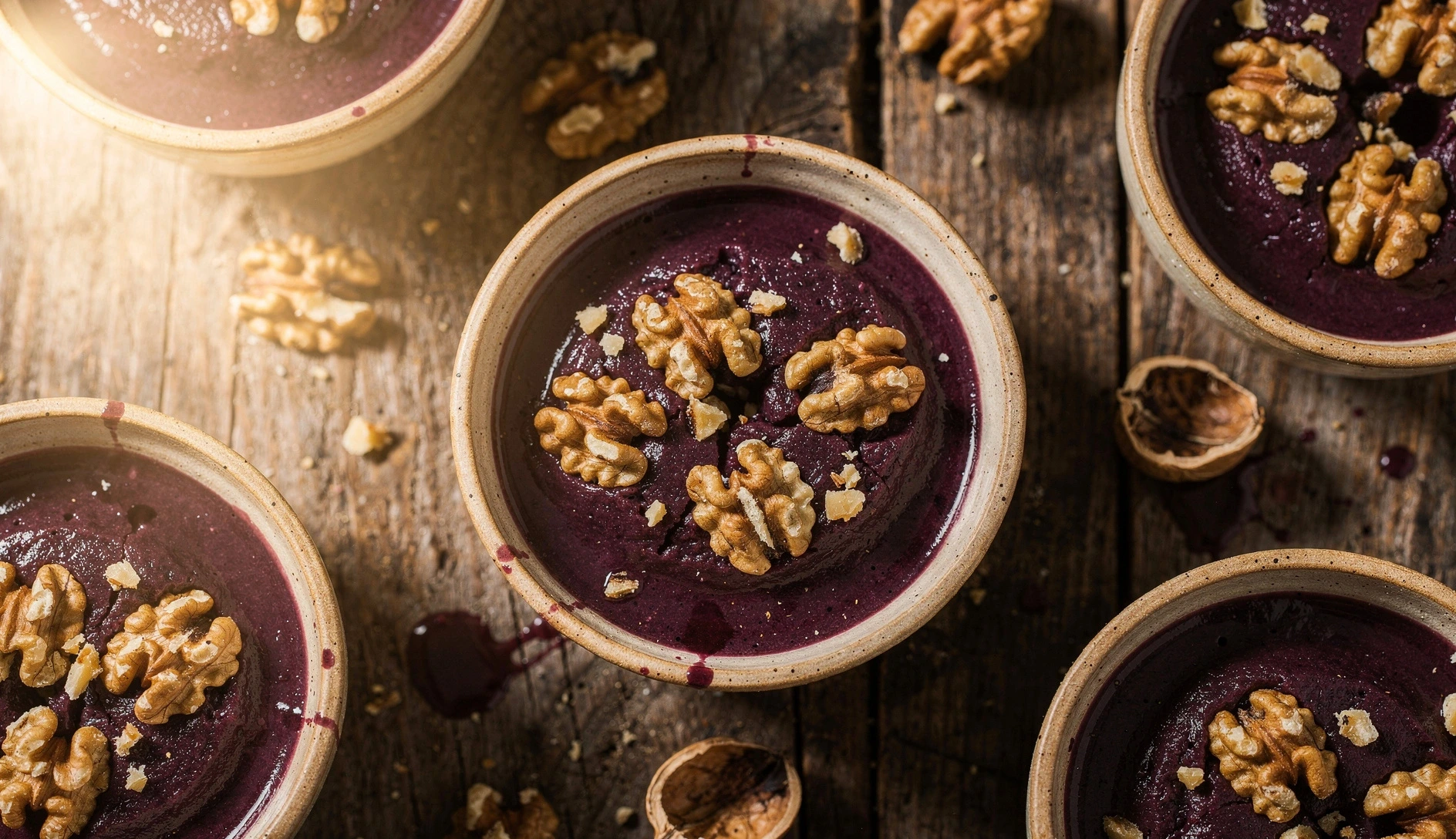
Every October in Kakheti, the air smells like fermenting grapes and woodsmoke. Families are knee-deep in Rtveli — the annual grape harvest — crushing grapes for wine, pressing the leftover juice into badagi, and turning that thick, sweet concentrate into two things: churchkhela (the walnut-string candy you see hanging in every market) and pelamushi, its lesser-known sibling. Pelamushi is essentially what happens when you thicken badagi with flour and let it set. That's it. Grape juice and flour. But the result is something remarkable — a dense, jewel-toned pudding with the concentrated sweetness of a hundred grapes in every spoonful.
Pelamushi Quick Facts
- Georgian name: ფელამუში (pe-la-MU-shi)
- Also called: თათარა (tatara) in Kakheti
- Type: Set grape pudding / dessert
- Active time: 10 minutes
- Cook time: 15–20 minutes
- Difficulty: Easy — the hardest part is sourcing the right grape juice
- Diet: Vegan, dairy-free (naturally gluten-free if using only cornflour)
What Is Pelamushi
Pelamushi is one of those ancient dishes that's so simple it barely qualifies as a recipe. Concentrated grape juice. Flour. Heat. Stir. Done. But like most things in Georgian cooking, simplicity is the point. The grape juice does all the work — providing sweetness, color, and a depth of flavor that no amount of seasoning could replicate.
The name changes depending on where you are in Georgia. In most of the country it's pelamushi (ფელამუში). In Kakheti — Georgia's wine heartland, where grapes are practically a religion — they call it tatara (თათარა). Same thing, different name, occasional arguments about which version is better (Kakhetians will tell you theirs is the only real one, because of course they will).
If you've eaten churchkhela, you've already tasted the base of pelamushi. That thick coating on the walnut strings? That's pelamushi mixture, dipped and dried. When you pour the same mixture into a bowl and let it set instead of dipping nuts in it, you get pelamushi — softer, spoonable, served as a standalone dessert rather than a portable snack.
Pelamushi vs Churchkhela
People get confused about the relationship between these two. Here's the simple version: pelamushi is the mixture. Churchkhela is what happens when you dip walnut strings into that mixture and let it dry. Same base, completely different results.
| Feature | Pelamushi | Churchkhela |
|---|---|---|
| Base | Badagi + flour | Badagi + flour (same mixture) |
| Form | Poured into bowls, set like pudding | Dipped over walnut strings, dried |
| Texture | Soft, dense, spoonable | Chewy exterior, crunchy nut center |
| Shelf life | 3–5 days refrigerated | Months if properly dried |
| When eaten | Fresh, during/after Rtveli | Year-round (dried and stored) |
| Effort | 30 minutes total | Multiple dippings over days + weeks of drying |
The Churchkhela Connection
During Rtveli, families make a massive batch of the flour-thickened badagi. Some goes into bowls for pelamushi (the immediate gratification). The rest gets used to dip churchkhela strings — a process that takes days of repeated dipping and drying. Pelamushi is essentially the cook's reward for starting the churchkhela process.
Understanding Badagi — The Key Ingredient
Badagi (ბადაგი) is the soul of pelamushi, and the reason this dish exists as a harvest tradition rather than something you make on a Tuesday in March. It's concentrated grape juice — not the pasteurized stuff from a carton, but fresh-pressed juice that's been slowly reduced over heat until it's thick, intensely sweet, and deeply colored.
In traditional Georgian households, badagi is made from the juice left over after wine-making. The grapes have been crushed in the satsnakheli (wine press), the must has gone into qvevri for fermentation, and what remains is a river of sweet juice that would otherwise go to waste. Nothing goes to waste in Georgia.
| Grape Juice Type | Color Result | Sweetness | Best For |
|---|---|---|---|
| Saperavi (red) | Deep purple, almost black | Moderate — may need sugar | Classic pelamushi, dramatic color |
| Rkatsiteli (white) | Pale amber to golden | Higher — often no sugar needed | Lighter, more delicate version |
| Concord (substitute) | Rich purple | Very sweet | Best substitute outside Georgia |
| Generic store-bought | Medium purple | Varies widely | Works, but lacks depth — reduce first |
Making Badagi at Home (Outside Georgia)
If you can't get proper badagi — and unless you live near a Georgian family during harvest season, you can't — here's how to approximate it:
- Best option: Buy 2 liters of high-quality, not-from-concentrate Concord grape juice. Pour it into a wide, heavy pot and simmer on low heat, uncovered, stirring occasionally, until it reduces by half. This takes about 45–60 minutes. You'll end up with roughly 1 liter of concentrated juice with a syrupy consistency and intense grape flavor.
- Acceptable shortcut: Use 1 liter of regular grape juice without reducing, but add an extra 30–50g of flour to compensate for the thinner consistency. The result will be lighter in flavor but still recognizably pelamushi.
- If you have access to a wine press: Use the fresh juice directly. No reduction needed — it's already concentrated enough from the pressing.
Skip the "Grape Drink"
Not all grape juice is created equal. Avoid anything labeled "grape drink," "grape cocktail," or with added water, corn syrup, or artificial flavors. You need 100% grape juice with no additives. Check the ingredients list — it should say "grape juice" and nothing else. The better the juice, the better the pelamushi. This is a two-ingredient recipe; there's nowhere for bad ingredients to hide.
Ingredients
| Ingredient | Amount | Notes |
|---|---|---|
| Badagi (concentrated grape juice) | 1 liter | Or 2L regular juice reduced by half |
| All-purpose flour | 200g (~1⅔ cups) | Or use 150g flour + 50g fine cornflour |
| Sugar | 2 tablespoons | Optional — taste the juice first |
| Walnuts | A handful of halves | For topping |
The Flour Question: Wheat vs Corn
Traditional pelamushi uses wheat flour. Full stop. But in western Georgia — particularly Samegrelo and Imereti — some cooks mix in cornflour (not cornstarch, but finely ground corn flour) for a slightly different texture: denser, with a subtle corn sweetness that complements the grape. A 3:1 ratio of wheat to cornflour is a good starting point if you want to try this.
The all-cornflour version exists too, mostly in Samegrelo, and it's noticeably different — grittier, more opaque, with a firmer set. It's an acquired taste. Start with wheat flour for your first batch.
Step-by-Step Instructions
Step 1: Make the Slurry
Sift the flour into a large mixing bowl. Take about 400ml of the cold badagi (roughly a third of the total) and pour it into the flour in a thin, steady stream, whisking constantly. You're making a slurry — a smooth, lump-free mixture that will thicken the rest of the juice evenly.
This is the most important step. If you dump all the flour into hot juice, you'll get lumps. Guaranteed. The cold-slurry method prevents this entirely. If you still see small lumps after whisking, push it through a fine-mesh sieve or hit it with an immersion blender for 10 seconds.
Step 2: Heat the Remaining Juice
Pour the remaining 600ml of badagi into a heavy-bottomed pot — cast iron or thick stainless steel works best. Bring it to a gentle simmer over medium heat. Don't boil it aggressively; you just want it warm and starting to steam.
Step 3: Combine and Stir
Here's where the magic happens. Pour the cold slurry into the simmering juice in a steady stream, stirring vigorously the entire time. The mixture will begin thickening almost immediately. Reduce the heat to low.
Step 4: The Stirring Marathon
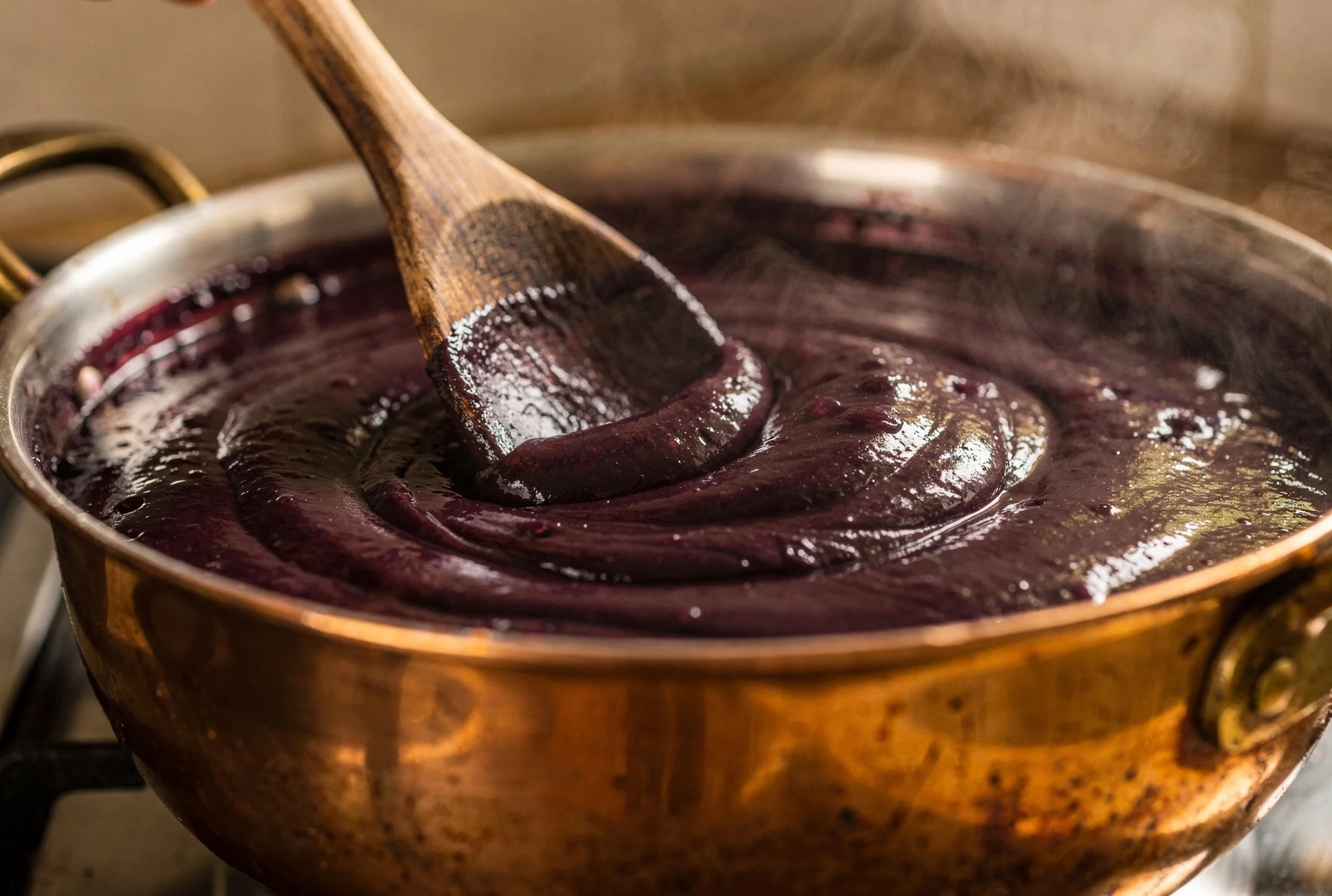
Now you stir. And stir. And stir some more. For 8–12 minutes, without stopping, over low heat. Use a wooden spoon — it gives you better feel for the changing consistency than a whisk at this stage.
What you're watching for:
| Stage | Time | What It Looks Like | What to Do |
|---|---|---|---|
| Thin | 0–3 min | Runny, like thin gravy | Keep stirring, keep heat low |
| Thickening | 3–6 min | Coats the spoon, glossy surface | Taste for raw flour flavor |
| Nearly done | 6–10 min | Dense, pulls from sides, spoon leaves trail | Taste again — no flour taste means done |
| Done | 8–12 min | Thick like pudding, smooth, no raw flour taste | Remove from heat immediately |
Step 5: Pour and Set
Work fast once it's done — pelamushi starts setting the moment it leaves the heat. Pour into individual serving bowls, ramekins, or a wide shallow dish. If using individual portions, fill them about two-thirds full. Press walnut halves into the surface while it's still warm and soft.
Let it cool at room temperature for at least 2 hours. Don't rush this by refrigerating — the texture is better when it sets slowly. Once fully cooled and firm to the touch, you can refrigerate it, but bring it back to room temperature before serving for the best flavor.
Step 6: The Sugar Bloom
After a few hours in the fridge, you'll notice the surface develops a matte, slightly frosted appearance — white-ish specks across the dark purple. Don't panic. This isn't mold. It's natural grape fructose crystallizing on the surface, and it's a sign that your pelamushi is properly made with real grape juice. Georgians expect to see this. If your pelamushi doesn't bloom, your juice probably had too much added water.
The Rtveli Tradition
Pelamushi doesn't exist in isolation. It's part of Rtveli (რთველი) — Georgia's annual grape harvest, which happens from mid-September through October depending on the region and variety. Rtveli is less "agricultural labor" and more "national festival that happens to involve grapes." Entire extended families descend on vineyards. Neighbors help neighbors. There's singing, feasting, and an almost spiritual connection to the land that makes the whole thing feel like Georgia's real national holiday.
Making pelamushi is one of the harvest rituals. As the women (traditionally) cook the badagi down and thicken it, kids crowd around waiting for the first warm taste straight from the pot. That first bowl of pelamushi — still hot, slightly loose, eaten standing in the kitchen — is one of those sense-memories that every Georgian carries.
🍷 Pelamushi from Red Grapes
The classic Kakhetian version. Deep purple, almost black. Made primarily from Saperavi grapes. Slightly tart, intensely grape-forward. What most people picture when they think of pelamushi.
🥂 Pelamushi from White Grapes
The Imeretian and western Georgian version. Pale amber to golden. Made from Rkatsiteli or Tsolikouri. Sweeter, more delicate, milder grape flavor. Rarely seen outside Georgia.
Common Mistakes
🚫 Adding Flour to Hot Juice
The number one mistake. Flour hits hot liquid and instantly forms lumps that no amount of stirring will dissolve. Always make a cold slurry first, then add to the hot juice.
🚫 Using Weak Juice
Watered-down grape juice makes watered-down pelamushi. If your juice tastes thin, reduce it by simmering first. The concentrate should taste almost syrupy — sweet and intense.
🚫 Not Stirring Enough
Walk away for 30 seconds and it scorches on the bottom. Pelamushi requires continuous stirring the entire time it's on heat. No breaks. No multitasking. Commit to the spoon.
🚫 Pulling It Too Early
If you taste raw flour, it's not done. Undercooked pelamushi has a gritty, starchy aftertaste that ruins the whole thing. Cook until the flour is fully incorporated — taste is the only reliable test.
🚫 Refrigerating Too Soon
Let it cool and set at room temperature first. Refrigerating warm pelamushi creates condensation on the surface and an uneven, rubbery texture. Patience.
🚫 Overcooking to Rubber
There's a sweet spot between "still tastes like flour" and "so thick it bounces." The mixture continues to firm up as it cools, so pull it from the heat when it's the consistency of thick custard, not concrete.
Variations
Cornflour Version (Samegrelo)
Replace wheat flour with fine cornflour for a denser, grittier texture and opaque yellow-purple color. Common in western Georgia. Firmer when set, more substantial.
Mixed Flour
Use 150g wheat flour + 50g cornflour for a hybrid that combines the smoothness of wheat with the subtle corn sweetness. Many families prefer this balance.
White Grape (Golden)
Made with Rkatsiteli or Tsolikouri juice. Lighter color, sweeter, more delicate. Beautiful amber when set. Pairs well with hazelnuts instead of walnuts.
Pomegranate Pelamushi
Not traditional, but some modern cooks substitute pomegranate juice for grape. Tarter, redder, and surprisingly good. Use slightly more sugar to balance the acidity.
Serving and Pairing
Pelamushi is served at room temperature or slightly chilled. Never warm it up after it has set — the texture goes from pleasantly dense to unappealingly gloopy. The traditional presentation is simple: a small bowl with walnut halves pressed into the top. No sauce, no garnish, no performance. The grape does the talking.
| Pairing | Why It Works |
|---|---|
| Black tea | The tannins cut the sweetness beautifully. The classic Georgian pairing. |
| Turkish coffee | Bitter and sweet in one sitting. Pelamushi becomes the dessert course. |
| Gozinaki | Grape pudding and honey walnut brittle side by side — a classic Rtveli spread. |
| Churchkhela | Its sibling. Different textures of the same flavor — soft vs chewy. |
| Fresh seasonal fruit | Figs, pomegranate seeds, or late-season grapes. Keeps the grape theme going. |
Storage and Shelf Life
| Method | Duration | Notes |
|---|---|---|
| Room temperature | 24 hours | Fine for same-day serving. Cover with cloth. |
| Refrigerated | 3–5 days | Cover tightly. Bring to room temp before serving. |
| Frozen | Not recommended | Texture breaks down on thawing. Make fresh batches. |
Pelamushi is best within the first 48 hours. By day three it's still edible but the texture becomes denser and the surface dries out even covered. This is a make-it-fresh-and-eat-it dish, not a make-ahead project. The good news: it takes 30 minutes from start to poured, so there's no reason not to make a fresh batch.
Frequently Asked Questions
Can I use store-bought grape juice?
Yes, but it needs to be 100% grape juice, not-from-concentrate ideally. Concord grape juice gives the best results outside Georgia. You'll likely need to reduce it by simmering to get a more concentrated flavor, or accept a milder result. Avoid anything with added sweeteners or water.
Is pelamushi gluten-free?
The traditional wheat flour version is not. But you can make it entirely with fine cornflour (not cornstarch — actual corn flour, sometimes labeled "maize flour") for a gluten-free version. The texture will be slightly different — denser and more opaque — but it's how many western Georgian families make it anyway.
Why does my pelamushi taste like flour?
You didn't cook it long enough. The flour needs a full 8–12 minutes of continuous cooking over heat to lose its raw starchy flavor. Keep stirring and tasting. When the floury aftertaste disappears, it's done. If you pull it off heat early, no amount of cooling will fix that taste.
Can I make pelamushi without reducing the juice?
You can, but add more flour (250g instead of 200g) and expect a milder grape flavor. The reduction step concentrates the sugars and flavor compounds. Without it, you're essentially making a lighter, thinner version. Still good, just not as intense.
What's the white stuff on the surface after refrigerating?
Natural grape fructose crystallizing. It's completely normal and expected — it's actually a sign of properly made pelamushi with real grape juice. It's edible, harmless, and adds a slight crunch to the first bite. Think of it like the white bloom on good chocolate.
Written by The Georgian Eats Team
We've watched pelamushi being made in Kakhetian kitchens during Rtveli more times than we can count — including eating it straight from the pot before it's had a chance to set. This recipe is the real thing, tested and adapted for kitchens outside Georgia where fresh badagi isn't readily available.
Last updated: February 2026.
Related Articles
Gozinaki
Georgia's honey-walnut brittle — the other essential harvest season sweet.
Churchkhela Guide
The complete guide to Georgia's walnut-and-grape candy — pelamushi's dried sibling.
Georgian Grape Varieties
The grapes that go into pelamushi — Saperavi, Rkatsiteli, and 500+ more.
Georgian Food Guide
The complete overview of Georgian cuisine and what makes it extraordinary.