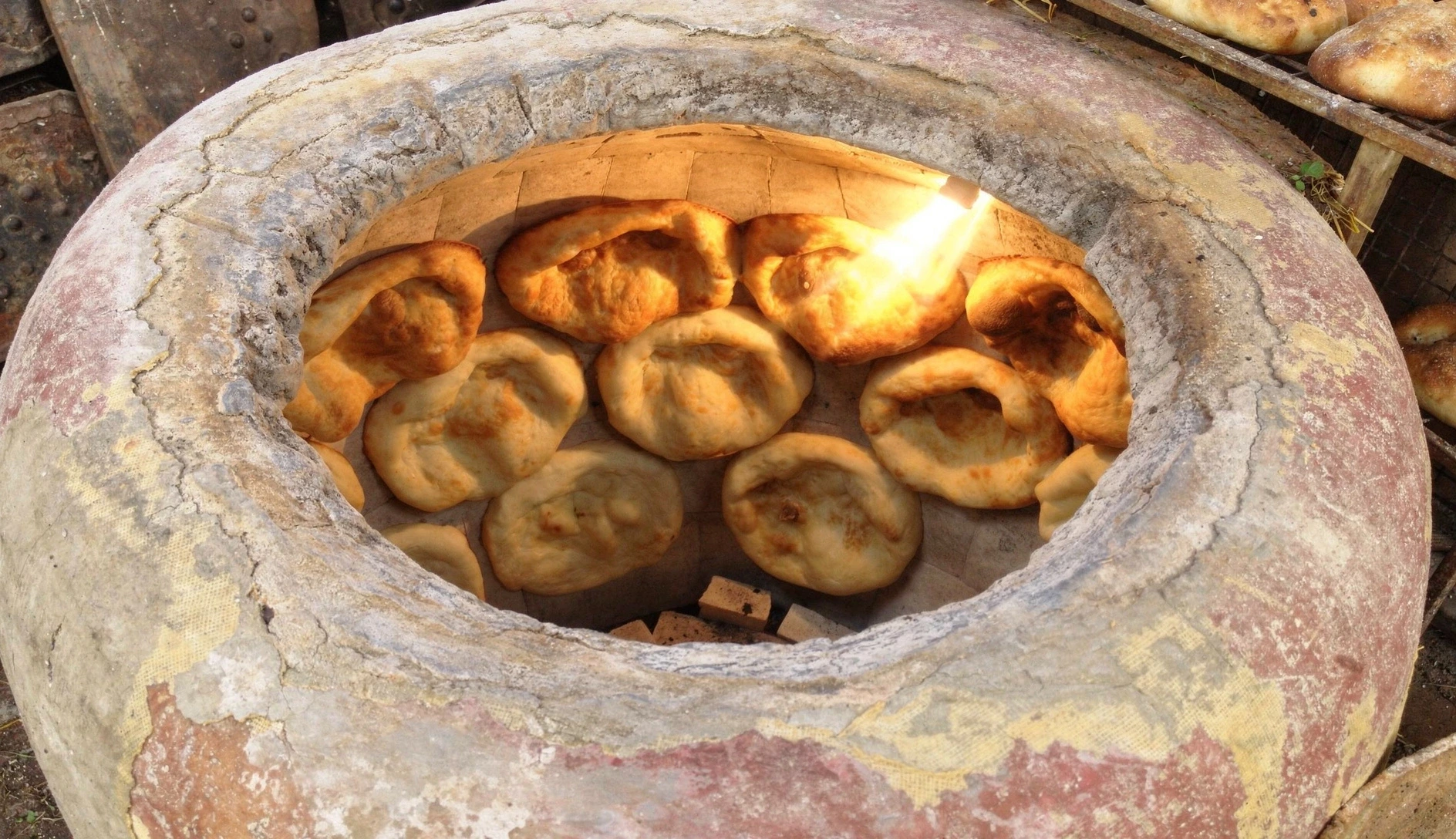
Walk down any street in Tbilisi and you'll smell it before you see it — the warm, yeasty scent drifting from a small storefront where a baker leans into a deep clay well, sticking raw dough to walls that glow orange with heat. Minutes later, a golden, canoe-shaped loaf emerges, its crust blistered and slightly charred, its interior soft and steaming. This is shotis puri — the bread that defines Georgian eating. Every meal starts with it. Every table has it. And once you've eaten it fresh from a tone, supermarket bread will never feel the same.
Georgian Bread Quick Facts
- Georgian name: შოთის პური (SHO-tis POO-ree)
- Meaning: "Bread from Shoti" (the elongated shape)
- Also called: Shoti, shoti bread
- Oven: Tone (თონე) — deep cylindrical clay oven
- Shape: Elongated canoe with pointed ends
- Ingredients: Flour, water, yeast, salt
- Prep time: 15 minutes active + 1–1.5 hours rising
- Bake time: 10–14 minutes at maximum heat
- Makes: 3–4 loaves
- Cost in Georgia: 1–1.50 GEL per loaf (~$0.40–0.55)
Bread in Georgia Is Not a Side Dish
In most Western countries, bread accompanies the meal. In Georgia, bread is the meal's foundation. The Georgian word for bread — puri (პური) — is practically sacred. There's a superstition that dropping bread on the floor brings bad luck. Throwing bread away is considered deeply disrespectful. When Georgians toast at a supra, they often tear bread rather than cut it, a gesture with roots older than anyone can trace.
This isn't performative respect — it's the residue of a country where bread was survival. Georgia's climate and terrain meant wheat was precious. The person who baked it earned genuine status. Even today, neighborhood tone bakeries function as informal social centers. You buy your loaf, exchange gossip with whoever's waiting, and carry it home still warm enough to melt butter.
The typical Georgian household doesn't stock bread for days. They buy it fresh, often twice a day — a morning loaf and an evening one. The idea of eating yesterday's bread when there's a bakery on the corner is mildly offensive.
Shotis Puri vs. Tonis Puri — What's the Difference?
Visitors get confused because Georgians use several bread names interchangeably — and even locals aren't always consistent. Here's the actual distinction:
| Feature | Shotis Puri (შოთის პური) | Tonis Puri (თონის პური) |
|---|---|---|
| Shape | Elongated canoe with pointed ends | Round or oval, like a thick disc |
| Size | 35–45cm long, 12–15cm wide | 20–25cm diameter |
| Crust | Thinner, crispier, more charred | Thicker, chewier |
| Interior | Flat center, puffy edges | Uniformly thick and soft |
| Oven | Tone (same oven) | Tone (same oven) |
| Dough | Identical — flour, water, yeast, salt | Identical — flour, water, yeast, salt |
| Where most common | Eastern Georgia, especially Tbilisi | Everywhere, slightly more rural |
| Best for | Tearing and sharing, scooping up stews | Sandwiches, wrapping around cheese/herbs |
The key takeaway: same dough, same oven, different shape. Shotis puri is the long one. Tonis puri is the round one. Both come from the tone. Both are extraordinary when fresh. Both taste like cardboard eight hours later.
Most Tbilisi bakeries make both shapes. The baker reads the room — families buying for a supra usually want shoti (it tears and shares more dramatically). A construction worker grabbing lunch wants tonis puri (easier to fold around cheese and herbs).
The Tone Oven: Georgia's 3,000-Year-Old Technology
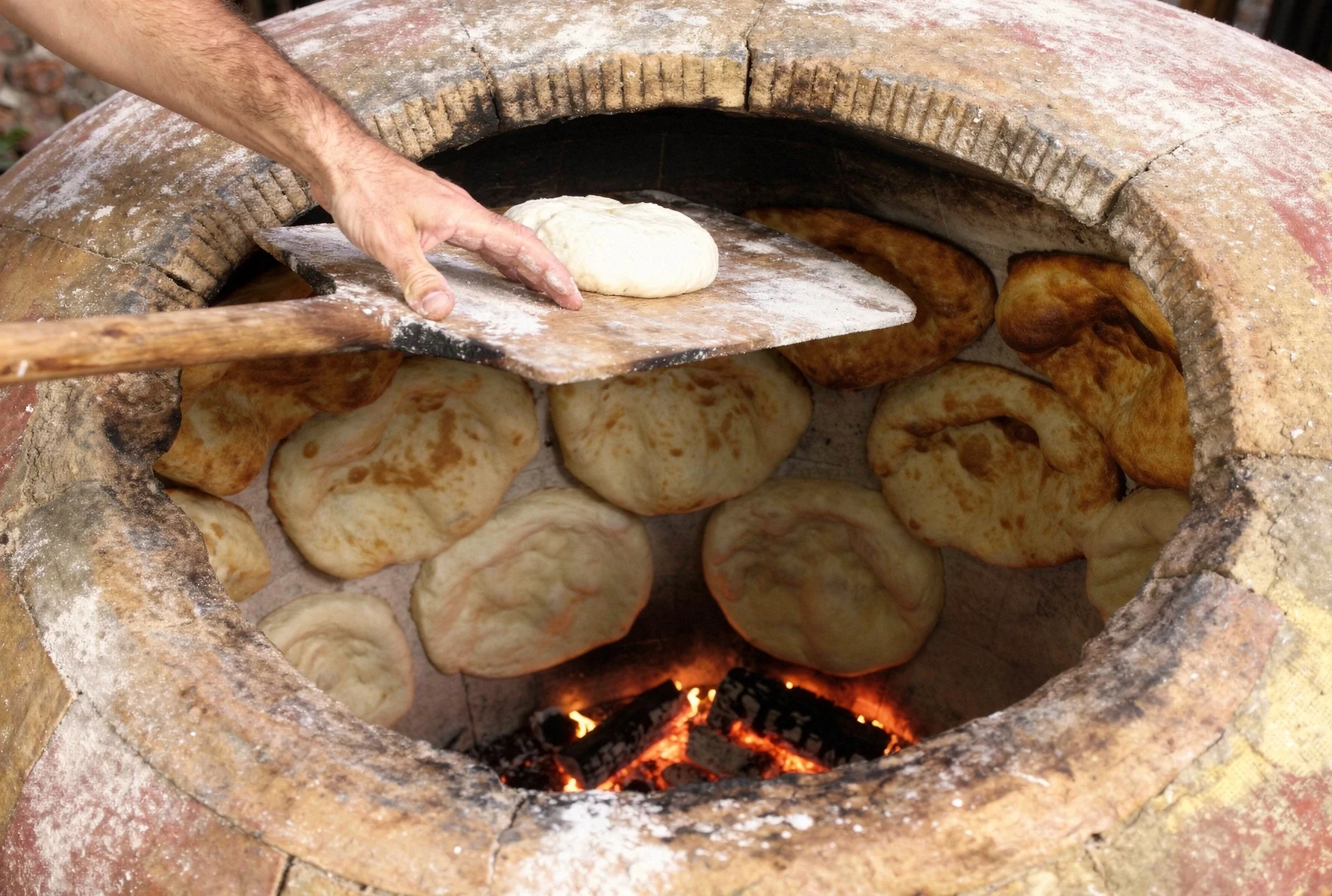
The tone (თონე) is a deep, cylindrical clay oven sunk into the ground or built above it. Think of it as a Georgian cousin of the Indian tandoor — the words share the same ancient root. The oven tapers slightly toward the bottom, where a gas burner or (traditionally) wood fire heats the walls to extreme temperatures, often above 300°C (570°F).
Here's the part that amazes first-time visitors: the baker doesn't place the bread on anything. They stretch the dough into shape, drape it over a round cushion-like pad, lean into the oven's mouth, and slap the raw dough directly onto the scorching inner wall. The dough sticks. Gravity wants to pull it off. The baker's skill determines whether you get bread or a dough puddle in the fire below.
The bread bakes in 7–12 minutes, depending on size and heat. When it's done, the baker uses a long metal hook to peel each loaf off the wall. The bottom side — the one that faced the fire — has gorgeous, irregular char marks. The top is smooth, pale, and slightly pillowy where the dough puffed away from the wall.
The Racha Baker Tradition
Historically, the best tone bakers came from the Racha region in western Georgia. Rachvelians (as they're called) had a near-monopoly on the trade in Tbilisi for generations. The tradition was passed from father to son, and a skilled tone baker could produce over 1,400 loaves in a single New Year's rush — all hand-mixed, hand-shaped, and hand-stuck to the oven wall. Some Tbilisi bakeries still proudly advertise their baker's Racha origins.
Beyond Shoti: Other Georgian Breads
Georgia's bread culture goes deeper than most people realize. Each region has its own style:
| Bread | Georgian | Region | What Makes It Different |
|---|---|---|---|
| Shotis Puri | შოთის პური | East Georgia | Canoe-shaped, charred crust, the classic |
| Tonis Puri | თონის პური | Nationwide | Round, thick, soft center — sandwich-friendly |
| Lavashi | ლავაში | East Georgia | Thin, flexible flatbread, also baked in tone |
| Mchadi | მჭადი | West Georgia | Cornbread, pan-fried, gluten-free. Recipe → |
| Nazuki | ნაზუქი | Surami area | Sweet bread with cloves, cinnamon, raisins |
| Lobiani | ლობიანი | Nationwide | Bread stuffed with spiced bean paste. Recipe → |
| Khachapuri | ხაჭაპური | Nationwide | Cheese bread in many regional shapes. Recipe → |
| Kubdari | კუბდარი | Svaneti | Meat-stuffed bread with mountain spices. Recipe → |
Notice something? Half of Georgia's most famous dishes are bread-based. Khachapuri, lobiani, kubdari — they're all variations of "put something incredible inside dough." Georgia is, fundamentally, a bread civilization.
Ingredients
The beauty of Georgian bread is its simplicity. Four core ingredients, nothing fancy:
| Ingredient | Amount | Notes |
|---|---|---|
| Bread flour | 500g | 12–13% protein. All-purpose works but gives a softer crumb. |
| Warm water | 325ml | About 38°C / 100°F — warm to the touch, not hot. 65% hydration. |
| Instant yeast | 7g (1 packet) | Or 10g active dry (bloom in warm water first). |
| Salt | 10g (2 tsp) | Fine table salt. Georgian bakers use coarse salt, so reduce by 20% if using fine. |
| Sugar | 1 tsp | Feeds the yeast. Not traditional but helps with home-oven browning. |
| Vegetable oil | 1 tbsp | Optional. Makes the dough more pliable and the crust slightly softer. |
Flour Matters More Than You Think
Georgian bakers use flour with a protein content between 12–14%. This is what gives shoti its characteristic chew — structured enough to stretch without tearing, but not so strong that it becomes tough. Bread flour (strong flour in the UK) is your best bet. All-purpose flour works but produces a slightly softer, less chewy loaf. Avoid cake or pastry flour entirely.
Step-by-Step Instructions
Step 1: Mix the Dough (5 minutes)
Dissolve the yeast and sugar in the warm water. Let it sit for 5 minutes — you should see some light foaming on the surface, which tells you the yeast is alive and ready. If nothing happens after 10 minutes, your yeast is dead. Get new yeast.
Add the flour, salt, and oil to a large bowl. Pour in the yeast water. Mix with a wooden spoon or your hand until a shaggy, rough dough forms. It doesn't need to be smooth at this stage — just get everything incorporated so there are no dry flour pockets.
Step 2: Knead (8–10 minutes)
Turn the dough out onto a lightly floured surface. Knead using the push-fold-turn technique: push the dough forward with the heel of your hand, fold it back over itself, rotate 90°, repeat. After 8–10 minutes of steady kneading, you should have a smooth, elastic ball that springs back when you poke it with a finger.
The dough should feel slightly tacky — like a Post-it note — but not sticky. If it's sticking to your hands, add a light dusting of flour. If it's stiff and hard to work, your water was probably too cold or you added too much flour. Georgian bakers want a soft, pliable dough because they need to stretch it into shape.
The Windowpane Test
Pinch off a small piece of dough and gently stretch it between your fingers. If it stretches thin enough to see light through without tearing, your gluten is developed and you can stop kneading. If it tears immediately, keep going for another 2–3 minutes.
Step 3: First Rise (1–1.5 hours)
Place the dough in a lightly oiled bowl, turn it once to coat all sides, and cover with a damp kitchen towel or plastic wrap. Leave it in a warm spot — ideally around 25–28°C (77–82°F). Near a warm oven, on top of the fridge, or inside a turned-off oven with just the light on all work.
Wait until the dough has roughly doubled in size. This takes 1 to 1.5 hours depending on your room temperature. Don't rush it, and don't punch it down aggressively — a gentle deflation is all you need.
Step 4: Preheat Your Oven (30 minutes before baking)
This is where home baking diverges from the tone. You need to simulate that intense, radiant heat as best you can. Crank your oven to the absolute maximum — 250–270°C (480–520°F). If you have a convection/fan setting, use it.
Place a baking stone, pizza steel, or heavy inverted baking sheet on the middle rack. It needs at least 30 minutes at full temperature to absorb enough heat. This preheated surface is what gives you anything close to a tone-baked crust.
Step 5: Shape the Loaves (3–4 minutes each)
Divide the dough into 3–4 equal pieces. Working with one piece at a time (keep the rest covered), shape each one:
- Flatten the dough into a rough oval with your hands.
- Stretch it lengthwise to about 35–40cm, keeping the center wider (12–15cm) and tapering both ends to points. You're making a canoe shape — a narrow boat, wider in the middle, pointed at each end.
- The center should be about 1.5cm thick. The tapered ends can be thinner.
- Poke the center of the loaf with your fingertips 6–8 times. This creates small dimples that prevent the middle from puffing up like a balloon. Traditional shotis puri has puffy edges but a flatter center — the dimples make that happen.
Step 6: Bake (10–14 minutes)
Transfer the shaped loaves to the preheated stone. The easiest method: shape on parchment paper, then slide the parchment directly onto the stone. Or use a well-floured wooden pizza peel.
Bake for 10–14 minutes. You're looking for deep golden color with some darker spots — even a few small charred patches. If your oven runs cool, push it to 14 minutes. If it's a powerhouse, check at 10.
For extra crust char (mimicking the tone effect), switch to the broiler for the last 1–2 minutes. Watch it like a hawk — it goes from golden to burnt in 30 seconds.
Step 7: Cool and Serve
Transfer to a wire rack. Let it cool for just 5 minutes — enough that you won't burn your mouth, but not so long that you lose the magic of warm bread. Shotis puri is at its absolute peak within the first hour of baking. After 4–5 hours, it starts to dry out and stiffen. By the next day, it's toast material.
🔥 Steam Trick
Place a metal pan on the oven floor. Right before you put the bread in, pour 1 cup of hot water into the pan and close the door fast. The burst of steam gives you better crust color and a thinner, crispier shell — closer to the steamy environment inside a tone.
❄️ Freezing Shotis Puri
Bake, cool completely, wrap tightly in foil, then freeze for up to 2 months. Reheat from frozen: unwrap, sprinkle with water, and bake at 200°C for 8–10 minutes. Not as good as fresh, but better than no shoti at all.
Making It Work Without a Tone
Let's be honest: you cannot perfectly replicate tone-baked bread in a home oven. The tone operates at 300°C+ with radiant heat from all sides, and the dough bakes while stuck to a vertical wall. Your oven heats from below (or above), maxes out around 250–270°C, and bakes on a horizontal surface. The physics are fundamentally different.
But you can get surprisingly close. Here's what matters most:
| Factor | Tone Oven | Home Oven Hack |
|---|---|---|
| Temperature | 300–350°C | Max setting (250–270°C) + 30-min preheat with stone |
| Heat source | Radiant from clay walls | Baking stone or steel (stores and radiates heat) |
| Steam | Natural moisture in clay | Water in a hot pan on the oven floor |
| Char marks | From direct wall contact | Broiler for last 1–2 minutes |
| Shape holding | Gravity pulls dough down on wall | Dimple the center, don't overproof |
A pizza steel is the single best investment if you bake bread regularly. It transfers heat to the dough faster than a stone and gives you that snappy, blistered bottom crust. A thick baking stone is a solid second choice. An inverted heavy baking sheet is the budget option — it works, just not quite as well.
How Georgians Eat Their Bread
Georgian bread is never sliced. It's torn. At the supra, the host tears the first piece. Everyone else follows. Here's how it actually gets used at a typical meal:
With Cheese and Herbs
Tear off a piece, place a slab of Imeretian cheese on it, add fresh tarragon or basil. The classic Georgian snack — basically an open-face sandwich.
Scooping Stews
Tear bread into smaller pieces and use them to scoop up lobio, chanakhi, or any saucy dish. The bread replaces the spoon.
Under the Mtsvadi
Grilled mtsvadi (BBQ pork) gets served on top of bread so the juices and rendered fat soak into it. The bread underneath is the best part of the plate.
With Butter and Honey
Warm bread, cold butter, mountain honey. The Georgian breakfast when there's nothing else in the house — and still better than 90% of what you'd order at a restaurant.
Common Mistakes
❌ Cold Oven
Putting bread in an oven that hasn't preheated for at least 30 minutes. The stone needs to be screaming hot. You'll get pale, dense bread otherwise.
❌ Too Thick
Making the center more than 2cm thick. Shotis puri should be relatively flat in the middle with puffy edges. If it's uniformly thick, you've made tonis puri — which is fine, but different.
❌ Over-flouring
Adding too much flour during kneading because the dough is sticky. A slightly tacky dough is correct. Too much flour = tough, dense bread. Use oil on your hands instead.
❌ Skipping the Dimples
Not poking the center before baking. Without dimples, the center puffs up into a dome and you get a pillow instead of a canoe. Dimple aggressively.
❌ Low Temperature
Baking at 200°C because that's what most bread recipes say. Georgian bread needs maximum heat. 250°C minimum. Higher is better. The intense heat is what creates the blistered, slightly charred crust.
❌ Eating It Tomorrow
Shotis puri has a shelf life of about 4–5 hours. After that, it's a different (worse) product. Make only what you'll eat. If you're serving it at dinner, bake it right before dinner — not in the morning.
Frequently Asked Questions
Can I make shotis puri without a baking stone?
Yes. Flip a heavy baking sheet upside down and preheat it for 30 minutes at maximum temperature. The flat surface works similarly to a stone. You won't get quite the same bottom crust, but it's perfectly good bread.
What's the difference between Georgian bread and naan?
Same concept (dough stuck to oven walls), related ovens (tone and tandoor share a linguistic root), different results. Naan often includes yogurt and sometimes egg, making it richer and softer. Georgian bread is leaner — just flour, water, yeast, and salt — with a chewier, more bread-like crumb.
Can I use a sourdough starter instead of yeast?
You can, though it's not traditional. Replace the yeast with about 150g of active starter and reduce the water by 75ml and the flour by 75g. The rise will take longer (3–5 hours), and the flavor will have that sourdough tang that Georgian bread doesn't normally have. It's good bread — just not exactly the same thing.
Why is my bread pale and soft instead of charred?
Your oven isn't hot enough or didn't preheat long enough. Make sure the stone has been at maximum temperature for at least 30 minutes. Try adding steam (water in a hot pan) and finish with 1–2 minutes under the broiler for color.
How much bread do Georgians actually eat?
Georgia has one of the highest per-capita bread consumption rates in the world — roughly 500g per person per day. For context, the European average is about 200g. Bread appears at every meal, including breakfast, and many traditional dishes are essentially ways to use bread as an edible utensil.
Written by The Georgian Eats Team
We buy bread from the same Tbilisi tone bakery almost every day. After years of watching bakers work and eating through hundreds of loaves, we've figured out how to get close to that flavor at home — and we're honest about what you can't replicate.
Last updated: February 2026.
Related Articles
Mchadi: Georgia's Golden Cornbread
The other essential Georgian bread — no wheat, no yeast, three ingredients.
Lobiani: Bean-Stuffed Bread
Take this dough, stuff it with spiced bean paste, and bake it golden.
Adjarian Khachapuri
The boat-shaped cheese bread — Georgia's most photogenic carb.
The Georgian Supra
The feast tradition where bread takes center stage.