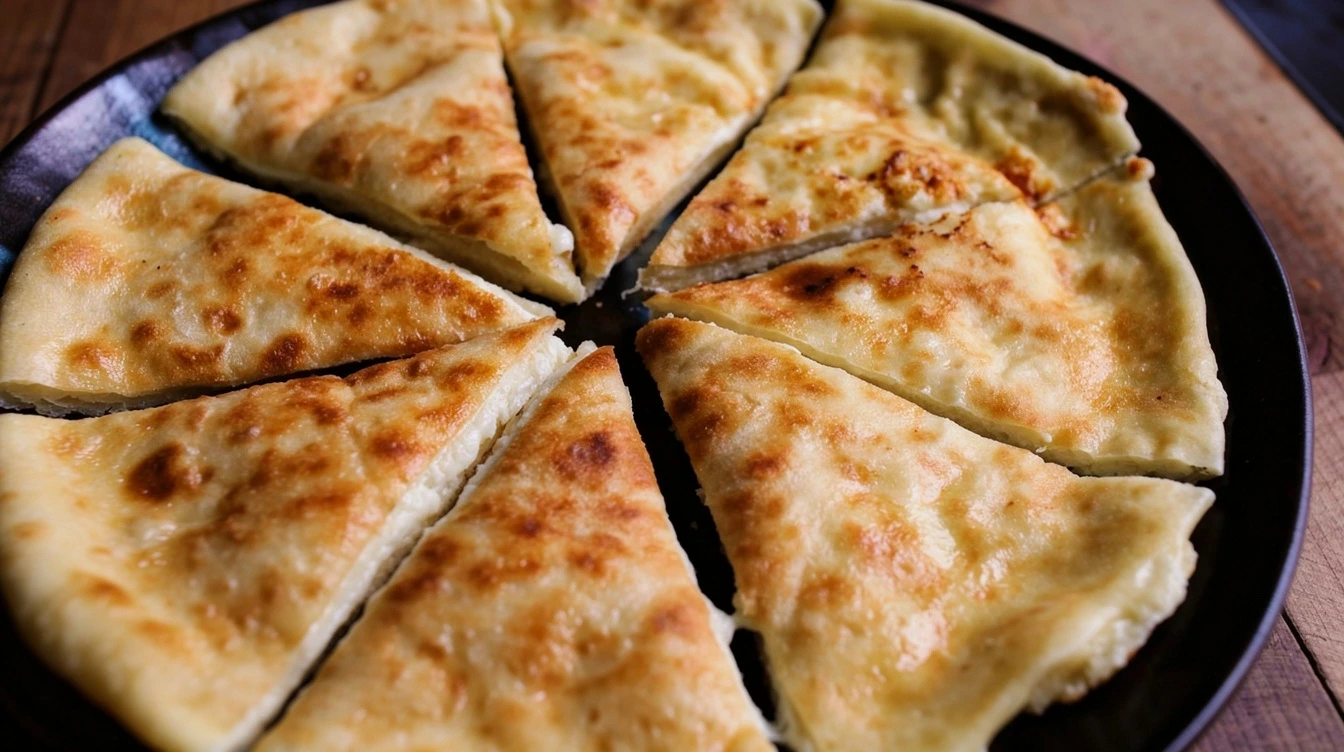
Adjarian khachapuri gets all the Instagram attention — the boat shape, the raw egg yolk, the dramatic butter stir. Fair enough. But if you want to know what Georgians actually eat every day, it's this. Imeruli khachapuri. A round, golden disk of dough stretched thin around a molten core of salty, stretchy cheese. No theatrics. No boats. Just the best cheese bread you'll ever make at home. It's the version that appears at every supra, every bakery counter, every school kid's lunch. And once you've made it a few times, you'll understand why 53 million of these get eaten in Georgia every year — in a country of 3.7 million people.
Imeruli Khachapuri Quick Facts
- Georgian name: იმერული ხაჭაპური (ee-meh-ROO-lee kha-cha-POO-ree)
- Meaning: "Cheese bread from Imereti"
- Origin: Imereti region, western-central Georgia
- Key cheese: Imeretian cheese (imeruli kveli) — a fresh, salty, slightly crumbly white cheese
- Prep time: 15 minutes active (+ 1-1.5 hour rise)
- Cook time: 12-15 minutes
- Serves: 2-3 people
- Cost in Georgia: 5-8 GEL (~$2-3) at a bakery
- Fun fact: Georgia's National Statistics Office tracks the khachapuri price index — it's that important to the economy
Why Imeretian Khachapuri Is the One to Learn
Georgia has at least a dozen regional khachapuri varieties. The Adjarian boat is the showpiece. Megrelian has extra cheese melted on top. Gurian is stuffed with hard-boiled eggs and folded like a calzone. Svan khachapuri has meat. Rachuli has walnuts. Ossetian has potatoes.
But Imeretian is the default. When a Georgian says "khachapuri" without a regional qualifier, they mean this one. It's the version that shows up at every celebration, every restaurant, every bakery. It's also the most forgiving to make — no shaping boats, no folding half-moons. You wrap dough around cheese, flatten it, and bake. The technique rewards repetition but doesn't punish beginners.
The cheese-to-dough ratio is the whole game. A great Imeretian khachapuri has a thin, barely-there layer of bread around an obscene amount of melted cheese. You should hear it crackle when you cut in. The dough is a delivery vehicle — essential, but never the star.
The Cheese — Getting It Right
The single thing that separates good Imeretian khachapuri from mediocre cheese bread is the cheese. Authentic Imeruli uses Imeretian cheese (იმერული ყველი) — a fresh, brined white cheese with a clean, salty, slightly tangy flavor and a crumbly-but-meltable texture. It's somewhere between feta and young mozzarella. When heated, it softens into a stretchy, gooey mass without becoming greasy.
Most Georgian cooks use a 2:1 blend — two parts Imeretian cheese to one part sulguni (სულუგუნი), which is Georgia's stretchy, brined cheese similar to young provolone. The sulguni adds the signature pull — that stringy, stretchy quality that makes cutting into a khachapuri so satisfying.
| Georgian Cheese | Best Substitute | Why It Works |
|---|---|---|
| Imeretian cheese (2 parts) | Feta cheese (drained, crumbled) | Similar saltiness and crumbly texture; slightly tangier |
| Sulguni (1 part) | Low-moisture mozzarella (grated) | Provides the stretch and melt; closest in texture |
| Alternative blend | 50/50 feta and mozzarella | Good balance if you want simplicity |
| Budget option | Farmer's cheese + mozzarella | Less salty, milder flavor — add 1/2 tsp salt |
The Moisture Problem
If your feta is packed in brine, drain it well and press it gently in a towel. Too much moisture in the filling = a soggy bottom on your khachapuri. This is the single most common mistake people make with substitute cheeses. The filling should clump together when you squeeze it, not drip.
If you live near a Russian, Turkish, or Eastern European grocery store, check for sulguni — it's become fairly available in diaspora shops worldwide. Real Imeretian cheese is harder to find outside Georgia, but any young brined white cheese in the feta family will work.
Ingredients
The Dough
| Ingredient | Amount | Notes |
|---|---|---|
| All-purpose flour | 250g (2 cups) | Don't use bread flour — too chewy |
| Warm milk | 120ml (½ cup) | 40-45°C — warm to touch, not hot |
| Active dry yeast | 5g (1 tsp) | Or 4g instant yeast (skip blooming) |
| Sugar | 5g (1 tsp) | Feeds the yeast — doesn't sweeten |
| Salt | 3g (½ tsp) | The cheese is salty — go easy here |
| Egg | 1 large | Room temperature; adds richness |
| Sunflower oil | 1 tbsp | Or any neutral oil |
The Filling
| Ingredient | Amount | Notes |
|---|---|---|
| Imeretian cheese (or feta) | 200g | Crumbled or grated; well-drained |
| Sulguni (or low-moisture mozzarella) | 100g | Grated on large holes |
| Egg | 1 large | Binds the filling together |
| Butter | 15g | For brushing after baking |
Equipment
Essential
Large mixing bowl, rolling pin, baking sheet, parchment paper, box grater. That's genuinely all you need.
Nice to Have
Pizza stone or steel (crispier bottom), bench scraper (dough handling), kitchen scale (precision matters for dough).
Step-by-Step Recipe
Step 1: Make the Dough (5 minutes active + 1-1.5 hours rising)
Dissolve the sugar in warm milk. The milk should feel comfortably warm on the inside of your wrist — around 40-45°C. Too hot kills the yeast. Too cold and it'll take forever to activate. Stir in the yeast and set aside for 5-10 minutes. You want a frothy, bubbly surface with a distinct yeasty smell.
In a large bowl, whisk the flour and salt. Make a well in the center. Crack in the egg, pour in the oil and the yeast mixture. Stir with a wooden spoon or spatula until a shaggy, rough dough forms — it'll look messy, and that's fine.
Turn the dough out onto a lightly floured surface and knead for 5-7 minutes. You're looking for a smooth, elastic ball that's slightly tacky to the touch — it should spring back slowly when you poke it. If it's sticking to everything, add flour a teaspoon at a time. If it's too stiff, wet your hands.
Place the dough in a lightly oiled bowl, roll it around to coat, cover with a damp towel or plastic wrap, and leave it somewhere warm. It needs 1-1.5 hours to double in size. Near a warm oven works. On a cold winter day, put it in the oven with just the light on.
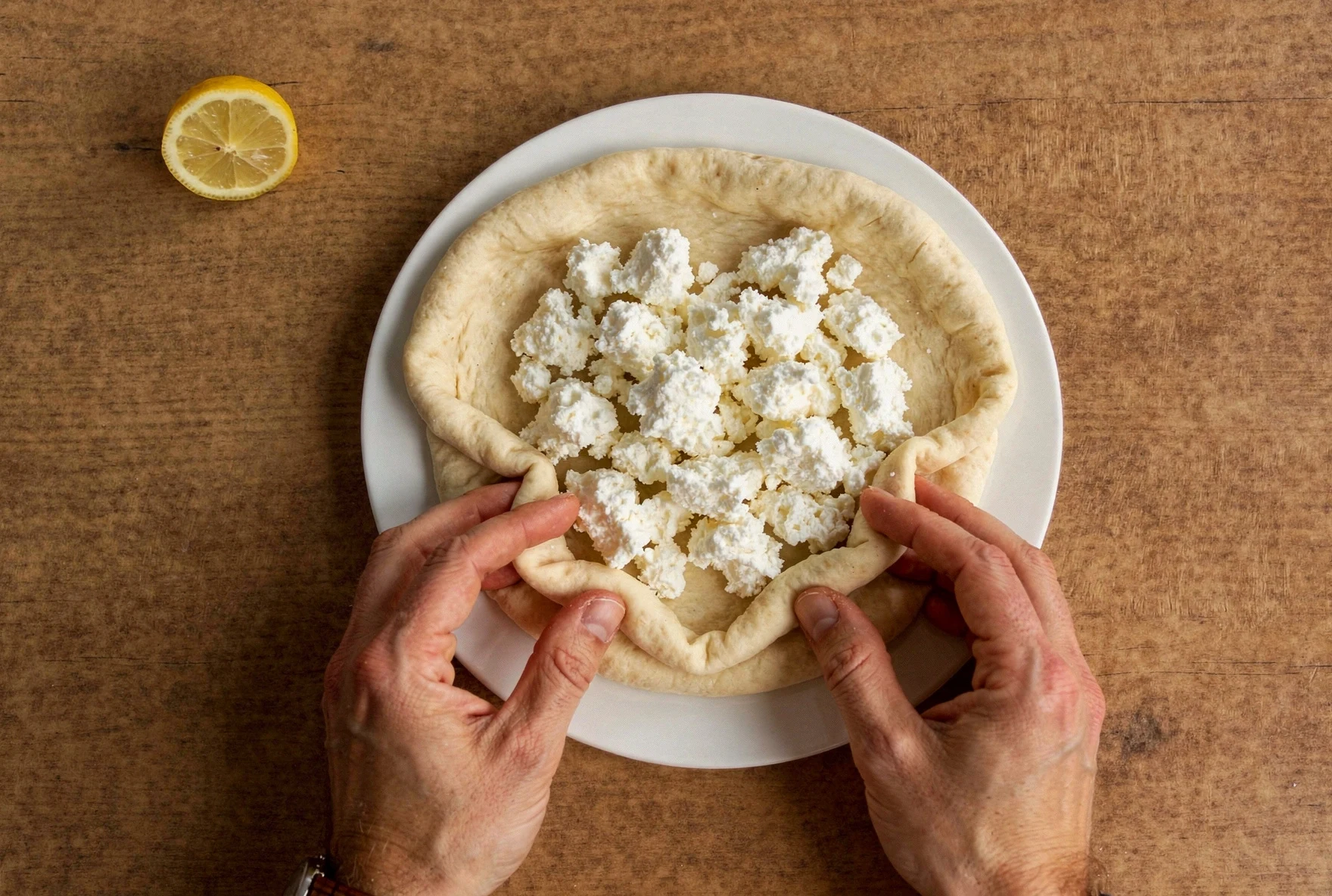
Step 2: Prepare the Filling (5 minutes)
While the dough rises, grate both cheeses on the large holes of a box grater. If using feta, crumble it by hand into small pieces — don't bother grating, it'll just stick. Combine in a bowl, crack in the egg, and mix with your hands until everything clumps together. The egg is important — it binds the cheese so it doesn't leak out in chunks when you bite in.
The filling should hold its shape when you squeeze a handful. If it's too wet (which happens with briny feta), drain off any excess liquid. If it's too dry (rare, but possible with very aged cheese), add a splash of milk.
Step 3: Shape the Khachapuri (5 minutes)
This is the part that looks intimidating but is actually very simple. Preheat your oven to 220°C (430°F) with a baking sheet inside — the hot sheet gives you a crispier bottom.
Punch the dough down, turn it out onto a lightly floured surface, and roll it into a circle about 30cm in diameter. Don't stress about perfection — slightly uneven is fine and actually looks more authentic.
Pile all the cheese filling in the center, leaving 6-8cm of bare dough around the edges. Now gather the edges up and over the cheese, pleating as you go, like you're wrapping a dumpling. Pinch the gathered top to seal, twist it gently, and tuck it under.
Flip the whole thing over so the seam is on the bottom. Now gently press it flat with your palms and roll it with the rolling pin to about 25-28cm diameter and 2-3cm thick. Go gently — you don't want to puncture the dough and lose cheese. Cut 3-4 small slits in the top with a knife to let steam escape.
| Visual Cue | What It Means |
|---|---|
| Dough tears while rolling | Too thin — stop rolling, patch with extra dough |
| Cheese visible through top | Perfect — the dough is thin enough. That's the goal. |
| Thick, puffy edges | You gathered too much dough at the seam — use less overlap next time |
| Even, flat disk | You're doing it right. It should look unassuming going in. |
Step 4: Bake (12-15 minutes)
Transfer the khachapuri onto parchment paper and slide it onto the preheated baking sheet. Bake at 220°C for 12-15 minutes. You're watching for:
- The top turning golden brown with darker spots (those are good — means the cheese is bubbling underneath)
- The dough puffing slightly, especially around the edges
- The steam vents hissing gently — that's cheese-steam, and it means things are happening
The Temperature Matters
220°C is the sweet spot. Lower, and the dough dries out before it browns. Higher, and the outside burns while the center stays doughy. If you have a pizza stone, use it — preheat it for 30 minutes and you'll get a bottom crust that's almost cracker-crisp.
Step 5: Butter and Serve (immediately)
Pull the khachapuri out of the oven and immediately brush the top with butter — generously. The hot bread absorbs it, giving the surface a glossy, rich finish that's impossible to achieve any other way. Let it rest 3-5 minutes (the cheese inside is volcanic at this point), then cut into wedges like a pizza.
Serve hot. This is non-negotiable. Imeretian khachapuri eaten warm from the oven is transcendent. Imeretian khachapuri eaten cold from the counter two hours later is just... cheese bread. Still good, but you'll know what you're missing.
Serving Pairings
| Pairing | Why It Works |
|---|---|
| Georgian salad (tomato, cucumber, walnut, herbs) | The freshness cuts through the richness — the classic Georgian balance |
| Lobio (bean stew) | Earthy beans + cheesy bread = the meal that built Georgia |
| Badrijani nigvzit | Walnut-stuffed eggplant — lighter than it sounds, great alongside |
| Pkhali | Walnut-herb paste on vegetables — the green counterpoint |
| Tarragon lemonade (tarkhuna) | The bright anise-herbal flavor is the traditional Georgian pairing |
| Dry white wine (Tsinandali, Kisi) | Crisp acidity balances the fat — don't go amber/orange here |
Khachapuri Varieties Compared
Imeretian is the foundation, but understanding the full family helps you appreciate what makes each version unique. Here's how the major varieties stack up:
| Variety | Shape | Filling | Difficulty |
|---|---|---|---|
| Imeretian (this recipe) | Round, flat | Imeretian cheese + sulguni | Easy |
| Adjarian | Boat-shaped, open | Cheese + egg yolk + butter | Medium |
| Megrelian | Round, cheese on top | Double cheese — inside AND outside | Easy |
| Gurian | Half-moon (calzone) | Cheese + hard-boiled eggs | Medium |
| Kubdari (Svan) | Round, flat | Spiced meat (technically khachapuri's cousin) | Medium |
Variations and Adaptations
| Variation | Change | Notes |
|---|---|---|
| Stovetop method | Fry in a dry skillet (or light oil) on medium, 5 min per side | Crispier crust, no oven needed — many Georgian homes do it this way |
| Yogurt dough (no yeast) | Replace milk + yeast with 150ml matsoni (or Greek yogurt) + ½ tsp baking soda | Faster (no rising), slightly tangier — valid shortcut |
| Megrelian upgrade | Scatter 100g grated sulguni on top before baking | The "more is more" approach — crispy cheese crust on top |
| Mini khachapuri | Divide dough into 4, make individual-sized ones | Great for parties — bake 8-10 min instead of 12-15 |
| Herb-speckled | Knead fresh dill or cilantro into the cheese filling | Not traditional, but delicious — Georgians won't judge |
Stovetop Is Totally Legit
Many Georgian families cook khachapuri in a dry skillet on the stovetop, not in an oven. Medium heat, 4-5 minutes per side, pressing gently with a spatula. It gives you a slightly different texture — crispier and more golden — and is arguably closer to how it was made before modern ovens. Try both methods and pick your favorite.
Common Mistakes
Too Much Dough
The bread should be thin — a vehicle for cheese, not a thick crust. If your dough layer is more than 5mm, roll it thinner or use less dough.
Wet Cheese
Brine-packed feta or fresh mozzarella will dump moisture into your dough. Drain, press, pat dry. Your bottom crust depends on this.
Cold Oven
Putting khachapuri into a cold or warm oven means it takes longer, the dough dries out, and you lose the puff. Hot oven, hot baking sheet — always.
Skipping the Butter
Brushing hot khachapuri with butter isn't optional. It soaks in, adds richness, and gives the top a gloss that screams "eat me." Don't skip it.
No Steam Vents
Those little slits in the top let steam escape. Without them, steam builds up, the dough balloons unevenly, and you get a cheese pillow instead of a flat disk.
Eating It Cold
Khachapuri is engineered to be eaten hot. The cheese solidifies as it cools, the dough loses its crispness. Reheat in a skillet if you have leftovers — never microwave.
Pro Tips
🧊 Freeze the Dough
Make a double batch of dough, portion it, and freeze. Thaw overnight in the fridge for weeknight khachapuri in 30 minutes (filling + bake time only).
🪨 Use a Pizza Stone
Preheat a pizza stone for 30+ minutes. The intense bottom heat gives you a crispier base that stays firm even as the cheese melts inside.
🧂 Taste Your Cheese First
Cheese saltiness varies wildly. Taste a piece before mixing. If it's very salty (like good feta), use no salt in the dough and no salt in the filling.
📏 Weigh, Don't Measure
A kitchen scale makes dough infinitely more consistent than cups. 250g of flour is 250g whether it's scooped, spooned, or sifted. Cups vary by 30%+.
Where to Eat It in Tbilisi
Retro
Consistent, classic khachapuri in a no-frills setting. Multiple locations across Tbilisi. The Imeretian version here is exactly what a good one should taste like — thin dough, plenty of cheese, properly salted.
Machakhela
Chain restaurant that serves a reliable Imeretian khachapuri. Not groundbreaking, but always well-made. Good baseline for comparison if you're trying multiple places.
Sakhachapure No. 1
The name means "Khachapuri Place #1" and they take that literally. Dedicated khachapuri spot with every regional variety. The Imeretian here uses real Imeretian cheese — you'll taste the difference.
Any Street Bakery
Honestly? Some of the best Imeretian khachapuri in Tbilisi comes from unnamed hole-in-the-wall bakeries (gamotskhobi). Look for women pulling them out of clay ovens. 3-5 GEL. Often better than restaurants.
Nutrition
| Nutrient | Per Serving |
|---|---|
| Carbohydrates | 52g |
| Fiber | 2g |
| Sodium | 980mg |
| Calcium | 420mg (42% DV) |
Storage and Reheating
Same Day
Keep at room temperature covered with a towel. Reheat in a dry skillet over medium heat, 2-3 minutes per side. Perfectly good for 4-6 hours.
Refrigerator
Wrap tightly, stores 2-3 days. Reheat in a skillet (not microwave — you'll get a sad, rubbery result). Oven at 180°C for 8-10 min also works.
Freezer
Freeze unbaked — shape and fill, then freeze on a tray before wrapping. Bake from frozen at 200°C for 20-25 min. The texture is surprisingly close to fresh.
Never Microwave
Microwaving turns the dough rubbery and the cheese into a solid mass. Always reheat with dry heat — skillet or oven. It takes 5 minutes more and the difference is enormous.
Frequently Asked Questions
What's the difference between Imeretian and Adjarian khachapuri?
Imeretian is round and flat with cheese sealed inside the dough. Adjarian is boat-shaped and open-topped with a raw egg yolk and butter added after baking. Imeretian is the everyday version — what most Georgians mean when they say "khachapuri" without specifying a region.
Can I make khachapuri without yeast?
Yes. Replace the milk and yeast with 150ml of matsoni (Georgian yogurt) or Greek yogurt plus ½ tsp baking soda. No rising time needed — you can assemble and bake immediately. The result is slightly tangier and denser, but many Georgian cooks prefer this shortcut for weeknight cooking.
What cheese should I use outside Georgia?
A 2:1 mix of crumbled feta and grated low-moisture mozzarella is the best substitute. Feta brings the salt and tang of Imeretian cheese; mozzarella brings the stretch of sulguni. Drain the feta well to avoid soggy dough. Check Eastern European grocery stores for actual sulguni — it's becoming more available.
Can I cook it on the stovetop?
Absolutely — and many Georgian families do it this way. Dry skillet or lightly oiled pan, medium heat, 4-5 minutes per side with gentle spatula pressing. You'll get a crispier crust than the oven method. It's arguably more traditional for home cooking.
How do I reheat leftover khachapuri?
Dry skillet over medium heat, 2-3 minutes per side. Or oven at 180°C for 8-10 minutes. Never microwave — it makes the dough rubbery and the cheese weirdly solid. A skillet reheat genuinely brings day-old khachapuri back to near-fresh quality.
Written by The Georgian Eats Team
Based in Tbilisi, where we eat khachapuri at least twice a week. We've tested this recipe with Georgian cheese, substitute blends, and every oven configuration imaginable. The stovetop version might actually be our favorite.
Last updated: February 2026.