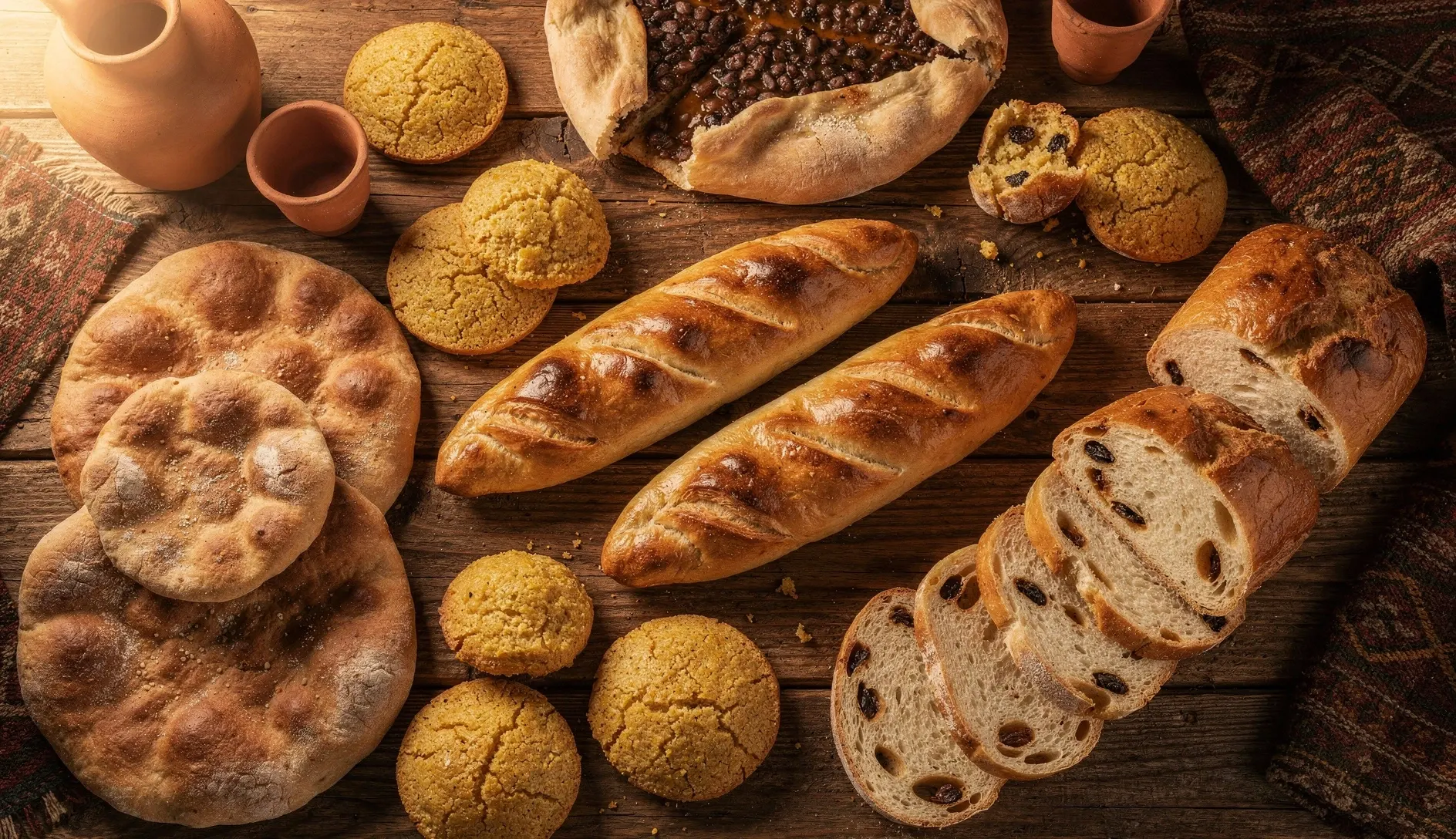
Bread in Georgia isn't a side dish. It's the table itself — the thing everything else is built around. A Georgian meal without bread is like a sentence without a verb: technically possible, but nobody would do it on purpose.
The country has at least a dozen distinct bread types, each tied to a specific region, occasion, or purpose. Some are baked in cylindrical clay ovens sunk into the ground. Others are fried in cast iron. A few are stuffed with meat, beans, or cheese and function as entire meals. The variety is remarkable for a country of fewer than four million people — and it reflects something important about how Georgians think about food: bread isn't generic. Every meal has a bread that belongs to it.
This guide covers every major Georgian bread type, how they're made, what they're eaten with, and which ones you can realistically pull off at home. If you've only ever tried khachapuri, you're missing most of the story.
The Tone: Georgia's Underground Bread Oven
You can't understand Georgian bread without understanding the tone (ტონე) — the cylindrical clay oven that's been the center of Georgian baking for millennia. It looks like a large clay pot sunk into the ground or into a raised platform, about a meter deep and half a meter wide. Charcoal or wood burns at the bottom. The baker slaps raw dough directly onto the hot interior walls, where it sticks and bakes from radiant heat.
The tone isn't a relic. Walk through any Tbilisi neighborhood and you'll find a tonis purni (ტონის პურნი) — a tone bakery — with bread coming out every few minutes. The baker reaches into the oven with bare arms or a long hook, peeling off finished loaves and passing them up still too hot to hold comfortably. A fresh shotis puri costs about 1–1.50 GEL (around $0.35–$0.55). Most families buy bread at least once a day.
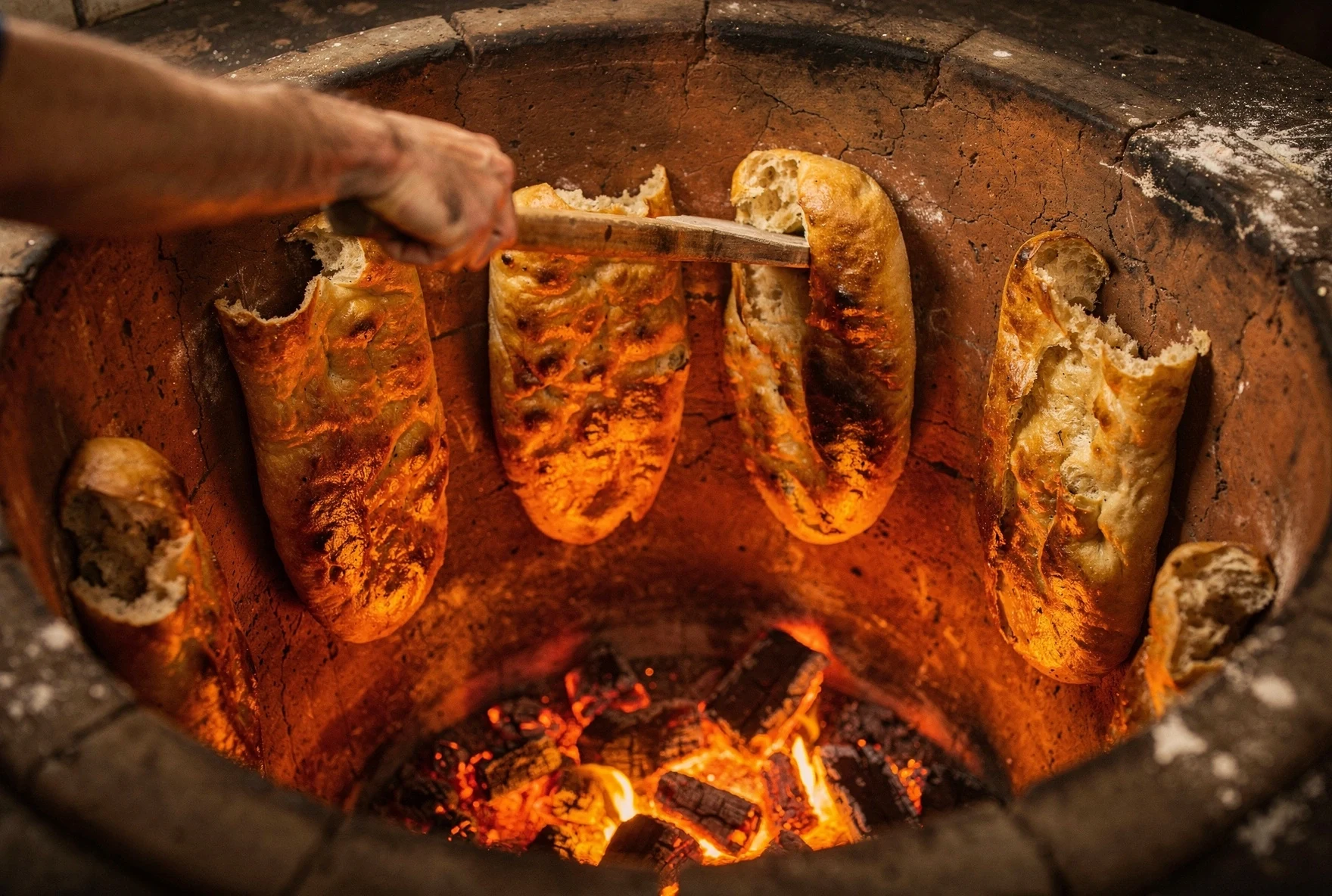
The tone produces two main bread shapes: shotis puri (elongated, canoe-shaped) and tonis puri (round). Both use the same basic dough — flour, water, salt, yeast — but the shape changes the texture. The pointed ends of shotis puri get crispier, while the thicker middle stays soft and chewy. Tonis puri is more uniform.
Why Tone Bread Tastes Different
The tone's radiant heat (350–400°C) creates a specific crust that no conventional oven can replicate. The bread bakes in 5–8 minutes, getting an almost smoky char on the side touching clay while staying pillowy inside. A pizza stone in a home oven at max temperature is the closest approximation, but it's still not the same.
Shotis Puri — The Everyday Bread
Shotis puri (შოთის პური) is what most people mean when they say "Georgian bread." It's the canoe-shaped loaf you see stacked in every bakery window, carried home tucked under arms, and torn apart at every meal. The name literally means "bread from the shoti" — shoti being the elongated shape.
A good shotis puri has a thin, crackly crust that yields to a soft, slightly chewy interior with irregular air pockets. The pointed ends are the best part — dark, crispy, almost cracker-like. Georgians will fight over the ends. The middle is for tearing and using as an edible utensil, sopping up sauce, pinching cheese, wrapping around grilled meat.
It's best within an hour of baking. By the next day, it's stale enough to use for khamshi (bread soup) or toast. This is why Georgians buy bread daily — not out of habit, but because yesterday's bread genuinely isn't the same thing.
| Feature | Shotis Puri | Tonis Puri |
|---|---|---|
| Shape | Elongated canoe, pointed ends | Round or oval, flat |
| Crust | Thin, crackly, crisp ends | Slightly thicker, uniform |
| Interior | Airy, irregular holes | Denser, more even crumb |
| Size | 40–60 cm long | 25–35 cm diameter |
| Best With | Cheese, stews, grilled meat | Spreads, dips, bean dishes |
| Price | 1–1.50 GEL | 1–1.50 GEL |
→ Full shotis puri recipe and history
Tonis Puri — The Round One
Tonis puri (ტონის პური) is the round flatbread baked in the same tone oven. It's essentially the same dough as shotis puri, just shaped differently — flattened into a disc or oval rather than stretched into a canoe. The result is a bread that's slightly denser and more uniform, without the crispy pointed ends that make shoti so distinctive.
Tonis puri is the more practical bread for certain uses. Its flat surface makes it better for wrapping things — a slab of sulguni, some fresh herbs, a piece of grilled meat. It tears more evenly. In Tbilisi, most bakeries make both, and you'll see locals grab whichever is coming out of the oven when they walk by. In western Georgia, the round shape is more common as the default bread.
Some bakeries stamp patterns into tonis puri before baking, pressing their fingers into the dough to create dimples that help it cook evenly and prevent large air pockets. This gives it a visual signature — rows of small indentations across the surface.
Mchadi — Cornbread from the Skillet
Mchadi (მჭადი) is Georgia's cornbread, and it's nothing like the American version. There's no sugar, no butter, no eggs, no milk. Just white or yellow cornmeal (simindi), water, and a pinch of salt, shaped into small thick patties and fried in a skillet or baked until the outside is golden and crisp while the inside stays dense and slightly crumbly.
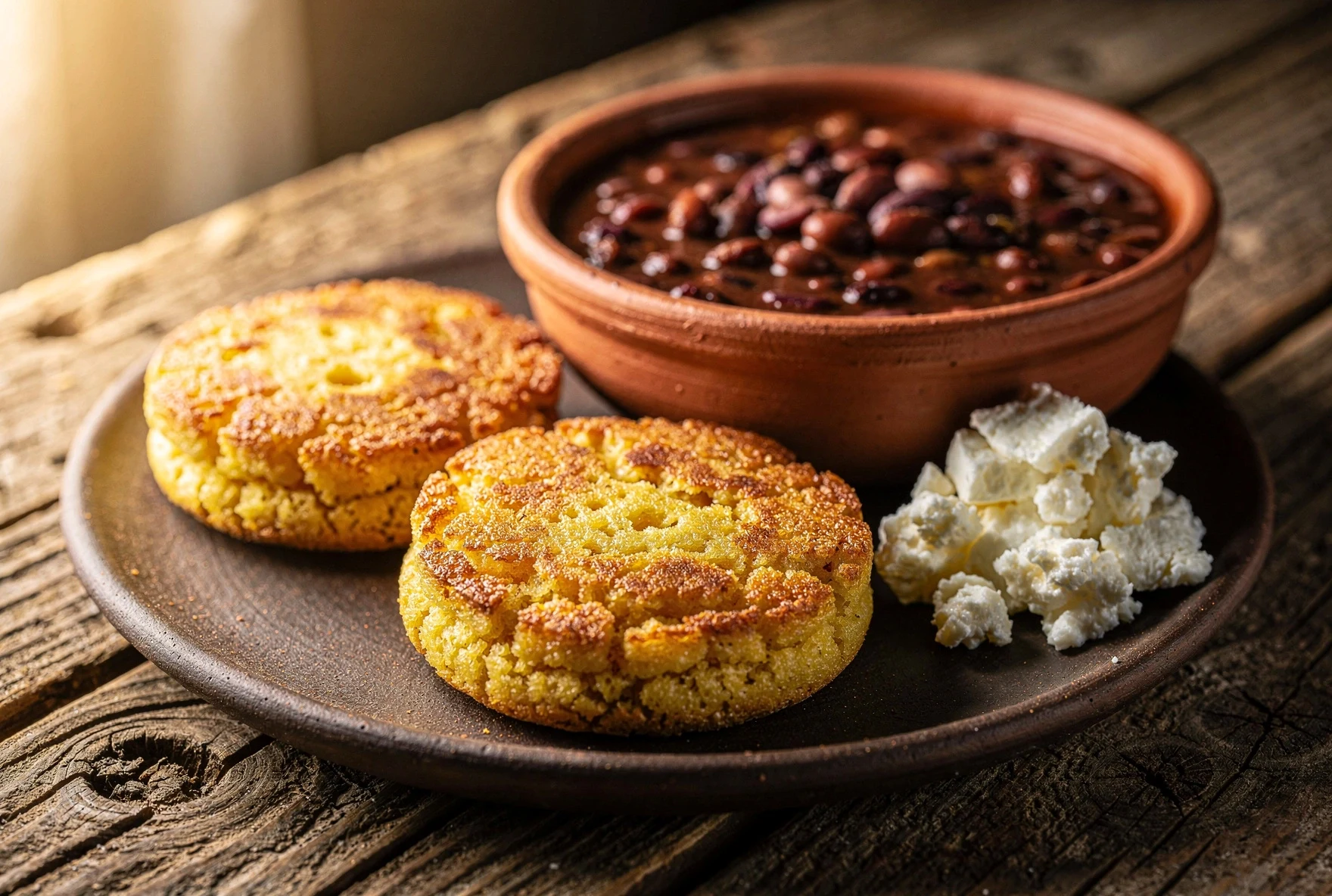
Mchadi exists for one primary reason: lobio. The pairing of mchadi and lobio (bean stew) is one of Georgia's most fundamental food combinations — the bland, crispy cornbread against the smoky, spiced beans. Add a slab of fresh cheese and you have a complete meal that costs almost nothing to make. This was poor people's food for centuries, and it still is — in the best possible way.
In western Georgia, especially Samegrelo and Svaneti, mchadi is the default bread rather than wheat-based puri. Corn grows better in the humid lowlands, and the cuisine reflects it. Elarji (stretchy cheesy cornmeal) and chvishtari (cheese-stuffed cornbread) are variations on the same theme.
The Corn Divide
Georgia has a rough east-west bread divide. Eastern Georgia (Kakheti, Kartli) is wheat country — shotis puri territory. Western Georgia (Samegrelo, Imereti, Svaneti) leans heavily on corn: mchadi, elarji, chvishtari, ghomi. The divide isn't absolute — you'll find both everywhere — but it shapes the regional cuisines in fundamental ways. See our regional cuisine guide for more.
The Stuffed Breads: Meals in Dough
Some of Georgia's best breads aren't really bread at all — they're complete meals wrapped in dough. This is where Georgian baking gets serious.
Khachapuri — Cheese Bread (Five Ways)
Khachapuri (ხაჭაპური) barely needs introduction. It's Georgia's most famous food export, and calling it "cheese bread" is like calling pizza "bread with tomato." Technically true, wildly insufficient.
And once you get past the obvious big hitters, the family gets more interesting. Khabidzgina, the thin potato-and-cheese Ossetian-style version, is a good example: less flashy than Adjarian, more substantial than Imeretian, and better than it has any right to be on a cold day. Pkhlovani belongs in the same conversation — a Svanetian greens-and-cheese bread that proves Georgian stuffed breads are not only about meat or pure dairy excess.
What most people don't realize is that khachapuri isn't one thing — it's a family of at least five major regional variations, each with different dough, cheese, and technique:
🧀 Imeretian (იმერული)
The everyday version. Round, enclosed, filled with fresh Imeretian cheese. Eaten more often than any other type. The one Georgian grandmothers make weekly.
🥚 Adjarian (აჭარული)
The boat-shaped showstopper with egg and butter. From Batumi. The one that goes viral on Instagram. Best eaten immediately — it waits for no one.
🔥 Megrelian (მეგრული)
Like Imeretian, but with cheese melted on top too. Double cheese. From Samegrelo, where everything is more intense. The richest version.
✨ Penovani (ფენოვანი)
Puff pastry khachapuri — flaky, buttery, crispy layers with molten cheese inside. The easiest to make at home using store-bought puff pastry.
There's also khabidzgina / Ossetian khachapuri (round, thin, with potato-cheese filling), Rachuli (with boiled egg slices inside), Gurian (crescent-shaped, holiday version with hard-boiled egg), and Meskhetian (thinner, crispier, from southern Georgia). But the four above are what you'll encounter 95% of the time.
Lobiani — Bean Bread
Lobiani (ლობიანი) is khachapuri's savory cousin — the same yeasted dough, but stuffed with spiced mashed kidney beans instead of cheese. It's named after lobio (beans), and it's traditionally eaten on Barbaroba (St. Barbara's Day, December 17), though bakeries sell it year-round.
The filling is key: cooked red kidney beans mashed with fried onions, butter, and a heavy hand of coriander, blue fenugreek, and black pepper. The best lobiani has enough butter in the bean paste that it's almost greasy — in a very good way. When you tear it open, the filling should be creamy and fragrant, not dry.
Kubdari — Svaneti's Meat Bread
Kubdari (კუბდარი) is Svaneti's gift to Georgian cuisine — a round bread stuffed with hand-chopped beef and pork seasoned with cumin, blue fenugreek, dill, and coriander. Unlike khachapuri and lobiani, where the filling is pre-cooked, kubdari's meat goes in raw and cooks inside the sealed dough, steaming in its own juices.
The result is extraordinary: when you cut it open, meat juices run out. The dough has absorbed flavor from the inside. The spice mix is distinctly Svan — heavier on cumin and dill than anything from eastern Georgia. It's a complete meal, and it's the kind of food that makes you understand why Svaneti's cuisine is considered the most distinctive in the country.
The Corn Breads: Western Georgia's Foundation
Western Georgia runs on corn. While eastern Georgia built its cuisine around wheat, the humid lowlands of Samegrelo, Imereti, and Guria grow corn easily, and the bread traditions reflect it.
| Bread | Region | Key Feature | Best With |
|---|---|---|---|
| Mchadi | All western Georgia | Plain cornbread patties, fried | Lobio, cheese, beans |
| Chvishtari | Svaneti | Cornbread stuffed with sulguni | On its own, with beans |
| Elarji | Samegrelo | Stretchy cornmeal-cheese porridge | Bazhe sauce, fried fish |
| Ghomi | Samegrelo, Guria | Plain cornmeal porridge (no cheese) | Replaces bread entirely |
Ghomi (ღომი) deserves special mention even though it's technically a porridge, not a bread. In Samegrelo and Guria, ghomi replaces bread entirely at the table. It's plain cornmeal cooked with water until thick and stiff, then served in portions that you tear pieces from — exactly like bread. Elarji is essentially ghomi with an absurd amount of sulguni cheese stirred in. If you visit a Megrelian home, you'll likely be served ghomi before you see wheat bread.
The Sweet Breads
Nazuki — Cinnamon-Raisin Bread from Surami
Nazuki (ნაზუქი) is Georgia's sweet bread, and it's most closely associated with the town of Surami on the highway between Tbilisi and Kutaisi. If you've driven that road, you've seen the roadside sellers — dozens of them, holding long golden loaves by the highway, flagging down cars. Buying nazuki from a Surami roadside vendor is a Georgian road trip ritual.
The bread itself is enriched dough flavored with cinnamon, cloves, and raisins, glazed with egg wash for a shiny golden crust. It's mildly sweet — more like brioche than cake. The best nazuki is slightly warm, with the cinnamon fragrance hitting you before the first bite. It's traditionally baked in a tone oven, which gives it a subtle smokiness that complements the sweet spices.
Kada — Butter-Sugar Bread
Kada (კადა, also called gata) comes from southern Georgia and has strong Armenian influences. It's a rich dough filled with a paste of butter, sugar, and flour, then baked until golden. Some versions add vanilla or cardamom. The filling creates almost caramelized layers inside, like a Middle Eastern pastry crossed with a Danish.
Kada is less common than nazuki but worth seeking out, especially in Akhaltsikhe and Borjomi. It's a holiday and celebration bread — you'll see it at weddings and special occasions.
Lavashi — The Thin Flatbread
Lavashi (ლავაში) in Georgia is a thin, flexible flatbread — similar to Armenian lavash but often slightly thicker. It's baked on the walls of the tone like other Georgian breads, but pulled off while still pliable rather than crispy.
Lavashi's primary role is as a wrap. It's what Georgian families use to wrap cheese, herbs, and grilled meat into quick rolls at the table. At a supra, you'll see stacks of lavashi alongside shotis puri — the shoti for tearing and dipping, the lavashi for wrapping.
In some regions, particularly Kakheti, lavashi is dried and stored for winter. The dried sheets can last months and are rehydrated by sprinkling water and covering with a cloth. This was historically important — fresh bread required a fire, but dried lavashi was ready to eat.
Lavashi vs Lavash vs Pita
Georgian lavashi is related to Armenian lavash but not identical. Georgian versions tend to be slightly thicker and softer. It's also not the same as Middle Eastern pita — there's no pocket. Think of it as a Caucasian tortilla: thin, flexible, and designed for wrapping rather than dipping.
Making Georgian Bread at Home
The honest truth: the breads that require a tone oven — shotis puri, tonis puri, lavashi — will never be quite the same from a home oven. The 400°C clay walls, the radiant heat, the 5-minute bake time — it's a fundamentally different cooking method. That said, you can get surprisingly close with a pizza stone preheated at maximum temperature.
The breads that translate best to home kitchens are the ones that were always made at home:
| Bread | Home Difficulty | Special Equipment | Time |
|---|---|---|---|
| Mchadi | Easy | Cast iron skillet | 20 min |
| Imeretian Khachapuri | Easy | Skillet or oven | 1 hour |
| Penovani Khachapuri | Very easy | Oven, store-bought puff pastry | 45 min |
| Chvishtari | Easy | Skillet | 30 min |
| Lobiani | Medium | Oven | 2+ hours (beans) |
| Kubdari | Medium | Oven | 2 hours |
| Adjarian Khachapuri | Medium-hard | Oven, shaping practice | 1.5 hours |
| Shotis Puri | Hard | Pizza stone, max oven heat | 1.5 hours |
| Nazuki | Medium | Oven | 2 hours |
Bread in Georgian Culture
Bread has a status in Georgia that goes well beyond food. The Georgian word for bread — puri (პური) — appears in greetings, blessings, and proverbs. "Puris mogebas" (bread harvest) was historically the most important date on the calendar. Wasting bread is still considered disrespectful in most Georgian families — stale bread is repurposed, never thrown away.
At the supra (feast), bread is never cut with a knife. It's torn by hand. Placing bread upside-down on the table is considered bad luck. And when Georgians make a toast — which happens roughly every five minutes at a supra — the bread on the table is as sacred as the wine in the glass.
There's a practical dimension too. Georgia's bread consumption per capita is among the highest in the world — roughly 500 grams per person per day by some estimates. That's nearly double the European average. Bread isn't a side here. It's caloric infrastructure.
🫓 Bread Superstitions
Never place bread upside-down. Never stick a knife into bread. If bread falls on the floor, pick it up and kiss it. These aren't quaint customs — older Georgians genuinely observe them.
🏠 The Tone as Community
In villages, the neighborhood tone bakery is a social hub — the equivalent of a café or pub. People gather, gossip, and wait for their bread. In Tbilisi, the tonis purni serves the same role in many neighborhoods.
Where to Try the Best Bread
Every neighborhood in Tbilisi has a tone bakery, and the bread is almost always good — it's hard to mess up when the oven is 400 degrees and the loaf bakes in five minutes. That said, some spots are worth seeking out:
🍞 Tone Bakeries (Any Neighborhood)
Look for the small storefronts with no sign — just a window where bread is stacked. Ask for tskheli (ცხელი, "hot") to get one straight from the oven. Best bread in the city, every time.
🏔️ Surami Highway (Nazuki)
The stretch of highway through Surami has dozens of nazuki sellers. Buy from whoever's loaves look the most golden. The best vendors bake throughout the day — avoid the ones with pale loaves sitting for hours.
🏔️ Mestia (Kubdari)
Kubdari is best in Svaneti, where it originates. Mestia's restaurants all serve it, but the home-cooked version from guesthouses is superior — ask your host to make it.
🧀 Imereti Region (Khachapuri)
The original Imeretian khachapuri is best in its homeland — Kutaisi and surrounding towns. The cheese is fresher and the technique more practiced than in Tbilisi.
Frequently Asked Questions
What's the most common Georgian bread?
Shotis puri — the canoe-shaped loaf from the tone oven. It's the default bread at most meals in eastern Georgia and Tbilisi.
Is Georgian bread sourdough?
Traditional tone breads use commercial yeast, not sourdough starter. Some village bakers still use natural leaven, but it's not the norm in bakeries.
What's the difference between shoti and puri?
Puri means "bread" in Georgian. Shoti refers to the elongated canoe shape. So shotis puri = "bread in the shoti shape." Tonis puri = "bread from the tone oven." They're the same dough, different shapes.
Is khachapuri technically bread?
Georgians would say yes — it's bread (puri) with cheese. The dough is essentially the same as other Georgian breads, just with cheese filling. But it functions more like a dish than a side.
Can I buy Georgian bread outside Georgia?
Georgian bakeries exist in cities with large diaspora communities — Moscow, Berlin, New York, Istanbul. Search for "tone bakery" or "Georgian bakery" in your area. Otherwise, the home recipes on this site are your best bet.
Is Georgian bread gluten-free?
Wheat-based breads (shoti, tonis puri, khachapuri) are not. But mchadi, chvishtari, elarji, and ghomi are all made from cornmeal — naturally gluten-free. Western Georgian cuisine is surprisingly accessible for people avoiding wheat.
Written by The Georgian Eats Team
Based in Tbilisi, where we buy bread from the neighborhood tone almost every day. We've eaten our way through every regional variation — from Svaneti's kubdari to Samegrelo's mchadi — and we still argue about which bakery on our street makes the best shoti.
Last updated: March 2026.
Related Articles
Shotis Puri: Georgia's Iconic Bread
The full recipe and history of Georgia's everyday canoe-shaped bread.
Regional Cuisine: West to East
How Georgian food changes across eight distinct culinary regions.
Georgian Street Food
Bakery windows, stuffed breads, and the snacks locals eat between meals.
The Georgian Supra
The feast tradition where bread holds sacred status on the table.