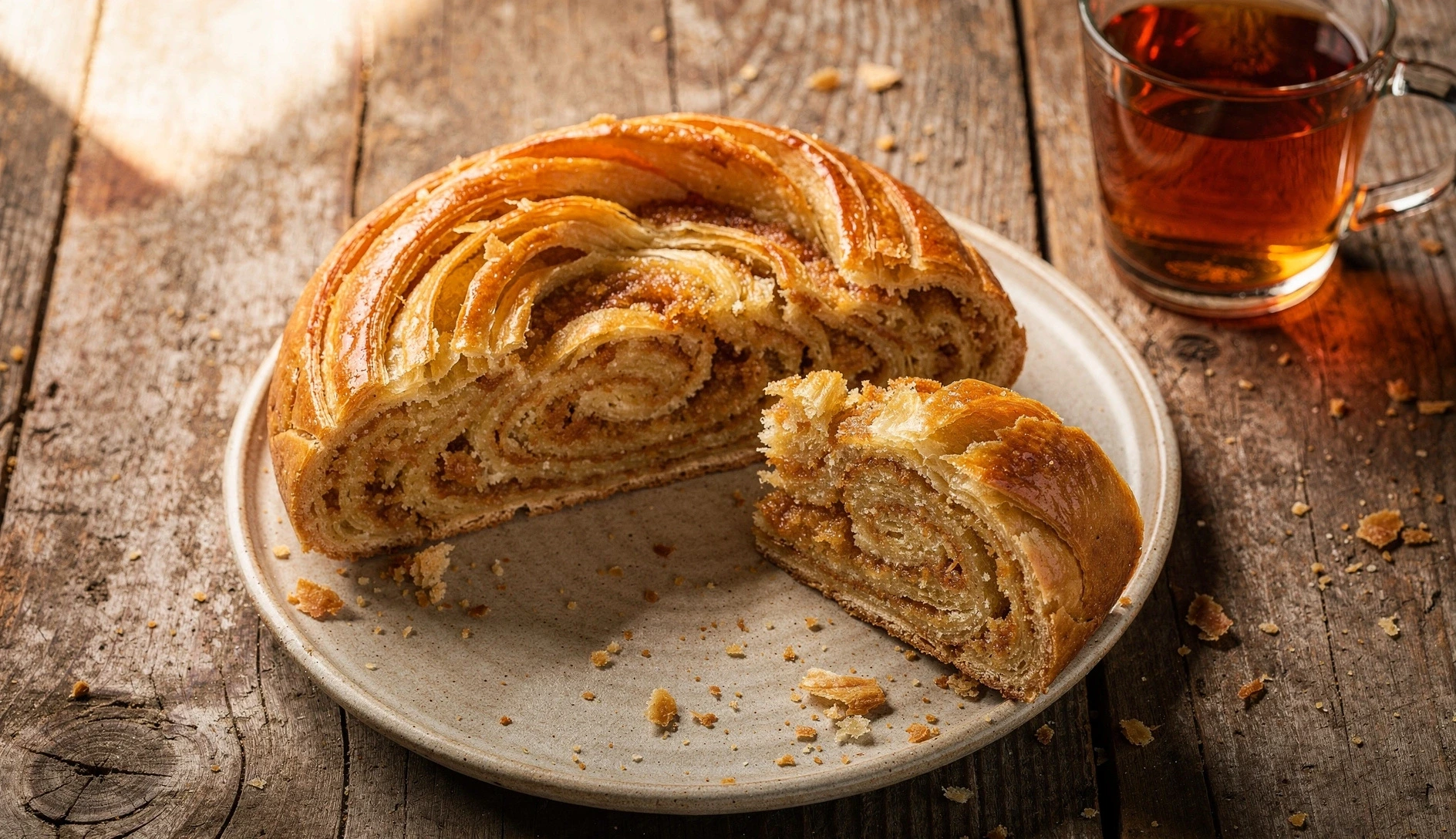
Walk into any Georgian bakery — the kind with a glass case and a woman who doesn't smile until she knows your order — and you'll see kada. Golden, spiral-layered, sitting there looking deceptively plain next to flashier pastries. Don't be fooled. This is the thing locals grab with their morning tea, the pastry Georgian grandmothers have opinions about, and the sweet that somehow makes flour, butter, and sugar feel like a revelation. Kada is what happens when you take the simplest possible ingredients and apply centuries of technique. No fruit, no cream, no chocolate. Just layers.
Kada Quick Facts
- Georgian name: კადა (KA-da), also ყადა (qa-da)
- Region: Imereti, but made everywhere
- Type: Layered sweet pastry
- Active time: 30 minutes
- Total time: 2.5 hours (including chilling)
- Difficulty: Medium — the technique is the filling, not the dough
- Key skill: Cooking the shakarishi (filling) to the right color without burning it
What Is Kada, Exactly?
Kada sits in a category that doesn't really exist in Western baking. It's not a bread — there's no yeast. It's not a cake — there's no creaming or whipping. It's not quite a pie, though it has a filling. The closest comparison might be a cross between puff pastry and a cinnamon roll, but even that doesn't capture it.
Here's what kada actually is: a rich, flaky dough wrapped around a filling called shakarishi (შაქარიში) — literally "sugared thing." Shakarishi is flour cooked in butter until golden, then mixed with sugar. It sounds boring on paper. In practice, it tastes like the best parts of a croissant, a shortbread cookie, and caramel all compressed into one buttery layer.
The dough gets rolled thin, spread with this filling, rolled up into a log, then coiled into a spiral. When baked, the layers separate and crisp, the filling melts between them, and the whole thing becomes this golden, shatteringly flaky pastry that somehow weighs about twice what you expect.
Regional Variations
Every region in Georgia makes kada slightly differently, and every region will tell you their way is the original. The truth is that the basic concept — dough plus cooked-flour filling — is ancient and widespread across the Caucasus, with related pastries in Armenia and Azerbaijan too.
| Region | Style | Distinctive Feature |
|---|---|---|
| Imereti | Large round spiral | Classic version — coiled log in a round pan, rich shakarishi filling |
| Guria | Smaller individual rolls | Often uses lard instead of butter, slightly less sweet |
| Samegrelo | Flat layered pie | Multiple stacked layers rather than a spiral roll |
| Kakheti | Elongated roll | Sometimes adds walnuts to the filling |
| Tbilisi bakeries | All shapes | Often uses margarine to cut costs — you can always tell |
The recipe below follows the Imeretian style — the large spiral coil — because it's the most common, the most impressive-looking, and honestly the most satisfying to slice through.
Ingredients Breakdown
The Dough
Kada dough is a hybrid: part shortcrust (cold butter rubbed into flour), part enriched dough (egg and matsoni for richness and tenderness). The baking soda reacts with the acidic matsoni to give just a touch of lift — not enough to make it puffy, but enough to keep the layers distinct.
| Ingredient | Amount | Notes |
|---|---|---|
| All-purpose flour | 500g | Don't use bread flour — too much gluten makes it tough |
| Unsalted butter | 200g, cold | Must be cold. Cut into 1cm cubes straight from the fridge |
| Matsoni or yogurt | 150ml | Full-fat plain yogurt works perfectly if you can't find matsoni |
| Egg | 1 large | Plus 1 extra for egg wash |
| Sugar | 1 tbsp | Just a touch — the sweetness comes from the filling |
| Baking soda | 1/2 tsp | Reacts with the acid in matsoni for slight lift |
| Salt | 1/2 tsp | Essential — balances the sweet filling |
The Filling (Shakarishi)
Shakarishi is what makes kada special. It's essentially a roux taken further — flour cooked in butter until it's deeply golden and fragrant, then sweetened. Think of it as the Georgian answer to praline paste, except made with pantry staples.
| Ingredient | Amount | Notes |
|---|---|---|
| Unsalted butter | 200g | Melted first, then flour goes in |
| All-purpose flour | 250g | Cooks for 8–10 minutes until golden |
| Granulated sugar | 200g | Added off heat — melts into the warm mixture |
| Vanilla | 1/2 tsp (optional) | Not traditional but nice. Many modern Georgian bakers add it |
The Filling Is Everything
The shakarishi is what separates good kada from forgettable kada. Cook the flour too little and the filling tastes raw and pasty. Cook it too long and it turns bitter. You want a deep golden color — darker than you think — and a smell like toasted nuts. This takes 8–10 minutes of constant stirring. Don't walk away.
Step-by-Step Instructions
Step 1: Make the Dough (10 minutes + 1 hour chilling)
Sift the flour into a large bowl. Add the cold butter cubes and get your hands in there — rub the butter into the flour between your fingertips until the mixture looks like coarse breadcrumbs. You should still see some pea-sized butter pieces. This is good. Those chunks create the flaky layers later.
In a separate bowl, whisk together the matsoni, egg, sugar, salt, and baking soda. It'll fizz slightly from the soda reacting with the acid. Pour this into the flour mixture and stir with a fork until a shaggy dough forms. Turn it out onto a floured surface and knead for about one minute — just until it comes together. Don't overwork it. The dough should feel soft and slightly sticky, not smooth and elastic.
Wrap tightly in cling film and refrigerate for at least 1 hour. You can make this the night before — cold dough is actually easier to work with.
Step 2: Make the Shakarishi Filling (15 minutes)
This is the step that matters most. Melt 200g of butter in a heavy-bottomed pan over medium-low heat. Once fully melted, add all the flour at once and stir immediately with a wooden spoon.
Now stir. And keep stirring. The mixture will look like wet sand at first. After 3–4 minutes, it'll start to smell like cooking butter. At 5–6 minutes, it begins to turn golden. At 8–10 minutes, it should be a deep golden-amber color — think the color of a brown paper bag — and smell distinctly nutty, almost like toasted hazelnuts.
The visual cues to watch for:
- Too pale (under 6 minutes): Raw flour taste. Not ready.
- Light gold (6–7 minutes): Getting there but still mild.
- Deep gold (8–10 minutes): Perfect. Nutty aroma, no raw taste.
- Dark brown (over 12 minutes): Burnt. Bitter. Start over.
Remove from heat and stir in the sugar immediately. The residual heat will partially dissolve it. Add vanilla if using. Let the filling cool to room temperature — about 20 minutes. It'll thicken into a spreadable paste as it cools. If it's too thick to spread, it's fine. You'll work it onto the dough with your fingers.
Step 3: Assemble (10 minutes)
Divide the chilled dough into 2 equal pieces. Work with one at a time, keeping the other in the fridge.
On a well-floured surface, roll the first piece into a thin rectangle — about 40×30cm and roughly 3mm thick. Don't stress about perfect geometry. Georgian grandmothers don't use rulers.
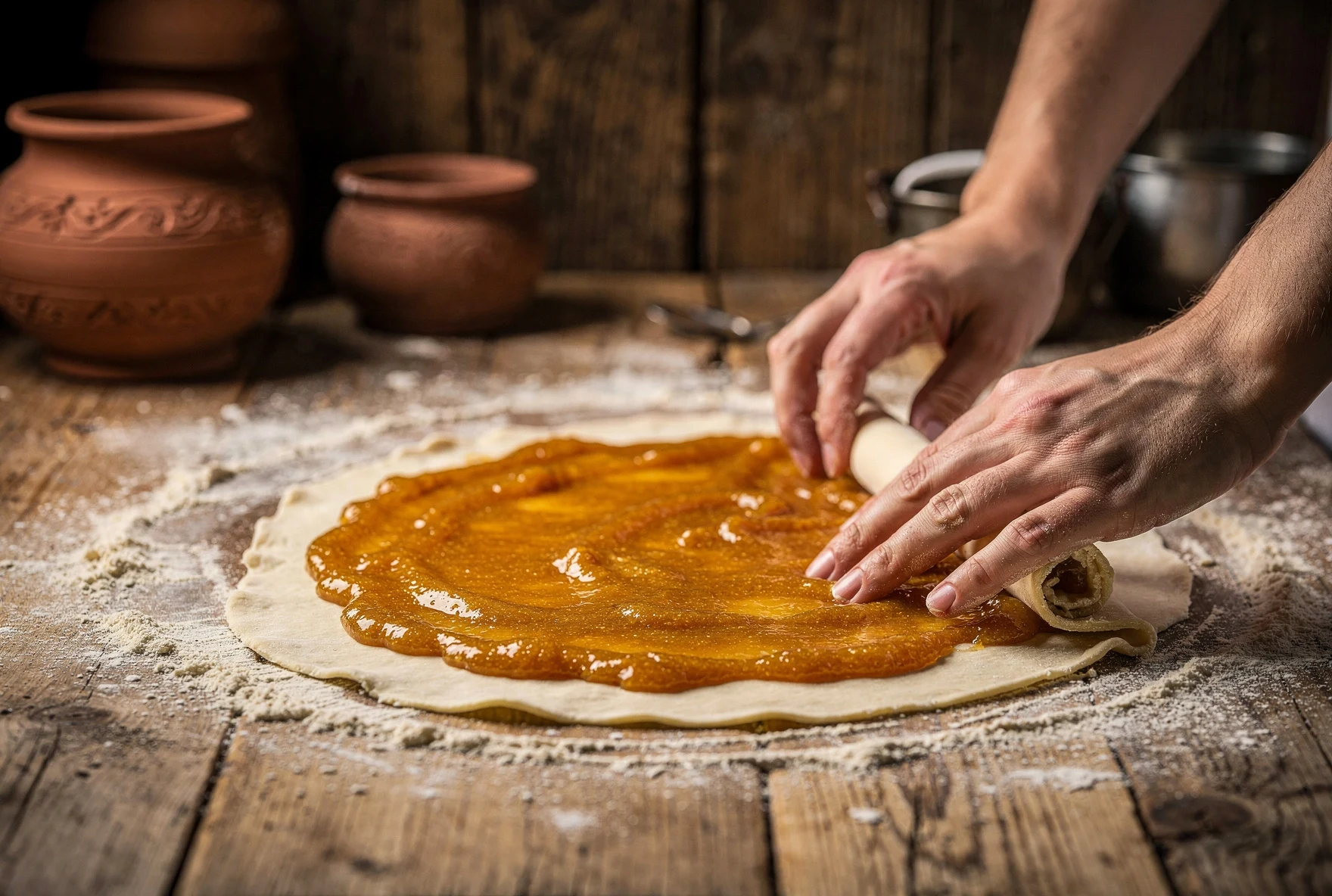
Spread half the cooled filling evenly over the entire surface, leaving about a 1cm border on all sides. Use the back of a spoon or your fingers — the filling is forgiving. It doesn't need to be perfectly even, but you want consistent coverage.
Starting from the long side, roll the dough up into a tight log. Then coil the log into a spiral, like a snail shell, and place it in a buttered round baking pan (24–26cm). Tuck the end underneath so it doesn't unravel. Repeat with the second piece. You can either place both spirals in the same large pan (they'll merge into one pastry) or use two separate pans.
The Rolling Trick
Roll the log as tightly as you can. Loose rolls mean the layers separate too much during baking and you get gaps. Tight rolls mean the filling stays evenly distributed between thin, crisp layers. If the dough tears a little while rolling — and it might — just pinch it closed. Nobody will know once it's baked.
Step 4: Bake (35–40 minutes)
Preheat your oven to 180°C (350°F). Beat an egg and brush the top of the kada generously — this gives you the deep golden, slightly glossy finish.
Bake for 35–40 minutes. You're looking for a deep golden color on top and firm edges. The center should feel set when you press it gently. At about the 25-minute mark, your kitchen will smell like a Georgian bakery — that's the butter and toasted flour doing their thing.
Let it cool in the pan for 15 minutes. Then either slice and serve from the pan, or carefully turn it out onto a wire rack. Don't skip the cooling — the layers need time to set or they'll be too soft to hold their shape when sliced.
How to Serve Kada
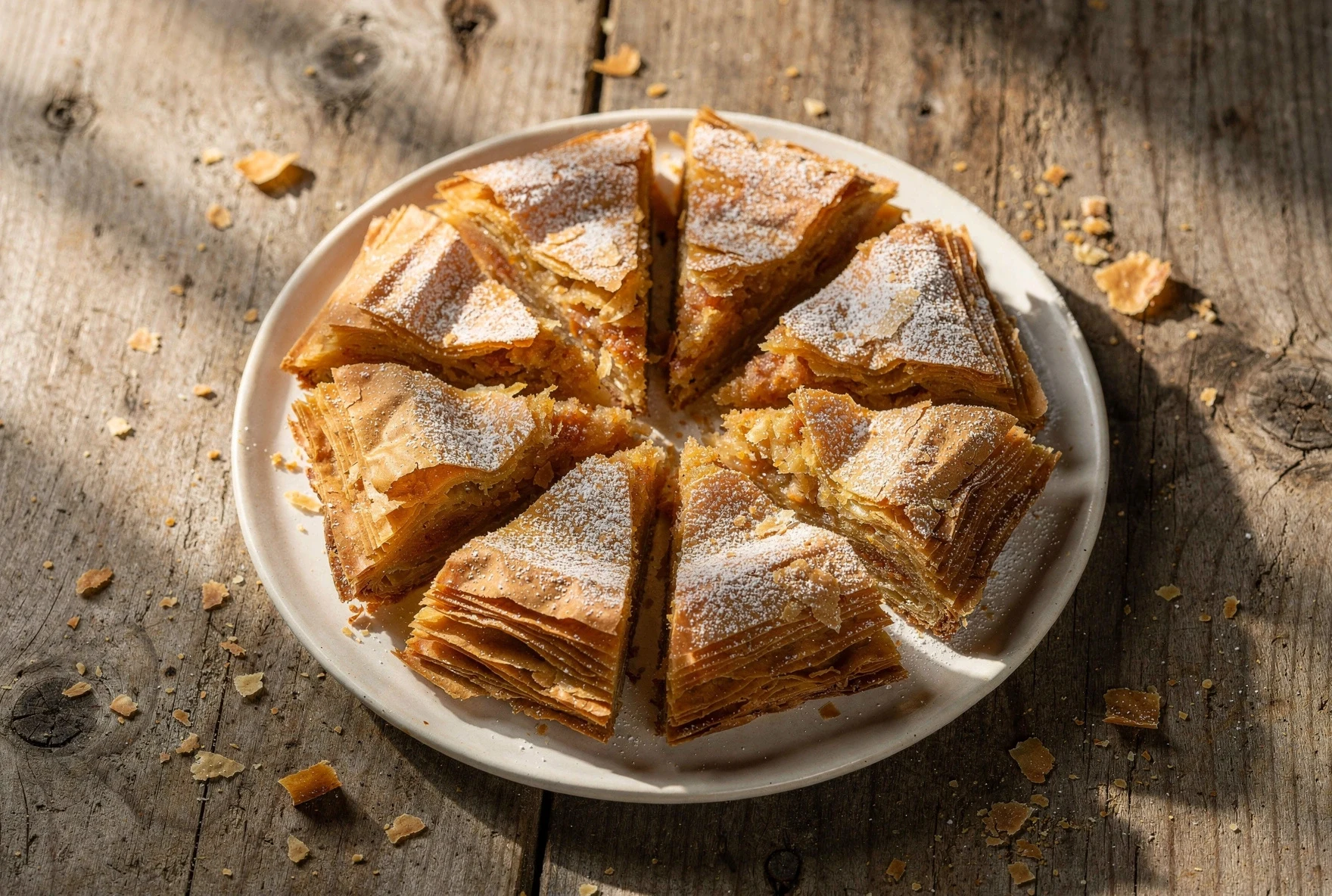
Kada is best warm or at room temperature. It's a tea pastry through and through — Georgians eat it with strong black tea, no milk, often for breakfast or as an afternoon snack. It's also common at celebrations, religious holidays, and basically any excuse to have guests over.
Best Pairings
Strong black tea (Georgian or Turkish-style). Coffee works too, but tea is traditional. Cold milk is the childhood pairing that Georgian adults won't admit they still prefer.
Storage
Wrapped at room temperature: 3–4 days. Actually improves on day two as the butter redistributes through the layers. Reheat gently in a 150°C oven for 10 minutes to re-crisp.
Tips That Actually Matter
| Problem | Cause | Fix |
|---|---|---|
| Layers aren't flaky | Butter was too warm or dough overworked | Keep everything cold. Handle the dough as little as possible. |
| Filling tastes raw | Shakarishi undercooked | Cook longer. It should smell nutty, not floury. Deep gold, not pale. |
| Filling leaked out | Too much filling or log rolled too loosely | Roll tightly and leave a 1cm border unfilled at edges. |
| Top browned but inside raw | Oven too hot | 180°C is the ceiling. Cover with foil at 25 min if browning fast. |
| Dry and crumbly | Overbaked or too little butter in dough | Pull at 35 minutes and check. Use full amount of butter. |
Variations Worth Trying
Once you've nailed the basic kada, these are legitimate variations — not trendy experiments, but things Georgian bakers actually do:
🥜 Walnut Kada
Add 100g finely ground walnuts to the shakarishi filling. Common in Kakheti. The walnuts add richness and a slightly grainy texture that's excellent.
🧈 Lard Kada (Gurian Style)
Replace the butter in the filling with rendered pork lard. Sounds strange, makes the filling incredibly tender and slightly savory. Traditional in Guria.
🍯 Honey Kada
Replace half the sugar in the filling with honey. Best with Georgian mountain honey. The flavor is more complex but the filling is looser — use slightly more flour to compensate.
📏 Individual Rolls
Instead of one big spiral, cut the filled log into 5cm pieces and arrange cut-side up on a baking sheet. Bake 25 minutes. Great for parties or gifts.
Kada in Georgian Life
Kada isn't a special-occasion pastry — it's an everyday one. You'll find it in every bakery in the country, from high-end Tbilisi patisseries to roadside stops in Kutaisi. It costs between 3–5 GEL (about $1–2) for a slice, which makes it one of the cheapest breakfast options in Georgia.
It's also one of the most democratic. Unlike elaborate desserts that require specialty ingredients, kada uses things every Georgian kitchen already has. Flour, butter, sugar. That's why it's survived unchanged for generations — nobody needs a recipe book. Mothers teach daughters the technique by feel, the way French grandmothers teach crêpes or Italian nonnas teach fresh pasta.
In Imereti — the region around Kutaisi — kada is practically a food group. Bakeries there sell it in enormous rounds that could feed a family of six, and the best ones cook the shakarishi over a wood fire, which adds a faint smokiness that no oven can replicate. If you're ever driving through western Georgia and see a roadside bakery with smoke coming out of it, stop. The kada will be worth it.
Where to Find the Best Kada in Georgia
The best kada comes from small bakeries in Imereti, not Tbilisi restaurants. Look for places where the pastry is still warm when you buy it. In Tbilisi, the bakeries along Chavchavadze Avenue and around Dezerter Bazaar sell decent versions. But the real thing is a roadside bakery between Zestaponi and Kutaisi, where it costs 2 GEL and changes your understanding of what flour and butter can do.
Frequently Asked Questions
Can I use store-bought puff pastry?
Technically yes, but the texture will be different — too airy and layered. Kada dough is denser and richer. The homemade dough takes 10 minutes and is worth it.
What's matsoni? Can I substitute it?
Matsoni is Georgian fermented milk — tangy, thick, similar to yogurt. Full-fat plain yogurt is a perfect substitute. Sour cream thinned with a splash of milk also works.
Can I freeze kada?
Yes. Wrap tightly in foil and freeze for up to 2 months. Reheat from frozen at 170°C for 20 minutes. It won't be quite as flaky as fresh, but still very good.
Is kada the same as gata?
Very closely related. Armenian gata and Georgian kada share the same basic concept — pastry with a cooked flour filling. The technique varies slightly by region, but they're cousins.
Can I make the dough ahead?
Absolutely. Make the dough and the filling separately, refrigerate both (covered), and assemble the next day. The dough can rest in the fridge for up to 48 hours.
How sweet is it?
Moderately sweet — nothing like American pastries. The filling is sweet but the dough barely is. The overall effect is rich and buttery first, sweet second. It won't give you a sugar headache.
Written by The Georgian Eats Team
We've eaten our way through Georgia's bakeries from Tbilisi to Kutaisi. The kada at a roadside spot near Zestaponi ruined all other pastries for us. This recipe is our best attempt at recreating it at home — and it's close.
Last updated: March 2026.
Related Articles
Gozinaki: Honey-Walnut Brittle
Georgia's iconic New Year's candy — just honey and walnuts.
Nazuki: Georgian Sweet Bread
Spiced sweet bread with cinnamon and cloves from the heart of Georgia.
Georgian Desserts Guide
The complete guide to Georgian sweets, from churchkhela to pelamushi.
Georgian Bread: A Complete Guide
Shotis puri, tonis puri, mchadi, lobiani — bread is life in Georgia.