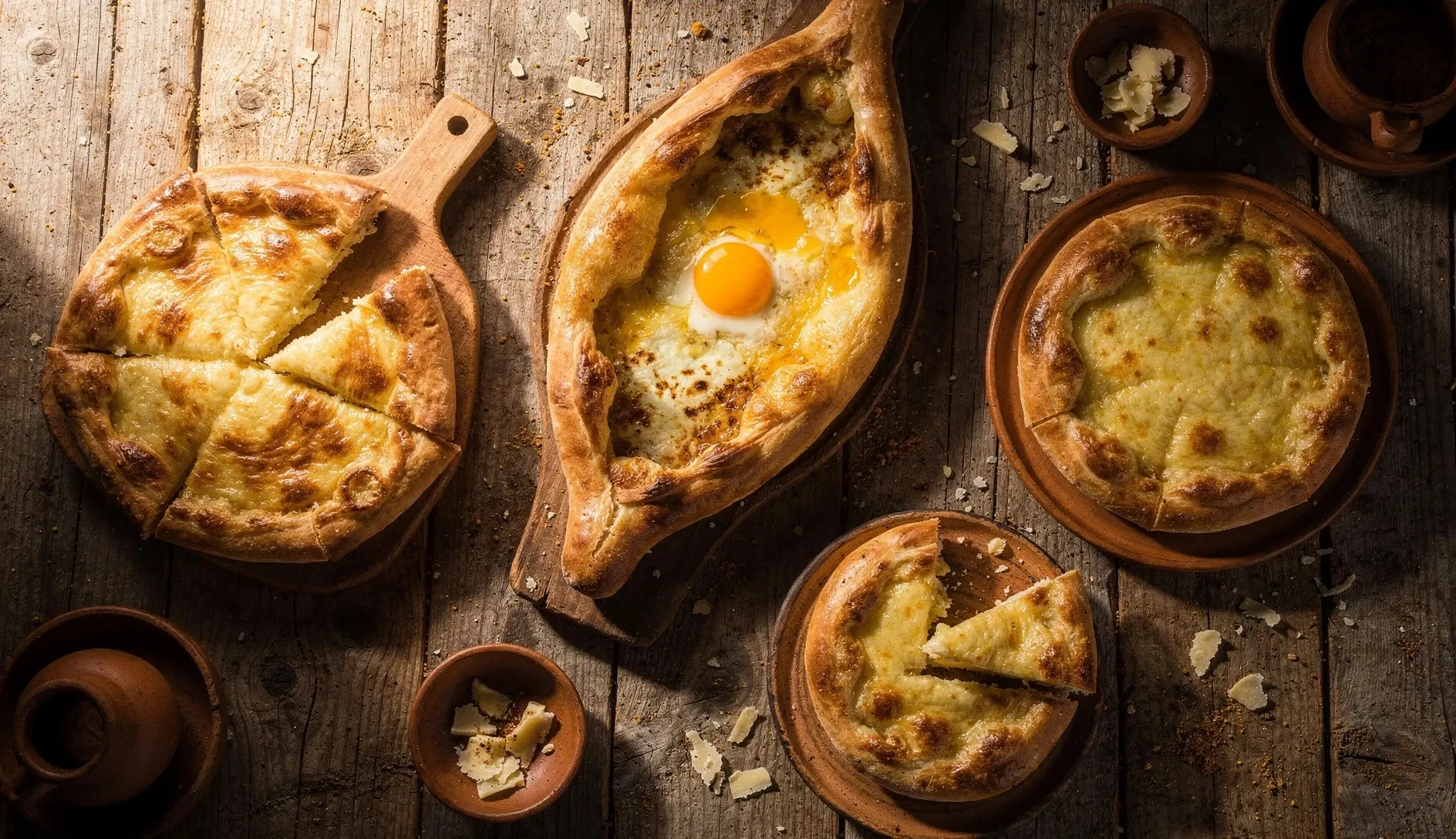
Every khachapuri variation tells you something about where it comes from. Adjarian is dramatic — a bubbling cheese boat from the Black Sea coast. Imeretian is honest and round, the everyday bread of central Georgia. And Gurian? Gurian is the one that shows up once a year, looking like a golden crescent moon, hiding hard-boiled eggs inside a pocket of melted cheese and soft dough. It's Georgia's Christmas bread, and it might be the most underrated member of the entire khachapuri family.
Gurian Khachapuri Quick Facts
- Georgian name: გურული ხაჭაპური (gu-RU-li kha-cha-PU-ri), also called გურული გვეზელი (guruli gvezeli)
- Origin: Guria region, western Georgia
- Shape: Crescent (half-moon), sealed like a calzone
- Key difference: Hard-boiled eggs inside the cheese filling
- Traditional occasion: Christmas (January 7th, Georgian Orthodox calendar)
- Cost in Georgia: 6–12 GEL (~$2–5 USD)
What Makes Gurian Khachapuri Different
Three things set Gurian khachapuri apart from every other version:
The eggs. Sliced hard-boiled eggs mixed into the cheese filling. When you cut into it, you get layers of golden yolk, white cheese, and soft dough. No other khachapuri does this.
The shape. A sealed crescent — more like an oversized empanada or calzone than the open-faced styles of Adjarian or the flat rounds of Imeretian. The crescent shape is deliberate: it represents the moon, a symbol of fertility and abundance in pre-Christian Georgian tradition.
The occasion. In Guria, this isn't everyday bread. It's Christmas bread. Families bake it for Georgian Orthodox Christmas on January 7th, and in some households, a coin is hidden inside one of the individual pies. Whoever finds it gets good luck for the year — or a cracked tooth, depending on how enthusiastic you are about biting through.
The History Behind the Christmas Bread
Guria is a small region in western Georgia, sandwiched between Mingrelia, Imereti, and Adjara — three regions famous for their own khachapuri styles. With neighbors like that, Guria had serious cheese bread credentials. But Gurians did something nobody else did: they turned khachapuri into ritual food.
The Christmas tradition runs deep. Historically, every family member received their own individually baked gvezeli. The largest one went to the eldest. One oversized pie, loaded with the most eggs, sat in the center of the table with a candle on top — a symbol of family abundance. The woman kneading the dough would pray while working it, and press a small cross of dough into the surface before baking.
Beyond Christmas, Gurian khachapuri was also baked when a mother visited her newly married daughter's family, or when a godchild visited their godparents. The number of eggs inside was a measure of respect: more eggs, more honor.
Today, you can find Gurian khachapuri on restaurant menus year-round across Georgia — though not every restaurant actually has it when you order. It's become a national dish rather than strictly a Gurian one, but the Christmas association remains strong.
Ingredients
Makes 2 large crescents (each serves 2–3 people)
🫓 Dough
| All-purpose flour | 500g |
| Warm milk (~38°C) | 200ml |
| Plain yogurt or matsoni | 100ml |
| Instant yeast | 7g |
| Sugar | 1 tsp |
| Salt | 1 tsp |
| Butter, melted | 50g |
| Egg | 1 |
🧀 Cheese Filling
| Imeretian cheese or mozzarella | 400g |
| Feta, crumbled | 100g |
| Egg | 1 |
🥚 The Eggs
| Hard-boiled eggs, sliced | 4 |
| Butter, melted (brushing) | 30g |
Cheese Substitutions
The authentic cheese is imeruli — a mild, slightly tangy brined cheese from the Imereti region. Outside Georgia, the best substitute is a 4:1 mix of low-moisture mozzarella and feta. The mozzarella gives you the melt and stretch, the feta gives you the salt and tang. If you can find sulguni, use it — it's the closest widely available option. See our Georgian cheese guide for more on authentic cheeses.
Method
Step 1: Make the Dough (20 min active + 1 hour rising)
Combine warm milk, sugar, and yeast in a large bowl. Wait 5 minutes until the surface is foamy — if nothing happens, your yeast is dead. Start over with fresh yeast.
Add the yogurt, melted butter, egg, and salt. Stir to combine. Gradually add the flour, mixing with a wooden spoon until a shaggy mass forms.
Turn out onto a lightly floured surface and knead for 8–10 minutes. You're looking for a dough that's smooth, elastic, and just slightly tacky — not sticky, not dry. The milk and yogurt make this dough softer and richer than pizza dough. That softness matters. If the dough tears instead of stretching when you pull a piece, keep kneading.
Place in a lightly oiled bowl, cover with a damp towel, and let rise for 1 hour in a warm spot until doubled in size.
Step 2: Prepare the Eggs (while dough rises)
Place 4 eggs in a saucepan, cover with cold water by about 2cm. Bring to a rolling boil over high heat, then reduce to medium and cook for exactly 10 minutes.
Transfer immediately to an ice bath. Peel after 5 minutes — the cold shock makes peeling dramatically easier.
Slice each egg into rounds about 5mm thick. You want distinct rounds, not crumbles. A sharp knife and a gentle hand.
Traditional Twist: Smoked Eggs
In old Gurian households, the hard-boiled eggs were smoked over the fireplace for a day or two before baking — hung in a cloth basket above the embers. This gave them a deep, smoky flavor that you can't replicate easily at home. A modern shortcut: lightly pan-fry the egg slices in butter for 2 minutes per side until golden. Not the same, but it adds a richness that plain boiled eggs lack.
Step 3: Make the Filling
In a large bowl, combine the grated cheese, crumbled feta, and 1 egg. Mix with your hands until everything is evenly distributed. The mixture should be moist and cohesive but not wet.
Gently fold in the sliced hard-boiled eggs. Don't mash them — you want visible egg rounds in every slice of the finished bread.
Step 4: Shape the Crescents
Preheat your oven to 200°C / 400°F. Line a large baking sheet with parchment paper.
Divide the risen dough into 2 equal pieces. On a lightly floured surface, roll each piece into a round about 35cm (14 inches) in diameter and roughly 5mm thick.
Spread half the filling over one half of each round, leaving a 2cm border along the edge. Distribute the egg slices evenly across the cheese — you want eggs in every bite, not clustered in one spot.
Fold the empty half of the dough over the filling to create a half-moon shape. Press the edges firmly together, then roll and crimp them to seal completely. Now gently curve the straight edge inward to form a crescent — the points should come toward each other slightly.
Getting the Crescent Right
The crescent shape is the whole identity of this bread. Don't skip it or you just have a calzone. After sealing the half-moon, place it on the baking sheet and gently push the two pointed ends toward each other while curving the rounded belly outward. Think croissant silhouette. The seam should be tight — if cheese leaks during baking, you didn't seal well enough. Double-roll the edge if needed.
Step 5: Bake
Brush the crescents generously with melted butter. Make 2–3 small slits on top with a sharp knife — this lets steam escape so the bread doesn't balloon and crack.
Bake for 20–25 minutes until the crust is a deep golden brown. Not pale gold — deep, burnished, almost bronze in spots. That's where the flavor is.
Remove from the oven and immediately brush again with melted butter. This is what gives Gurian khachapuri its glossy, rich-looking crust.
Let it rest for 5 minutes before slicing. Unlike Adjarian khachapuri, which is a sprint to the table, Gurian can handle a brief rest — the sealed shape holds its heat.
How to Serve It
Slice into wedges like a pie — cut from the curved outer edge toward the center. Each slice should reveal a cross-section of dough, melted cheese, and egg rounds.
Gurian khachapuri is satisfying on its own, but it's traditionally served alongside:
- Fresh herbs — tarragon, cilantro, and basil. The herbal brightness cuts through the richness.
- Pickled vegetables — especially jonjoli (pickled flower buds), which are another Gurian specialty.
- A simple salad — tomato and cucumber with walnut oil.
- Tea — Gurians are historically tea-growing country, and hot black tea with this bread is the classic pairing.
How It Compares to Other Khachapuri
| Style | Shape | Filling | Best For |
|---|---|---|---|
| Gurian | Crescent (sealed) | Cheese + hard-boiled eggs | Holidays, sharing, packed lunch |
| Adjarian | Boat (open) | Cheese + raw egg + butter | Show-stopper, individual serving |
| Imeretian | Round (sealed) | Cheese only | Everyday, breakfast, any meal |
| Megrelian | Round (cheese on top) | Double cheese | When you want maximum cheese |
| Penovani | Square/triangle (puff pastry) | Cheese only | Quick version, flaky texture |
Tips and Troubleshooting
Filling leaking out?
Your edges aren't sealed tightly enough. Double-roll the crimp and press firmly with a fork. Don't overfill — leave that 2cm border.
Dough tearing when shaping?
It's not rested enough or it's too dry. Let it relax 5 minutes and try again. Add a tablespoon of milk if the dough feels stiff.
Eggs crumbling?
Use a sharp, wet knife. Slice gently — don't press down. Slightly undercooked eggs (9 min instead of 10) hold together better.
Top is golden but bottom is pale?
Your baking sheet is too thick or oven isn't hot enough at the bottom. Try baking on the lower rack, or use a preheated pizza stone.
Can I make it smaller?
Absolutely. Divide the dough into 4–6 pieces for individual portions. Reduce baking time to 15–18 minutes. Traditional Christmas versions were often individual-sized.
Can I add scallions?
Yes — some restaurants add finely sliced scallions to the filling, and it's genuinely good. Not traditional, but it works. About 3–4 stalks, thinly sliced.
Make-Ahead and Storage
Gurian khachapuri is one of the few khachapuri styles that's genuinely good at room temperature. The sealed shape keeps everything moist, making it practical in ways that Adjarian never could be.
- Same day: Best within 2–3 hours of baking. Perfectly fine at room temperature — no need to keep it warm.
- Next day: Reheat in a 180°C oven for 8–10 minutes. Microwave works in a pinch but the crust goes soft.
- Freeze the dough: Make the dough ahead, let it rise once, then punch down and freeze in portions. Thaw overnight in the fridge.
- Freeze assembled (unbaked): Shape the crescents, freeze on a baking sheet until solid, then wrap in plastic. Bake from frozen — add 5–8 minutes to the baking time.
- Pack for travel: This is traditional picnic and travel food. Wrap in cloth (not plastic — it sweats) and it holds for hours.
Variations Worth Trying
🧅 With Scallions
Add 3–4 finely sliced scallions to the filling. Common in restaurants. The mild onion flavor works really well against the rich cheese and eggs.
🌿 With Fresh Herbs
Mix a handful of chopped fresh tarragon or cilantro into the filling. Not traditional but common in some Gurian households. The tarragon version is especially good.
🫘 Gurian Lobiani
Some Gurian families make a bean-filled version with the same crescent shape. Replace the cheese and eggs with seasoned mashed kidney beans. Same dough, same shape, completely different filling.
🧀 Extra Cheese Top
For a Megrelian-Gurian hybrid, sprinkle grated sulguni on top before baking. Not traditional, but satisfying if you're the kind of person who thinks there's never enough cheese.
Frequently Asked Questions
Is Gurian khachapuri actually khachapuri?
Technically, Gurians themselves call it "gvezeli" (პირო) or "Gurian pie" rather than khachapuri. But the rest of Georgia calls it Gurian khachapuri, and that's the name that stuck. It has cheese and dough — close enough.
Do I have to make it for Christmas?
No. While the Christmas tradition is wonderful, restaurants serve it year-round and there's no rule against making it any time. It's become a national dish, not just a holiday one.
Can I use store-bought puff pastry?
You can, but it won't be Gurian khachapuri — it'll be penovani with eggs. The yeast dough is softer and more bread-like, which is the whole point. The puff pastry version is a different (also delicious) thing.
How many eggs should I use?
For 2 large crescents, 4 hard-boiled eggs gives you good distribution. Traditional holiday versions used more — up to 10 in a large family-sized pie. More eggs = more respect, according to Gurian custom.
What about the coin tradition?
If you make individual portions for a group, wrap a clean coin in foil and hide it in one. Whoever finds it gets good luck for the year. It's a fun tradition — just warn people so nobody cracks a tooth.
What wine pairs with this?
A crisp white like Tsinandali or Kakhuri Mtsvane cuts through the richness well. If you want amber wine, Rkatsiteli works. See our wine pairing guide for more.
Written by The Georgian Eats Team
We've eaten our way through every khachapuri variant Georgia has to offer — including tracking down the real thing in Guria. This recipe balances tradition with practicality for home bakers outside Georgia.
Last updated: March 2026.
Related Articles
Adjarian Khachapuri: The Boat-Shaped Cheese Bread
The most famous khachapuri — molten cheese, raw egg, butter.
Imeretian Khachapuri: The Everyday Classic
The round, flat version that Georgians eat for breakfast, lunch, and dinner.
The Complete Khachapuri Guide
Every regional variety explained — from Adjarian boats to Ossetian pies.
Georgian Wine & Food Pairing Guide
Which wines go with which dishes — practical pairing advice.