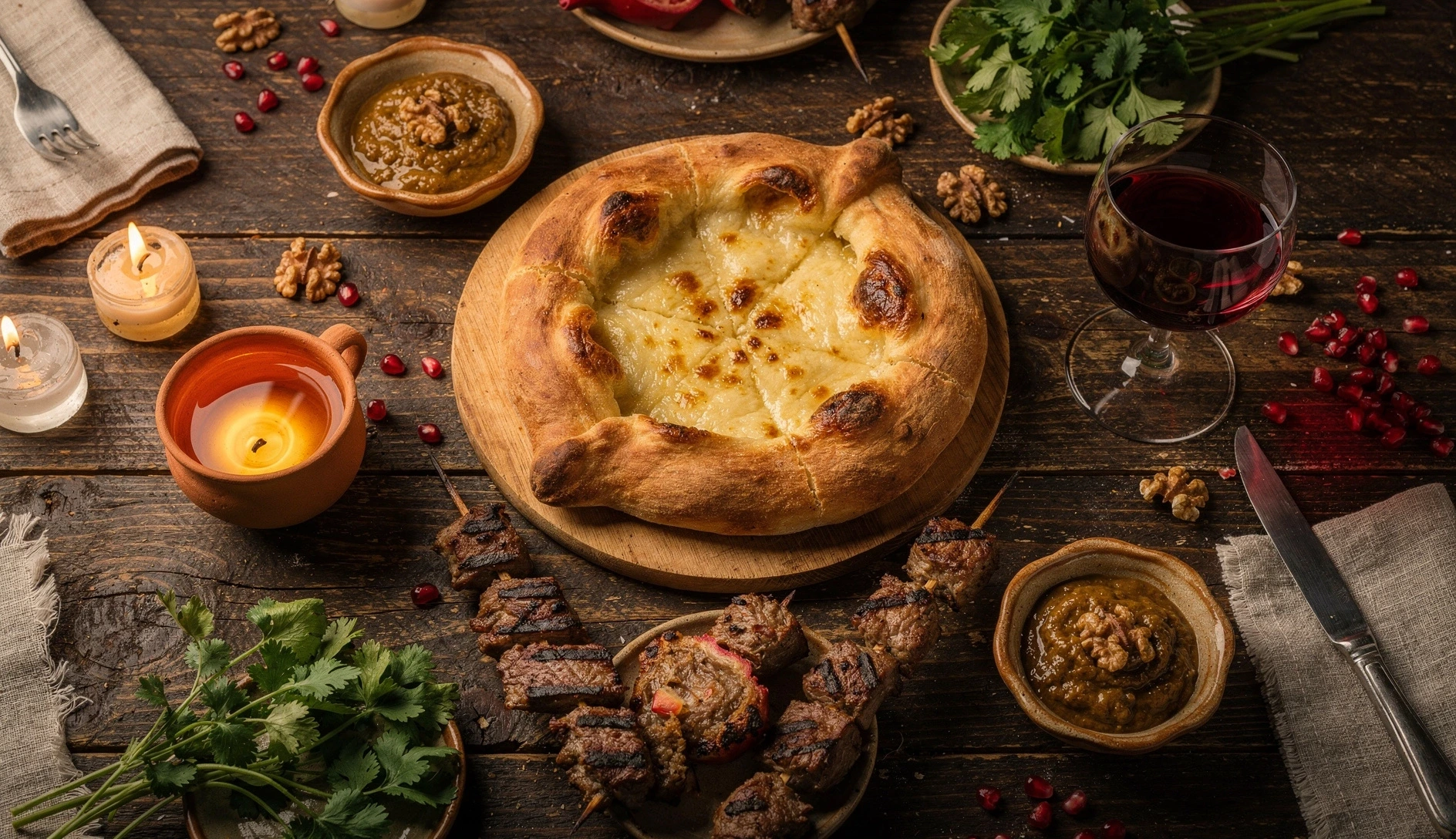
Georgia has been making wine for 8,000 years and cooking extraordinary food for just as long. The two evolved together — not as separate traditions that someone later decided to "pair," but as a single culture where the wine on the table was always made to drink with the food next to it. That matters, because it means Georgian wine and food pairing isn't about following rules from a sommelier textbook. It's about understanding a relationship that's been developing since the Neolithic.
The problem with most pairing guides is they treat Georgian wine like it's French wine with different grape names. It isn't. Amber wines made in qvevri don't behave like conventional whites. Saperavi isn't Cabernet with a Georgian accent. And the food — heavy on walnuts, fresh herbs, sour fruit sauces, and melted cheese — doesn't map neatly onto Western pairing logic either. You need a different framework.
This guide gives you one. Dish by dish, wine by wine, based on what actually works at a Georgian table.
How Georgian Pairing Actually Works
Forget everything you know about "white with fish, red with meat." Georgian cuisine breaks those rules constantly, and Georgian wine was never designed around them in the first place.
Three things make Georgian pairing unique:
Amber wine is the wildcard. Skin-contact white wines made in qvevri have the tannin structure of a light red but the acidity of a white. They pair with foods that stump conventional wines — things loaded with walnuts, cheese, and herbs simultaneously. When in doubt at a Georgian table, amber wine is almost always a safe bet.
Sour fruit sauces change everything. Tkemali (sour plum sauce), satsebeli (tomato-herb sauce), and pomegranate reduction are on every Georgian table. They add acidity that shifts the pairing equation — a rich meat dish becomes wine-friendly in a completely different way when there's tkemali involved.
The supra dictates the flow. A Georgian supra (feast) doesn't serve courses — everything hits the table at once, and you eat for hours. The wine needs to work across dozens of dishes simultaneously. That's why Georgians don't typically switch wines between dishes. They pick one or two and stick with them. The wines evolved to be versatile, not specialized.
The One-Wine Supra Rule
If you can only bring one wine to a Georgian feast, bring an amber Rkatsiteli or Mtsvane. It handles cheese, meat, vegetables, walnut sauces, and pickles equally well. Saperavi is the crowd favorite, but it can overwhelm delicate herb dishes. Amber wine has no such weakness.
The Four Georgian Wine Styles (Quick Reference)
Before we get into specific pairings, here's what you're working with. Georgian wine falls into four broad categories, and understanding them is the foundation of everything that follows.
| Style | Key Grapes | Flavor Profile | Best With |
|---|---|---|---|
| Red | Saperavi, Aleksandrouli, Otskhanuri Sapere | Deep, tannic, dark fruit, sometimes smoky | Grilled meat, stews, beans, aged cheese |
| White (European-style) | Tsinandali blend, Kisi, Mtsvane | Crisp, citrus, stone fruit, mineral | Fish, light salads, fresh cheese, chicken |
| Amber (qvevri white) | Rkatsiteli, Mtsvane, Kisi, Khikhvi | Tannic, nutty, dried fruit, tea-like | Almost everything — cheese, nuts, herbs, meat |
| Semi-sweet Red | Khvanchkara, Kindzmarauli | Fruity, soft tannins, slightly sweet | Spicy food, blue cheese, desserts, fruit |
Cheese and Bread Dishes
Cheese is the backbone of Georgian cuisine. It shows up in bread, in pastries, fried, baked, stuffed, and just sliced on a plate. The pairing depends heavily on which cheese and how it's prepared.
Khachapuri (All Varieties)
Adjarian khachapuri — the boat-shaped one with the egg and butter — is the richest version. It needs a wine with enough acidity and structure to cut through all that melted cheese and fat. Amber Rkatsiteli is perfect here. The tannins scrub your palate clean, and the nutty notes complement the browned cheese. If you prefer red, a young, fruit-forward Saperavi works too — the acidity matches the salt of the sulguni.
Imeretian khachapuri is lighter — just soft cheese in dough. A crisp European-style white (Tsinandali or Kisi) won't overpower it. Megrelian, loaded with extra cheese on top, swings back toward needing amber wine or light red.
Penovani (puff pastry style) — the buttery layers love a sparkling wine if you can find Georgian one, or a high-acid amber.
| Khachapuri Type | Best Wine | Why It Works |
|---|---|---|
| Adjarian (boat) | Amber Rkatsiteli | Tannins cut through butter and egg richness |
| Imeretian (round) | Tsinandali or Kisi | Crisp acidity balances soft cheese without overpowering |
| Megrelian (double cheese) | Amber Mtsvane or young Saperavi | Needs structure to handle the extra cheese intensity |
| Penovani (puff pastry) | Sparkling or high-acid amber | Acidity and bubbles lift the heavy butter layers |
| Achma (layered) | Amber Rkatsiteli | Rich, lasagna-like layers need tannic white |
Other Cheese and Bread
Lobiani (bean-filled bread) is earthy and heavy. Red Saperavi is the natural partner — beans and tannic red wine have a deep affinity across many food cultures. Kubdari (Svan meat pie), spiced and fatty, demands a full-bodied Saperavi with some age on it. Chvishtari (cheesy cornbread) is simple enough for any amber or white.
Grilled Meat and Stews
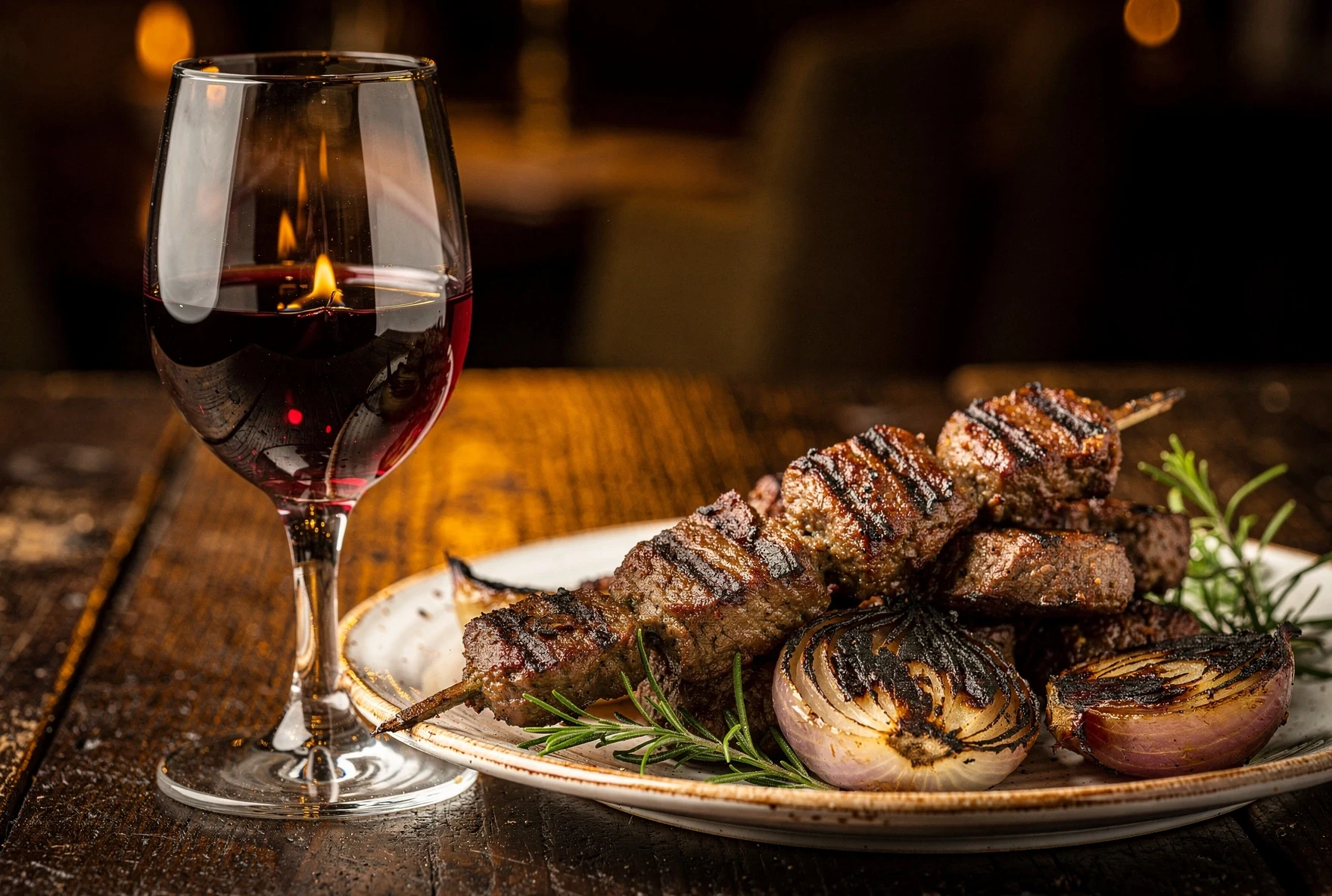
This is Saperavi territory. Georgia's signature red grape was made for meat — literally, in the sense that for thousands of years, the same families who raised livestock also grew Saperavi vines. The pairing is in the terroir.
Mtsvadi (Grilled Meat Skewers)
Mtsvadi — pork or beef cooked over grapevine coals — is the ultimate Saperavi pairing. The smoky char on the meat mirrors the dark fruit and slight smokiness in a good Saperavi. Medium-bodied, not overly tannic. If you're grilling pork mtsvadi specifically, a lighter Saperavi (like one from Kartli rather than Kakheti) keeps things balanced. Beef mtsvadi can handle the biggest, most concentrated Saperavi you can find.
Stews: Chashushuli, Chanakhi, Ostri
Chashushuli (spicy veal stew) has tomatoes and chili heat — a medium Saperavi works, but an unexpected option is semi-sweet Kindzmarauli. The residual sugar tames the spice, similar to how off-dry Riesling works with spicy Asian food. Try it before you dismiss it.
Ostri is the hotter, quicker beef dish and usually wants the same logic pushed one click further. Young Saperavi works if you want structure, but slightly chilled Kindzmarauli or another semi-sweet red is genuinely good here because the sweetness rounds out the adjika and chili without flattening the beef.
Chanakhi (lamb stew with eggplant) is rich and fatty. Full-bodied Saperavi or Aleksandrouli from Racha. The lamb fat needs serious tannins to cut through. Chakapuli (lamb with tarragon and sour plums) is different — it's bright and herbaceous. An amber Kisi or even a crisp Tsinandali brings out those green, sour notes beautifully.
The Chakapuli Exception
Chakapuli is the one lamb dish where red wine is the wrong call. The tarragon and tkemali make it essentially a herb-and-acid dish that happens to contain lamb. Treat it like a vegetable dish for pairing purposes — amber or crisp white, not Saperavi.
Chicken
Chicken tabaka (pressed and fried under a brick) — crispy skin, garlic, herbs. Amber wine is ideal. The tannins and nuttiness match the crispy skin, while the acidity cuts the oil. European-style Mtsvane also works well.
Chakhokhbili (chicken in tomato-herb sauce) — the tomatoes and herbs push this toward a light red or rosé. Tavkveri rosé from Kartli is increasingly available and was practically designed for this dish.
Shkmeruli (garlic cream chicken) — overwhelmingly creamy and garlicky. You need acidity to survive. A bone-dry amber Rkatsiteli or a racy Tsitska from Imereti. Anything soft will get buried.
Satsivi (cold chicken in walnut sauce) is the New Year's dish, traditionally served without wine since it's often eaten on January 1st when everyone is recovering. But if you're pairing it, the walnut richness and spice need amber wine — specifically Kisi, which has a honeyed quality that complements the cinnamon and fenugreek in satsivi.
Walnut-Based Dishes
Walnuts are everywhere in Georgian cooking, and they create a specific pairing challenge. Their richness and slight bitterness can clash with high-tannin reds (tannin + tannin = too astringent) and overpower delicate whites. Amber wine is the answer to nearly every walnut dish — its own nutty, slightly oxidative character creates harmony rather than competition.
| Walnut Dish | What It Is | Best Wine |
|---|---|---|
| Badrijani Nigvzit | Eggplant rolls with walnut paste | Amber Rkatsiteli or Mtsvane |
| Pkhali | Vegetable-walnut pâté | Amber Kisi or Tsinandali |
| Bazhe | Cold walnut sauce (for chicken/fish) | Amber Khikhvi or Kisi |
| Satsivi | Chicken in walnut-spice sauce | Amber Kisi |
| Gebzhalia | Cheese rolls in mint-walnut sauce | Tsitska or light amber |
The one exception: Kharcho contains walnuts but is fundamentally a spicy beef soup. The meat and spice dominate the walnut, so Saperavi actually works here — the walnut thickens the broth but doesn't define the flavor.
Soups
Georgians don't traditionally pair wine with soup the way the French might. At a supra, soup usually isn't served. But when you're having soup as a meal — especially at a restaurant — the pairings are worth knowing.
Kharcho (spicy beef and walnut soup) — medium Saperavi or, surprisingly, semi-sweet Kindzmarauli. The spice-sweetness interplay is excellent.
Chikhirtma (egg-thickened chicken broth with lemon) — this is the hangover soup, so you're probably not pairing it with anything. But if you are: a very light, crisp Tsinandali or Tsitska. The lemon acidity wants matching acidity in the wine.
Khashi (tripe soup eaten at 6 AM) — traditionally paired with chacha (grape brandy), not wine. Some things shouldn't be messed with.
Khashi and Chacha
Khashi is always eaten at dawn — it's a recovery meal. The tradition is a shot (or three) of chacha alongside the garlic-laden tripe broth. This isn't a wine occasion. If someone offers you wine with khashi, they're either a tourist or testing you.
Khinkali (Dumplings)
Khinkali is a contentious topic in Georgian food pairing because traditionally, khinkali is paired with beer, not wine. The reasoning is practical: you eat khinkali with your hands, it's greasy, and you consume large quantities. Beer is the natural companion.
But if you insist on wine (and many restaurants now serve khinkali alongside wine without issue), here's what works:
Meat khinkali (the classic, with pork-beef mix and broth inside): Light to medium Saperavi, slightly chilled. The spiced meat filling wants red wine, but the dough wrapping dilutes the meat flavor enough that you don't need anything massive. Alternatively, a robust amber Rkatsiteli handles the dough and meat equally well.
Cheese khinkali: Amber wine or crisp white. Same logic as khachapuri — acidity and structure to match molten cheese.
Mushroom khinkali: This is actually the best wine-pairing khinkali. Earthy mushrooms love Saperavi's dark fruit, or an amber Kisi with its slightly honeyed earthiness.
Potato khinkali: The simplest filling pairs with the simplest wine. Any light white or amber.
Vegetable Dishes and Starters
Georgian vegetable dishes are some of the most complex and flavor-dense in the cuisine — often more interesting to pair than the meat dishes because they combine multiple challenging elements: walnuts, fresh herbs, vinegar, garlic, and various spice blends.
Ajapsandali (Georgian ratatouille) — eggplant, tomato, pepper, and herbs. A classic match for rosé (Tavkveri) or a light amber wine. The Mediterranean-esque flavors want something with freshness.
Lobio (spiced kidney beans) — earthy, hearty, slightly spicy. Saperavi is the classic pairing. Beans and tannic red wine is one of those combinations that works across every food culture where both exist — Tuscany has Chianti and fagioli, Georgia has Saperavi and lobio.
Soko Ketsze (mushrooms in clay pot with cheese) — the earthiness of mushrooms plus the richness of melted sulguni cheese. Amber wine is ideal. If you go red, keep it light — a Tavkveri or young Saperavi.
Tolma (stuffed grape leaves) — the grape leaves themselves add a tannic, slightly bitter element. Amber wine mirrors this beautifully. European-style Rkatsiteli is also a safe choice.
Sauces and Condiments
Georgian sauces aren't just accompaniments — they fundamentally change the pairing equation for whatever they're served with. Understanding how each sauce interacts with wine is key.
Tkemali (Sour Plum)
Adds bright acidity to grilled meats and potatoes. The sourness wants a wine with matching or higher acidity — Saperavi (naturally high-acid) or amber wine. Avoid low-acid, fruity wines — tkemali will make them taste flat.
Adjika (Chili Paste)
Heat from adjika amplifies tannin perception and makes high-alcohol wines taste hotter. Go for lower-alcohol amber wines or semi-sweet reds (Kindzmarauli) that tame the burn.
Bazhe (Walnut Sauce)
Cold, rich, nutty. The walnut fat coats your palate — you need acidity and some tannin to cut through. Bazhe makes amber wine shine more than almost any other Georgian preparation.
Satsebeli (Tomato-Herb)
The acidity from tomatoes and the herbal notes make satsebeli wine-friendly. Light reds, rosé, or amber all work. It's one of the most forgiving sauces for wine pairing.
The Master Pairing Table
Here's the full reference — every major Georgian dish matched with its ideal wine. Bookmark this one.
| Dish | Category | First Choice | Alternative |
|---|---|---|---|
| Adjarian Khachapuri | Cheese bread | Amber Rkatsiteli | Young Saperavi |
| Khinkali (meat) | Dumplings | Beer (traditional) | Light Saperavi or amber |
| Mtsvadi (pork) | Grilled meat | Medium Saperavi | Otskhanuri Sapere |
| Mtsvadi (beef) | Grilled meat | Full-bodied Saperavi | Aleksandrouli-Mujuretuli |
| Chakapuli | Lamb stew | Amber Kisi | Tsinandali |
| Chashushuli | Spicy stew | Medium Saperavi | Kindzmarauli |
| Chanakhi | Lamb stew | Full-bodied Saperavi | Aleksandrouli |
| Chicken Tabaka | Fried chicken | Amber Mtsvane | European-style Mtsvane |
| Shkmeruli | Garlic cream chicken | Dry amber Rkatsiteli | Tsitska |
| Chakhokhbili | Chicken stew | Tavkveri rosé | Light amber |
| Satsivi | Cold walnut chicken | Amber Kisi | Amber Khikhvi |
| Lobio | Bean stew | Saperavi | Robust amber |
| Badrijani Nigvzit | Eggplant-walnut | Amber Rkatsiteli | Amber Mtsvane |
| Pkhali | Vegetable-walnut | Amber Kisi | Tsinandali |
| Kharcho | Spicy beef soup | Medium Saperavi | Kindzmarauli |
| Ojakhuri | Fried meat + potatoes | Saperavi | Amber Rkatsiteli |
| Kupati | Sausages | Saperavi | Otskhanuri Sapere |
| Kuchmachi | Organ meats | Full Saperavi | Khvanchkara |
| Elarji | Cheesy cornmeal | Amber Rkatsiteli | Tsitska-Tsolikouri |
| Chirbuli | Eggs in tomato | Tavkveri rosé | Light amber |
Sweets and Dessert
Georgian desserts are heavily nut and fruit-based rather than sugar-bomb pastries, which makes them more wine-friendly than you might expect.
Churchkhela (walnut strings dipped in grape must) — the ultimate Georgian snack. Khvanchkara (semi-sweet red from Racha) is the classic pairing. The grape flavors in churchkhela literally come from the same fruit family. Kindzmarauli works too.
Gozinaki (honey-walnut brittle, eaten on New Year's) — very sweet, very crunchy. Needs a wine sweeter than the food or something completely different. Late-harvest Rkatsiteli if you can find it, or honestly, chacha.
Pelamushi (grape pudding) — made from grape must, like a liquid churchkhela. Semi-sweet Kindzmarauli mirrors the grape flavors. Or skip wine and drink tea — many Georgians do.
Nazuki (sweet spiced bread) — cinnamon, cloves, and a hint of sweetness. Semi-sweet red or even a slightly chilled Khvanchkara.
Buying Georgian Wine: What to Look For
Not all Georgian wine is created equal. The market ranges from excellent natural wines made by passionate small producers to mass-produced, industrially sweetened bottles that taste like grape juice with alcohol. Here's how to navigate it.
For Amber Wine
Look for "qvevri" on the label — it means the wine was made in clay vessels underground. Producers to trust: Pheasant's Tears, Iago's Wine, Lapati Wines, Nikoladzeebis Marani, Our Wine. Expect to pay ₾30-80 ($11-30) for a good bottle in Georgia, more abroad.
For Saperavi
Kakheti is the heartland. Avoid the cheapest bottles (under ₾10) — they're often bulk wine. Good mid-range: Teliani Valley, Marani, Shumi. Premium: Vinoterra, Baia's Wine, Gotsa. A solid Saperavi costs ₾20-50 ($7-18) in Georgia.
For Semi-Sweet
This is where fakes thrive. Real Khvanchkara and Kindzmarauli are appellation-controlled — they must come from specific micro-zones and specific grapes. If a bottle is under ₾15, it's almost certainly artificially sweetened industrial wine. Pay more or don't bother.
For European-Style White
Tsinandali (Rkatsiteli-Mtsvane blend, oak-aged) is the most famous appellation. Telavi Wine Cellar and Shumi make reliable versions. For un-oaked freshness, look for varietal Kisi or Mtsvane from smaller producers.
The Tourist Trap Wine Warning
Tourist restaurants in Tbilisi's Old Town frequently serve industrial wine by the carafe at ₾5-8 per liter. It's drinkable but bears no resemblance to real Georgian wine. If you want to understand what Georgian wine can actually be, visit a wine bar like Vino Underground, g.Vino, or Wine Gallery and try bottles from small producers. The difference will reset your expectations entirely.
Practical Tips for Georgian Wine and Food
A few things that are obvious to anyone who's spent time eating in Georgia but rarely mentioned in pairing guides:
Temperature matters more than variety. In Georgian summers (35°C+), even Saperavi benefits from a slight chill — 15-16°C rather than room temperature. Amber wine should be served at cellar temperature (12-14°C), not fridge-cold. Too cold and the tannins become harsh; too warm and the fruit turns flabby.
Georgians drink wine from clay cups (piala). This isn't just aesthetic — the wide, open shape lets you smell the wine differently than a stemmed glass. For amber wines especially, a piala arguably works better than a wine glass. The tannin structure doesn't need the concentration that a tulip glass provides.
At a supra, you drink when the tamada says. The toastmaster controls the pace of the feast — including wine consumption. You don't sip independently. This means pairing becomes less about individual dishes and more about how well your wine holds up over 3-4 hours of continuous eating and toasting. Another reason amber and Saperavi dominate: they're marathon wines, not sprint wines.
Chacha before, wine during, chacha after. The traditional Georgian drinking arc starts with a shot of chacha (grape brandy), transitions to wine with food, and often ends with chacha again. If you're hosting a Georgian-style dinner, this matters — the palate is already primed when the wine arrives.
Pickles are the palate cleanser. Between rich dishes, Georgians reach for pickled vegetables — jonjoli (pickled blossoms), pickled garlic, pickled peppers. These reset your palate between bites in a way that bread does in Western dining. The vinegar also keeps the wine tasting fresh.
Frequently Asked Questions
Can I use non-Georgian wines?
Of course, but you'll be working harder. The closest equivalents: Jura Savagnin for amber wine, Monastrell or Touriga Nacional for Saperavi, off-dry Riesling for semi-sweet reds. But honestly, Georgian wines are increasingly available worldwide and not expensive. Use the real thing.
What if I only like white wine?
Try amber. It bridges the gap between white and red — has structure and tannin like a red but made from white grapes. Many "white wine only" people discover amber wine and never look back. Start with Kisi qvevri — it's the most approachable amber for newcomers.
Is Kindzmarauli really good or just famous?
Real Kindzmarauli from a good producer (Khareba, Marani, smaller estates) is genuinely excellent — soft, fruity, with real complexity. The problem is that 90% of bottles labeled "Kindzmarauli" in tourist shops are industrial sweetened wine. If you've only tried cheap versions, you haven't tried Kindzmarauli.
What wine for a first Georgian dinner?
One bottle of amber Rkatsiteli and one bottle of Saperavi. Between them, they'll cover everything on the table. If you can only get one, go amber — it's more versatile with the breadth of a Georgian spread.
Do Georgians actually care about pairings?
Not in the Western "sommelier recommends" sense. Most families drink whatever wine they made (or their neighbor made). But there's an intuitive understanding — you'll never see a Georgian grandmother serving Kindzmarauli with khinkali. The pairings evolved naturally over centuries.
Written by The Georgian Eats Team
Based in Tbilisi, we've spent years eating and drinking our way through Georgia's wine bars, home supras, and village feasts. These pairings come from experience at the table, not from textbooks.
Last updated: February 2026.
Related Articles
What Is Georgian Amber Wine?
The 8,000-year-old winemaking tradition that's reshaping how the world thinks about white wine.
Georgian Grape Varieties
From Saperavi to Rkatsiteli — a guide to Georgia's 525+ native grape varieties.
Qvevri Winemaking
How Georgian winemakers use buried clay vessels to create wines unlike anything else on earth.
The Georgian Supra
Everything you need to know about Georgia's legendary feast tradition.