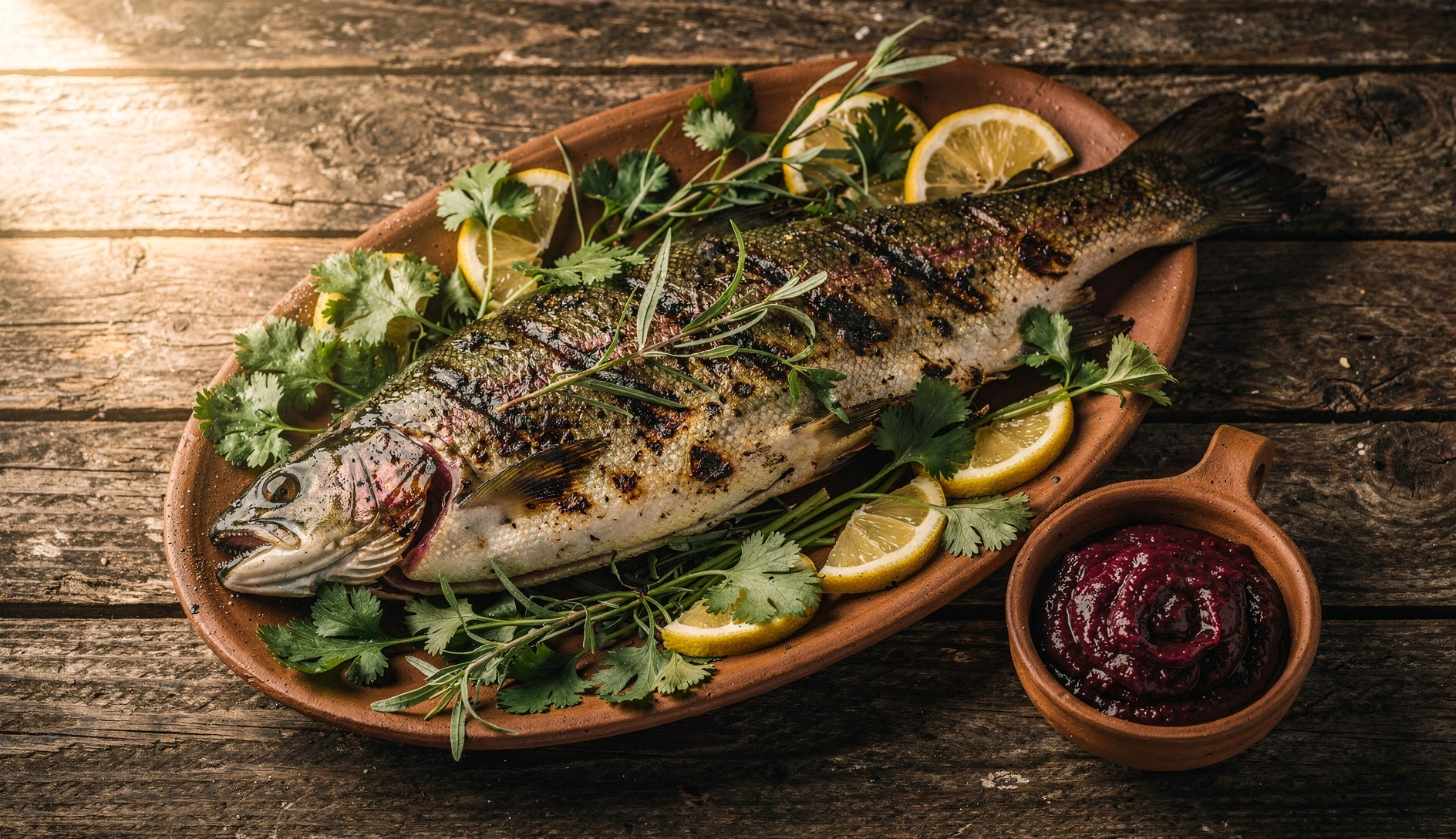
Georgia's mountain rivers are full of trout, and Georgians have been cooking them the same way for centuries — whole, bone-in, with not much more than salt, fire, and whatever grows nearby. Kalmakhi (კალმახი) is the Georgian word for trout, and if you've driven through the Aragvi valley, Borjomi gorge, or anywhere in Tusheti, you've seen the roadside restaurants with tanks of live fish out front. You point at one, they pull it out, and twenty minutes later it's on your plate. This is how you make it at home — three ways, all of them simple, all of them better than whatever you're doing with salmon fillets.
Kalmakhi Quick Facts
- Georgian name: კალმახი (kal-MA-khi)
- Best fish: Rainbow trout, brown trout, or Arctic char
- Traditional cooking: Whole, over charcoal or in a pan
- Key seasoning: Salt, black pepper, blue fenugreek
- Classic accompaniment: Tkemali sauce
- Where to eat it in Georgia: Aragvi valley, Borjomi, Pasanauri, Tusheti
- Cost in restaurants: 15–25 GEL ($5–9 USD)
Why Georgian Trout Is Different
Most Western trout recipes involve delicate pan-searing, dill, and white wine — French-influenced, careful, restrained. Georgian trout is none of those things. The fish is cooked whole (head, tail, bones — all of it), seasoned aggressively with spices you probably can't buy at a regular supermarket, and served with sauces that have nothing to do with beurre blanc.
The difference starts with the spices. Blue fenugreek (უცხო სუნელი, utskho suneli) gives the fish an earthy, slightly nutty flavor that's impossible to replicate with any single Western spice. Ground coriander adds warmth. And tkemali — the sour plum sauce that's on every Georgian table — does for trout what lemon does for fish in the Mediterranean, but with more complexity and a sweet-tart punch.
Then there's the cooking method. Georgians don't fillet trout. They cook it whole, which keeps the flesh impossibly moist and gives you those crispy skin bits that stick to the grill. The bones come out easily once cooked, and the head? Some people eat that too. At minimum, the cheeks are worth picking at — they're the best part of any fish.
Choosing Your Fish
You want whole trout, 350–450g each (roughly 12–16 inches). One fish per person for a main course, or one between two as part of a larger Georgian spread. Ask your fishmonger to gut and clean them but leave the head and tail on.
| Fish | Best For | Notes |
|---|---|---|
| Rainbow Trout | All three methods | Most authentic. Mild, sweet, widely available. |
| Brown Trout | Grilling, pan-frying | Slightly richer flavor. Firmer flesh holds up to heat. |
| Arctic Char | Pan-frying, pomegranate | Fattier, more delicate. Beautiful pink flesh. |
| Steelhead Trout | All three methods | Larger, may need to butterfly. Excellent flavor. |
Don't Use Salmon
Salmon is too oily and strong-flavored for this preparation. The Georgian spice profile and tkemali pairing work specifically with the cleaner, more delicate taste of trout. If you can only find salmon, make something else — try bazhe sauce with poached salmon instead.
The Essential Seasoning Mix
This is the base seasoning for all three cooking methods. Mix it up ahead of time — it keeps in a sealed jar for months.
Per 2 Trout
- 2 tsp fine sea salt
- 1 tsp freshly ground black pepper
- 1 tsp blue fenugreek (utskho suneli)
- ½ tsp ground coriander
Substitutions
- No blue fenugreek? Use ½ tsp dried fenugreek leaves + pinch of dried marigold
- No dried marigold? Skip it. Don't use turmeric as a substitute — it's the wrong flavor entirely.
- Khmeli suneli (Georgian spice mix) works as an all-in-one alternative
Score each fish 2–3 times diagonally on both sides, cutting about halfway to the bone. This lets the seasoning penetrate and helps the fish cook evenly. Rub the spice mix inside the cavity and into the scored cuts. Let the fish sit for 15–20 minutes at room temperature — don't skip this. Cold fish on a hot grill or pan steams instead of searing.
Method 1: Charcoal-Grilled (The Classic)
This is how you'll eat kalmakhi at any mountain restaurant in Georgia. The fish goes directly over charcoal — no foil, no grill basket, just fish and fire. If you have access to a charcoal grill, this is the version to make.
What You Need
- Charcoal grill (kettle, kamado, or open grill)
- Seasoned trout (see above)
- Vegetable oil for brushing
- Long tongs and a wide spatula
Step by Step
- Build a medium-hot fire. You want coals you can hold your hand over for about 3–4 seconds. Not screaming hot — trout is delicate and burns fast.
- Clean and oil the grill grate thoroughly. This is not optional. Trout skin sticks like nothing else. Oil a folded paper towel with vegetable oil and rub the grate right before cooking.
- Brush the fish lightly with oil on both sides.
- Place fish on the grill at a 45-degree angle to the grate bars. This gives you better grill marks and makes flipping easier.
- Cook 5–6 minutes per side. Don't touch it for the first 4 minutes — the skin needs to set and release from the grate. If it's sticking, it's not ready to flip.
- Flip once, carefully. Use a wide spatula underneath and tongs to support the head. If the skin tears a little, don't panic — it still tastes the same.
- Check for doneness: The flesh should be opaque and flake easily when poked with a fork at the thickest part (just behind the head). The skin should be charred in spots and crispy.
Method 2: Butter-Basted in Cast Iron
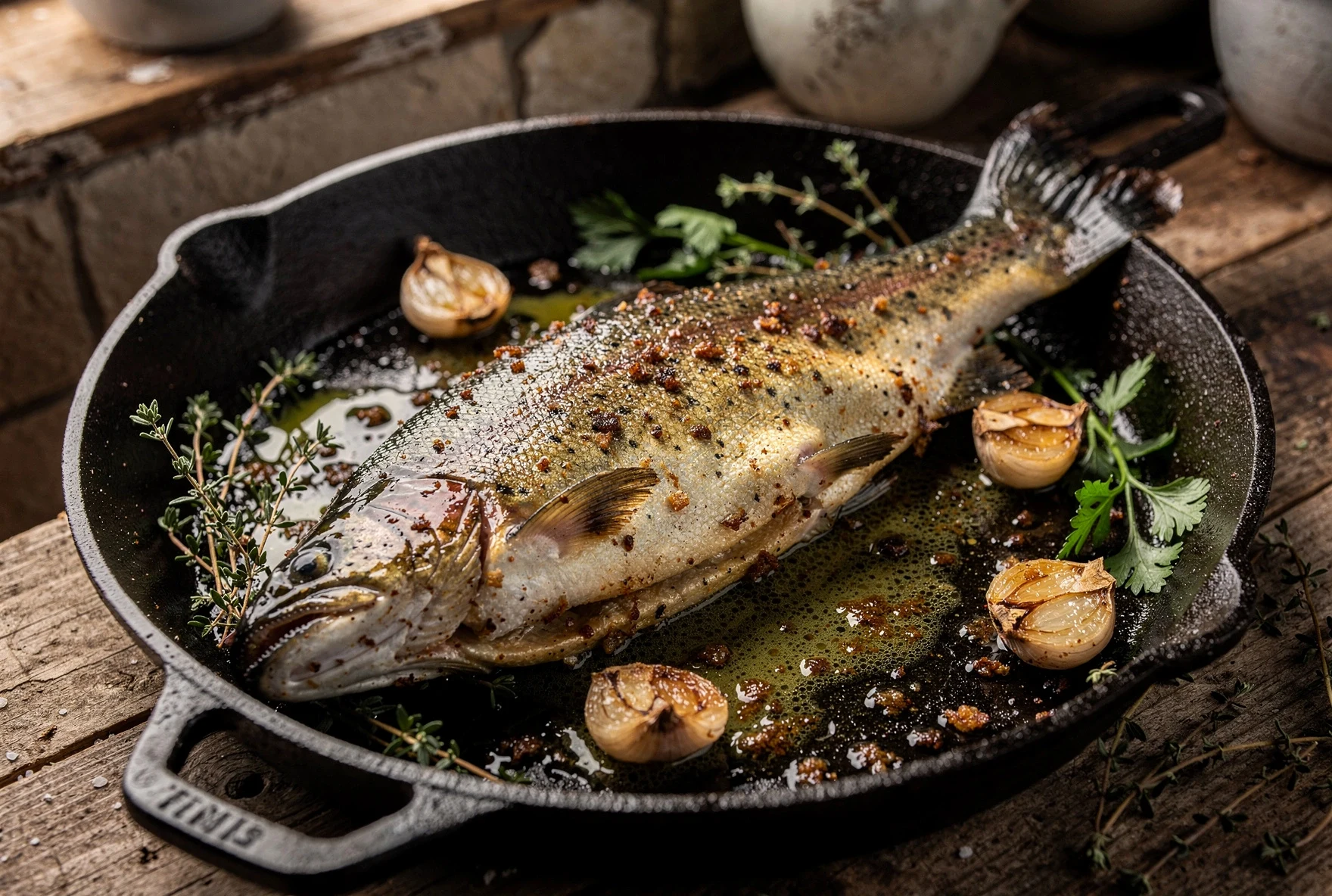
If you don't have a grill, this is arguably the better version anyway. A cast iron skillet gets the skin shatteringly crispy, and you baste the fish with foaming butter, garlic, and tarragon in the last couple of minutes. It's the kind of thing that makes your kitchen smell so good the neighbors come knocking.
What You Need
- Large cast iron skillet (12 inches minimum — the fish needs room)
- 4 tbsp butter
- 4 cloves garlic, lightly crushed with the flat of a knife
- 4–5 sprigs fresh tarragon (or cilantro)
- Seasoned trout
Step by Step
- Heat the skillet over medium-high for 2–3 minutes. It needs to be properly hot before the fish goes in.
- Add 2 tbsp butter. Let it melt, foam, and just start to smell nutty. Not brown — just nutty.
- Lay the trout in the pan away from you (to avoid splatter). Press it down gently with a spatula for the first 30 seconds to ensure full contact with the pan.
- Cook 4–5 minutes without moving. The skin will crackle and pop. That's good. Peek underneath — you want deep golden brown, not pale.
- Flip the fish. Add the remaining 2 tbsp butter, garlic cloves, and tarragon sprigs to the pan.
- Tilt the pan slightly and use a spoon to baste the fish with the foaming butter, garlic, and herb mixture. Do this continuously for 2–3 minutes.
- Remove when the flesh flakes easily. Pour the pan butter over the fish on the plate.
The Butter Basting Trick
Tilting the pan and spooning the butter over the fish is the single most important technique here. It cooks the top side gently while the bottom crisps, and it infuses the fish with garlic and herb flavor without you having to flip it twice. In Georgian mountain restaurants, they often use clarified butter (erbo) which has a deeper, nuttier taste. If you have ghee, use that.
Method 3: In Pomegranate Sauce
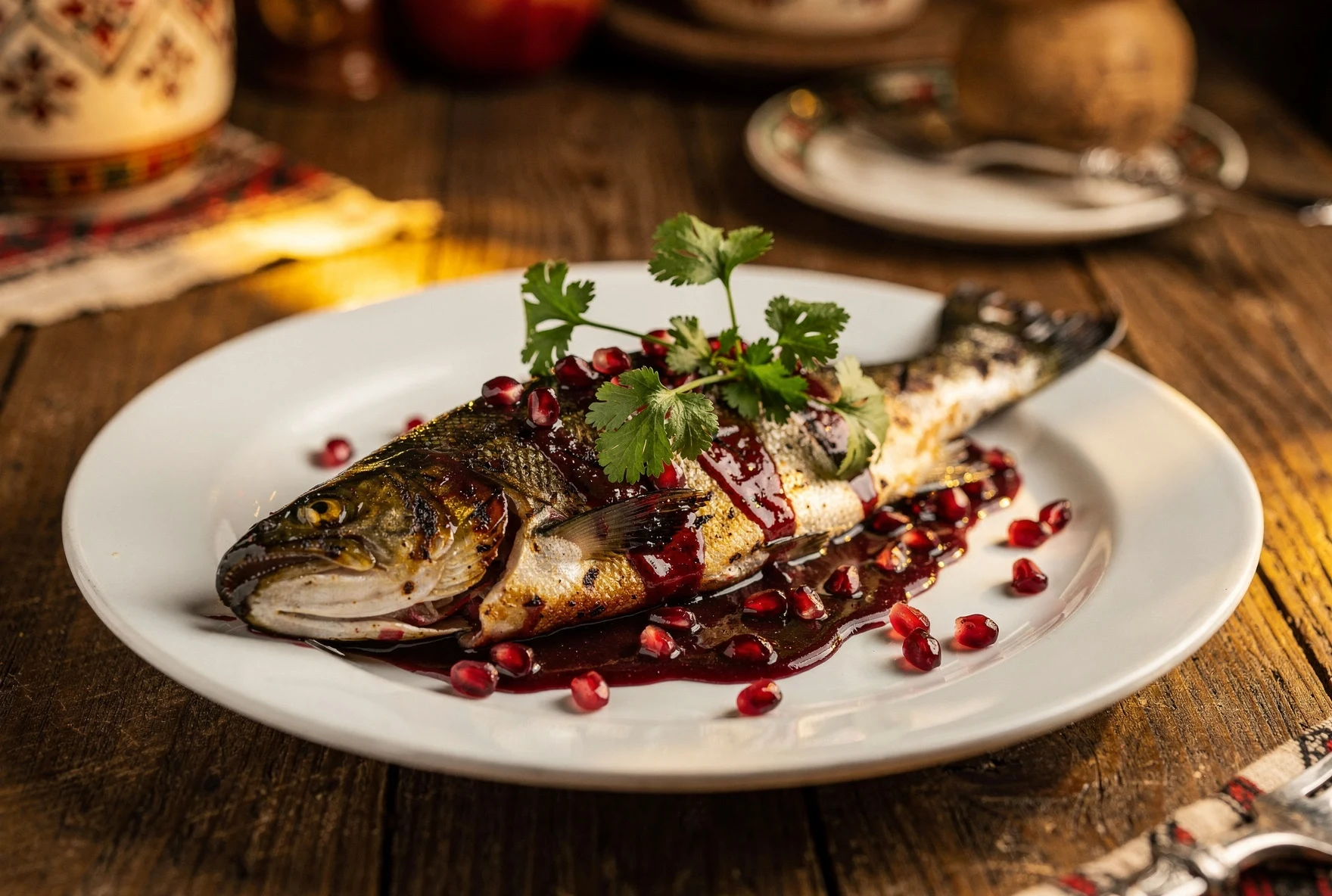
This is the showpiece version — kalmakhi brotseulis tsvenshi (კალმახი ბროწეულის წვენში). Pan-fried trout finished in a walnut-studded pomegranate sauce, scattered with ruby seeds. It looks like something from a food magazine, and it's the version Georgian grandmothers make when they want to show off.
Additional Ingredients
- 200ml pomegranate juice (fresh-pressed or 100% pure, not from concentrate)
- 1 medium onion, thinly sliced
- 50g walnuts, ground to a coarse powder
- ½ tsp ground coriander
- Pinch of ground cinnamon
- Seeds from ½ pomegranate
- Fresh cilantro for garnish
Step by Step
- Pan-fry the trout as in Method 2, but without the butter basting. Just cook until golden on both sides. Remove to a plate.
- In the same pan (don't clean it — those fish drippings are flavor), add a splash of oil and cook the sliced onion over medium heat until soft and translucent, about 5 minutes.
- Add the pomegranate juice and bring to a simmer. Let it reduce by about half — this concentrates the flavor and thickens the sauce naturally. Takes about 5–7 minutes.
- Stir in the ground walnuts, coriander, and cinnamon. The sauce will thicken further and turn a deep ruby color.
- Return the trout to the pan. Spoon the sauce over the fish and simmer gently for 3–5 minutes so the fish absorbs some of the sauce.
- Transfer to a plate. Spoon the sauce over, scatter pomegranate seeds and cilantro on top.
Wine Pairing
The grilled and pan-fried versions pair beautifully with a dry Kakheti white — Rkatsiteli or Mtsvane, ideally with some skin contact (amber/orange style). The pomegranate version wants something with more body: a full amber wine or even a light Saperavi rosé. Read more in our Georgian wine and food pairing guide.
How to Serve
Georgian trout comes to the table whole — always. You eat it with your hands and a fork, pulling the flesh off the bones as you go. Here's what goes alongside:
Essential Sides
- Tkemali sauce — the default condiment
- Fresh herb platter (tarragon, cilantro, basil, dill)
- Lemon wedges
- Shotis puri or any crusty bread
Goes Well With
- Badrijani nigvzit (eggplant rolls)
- Ajapsandali (summer ratatouille)
- Simple tomato-cucumber salad
- Pickled jonjoli (bladdernut buds)
Tips That Actually Matter
| Problem | Why It Happens | Fix |
|---|---|---|
| Fish sticks to grill | Grate not clean/hot enough, fish not oiled | Oil the grate AND the fish. Wait until skin releases on its own. |
| Skin not crispy | Fish was wet, pan not hot enough | Pat fish completely dry with paper towels. Preheat pan 3 minutes. |
| Fish falls apart when flipping | Overcooked, or flipped too early | Wait. The skin will release when ready. Use two spatulas for support. |
| Flesh is dry | Overcooked (the #1 trout crime) | Pull fish at 60°C / 140°F internal. Carryover heat does the rest. |
| Pomegranate sauce too thin | Didn't reduce enough | Reduce juice by half before adding walnuts. Sauce should coat a spoon. |
Where to Eat the Best Kalmakhi in Georgia
You can find trout at almost any restaurant in Georgia, but these are the places where it's exceptional — where the fish comes from nearby rivers or ponds, and the cooking is genuinely traditional.
| Area | What to Expect | Price Range |
|---|---|---|
| Aragvi Valley (Pasanauri area) | Roadside restaurants with live fish tanks. Pick your fish, they grill it. Classic. | 15–20 GEL |
| Borjomi Gorge | Mountain stream trout, often served alongside mineral water. Clean, sweet fish. | 18–25 GEL |
| Tusheti | The most remote option. River trout cooked over open fire at guesthouses. Worth the 10-hour drive. | 12–18 GEL |
| Lagodekhi | Near the national park. Pond-raised trout, very fresh, quiet setting. | 12–20 GEL |
| Tbilisi | Many restaurants serve trout but it's rarely the star. Best at Salobie Bia or Shavi Lomi. | 22–35 GEL |
Common Questions
Can I use trout fillets instead of whole fish?
You can, but you lose a lot. Bones keep the flesh moist, the skin gets crispier on a whole fish, and it just doesn't look right. If fillets are all you can get, go with the pan-fried method and cook skin-side down for 80% of the time.
Where do I buy blue fenugreek?
Online is easiest — search for "utskho suneli" or "blue fenugreek." Any Georgian or Eastern European grocery will carry it. It's cheap and lasts forever in a sealed container. Read our guide to Georgian spices for sourcing tips.
What's the best sauce for grilled trout?
Tkemali, full stop. The sour plum sauce cuts through the richness of the fish perfectly. Green tkemali for a sharper, more tart hit; red for something sweeter. Some people also serve it with bazhe (cold walnut sauce), which is traditional for cold fish dishes.
Is kalmakhi eaten hot or cold?
Hot for grilled and pan-fried. The pomegranate version is excellent both ways — some Georgians actually prefer it at room temperature, where the sauce thickens and the flavors meld. It makes great leftovers.
Can I use a grill basket or foil?
A grill basket is fine and makes flipping much easier — no judgment. Foil works but you lose the crispy skin and char, which is half the point. If you wrap it in foil, you're basically steaming it, and you should use a different recipe.
How many trout should I make per person?
One 350-450g trout per person for a main course. If you're serving it as part of a bigger Georgian spread with bread, salads, and other dishes, one trout can serve two. In Georgia, one per person is standard, and most people eat the whole thing.
Written by The Georgian Eats Team
Based in Tbilisi, where arguing about whether Pasanauri or Borjomi has the best kalmakhi is considered a legitimate hobby. We've eaten trout at roadside restaurants from Kazbegi to Lagodekhi — usually with too much bread and not enough napkins.
Last updated: March 2026.
Related Articles
Tkemali: Georgia's Sour Plum Sauce
The essential condiment for grilled fish and almost everything else on a Georgian table.
Bazhe: Cold Walnut Garlic Sauce
The traditional sauce for cold fish dishes — ground walnuts, garlic, and Georgian spices.
Georgian Wine & Food Pairing Guide
Which wines go with which dishes — including the perfect match for grilled trout.
Mtsvadi: Georgian BBQ Pork
The other thing Georgians grill over charcoal — pork shoulder with salt and pomegranate juice.