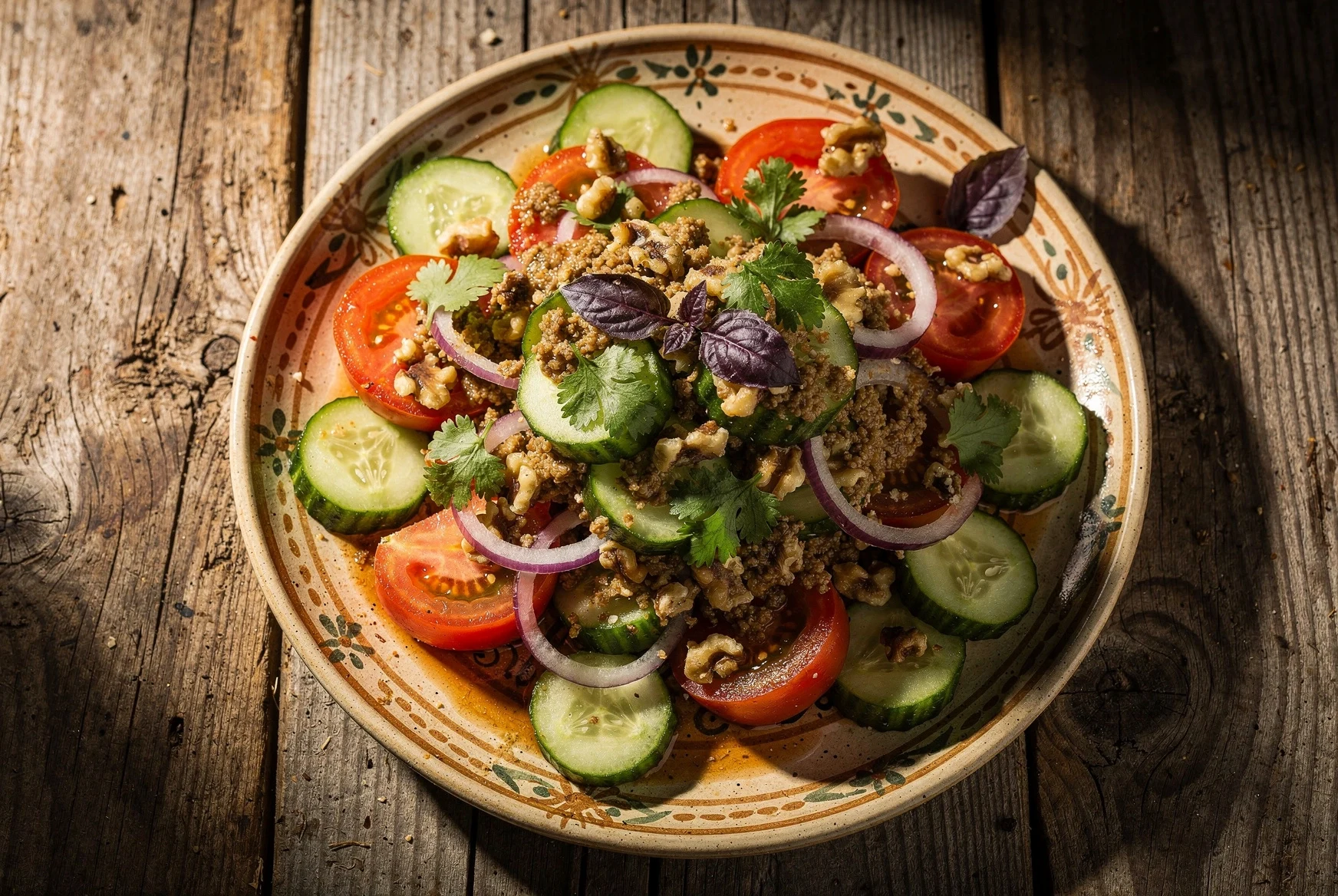
If you eat in Georgia for more than a week, this salad stops feeling like a side dish and starts feeling like a standard of civilization. Good tomatoes, crisp cucumbers, a little onion, fistfuls of herbs, oil, salt. That's the base version. The better version — the one that makes you keep tearing bread and dragging it through the plate long after the meat is gone — adds walnut dressing. Not a polite drizzle. A proper, garlicky, slightly coarse walnut sauce that turns peak summer vegetables into something with weight, depth, and actual Georgian character.
Georgian Salad Quick Facts
- Georgian name: კიტრი-პომიდვრის სალათა (kitri-pomidvris salata)
- Built around: Tomatoes, cucumbers, herbs, and salt — the dressing changes by household
- Best version: Summer tomatoes with walnut dressing and purple basil
- Where you eat it: At home, in restaurants, at supra tables, beside grilled meat, bread, and cheese
- Difficulty: Easy, but ingredient quality decides everything
- Total time: 20-30 minutes
What Makes This Salad Georgian
On paper, tomato-cucumber salad sounds too obvious to deserve an article. In practice, Georgian salad has a very specific personality. First, nobody hides the vegetables under lettuce. The tomatoes are cut big, the cucumbers stay crunchy, and the herbs are used like vegetables rather than garnish. Second, the seasoning is aggressive enough to wake the tomatoes up. Third — and this is the part many English-language recipes either skip or handle badly — walnuts show up whenever the cook wants the salad to carry more weight.
The simplest version is just tomatoes, cucumbers, onion, herbs, oil, and salt. In peak summer, that is not laziness. That is confidence. When the tomatoes are sweet, dense, and actually taste of sun rather than refrigerated sadness, you do not need much else. But in plenty of Georgian homes and restaurants, especially when the salad is part of a bigger spread, walnut dressing turns up as the serious version. It thickens the whole plate, adds garlic and gentle bitterness, and makes the salad feel connected to the rest of the cuisine — to pkhali, badrijani nigvzit, and all the other walnut-heavy dishes that make Georgian food taste unmistakably Georgian.
Ingredients
The ingredient list is short, which is exactly why you cannot hide. A bland tomato kills the whole idea. Watery cucumbers drag it down. Stingy herbs make it feel generic. Treat this like a produce recipe, not a dressing recipe.
| Ingredient | Amount | What matters |
|---|---|---|
| Ripe tomatoes | 4 large | Heavy, fragrant, slightly soft, preferably ugly in a good way |
| Cucumbers | 2 medium | Persian or English work best; avoid giant watery ones |
| Red onion | 1/2 small | Enough for bite, not enough to bully the tomatoes |
| Fresh herbs | 2-3 handfuls total | Cilantro is essential; basil and parsley or dill make it feel right |
| Sunflower oil | 2-3 tbsp | Classic choice in Georgia; mild olive oil is fine if needed |
| Walnuts | 150g | Fresh walnuts matter — stale ones make bitter dressing |
| Garlic + vinegar | 2 cloves + 2 tbsp | The dressing should taste alive, not flat |
Use More Herbs Than Feels Normal
One of the easiest ways to make Georgian food taste less Georgian is to be timid with herbs. This salad should smell green. If the plate looks pretty but restrained, add more cilantro and basil.
Simple Version vs Walnut Version
Both versions are legitimate. The simple version is what you want when the tomatoes are truly brilliant and you are serving the salad beside rich food that already brings plenty of depth — say mtsvadi fresh off the grill or hot Imeretian khachapuri. The walnut version is what you want when the salad needs to hold its own on a crowded table, or when your tomatoes are good but not peak-July-market good.
What you should not do is mash the two styles into one confused mess. If you are going simple, keep it clean and immediate: oil, salt, herbs, done. If you are going walnut, let the dressing be the point and make enough of it to matter.
Making the Walnut Dressing Properly
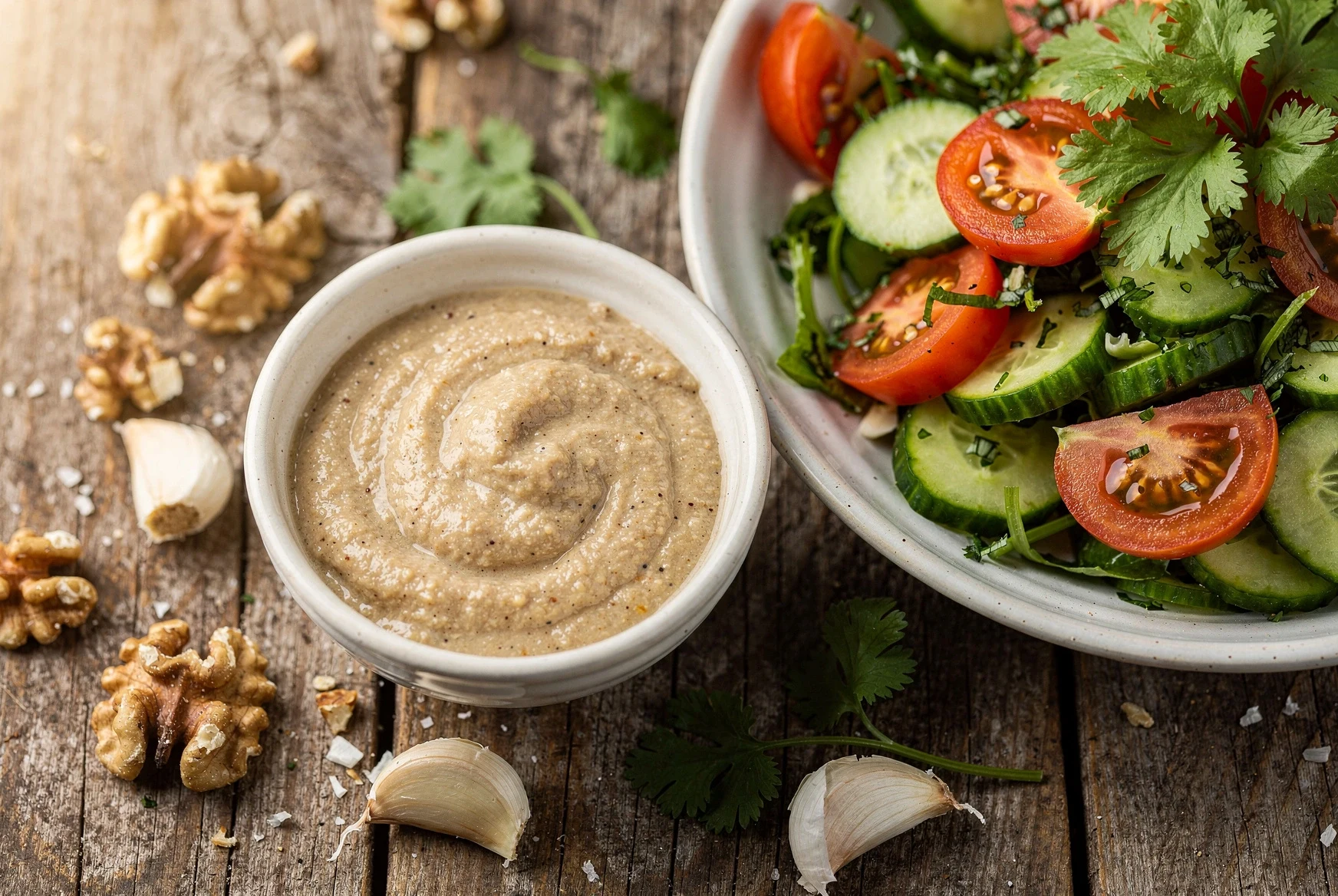
The dressing should sit somewhere between sauce and coarse cream. It is not a vinaigrette, and it is not a smooth puree. If you blitz it into a glossy nut butter, you have gone too far. If it tastes like wet chopped walnuts, you have not gone far enough.
Traditionally, walnuts and garlic would be ground together until the oils started to release, then loosened with vinegar, water, and spices. A food processor is fine, but use it with some restraint. Pulse, scrape, pulse again. Stop when the nuts are fine and damp, not oily.
Flavor profile
Garlicky, gently sharp from vinegar, nutty, slightly earthy from coriander, and a little bitter in the pleasant walnut way. It should taste assertive on its own because the vegetables will dilute it.
Texture target
Spoonable and thick, with visible tiny walnut granules. Think coarse tahini sauce, not ranch, not pesto, and definitely not hummus.
| If it looks like this | What happened | Fix |
|---|---|---|
| Greasy and pasty | Walnuts were over-processed | Loosen with a little cold water and vinegar, then stop touching it |
| Dry and crumbly | Not enough liquid | Add water a tablespoon at a time until spoonable |
| Flat and heavy | Needs acid and salt | Add a little more vinegar and another pinch of salt |
| Too sharp | Too much raw garlic or vinegar | Add a few more ground walnuts and a splash of water |
The Recipe: Step by Step
Step 1: Prep the vegetables
Cut the tomatoes into generous wedges or rough chunks. Do not dice them into sad little cubes. This salad should feel abundant. Slice the cucumbers thick enough to keep their crunch — half-moons about 5-7mm thick work well. Thinly slice the red onion. If the onion tastes harsh, give it 5 minutes in cold water, then drain and pat dry.
Roughly chop the herbs. Cilantro should be the main voice. Purple basil is especially good here because it gives that sweet-anise note you get constantly in Georgia in summer, but regular basil is still better than skipping it.
Step 2: Make the dressing
Add the walnuts and garlic to a food processor and pulse until finely ground. Add vinegar, coriander, optional blue fenugreek, optional chili, and 80ml cold water. Pulse again. Scrape down the sides and check the texture. Add more water only as needed. The dressing should drop from a spoon reluctantly, not pour like vinaigrette.
Taste it before it touches the vegetables. It should taste a bit too salty, a bit too punchy, and a bit too garlicky. That is correct. Once it hits juicy tomatoes and cucumbers, it calms down fast.
Step 3: Dress and plate
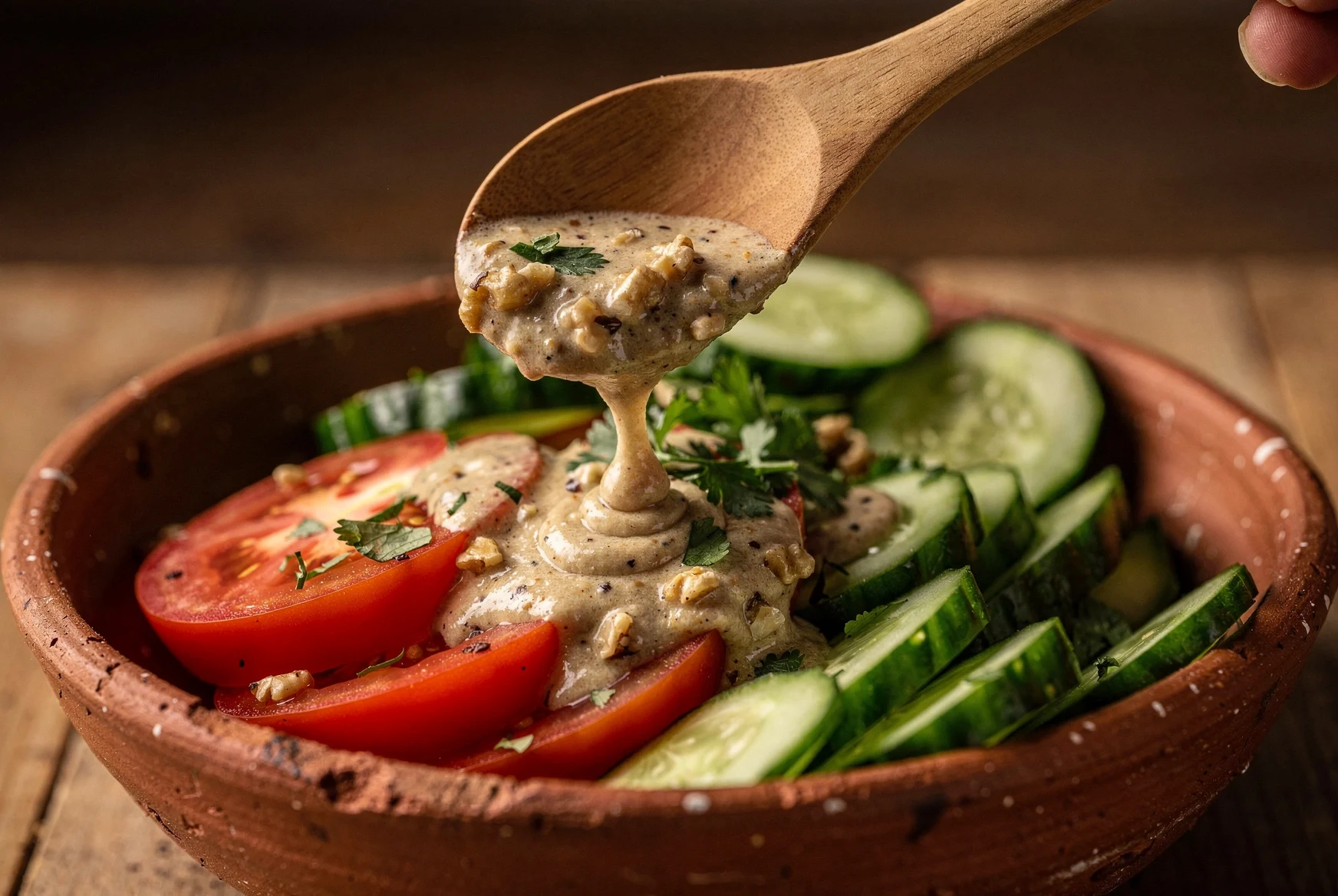
For the simple version, toss the tomatoes, cucumbers, onion, herbs, oil, and salt together in a wide bowl just before serving. For the walnut version, you have two good options: either spoon the dressing over the plated vegetables so you get contrast between fresh and rich, or toss lightly for more even coverage. I prefer spooning it over in patches so some bites stay bright and some get the full walnut hit.
Finish with one last pinch of salt. This sounds minor, but tomatoes lose their nerve quickly once dressed. A final salt adjustment at the plate is often the difference between "nice salad" and the one everyone keeps returning to.
How to Serve It
This salad belongs anywhere there is bread, grilled meat, beans, cheese, or all four at once. In Georgia it is less a "salad course" than a table constant. It sits there beside everything else, cooling down bites of rich food and catching bread drags between conversations.
Best pairings
Serve it with mtsvadi, chicken tabaka, lobio, hot bread, or a plate of Georgian cheese.
What to drink
A crisp white, a light amber wine, cold lager, or just sparkling water. The walnut dressing especially likes wines with grip rather than sugary fruit.
This Is Not a Make-Ahead Salad
You can make the walnut dressing a day ahead, but the salad itself should be cut and dressed right before eating. Tomatoes dump liquid, cucumbers soften, herbs blacken, and the whole thing loses the sharp summer energy that makes it worth making in the first place.
Common Mistakes
| Mistake | Why it hurts the salad |
|---|---|
| Using refrigerated flavorless tomatoes | No dressing on earth can save a tomato that tastes of nothing |
| Cutting everything too small | The salad turns wet and fussy instead of generous and fresh |
| Treating herbs as garnish | You lose the green, aromatic lift that makes the plate feel Georgian |
| Making the walnut dressing too smooth | It feels heavy and oily instead of lively and textured |
| Dressing it too early | The vegetables slump and the plate gets watery fast |
Useful Variations
There is room to move, but only within reason. Crumbled fresh cheese on top works. A few slices of sweet pepper can work in late summer. Some households add dill, others skip it. A touch of blue fenugreek in the walnut dressing tastes more recognizably Georgian. What does not improve the salad: lettuce, sugary balsamic glaze, bottled dressings, or trying to make it "Mediterranean" with olives. Wrong neighborhood.
If you want an even more stripped-back version, leave out the onion and focus on tomatoes, cucumbers, basil, cilantro, oil, and salt. That version is excellent with hot bread and cheese for breakfast or lunch. If you want the richer supra-table feel, keep the walnut dressing thick and serve it beside jonjoli and pickles.
FAQ
Do Georgians always use walnut dressing?
No. Plenty of Georgian salads are dressed simply with oil and salt. The walnut version is common, loved, and more distinctive, but the plain version is just as real.
Can I use olive oil?
Yes, but use a mild one. Unrefined sunflower oil is closer to the flavor many Georgians expect, especially in simple summer salads.
Can I make the dressing without a food processor?
Yes. Chop the walnuts very finely, crush the garlic to a paste, then mix by hand. The texture will be rougher, which is not a problem.
How long does the walnut dressing keep?
About 2 days in the fridge. Stir before using and loosen with a splash of cold water if it tightens up.
Written by The Georgian Eats Team
We eat this the way it is actually eaten in Georgia: beside bread, beans, grilled meat, and whatever tomatoes the season is kind enough to give us. The difference between a forgettable version and a great one is almost always the produce.
Last updated: March 2026.
Related Articles
Georgian Salads & Cold Dishes
The bigger picture: pkhali, badrijani, jonjoli, cheese plates, and how the Georgian cold spread works.
Pkhali
Another cold-table essential built on the Georgian walnut habit, this time with vegetables worked into seasoned paste.
Badrijani Nigvzit
Eggplant rolls with walnut filling — the richer, more celebratory cousin of this salad.
Mtsvadi
The classic grilled-meat partner. If you make one, you may as well make the other.