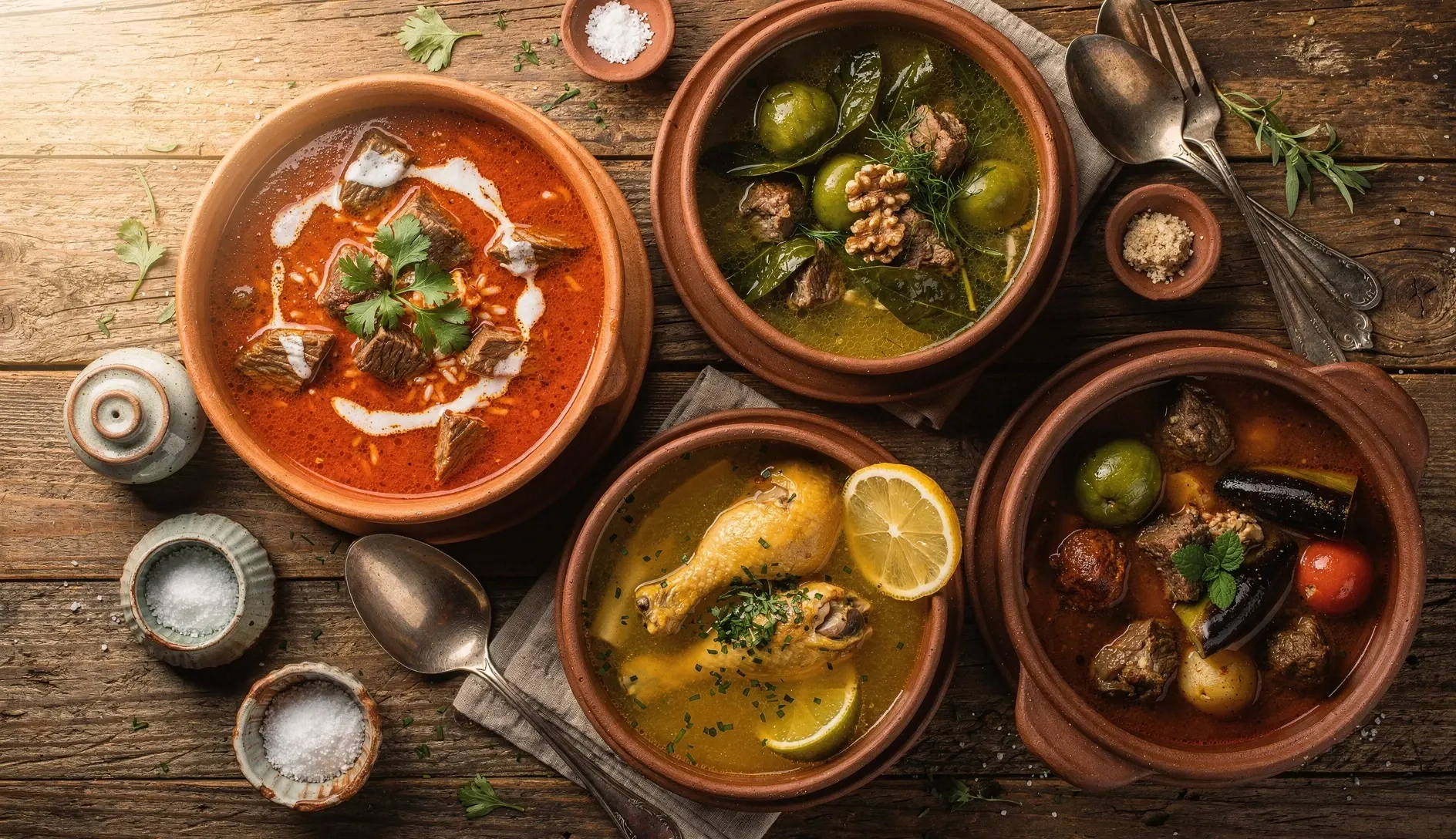
Georgian cuisine doesn't do light broths. Every soup is a meal, every stew is an argument about whose grandmother's version is correct, and most of them are thick enough to stand a spoon in. This is food built for Caucasus winters, post-feast recoveries, and the kind of deep satisfaction that a salad will never provide.
What makes Georgian soups and stews genuinely different from their European or Middle Eastern cousins is the flavor architecture. Where French stews rely on stock, wine, and butter, Georgian versions build on an entirely different foundation: crushed walnuts for body, sour plum paste (tkemali) for acidity, dried marigold petals and blue fenugreek for herbal depth, and enough fresh cilantro and tarragon to turn the pot green. The result is a flavor profile that doesn't exist anywhere else — earthy, tart, herbal, and warming all at once.
There are at least a dozen distinct soups and stews in the Georgian canon, and most households cook three or four of them on regular rotation. This guide covers every major one — what it is, what region it comes from, how it differs from the others, and whether you can realistically make it at home.
Quick Reference: Every Georgian Soup & Stew
Before diving into each dish, here's the full landscape. Georgian soups and stews split roughly into three categories: walnut-thickened soups, tomato-based stews, and herb-forward braises. Some are everyday food, others are seasonal or ceremonial. All of them are best with fresh shotis puri or mchadi.
| Dish | Type | Main Protein | Key Flavor | Difficulty |
|---|---|---|---|---|
| Kharcho | Thick soup | Beef | Walnut + sour plum | Medium |
| Chakapuli | Herb braise | Lamb | Tarragon + sour plum | Easy |
| Chikhirtma | Clear soup | Chicken | Egg-lemon | Medium |
| Chanakhi | Baked stew | Lamb | Eggplant + tomato | Easy |
| Chashushuli | Tomato stew | Beef | Tomato + chili | Easy |
| Ostri | Quick braise | Tender beef | Tomato + chili + garlic | Easy |
| Chakhokhbili | Tomato stew | Chicken | Herb + tomato | Easy |
| Khashi | Bone broth | Tripe/feet | Garlic + collagen | Hard |
| Tatariakhni | Clear broth | Beef on bone | Beef + peppercorn | Easy |
| Lobio | Bean stew | Beans (vegan) | Fenugreek + walnut | Easy |
| Satsivi | Walnut sauce (cold) | Chicken/turkey | Walnut + spice | Medium |
The Walnut-Thickened Soups
This is where Georgian soups diverge most dramatically from the rest of the world. Instead of using flour, cream, or egg yolks to thicken a broth, Georgian cooks grind walnuts into a paste and dissolve it into the pot. The result is a soup with serious body — rich and slightly grainy, with a nutty warmth underneath whatever else is going on. It's the same principle as using bazhe as a sauce, just applied to hot liquid.
Kharcho — The King of Georgian Soups
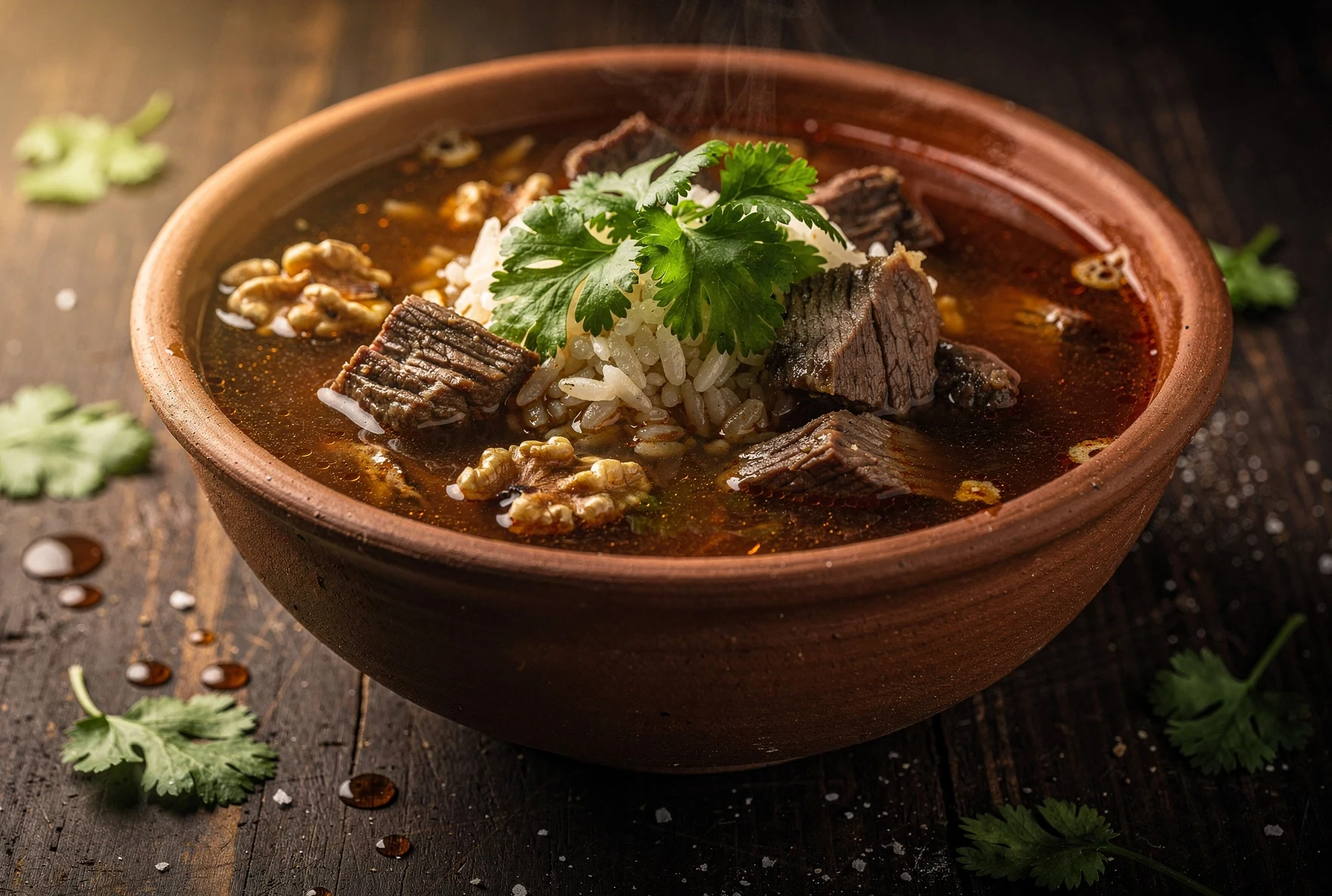
Ask any Georgian to name their national soup and they'll say kharcho without hesitating. It's beef simmered in a broth thickened with ground walnuts and acidified with tkemali (sour plum paste), loaded with rice, and finished with a fistful of cilantro and dried spices. The flavor is unlike any soup you've had — simultaneously nutty, tart, rich, and spicy, with a thickness that sits between soup and stew.
The original Megrelian version uses chicken, not beef, and skips the rice entirely. It's a thinner, more delicate soup where the walnut-plum flavor comes through cleaner. But the beef-and-rice version is what conquered the rest of Georgia and eventually the entire former Soviet Union, where it became a standard restaurant menu item from Moscow to Vladivostok.
What makes or breaks kharcho is the walnut paste. Too little and the soup tastes like a generic beef stew. Too much and it becomes gritty and overwhelmingly nutty. The right amount gives the broth an almost creamy quality without any dairy, and it should coat the back of a spoon with a thin, slightly grained film.
The Walnut Rule
For kharcho, you need roughly 150-200g of walnuts per liter of broth. Grind them as fine as possible — a food processor works, but the traditional mortar and pestle produces a better paste with more oil released. The walnuts go in during the last 15-20 minutes; cook them too long and the oils turn bitter.
Satsivi — The Cold One
Satsivi sits in a strange category — it's technically a sauce, but it's eaten as a dish, and the consistency puts it in stew territory. Chicken (traditionally turkey at New Year) is poached, then submerged in a cold walnut sauce made with a complex spice mix of cinnamon, cloves, blue fenugreek, dried marigold, and coriander. It's always served cold or at room temperature, which throws off anyone expecting a warm stew.
The walnut sauce in satsivi is different from kharcho's. It's thicker, more refined, with a spice profile that leans sweet-warm rather than tart. There's no tkemali. Instead, the acidity comes from a splash of vinegar or pomegranate juice. The result is something that sits closer to a mole than to any European sauce — complex, layered, and deeply satisfying in a way that's hard to explain until you've eaten it cold at midnight on New Year's Eve.
The Tomato-Based Stews
Georgia adopted the tomato late (it arrived in the 19th century), but when it did, tomatoes rewrote the stew chapter completely. Several of Georgia's most popular everyday dishes are built on a simple base of onions, tomatoes, and Georgian spice mixes, with different proteins and vegetables creating distinct dishes from the same technique.
Chashushuli — Everyday Beef Stew
Chashushuli is probably the dish Georgians cook most often at home that foreigners have never heard of. It's beef braised in a no-water sauce of tomatoes, onions, and hot peppers — the tomatoes release enough liquid to cook the meat, which concentrates their flavor into something intensely savory. The heat level varies by family; some versions barely whisper chili, others will clear your sinuses.
The key technique is patience. The onions go in first, then the beef, then the tomatoes, and you let time and heat do the work. No stock. No added water. Just the juice from a kilogram of tomatoes slowly reducing around chunks of beef until everything is thick and caramelized. It takes about two hours and the apartment will smell incredible for all of them.
Ostri — The Faster, Sharper Beef Dish
Ostri lives right beside chashushuli on Georgian menus and constantly gets confused with it. The difference is speed and cut. Ostri uses tender beef or veal, keeps the sauce a little looser, and leans harder into chili, garlic, and adjika. If chashushuli is the deep, slow-cooked version, ostri is the one you make when you want heat and beef flavor without committing your whole evening.
The mistake people make at home is using stew meat and treating ostri like a faster chashushuli. That gives you the worst of both worlds. Proper ostri should be done in under an hour and still taste lively. It belongs in this guide because it fills an important slot in the Georgian canon: not soup, not a long braise, but a sharp-edged beef dish that still eats like stew food.
Chakhokhbili — The Herb-Loaded Chicken Stew
Chakhokhbili follows the same no-water principle as chashushuli but with chicken and a truly ridiculous amount of fresh herbs. The name comes from khokhbi — pheasant — because the original version used wild game. These days it's always chicken, and the herbs are the real protagonist: cilantro, parsley, basil, and sometimes tarragon, added in quantities that would alarm a French chef.
What separates good chakhokhbili from bad is timing the herbs. Half go in during the last ten minutes of cooking (for flavor), and the other half go in raw at the very end (for brightness). The stew should taste simultaneously cooked and fresh, with the tomato providing structure and the herbs providing life.
The No-Water Principle
Both chashushuli and chakhokhbili follow a rule that defines Georgian stew-making: no added water or stock. All the liquid comes from tomatoes and onions. This concentrates flavor dramatically, but it means you need ripe, juicy tomatoes — winter supermarket tomatoes won't cut it. In off-season, use canned San Marzano types instead.
The Herb-Forward Braises
Chakapuli — Spring in a Pot
Chakapuli is the one Georgian stew that has a season. It appears in spring when fresh tarragon is available and green tkemali plums are still unripe and sour on the tree. Lamb (preferably young spring lamb, sometimes veal) is braised with what can only be described as an unreasonable volume of fresh tarragon, green onions, cilantro, and those unripe green plums, all moistened with dry white Georgian wine.
The result is unlike any other stew in the Georgian repertoire. It's bright green, intensely aromatic, and the tarragon flavor hits like a wave — something between anise and fresh grass, with the sour plums providing a sharp tartness that cuts through the lamb fat. Chakapuli is traditionally served at Easter, and for many Georgian families it marks the start of spring more reliably than the calendar does.
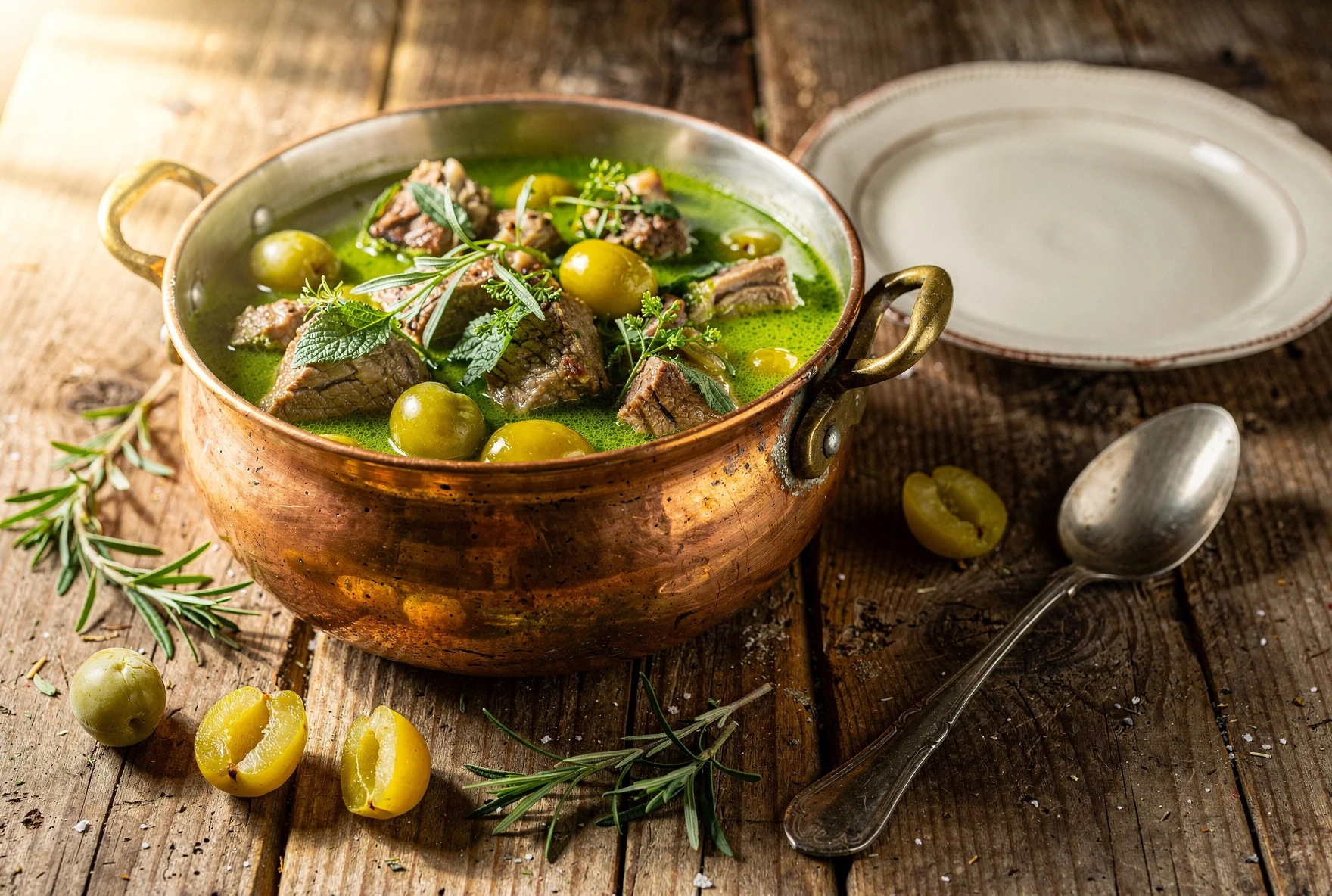
Outside Georgia, the hardest part of making chakapuli is finding the green plums. Some people substitute green grapes, gooseberries, or underripe regular plums, and while none of these are exactly right, any sour fruit will get you most of the way there. The tarragon is non-negotiable — dried tarragon is not a substitute; it's a different ingredient entirely.
Chanakhi — The Slow-Baked Clay Pot Stew
Chanakhi is less a recipe and more a method: layer lamb, eggplant, potatoes, tomatoes, and peppers in a clay pot, add garlic and herbs, seal it, and bake it slowly for three hours. No stirring, no checking, no intervention. The pot does all the work, and when you open the lid, everything has melted together into a rich, layered stew where you can still taste each ingredient individually.
The clay pot matters here. Georgian ketsi pots distribute heat evenly and slowly, and the clay itself adds a subtle mineral quality to the broth. You can make chanakhi in a Dutch oven — it'll be good — but the clay pot version has a depth that metal can't replicate. Chanakhi is also one of the easiest Georgian stews to make at home: chop everything, layer it, put it in the oven, and walk away.
The Outliers
Chikhirtma — The Hangover Cure
Chikhirtma is the most technically demanding Georgian soup, and it's the one that breaks all the rules. No walnuts. No tomatoes. No heavy spices. Instead, it's a clear chicken broth thickened with beaten egg yolks and brightened with lemon juice or vinegar — a technique that's closer to Greek avgolemono than to anything else in Georgian cooking.
The tricky part is tempering the eggs. You beat egg yolks with lemon juice, then slowly ladle hot broth into the mixture to bring it up to temperature before pouring it back into the pot. Rush this step and you get scrambled egg soup. Do it right and you get a silky, rich, golden broth that tastes like someone crossed chicken soup with custard and then made it savory.
Chikhirtma is Georgia's official hangover cure — the theory being that the egg protein and fat settle the stomach while the lemon cuts through whatever's left of last night's wine. Whether the science holds up is debatable. Whether it works is not. Every Georgian has a chikhirtma story about the morning after a supra.
The Egg Tempering Trick
Keep the heat low. Really low. When adding the egg-lemon mixture back to the pot, the broth should be barely simmering — if it's at a rolling boil, the eggs will curdle instantly. Stir constantly in one direction as you pour. The soup should never boil again after the eggs go in.
Khashi — The 6 AM Ritual
Khashi isn't just a soup — it's a cultural institution with its own rules, its own time slot, and its own social code. Made from cow's feet and tripe simmered overnight until the collagen dissolves into a thick, milky-white broth, khashi is served exclusively in the early morning (5-7 AM) and eaten with raw garlic, dried bread, and often a shot of chacha (grape brandy).
The soup itself has almost no seasoning — just salt. The garlic is added raw at the table, crushed and stirred into the steaming broth. This sounds simple because it is. The complexity comes from the 8-12 hour simmer, which extracts every molecule of flavor and collagen from the bones and cartilage. The texture is rich and gelatinous, somewhere between broth and aspic when it cools.
Khashi restaurants (sakhashle) open at 5 AM and close by 10 AM. Eating khashi at lunch would be like drinking orange juice at dinner — technically possible, culturally wrong. The morning ritual has roots in rural life, where the offal from a slaughter needed to be used quickly, and the long overnight simmer meant a hot, nourishing breakfast was ready by dawn.
Tatariakhni — The Forgotten One
Tatariakhni is the soup that nobody writes about because it's too simple to be interesting — and too good to stop making. It's beef on the bone simmered in water with onions, a few peppercorns, and maybe a bay leaf. That's it. No walnut paste, no sour plum, no tomato, no herbs beyond parsley. Just clean beef broth, clear and honest.
Georgian grandmothers make tatariakhni when someone is sick, when the weather turns harsh, or when the fridge is empty. It's comfort food in its most elemental form — a reminder that sometimes the best cooking means doing almost nothing and letting good ingredients speak. The beef must be bone-in (the marrow is half the point), and the simmer must be long and gentle (2-3 hours minimum).
Lobio — The Vegetarian Powerhouse
Lobio earns its place in this guide because it's functionally a stew, even though it contains no meat. Red kidney beans cooked with onions, walnuts, blue fenugreek, coriander, and plenty of fresh cilantro, served in a clay pot with a side of mchadi (cornbread). It's the dish Georgia's large Orthodox Christian fasting population turns to during the 200+ fasting days per year when meat is forbidden.
Good lobio has complexity that belies its ingredients. The walnuts add richness, the blue fenugreek (utskho suneli) provides an earthy, almost curry-like depth, and the beans themselves, when cooked properly, achieve a creamy interior that absorbs every flavor in the pot. There's a running joke in Georgia that lobio is the food you eat when you have nothing — and also the food you crave when you have everything.
Regional Differences
Like everything in Georgian cooking, soups and stews change as you move across the country. The west-east divide is especially stark: western Georgia (Samegrelo, Imereti, Guria) favors bolder, more intensely spiced dishes with heavier use of walnuts and chili, while eastern Georgia (Kakheti, Kartli) tends toward cleaner, simpler flavors.
Western Georgia (Samegrelo, Imereti)
Heavier walnut use, more chili heat, richer broths. Megrelian kharcho uses chicken, not beef. Elarji and gebzhalia come from this region. Sauces are thicker, spicing is bolder.
Eastern Georgia (Kakheti, Kartli)
Cleaner flavors, more tomato-based stews, less walnut. Chashushuli is quintessentially Kakhetian. Wine is used more freely in cooking. Herbs are fresh and abundant.
Svaneti (Mountains)
Hearty, meat-heavy stews designed for altitude and cold. Svanetian salt (a spice blend with garlic, fenugreek, and chili) flavors everything. Soups are thick, almost porridge-like.
Adjara (Black Sea Coast)
Turkish influence brings dairy-based flavors. Butter and cheese appear in stews where other regions would use walnuts. Flavors are milder, portions are larger.
When to Eat What
Georgians are particular about which soups belong to which season. Some of this is practical (you can't make chakapuli without spring plums), and some of it is cultural (eating khashi in summer would be considered insane). Here's the seasonal rotation:
| Season | Best Soups/Stews | Why |
|---|---|---|
| Spring (Apr–May) | Chakapuli, chakhokhbili | Fresh tarragon and green plums available; Easter traditions |
| Summer (Jun–Aug) | Chakhokhbili, lobio (light versions) | Ripe tomatoes peak; lighter stews preferred |
| Autumn (Sep–Nov) | Kharcho, chashushuli, chanakhi | Fresh walnuts harvested; hearty stews for cooling weather |
| Winter (Dec–Feb) | Khashi, kharcho, satsivi, tatariakhni | Cold demands calories; New Year satsivi; khashi season peaks |
Making Georgian Soups at Home
The good news: most Georgian soups and stews are fundamentally simple. They don't require fancy technique or equipment — just good ingredients, the right spices, and patience. The challenge for cooks outside Georgia is sourcing two things: the dried spice blends and the sour plum paste.
Essential Pantry Items
| Ingredient | Used In | Substitute If Needed |
|---|---|---|
| Tkemali (sour plum paste) | Kharcho, chakapuli | Tamarind paste + lemon juice |
| Utskho suneli (blue fenugreek) | Most soups/stews | Regular fenugreek (use half the amount) |
| Khmeli suneli (spice mix) | Kharcho, satsivi, lobio | No good substitute — order online |
| Dried marigold petals | Kharcho, satsivi, bazhe | Turmeric (for color only, not flavor) |
| Fresh tarragon | Chakapuli | No substitute — skip chakapuli without it |
| Walnuts | Kharcho, satsivi, lobio | No substitute |
Where to Buy Georgian Spices
Online retailers like GeorgianSpices.com, Amazon (search for "khmeli suneli"), and Russian/Eastern European grocery stores in major cities usually stock the essentials. For the best quality, look for spices imported directly from Georgia — the difference between fresh Georgian blue fenugreek and the year-old stuff on Amazon is significant. See our complete spice guide for details.
Difficulty Ranking for Home Cooks
🟢 Start Here
Chashushuli and chakhokhbili — both one-pot, no exotic ingredients needed beyond spices. Tomato-based, forgiving, and hard to mess up.
🟡 Intermediate
Kharcho and chanakhi — need Georgian spices and tkemali paste, but the techniques are straightforward. The walnut paste in kharcho requires some feel.
🟠 Seasonal Challenge
Chakapuli — easy technique, but finding fresh tarragon and green plums outside Georgia requires planning. The flavor is entirely dependent on ingredient quality.
🔴 Advanced
Chikhirtma and khashi — chikhirtma's egg tempering requires precision. Khashi needs 8-12 hours and access to good tripe and cow's feet.
What to Order at a Restaurant
If you're in Georgia for the first time and staring at a menu, here's the honest recommendation: start with kharcho. It's the most distinctly Georgian soup, and it'll tell you immediately whether you're in a good restaurant. Bad kharcho tastes like generic beef soup with some walnut dust thrown in. Good kharcho is thick, complex, and makes you wonder how a bowl of soup can have this many layers of flavor.
After that, the choice depends on the season and your tolerance for adventure. Chakapuli in spring is unmissable. Chashushuli is the safe bet — spicy, hearty, and consistently good everywhere. Chikhirtma is a revelation if it's made well, which it often isn't (many restaurants over-thicken it or skip the lemon). And khashi... you need to commit. Set an alarm, go to a dedicated khashi restaurant at 6 AM, and eat it with the old men who've been doing this every weekend for forty years.
| Dish | Typical Price (Tbilisi) | Best Paired With |
|---|---|---|
| Kharcho | ₾8–14 | Shotis puri, dry red wine |
| Chashushuli | ₾12–18 | Mchadi, Saperavi wine |
| Chakapuli | ₾14–20 | Shotis puri, dry white wine |
| Chanakhi | ₾12–18 | Fresh bread, amber wine |
| Chikhirtma | ₾8–12 | Dried bread, chacha |
| Khashi | ₾10–15 | Dried bread, raw garlic, chacha |
Frequently Asked Questions
What is the most popular Georgian soup?
Kharcho — a thick beef soup with walnuts, rice, and sour plum paste. It's the soup every Georgian knows and the one you'll find in every restaurant.
Are Georgian soups spicy?
Some are — chashushuli can be quite hot, and kharcho has a warming spice level. Others like chikhirtma and tatariakhni have no heat at all. It varies by dish and by cook.
Can I make Georgian soups without special ingredients?
Chashushuli and chakhokhbili need only common ingredients plus dried coriander and fenugreek. Kharcho and chakapuli require tkemali paste and specific herbs that you'll likely need to order online.
What makes Georgian stews different from European ones?
Three things: walnuts instead of flour/cream for thickening, sour plum paste instead of vinegar/wine for acidity, and a completely different spice palette (blue fenugreek, dried marigold, khmeli suneli).
Are any Georgian soups vegetarian?
Lobio is the main one — a rich bean stew with walnuts and herbs. Ajapsandali (eggplant stew) is also fully vegan. Georgia's fasting traditions mean there's no shortage of meatless options.
Why is khashi only served in the morning?
Tradition and practicality. Khashi simmers overnight, so it's ready at dawn. The heavy, collagen-rich broth was working-class fuel for laborers starting early shifts. The tradition stuck, and now it's a social ritual — eating khashi at noon would be like drinking champagne at breakfast.
Written by The Georgian Eats Team
We've eaten every soup on this list dozens of times — in Tbilisi restaurants, in village homes, and at 6 AM in khashi joints where we were the only foreigners. We cook most of these at home regularly, argue about whose kharcho recipe is better, and believe that a cold January evening in Tbilisi demands chanakhi.
Last updated: March 2026.
Related Articles
Regional Cuisine Guide
How Georgian food changes from west to east — eight distinct cuisines in one country.
Sauces & Condiments Guide
Tkemali, bazhe, adjika, satsebeli — every sauce that defines Georgian cooking.
Georgian Spices & Herbs
Khmeli suneli, utskho suneli, svanetian salt — every spice that defines the cuisine.
Wine & Food Pairing Guide
Which Georgian wines pair best with which dishes.