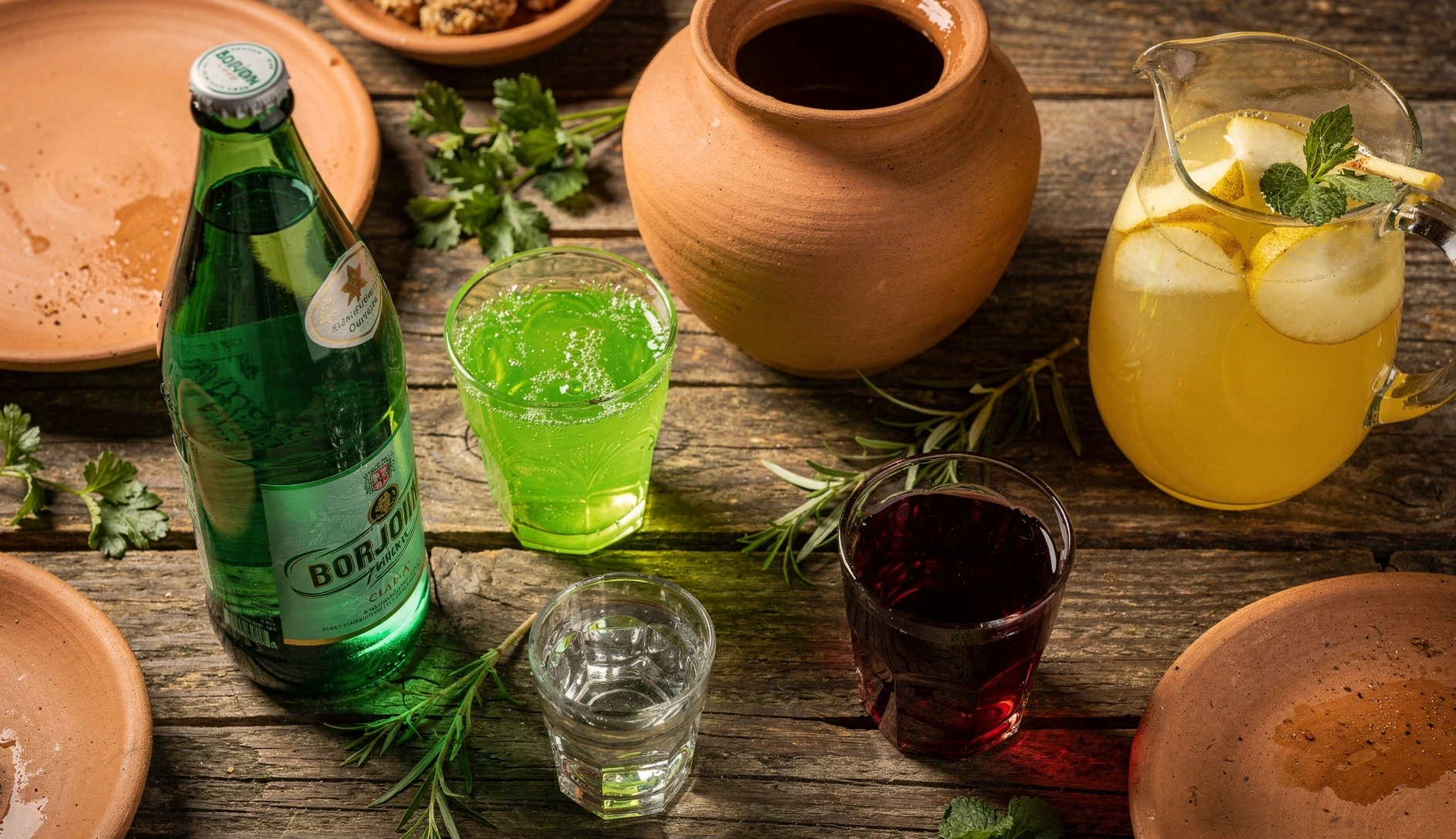
Everyone knows Georgia is a wine country. Eight thousand years of winemaking, qvevri clay vessels, amber wines — the whole bit. But wine is only one chapter of a much longer story. Walk into any Georgian home, restaurant, or roadside café, and you'll encounter a drink culture that goes far deeper than fermented grapes: volcanic mineral waters that taste like the earth itself, neon-green tarragon soda invented by a 19th-century pharmacist, fruit compotes simmered from whatever's in season, and chacha — the infamous grape spirit that rural families distill in their backyards every autumn.
Georgian drinks tell you as much about the country as the food does. Borjomi isn't just sparkling water — it's a national symbol that survived Soviet industrialization and post-independence chaos. Lagidze water isn't just flavored soda — it's a living piece of 1880s Kutaisi that Khrushchev reportedly had shipped to Moscow. And chacha isn't just strong alcohol — it's the final act of the grape harvest, the part where nothing goes to waste.
This guide covers everything Georgians drink, from the volcanic springs to the distillery. Whether you're planning a trip, stocking a Georgian dinner party, or just curious about what fills those glasses at a supra, here's the full picture.
Mineral Water: Georgia's Other National Treasure
Georgia sits on one of the most geologically active zones in the Caucasus, and the result is hundreds of natural mineral springs scattered across the country. Georgians don't treat mineral water as a fancy restaurant add-on — it's a daily staple, a digestive remedy, and in some cases, a point of regional pride more fiercely defended than wine preferences.
The tradition runs deep. Balneological spa towns like Borjomi, Sairme, and Tskaltubo were famous during the Russian Empire and became massive health resort complexes under the Soviets. People traveled from across the USSR to "take the waters," and the habit of drinking specific mineral waters for specific ailments persists today. Your Georgian mother-in-law will have opinions about which water helps with digestion, which one is best for kidney stones, and which one is too salty for everyday drinking.
The Major Brands
| Brand | Source | Type | Taste Profile | Price (0.5L) |
|---|---|---|---|---|
| Borjomi | Borjomi, Samtskhe-Javakheti | Sparkling | Strongly mineral, salty, volcanic | ₾1.5–2.5 |
| Nabeghlavi | Nabeghlavi, Guria | Sparkling | Milder, cleaner, less salty | ₾1.0–1.5 |
| Sairme | Sairme, Imereti | Sparkling / Still | Soft, slightly sweet, easy-drinking | ₾1.0–1.5 |
| Likani | Borjomi gorge | Sparkling | Similar to Borjomi, slightly lighter | ₾1.0–1.5 |
| Bakuriani | Bakuriani, Samtskhe-Javakheti | Still | Clean, neutral, everyday drinking | ₾0.7–1.0 |
| Sno | Sno village, Kazbegi | Still | Pure, mountain spring, very clean | ₾0.7–1.0 |
Borjomi: The One Everyone Knows
Borjomi is Georgia's most famous export after wine. The naturally carbonated volcanic water has been bottled since the 1890s, and during the Soviet era it was the prestige mineral water of the entire Union — served at state dinners, prescribed by doctors, and hoarded by anyone who could get their hands on it. Today it's exported to over 40 countries.
The taste is... an experience. If you're used to Pellegrino or Perrier, Borjomi will be a shock. It's aggressively mineral, distinctly salty, with a volcanic tang that some people describe as "drinking a hot spring." First-timers often grimace. Regulars swear it settles the stomach after a heavy meal — which, at a Georgian supra, is every meal.
The Borjomi Hangover Cure
Georgians swear by Borjomi the morning after heavy drinking. The high sodium bicarbonate content does actually help with rehydration and settles an acidic stomach. Whether it works better than any other sparkling water is debatable, but the ritual is sacred. You'll see half-empty Borjomi bottles on every Georgian breakfast table after a supra.
Nabeghlavi: The Local Favorite
Ask a Georgian which mineral water they actually drink daily, and many will say Nabeghlavi — not Borjomi. It's cheaper, milder, and doesn't make you feel like you're gargling seawater. Sourced from springs in Guria (western Georgia), Nabeghlavi has a cleaner, more approachable mineral profile. It's the water most restaurants pour when you just say "mineral water, please."
Roadside Springs
One of the small pleasures of driving through Georgia is the roadside mineral springs. You'll see them everywhere — pipes jutting from cliff faces, stone fountains by the highway, sometimes just a trickle from a rock face with locals filling up plastic jugs. The water is free, often naturally carbonated, and the mineral composition changes every few kilometers. In regions like Racha and Svaneti, stopping to fill bottles at a spring is as routine as stopping for gas.
Lagidze Water: Georgia's Original Craft Soda
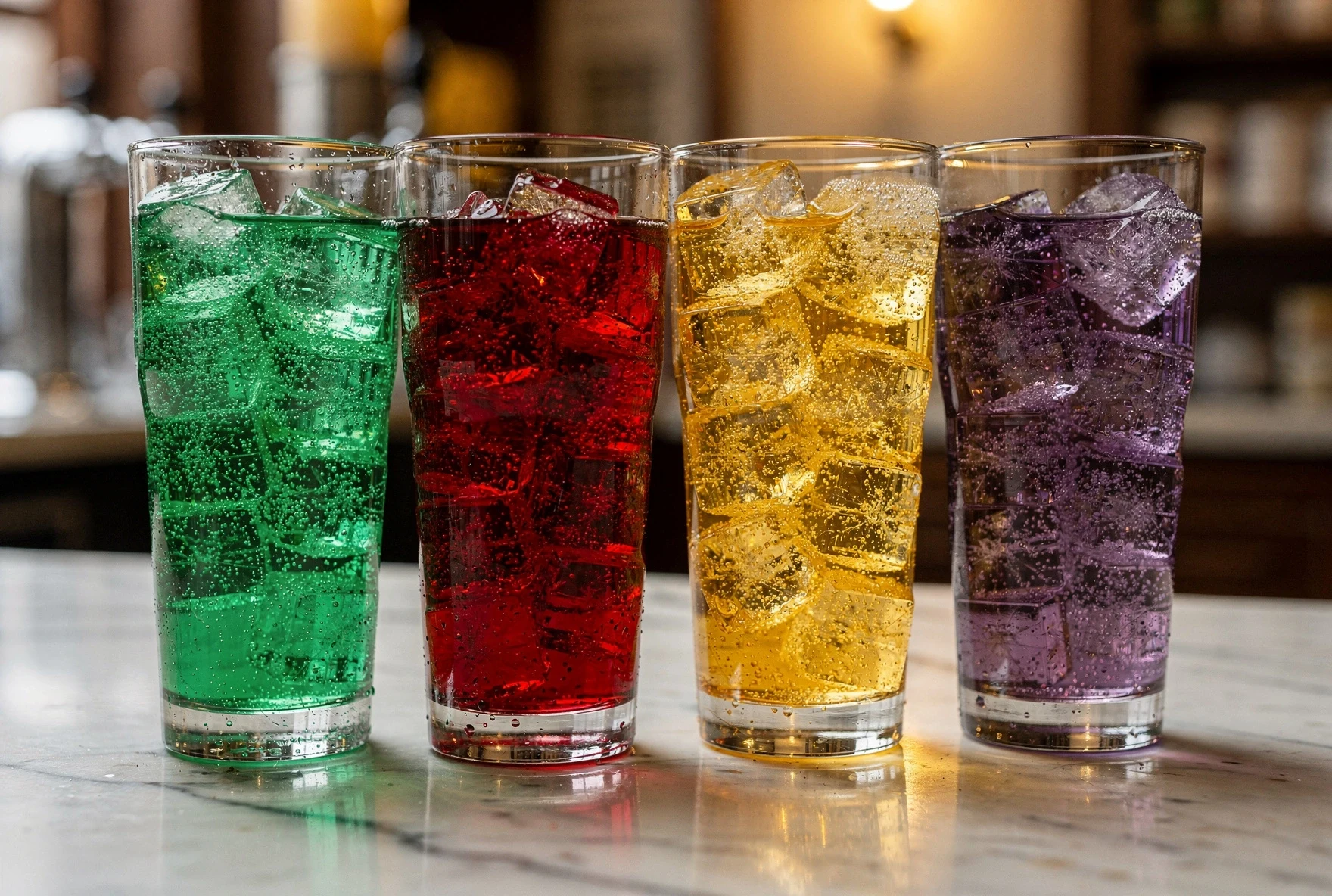
In 1887, a young pharmacist's apprentice named Mitrofan Lagidze started experimenting with natural fruit syrups in Kutaisi. He combined them with carbonated water and sold them from a soda fountain — and accidentally created what might be Georgia's most charming beverage tradition.
Lagidze Water (ლაღიძის წყალი) is flavored sparkling water made with natural fruit and herb syrups. No artificial colors, no preservatives — just syrup and bubbles. The original Lagidze establishment still operates in Tbilisi on Pushkin Street, where they dispense the drinks from vintage-looking soda fountains in the same flavors that made Mitrofan famous over a century ago.
Classic Lagidze Flavors
🌿 Tarkhuna (Tarragon)
The signature flavor. Bright green, herbal, slightly sweet, and like nothing you've tasted before. This is the one that hooked Soviet leaders.
🍐 Pear
Subtle and fragrant. Tastes like actual pears, not candy. One of the more popular flavors with locals who find tarkhuna too intense.
🍋 Lemon
Clean and tart. The most approachable flavor for newcomers — essentially a very good, natural sparkling lemonade.
🍒 Cherry
Deep red, sweet-tart. Made from sour cherry syrup. Popular in summer and genuinely refreshing — worlds apart from artificial cherry flavoring.
🍇 Grape
Several varieties: Saperavi (dark, tannic), Rkatsiteli (light, floral). Essentially grape juice soda. A non-alcoholic nod to Georgia's wine culture.
🫐 Feijoa
Tropical and unusual. Feijoa (pineapple guava) grows in western Georgia, and this flavor has a devoted following. Hard to describe — try it.
Where to Try Lagidze Water in Tbilisi
The original Lagidze soda fountain is on Pushkin Street near Liberty Square. It's a simple spot — you walk up, pick a flavor, and they fill a glass from the fountain. A glass costs about ₾1–2. There's also Lagidze-branded bottled water available in supermarkets, but the fountain experience is the reason to go. The tarkhuna from the fountain tastes noticeably different from the bottled version — fresher, less sweet, more herbaceous.
Limonati: Georgian Lemonade Culture
The word "limonati" (ლიმონათი) in Georgian doesn't mean lemon drink. It means any flavored carbonated soft drink — the way Americans use "soda" or "pop." Walk into any restaurant and the limonati menu will have a dozen options: tarragon, pear, cream soda, grape, feijoa, saperavi, lemon, orange, and a few regional specialties.
The biggest commercial brands are Natakhtari and Borjomi (which launched a limonati line). Natakhtari dominates the market — their tarkhuna and cream soda are ubiquitous. These are sweeter and more commercial than Lagidze, but they're genuinely popular. At any family gathering or birthday party, you'll see a row of two-liter Natakhtari bottles alongside the wine.
Limonati vs. Lagidze vs. Western Soda
| Feature | Lagidze | Natakhtari/Borjomi | Coca-Cola/Fanta |
|---|---|---|---|
| Ingredients | Natural fruit syrups | Mix of natural and artificial | Artificial flavoring, HFCS |
| Sweetness | Moderate, fruit-forward | Sweet, candy-like | Very sweet |
| Carbonation | Light fizz | Standard | Standard |
| Price (0.5L) | ₾1–2 (fountain) | ₾1.5–2.5 | ₾2–3 |
| Best flavor | Tarkhuna (tarragon) | Cream soda, pear | N/A |
Tarkhuna: The Drink That Defines Georgian Soda
Tarkhuna (ტარხუნა) deserves its own section because it's not just a flavor — it's a cultural phenomenon. This bright-green, tarragon-flavored soda was invented by Mitrofan Lagidze in the 1880s and became one of the most beloved soft drinks across the entire Soviet Union. It's still everywhere in Georgia, Russia, and the post-Soviet world.
The flavor is genuinely unlike anything in Western soda culture. Imagine if someone made a sparkling drink from fresh tarragon — herbal, slightly anise-like, sweet but with a green, almost medicinal edge. The color is startling: electric green, opaque, looking more like a science experiment than a beverage. First sip is always confusing. By the third, you're hooked.
Every restaurant in Georgia serves tarkhuna. It pairs surprisingly well with heavy, meat-based Georgian food — the herbal freshness cuts through the richness of dishes like mtsvadi or ojakhuri the way a good IPA cuts through barbecue.
Kompot: Soviet Heritage, Georgian Soul
Kompot (კომპოტი) is deceptively simple: fresh or dried fruit, simmered in water with sugar, then served chilled. It's not juice — the fruit stays whole or in chunks. It's not tea — there are no leaves. It's essentially a fruit infusion, and every Georgian grandmother has been making it since before you were born.
The tradition is deeply tied to Georgia's fruit abundance. When summer hits and the markets overflow with peaches, cherries, plums, apricots, and pears, making kompot is a natural response. You simmer the fruit, drink the liquid cold over the next few days, and eat the soft fruit with a spoon. In winter, dried fruit kompot serves the same purpose — warmth, sweetness, vitamins.
Common Kompot Varieties
🍑 Peach
The summer classic. Made with white or yellow peaches, minimal sugar needed. Best served ice cold. Tastes like summer in a glass.
🍒 Sour Cherry
Tart, deep red, the most flavorful variety. Georgian sour cherries are smaller and more intense than Western ones. Outstanding chilled.
🍎 Apple & Quince
An autumn/winter staple. Quince adds an aromatic, honey-like sweetness. Often spiced with cinnamon or clove.
🫐 Dried Fruit Mix
Winter kompot: dried apricots, prunes, raisins, apple rings. Darker, richer, almost like a light dessert. Served warm or cold.
You'll find kompot in almost every Georgian restaurant, usually listed quietly at the bottom of the drinks menu. It's also the default homemade drink — when a Georgian family invites you over, the pitcher on the table is almost certainly kompot, not juice.
Coffee and Tea: Daily Rituals
Georgian coffee culture has undergone a transformation. Fifteen years ago, "coffee" in Georgia meant Turkish-style: finely ground, boiled in a small pot (called a jezve or turka), and served with the grounds still in the cup. You'd find it everywhere — in homes, at street stalls, in tiny neighborhood cafés where retired men would sit for hours playing backgammon.
That tradition still exists, but Tbilisi has developed a genuine specialty coffee scene. The city is packed with third-wave coffee shops — places that roast their own beans, obsess over pour-over ratios, and charge ₾8–12 for a flat white. The shift happened fast, roughly between 2015 and 2020, driven by the same young, globally connected generation that transformed Tbilisi's restaurant and nightlife scenes.
| Coffee Style | Where to Find | Price | Note |
|---|---|---|---|
| Turkish/Georgian | Homes, traditional cafés, bakeries | ₾1–3 | Grounds in cup, strong, usually with sugar |
| Espresso/Americano | Specialty shops, modern restaurants | ₾5–8 | Standard Italian-style, good quality in Tbilisi |
| Pour-over/Filter | Third-wave specialty shops | ₾8–12 | Single-origin beans, barista-prepared |
| Instant (3-in-1) | Offices, older generation homes | ₾0.5–1 | Still widespread, especially outside Tbilisi |
Georgian Tea
Tea has a surprisingly deep history in Georgia. The country was the primary tea producer for the entire Soviet Union, with massive plantations in the subtropical western regions — particularly Guria, Samegrelo, and Adjara. At its peak in the 1980s, Georgia produced over 150,000 tons of tea annually, making it one of the world's larger tea producers.
The industry collapsed after independence, and most of those vast tea plantations were abandoned. But a small revival is underway: a handful of producers are growing high-quality Georgian tea again, and you can find it in specialty shops in Tbilisi. Georgian black tea has a mild, slightly floral character — nothing like the robustness of Assam or the astringency of cheap Chinese tea.
In everyday life, though, most Georgians drink imported tea. Black tea with sugar is the standard — served in a glass or small cup, always hot, always offered to guests. Herbal teas are also common, especially in rural areas: mountain thyme, chamomile, mint, and various wild herb blends that grandmothers collect in summer and dry for winter.
Mountain Tea in Tusheti and Svaneti
If you're trekking in Georgia's highlands, try whatever herbal tea your guesthouse serves. Mountain herbs grow wild at altitude, and the blends are different in every village. In Tusheti, you'll get wild thyme and oregano blends. In Svaneti, it's often a mix of alpine herbs that defy easy identification. These aren't commercial products — they're foraged, dried, and served from unlabeled jars. Some of the best tea you'll drink in Georgia comes from a kitchen that doesn't have a menu.
Chacha: Georgia's Firewater
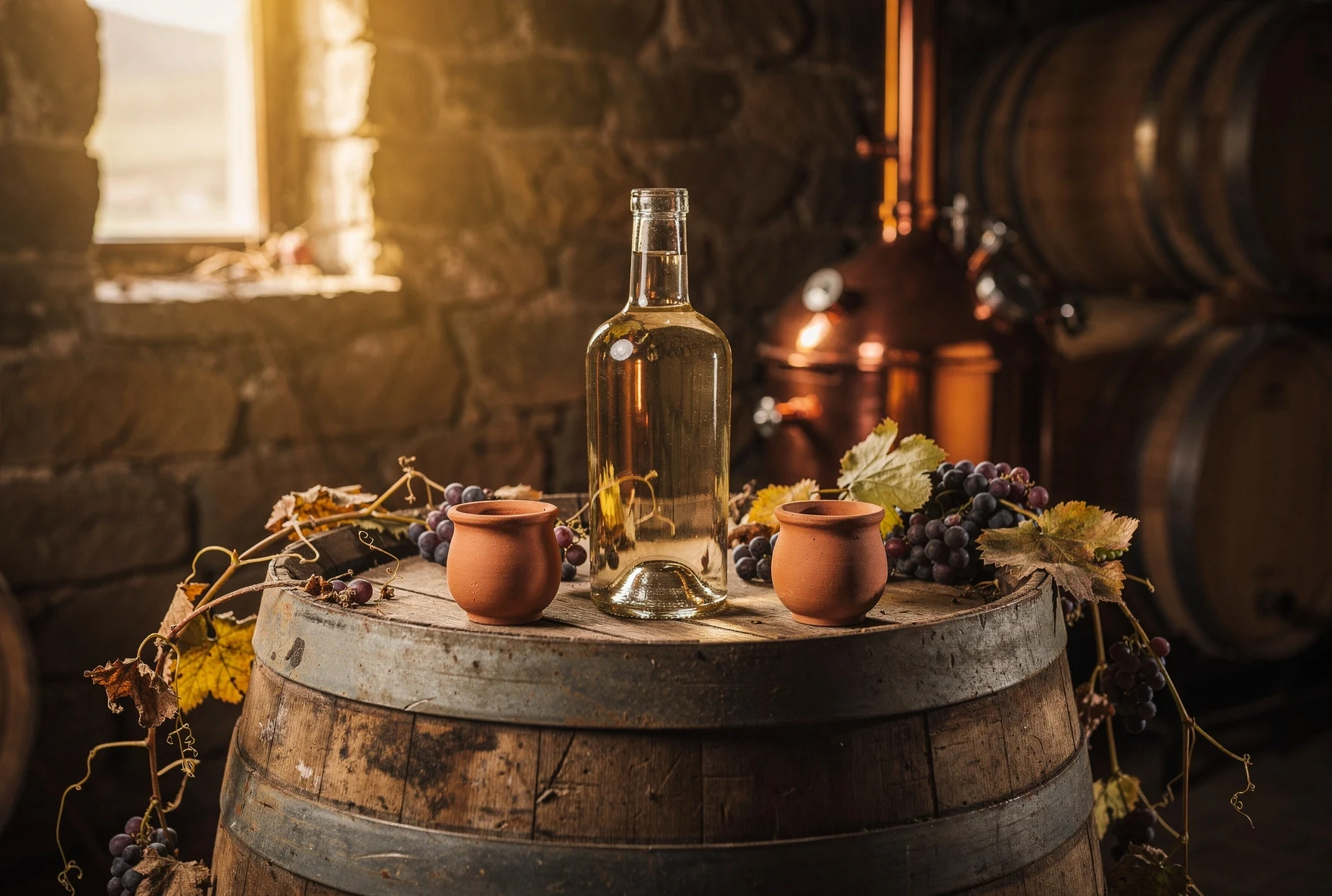
Chacha (ჭაჭა) is Georgia's pomace brandy — a clear spirit distilled from the grape skins, seeds, and stems left over after winemaking. Think Italian grappa, but wilder. Where grappa has been refined into a sophisticated digestif, chacha retains a rough, agrarian character that reflects its origins: this is a farmer's drink, born from the principle that nothing from the grape harvest should go to waste.
The word "chacha" literally means "grape pomace" in Georgian. After the grapes are pressed and the juice goes into qvevri for wine, the remaining solids are collected, sometimes mixed with water, and left to ferment for a few weeks. Then they're distilled — traditionally in a copper still over an open fire, though professional producers now use modern equipment.
Commercial chacha ranges from 40% to 50% ABV and is increasingly polished — some distilleries age it in oak barrels, producing an amber spirit that resembles brandy. But the chacha that most Georgians actually drink is homemade, unaged, and can push 60–70% ABV. Every family in Kakheti (the main wine region) either makes their own or knows someone who does.
How Chacha Is Made
Chacha Production Steps
A Word About Homemade Chacha
Homemade chacha is offered freely at supras, guesthouses, and basically any social gathering in rural Georgia. Declining politely is fine — nobody will be offended (much). But if you do drink it, know that quality varies enormously. Well-made homemade chacha is smooth, fruity, and surprisingly pleasant. Poorly made stuff burns going down and leaves a headache that lasts two days. The difference usually comes down to whether the maker properly separated the heads and tails during distillation. If it smells like nail polish remover, trust your instincts.
Chacha Varieties
| Type | Base Grape | ABV | Character |
|---|---|---|---|
| Clear (unaged) | Rkatsiteli, Saperavi, mixed | 40–65% | Sharp, fruity, clean when well-made |
| Oak-aged | Usually Rkatsiteli | 40–50% | Amber color, vanilla/caramel notes, smoother |
| Fruit chacha | Figs, mulberries, tangerines | 40–55% | Aromatic, sweeter, fruit-forward |
| Homemade | Whatever's available | 50–70% | Unpredictable — excellent or terrible |
Beer: The New Kid
Georgia is not historically a beer country. Wine has dominated for millennia, and beer was mostly an afterthought — cheap lager for hot days when wine felt too heavy. The main commercial brands (Natakhtari, Kazbegi, Argo) produce standard pale lagers that serve their purpose without inspiring much passion.
But craft beer has quietly taken hold in Tbilisi. Several microbreweries have opened in the last decade, producing IPAs, stouts, wheat beers, and even sour ales. Places like Black Dog Bar, Ludi (ლუდი means "beer" in Georgian), and several taprooms around Marjanishvili and Vera neighborhoods offer rotating taps of locally brewed beer. It's still a niche scene — at most Georgian restaurants, your beer options remain Natakhtari or Kazbegi — but it's growing.
Beer and the Supra
At a traditional supra (feast), beer is generally not served. It's a wine occasion — the tamada (toastmaster) leads toasts with wine, and switching to beer would be culturally odd. Beer is for casual meals, street food, and hanging out with friends at a bar. If someone pours you wine at a supra, drink wine. Save the craft IPA for later.
Matsoni Drinks: Drinkable Yogurt
Matsoni (მაწონი) is Georgia's traditional fermented milk product — thick, tangy, similar to yogurt but made with a different bacterial culture that gives it a distinctly sour, almost effervescent quality. While it's primarily eaten as a food (with bread, as a soup base, with honey for dessert), diluted matsoni is also a common drink.
Mix matsoni with cold water and a pinch of salt and you get something very close to Turkish ayran or Persian doogh — a tangy, refreshing, slightly salty yogurt drink. Some people add fresh mint or dill. It's the traditional pairing with khinkali — the cold, creamy sourness of matsoni drink cuts through the rich, meaty broth of the dumplings perfectly.
You'll also find commercial matsoni drinks in Georgian supermarkets, usually flavored with fruit or herbs. They're decent, but the homemade version — especially made with village matsoni, which is thicker and more sour than commercial — is in a different league.
Other Georgian Drinks Worth Knowing
🍯 Tatara / Pelamushi
Technically a dessert, but sometimes served warm as a thick, sweet grape juice drink. Made by thickening fresh grape juice with flour. The warm version during rtveli (grape harvest) is a seasonal treat. See our pelamushi recipe.
🧃 Badagi
Freshly pressed, unfermented grape juice — available only during the autumn harvest season. Sweet, thick, and completely different from commercial grape juice. If you're in Kakheti during rtveli, find some.
🥛 Aragvi / Kefir
Kefir is widely consumed, especially the rich, tangy versions from village producers. Aragvi brand is the most common commercially. Drink it plain or mixed with fruit.
🫖 Churchkhela "Tea"
Not an actual drink, but during churchkhela-making, the leftover thickened grape juice (tatara) is sometimes diluted with hot water and drunk as a sweet, warming beverage. A harvest-season rarity.
What to Drink When: A Pairing Guide
| Situation | Best Drink | Why |
|---|---|---|
| Heavy meat feast | Borjomi + wine | Mineral water aids digestion, wine complements meat |
| Hot summer day | Tarkhuna or kompot | Herbal freshness or fruit sweetness, served ice cold |
| With khinkali | Beer or matsoni drink | Light and cold to balance rich, meaty dumplings |
| Breakfast | Tea or Turkish coffee | Traditional morning ritual, especially with bread and cheese |
| After a supra | Chacha (small glass) | Digestif tradition — "for the road" |
| Rtveli (grape harvest) | Badagi (fresh grape juice) | Seasonal — only available during autumn harvest |
| Street food stop | Natakhtari limonati | Cheap, everywhere, pairs with khachapuri and lobiani |
Where to Try Georgian Drinks
🏪 Lagidze Water Bar
Pushkin Street, Tbilisi. The original soda fountain. Try all the flavors — tarkhuna first, then feijoa. Cheap, quick, unforgettable.
🍷 Any Kakheti Winery
Most wineries offer chacha tastings alongside wine. Telavi, Sighnaghi, or the Tsinandali area — you'll taste commercial chacha at its best.
🫖 Village Guesthouses
The best kompot, matsoni, and herbal tea come from village homes. Tusheti, Svaneti, and Racha guesthouses always have homemade drinks on the table.
🏬 Goodwill / Carrefour
For commercial versions of everything — Borjomi, Nabeghlavi, Natakhtari limonati, bottled Lagidze, matsoni drinks. The supermarket drink aisle in Georgia is an education in itself.
Frequently Asked Questions
Is Georgian tap water safe to drink?
In Tbilisi, yes — it's treated and WHO-compliant. In older buildings with Soviet-era pipes, consider filtering. In rural areas, stick to bottled or spring water.
Can I buy Georgian drinks abroad?
Borjomi is exported worldwide and available in many international grocery stores and on Amazon. Tarkhuna (Natakhtari brand) is available in Russian/Eastern European shops.
What's the difference between chacha and grappa?
Same concept — both are pomace brandies. Chacha tends to be stronger (50%+ vs 40% for grappa), less refined, and more often consumed young/unaged. Good chacha has more fruity, wild character than most grappas.
Is it rude to refuse chacha?
No. Georgians are generous with chacha, but they understand if you decline. A simple "no, thank you" works. Saying you're driving or not feeling well are perfectly accepted reasons.
What's the green soda I keep seeing?
That's tarkhuna — tarragon-flavored soda. It's everywhere in Georgia and the wider post-Soviet world. The bright green color comes from the tarragon extract (and sometimes food coloring in cheaper brands).
Do Georgians drink Coca-Cola?
Yes, it's available everywhere. But at a restaurant, Georgians are more likely to order Borjomi, a limonati, or wine. Cola is seen as more of a casual/kids' drink.
Written by The Georgian Eats Team
We've been drinking our way through Georgia for years — from Borjomi hangovers to questionable village chacha to that first life-changing glass of tarkhuna at the Lagidze fountain. This guide reflects what actually ends up in Georgian glasses, not just what looks good on a drinks menu.
Last updated: March 2026.
Related Articles
Amber Wine: Georgia's 8,000-Year-Old Tradition
How qvevri winemaking creates the world's most ancient wine style.
The Georgian Supra: A Complete Guide to the Feast
How to survive (and enjoy) Georgia's legendary feast tradition.
Georgian Breakfast: What Georgians Actually Eat
From bread-and-cheese with tea to chirbuli and matsoni.
Pelamushi: Georgian Grape Pudding
The thick, sweet grape juice dessert made during autumn harvest.