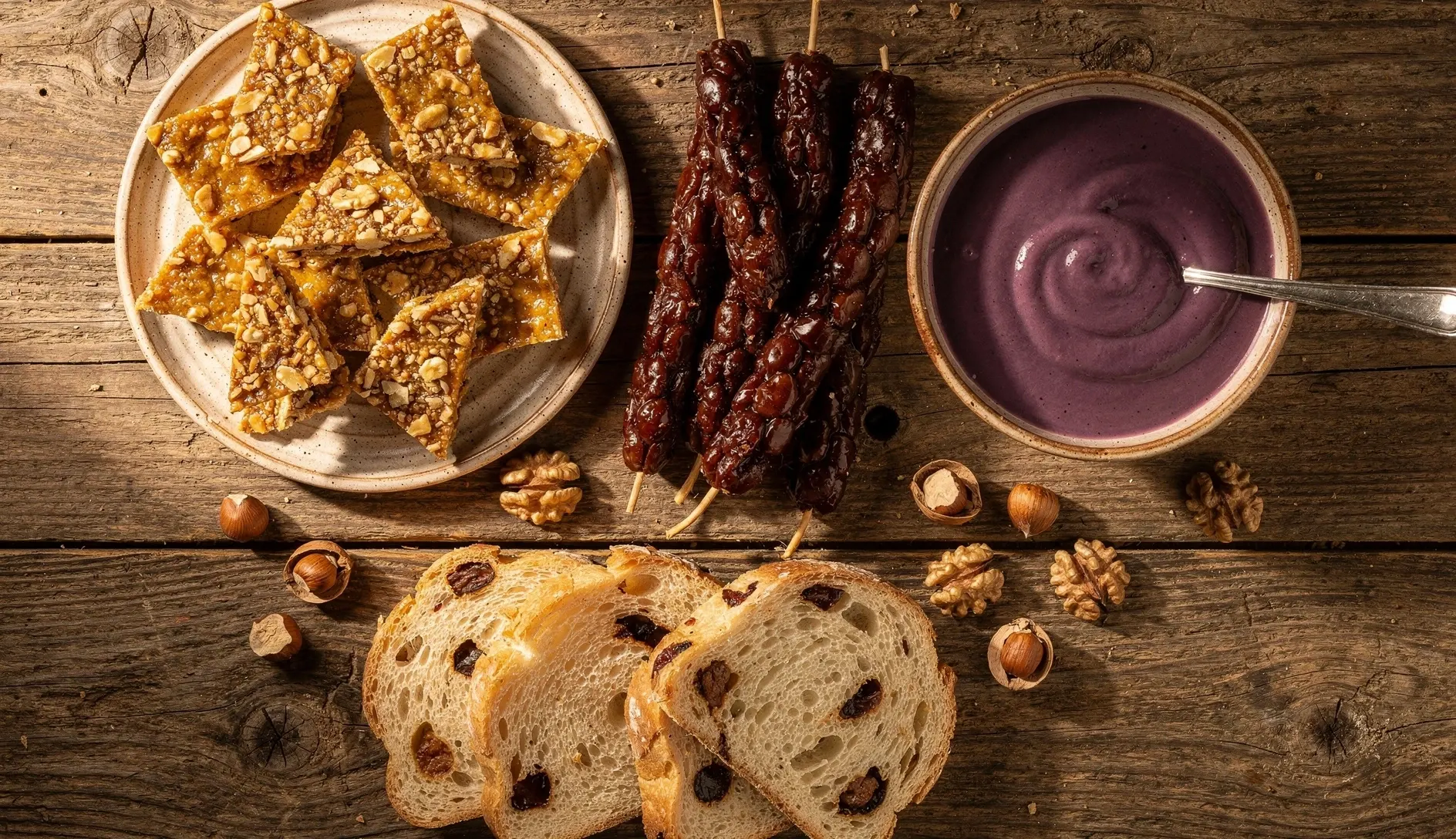
Georgia is not a dessert country — at least not in the way France or Turkey is. There are no patisseries on every corner, no elaborate multi-layered cakes that define the culture. What Georgia has instead is something more interesting: a set of ancient, deeply seasonal sweets built almost entirely around walnuts, honey, and grape juice. These aren't afterthoughts. They're tied to specific holidays, harvests, and rituals that have survived centuries of invasion, communism, and modernization.
If you sit down at a Georgian supra (feast), dessert isn't a separate course. The sweets have been on the table since the beginning — churchkhela draped next to the bread, gozinaki stacked on a plate between the cheese and the salads. The line between savory and sweet is blurry here, and that's the point.
This guide covers every traditional Georgian sweet worth knowing — what they are, when they're eaten, how they're made, and which ones you can actually recreate at home.
Grape-Based Sweets: The Harvest Desserts
Georgia has been making wine for at least 8,000 years, and the grape harvest (rtveli) is the country's most important annual event after Easter and New Year. It's no surprise that the most iconic Georgian desserts come directly from the winemaking process — they're made from the same grape must (freshly pressed juice) that becomes wine, just taken in a different direction.
This isn't an accident or a happy byproduct. Georgian desserts evolved specifically to use every part of the grape harvest. When you press grapes for wine, you get juice. Thicken that juice with flour, and you have tatara — the base for both churchkhela and pelamushi. Nothing is wasted.
Churchkhela — Georgia's Iconic Walnut Candy
If Georgia had a national candy, this is it. Churchkhela (ჩურჩხელა) is walnuts (or hazelnuts) threaded on a string, dipped repeatedly into thickened grape juice called tatara, then hung to dry for weeks. The result is a chewy, slightly waxy exterior wrapped around crunchy nuts — an energy bar that predates energy bars by about 2,000 years.
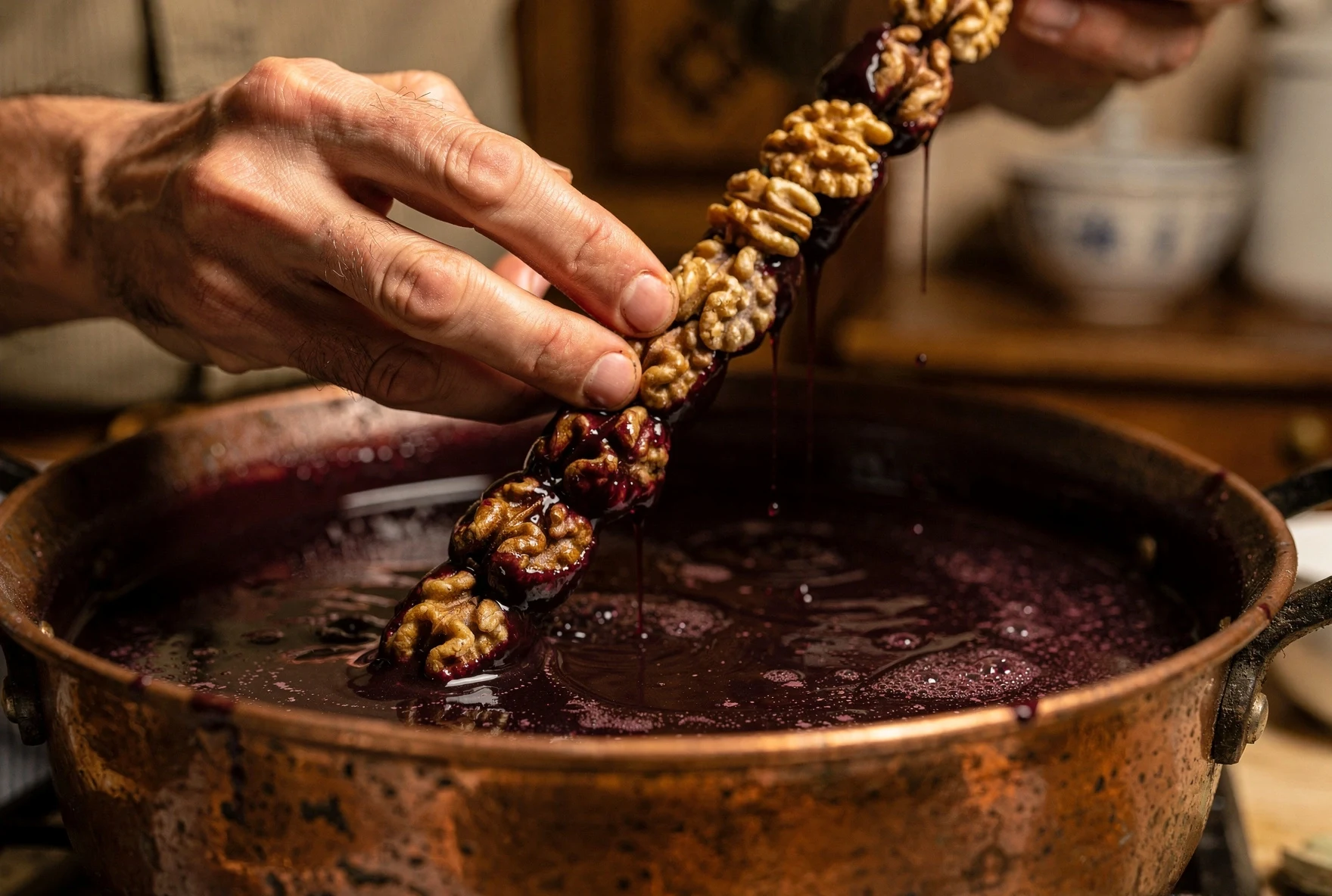
The making process is genuinely beautiful. In autumn, during rtveli, families across Kakheti and other wine regions set up outdoor stations with large copper cauldrons of grape must. Someone threads walnut halves onto strings using a needle. Someone else stirs the tatara — grape juice thickened with wheat flour — over low heat until it reaches the right consistency. Then the strings get dipped, hung, dipped again, and hung again. This continues until the coating is thick enough, usually 3-5 dips over several days.
The drying takes 2-3 weeks in open air. By the time they're ready, the outside has a firm, slightly chewy skin, and the inside is dense with nuts. Good churchkhela has a deep, wine-like fruitiness — not sugary, not candy-sweet, but complex. Bad churchkhela (the stuff sold in tourist bazaars with food coloring) is rubbery and tasteless.
How to spot good churchkhela
Look for natural, matte exterior — not shiny or plastic-looking. Bend it slightly: it should flex without cracking (too dry) or feeling gummy (too fresh or commercial). The best ones come from Kakheti villages during October-November. At Tbilisi's Deserter Bazaar, buy from vendors who made it themselves — they'll have mismatched shapes and sizes, not uniform factory rows. Expect to pay 3-5 GEL per piece for the good stuff.
There are regional variations worth knowing. Kakhetian churchkhela uses grape juice and walnuts — the classic. Imeretian versions sometimes use hazelnuts. In Racha, you'll find ones made with dried fruits alongside nuts. Some western Georgian versions swap grape juice for mulberry or pomegranate juice, which gives a completely different flavor profile — tarter, less sweet.
Read our complete churchkhela guide for the full story, including how to make it at home.
Pelamushi — Grape Pudding
Pelamushi (ფელამუში) — also called tatara in some regions — is essentially the same grape-and-flour mixture used to coat churchkhela, except instead of dipping nuts in it, you pour it into molds and let it set. The result is a dense, silky grape pudding with the consistency somewhere between panna cotta and Turkish delight.
It's made fresh during rtveli and eaten within a few days. In Kakheti, families make batches of pelamushi alongside churchkhela — same cauldron, same process, just a different end product. Some serve it warm, straight from the pot, which gives it a looser, more porridge-like texture. Others let it cool and set in shallow bowls, then slice it like a firm pudding.
The color depends on the grape variety: Saperavi (red) gives deep purple, Rkatsiteli (white) gives a lighter amber. Neither is sweetened with sugar — all the sweetness comes from the concentrated grape juice. Good pelamushi has an almost wine-like depth, a hint of tannins, and a silky mouthfeel from the slow-cooked flour.
Topped with crushed walnuts, it's one of the simplest and most satisfying Georgian desserts. See our pelamushi recipe →
Tklapi — Sour Fruit Leather
Tklapi (ტყლაპი) is thin sheets of dried fruit pulp — usually sour plum (tkemali plum), cornelian cherry, or grape. It's technically more of a preserved ingredient than a standalone dessert, but Georgians absolutely eat it as a snack, and it bridges the sweet-sour divide that defines Georgian flavor.
The process is simple: fruit pulp is cooked down, spread thin on wooden boards, and sun-dried until it becomes flexible, leather-like sheets. The sour plum version is tangy and mouth-puckering — used in cooking (dissolved into soups and stews like kharcho) but also eaten straight as a chewy, intensely flavored snack. Kids love it.
You'll find tklapi at any market in Georgia, usually sold as flat, dark sheets rolled up or stacked. The grape version is sweeter and closer to Western fruit leather. The plum version is aggressively sour — an acquired taste for outsiders but deeply addictive once you get used to it.
Nut & Honey Sweets: The Winter Treats
If grape-based sweets belong to autumn's harvest, the nut-and-honey category belongs to winter — specifically Christmas and New Year. These are the sweets that appear on every Georgian table on December 31st and stay there through Orthodox Christmas on January 7th. They keep well (months, in some cases), which made them practical in the pre-refrigeration era and celebratory in the modern one.
Gozinaki — Honey-Walnut Brittle
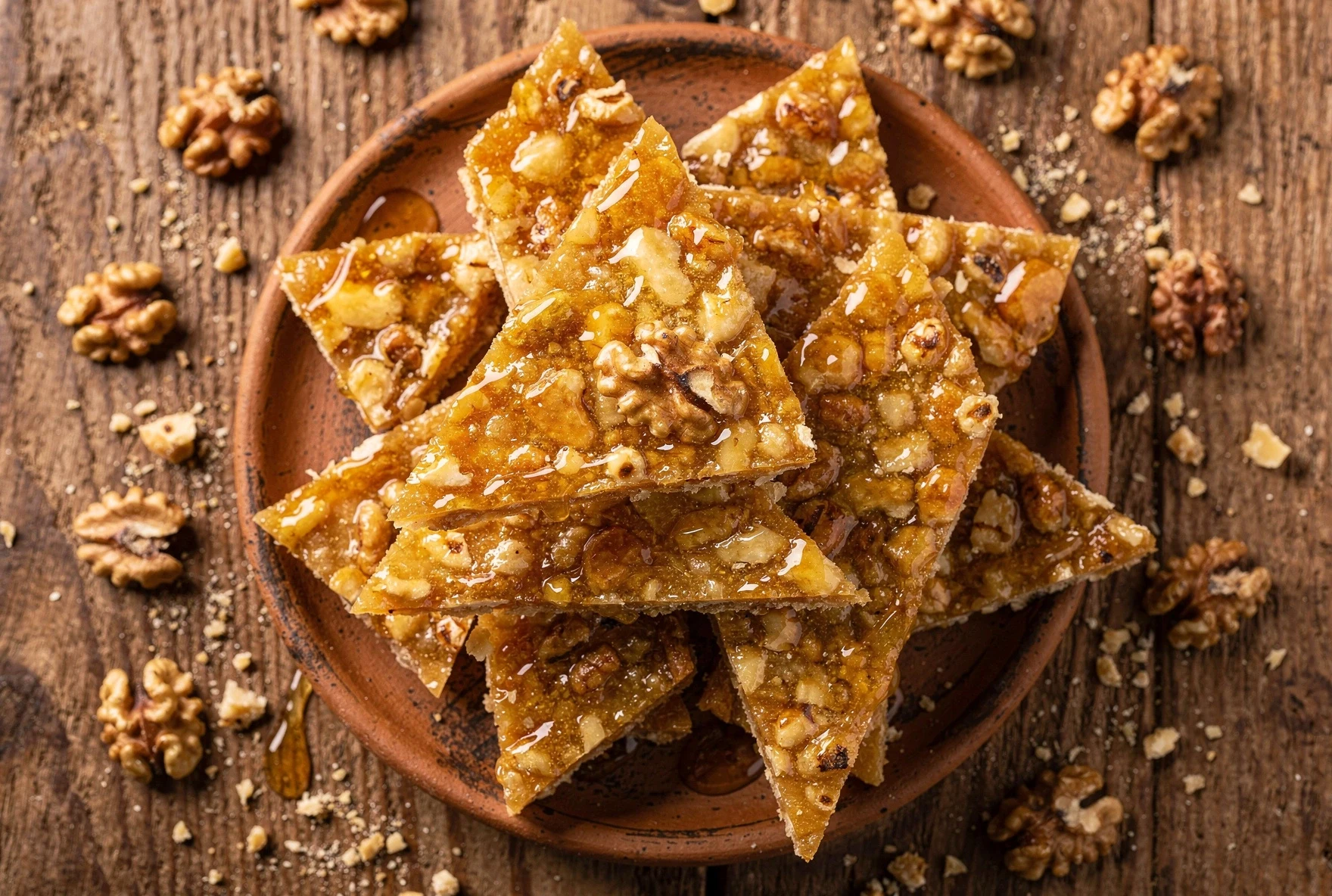
Gozinaki (გოზინაყი) is the Georgian New Year's dessert, full stop. On December 31st, every household in the country makes (or buys) gozinaki — diamond-shaped pieces of toasted walnuts bound in caramelized honey. It's the first thing you eat after midnight, the first sweet of the new year, and it's been this way for centuries.
The making process is deceptively simple but demands precision. Walnuts are toasted until fragrant (not burnt — this is where most people go wrong). Honey is heated until it darkens and thickens — the caramelization stage that gives gozinaki its characteristic amber color and slight bitterness. The walnuts go into the honey, everything gets stirred, and the mixture is poured onto a wet surface (traditionally a marble slab, practically a wet cutting board) and pressed flat. While still warm, it's cut into diamonds.
Good gozinaki shatters when you bite it — the honey is fully caramelized, not chewy or sticky. The walnuts should be golden, not dark. The overall flavor is rich, toasty, and only moderately sweet — Georgian honey tends to be wildflower-based and less cloying than commercial honey.
| Gozinaki Detail | Info |
|---|---|
| When eaten | New Year's Eve through January 7th (Orthodox Christmas) |
| Key ingredients | Walnuts, honey (that's it — two ingredients) |
| Shelf life | Several weeks at room temperature, months if stored cool |
| Common mistake | Under-caramelizing the honey → chewy, sticky result instead of brittle snap |
| Variations | Hazelnuts, sesame seeds, or sunflower seeds used in some regions |
Kada — Butter-Sugar Filled Pastry
Kada (ქადა) is one of those Georgian sweets that doesn't photograph well but tastes incredible. It's a yeasted or unleavened dough wrapped around a filling of butter, sugar, and flour — essentially a sugar-butter paste — then rolled flat, folded, and baked until golden. The result is flaky, buttery, and sweet in a restrained way.
There are two main styles. The flat version is rolled thin and baked as a large round, then cut into wedges — similar to a sweet flatbread. The layered version is folded multiple times to create visible strata, almost like a rough puff pastry. Both are good. The flat version is crunchier; the layered version is more tender.
Kada is especially popular in eastern Georgia and is served at holidays, name days, and family celebrations. You'll find it at most bakeries year-round, usually pre-sliced and sold by weight. It keeps well for days, which makes it practical travel food — and historically, that's exactly what it was. Shepherds and travelers carried kada because it's calorie-dense, doesn't spoil fast, and tastes good at room temperature.
Honey-Dipped Nuts (Kozinaki Variants)
Beyond gozinaki, Georgia has a broader category of honey-and-nut confections that don't always get their own names. At markets, you'll see trays of different combinations: honey with hazelnuts, honey with sunflower seeds, honey with sesame (kozinaki with sesame is popular in Tbilisi). These are all variations on the gozinaki principle — caramelized honey holding nuts or seeds together — but with different flavors and textures.
The hazelnut versions tend to be a bit chewier (hazelnuts have more oil than walnuts). Sesame kozinaki is crunchier and has a toasty, almost savory note. Some vendors add dried fruit — apricots, figs, raisins — which makes the result more complex but further from tradition.
Sweet Breads & Pastries
Georgian baking is primarily about savory bread — shotis puri, lobiani, kubdari. But there's a smaller tradition of sweet baked goods that sits quietly alongside the bread-cheese-meat obsession. These aren't pastry-shop elaborate — they're home-baked, often tied to specific towns or festivals.
Nazuki — Surami's Legendary Sweet Bread
If you drive along Georgia's east-west highway between Tbilisi and Kutaisi, you'll pass through the town of Surami. You'll know it by the roadside stalls selling glossy, dark-golden loaves of nazuki (ნაზუქი). Pull over. This is one of the best things you'll eat in Georgia.
Nazuki is a sweet, enriched bread flavored with cinnamon, cloves, and raisins. The dough is softer and richer than regular Georgian bread — more butter, eggs, and sugar in the mix. It's baked in a tone oven (the same cylindrical clay oven used for shotis puri), which gives it a slightly charred, smoky exterior that contrasts beautifully with the sweet, spiced interior.
Surami's nazuki is legendary because the town's bakers have been making it the same way for generations — same ovens, same recipes, same roadside selling. It's a whole micro-economy. Fresh from the oven, nazuki is almost intolerably good — warm, fragrant, slightly sticky from the sugar glaze. By the next day, it's still excellent but firmer, better for toasting. It keeps about 3-4 days before drying out.
Sweet Penovani
Penovani (ფენოვანი) literally means "layered" in Georgian, and while the savory version — penovani khachapuri — is the most famous, there's a sweet version filled with sugar-butter paste or jam. The puff pastry-like dough (bought from stores or made at home with the traditional folding technique) is filled, sealed, and baked until golden and shatteringly crispy.
Sweet penovani is more of a household treat than a bakery staple. Georgian grandmothers make it when kids visit, filling the layers with whatever's on hand — homemade jam (particularly quince, fig, or cornelian cherry), sweetened cottage cheese, or the same butter-sugar mixture used in kada.
Georgian Pakhlava
Yes, Georgia has its own version of baklava — called pakhlava (ფახლავა). It's similar to the Turkish and Middle Eastern versions but with Georgian tweaks: the nut filling is almost always walnut (never pistachio), the syrup often uses honey instead of sugar syrup, and the spicing leans toward cinnamon and clove rather than cardamom or rosewater.
Georgian pakhlava tends to be less intensely sweet than its Turkish cousin — less syrup, more nut. The layers are usually fewer (6-8 versus the 30+ of a Turkish showpiece), and the overall effect is denser and more rustic. It's a holiday dessert, especially popular in eastern Georgia and among Georgian Muslims in Adjara and the Pankisi Valley.
You'll find pakhlava at most Georgian bakeries, especially around holidays. The quality varies wildly — the best is made at home with real honey and hand-cracked walnuts. The worst is commercial, over-sweetened, and soggy.
Dairy-Based Sweets
Matsoni — Georgia's Everyday Sweet Ending
Matsoni (მაწონი) — Georgia's thick, tangy fermented milk — isn't technically a dessert, but it functions as one. After a heavy Georgian meal, a bowl of cold matsoni with a drizzle of honey is the most common "dessert" you'll actually encounter. It's light, cuts through the richness of everything that came before, and settles the stomach.
In villages, matsoni is made at home from cow's, sheep's, or goat's milk. The culture is passed down — literally, the starter culture from one batch inoculates the next, sometimes spanning decades of the same bacterial lineage. Commercial matsoni (Sante, Eco, and other brands) is widely available and perfectly good, but the homemade village versions tend to be thicker, tangier, and more complex.
Matsoni with honey and crushed walnuts is the closest Georgia gets to a standard dessert — served in homes, guesthouses, and some restaurants. It's simple, satisfying, and honestly, after a proper supra, it's all the dessert you need.
The matsoni-honey trick
Add a tablespoon of honey to matsoni before it's fully set (while still slightly warm after culturing). The honey partially ferments, creating a tangy-sweet combination that's more complex than simply drizzling honey on top. Georgian grandmothers know this. Hotels don't.
Nadughi — Sweet Cottage Cheese
Nadughi (ნადუღი) is a fresh, soft cheese made from whey — essentially Georgian ricotta. On its own, it's mild and slightly sweet. Mixed with honey or sugar and served with fresh fruit, it becomes a light dessert that shows up at Georgian breakfast tables and as a post-dinner offering.
The Megrelian version wraps nadughi in thin sheets of sulguni cheese and ties them into bundles — a dish called gadazelili or nadughi bundles. When served fresh with a bit of mint, it's a genuinely elegant dessert that wouldn't look out of place at a fancy restaurant, despite being peasant food at its core.
The Georgian Dessert Calendar
Georgian sweets aren't random — they follow a strict seasonal rhythm tied to the agricultural and religious calendar. Knowing when each dessert appears tells you a lot about what matters in Georgian culture.
| Season / Holiday | Sweets | Why |
|---|---|---|
| Rtveli (Sept–Oct) | Churchkhela, pelamushi, tklapi | Grape harvest — fresh must available |
| New Year (Dec 31) | Gozinaki, dried fruit, churchkhela | Honey and nuts symbolize sweetness in the coming year |
| Orthodox Christmas (Jan 7) | Gozinaki, nazuki, kada | Continuation of New Year celebrations |
| Easter | Paska (sweet bread), colored eggs | Orthodox tradition |
| Summer | Fresh fruit, matsoni with honey | Fruit season — peaches, figs, watermelon replace made sweets |
| Year-round | Kada, pakhlava, dried churchkhela | Long shelf life, always available at bakeries |
Modern Georgian Desserts
The traditional dessert canon is small and hasn't changed much in centuries. But modern Tbilisi has developed its own sweet culture that blends Georgian ingredients with European pastry techniques. This is a real, recent phenomenon — driven by the city's booming café scene and a generation of Georgian pastry chefs who trained in France and Italy.
Walnut & Honey Tarts
Traditional gozinaki filling in French tart shells. You'll find these at places like Entrée and Stamba. The best of both worlds — Georgian flavors, European technique.
Churchkhela Ice Cream
Several Tbilisi ice cream shops make churchkhela-flavored gelato — grape-must base with walnut pieces. Luca Polare does a version that's genuinely good.
Tatara Panna Cotta
Pelamushi reimagined as Italian panna cotta. The grape-must flavor works brilliantly in a lighter, creamier format. You'll see this at upscale Tbilisi restaurants.
Tkemali Sorbet
Sour plum sorbet — aggressively tart, deeply refreshing. A few experimental restaurants serve this as a palate cleanser between courses. Brilliant concept.
Where to find modern Georgian desserts in Tbilisi
The best spots for updated Georgian sweets are Entrée (Vera district), Stamba (Chubinashvili), and Café Littera (Literary Museum). For ice cream with Georgian flavors, try Luca Polare (multiple locations) or Tutti Frutti (Rustaveli). Most traditional restaurants still serve matsoni or fruit for dessert — the modern stuff is concentrated in the café-bistro scene.
Where to Buy Traditional Sweets
The best Georgian sweets aren't in shops — they're at markets, roadside stalls, and in people's homes. But here's where to find quality versions if you're visiting or just arrived.
Deserter Bazaar (Tbilisi)
The best churchkhela in Tbilisi. Buy from vendors who sell their own — uneven sizes, different colors, handwritten signs. Avoid the uniform, bright-colored ones near the entrance. Also good for tklapi, dried fruit, and honey.
Surami (Highway Stop)
The only place for real nazuki. On the main highway between Tbilisi and Kutaisi. Multiple stalls — they're all decent, but the ones with active tone ovens are best (you can see the bread being pulled out).
Village Guesthouses
The best homemade sweets you'll find. Guesthouse breakfasts in Kakheti, Svaneti, and Tusheti always include homemade churchkhela, honey, and fresh fruit. Some hosts sell churchkhela — always buy it.
Supermarkets
For everyday sweets: gozinaki, packaged churchkhela, honey, dried fruit. Goodwill, Nikora, and Carrefour all carry these. Quality is acceptable but never as good as market or homemade versions.
Making Georgian Sweets at Home
The good news about Georgian desserts is that most of them are genuinely simple. No tempering chocolate, no choux pastry, no multi-day laminated doughs. The challenge is usually patience (churchkhela takes weeks to dry) or getting one specific technique right (caramelizing honey for gozinaki).
| Dessert | Difficulty | Time | Key Challenge |
|---|---|---|---|
| Gozinaki | Easy | 30 minutes | Getting the honey caramelization right — too little and it's sticky, too much and it's bitter |
| Pelamushi | Easy | 45 minutes + setting | Finding quality grape juice (must be 100% juice, no added sugar) |
| Nazuki | Moderate | 3-4 hours (with rising) | Getting the enriched dough right — too much butter/sugar and it won't rise properly |
| Churchkhela | Moderate | 1 hour + 2-3 weeks drying | Tatara consistency and having space to hang the strings for weeks |
| Kada | Moderate | 2 hours | Rolling thin enough without tearing, even sugar-butter distribution |
| Pakhlava | Moderate-Hard | 2-3 hours | Layering thin dough sheets evenly, getting the syrup absorption right |
How Georgian Desserts Compare
Georgian sweets sit at a fascinating crossroads — influenced by Persian, Turkish, and Russian traditions but distinctly their own. Understanding these connections helps explain why Georgian desserts taste the way they do.
vs. Turkish Sweets
Turkey has baklava, Georgia has pakhlava — but Georgian versions use less sugar, more honey, and always walnuts (never pistachio). Georgia lacks Turkey's elaborate pastry tradition (no künefe, no kadayıf) but has the grape-based sweets Turkey doesn't.
vs. Armenian Sweets
The most overlap. Armenia has its own gata (similar to kada), dried fruit traditions, and nut-based confections. Churchkhela is Georgian-claimed but also made in parts of Armenia. The cultures share a walnut-and-honey DNA.
vs. Russian/Soviet
The Soviet era brought Napoleon cake, medovik (honey cake), and condensed milk-based sweets to Georgia. These are popular but not traditional. Georgian bakeries sell both — you'll see Napoleon next to gozinaki without anyone thinking it's weird.
vs. Persian/Iranian
The influence is subtle but real. Rosewater, saffron, and nut-paste confections entered Georgian cuisine through centuries of Persian rule. Pakhlava is the clearest connection, but the broader nut-as-dessert-base philosophy has Persian roots.
Common Questions
Are Georgian desserts very sweet?
No — that's actually their defining characteristic. Most Georgian sweets rely on the natural sweetness of honey, grape juice, and nuts. If you're used to American or Middle Eastern sweets, Georgian desserts will taste almost savory by comparison. The exception is pakhlava, which can be quite sweet when drenched in syrup.
What's the best Georgian dessert to try first?
Churchkhela — it's the most uniquely Georgian, widely available, and nothing else in the world tastes like it. Buy it at a market, not a tourist shop. After that, try gozinaki if it's winter, or pelamushi if it's autumn.
Can I bring churchkhela home from Georgia?
Yes — it's the most popular edible souvenir. Dried churchkhela lasts 2-3 months at room temperature, travels well (it's basically a flexible stick), and passes through customs without issues. Wrap it in paper, not plastic — it needs to breathe.
Where do Georgians get dessert at restaurants?
Most traditional Georgian restaurants don't have a real dessert menu. You might get matsoni with honey, fruit, or a slice of cake. Georgians don't really eat dessert "courses" — sweets are on the table throughout the meal, or eaten later with tea. For proper desserts, you go to a café or bakery, not a restaurant.
Are Georgian desserts gluten-free friendly?
Some are naturally gluten-free: gozinaki (just honey and walnuts), fresh churchkhela with corn-flour tatara (varies by recipe), matsoni with honey, and dried fruit. But churchkhela often uses wheat flour in the tatara, and the breads and pastries (nazuki, kada, pakhlava) are all wheat-based.
What nuts are most important in Georgian desserts?
Walnuts dominate overwhelmingly — they're in churchkhela, gozinaki, pakhlava, and used as garnish on pelamushi. Georgia is a major walnut-producing country, and walnut trees grow in nearly every garden. Hazelnuts come second, used in some churchkhela variations and coastal western Georgian sweets.
Written by The Georgian Eats Team
We've been eating Georgian sweets for years — buying churchkhela from the same vendors at Deserter Bazaar, making gozinaki every New Year, and pulling over at Surami for nazuki on every road trip. This guide is based on what we've eaten, cooked, and learned from Georgian friends and their grandmothers.
Last updated: March 2026.
Related Articles
Churchkhela: The Complete Guide
How it's made, regional varieties, where to buy, and how to make it at home.
Gozinaki: Honey-Walnut Brittle
Georgia's iconic New Year candy — just two ingredients, 30 minutes.
Pelamushi: Grape Pudding
Dense grape pudding made from the same base as churchkhela.
Georgian Sauces & Condiments
The complete guide to every sauce that defines Georgian cooking.