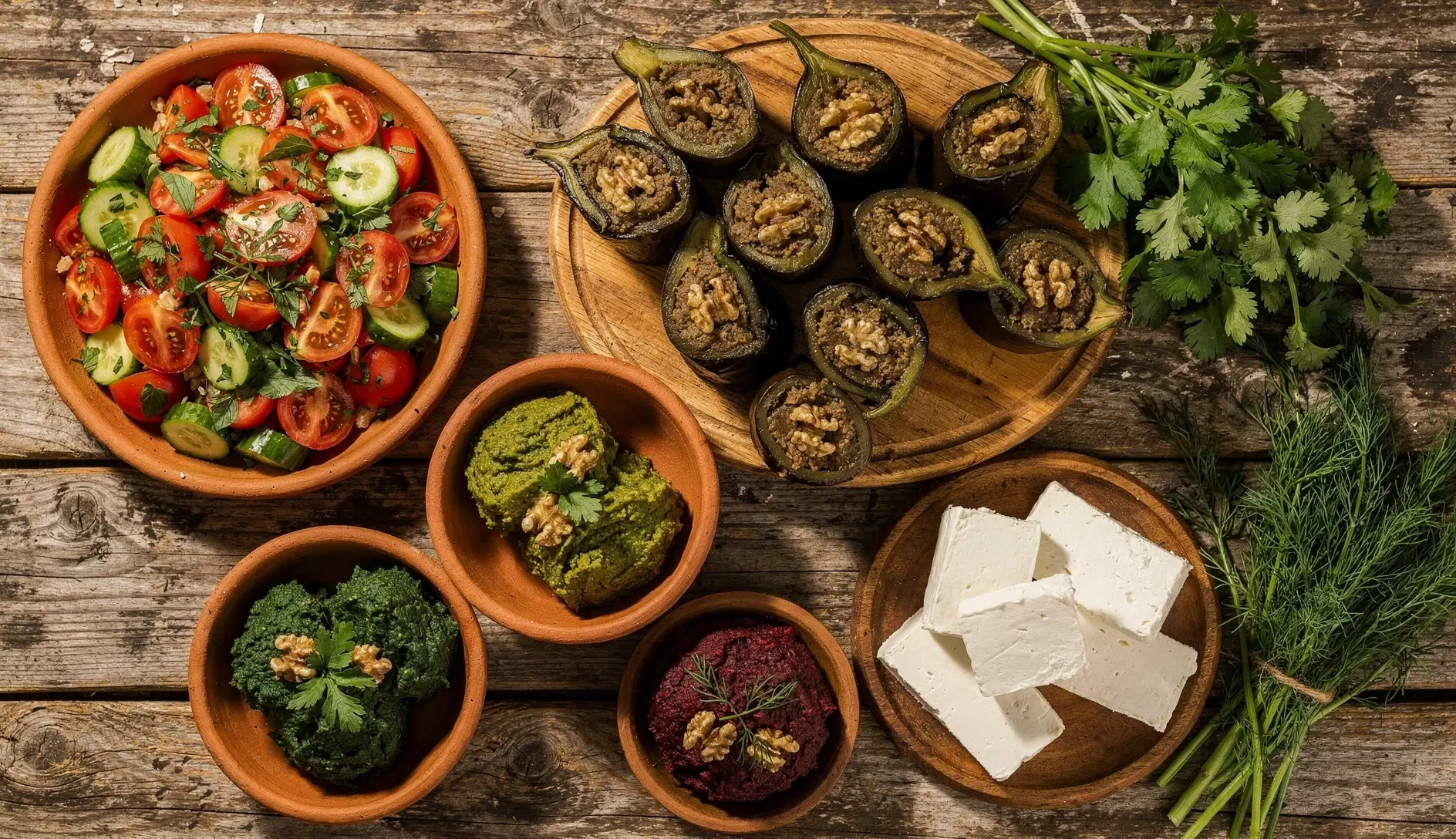
Every Georgian meal worth its salt starts cold. Before the khinkali arrive steaming, before the khachapuri comes golden from the oven, before anyone even thinks about grilled meat — there's the spread. Small bowls of walnut-laced vegetable pastes. Eggplant rolls bursting with herbed filling. Simple tomato salads dressed in nothing but good oil and fresh herbs. This is the Georgian mezze tradition, and understanding it is understanding half of what makes this cuisine extraordinary.
The Role of Cold Dishes in Georgian Cuisine
Walk into any Georgian restaurant, join any family dinner, attend any supra feast, and the table will already be covered when you sit down. This isn't appetizers in the Western sense — it's the foundation. Georgian hosts consider an empty table a disgrace. Guests should never wait for food to arrive.
The cold dishes serve several functions:
- Stomach preparation — Light vegetables and herbs before heavy meats and breads
- Toast accompaniment — Something to eat between the endless toasts
- Visual abundance — A full table signals generosity and prosperity
- Flavor balance — Acidic, herbaceous, and nutty notes that cut through richer dishes
The cold spread stays on the table throughout the meal, constantly picked at, topped up, and argued about. By the time the main courses arrive, you've already eaten enough cold food to constitute a full meal anywhere else. This is intentional.
The Walnut Foundation
Walnuts appear in Georgian cold dishes with almost religious consistency. Ground into pastes, made into dressings, scattered on top as garnish — they're the connective tissue of the entire category. Georgia is one of the world's oldest walnut-growing regions, and the nut's rich, slightly bitter flavor defines the cuisine. Stock up.
The Classic Georgian Salad (კიტრი-პომიდორი)
The simplest and most common cold dish in Georgia has no formal name — it's just "salad" or kitri-pomidori (cucumber-tomato). Every restaurant serves it. Every grandmother makes it differently. The version you'll encounter most often is tomatoes, cucumbers, red onion, and fresh herbs, dressed simply with oil. But the version worth making at home — the one that transforms it from ordinary to extraordinary — includes the walnut dressing.
Want the actual recipe?
Go straight to our Georgian salad recipe for exact quantities, walnut dressing ratios, and the small details that keep it tasting Georgian instead of generic.
The Basic Salad
| Ingredient | Amount | Notes |
|---|---|---|
| Ripe tomatoes | 3–4 large | Summer tomatoes only — mealy winter ones are pointless |
| Cucumbers | 2 medium | Persian or English preferred — less watery |
| Red onion | ½ small | Thinly sliced, soaked in cold water if too sharp |
| Fresh herbs | Large handful | Cilantro, basil, parsley, dill — use 2–3 together |
| Salt | To taste | Flaky sea salt preferred |
| Sunflower oil | 2–3 tbsp | Or walnut oil if available |
Cut tomatoes into wedges, slice cucumbers into half-moons, thinly slice the onion, tear the herbs roughly. Toss with salt and oil. Serve immediately — this salad doesn't hold. Some versions add crumbled fresh cheese (imeruli or feta) on top.
Georgian Walnut Dressing (ნიგვზის საწებელა)
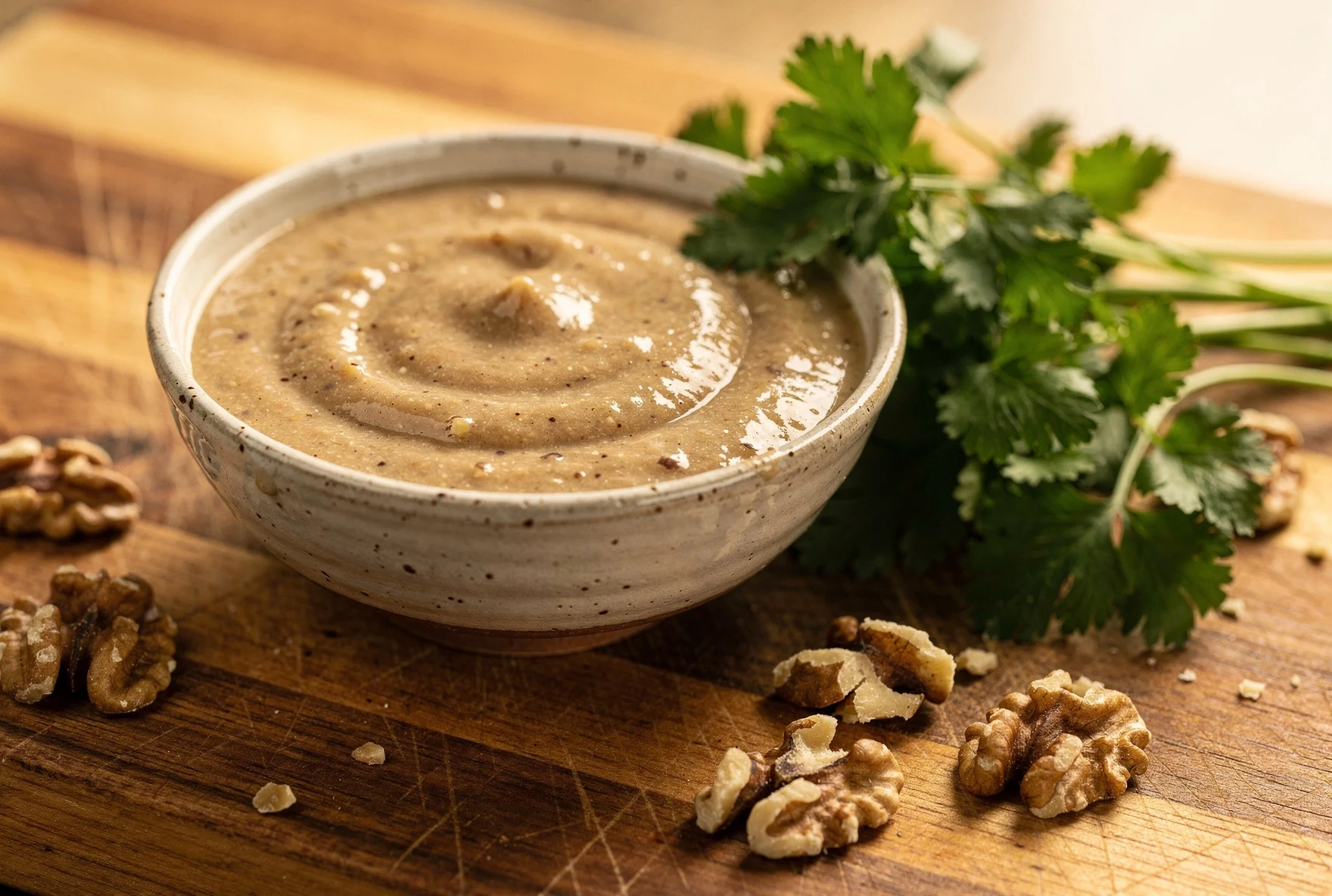
This is what elevates the simple salad into something memorable. Georgian walnut dressing is thicker than Western vinaigrettes — almost a sauce — with a creamy texture from ground walnuts and brightness from vinegar or lemon. It works on tomato salads, poured over roasted vegetables, or as a dip for bread. Once you have this in your repertoire, you'll use it constantly.
Dressing Ingredients
| Walnuts | 150g (1½ cups) |
| Garlic cloves | 2–3 |
| Red wine vinegar | 2 tbsp |
| Cold water | 80–100ml |
| Salt | ½ tsp |
| Ground coriander | ½ tsp |
| Cayenne or adjika | Pinch |
Method
- 1. Blend walnuts and garlic in a food processor until finely ground.
- 2. Add vinegar, salt, coriander, and cayenne. Pulse to combine.
- 3. With the processor running, slowly drizzle in cold water until you reach a thick but pourable consistency.
- 4. Taste and adjust salt, acid, and heat. It should be punchy.
- 5. Refrigerate 30 min before serving — flavors meld significantly.
The Texture Matters
Georgian walnut sauces should be creamy but with some texture — not perfectly smooth like hummus. If you over-process, you'll extract too much oil and end up with something greasy. Stop when it's still slightly grainy. This isn't peanut butter.
The Pkhali Family (ფხალი)
Pkhali is the jewel of Georgian cold dishes — small mounds of vegetable paste bound with ground walnuts, seasoned with garlic and coriander, traditionally shaped into balls or patties and garnished with pomegranate seeds. The base vegetable varies: spinach, beet, green bean, cabbage, leek, nettles. A proper Georgian spread includes at least two or three varieties, their colors creating a visual feast before you even taste them.
See our complete pkhali recipe for detailed instructions on all varieties.
| Variety | Georgian Name | Base Vegetable | Notes |
|---|---|---|---|
| Spinach Pkhali | ისპანახის ფხალი | Blanched spinach | The most common — vibrant green, earthy |
| Beet Pkhali | ჭარხლის ფხალი | Roasted or boiled beets | Deep magenta, sweet and earthy |
| Green Bean Pkhali | ლობიოს ფხალი | Blanched green beans | Lighter green, subtle flavor |
| Cabbage Pkhali | კომბოსტოს ფხალი | Blanched cabbage | Mild, slightly sweet |
| Leek Pkhali | პრასის ფხალი | Sautéed leeks | Oniony, rich |
| Nettle Pkhali | ჭინჭრის ფხალი | Foraged nettles | Seasonal spring dish, grassy flavor |
The technique is identical for all: cook the vegetable, squeeze out excess water, chop finely, mix with ground walnut paste (walnuts, garlic, coriander, fenugreek, salt, vinegar). The water content of the vegetable is critical — wet pkhali falls apart. Shape into balls or patties, indent the top with your thumb, fill with pomegranate seeds or a walnut half.
Badrijani Nigvzit (ბადრიჯანი ნიგვზით)
Eggplant rolls stuffed with spiced walnut paste are the dish that converts eggplant skeptics. The aubergine is sliced thin, fried or grilled until soft and silky, then rolled around a filling of ground walnuts, garlic, and herbs. Each roll gets a pomegranate crown and a drizzle of pomegranate molasses if you're feeling fancy.
See our complete badrijani nigvzit recipe for detailed instructions.
🍆 The Eggplant
Slice lengthwise, 5mm thick. Salt and drain 30 minutes to remove bitterness and excess moisture. Fry in vegetable oil until deeply golden and completely soft — undercooked eggplant won't roll without cracking. Drain on paper towels.
🌰 The Filling
Nearly identical to pkhali paste: ground walnuts, garlic, cilantro, blue fenugreek (utskho suneli), ground coriander, vinegar, salt. Some versions add a spoon of pomegranate molasses to the paste itself. The filling should be thick enough to hold its shape.
Fry vs. Grill
Traditional badrijani is fried. Healthier versions grill or roast the eggplant slices. Grilled has better flavor (char, smoke) but can be drier. If grilling, brush generously with oil and cook on high heat until marked and softened. Either way, the eggplant must be fully cooked and pliable.
Jonjoli & Pickle Salads (ჯონჯოლი)
Jonjoli is Georgia's secret weapon — pickled flower buds from the bladdernut tree that exist nowhere else in mainstream cuisine. They look like tiny green capers, taste like a cross between pickled capers and green beans, and carry a funky, fermented complexity that's addictive once you acquire the taste. Served as a salad dressed with oil and onions, they're a traditional accompaniment to meat dishes and a guaranteed conversation starter.
See our pickles and preserves guide for more on Georgian fermented vegetables.
🌸 Jonjoli Salad
Drain pickled jonjoli, toss with thinly sliced red onion, sunflower oil, and a splash of the brine. Some add chopped fresh herbs or a squeeze of lemon. The flavor is sour, vegetal, and utterly unique.
🥒 Pickle Plate
A typical supra includes a mixed pickle plate: green tomatoes, peppers, garlic, cabbage, cucumbers. All lacto-fermented (not vinegar pickled), served with their brine. The tangy crunch cuts through rich foods.
Bean Salads & Lobio Variations
While hot lobio (bean stew) is Georgia's comfort food, cold bean preparations are equally important. Bean salads appear at every supra, usually dressed simply with oil, herbs, and onions. The beans of choice are typically kidney beans or white beans, cooked until creamy but still holding their shape.
| Bean Dish | Style | Key Ingredients |
|---|---|---|
| Simple Bean Salad | Cold, dressed | Kidney beans, red onion, oil, vinegar, cilantro |
| Bean & Walnut Salad | Cold, dressed | Beans, walnut dressing, herbs, pomegranate |
| Lobio Salat | Room temp | Mashed beans, walnut paste, similar to pkhali |
Cheese & Fresh Herb Plates
No Georgian cold spread is complete without fresh white cheese and a mountain of herbs. These aren't garnishes — they're meant to be eaten in quantity, grabbed by the handful between bites of everything else.
🧀 Fresh Cheese
- • Imeruli — soft, mild, slightly tangy brined cheese
- • Sulguni — denser, saltier, sometimes smoked
- • Nadughi — fresh cottage cheese-like curds
- • Outside Georgia: use good feta or fresh mozzarella
See our Georgian cheese guide for more.
🌿 The Herb Plate
- • Cilantro (kindza) — the most used herb by far
- • Purple basil (rehan) — uniquely Georgian variety
- • Flat-leaf parsley — ubiquitous
- • Dill — especially with fish or eggs
- • Tarragon (tarkhuna) — anise-like, distinctive
- • Green onions/scallions — always present
Seasonal Availability
Georgian cold dishes are deeply seasonal. The best tomato salads exist only in summer when the fruit is actually worth eating. Jonjoli appears briefly in spring. Root vegetables dominate winter spreads. Understanding seasonality helps you cook authentically.
| Season | Star Dishes | Notes |
|---|---|---|
| Spring (Apr–May) | Jonjoli, nettle pkhali, leek pkhali | Foraged greens, fresh pickles |
| Summer (Jun–Aug) | Tomato salads, badrijani, cucumber dishes | Peak season — everything is ripe |
| Autumn (Sep–Nov) | Beet pkhali, bean dishes, last tomatoes | Harvest time, pickling season |
| Winter (Dec–Mar) | Spinach pkhali, pickles, beet dishes | Preserved vegetables, roots |
Building a Georgian Cold Spread
If you want to serve an authentic Georgian mezze at home, here's how to compose it. The key is variety — colors, textures, temperatures, and flavors should all vary across the spread.
🎯 Essential (Always Include)
- • Fresh cheese plate
- • Herb plate
- • Fresh bread (shotis puri or mchadi)
- • At least 2 pkhali varieties
- • Pickles
✨ Recommended Additions
- • Badrijani nigvzit (eggplant rolls)
- • Tomato-cucumber salad (summer)
- • Jonjoli (if available)
- • Bean salad
- • Walnut dressing on the side
Portion Planning
For a Georgian-style dinner party, plan on 5–8 small cold dishes for 6–8 guests. Each dish should be modest — a small bowl, a few rolls, a handful of cheese. The abundance comes from variety, not portion size. Everything goes on the table at once before guests sit down.
Where to Try in Georgia
Every restaurant in Georgia serves cold dishes, but some places excel:
Traditional Restaurants (Tbilisi)
Shavi Lomi, Café Littera, and Barbarestan all serve exceptional cold spreads as part of their tasting menus. For more casual options, any dukani (neighborhood tavern) will have house-made pkhali and pickles.
Markets
Dezerter Bazaar in Tbilisi has vendors selling fresh pkhali, pickles, and cheese. Arrive early for the best selection. In Kutaisi, the Green Bazaar has excellent Imeretian specialties.
Home Restaurants
The best cold spreads are in Georgian homes. If you're invited to a supra, you'll experience the full tradition — multiple pkhali varieties, house pickles, cheese from the family's village, herbs from the garden. Accept every invitation.
Frequently Asked Questions
Can I make pkhali ahead of time?
Yes — pkhali keeps refrigerated for 3–4 days. The flavors actually improve after a day. Bring to room temperature before serving and add fresh pomegranate garnish at the last minute.
What if I can't find Georgian cheese?
Feta (for imeruli) and fresh mozzarella or queso fresco (for sulguni) are the best substitutes. The key is using fresh, mild cheese — nothing aged or sharp.
Is jonjoli available outside Georgia?
Rarely. Some Russian or Georgian specialty stores carry imported jars. There's no real substitute — if you can't find it, skip it and add extra pickles instead.
What's the difference between pkhali and badrijani filling?
They use the same walnut-garlic-herb paste base. Pkhali mixes the paste with cooked vegetables; badrijani uses the paste as a filling wrapped in eggplant. The paste itself is nearly identical.
How long does walnut dressing keep?
Refrigerated in an airtight container, about 5 days. The oil may separate — just stir before using. It thickens when cold, so let it warm up or thin with a splash of water.
What wine pairs with Georgian cold dishes?
Dry white wines like Rkatsiteli or Mtsvane work beautifully with the herbaceous, tangy flavors. Amber wines are even better — their tannins complement walnut-based dishes perfectly.
Written by The Georgian Eats Team
We've spent years eating our way through Georgian supras, learning from grandmothers, and making pkhali until our hands turned green. This guide reflects how cold dishes are actually served in Georgian homes — not restaurant approximations.
Last updated: March 2026.
Related Articles
Pkhali: Georgian Vegetable & Walnut Spreads
Step-by-step recipes for spinach, beet, and bean pkhali varieties.
Badrijani Nigvzit: Eggplant Rolls with Walnut Paste
The definitive guide to Georgia's beloved eggplant appetizer.
The Georgian Supra: A Complete Guide
Understanding Georgia's legendary feast tradition.
Georgian Vegetarian & Vegan Food Guide
Georgia's rich tradition of plant-based dishes.