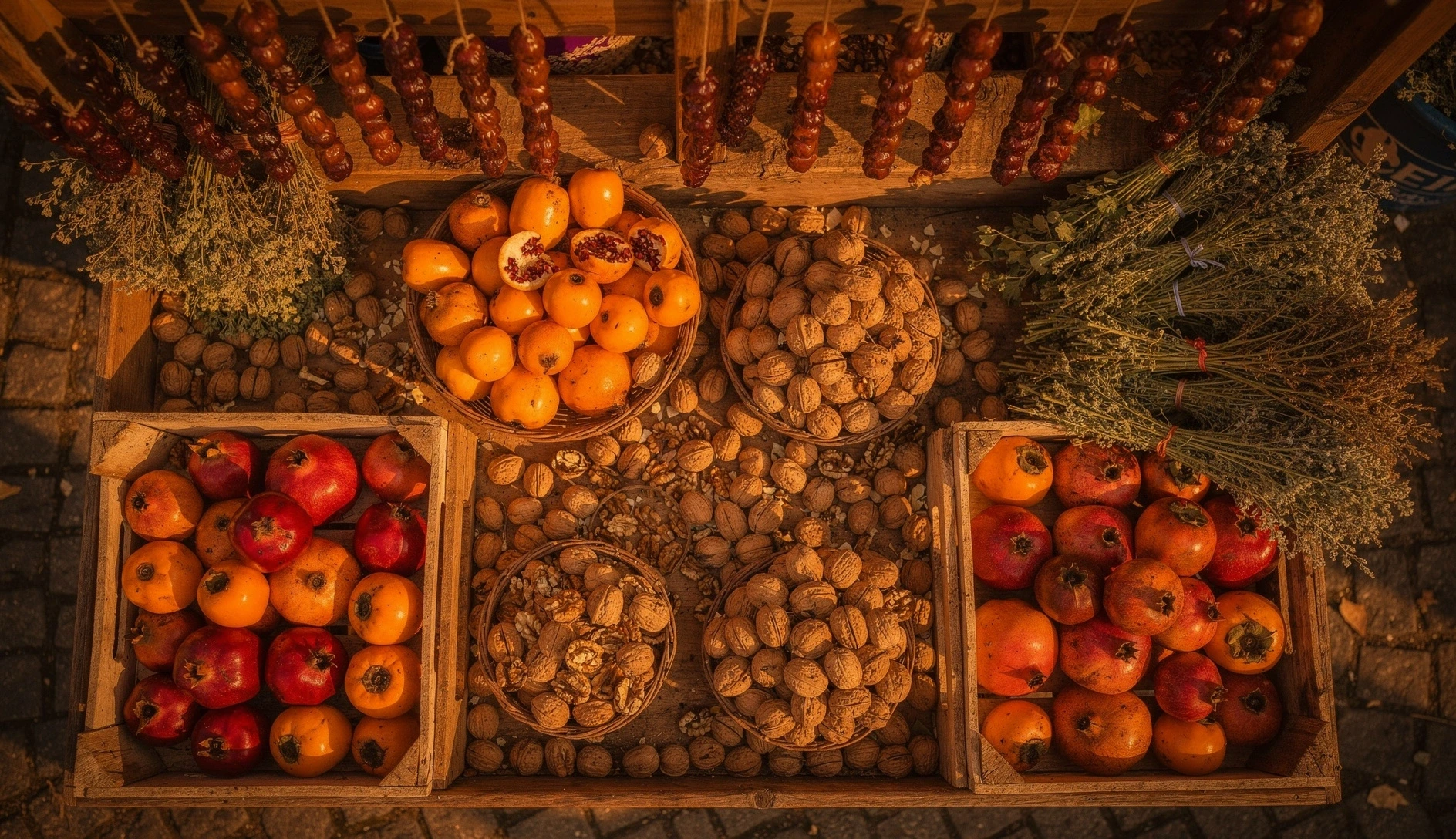
Georgian food doesn't exist in a vacuum. It follows the land — what's ripe, what's been slaughtered, what's been dried or pickled from last season. Walk through any bazaar in Tbilisi and you can tell the month by what's piled highest on the tables. Green almonds in April, mountains of tomatoes in August, churchkhela strands in October, tangerines in December. The Georgian table shifts dramatically through the year, and if you're only eating khachapuri and khinkali, you're missing the entire story.
This guide covers what Georgians actually eat in each season — which dishes peak when, what ingredients define each month, and what you should be ordering (or cooking) depending on when you visit. It's also a guide for home cooks outside Georgia who want to cook seasonally, the way Georgians do.
Spring (March–May): The Season of Renewal
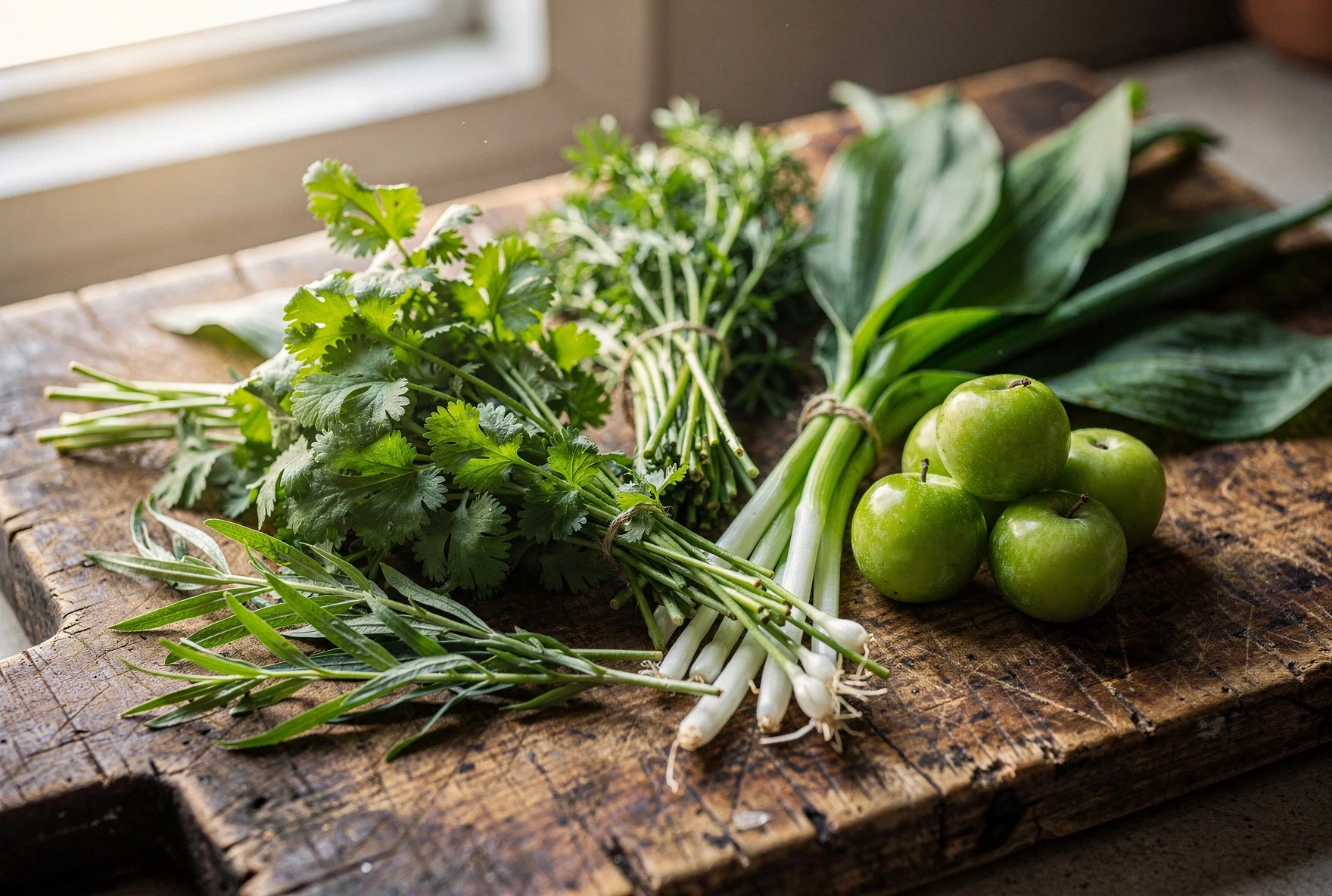
Spring in Georgia is when the kitchen wakes up. After months of preserved foods, dried herbs, and heavy stews, the first green shoots change everything. Markets flood with bundles of fresh tarragon, cilantro, green onions, and dill. Wild garlic appears in the mountains. Unripe green plums — tkemali — show up before the leaves have fully opened.
This is the season that defines some of Georgia's most celebrated dishes, because the ingredients are fleeting. You can't make proper chakapuli in August. The tarragon is wrong, the plums are wrong, the whole point is that it tastes like spring.
March
March is transitional. Winter hasn't fully let go, but the first signs appear. The last of the stored apples are finishing. Greenhouses produce early lettuce, radishes, and green onions. Bread and cheese remain breakfast anchors. This is still stew season — kharcho, chashushuli, and lobio dominate home kitchens.
In the markets, you'll see the first bunches of wild herbs. Women sell hand-gathered greens on street corners — things that don't have clean English names. Nettles start appearing, and some families make nettle pkhali.
March Highlights
Nettles for pkhali, first radishes, greenhouse greens. Orthodox Great Lent usually falls in March — meaning many families eat vegan for 48 days. This is when Georgia's vegetarian dishes really shine.
April
April is when it gets exciting. Tarragon explodes across every market — enormous bunches for almost nothing. Green plums appear, hard and sour, perfect for cooking. Green almonds show up, their fuzzy shells still soft enough to eat whole dipped in salt. This is a Georgian snack tradition: crack a green almond, dip it in coarse salt, eat it with beer. Visitors never expect it to be good. It's incredible.
Chakapuli season begins. This tarragon-heavy lamb stew made with green plums, white wine, and absurd quantities of fresh herbs is one of Georgia's greatest dishes, and it only works in April and May. Restaurants put it on specials. Families argue about whose version is best. If you visit Georgia in spring, eating chakapuli is mandatory.
Easter usually falls in April (Georgian Orthodox calendar), bringing satsivi and decorated eggs. Some families slaughter a lamb for the holiday table. The supra is long, serious, and loaded with the first spring greens.
May
May is peak spring. Strawberries arrive — small, fragrant, nothing like supermarket strawberries anywhere else. Cherries start in late May. Markets are wall-to-wall fresh herbs. Green beans appear for the first time.
This is the last window for good chakapuli — once the tarragon bolts and toughens in summer heat, the dish loses its soul. It's also when families start making fresh tkemali from the first green plums. The early-season tkemali is sharply sour, almost aggressive — very different from the mellower red tkemali of autumn.
Lobio transitions from the heavy winter version to lighter preparations with more fresh herbs. Ajapsandali season starts as the first eggplants appear.
| Month | Key Ingredients | Signature Dishes |
|---|---|---|
| March | Nettles, radishes, first greens, stored apples | Nettle pkhali, lobio, kharcho |
| April | Tarragon, green plums, green almonds, Easter lamb | Chakapuli, satsivi, Easter supra |
| May | Strawberries, cherries, green beans, eggplant (first) | Green tkemali, ajapsandali, chakapuli (last chance) |
Summer (June–August): The Season of Abundance
Summer in Georgia is overwhelming. The markets are so loaded with produce that you can't physically walk through some aisles. Tomatoes go from expensive to absurdly cheap — 1-2 lari per kilo for the big, ugly, flavorful ones that taste like tomatoes used to taste before industrial farming ruined them. Peppers, cucumbers, eggplant, corn, watermelon, peaches, apricots, figs — everything at once, all of it cheap, all of it better than what you've eaten before.
Georgian cooking in summer is defined by freshness and volume. Salads dominate. Grilling intensifies. Fruit is eaten in heroic quantities. This is also the season of badrijani nigvzit, because eggplant is everywhere and costs nothing.
June
June is cherry season. Sour cherries, sweet cherries, every shade from pale yellow to almost black. Georgian sour cherries make the best compote you've ever tasted — families boil them with sugar into a thick fruit drink that gets served ice cold all summer.
Tomatoes are getting good but haven't peaked. Eggplant is fully in season. This is when ajapsandali moves from occasional to daily — the eggplant-pepper-tomato stew that every family makes slightly differently. Badrijani nigvzit appears on every restaurant table as a starter.
Mtsvadi season is in full swing. Weekends mean charcoal grills everywhere — parks, backyards, roadsides. The combination of grilled meat, fresh tomato-cucumber salad, and cold beer is the Georgian summer in one meal.
July
July is the peak of everything. Tomatoes reach their best — the heirloom varieties at Dezerter Bazaar are so good they need nothing but salt and maybe a torn basil leaf. Watermelons from Kakheti are enormous and dirt cheap. Peaches and apricots overflow from every market stall.
This is when Georgian salads hit their peak. The classic tomato-cucumber-walnut salad becomes a daily fixture. Fresh basil — both purple and green — goes on everything. Chirbuli (eggs in tomato sauce) is at its best because the tomatoes don't need any help.
Corn season starts. Georgians eat simindi (boiled corn on the cob) as street food, and mchadi and elarji appear more often in western Georgian households.
July is Preservation Month
Many Georgian families spend July weekends preserving. Tomato sauce gets canned by the liter. Adjika gets made in bulk. Tkemali from red plums gets bottled for winter. Pickled peppers, pickled green tomatoes, pickled everything. The pantry is being stocked for the next six months.
August
August is Georgia's most generous month. Everything is still in season, figs have arrived, and the first grapes appear. Late-summer peaches from Kakheti are legendary — so juicy that eating one requires a napkin and ideally a sink nearby.
This is when families do their heaviest preserving. Every household with a grandmother is canning tomato sauce, making adjika, and pickling everything they can get their hands on. The goal is simple: stock the cellar before autumn. Walk through any residential neighborhood and you can smell vinegar and hot peppers through open windows.
Street food peaks in August. Corn vendors line the beach in Batumi. Khinkali restaurants fill with tourists. Every restaurant terrace is packed because it's too hot to cook at home.
| Month | Key Ingredients | Signature Dishes |
|---|---|---|
| June | Cherries, eggplant, peppers, herbs in bulk | Ajapsandali, badrijani nigvzit, mtsvadi, compote |
| July | Peak tomatoes, watermelon, peaches, apricots, corn | Tomato salads, chirbuli, mchadi, preservation season |
| August | Figs, first grapes, late peaches, peppers in bulk | Adjika making, fig preserves, grilled everything |
Autumn (September–November): The Season of Harvest
Autumn is Georgia's most important food season. This is when the grape harvest happens, when churchkhela gets made, when the pantry gets its final stocks, and when the food transitions from light summer dishes back to the slow-cooked, warming meals that define winter. It's also when Georgia is at its most beautiful — golden light, red-leafed vineyards, and markets that look like Renaissance paintings.
September
September marks the start of rtveli — the grape harvest. In Kakheti, families work dawn to dusk picking grapes, pressing juice, and filling qvevri (clay vessels) for the next year's wine. It's the single most important agricultural event in the Georgian calendar, and it shapes everything else on the table.
The harvest brings its own food traditions. Workers eat mtsvadi grilled over grapevine cuttings — the smoke from dried vine wood gives a flavor you can't replicate any other way. Shotis puri gets baked in enormous quantities to feed the harvest crews. Fresh grape juice (must) becomes pelamushi — a thick grape pudding that's essentially churchkhela filling in a bowl.
Pomegranates start appearing. Walnuts are harvested. Persimmons begin turning orange on the trees but aren't ripe yet — leave them alone until November.
Rtveli: More Than Wine
The grape harvest isn't just about wine. The fresh juice becomes pelamushi (grape pudding) and gets boiled down to make churchkhela — strings of walnuts dipped in thickened grape juice and dried. Families make hundreds of churchkhela at a time, hanging them from wooden racks to dry for weeks. It's the original Georgian energy bar, and nothing tastes like the fresh-made version.
October
October is churchkhela month. Market stalls shift from summer fruit to autumn colors — deep reds, oranges, and browns. Churchkhela strands hang everywhere, still slightly soft and chewy from recent making. Fresh walnuts are cracked and eaten by the handful. Pomegranates are fully ripe.
The cuisine shifts back to heavier dishes. Chanakhi — lamb and eggplant baked in clay pots — returns to regular rotation. Kharcho feels right again after months of being too heavy. Lobio moves from its lighter summer version back to the full, slow-cooked classic with dried herbs.
Red tkemali gets made from ripe plums — sweeter and mellower than the sharp green spring version. Families that didn't preserve enough in summer have their last chance now.
November
November is persimmon season. The khurma variety sold everywhere is almost cloyingly sweet when ripe — soft as pudding, bright orange, eaten with a spoon. Markets stack them in pyramids. Quince appears, used in some regions to make preserves or to add to lamb stews.
This is when the last fresh produce fades. The tomato-based dishes of summer are over. Preserved foods take center stage — jars of adjika, bottles of tkemali, pickled everything. Pickles become the default table accompaniment.
The first tangerines from western Georgia start appearing in late November. Abkhazian and Adjarian tangerines are famously good — small, fragrant, with loose peels and an intense sweetness that commercial tangerines can't match.
| Month | Key Ingredients | Signature Dishes |
|---|---|---|
| September | Grapes (rtveli), walnuts, pomegranates, fresh must | Pelamushi, churchkhela making, mtsvadi on vine coals |
| October | Churchkhela, walnuts, pomegranates, late plums | Chanakhi, kharcho, red tkemali, lobio |
| November | Persimmons, quince, first tangerines, preserved foods | Preserved pickles, heavy stews, persimmons as dessert |
Winter (December–February): The Season of Feasts
Winter in Georgia is cold, grey, and punctuated by enormous feasts. The fresh produce is gone except for hardy greens, root vegetables, tangerines, and whatever the greenhouse industry provides. But what winter lacks in freshness, it makes up for in celebration. Georgian New Year and Christmas involve some of the most elaborate cooking of the entire year.
December
December is tangerine season. Western Georgian tangerines flood every market, street corner, and car trunk in the country. The smell of tangerine peels is the smell of Georgian December. Families buy them by the crate — 10-15 lari for a full box.
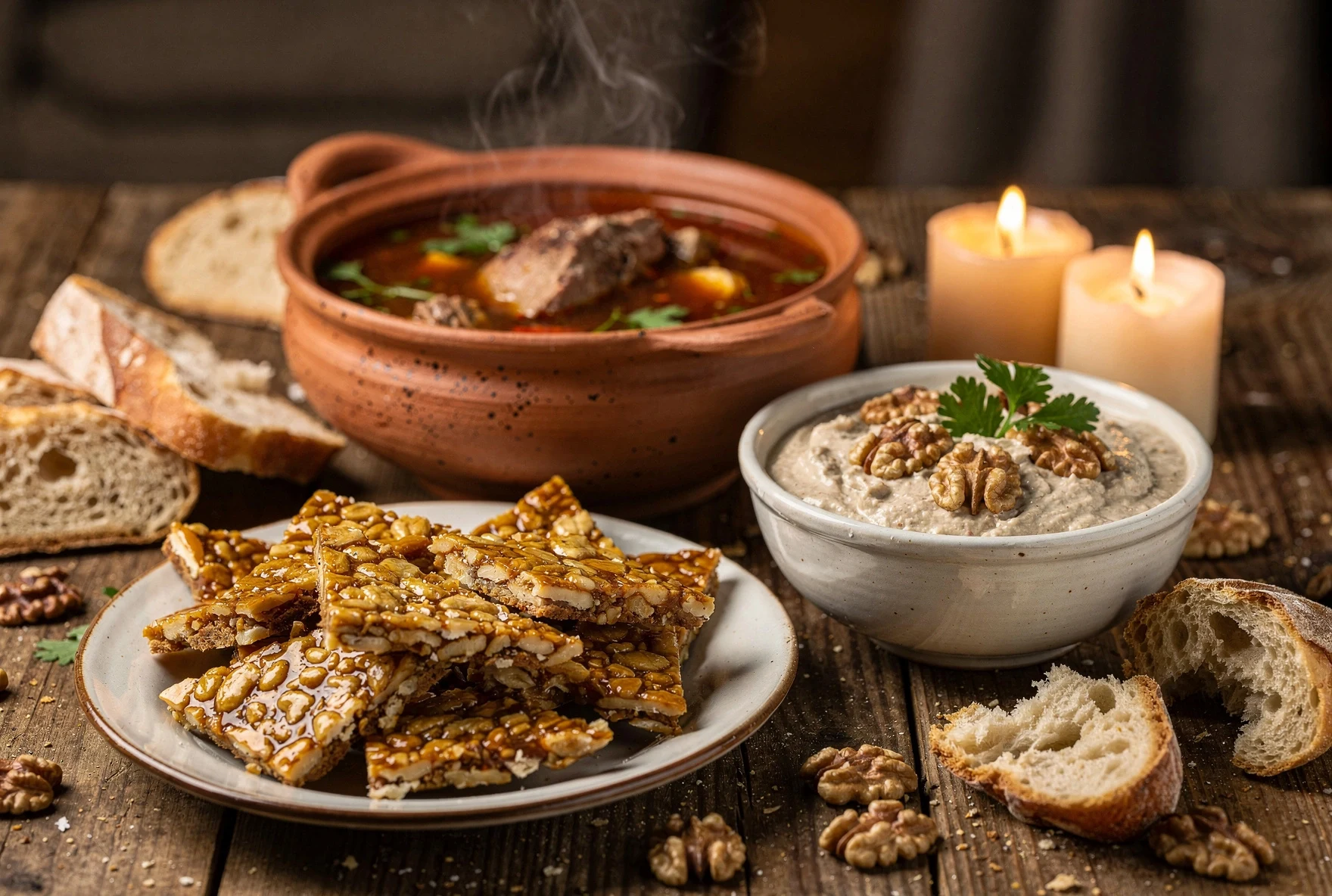
New Year's Eve preparations start mid-month. This is the biggest food event of the Georgian winter. The table must be loaded — it's bad luck to start the year with an empty table. Satsivi (cold chicken in walnut sauce) gets made in enormous batches. Gozinaki (honey-walnut brittle) gets made from scratch — a sticky, satisfying process that fills the kitchen with the smell of caramelized honey.
Kuchmachi — organ meats with walnuts and pomegranate — appears on the New Year's table as a rich appetizer. Bazhe sauce gets made to accompany cold turkey or chicken. The full New Year's table might have 15-20 dishes, most prepared in the days leading up to December 31st.
January
January is feasting month. After secular New Year (Dec 31), Georgian Orthodox Christmas falls on January 7th, bringing another full supra. Then Old New Year on January 14th — another feast. Some families celebrate Bedoba (Jan 2) as well. The result is roughly two weeks of near-continuous eating.
Khashi enters its prime season. This cow-foot and tripe soup, served at dawn with raw garlic and chacha (grape brandy), is traditionally a winter dish and specifically a post-party recovery meal. Dedicated khashi restaurants open at 6 AM and close by 10 AM. The line starts early. If you've never had khashi on a freezing January morning after a night of wine, you haven't fully experienced Georgian winter.
Leftover satsivi gets eaten for days — it's actually better on day two or three, after the walnut sauce has had time to meld. Lobio in a clay pot is the default weeknight dinner. Heavy, warming, cheap, and deeply satisfying.
February
February is the quietest food month. The excitement of the holidays is over. Stored foods are running lower. Markets offer greenhouse tomatoes and cucumbers (acceptable, not great), root vegetables, imported citrus, and whatever dried herbs are left from the autumn harvest.
This is comfort food season in its purest form. Chashushuli is perfect for February — a no-water beef stew that fills the house with warmth. Chakhokhbili (herb-loaded chicken stew) is another weeknight staple. Chikhirtma — the egg-lemon chicken soup — is classic February food, light enough that you don't feel weighed down but warm enough to fight the cold.
Great Lent sometimes begins in late February, depending on the year. When it does, the table shifts overnight to vegan — no meat, no dairy, no eggs. Lobio, ajapsandali, pkhali, and bean-based dishes become the core diet. The vegetarian tradition isn't a modern trend in Georgia — it's a religious practice that shaped the cuisine over centuries.
| Month | Key Ingredients | Signature Dishes |
|---|---|---|
| December | Tangerines, walnuts, dried fruits, holiday shopping | Satsivi, gozinaki, kuchmachi, bazhe, New Year's supra |
| January | Leftover feast food, tangerines, preserved foods | Khashi (dawn soup), leftover satsivi, lobio, Christmas supra |
| February | Greenhouse vegetables, root vegetables, dried herbs | Chashushuli, chakhokhbili, chikhirtma, Lenten dishes |
Dishes You'll Find Year-Round
Not everything is seasonal. Some Georgian dishes transcend the calendar — they're served every day, in every season, in every part of the country.
🧀 Khachapuri
Every style, every day. Imeretian at home, Adjarian at restaurants, Megrelian when you need maximum cheese. Season-proof.
🥟 Khinkali
Khinkali restaurants serve all year. Meat filling in winter, mushroom and cheese versions gain popularity in fasting periods.
🍞 Bread
Shotis puri and tonis puri come fresh from bakeries 365 days a year. Bread is non-negotiable in Georgia.
🍳 Shkmeruli
Garlic chicken in milk sauce doesn't depend on any seasonal ingredient. Available everywhere, always.
🍄 Soko Ketsze
Mushrooms in clay with butter and cheese — year-round because mushrooms aren't seasonal in the commercial supply.
🌶️ Ojakhuri
Pork and potatoes in a sizzling ketsi. Pure comfort food that works every day of the year.
When to Visit Georgia for Food
If you're planning a trip around food — which you should be — your timing matters more than you think. Here's the honest breakdown:
🏆 Best Overall: September–October
Rtveli (grape harvest), churchkhela making, perfect weather, markets overflowing, wine tasting in Kakheti. This is peak Georgian food season.
🌸 Best for Unique Dishes: April–May
Chakapuli season, green almonds, Easter celebrations, wildflowers everywhere. You'll eat things that simply don't exist the rest of the year.
☀️ Best for Produce: July–August
If you want the best tomatoes, fruit, and grilled food of your life, summer is when markets are at absolute maximum. Hot, though.
🎉 Best for Feasts: December–January
New Year, Christmas, Old New Year — back-to-back supras with satsivi, gozinaki, and khashi at dawn. Cold but magical.
The Only Bad Time for Georgian Food
There isn't one. Even in February — the quietest food month — you'll eat better in Georgia than most places on earth. The bread is still fresh, the cheese is still good, the wine is still flowing. Seasonal eating just means the experience is different month to month, not worse.
Cooking Georgian Food Seasonally at Home
If you're cooking Georgian food outside Georgia, matching the season to the dish makes everything better. Here's how to think about it:
| Your Season | Cook These | Why |
|---|---|---|
| Spring | Chakapuli, pkhali, green tkemali | Fresh tarragon and sour fruits are available |
| Summer | Ajapsandali, badrijani, mtsvadi, chirbuli | Eggplant and tomatoes are at their peak |
| Autumn | Chanakhi, lobio, red tkemali, churchkhela | Time for slow-cooked dishes and preserving |
| Winter | Satsivi, gozinaki, kharcho, khashi | Rich, warming, celebratory — made for cold weather |
The single best piece of advice: don't fight the calendar. Chakapuli made with dried tarragon in December isn't chakapuli — it's a different dish wearing chakapuli's name. Ajapsandali made with mealy winter eggplant won't taste right. Cook what the season gives you, and you'll naturally end up eating like a Georgian.
Frequently Asked Questions
What's the best month for food in Georgia?
September and October. The grape harvest is happening, markets are loaded with autumn produce, churchkhela is being made fresh, and the weather is perfect.
Do restaurants serve seasonal menus?
Most restaurants serve the same menu year-round, but they'll add seasonal specials — chakapuli in spring, churchkhela in autumn. Home cooking is far more seasonal than restaurant food.
When are Georgian markets most impressive?
July through October. The Dezerter Bazaar in Tbilisi is extraordinary year-round, but summer and early autumn are when it's at its most overwhelming.
What's the deal with fasting?
Orthodox fasting (roughly 200 days/year) means no meat, dairy, or eggs. During fasting periods, restaurants serve more bean, walnut, and vegetable dishes. It's a great time to explore Georgia's vegan traditions.
Can I find good food in winter?
Absolutely. Winter food is different — heavier, more preserved, centered around stews and feasts — but it's deeply satisfying. Plus: New Year's and Christmas supras are legendary.
What fruit is Georgia famous for?
Peaches (July-Aug), persimmons (Nov), tangerines (Dec-Jan), cherries (June), and figs (Aug-Sep). Georgian fruit, especially from Kakheti, is exceptional because most is still grown without industrial methods.
Written by The Georgian Eats Team
Based in Tbilisi, shopping at Dezerter Bazaar through every season. We've watched the market stalls shift from green almonds in April to churchkhela in October, and we've eaten our way through every month of the Georgian calendar.
Last updated: March 2026.
Related Articles
Regional Cuisine Guide
How Georgian food changes from west to east — eight distinct cuisines.
Pickles & Preserves Guide
Every pickle on the Georgian table — jonjoli, mzhave, and more.
20 Dishes You Need to Try
The definitive guide to Georgian food — what to order and how to eat it.
Georgian Wine for Beginners
Everything you need to know about Georgian wine — grape varieties, regions, and qvevri.