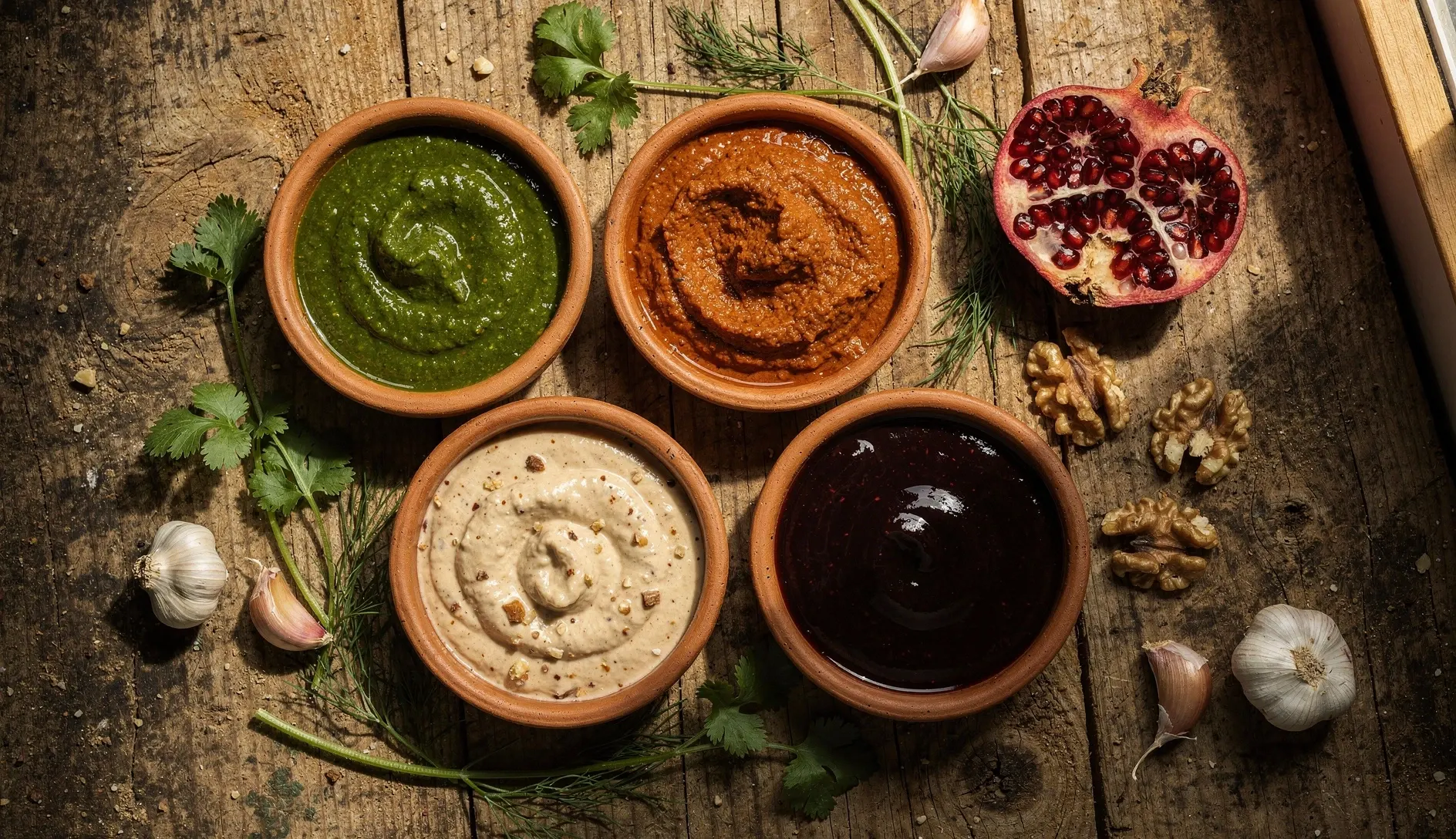
Georgian cuisine has a sauce problem — in the best possible way. Where most food cultures have one or two go-to condiments (ketchup and mustard, soy sauce and rice vinegar), Georgia has an entire ecosystem of sauces built on walnuts, sour plums, tomatoes, pomegranates, and enough garlic to ward off every vampire in the Caucasus.
These aren't background players. Georgian sauces are loud, opinionated, and structurally essential. Take away tkemali and grilled meat loses its soul. Remove bazhe and half the cold dishes on the supra table disappear. Satsebeli isn't a topping — it's a core ingredient that ties dishes together the way butter ties together French cooking.
If you've eaten at a Georgian table, you've seen the lineup: small bowls clustered in the center, each a different color, each reaching for a different flavor register. Tart, nutty, fiery, herbal, sweet-sour. The idea is that any bite of food can be redirected with a spoonful of sauce. Grilled pork too simple? Hit it with tkemali. Fried eggplant needs depth? Bazhe. Boiled chicken feeling plain? That's what satsivi was invented for.
This guide covers every major Georgian sauce and condiment — what it is, what it goes on, and where to find the recipe if you want to make it yourself.
The Walnut Sauces: Georgia's Secret Weapon
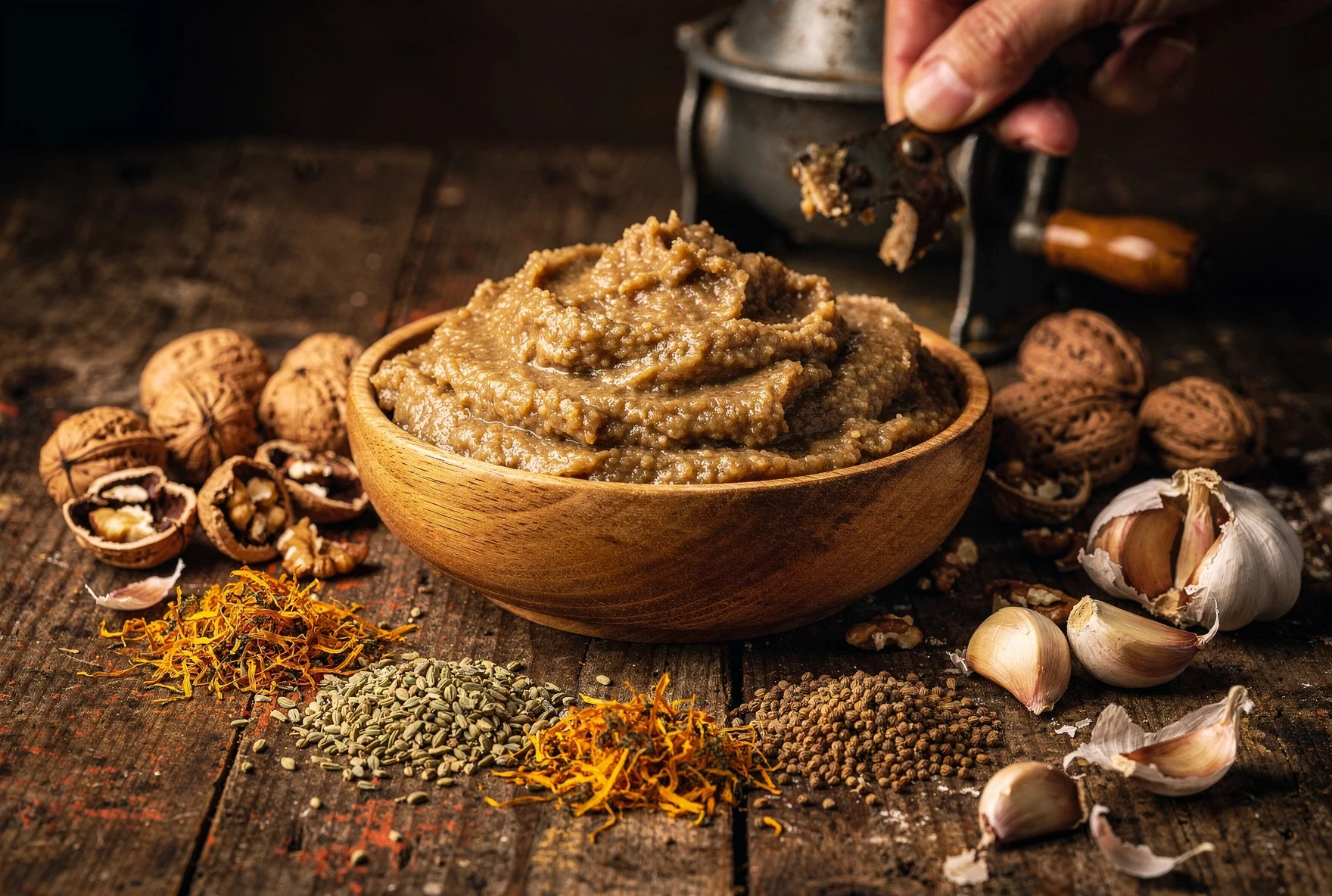
If French cuisine runs on butter and cream, Georgian cuisine runs on walnuts. Ground walnuts form the base of at least four major sauces, and they show up as a supporting player in a dozen more. This isn't a quirky ingredient choice — it's fundamental. Walnuts provide the richness, body, and emulsification that dairy provides in European cooking, but with a completely different flavor profile: earthy, slightly bitter, with a sweetness that rounds out garlic and spice.
Georgia is one of the world's original walnut territories. The trees grow wild across the country, and every household has a meat grinder or mortar that's been used to pulverize walnuts into paste for generations. The technique is always the same: grind the walnuts fine, season with garlic and dried spices, then thin with water or broth until you reach the right consistency. What changes between sauces is the spice mix, the acidity source, and whether it's served warm or cold.
Bazhe — The Mother Sauce
If you learn one Georgian sauce, learn bazhe. It's the foundation — a cold walnut-garlic sauce seasoned with blue fenugreek (utskho suneli), dried marigold petals (kviteli kvavili), and coriander. No cooking required. You grind walnuts, mix in the spices and garlic, thin with water until it's the consistency of heavy cream, and that's it.
Bazhe goes on everything cold: fried eggplant, poached chicken, boiled vegetables, fish. It's the sauce that appears at every supra on top of badrijani nigvzit and alongside cold chicken. The flavor is hard to describe if you haven't had it — rich but not heavy, garlicky but not sharp (the garlic mellows when blended into the walnut fat), with an herbal complexity from the fenugreek and marigold that tastes like nothing in Western cooking.
The walnut quality matters
Bazhe is only as good as your walnuts. Stale, bitter walnuts will make bitter sauce — no amount of garlic can save it. In Georgia, people buy walnuts in autumn when they're fresh and store them in-shell. If your walnuts taste even slightly rancid, start over. Fresh walnuts should taste sweet and mildly creamy, not bitter.
Satsivi — The Holiday Walnut Sauce
Satsivi is bazhe's cooked cousin. Same walnut base, same garlic-and-fenugreek backbone, but satsivi is thinned with chicken broth, enriched with egg yolk, and gently heated (never boiled — the walnuts will separate). It's then poured over poached chicken or turkey and served cold. This is Georgia's Christmas and New Year's dish — no holiday table is complete without it.
The key difference from bazhe: satsivi has more body because of the broth and egg, a deeper flavor from being gently warmed so the spices bloom, and it's specifically meant as a complete dish (sauce + protein together) rather than a dipping sauce. It's also slightly more acidic — white wine vinegar is traditional.
Garo — The Forgotten Walnut Sauce
Garo is the walnut sauce most foreigners never encounter. It's essentially a walnut-garlic sauce sharpened with vinegar and enriched with egg yolk, traditionally served with poultry. Think of it as the bridge between bazhe (cold, raw) and satsivi (cooked, enriched). Garo uses coriander heavily and gets a pleasant bitterness from fenugreek. It's rarer now — you'll find it in some home kitchens in Kakheti and Kartli, but restaurants rarely serve it.
Tkemali: The Sour Plum Sauces
If walnuts are the backbone of Georgian sauces, sour plums are the soul. Tkemali — named after the wild cherry plum (Prunus cerasifera) that grows everywhere in Georgia — is the country's national condiment. It sits on every table the way ketchup sits on American tables, except it's actually good.
There are two main varieties, and Georgians have strong opinions about which is better:
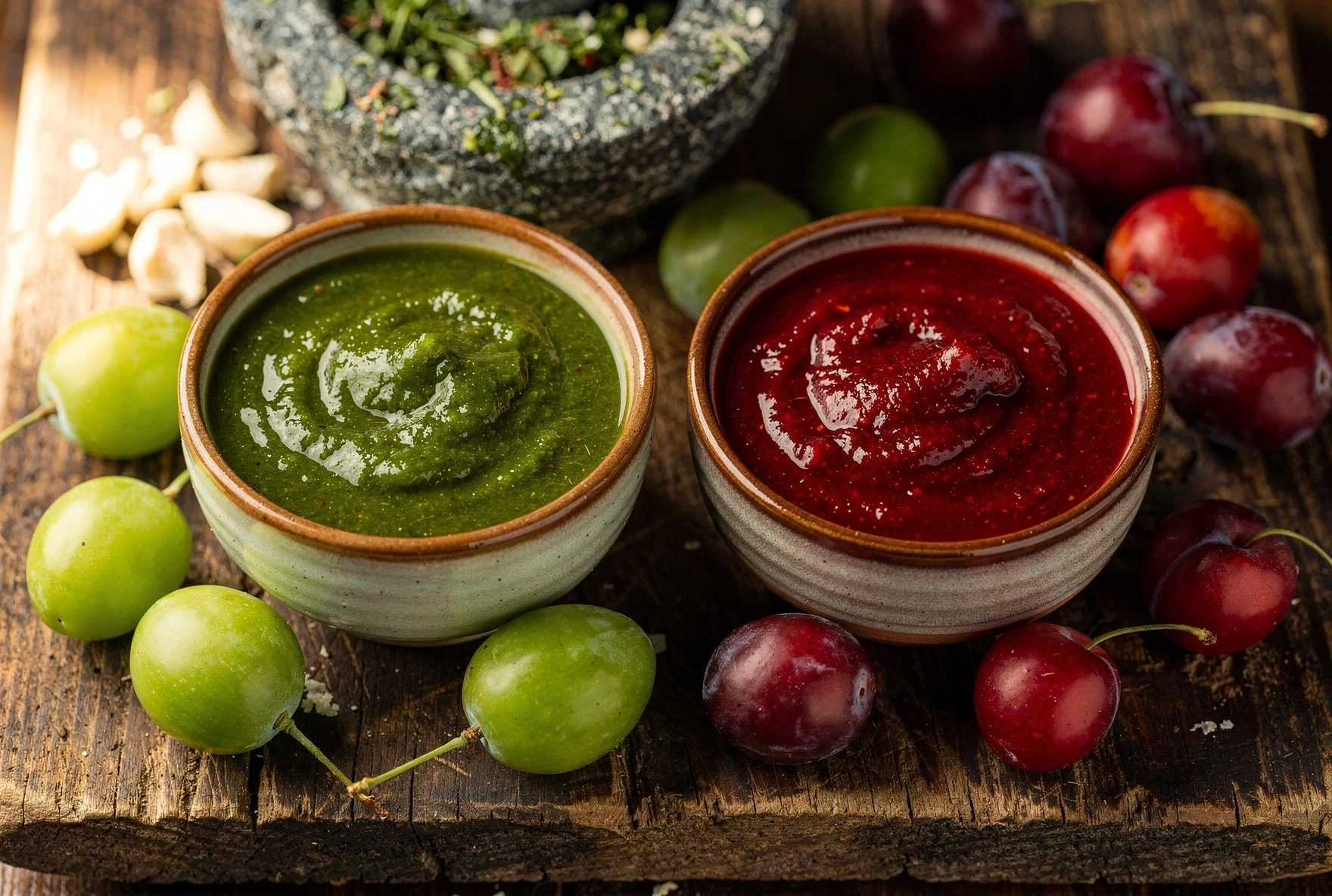
Green Tkemali
Made from unripe green plums in late spring. Intensely sour, bright, herbaceous. Flavored with pennyroyal (ombalo), cilantro, dill, and garlic. This is the sharper, more assertive version — it cuts through fatty grilled meat like a knife. Seasonal: available fresh May–June, preserved year-round.
Red Tkemali
Made from ripe red or purple plums in late summer. Sweeter, rounder, with more depth. Still tart, but less aggressively so. Some versions use cherry plums, others use regular plums or even damson varieties. This is the tkemali most commercial brands sell — more approachable for newcomers.
Tkemali's flavor profile — aggressively sour, garlicky, herbal — makes it an ideal companion for rich, fatty foods. The classic pairings:
| Dish | Tkemali Type | Why It Works |
|---|---|---|
| Mtsvadi (grilled pork) | Green | The acid cuts through pork fat — non-negotiable pairing |
| Ojakhuri (fried pork & potatoes) | Either | Adds brightness to the fried richness |
| Chicken Tabaka | Red | Sweeter red balances crispy chicken skin |
| Lobio (bean stew) | Green | Acid lifts the earthy, heavy beans |
| Fried potatoes | Either | Georgia's answer to ketchup-with-fries |
| Kupati (sausage) | Green | Sour plum and spiced pork is a legendary combination |
The ombalo question
Traditional tkemali uses ombalo (pennyroyal mint), a wild herb that grows throughout Georgia. It's almost impossible to find outside the Caucasus. If you're making tkemali abroad, the best substitution is a mix of regular mint and dried thyme. Some Georgian cooks living abroad use Vietnamese mint (rau ram) as a closer match. Don't skip the herb entirely — it's what separates real tkemali from "sour plum sauce."
Tklapi — Sour Plum Leather
Tklapi deserves its own mention because it's one of the most clever preservation techniques in any cuisine. It's tkemali sauce spread thin on a board and sun-dried into a leather sheet — essentially a fruit leather, but savory. Before year-round tkemali was bottled and sold in supermarkets, tklapi was how families stored their sour plum supply through winter.
You tear off a piece of tklapi and dissolve it in hot water or broth to recreate tkemali sauce on demand. It's a key ingredient in kharcho (the spiced beef soup) and chakapuli (the spring lamb stew), where it provides the sour element without adding too much liquid. Some older recipes for satsivi also call for tklapi rather than vinegar.
Tklapi is sold in sheets at any Georgian bazaar — usually rolled up like scrolls. The best ones are intensely sour and slightly sticky. If they're completely dry and brittle, they've been stored too long.
Make it from scratch
If you want the full process rather than just the concept, our tklapi recipe walks through cooking the plums down, straining them, and drying the sheets properly.
Satsebeli: Georgia's Tomato Sauces
The word satsebeli (საწებელი) literally means "sauce" in Georgian — which tells you something about its importance. In common usage, satsebeli refers to the tomato-based sauce that sits alongside tkemali on every Georgian table. But technically, satsebeli is a generic term for any dipping sauce, and older Georgian cookbooks use it for walnut sauces too.
The standard satsebeli you'll encounter is a cooked tomato sauce with garlic, cilantro, and often ground walnuts for body. It's thicker than Italian tomato sauce, more herbaceous, and carries more garlic. Think of it as Georgia's answer to salsa — raw versions exist too, especially in summer when tomatoes are at their peak.
What makes Georgian satsebeli different from, say, a Mexican salsa or Italian passata is the walnut. Even a small amount of ground walnut transforms the texture from thin and sharp to rich and velvety. It's the same principle as adding butter to a pan sauce, but with a nuttier, more complex result.
| Satsebeli Type | Base | Season | Best With |
|---|---|---|---|
| Classic red satsebeli | Ripe tomatoes, garlic, cilantro, walnuts | Year-round | Grilled meats, khinkali, bread |
| Raw summer satsebeli | Fresh tomatoes, raw garlic, green herbs | July–September | Cheese, bread, fresh vegetables |
| Green satsebeli | Green tomatoes or tomatillos, heavy herbs | Early autumn | Fried fish, boiled chicken |
| Walnut-heavy satsebeli | Equal parts tomato and ground walnut | Year-round | Cold dishes, eggplant, pkhali |
Adjika: The Chili Paste
Adjika is technically Abkhazian, not Georgian — but it's been adopted so thoroughly into western Georgian cooking (especially Megrelian) that drawing the line is pointless. It's a raw chili paste ground with garlic, fresh herbs (cilantro, dill, basil), fenugreek, and coriander seeds. No cooking. The result is a thick, fiery, deeply aromatic paste that's closer to a Southeast Asian sambal than anything in European cooking.
The color depends on the peppers: classic Abkhazian adjika uses dried red peppers and is a deep brick red. Green adjika, made with fresh green chilis and masses of herbs, is more common in the rest of western Georgia. Both are intense — a teaspoon transforms a bowl of beans, a plate of cheese, or a piece of grilled chicken.
Red Adjika
Dried red peppers, garlic, salt, blue fenugreek, coriander, sometimes walnuts. More concentrated, keeps longer. The style you'll find in jars at the bazaar. A Georgian pantry staple — a single jar lasts months because you use so little.
Green Adjika
Fresh green chilis, massive quantities of fresh herbs, garlic, salt. Brighter, more herbaceous, less shelf-stable. More common in restaurants. Think of it as a Georgian pesto-meets-hot-sauce — herbal heat rather than pure fire.
Adjika's role in Georgian cooking goes beyond being a condiment. It's also a cooking ingredient — Megrelian kharcho gets its heat from adjika stirred in during cooking, and many families add a spoonful to lobio or chashushuli for extra kick. It's also traditionally rubbed onto meat before grilling — not as a marinade, but as a flavor crust.
Adjika is NOT a hot sauce
A common mistake is thinking adjika is just Georgian sriracha. It's not. Real adjika is primarily about aromatic complexity — the herbs and spices matter as much as the heat. If all you taste is chili burn, the adjika is poorly made. Good adjika should have layers: garlic first, then herbs, then warmth, then the slow build of chili heat.
Narsharab and Pomegranate
Pomegranate is to Georgian sauces what lemon is to Mediterranean cooking — the acid source that brightens everything. But Georgia takes it further than just squeezing pomegranate over food. Narsharab is concentrated pomegranate juice reduced to a thick, dark syrup. It's technically Azerbaijani in origin, but it's widely used in eastern Georgian cooking, especially in Kakheti.
Narsharab drizzled over grilled fish or meat adds a sweet-tart intensity that nothing else replicates. It's also stirred into walnut sauces for extra complexity and used as a glaze for roasted vegetables. The best narsharab is homemade — fresh pomegranate juice reduced by about 75% with nothing added. Commercial versions sometimes add sugar, which defeats the purpose.
Beyond narsharab, fresh pomegranate juice and seeds appear in several sauces as a finishing element. Kuchmachi gets its pomegranate crown — the seeds scattered generously over the finished dish. Fresh pomegranate juice mixed with ground walnut and garlic creates a quick sauce for grilled vegetables that's somewhere between bazhe and vinaigrette.
The Spice Blends That Make It All Work
Georgian sauces rely on a handful of spice blends that don't exist anywhere else. Understanding these is key to understanding why Georgian sauces taste different from everything else you've had. For the full breakdown, see our Georgian Spices & Herbs Guide.
| Spice | Georgian Name | Used In | Flavor |
|---|---|---|---|
| Blue fenugreek | უცხო სუნელი (utskho suneli) | Bazhe, satsivi, satsebeli | Mild, nutty, slightly bitter — the signature of Georgian walnut sauces |
| Dried marigold | ყვითელი ყვავილი (kviteli kvavili) | Bazhe, satsivi | Earthy, subtle, adds golden color and depth |
| Khmeli suneli | ხმელი სუნელი | Satsebeli, kharcho, general cooking | All-purpose blend — fenugreek, coriander, savory, dill, marigold, bay |
| Svanetian salt | სვანური მარილი (svanuri marili) | Adjika, meat rubs, finishing | Salt blended with garlic, fenugreek, caraway, coriander, dill, chili |
| Pennyroyal mint | ომბალო (ombalo) | Tkemali (essential) | Minty, peppery, slightly medicinal — irreplaceable in authentic tkemali |
What Goes With What: The Cheat Sheet
Knowing which sauce to put on what is half the skill of eating Georgian food. There are no hard rules — Georgians will argue about pairings over wine until 3 AM — but there are strong defaults that most families agree on.
🥩 Grilled Meat (Mtsvadi)
Primary: Green tkemali. Secondary: Adjika, raw onion with sumac. The acid and heat cut through char and fat. Bazhe is wrong here — too rich on rich.
🍆 Cold Vegetables & Eggplant
Primary: Bazhe or walnut paste. Secondary: Satsebeli. This is bazhe's natural habitat — fried or grilled vegetables need that nutty richness.
🐔 Poultry (Chicken, Turkey)
Primary: Satsivi (cold) or red tkemali (grilled). Secondary: Bazhe, satsebeli. Chicken is the most versatile protein — almost any Georgian sauce works.
🐟 Fish
Primary: Bazhe or narsharab. Secondary: Green tkemali. Fish in Georgia is always paired with walnut sauce or pomegranate — never tomato-based sauces.
🫘 Beans & Legumes
Primary: Tkemali (either color). Secondary: Adjika. Beans need acid to come alive. A spoonful of tkemali in lobio transforms it.
🧀 Cheese & Bread
Primary: Adjika, satsebeli. Secondary: Tkemali. Simple foods with big sauces. A piece of sulguni with green adjika on bread is a perfect Georgian snack.
Buying vs. Making: What's Worth the Effort
Not all Georgian sauces are worth making from scratch — some are better bought, some are only worth making yourself. Here's an honest assessment:
| Sauce | Make or Buy? | Why |
|---|---|---|
| Bazhe | Always make | Takes 10 minutes. No commercial version comes close to fresh. |
| Tkemali | Buy (unless you have plums) | Good commercial brands exist. Making from scratch requires cherry plums and ombalo — hard to find outside Georgia. |
| Adjika | Make if possible | Commercial adjika is usually just chili paste. Real adjika needs fresh herbs — worth making for the aroma difference. |
| Satsebeli | Make in summer, buy in winter | Summer tomatoes make sublime satsebeli. Winter tomatoes are pointless — buy a jar. |
| Narsharab | Buy | Reducing pomegranate juice is easy but tedious. Good imported bottles are widely available. |
| Satsivi | Always make | Not sold commercially (it's a dish, not a bottled sauce). Recipe is the only option. |
The Georgian Sauce Table: How It's Set
At a proper Georgian meal — whether a full supra or just a family dinner — the sauce bowls go out before the food. They're not an afterthought. The typical lineup:
Three small bowls minimum: tkemali (green or red, depending on season and personal preference), satsebeli, and adjika. If there's cold food on the table — eggplant rolls, pkhali, cold chicken — bazhe joins the lineup. For a supra, you might see five or six bowls, plus fresh herbs, sliced raw onion, and radishes.
The bowls are communal. Everyone dips from the same bowls, using bread or their fork. There's no individual ramekin. Sauce bowls go in the center of the table, within arm's reach of everyone. If you're hosting and the sauce bowl is empty, refill it before anyone asks — that's basic Georgian hospitality.
Wine and sauce: the hidden pairing
Georgian sauces are designed to work with Georgian wine — and the pairing logic is different from Western conventions. Walnut sauces (bazhe, satsivi) pair beautifully with amber wine — the tannins complement the nut fat. Tkemali's acidity works with young, fruity reds like Saperavi. Adjika's heat wants something with residual sweetness — try a Kindzmarauli or Khvanchkara semi-sweet.
Storing Georgian Sauces
Georgian grandmothers have been preserving sauces for centuries, and the principles are simple:
Shelf-Stable (Pantry)
Tkemali: Properly canned, lasts 1–2 years. The acidity acts as a natural preservative. Adjika: Salt-preserved versions keep 6–12 months in a cool, dark place. Tklapi: Dried fruit leather keeps indefinitely if stored dry. Narsharab: Concentrated syrup keeps 1+ year unopened.
Refrigerate (Short Shelf Life)
Bazhe: Make fresh, use within 2–3 days. Does not freeze well (separates). Satsebeli: Fresh version keeps 5–7 days refrigerated. Green adjika: The fresh herb version lasts 1–2 weeks refrigerated. Satsivi: The finished dish keeps 3–4 days.
Frequently Asked Questions
What's the most important Georgian sauce to try first?
Tkemali. It's the one sauce Georgians can't live without. If you taste one Georgian condiment in your life, make it green tkemali with grilled meat. You'll understand immediately why Georgians think ketchup is a waste of time.
Can I substitute walnuts in Georgian sauces?
Technically, hazelnuts work in a pinch (some Megrelian recipes traditionally use them). Cashews blend smoother but taste wrong. Almonds are too neutral. Honestly, if you can't get walnuts, you're making a different sauce. Walnuts are non-negotiable for the authentic flavor.
Where can I buy Georgian sauces outside Georgia?
Look for brands like Kula, Marani, or Georgika on Amazon or specialty food sites. Russian/Georgian grocery stores in major cities usually carry tkemali and adjika. For bazhe and satsivi, you'll need to make them yourself — they aren't commercially bottled.
Are Georgian sauces spicy?
Only adjika is genuinely spicy. Tkemali is sour, not hot. Bazhe is rich and garlicky, not spicy. Satsebeli has mild warmth at most. Georgian cuisine in general is more about aromatic complexity than heat — adjika is the exception, and even then, it's about flavor first, fire second.
What's the difference between satsebeli and tkemali?
Satsebeli is tomato-based (rich, garlicky, mild). Tkemali is plum-based (sour, sharp, herbal). They serve different purposes: satsebeli is the everyday all-rounder, tkemali is the specialist for cutting through fat and richness. Most Georgian tables have both.
Written by The Georgian Eats Team
We live in Tbilisi and eat these sauces daily. Our kitchen always has at least three varieties of tkemali, a jar of adjika, and fresh walnuts for bazhe on demand. This guide reflects years of cooking Georgian food at home and arguing about sauce pairings over too much wine.
Last updated: February 2026.
Related Articles
Tkemali: Sour Plum Sauce
The tart, garlicky condiment that replaces ketchup on every Georgian table.
Bazhe: Cold Walnut Garlic Sauce
The mother sauce of Georgian cooking — ground walnuts, garlic, and Georgian spices.
Adjika: Georgia's Fiery Chili Paste
The authentic Megrelian chili paste — raw peppers ground with garlic, herbs, and spices.
Georgian Spices & Herbs: The Complete Guide
Khmeli suneli, utskho suneli, svanetian salt — every spice that defines the cuisine.