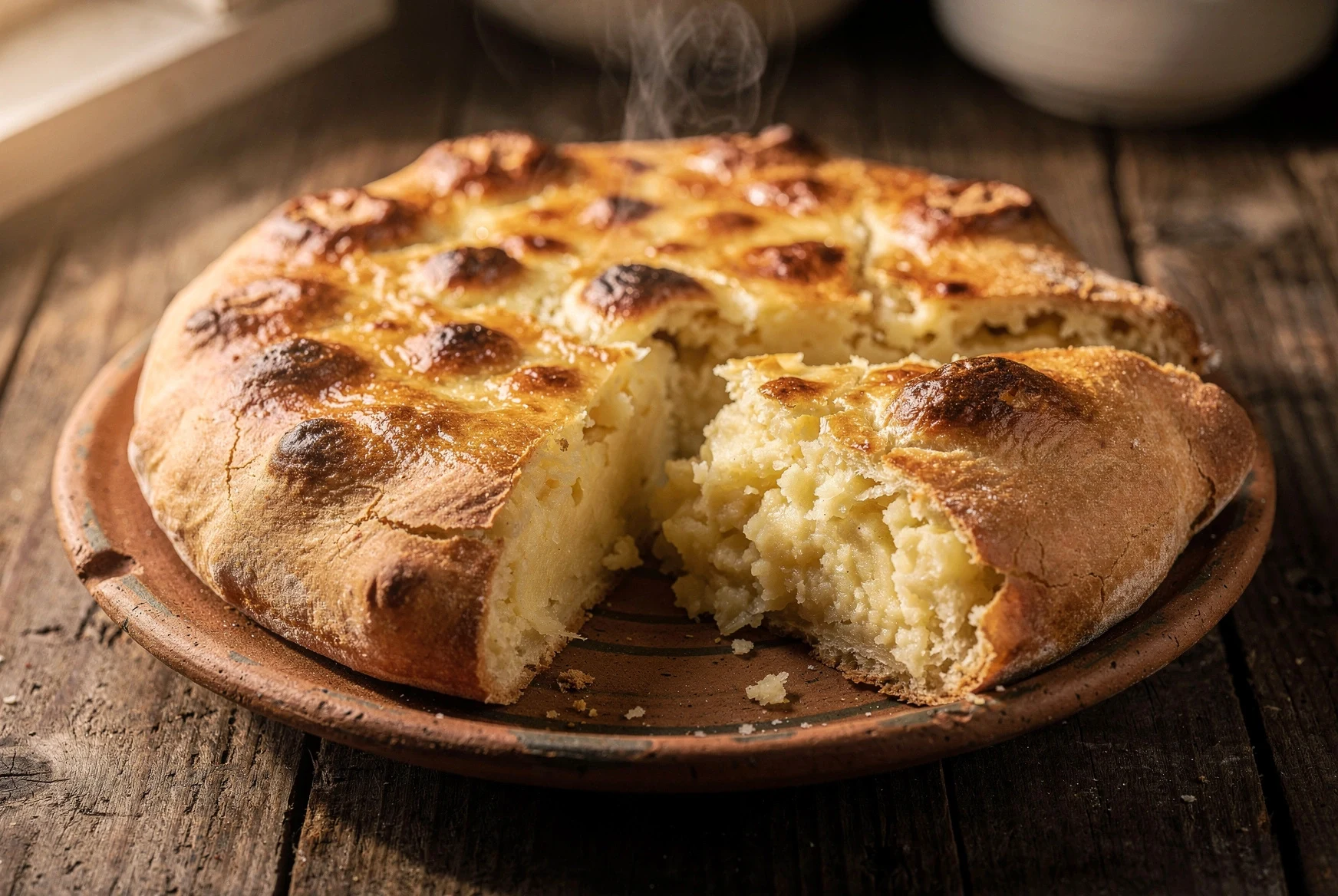
Khabidzgina is the khachapuri for people who think plain cheese filling is good but could use more substance. It comes from the Ossetian side of the Georgian bread family: a thin round pie packed with mashed potato and cheese, rolled flatter than most khachapuri and baked until the top freckles brown. Good khabidzgina is soft, rich, and almost unfairly comforting. Bad khabidzgina is just a thick bread wheel with potato trapped inside. The difference is mostly ratio and handling.
The filling should dominate. The dough is there to hold the potato-cheese mixture together, not to show off. That is the main thing most English recipes get wrong. They treat it like a stuffed loaf. It is not a stuffed loaf. It should eat more like a thin pie where the crust barely stays out of the way.
Khabidzgina Quick Facts
- Georgian name: ხაბიძგინა
- Also called: Ossetian khachapuri, potato-and-cheese khachapuri
- Style: Thin round stuffed bread
- Main filling: Potato, sulguni, brined cheese
- Best texture: Soft filling, thin crust, no dramatic bread dome
- Makes: 2 large pies
- Best served with: Matsoni, pickles, black tea, or absolutely nothing
What khabidzgina actually is
If you know the broader khachapuri family, khabidzgina sits closest to Ossetian pies and the potato-cheese breads you find in and around Shida Kartli and the Ossetian culinary orbit. It is not as famous as Adjarian or Imeretian khachapuri, but it deserves more attention because the flavor logic is perfect: potato softens the salt of the cheese, cheese keeps the potato from going dull, and the thin dough gives you just enough chew around the edges.
The potato is not filler in the cheap sense. It changes the whole balance. Pure-cheese khachapuri hits you fast and rich. Khabidzgina is gentler, more rounded, better for cold weather, and better if you actually want to eat more than one slice without needing a nap. There is a reason potato-and-cheese breads show up in mountain and highland cooking across the Caucasus. They make sense.
| Bread | Filling | Shape | What it eats like |
|---|---|---|---|
| Imeretian khachapuri | Cheese only | Round | Stretchy, salty, more overtly cheesy |
| Megrelian khachapuri | Cheese inside and on top | Round | Richest and heaviest |
| Khabidzgina | Potato and cheese | Thin round | Soft, balanced, less aggressive, deeply comforting |
| Lobiani | Seasoned beans | Round | Earthier and more pantry-driven |
Ingredients that matter
There are only two places to get this badly wrong: the potatoes and the cheese. Use starchy potatoes, not waxy ones. You want a fluffy mash that mixes cleanly with cheese and stays light enough to spread. Waxy potatoes turn gluey and make the filling dense in a depressing way.
On the cheese side, sulguni is the best anchor because it melts well and has that familiar Georgian salty pull. But if you use only sulguni or only mozzarella, the filling starts reading like generic pizza potato nonsense. You need a second, brined cheese for tang. Feta is the practical substitute outside Georgia. Inside Georgia, a mix of sulguni and imeruli or another fresh brined cheese is better.
| Ingredient | Why it matters | Best choice | Fallback |
|---|---|---|---|
| Potatoes | Create body without heaviness | Russet or other floury potato | Yukon Gold, but use less moisture |
| Main cheese | Melting and stretch | Sulguni | Low-moisture mozzarella |
| Salty cheese | Tang and salt balance | Imeruli or fresh brined cheese | Feta |
| Fenugreek | Gives a whisper of Georgian identity | Blue fenugreek | Skip it rather than overdoing regular fenugreek |
Salt carefully
Taste the cheese mixture before adding extra salt. Sulguni and feta can turn this from balanced to punishingly salty fast. The potatoes mute salt a bit, but not enough to rescue recklessness.
The correct filling texture
This is the real trick. The filling should feel like soft, warm mashed potato bound with cheese. It should roll into a ball. It should not ooze. It should not be so dry that it cracks. Think smoother than rustic mash, but not pure puree. If the filling is too wet, it will burst through the dough. If it is too stiff, the dough will squeeze around it and you will end up with thick bready edges and a lopsided pie.
Mash the potatoes while still hot so the cheese starts softening into them. Add the cheese, butter, and pepper while the residual heat is doing useful work. If the filling feels slightly dry, add a spoonful of milk or matsoni. One spoonful. Not a flood. You are correcting, not making baby food.
The dough should stay in the background
Use a simple yeasted dough. Nothing enriched, nothing sweet, nothing heavy. It should be supple enough to stretch around the filling and thin enough to flatten without tearing. You are not making focaccia. You are not making pizza. You are making a wrapper that happens to be delicious when baked.
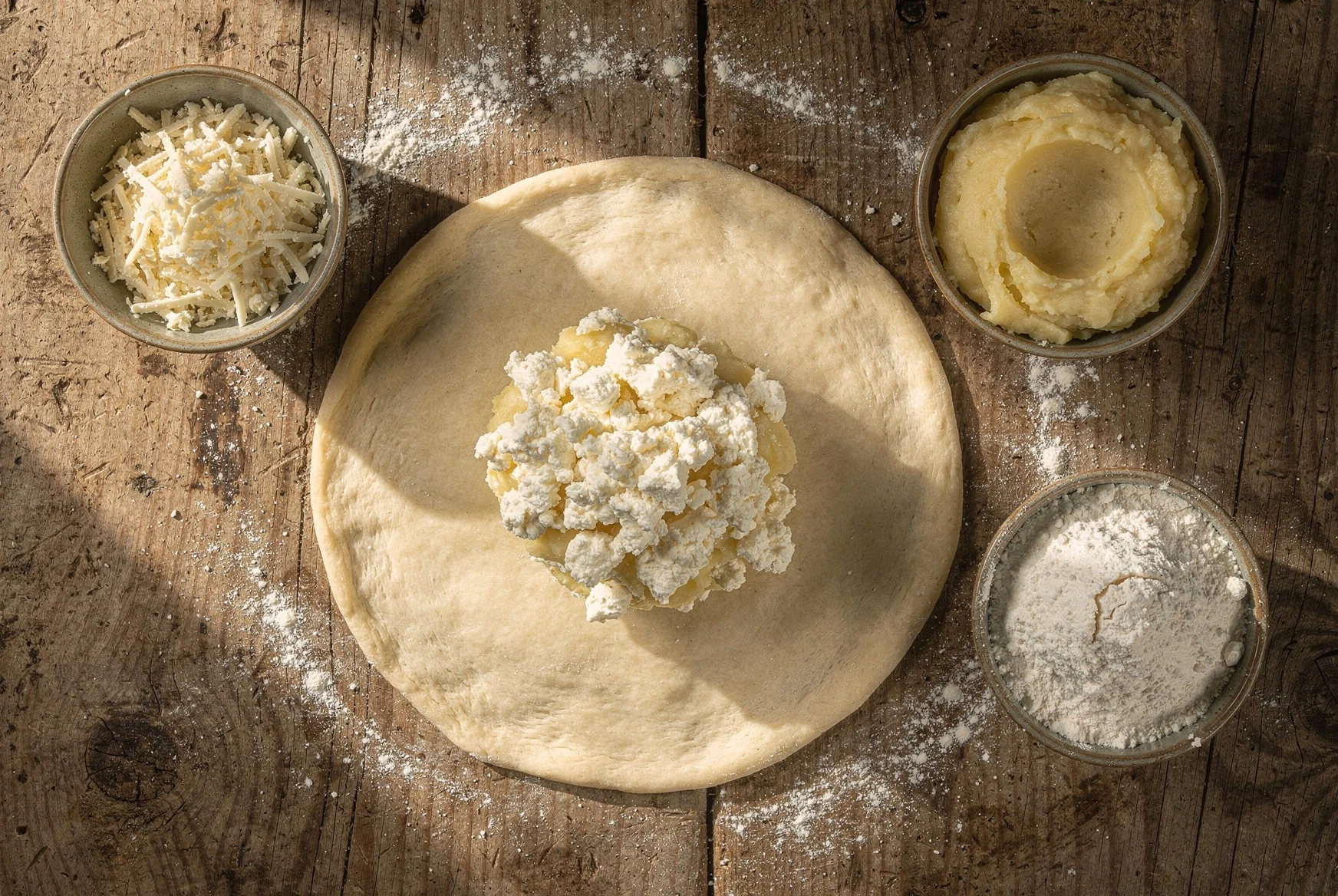
After the first rise, divide the dough into two pieces and make the filling balls slightly larger than the dough balls. That ratio feels wrong if you are used to stuffed breads, but it is exactly the point. When flattened properly, the filling should push almost all the way to the edges. Every bite should include potato and cheese.
Step-by-step method
Step 1: Make the dough
Mix the flour, yeast, sugar, and salt. Add lukewarm water and oil. Knead until smooth and elastic, about 8 to 10 minutes. The dough should feel soft but not sticky. Cover and let it rise until doubled, about 1 hour in a warm kitchen.
Step 2: Cook and dry the potatoes properly
Boil the potatoes in salted water until fully tender. Then drain them well and let them sit in the empty hot pot for a minute or two. This drives off excess steam. If you mash them while they're still waterlogged, the filling gets gummy.
Step 3: Build the filling
Mash the potatoes smooth. Mix in grated sulguni, crumbled brined cheese, melted butter, black pepper, and blue fenugreek if using. Taste. Adjust only if needed. Split the filling into two compact balls. It should feel almost like a very soft dumpling filling.
Step 4: Enclose the filling
Flatten one dough ball into a round about the size of your hand. Place a filling ball in the center. Bring the dough up around it like a pouch and pinch it closed at the top. Set it seam-side down and let it relax for 5 minutes. This rest matters. If you start flattening immediately, the dough fights back and tears more easily.
Step 5: Flatten thin, from the center out
Dust the top lightly with flour and start pressing gently from the center outward. Do not crush the edges first. You want the filling to spread evenly in all directions. Rotate as you go. Stop around 24 to 26 cm wide. The pie should stay flat, not domed. Make a tiny steam hole in the center.
If you feel a weak spot or see the filling threatening to poke through, dust that area lightly and stop bullying it. Small repairs are fine. Overworking is not.
Step 6: Bake hot and fast
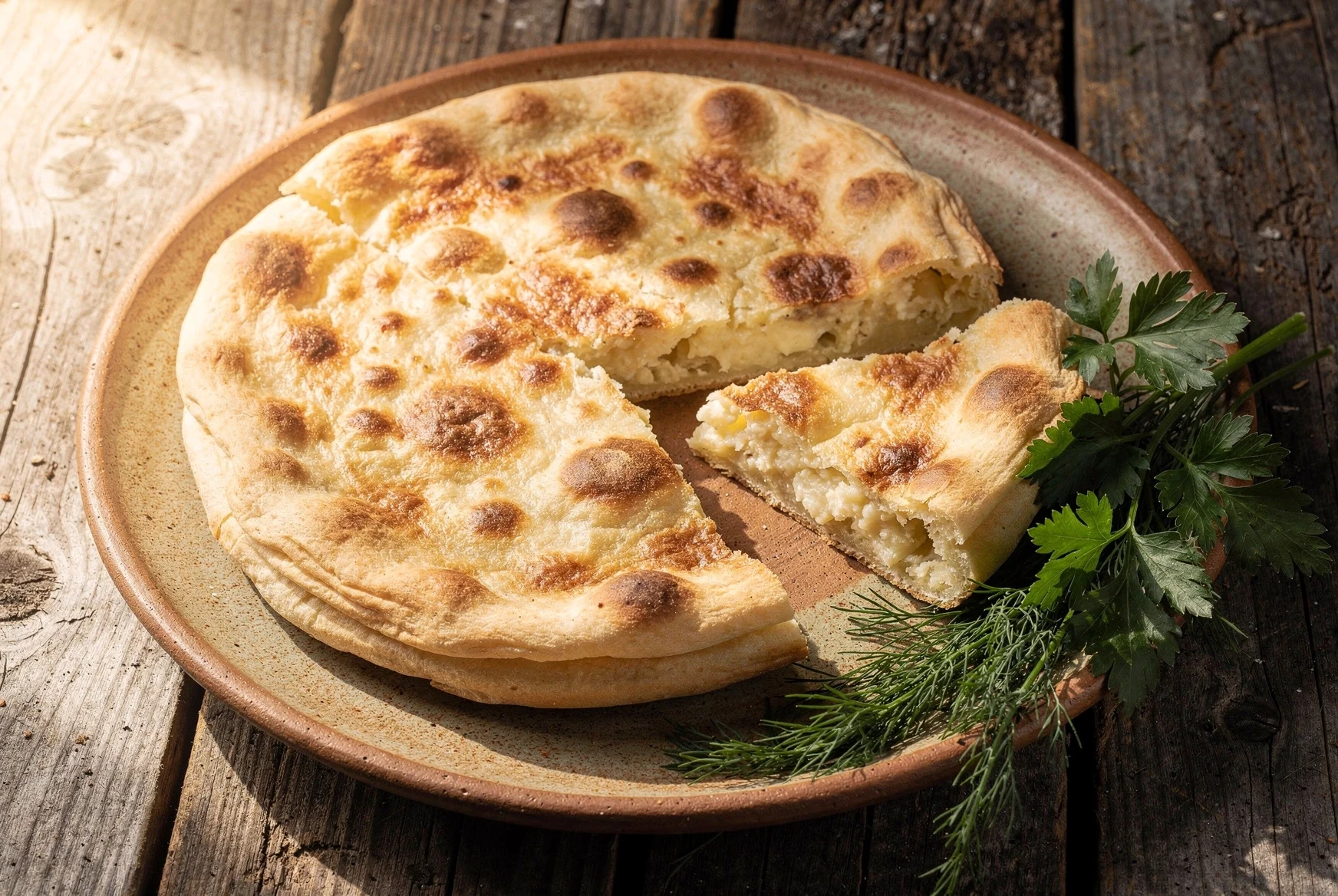
Use the hottest oven you can realistically manage, ideally 250°C with a preheated stone, steel, or baking sheet. The point is to set the dough quickly and color the top before the filling dries out. Ten to twelve minutes is usually enough. You want scattered brown spotting, a cooked underside, and no raw-looking pale patches in the center.
Step 7: Butter and serve
Brush the finished pie with melted butter right away. Cut into wedges and eat it hot. Khabidzgina is more forgiving than Adjarian khachapuri, but it is still best in the first 15 minutes while the filling is soft and the crust still tender.
Mistakes that ruin it
Too much dough
The classic mistake. If the crust is thick, you missed the whole point. Khabidzgina should be filling-forward.
Wet filling
Waterlogged potatoes or too much dairy will make the pie tear and bake up gummy in the center.
Only mozzarella
It melts, sure, but it tastes flat. You need a salty, brined note or the potato dominates in the wrong way.
Rolling aggressively
A rolling pin can work, but hands are safer. Pressing lets you feel where the filling is too thick or the dough is too thin.
Under-baking
Pale khabidzgina is sad khabidzgina. It needs proper spotting and a cooked base or it tastes unfinished.
Serving it cold
It does reheat reasonably well, but fresh is still better. The filling firms up as it cools and loses its nicest texture.
What to serve with it
Honestly, not much. Khabidzgina is already a complete thing. But if you want the table to feel more Georgian, pair it with something sour or cool. That balance matters.
| Side | Why it works |
|---|---|
| Matsoni | Cold tang cuts the starch and cheese nicely. |
| Jonjoli or pickles | Sharp acidity wakes the whole thing up. |
| Black tea | Classic with richer breads, especially if you're eating it mid-afternoon. |
| Fresh herbs | Tarragon, cilantro, or green onion keep things from feeling too soft and beige. |
Make-ahead and reheating
You can make the filling a day ahead and keep it chilled. Let it come closer to room temperature before stuffing the dough so it spreads more evenly. The dough can also do its first rise in the fridge overnight if that suits your life better.
Reheating is decent here, better than for many khachapuri styles. Use a hot oven, around 190°C, for 6 to 8 minutes. Do not microwave unless your standards have collapsed. The crust goes rubbery and the filling turns oddly tight.
Best dinner-party move
Make the filling early, proof the dough, and keep both ready. Flatten the pies right before guests sit down, then bake them one after the other. Khabidzgina is excellent warm from the oven and still good while you open wine and pretend you planned the timing perfectly.
Where it fits in Georgian food culture
Khabidzgina sits in that useful Georgian zone where bread stops being a side and starts being the meal. It belongs with lobiani, kubdari, and the less-famous regional khachapuri styles that serious eaters eventually start preferring because they feel more local and less theatrical.
Adjarian khachapuri gets the cameras. Imeretian gets the everyday love. Khabidzgina gets the people who know what they want. It is less showy, more grounded, and on a cold day it is hard to beat.
Frequently asked questions
Is khabidzgina Georgian or Ossetian?
Both, in practice. It sits in the Georgian khachapuri family but clearly overlaps with Ossetian pie traditions. Food borders in the Caucasus are rarely tidy.
Can I use leftover mashed potatoes?
Only if they are plain and not loose. But fresh potatoes are better because you control the moisture and salt from the start.
Can I pan-cook it instead of baking?
You can, especially in a heavy skillet, but baking gives a more even, cleaner result for this thin style.
Why did my dough tear?
Usually because the filling was too wet, too lumpy, or you flattened too fast before the pouch had time to relax.
What cheese blend works best outside Georgia?
Low-moisture mozzarella plus feta is the safest move. It gives you melt, salt, and just enough tang to feel right.
Should the filling stretch like pizza cheese?
No. A little melt is good, but the filling should read mostly as soft potato-and-cheese, not a giant mozzarella pull.
Written by The Georgian Eats Team
We spend an unreasonable amount of time chasing regional breads around Georgia, and khabidzgina is one of those dishes that deserves more respect than it usually gets. When it is made thin and filling-heavy, it is one of the most satisfying breads on the table.
Last updated: March 2026.
Related Articles
Imeretian Khachapuri
The everyday benchmark for Georgian cheese bread.
Lobiani
Another stuffed Georgian bread where the filling matters more than the dough.
Khachapuri Guide
Where khabidzgina fits in the wider Georgian cheese-bread family.
Georgian Bread Guide
The broader map of Georgian breads, from tone loaves to stuffed regional pies.