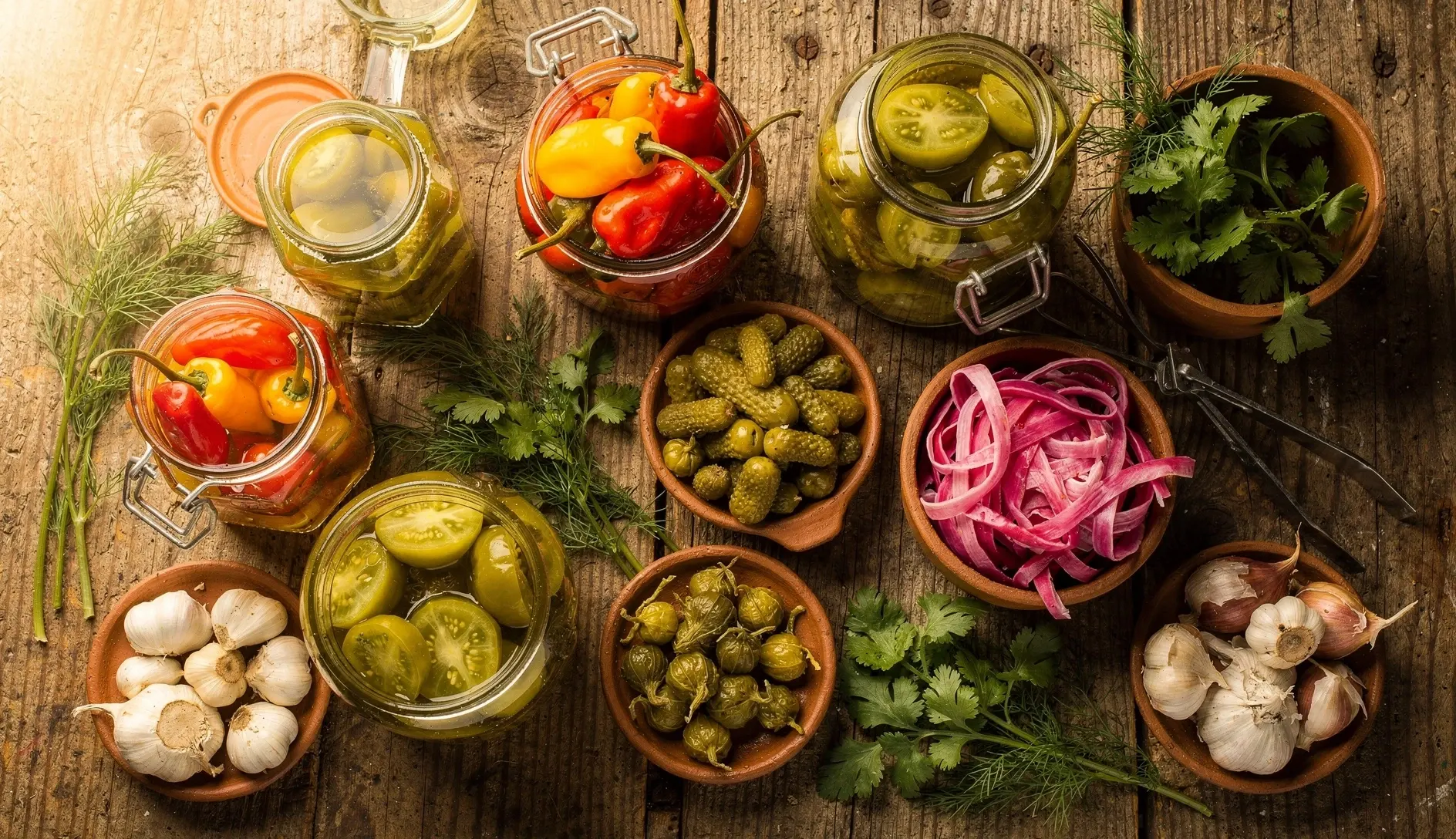
Walk into any Georgian household — rich or poor, urban or rural, Kakhetian farmhouse or Tbilisi apartment — and open the fridge. You'll find pickles. Not one kind. Three, four, five kinds. Pickled green tomatoes. Pickled peppers. Pickled garlic. Something fermented in a jar with dill floating on top. This isn't meal prep. This is how Georgians eat.
Pickles aren't a side dish in Georgia — they're a structural element of the table. No supra is complete without a plate of assorted mzhave (მჟავე, literally "sour things"). No winter dinner happens without cracking open jars put up in autumn. And no serious drinking session proceeds without pickled vegetables to cut through the wine and chacha. The Georgian pickle tradition is older than the country's winemaking — and that's saying something, given that Georgia has 8,000 years of wine history.
This guide covers every major Georgian pickle and preserve: what they are, how they're made, what makes them different from the pickles you know, and why they're essential to understanding how Georgians actually eat.
Georgian Pickles Are Fermented, Not Vinegar-Pickled
The first thing to understand: most Georgian pickles are lacto-fermented. That means salt brine and time — no vinegar. The vegetables sit in salted water, and naturally occurring lactobacillus bacteria do the work over days or weeks. The result is tangier, more complex, and more alive than vinegar-pickled vegetables. Think sauerkraut or kimchi, not the dill pickles from a supermarket shelf.
This matters because fermented pickles have that characteristic fizzy tang — slightly effervescent on the tongue, sour but not sharp, with a depth of flavor that vinegar can't replicate. Georgian grandmothers will tell you that the best pickles need nothing but salt, water, and patience. Maybe some dill and garlic. Definitely celery leaves. That's it.
Vinegar-based pickling exists in Georgia too — especially for quick pickles and commercial products — but the traditional method is always fermentation. When Georgians say mzhave, they mean fermented.
The science behind Georgian fermentation
Lacto-fermentation works because salt kills harmful bacteria while allowing lactobacillus (naturally present on vegetable surfaces) to thrive. The lactobacillus converts sugars into lactic acid, which preserves the food and creates the sour flavor. Georgian pickles are probiotic-rich — genuinely good for your gut. The traditional clay pot (qvevri for wine, ceramic jars for pickles) provides an ideal anaerobic environment for fermentation.
Jonjoli: Georgia's Most Unique Pickle
If there's one pickle that defines Georgian food culture, it's jonjoli (ჯონჯოლი). These are the pickled flower buds of the bladdernut tree (Staphylea colchica), which grows wild across western Georgia. Nothing like this exists in any other cuisine. You won't find it in Turkish, Armenian, Russian, or Iranian food. It's purely and distinctly Georgian.
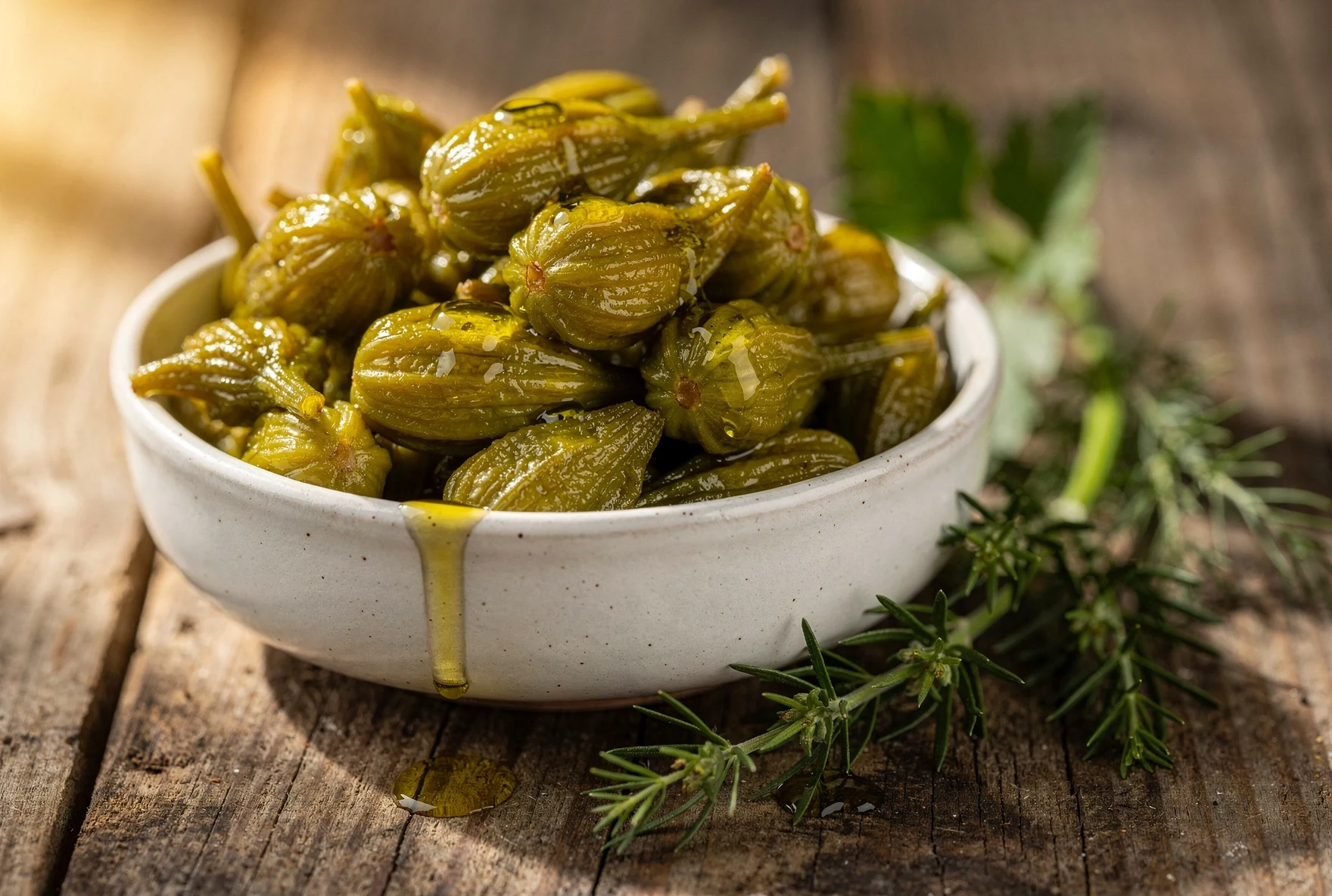
Jonjoli buds are harvested in May when they're still tightly closed. They're cleaned, packed into jars with salt brine, and left to ferment for several weeks. The result is a tangy, slightly crunchy pickle with a unique vegetal flavor — somewhere between capers and fermented green beans, but more delicate than either. The buds are small, pale green, and clustered on their stems.
At the table, jonjoli is typically dressed with oil, sliced onion, and sometimes fresh herbs. It appears on virtually every supra spread and every serious appetizer selection. Ordering a platter of Georgian appetizers at a restaurant and not getting jonjoli means something went wrong.
Want to make jonjoli properly?
We put together a dedicated jonjoli recipe guide covering the salting, squeezing, brining, fermentation, and the classic onion-and-oil dressing that turns it from jar pickle into a real Georgian table dish.
Jonjoli season is short
Fresh jonjoli is available only in May. Families who pickle their own have a narrow window — about two to three weeks — to harvest the buds before they open into flowers. Miss the window and you're buying someone else's jonjoli at the bazaar. Commercial jarred versions are available year-round in Georgian supermarkets (look for "ჯონჯოლი" on the label), but homemade is always better.
Pickled Green Tomatoes: The Georgian Classic
If jonjoli is the most unique Georgian pickle, pickled green tomatoes (mzhave pomidori, მჟავე პომიდორი) are the most ubiquitous. Every family makes them. Every table has them. They're served alongside meat, inside sandwiches, next to khachapuri, and as a standalone snack with bread and cheese.
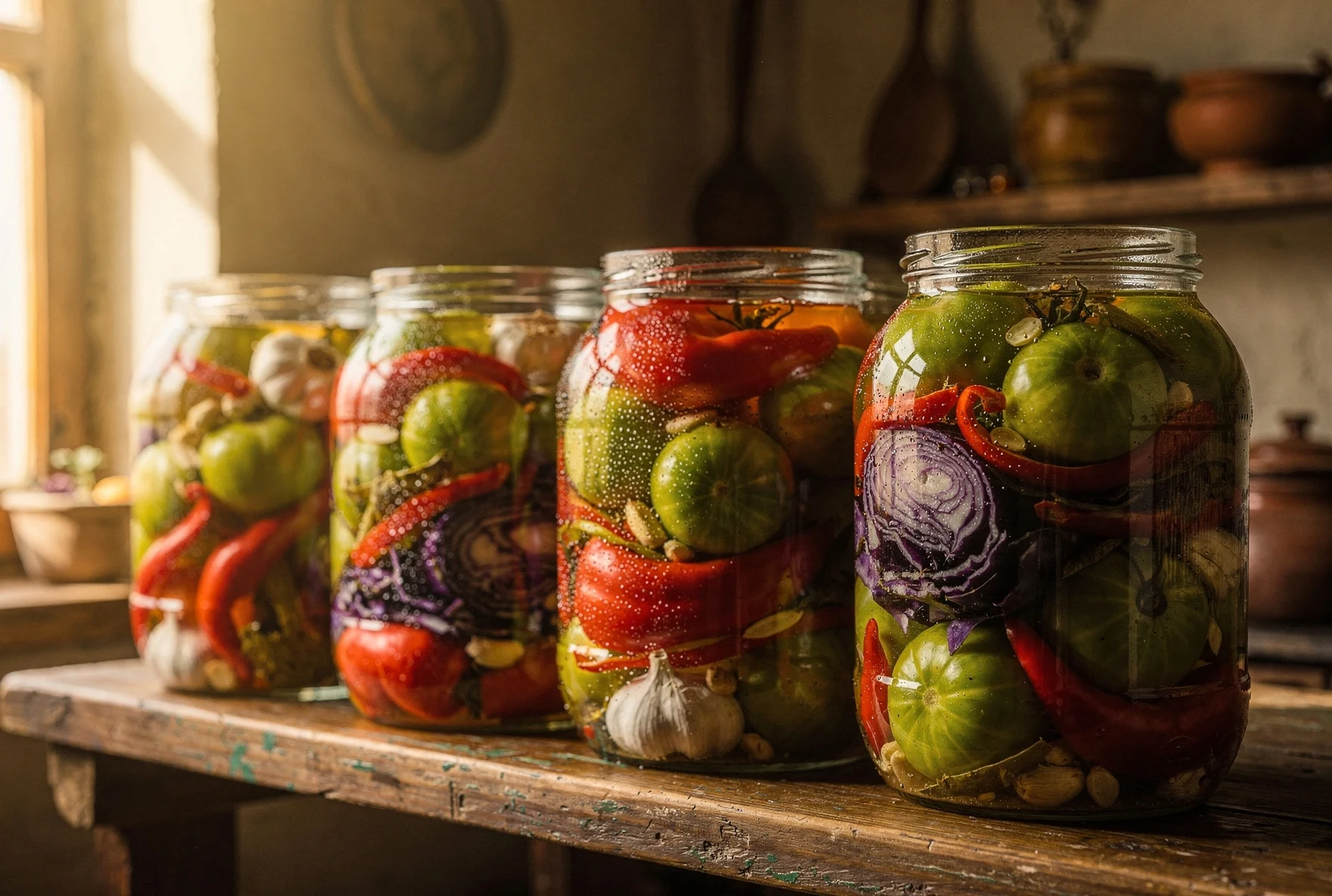
Georgian pickled green tomatoes are fermented whole — not sliced, not quartered, whole. Small to medium unripe tomatoes go into a brine with garlic, dill, celery leaves, and sometimes hot pepper. After two to three weeks of fermentation, they're sour, slightly fizzy, and still firm enough to bite through with a satisfying crunch. The garlic and celery infuse the brine, and the dill adds that classic Eastern European pickle character.
The key difference from, say, a Southern American fried green tomato: Georgian green tomatoes are raw-fermented, tangy, and eaten cold. They're a pickle, not a cooked dish. And they're far more sour than most Western pickles — this isn't a subtle tang. It hits you.
Want to make them properly?
Use the full pickled green tomatoes recipe for the right 3% brine, fermentation timing, and the garlic-dill-celery balance that makes them taste Georgian instead of generic deli pickles.
Pickled Peppers: From Mild to Nuclear
Georgia pickles peppers across the entire heat spectrum. The most common varieties:
| Type | Georgian Name | Heat Level | Notes |
|---|---|---|---|
| Green bell peppers | მჟავე წიწაკა | None | Fermented whole, stuffed with celery and garlic |
| Long green peppers | მწვანე წიწაკა | Mild–Medium | The most common; slightly spicy, very tangy |
| Red hot peppers | ცხარე წიწაკა | Hot | Small, thin-walled, intense; served whole |
| Stuffed peppers | ტოლმა წიწაკა | None | Bell peppers stuffed with cabbage and carrot |
The long green peppers are the workhorses. They appear on the table at virtually every meal, lying on a plate alongside green tomatoes and whatever other pickles the household has on hand. They're fermented in the same salt-and-garlic brine as everything else, and they develop a deep, tangy sourness that works especially well with grilled meats and rich, cheesy dishes.
Hot pickled peppers are a different animal — these are for people who want fire with their tang. Small red chili peppers fermented whole until they're soft, sour, and blazingly hot. One or two on the side of a plate of mtsvadi or kupati is standard for spice lovers.
Pickled Cabbage: The Winter Staple
Pickled cabbage (mzhave kombosto, მჟავე კომბოსტო) is Georgia's answer to sauerkraut — but chunkier and spicier. Rather than shredding the cabbage finely, Georgian style keeps the pieces large: quarters, thick wedges, or even half-heads. The cabbage ferments in brine with beetroot (which turns it a gorgeous magenta), garlic, celery, and hot pepper.
The beetroot-stained version is the most iconic — bright pink, tangy, and slightly sweet from the beet. It's a visual standout on any pickle plate. Without beetroot, the cabbage stays pale green and tastes more purely sour. Both versions are excellent. The chunks are meaty and substantial — this isn't a garnish, it's a side dish.
Pickled cabbage shows up most in winter, when fresh salad vegetables are expensive or unavailable. Families who pickle seriously in autumn might put up 20, 30, 50 kilograms of cabbage in large buckets or barrels. By January, when fresh produce in the bazaar is limited to imported Turkish tomatoes and greenhouse cucumbers, that fermented cabbage is gold.
Pickled Garlic: Georgia's Secret Addiction
Georgians eat a staggering amount of garlic — raw, cooked, and pickled. Pickled garlic (mzhave niori, მჟავე ნიორი) is whole cloves or whole heads fermented in brine until they turn translucent and lose most of their raw bite. What remains is a mellow, tangy, slightly sweet garlic that you can eat by the handful without regretting it the next morning.
Some variations ferment the garlic with beetroot brine, giving the cloves a pink-purple color that looks striking on a plate. Others add herbs — tarragon, dill, or bay leaves. The basic version is just garlic and salt water, which is all you need.
Pickled garlic is eaten as a snack, added to bean dishes, served alongside grilled meats, and used as a cooking ingredient. It's gentler than raw garlic but still distinctly garlicky — the fermentation rounds off the sharp edges without eliminating the flavor. Think roasted garlic's tangier cousin.
Pickled Cucumbers: The Eastern Bloc Connection
Georgian pickled cucumbers (mzhave kitri, მჟავე კიტრი) are the same lacto-fermented cucumbers you'd find across Russia, Ukraine, and Poland. Small, firm cucumbers in salt brine with dill, garlic, grape leaves (or cherry leaves, or horseradish leaves — anything with tannins to keep the cucumbers crunchy), and sometimes mustard seeds.
The grape leaf detail is particularly Georgian: fresh grape leaves from the vineyard go into the pickle jar, providing tannins that prevent the cucumbers from going soft. It's the same grape leaves used for tolma (stuffed vine leaves), but here they serve a structural purpose.
These are proper sour pickles — no sugar, no vinegar. Just salt, water, time, and whatever herbs the household prefers. They're crunchier and more complex than store-bought pickles, with that characteristic lacto-fermented funk that commercial products can't replicate.
Other Georgian Pickles Worth Knowing
🌿 Pickled Leeks
Young wild leeks (pkhali in some dialects, prasi) fermented with salt and herbs. Common in western Georgia, especially Samegrelo and Imereti. Milder than onion, with a grassy tang.
🍆 Pickled Eggplant
Small eggplants slit open, stuffed with a walnut-garlic-herb paste, then fermented in brine. Essentially a preserved version of badrijani nigvzit. Incredible with bread.
🫛 Pickled Beans
Green beans fermented whole with dill and garlic. Crunchy, tangy, and especially popular in Kakheti. Often served dressed with oil alongside mtsvadi.
🌶️ Pickled Tsitsaka
Small round green peppers called tsitsaka, fermented until very sour. Not spicy — these are a specific mild Georgian pepper variety. Served whole as a table condiment.
Beyond Pickles: Georgian Fruit Preserves
Georgia's preservation culture extends far beyond vegetables. Fruit preserves — jams, fruit leathers, and compotes — are equally central to the pantry.
Tklapi: Fruit Leather
Tklapi (ტყლაპი) is dried fruit leather made from sour plum, cherry plum, cornelian cherry, or grape juice. The pulp is spread thin on fabric or wooden boards and sun-dried until it forms a flexible, leathery sheet. It's then rolled up and stored for use throughout the year — not as a snack, but as a cooking ingredient.
Tklapi is torn into pieces and dissolved into soups and stews to add sourness. It's the traditional souring agent in kharcho and other dishes where you want tartness without the liquid of fresh citrus. Think of it as concentrated sour plum flavor in shelf-stable form. Clever and practical — this is a preservation technique that's thousands of years old.
Want to make real sour-plum tklapi?
We built a dedicated tklapi recipe guide covering the right fruit, the puree thickness, and how to dry it so it stays flexible enough for cooking instead of turning brittle.
Muraba: Georgian Whole-Fruit Jam
Muraba (მურაბა) is not your average jam. Rather than cooking fruit down into a homogeneous spread, muraba preserves whole fruits or large pieces in thick sugar syrup. Walnut muraba is the most famous — green, unripe walnuts soaked, peeled, and slow-cooked in sugar syrup until they turn black and the texture becomes almost meaty. Fig muraba, cherry muraba, quince muraba, and cornelian cherry muraba are equally traditional.
Muraba is served with tea, offered to guests as a welcome treat, and eaten by the spoonful as a sweet snack. It's more confection than condiment — concentrated sweetness with the preserved fruit providing texture and a subtle bitter-tart counterpoint to the sugar.
| Preserve | Base Fruit | Use | Season |
|---|---|---|---|
| Tklapi | Sour plum, cornelian cherry | Cooking (souring agent for stews) | Summer (drying) |
| Walnut Muraba | Green unripe walnuts | Tea accompaniment, dessert | June (harvest), cooked year-round |
| Fig Muraba | Figs | Tea accompaniment, guest welcome | August–September |
| Tatara | Grape must (concentrated) | Drizzled on bread, used in churchkhela | September–October (rtveli) |
| Pelamushi | Grape juice + flour | Dessert (set pudding) | Autumn (grape harvest) |
| Compote | Various (peach, cherry, plum) | Drink (diluted with water) | Summer (canning) |
Kompoti: Canned Fruit Drinks
Every Georgian grandmother has rows of glass jars filled with kompoti — whole fruits preserved in sugar syrup. Peach, cherry, plum, pear, apple. These aren't eaten directly (though you can). They're diluted with water and served as a sweet, fruity drink, especially in winter when fresh fruit is scarce. Think of it as homemade fruit juice concentrate, but with the actual fruit preserved inside.
Kompoti is the default after-dinner drink at many Georgian tables — sweet, refreshing, and a natural end to a heavy meal. At guesthouses in rural Georgia, you'll often be offered kompoti made from whatever grew in the backyard.
The Pickling Season: September Through November
Georgian pickling follows a strict seasonal rhythm. The heavy lifting happens in autumn, when produce is cheap, abundant, and at peak quality.
🌸 May
Jonjoli harvest. Short window — buds must be picked before they flower. Families go into the hills or buy at markets.
☀️ July–August
Tklapi production. Sour plum and cherry plum pulp spread on boards and dried in the sun. Kompoti canning with stone fruits.
🍇 September–October
Peak pickling: green tomatoes, peppers, cabbage, garlic, cucumbers. Walnut muraba. Tatara and pelamushi during rtveli (grape harvest).
🍂 November
Final pickling push before cold weather. Late-season cabbage. Double-checking jar seals. The pantry should be full by now.
For families in rural Georgia, autumn pickling isn't a hobby — it's serious logistics. Buying vegetables in bulk at the bazaar (or harvesting from the garden), washing, sorting, brining, jarring, and storing dozens of jars in a cool basement or cellar. Some households put up enough pickles to last until the following summer.
How Georgian Pickles Are Made at Home
The basic method is the same for almost every Georgian pickle: salt brine, aromatics, time. Here's the universal process:
Basic Georgian Pickle Method
Prepare the brine: Dissolve 30–40g salt per liter of water (about 2 tablespoons per quart). Some recipes use up to 50g/L for denser vegetables like cabbage.
Layer the jar: Put dill (fresh or dried), garlic cloves, celery leaves, and optionally hot pepper at the bottom. Add the vegetables. Top with more herbs.
Pour the brine: Cover the vegetables completely. They must stay submerged — anything above the brine line will mold. Use a plate or weight to keep them down.
Ferment at room temperature: 3–7 days for quick pickles (cucumbers), 2–4 weeks for green tomatoes, cabbage, and peppers. Taste daily after the first few days.
Move to cold storage: Once the pickles reach your preferred sourness, seal and refrigerate (or move to a cool cellar). Cold slows fermentation dramatically.
The cardinal rule: keep vegetables submerged
Any vegetable poking above the brine will develop mold. This is the #1 cause of failed pickle batches. Georgian households use inverted plates, ceramic weights, or even a plastic bag filled with brine (which conforms to the jar shape) to keep everything under the liquid. If white mold appears on the surface of the brine, it's usually harmless kahm yeast — skim it off. Pink, black, or fuzzy mold means something went wrong.
What to Eat Georgian Pickles With
The short answer: everything. But some pairings are particularly classic:
| Pickle | Classic Pairings | Why It Works |
|---|---|---|
| Green tomatoes | Khachapuri, lobio, grilled meat | Sharp acid cuts through fat and cheese |
| Jonjoli | Supra appetizer spread, wine | Delicate tang pairs with walnut dishes |
| Hot peppers | Mtsvadi, kupati, ojakhuri | Heat + acid against rich grilled meat |
| Cabbage | Heavy winter stews, lobio, bread | Crunchy freshness in winter meals |
| Garlic | Chacha, wine, bean dishes | Mellow garlic enhances everything |
| Cucumbers | Khinkali, bread and cheese, vodka | Classic Eastern European pairing |
Where to Buy Georgian Pickles
🏪 Dezerter Bazaar (Tbilisi)
The best place to buy homemade pickles in the capital. Vendors sell from large buckets — you buy by weight. Taste before you buy. Prices are low: 3–5 GEL per kilogram for most varieties.
🛒 Supermarkets
Chains like Goodwill, Carrefour, and Nikora stock jarred Georgian pickles from brands like Kula and Megobari. Decent quality but not as good as bazaar or homemade. Jonjoli jars typically 4–7 GEL.
🏡 Roadside & Village
Driving through the countryside, you'll see families selling jars of pickles from tables by the road. Always worth stopping — the quality is often outstanding, and you're buying directly from the person who made them.
🌐 Online (Outside Georgia)
Georgian grocery stores in diaspora communities (NYC, Moscow, Berlin, Istanbul) stock imported pickles. Qartuli Market and GeorgianFoodBox ship internationally. Expect 2–3x Georgian prices.
Why Pickles Matter in Georgian Food Culture
Pickles aren't just food preservation in Georgia — they're a cultural institution. A few reasons why:
They balance the table. Georgian food is rich. Cheese bread, walnut sauces, grilled meat, butter-drenched mushrooms. Without the sharp, sour punch of pickles, meals would be one-dimensional. Pickles provide the acid that makes everything else taste better — the same role that salad plays in Mediterranean cuisine, but more intense.
They connect generations. Every family has pickle recipes passed down from grandmothers. The specific combination of herbs in the brine, the timing of when to move the jars to the cellar, whether to add a piece of horseradish root or not — these are family traditions, argued about with the same passion that Italians argue about ragù.
They mark the seasons. Pickling is one of the rituals that structure the Georgian agricultural year, alongside rtveli (grape harvest) and supra (feast). The autumn pickling session is a communal event — families work together, neighbors trade vegetables, and the pantry fills up for winter. It's a physical, tangible connection to the land and the seasons that's largely been lost in urban Western cultures.
They're deeply democratic. Unlike some Georgian foods that require skill or expensive ingredients, pickles are accessible to everyone. Salt, water, vegetables from the garden or bazaar. That's it. The poorest family and the wealthiest family both have pickled green tomatoes on the table. It's one of the great equalizers of Georgian food culture.
Pickles and wine: the Georgian pairing no one talks about
In Georgia, pickles are considered the ideal companion to wine — not cheese, not charcuterie, not the fancy pairings Western sommeliers recommend. The logic is simple: acid + alcohol work together. Tangy pickles cleanse the palate between sips of rich amber wine or bold Saperavi. At informal drinking sessions, a plate of mixed pickles and bread may be the only food on the table.
Making Georgian Pickles at Home (Outside Georgia)
The good news: Georgian pickles are among the easiest Georgian foods to replicate abroad. You don't need special equipment, unusual ingredients, or Georgian-specific techniques. The method is universal lacto-fermentation — the same process used for sauerkraut, kimchi, and traditional dill pickles.
| Pickle | Difficulty | Time | Ingredient Availability |
|---|---|---|---|
| Cucumbers | Easy | 3–5 days | Available everywhere |
| Green tomatoes | Easy | 2–4 weeks | Farmers markets (late season) |
| Cabbage (beet-stained) | Easy | 2–3 weeks | Available everywhere |
| Peppers | Easy | 1–3 weeks | Available everywhere |
| Garlic | Easy | 3–4 weeks | Available everywhere |
| Jonjoli | Impossible | N/A | Bladdernut trees don't grow outside the Caucasus |
The only pickle you genuinely can't make outside Georgia is jonjoli — the bladdernut tree is native to the Caucasus and extremely rare elsewhere. For everything else, the only variable is finding good vegetables. Green tomatoes are easy to source at farmers markets in late summer. The herbs are standard (dill, garlic, celery). The one Georgian-specific touch — grape leaves for keeping cucumbers crunchy — can be substituted with oak leaves, cherry leaves, or horseradish leaves (any leaf high in tannins works).
Frequently Asked Questions
Are Georgian pickles healthy?
Yes — lacto-fermented pickles are rich in probiotics and vitamin C. They're also low-calorie and contain no sugar. The salt content is the only health consideration; people on sodium-restricted diets should moderate intake.
How long do Georgian pickles last?
Properly fermented and stored in a cool place (cellar or refrigerator), most Georgian pickles last 6–12 months. Green tomatoes and cabbage are best within the first 3–4 months before they get too soft.
What does jonjoli taste like?
Tangy and vegetal, with a texture similar to capers but milder. The flavor is fermented-sour, slightly grassy, and uniquely its own thing. There's no perfect Western comparison — you need to try it.
Do Georgian pickles use vinegar?
Traditional Georgian pickles do not — they're lacto-fermented with salt brine only. Some modern commercial brands add vinegar for shelf stability, but this changes the flavor significantly. Homemade is always salt-fermented.
Can I buy Georgian pickles outside Georgia?
Yes — Georgian grocery stores in diaspora communities (especially in Russia, Germany, Israel, and the US) stock imported pickles. Online retailers like Qartuli Market ship internationally. Jonjoli in particular is available jarred.
What's the difference between mzhave and marinated?
Mzhave (მჟავე) means "fermented/sour" — salt brine, no vinegar. Marinadi (მარინადი) means marinated — uses vinegar. In Georgia, mzhave is more traditional and preferred. Marinadi is seen as quicker but less authentic.
Written by The Georgian Eats Team
We've eaten through hundreds of jars of homemade Georgian pickles — from Kakhetian farmhouse cellars to Tbilisi bazaar vendors. If it's fermented and Georgian, we've tried it.
Last updated: March 2026.
Related Articles
Georgian Sauces & Condiments
Tkemali, bazhe, adjika, satsebeli — every sauce that defines the cuisine.
Vegetarian & Vegan Georgian Food
Georgia's incredible plant-based food tradition and how to navigate it.
Tkemali: Sour Plum Sauce
The tart, garlicky condiment on every Georgian table.
Regional Cuisine Guide
How Georgian food changes from west to east — eight distinct cuisines.