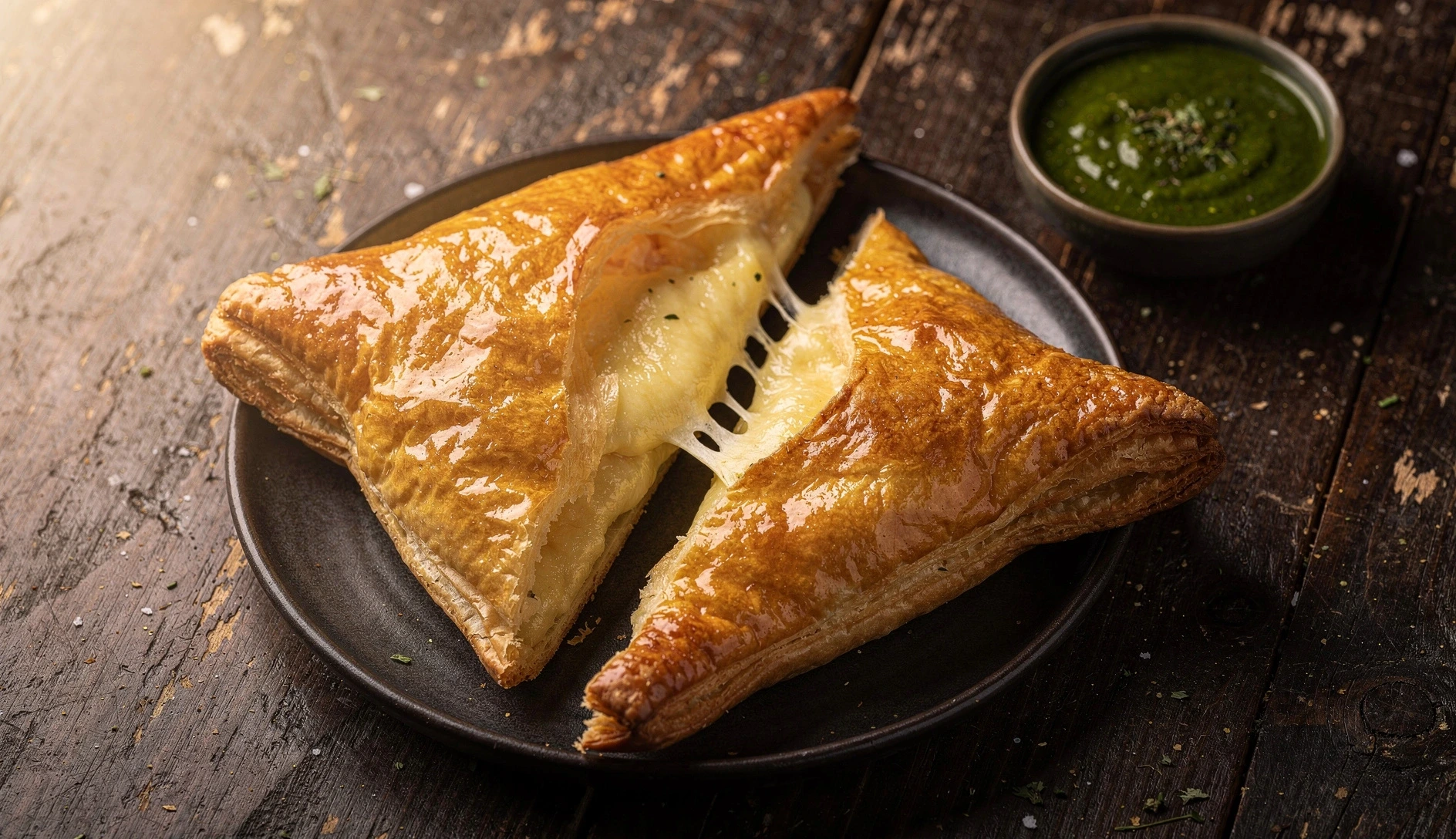
Every bakery in Georgia sells penovani khachapuri. It sits in the glass display case alongside the round Imeretian discs and the boat-shaped Adjarian — a golden square of puff pastry, cheese oozing from the seams, flaky crumbs everywhere. You point, they reheat it, you eat it walking down the street. It's the least fussy of all the khachapuri varieties and, depending on your priorities, arguably the most satisfying. Where Imeretian is about the cheese-to-dough ratio and Adjarian is about the theatrical egg yolk, penovani is about texture. Shatteringly crisp pastry that fractures into a hundred buttery layers when you bite through it, then the hot, stretchy cheese in the middle. It's a different pleasure entirely.
And here's the thing nobody tells you: penovani is by far the easiest khachapuri to make at home. No yeast dough, no rising time, no shaping boats or pleating edges. You buy puff pastry, mix cheese, fold, bake. Forty-five minutes, start to finish. If you've never made Georgian food before, this is the place to start.
Penovani Khachapuri Quick Facts
- Georgian name: ფენოვანი ხაჭაპური (peh-no-VAH-nee kha-cha-POO-ree)
- Meaning: "Layered khachapuri" (from ფენა / pena = layer)
- Origin: Samtskhe-Javakheti region, southern Georgia
- Key feature: Puff pastry (not yeasted dough) — crisp, flaky layers
- Prep time: 20 minutes
- Cook time: 20-25 minutes
- Serves: 4 people
- Cost in Georgia: 4-7 GEL (~$1.50-2.50) at a bakery
- Best for: When you want khachapuri NOW, not in two hours
Why Penovani Deserves More Attention
In the hierarchy of Georgian khachapuri, penovani gets the least international attention. Adjarian has the drama. Imeretian has the tradition. Megrelian has the double-cheese spectacle. Penovani is just... the square one. The one tourists walk past in bakeries because they're fixated on finding a boat.
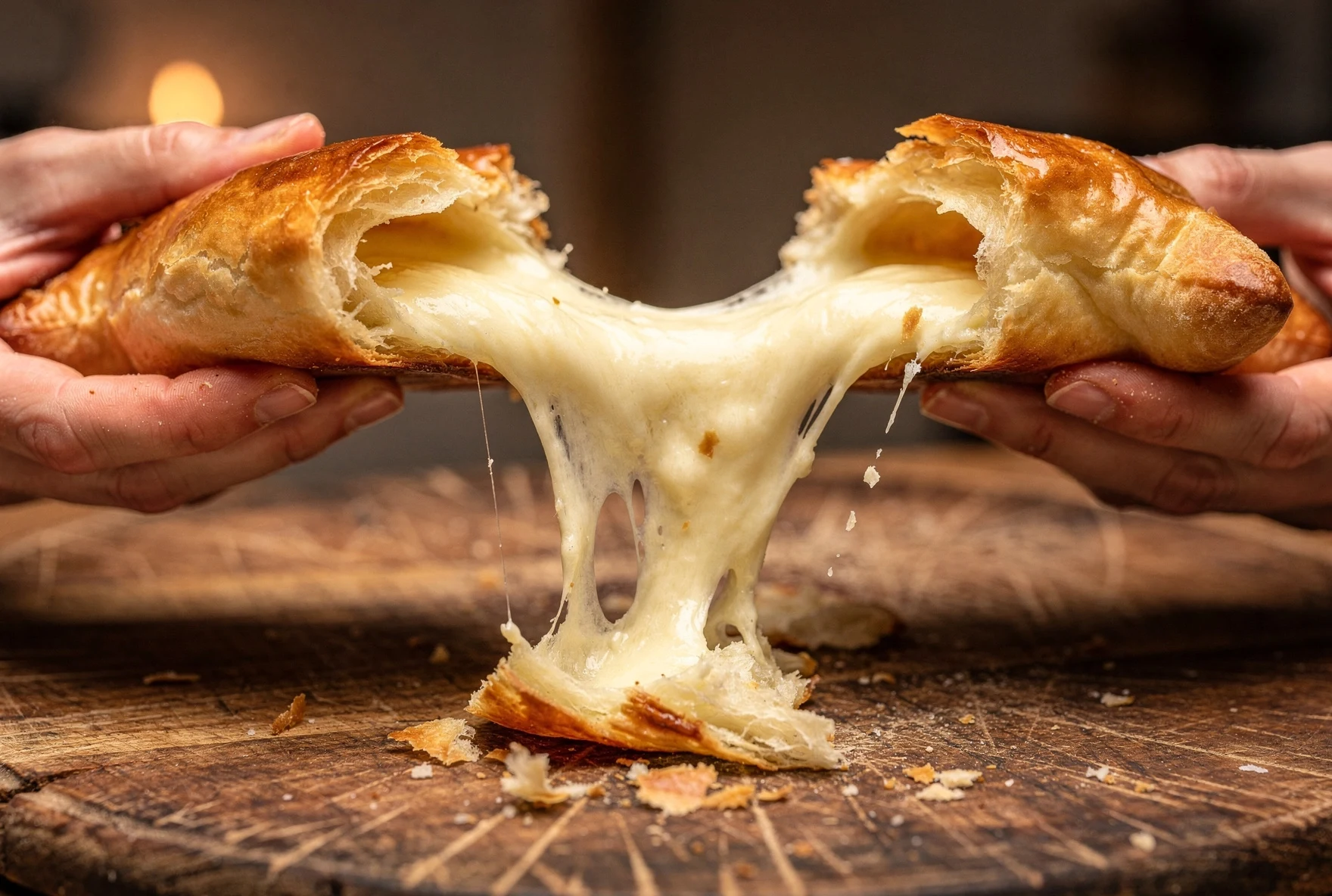
That's a mistake. Penovani has something the others don't: crunch. Real, multi-layered, butter-laminated crunch that you can hear across the room. The filling is the same molten cheese as Imeretian, but the delivery system is completely different. Instead of soft, chewy bread, you get paper-thin layers of pastry that shatter on contact. It's closer to a börek or a kourou than to the other khachapuri, and that textural contrast — crisp shell, molten center — is what makes it addictive.
Historically, penovani comes from the Samtskhe-Javakheti region in southern Georgia, near the Turkish border. The word penovani derives from pena (ფენა), meaning "layer" — which is literally what you get. Some food historians trace the puff pastry technique to Ottoman influence in the region, though Georgians have been making layered breads for centuries regardless.
The Cheese Filling
Penovani uses the same cheese filling as Imeretian khachapuri. The traditional combination is Imeretian cheese (იმერული ყველი) — a fresh, brined white cheese — mixed with sulguni (სულუგუნი), the stretchy brined cheese that gives you that satisfying pull. The egg binds it together and adds richness.
The ratio matters. You want roughly 3:1 Imeretian to sulguni. Too much sulguni and the filling becomes rubbery when it cools. Too little and you lose the stretch. The egg is essential — it keeps the filling cohesive and prevents the cheese from separating into a greasy puddle.
Outside Georgia: Cheese Substitutes
If you can't find Georgian cheese (and unless you're near a Russian or Georgian grocery, you probably can't), here's what actually works:
| Georgian Cheese | Best Substitute | Why It Works |
|---|---|---|
| Imeretian cheese (200g) | 130g low-moisture mozzarella + 70g feta | Mozzarella gives melt, feta gives salt and tang |
| Sulguni (100g) | 100g low-moisture mozzarella or young provolone | Provides the stretch and pull |
| Alternative blend | 200g farmer's cheese + 100g mozzarella + 100g feta | Farmer's cheese is closer in texture to Imeretian |
Fresh Mozzarella Won't Work
Don't use fresh mozzarella (the soft balls in water). It has too much moisture and will turn your filling into a soupy mess that makes the pastry soggy. You need low-moisture mozzarella — the firm, shreddable kind sold in blocks. This is one of the most common mistakes in khachapuri recipes online.
The Pastry: Store-Bought vs Homemade
Let's be honest: Georgian bakeries making penovani from scratch are rolling their own puff pastry with butter (or sometimes a butter-margarine mix). That means laminating dough — folding, chilling, rolling, repeating — for several hours. It's a proper craft skill.
You don't need to do this. Store-bought all-butter puff pastry makes excellent penovani, and there's no shame in using it. Even in Georgia, plenty of bakeries use commercial puff pastry. The filling is where the soul of the dish lives — the pastry is the delivery vehicle.
Choosing Puff Pastry
All-Butter Puff Pastry ✓
Brands like Dufour, Careme, or Wewalka. Richer flavor, better browning, crispier layers. Worth the extra cost. This is what you want.
Standard Puff Pastry
Pepperidge Farm, Jus-Rol, etc. Made with vegetable oil or margarine. Still works fine — just less buttery flavor and slightly less dramatic layers. Perfectly acceptable for a weeknight version.
Temperature Is Everything
Puff pastry must be cold when it goes into the oven. That's what creates the layers — cold butter hits hot oven, steam puffs the layers apart. If your pastry gets warm and floppy while you're assembling, slide the whole thing (on its baking sheet) back into the fridge for 10 minutes before baking. Warm pastry = flat, dense result.
Two Ways to Shape Penovani
There are two traditional ways to shape penovani khachapuri. Both work. The envelope method is more authentic; the two-sheet method is more foolproof.
Method 1: The Envelope (Traditional)
This is how you'll see it done in Georgian bakeries. You roll one large sheet of pastry, pile the cheese in the center, and fold the four corners toward the middle like an envelope. Then you flip it over and gently press it flat. The result is a square pastry with all the seams hidden underneath and a smooth top that puffs beautifully.
The trick is the seal. If your folds don't overlap enough, cheese will leak out during baking. Give yourself plenty of bare pastry around the filling — at least 8-10cm on each side — and overlap the folds by 2-3cm in the center. Press firmly where they meet.
Method 2: Two Sheets (Easier)
Roll two sheets of pastry, put the filling on one, lay the other on top, seal the edges. Like making a giant ravioli. This is more forgiving and harder to mess up. The downside is a slightly thicker edge where the two sheets overlap, but honestly, that's barely noticeable once it's baked and golden.
If your store-bought pastry comes as two sheets (like Pepperidge Farm), this method is the obvious choice. Don't fight the format.
The Recipe
| Component | Detail |
|---|---|
| Prep time | 20 minutes |
| Cook time | 20-25 minutes |
| Total time | ~45 minutes |
| Serves | 4 people |
| Oven temp | 200°C / 400°F |
Ingredients
For the filling:
- 300g Imeretian cheese (or 200g low-moisture mozzarella + 100g feta)
- 100g sulguni cheese (or additional low-moisture mozzarella)
- 1 large egg
- Pinch of salt (only if using substitute cheeses — Georgian cheeses are already salty)
For assembly:
- 500g puff pastry, thawed but still cool (1 standard package)
- All-purpose flour for dusting
- 1 egg yolk + 1 tsp water (egg wash)
- 15g butter, melted (for brushing after baking)
Instructions
Step 1: Make the filling. Grate the sulguni on the large holes of a box grater. Crumble the Imeretian cheese by hand (or crumble the feta and grate the mozzarella). Combine all the cheese in a bowl, crack in the egg, and mix with your hands until the filling holds together in a cohesive, slightly sticky mass. It shouldn't be dry or crumbly — the egg is the glue. Set aside.
Step 2: Preheat. Set your oven to 200°C (400°F) with a baking sheet on the middle rack. Preheating the sheet gives you a crisper bottom — puff pastry on a cold sheet tends to get soggy underneath.
Step 3: Roll the pastry. On a lightly floured surface, roll the puff pastry out to about 35×40cm, roughly 3mm thick. If your pastry comes as two sheets, roll each to about 30×25cm. Work quickly — you want the pastry to stay cold.
Step 4: Fill and shape.
- Envelope method: Pile the cheese in the center of the single sheet, forming a rough 15cm square. Fold each corner toward the center, overlapping them to seal. Press the seams. Flip seam-side down. Gently press with your palms to flatten to 3-4cm thick. Don't stretch aggressively — if the pastry tears, cheese will escape.
- Two-sheet method: Lay one sheet on parchment paper. Spread the cheese evenly, leaving a 2cm border. Brush the border with egg wash. Lay the second sheet on top and press the edges firmly to seal, crimping with a fork if you like. Poke 6-8 holes in the top with a fork for steam to escape.
Step 5: Egg wash and bake. Beat the egg yolk with 1 teaspoon of water and brush the entire top surface generously. Transfer (on parchment paper) to the hot baking sheet. Bake 20-25 minutes until deeply golden brown and dramatically puffed. Don't pull it early — the pastry needs to be a deep golden, almost caramel color, to get properly crisp.
Step 6: Butter and serve. As soon as it comes out of the oven, brush the top with melted butter. This soaks into the hot layers and adds richness. Let it rest 5 minutes (the cheese is volcanic), then cut into squares or diamonds. Serve immediately.
Don't Underbake
The most common mistake with penovani is pulling it from the oven too soon. Pale, blonde pastry means the inner layers are still raw and doughy. You want a deep golden brown — darker than you think. The layers need that heat to fully separate and crisp. If the top is browning too fast but the pastry isn't done, tent with foil and keep baking.
Tips for Perfect Penovani
Hot Sheet, Cold Pastry
Preheating your baking sheet is the single biggest improvement you can make. The hot surface hits the bottom pastry immediately, crisping it instead of letting it steam and get soggy. Cold pastry + hot oven + hot sheet = maximum puff.
Don't Overwork the Pastry
Puff pastry is layers of butter between layers of dough. Every time you re-roll or handle it excessively, you're melting butter and destroying layers. Roll once, shape once, bake. If it tears, patch it with a scrap rather than re-rolling the whole thing.
Seal the Seams
Cheese leaking out is the number one penovani failure mode. Molten cheese hits the baking sheet, burns, and you lose half your filling. Press your seams firmly, overlap your folds generously, and use egg wash as glue on the edges.
Eat It Fresh
Penovani is at its absolute best within 15-20 minutes of leaving the oven. The layers are still shatteringly crisp, the cheese is still molten and stretchy. After an hour, the pastry softens. Still good, but not the same. You can reheat at 180°C for 5-8 minutes, but the original crunch never fully returns.
Variations Worth Trying
Once you've nailed the basic penovani, there are a few riffs worth exploring:
Herb and cheese: Mix a tablespoon of chopped fresh dill or cilantro into the cheese filling. Not traditional, but common in home kitchens. The herbs add a fresh note that cuts through the richness.
Egg yolk penovani: Some bakeries make a version where they leave a small opening in the top and crack a raw egg yolk into the center during the last 3-4 minutes of baking — like a hybrid of penovani and Adjarian. Worth trying once for the novelty.
Mini penovani (triangles): Cut the pastry into squares, put a spoonful of cheese in the center of each, fold into triangles, seal with a fork. Bake 12-15 minutes. These are party food — finger-sized, one-bite khachapuri. Common at Georgian celebrations.
Lobiani penovani: Replace the cheese with the spiced bean filling from lobiani. Same technique, completely different dish. The crispy pastry works beautifully with the earthy, herby bean filling.
Penovani vs Other Khachapuri
| Variety | Dough | Shape | Texture | Difficulty |
|---|---|---|---|---|
| Penovani | Puff pastry | Square | Crisp, flaky, shattering | Easy |
| Imeretian | Yeasted bread dough | Round | Soft, chewy, bread-like | Medium |
| Adjarian | Yeasted bread dough | Boat | Soft crust, molten center | Hard |
| Megrelian | Yeasted bread dough | Round (cheese on top) | Soft, extra cheesy | Medium |
| Achma | Boiled dough sheets | Layered (like lasagna) | Soft layers, crispy top | Medium |
How to Serve Penovani
In Georgia, penovani khachapuri is served as-is — cut into squares, eaten hot. It needs no accompaniment. But if you want to build a meal around it:
- With tkemali or adjika: The tartness of tkemali or the heat of adjika cuts through the richness beautifully. This is how many Georgians eat it.
- With a simple salad: Sliced tomatoes, cucumbers, and fresh herbs (cilantro, basil, dill) dressed with sunflower oil and a squeeze of lemon. The freshness balances the heavy pastry.
- With lobio: Cheese bread and bean stew is a classic Georgian pairing. The smoky beans and the crispy cheese pastry complement each other well.
- With Georgian wine: A dry amber wine stands up to the richness of the cheese. Or a light Tavkveri rosé if you prefer something chilled.
Storage and Reheating
Penovani doesn't store as well as Imeretian khachapuri (which actually improves slightly the next day). The pastry softens within a couple of hours and won't recover its original crunch. That said:
- Room temperature: Fine for up to 3-4 hours. The cheese solidifies but the pastry stays acceptable.
- Refrigerator: Up to 2 days in an airtight container. The pastry will be soft.
- Reheating: 180°C (350°F) oven for 5-8 minutes, directly on the rack (not on a tray — the air circulation helps re-crisp the bottom). Microwave will make it rubbery. Don't.
- Freezing: You can freeze the assembled, unbaked penovani for up to a month. Wrap tightly in plastic wrap. Bake from frozen, adding 5-7 minutes to the bake time.
The Freezer Trick
Assemble penovani on a Sunday, freeze them individually wrapped, and bake one straight from frozen on a weeknight. Fresh-from-the-oven khachapuri in 30 minutes with zero prep. This is genuinely useful if you make khachapuri often.
Common Questions
Can I use phyllo dough instead of puff pastry?
You can, but it's a different dish at that point — closer to börek. Phyllo gives you thin, crispy layers but not the same buttery puff. If that's what you have, brush each sheet with melted butter as you layer them (use 6-8 sheets), add the cheese in the middle, and fold.
Why did my cheese leak out?
Your seams weren't tight enough, or the pastry tore during shaping. Next time: overlap your folds by at least 2-3cm, press firmly, and use egg wash as glue on the seams. Also check that your pastry wasn't too warm — warm pastry tears more easily.
Can I add meat?
If you add spiced ground meat, you're essentially making kubdari in puff pastry — which exists and is delicious but isn't really penovani anymore. For a meat-and-cheese version, try adding a thin layer of cooked ham or basturma between the cheese and the pastry.
Is this the same as Turkish börek?
Similar concept, different execution. Börek typically uses phyllo (yufka) and often includes fillings beyond cheese (spinach, meat). Penovani uses true puff pastry and is almost always just cheese. The result is distinctly different — thicker layers, more butter, more puff.
Can I make my own puff pastry?
Yes, if you want to spend 4+ hours on something you can buy for a few dollars. Homemade puff pastry is better — more butter, more layers, more control. But the improvement is maybe 15% while the effort is 500% more. Unless you're a baking enthusiast, store-bought wins on pure cost-benefit.
Written by The Georgian Eats Team
We live in Tbilisi and eat khachapuri in all its forms on a weekly basis. Penovani from the corner bakery is the default weekday lunch — fast, cheap, and unreasonably good for something that simple.
Last updated: February 2026.
Related Articles
Imeretian Khachapuri
The everyday round cheese bread — the most popular version in Georgia.
Adjarian Khachapuri
The famous boat-shaped cheese bread with egg and butter.
Achma: Layered Cheese Pie
Boiled dough sheets layered with sulguni and butter — Georgia's answer to lasagna.
Georgian Cheese Guide
Everything about Imeretian, sulguni, and Georgia's other essential cheeses.