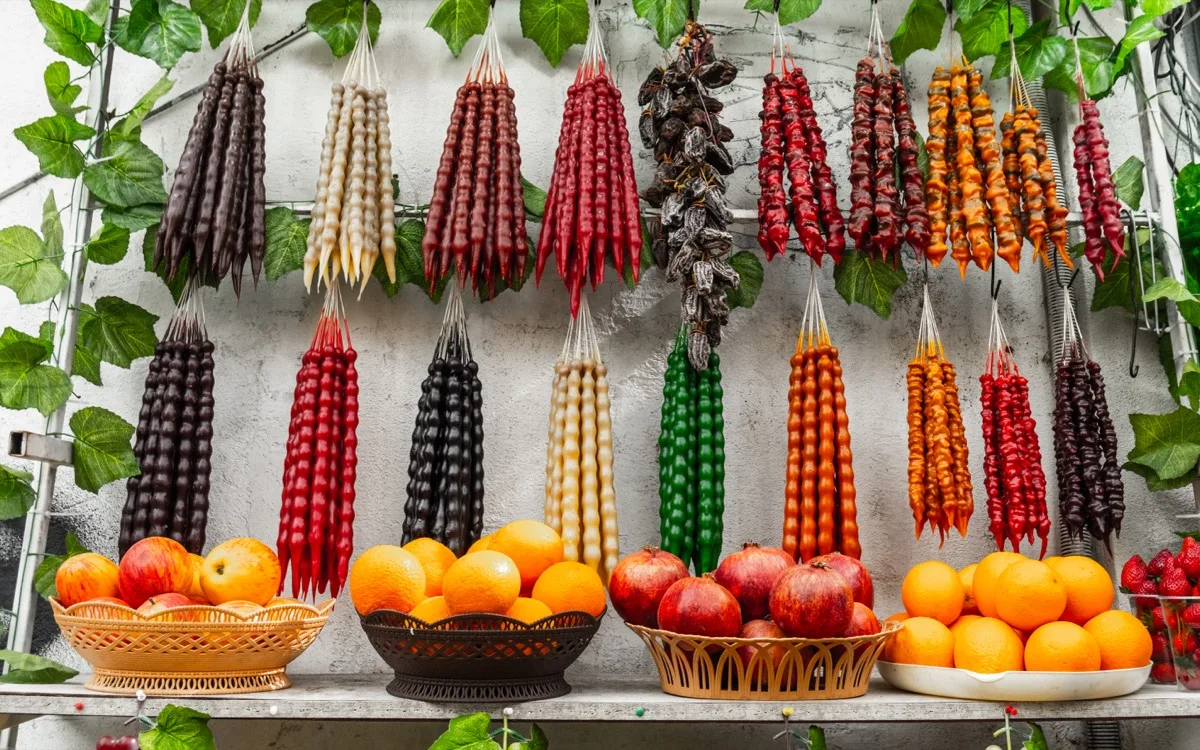
Churchkhela looks ridiculous if you didn't grow up with it. Strings of walnuts dipped in thick grape must, hung up like candles, then eaten as candy. Tourists buy one, take a photo, and often decide it's more interesting than delicious. That's usually because they bought a bad one. Good churchkhela is dense, chewy, faintly tannic, and not too sweet. It tastes like autumn in Kakheti: grape harvest, fresh walnuts, sticky pots, and kitchen windows fogged from steam. Done badly, it's rubbery and cloying. Done properly, it makes a lot more sense than most modern snacks.
Churchkhela Quick Facts
- Georgian name: ჩურჩხელა (churchkhela)
- Main flavor: walnuts wrapped in concentrated grape tatara
- Best juice: dark, tart grape juice rather than bland sweet juice
- Active work: about 45 minutes
- Total time: 1 to 2 weeks because drying is the whole point
- Difficulty: medium, mostly because consistency matters
- What ruins it: thin tatara, weak thread, or drying it in a humid room
What Good Churchkhela Actually Tastes Like
The biggest misunderstanding is sweetness. Proper churchkhela is not candy in the supermarket sense. It should taste of grapes first, then walnuts, with a little pull from the flour-thickened coating and a mild tannic edge that stops it from becoming childish. If it tastes like sticky sugar rope, something went wrong. Usually that means cheap juice, too much added sugar, or no drying time.
Texture matters just as much. The outside should be dry enough to handle without leaving your fingers sticky, but not so dry that it cracks like plaster. Inside, the coating should still have some chew. The walnuts should stay crisp enough to bite cleanly. That contrast is the whole appeal.
Ingredients
Traditional churchkhela is autumn food because that's when both fresh grape juice and fresh walnuts show up. If you're making it outside Georgia, you can still get close. The juice matters more than people think. Use unsweetened red grape juice with some acidity. If it tastes flat and sugary in the bottle, it will taste flat and sugary after reduction too.
| Ingredient | Amount | What to know |
|---|---|---|
| Walnut halves | 500g | Use fresh-tasting walnuts only. Bitter old walnuts will make the whole batch taste tired. |
| Red grape juice | 2 liters | Unsweetened. Dark juice gives the best color and a more serious flavor. |
| All-purpose flour | 180g | Thickens the tatara. Sift if lumpy. |
| Fine corn flour | 60g | Optional but helpful for body. Western Georgian versions often lean this direction. |
| Sugar | 2 tbsp | Only if your juice is sour enough to make you wince. Skip it if the juice is already sweet. |
| Cotton thread | 10 lengths | Use strong thread, not decorative twine and definitely not synthetic string. |
If your grape juice is boring, your churchkhela will be boring
The reduction intensifies everything. That means weak supermarket juice becomes thick weak supermarket juice. Choose something tart, dark, and wine-like. Saperavi-style juice is ideal because it already has the depth churchkhela needs.
Equipment and Setup That Make Life Easier
This is one of those recipes where setup saves your nerves. Once the tatara is cooked, you don't want to start looking for scissors or figuring out where the strings will dry. Thread the walnuts first. Build a drying station first. Put a tray under it first. Churchkhela is not hard, but it gets messy fast.
What you need
Large heavy pot, whisk, bowl for slurry, needle, cotton thread, drying rack or two wooden spoons across a deep tray, and patience.
Best drying spot
A cool room with airflow and no direct sun. Not above a stove. Not beside a humid dishwasher. A spare room or covered balcony works far better than a busy kitchen.
Step 1: Thread the Walnuts
Break any giant walnut halves into manageable pieces, but do not chop them finely. Churchkhela should have real bite. Thread 10 to 12 pieces per string, leaving a little space between pieces so the tatara can coat around them rather than gluing everything into one awkward lump. Tie a firm knot at the bottom. At the top, leave enough length to make a hanging loop.
The strings should end up around 18 to 22cm of walnut length. Longer than that gets annoying to dip and annoying to dry. Shorter is fine. This is one place where home cooks can improve on market churchkhela. Oversized ones look impressive hanging in a bazaar, but they're clumsy to eat.
Step 2: Reduce the Grape Juice
Pour 1.5 liters of the juice into a wide heavy pot and bring it to a gentle simmer. You're not trying to boil it aggressively. Hard boiling can give you a dull cooked flavor. Simmer it 20 to 25 minutes until it tastes more concentrated and the volume has dropped somewhat. This step deepens both flavor and color.
Meanwhile, keep 500ml juice cold and whisk it with both flours, salt, and optional sugar until smooth. No lumps. If you leave flour lumps now, you will spend the next ten minutes chasing them around a pot while muttering at yourself.
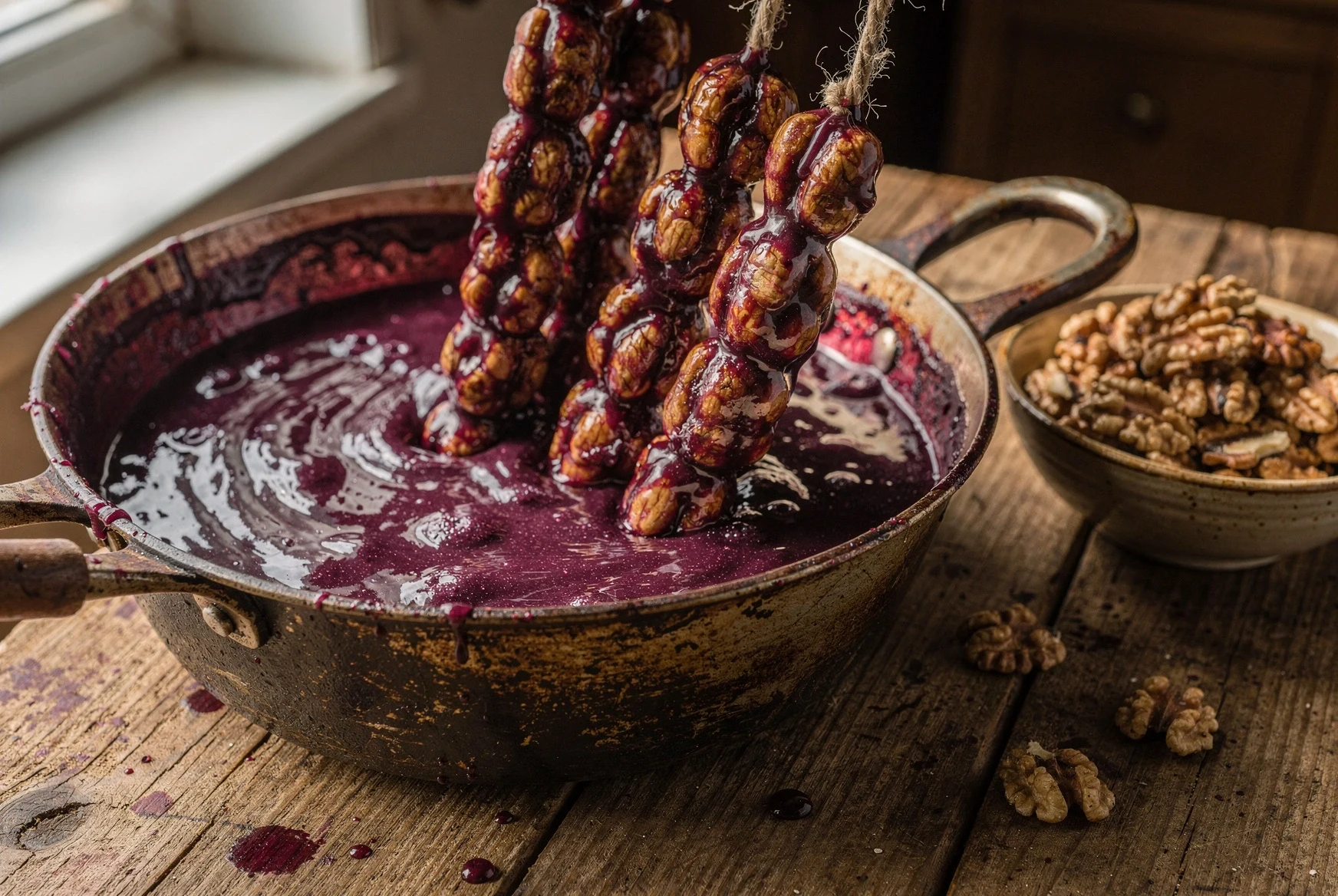
Step 3: Cook the Tatara to the Right Thickness
Lower the reduced juice to a gentle heat. Whisk in the flour slurry slowly. Keep stirring. At first it looks unimpressive, like muddy juice. Then it thickens. Then it suddenly becomes what you need: glossy, dense, and slow-moving.
The best visual cue is the spoon test. Lift a spoonful and let it fall back. If it runs like soup, it's too thin. If it drops in wide slow ribbons and coats the spoon heavily, you're in business. It should feel closer to loose pastry cream than to hot chocolate. Not cement, not gravy, not pudding. Somewhere in that narrow useful band.
| Tatara texture | What it means | What to do |
|---|---|---|
| Runs off fast | Too thin | Cook 2 to 4 minutes longer, stirring constantly |
| Falls in broad ribbons | Correct | Start dipping immediately |
| Almost clumps on the spoon | Too thick | Whisk in a little hot juice or hot water until loosened |
Thin tatara is the classic failure
If the first coat looks transparent and slides off the walnuts, stop and cook the mixture longer. Home recipes often undersell how thick tatara needs to be. It should grip the nuts immediately, not behave like syrup.
Step 4: Dip and Build the Coating
Dip one string at a time. Submerge the walnuts fully, lift slowly, let excess drip off, then hang. After 8 to 10 minutes, when the surface has stopped looking wet, dip again. Repeat until the coating is thick enough that each string looks substantial but not cartoonishly fat. Four dips will give you a leaner, chewier result. Six dips gets you closer to the market style.
Do not rush by dipping again while the previous layer is still wet. That just drags the coating off. On the other hand, don't let the tatara cool completely between rounds or it thickens beyond usefulness. Low heat under the pot helps, but keep stirring so the bottom does not catch.
Step 5: Dry It Properly
Drying is where churchkhela becomes churchkhela. Freshly dipped strings are basically edible grape paste on walnuts. After a week, they start to firm up. After two weeks, they begin to feel finished. The surface should no longer be sticky. When you press gently, it should give a little but not leave a fingerprint.
Humidity changes everything. In dry weather, seven days may be enough. In a damp apartment, you may need closer to two weeks. If you see moisture collecting, move the strings somewhere with better airflow immediately. Mold is not part of the romance here.
Ready to eat
Surface is dry, coating no longer tacky, and the string bends slightly without cracking.
Needs more drying
Feels sticky, leaves residue on fingers, or sags heavily when lifted by the loop.
Common Mistakes and the Fixes That Matter
| Problem | Why it happened | Fix |
|---|---|---|
| Coating slides off | Tatara too thin | Cook longer until it ribbons from the spoon |
| Churchkhela tastes raw | Flour not cooked enough | Keep the tatara on low heat until the flour taste disappears |
| String snaps | Weak thread or too many walnuts | Use stronger cotton thread and shorter strings |
| Surface molds | Drying area too humid | Move to a cooler drier room with airflow |
| Exterior cracks badly | Tatara too thick or dried too fast | Thin slightly next time and avoid direct sun or hot air |
Serving and Storage
Slice churchkhela into coins with a sharp knife, or just tear off chunks like a normal person standing in a kitchen. It is excellent with black tea and surprisingly good with coffee. If you want the best contrast, serve it with something unsweetened and hot.
Wrap finished churchkhela in parchment rather than plastic if you're storing it at room temperature. Plastic traps moisture and can undo the drying work you just waited two weeks for. In the fridge it lasts longer, though the coating gets firmer. Let it sit out a little before eating.
Variations Worth Making
Walnuts are the default, but not the only option. Western Georgian versions often use hazelnuts, which give a cleaner crunch and a slightly lighter feel. Some families make mixed strings with dried fruit between nuts. Those are usually better in theory than in practice. I prefer walnuts because they stand up to the grape reduction and actually taste Georgian.
Hazelnut churchkhela
More common in western Georgia. Slightly neater to eat and often a little less rich.
White grape version
Milder and lighter in color, but usually less memorable than the dark red style.
Thinner everyday style
Use four dips instead of six for a leaner, chewier result that feels less heavy.
Pelamushi side quest
If you have extra tatara, pour it into bowls and chill it. That's basically pelamushi, another Georgian autumn classic.
Why Churchkhela Still Matters in Georgia
Churchkhela survives because it still makes practical sense. It stores well. It uses ingredients people already have after harvest. It travels well. It is festive without being fragile. And unlike a lot of heritage foods that now exist mostly for tourists, Georgians still actually eat it. Not every day, and not with the same sentimental speeches foreigners attach to it, but it remains part of real kitchens and roadside stalls across the country.
If you want the broader cultural background, including history, regional styles, and where to buy the good stuff in Georgia, read our full churchkhela guide. This page is the hands-on version: the one for when you actually want to make the stuff instead of just reading about it.
Frequently Asked Questions
Can I use store-bought grape juice?
Yes, as long as it is unsweetened and tastes like actual grapes rather than candy.
Can I skip the drying time?
You can eat it fresh, but then it is basically sticky walnut tatara on a string. It is not the same thing.
Why add corn flour?
It gives slightly more body and a softer chew. If you do not have it, use more all-purpose flour.
How long does it keep?
About a month easily in a cool place, longer in the fridge if it is well dried.
Written by The Georgian Eats Team
We have eaten churchkhela from market stalls, village kitchens, and too many disappointing souvenir shops. The biggest lesson is simple: the good ones are never the neon shiny ones. This recipe is built around the darker, more serious style that actually tastes like grapes and walnuts.
Last updated: March 2026.
Related Articles
Churchkhela: The Complete Guide
History, regional variations, and how to buy the good stuff in Georgia.
Pelamushi: Georgian Grape Pudding
The same grape base, but spoonable and much faster.
Georgian Desserts Guide
The sweets worth knowing beyond khachapuri and khinkali.
Georgian Spices & Herbs
What actually gives Georgian food its edge.