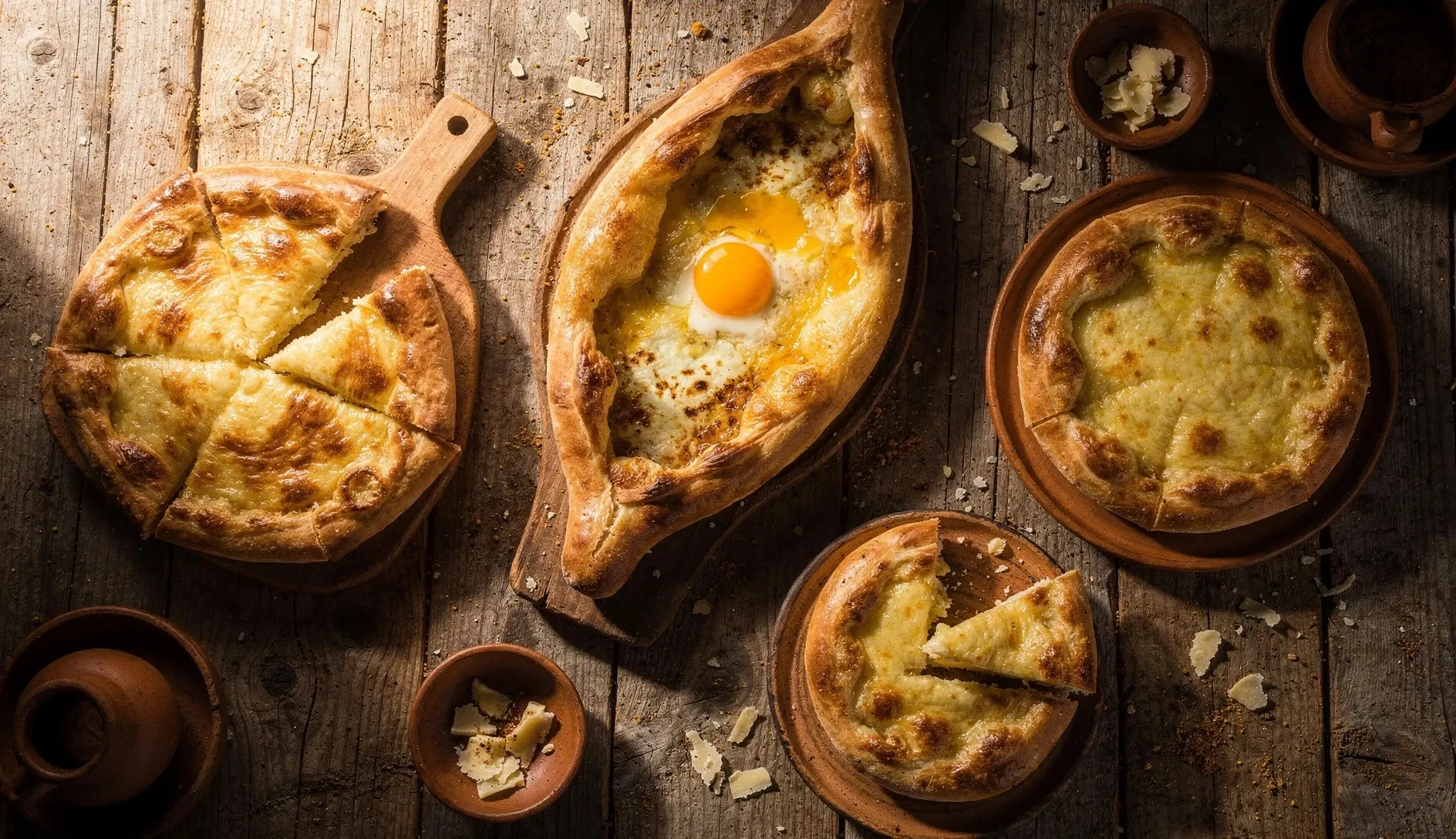
Khachapuri is not one dish. It's an entire family of cheese-filled breads, and every region of Georgia claims theirs is the best. The name comes from khacho (cottage cheese) and puri (bread), but that undersells it dramatically. There are at least a dozen distinct varieties across the country, each with its own shape, cheese, dough, and eating ritual. Some are round and sliced like a pie. One is shaped like a boat with a raw egg floating in it. Others are layered like pastry or stuffed with potatoes alongside the cheese.
If you've only tried the boat-shaped Adjarian version — the one that gets all the Instagram attention — you've barely scratched the surface. This guide covers every major variety, the cheeses that make them work, how to eat each one properly, and what to order when you're staring at a Georgian menu with no pictures.
What Makes Khachapuri Khachapuri
At its core, every khachapuri is dough plus cheese, baked or pan-fried. But the details vary enormously. The dough might be yeasted and puffy, unleavened and crisp, or layered like puff pastry. The cheese is almost always some combination of fresh Georgian varieties — primarily imeruli (a mild, stretchy brined cheese similar to mozzarella) and sulguni (a firmer, saltier pulled-curd cheese). Some regions add eggs, butter, or additional cheeses into the filling.
What all khachapuri share: they're eaten hot, the cheese should be melted and stretchy, and they're meant to be torn apart and shared (with the notable exception of the Adjarian version, which is a one-person affair). Cold khachapuri is sad khachapuri — the cheese solidifies and the dough toughens. Always eat it fresh.
The Khachapuri Index
Georgia's national statistics office publishes a monthly "Khachapuri Index" that tracks the cost of ingredients for one standard Imeretian khachapuri. It's used as an informal inflation indicator — like a Big Mac Index but with cheese bread. As of early 2026, the index sits around 7–8 GEL for homemade ingredients.
The Major Varieties
Here's every khachapuri variety worth knowing, organized by how likely you are to actually encounter them.
| Variety | Region | Shape | Key Feature | Availability |
|---|---|---|---|---|
| Imeretian (იმერული) | Imereti | Round, enclosed | The standard — cheese sealed inside | Everywhere |
| Adjarian (აჭარული) | Adjara | Boat-shaped, open | Egg + butter in melted cheese | Everywhere |
| Megrelian (მეგრული) | Samegrelo | Round, cheese on top | Double cheese — inside AND on top | Everywhere |
| Penovani (ფენოვანი) | No specific region | Square, layered | Puff pastry dough, crispy layers | Common |
| Gurian (გურული) | Guria | Half-moon | Hard-boiled egg inside with cheese | Seasonal (Christmas) |
| Ossetian / Khabidzgina (ოსური / ხაბიძგინა) | South Ossetia / Shida Kartli | Round, thin | Potato + cheese filling | Some restaurants |
| Svan (სვანური) | Svaneti | Round, flat | Cheese + green onions or potato | Svaneti / some Tbilisi spots |
| Rachuli (რაჭული) | Racha | Round, thick | Extra rich, heavy on butter | Rare outside Racha |
| Tushetian (თუშური) | Tusheti | Round, paper-thin dough | Cottage cheese curd (kalti) filling | Very rare |
| Achma (აჩმა) | Adjara / Abkhazia | Layered, rectangular | Boiled dough layers + cheese (like lasagna) | Common |
Imeretian: The Standard
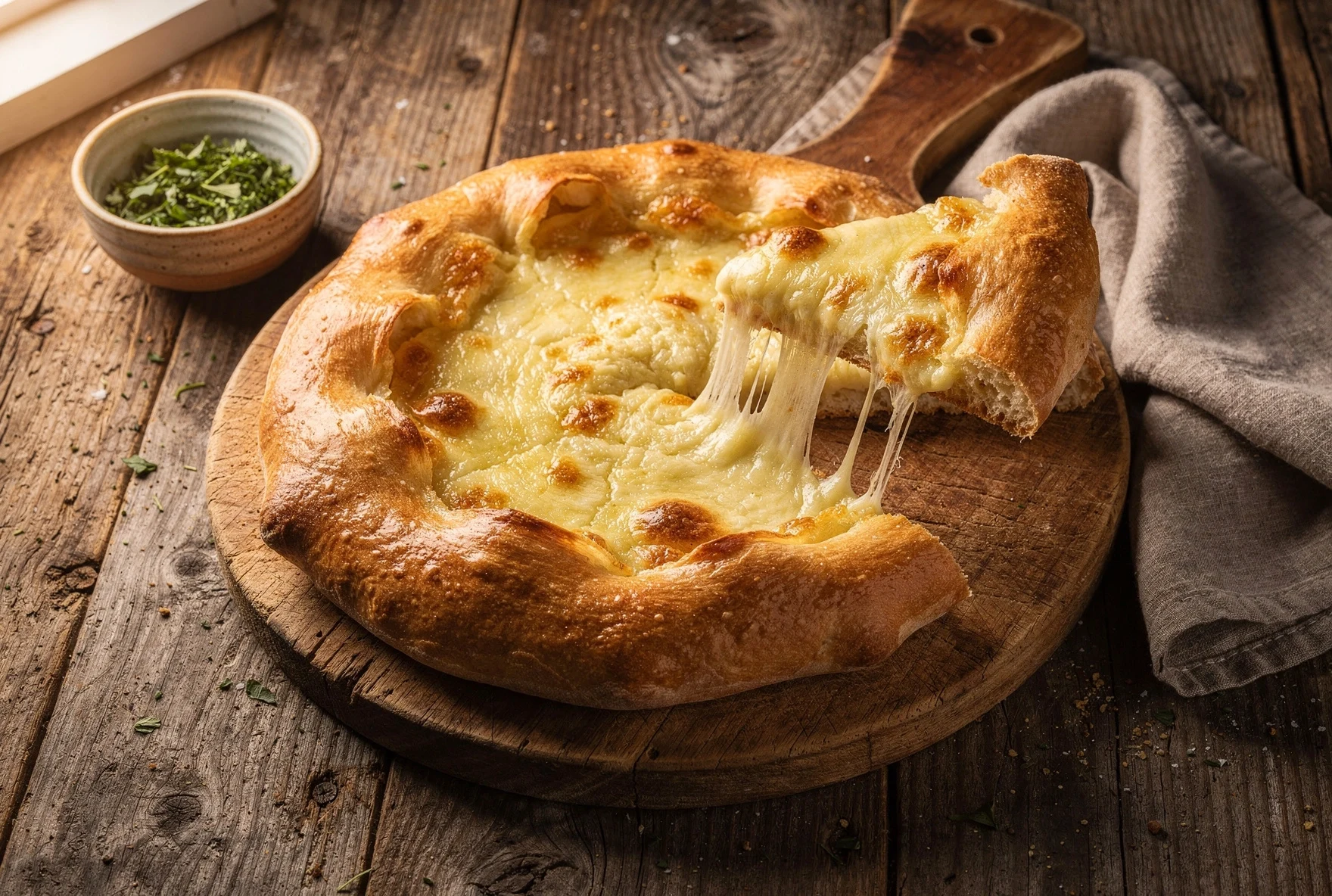
If someone in Georgia says "khachapuri" without a regional qualifier, they mean the Imeretian version. It's a round, fully enclosed bread with a generous layer of melted imeruli cheese inside. The top is smooth, lightly browned, and sometimes brushed with butter after baking. You slice it like a pie and eat it in wedges.
The dough is typically yeasted — soft and slightly puffy, with a satisfying chew. The cheese inside should be hot, stretchy, and slightly salty. A good Imeretian khachapuri has a thin, even layer of dough on top and bottom, with the cheese making up at least half the thickness. Bad ones have too much bread and not enough cheese — a disappointingly common problem at tourist-heavy restaurants.
This is the variety most Georgians eat most often. It's breakfast food, snack food, drunk food, party food. Every bakery in every town makes it. Prices range from 3–5 GEL at a bakery to 8–14 GEL at a restaurant.
The Cheese Matters
True Imeretian khachapuri uses imeruli cheese — a soft, brined cheese with mild flavor and excellent melting properties. Outside Georgia, the best approximation is a 70/30 mix of low-moisture mozzarella and feta. Using only mozzarella makes it too bland; only feta makes it too crumbly and salty.
Adjarian: The Famous One
This is the one you've seen on Instagram. A boat-shaped bread cradle filled with a bubbling pool of melted cheese, topped with a raw egg yolk and a slab of butter that melts into everything. It comes from Adjara, the subtropical Black Sea region around Batumi, and it's designed as a complete single-serving meal.
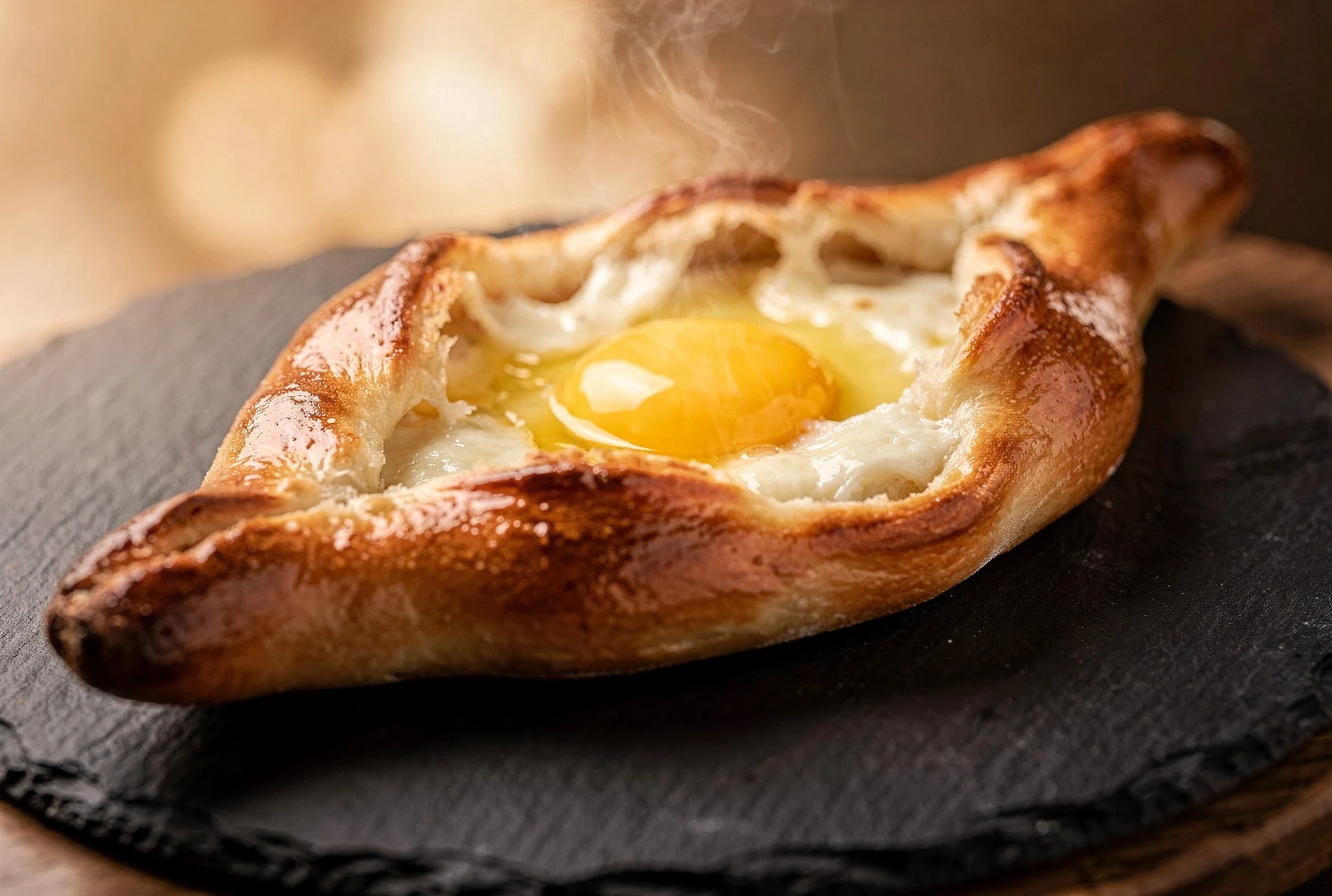
The ritual matters. When it arrives at the table — and it should arrive within seconds of leaving the oven — you tear off the pointed ends of the bread, use them to stir the egg yolk and butter into the cheese, and then use the torn bread pieces as edible scoops to eat the filling. You work your way inward, tearing more bread from the sides as you go, until only the bottom crust remains (which you also eat, now soaked in cheese and butter).
A proper Adjarian khachapuri is not a shared dish. One boat, one person. Ordering one "for the table" marks you as a tourist immediately — and means nobody gets enough cheese per bread ratio.
The 60-Second Rule
An Adjarian khachapuri must be eaten within about 60 seconds of arriving at the table. The egg needs to be stirred in while the cheese is still bubbling hot — once it cools, the cheese seizes up and the egg starts to set. If a restaurant brings it to you lukewarm, send it back. This is not negotiable.
Megrelian: Double Cheese
The Megrelian version is the Imeretian khachapuri's more indulgent cousin. Same round shape, same cheese filling inside, but with an additional layer of sulguni cheese melted on top. It's cheese bread with extra cheese, which is exactly as good as it sounds.
Samegrelo (Mingrelia) is Georgia's most aggressively flavored food region — they use more spice, more cheese, more heat than anyone else. Their khachapuri reflects this maximalism. The top layer of sulguni gets a beautiful golden-brown crust under the oven, slightly charred in spots, which adds a nutty, caramelized flavor you don't get from the Imeretian version.
If you like cheese and think the Imeretian version needs more of it, the Megrelian is your khachapuri. It's heavier and richer, so it works better as a main dish rather than a side.
Penovani: The Crispy One
Penovani means "layered," and that's exactly what it is — cheese sandwiched between layers of flaky puff pastry dough. Unlike the other varieties, which use yeasted bread dough, penovani uses laminated dough that shatters into buttery, crispy flakes when you bite into it.
It's typically cut into squares or diamonds. The cheese filling is the same imeruli blend as Imeretian, but the eating experience is completely different — crunchy instead of chewy, lighter instead of dense. It's the khachapuri most likely to show up on a breakfast table alongside your tea.
Penovani doesn't belong to any specific region. It's a bakery standard across the country, and you'll find it piled in stacks behind glass counters at virtually every Georgian bakery. Expect to pay 2–4 GEL for a generously sized piece.
Gurian: The Christmas Special
Gurian khachapuri is shaped like a half-moon — imagine a large empanada filled with cheese and a hard-boiled egg. The dough is yeasted and slightly sweetened, giving it a subtle richness that sets it apart from other varieties. The hard-boiled egg hidden inside is the signature surprise.
In Guria, this is a Christmas dish. You'll see it everywhere during the holiday season (Georgia celebrates Christmas on January 7, following the Julian calendar), but it's harder to find during the rest of the year. Some Tbilisi restaurants serve it year-round, but it's a seasonal specialty at heart.
The combination of slightly sweet dough, salty cheese, and the hard-boiled egg creates a surprisingly balanced flavor. It's lighter than Adjarian or Megrelian, and the half-moon shape makes it the most portable khachapuri — you can eat it walking without making a mess.
Lesser-Known Varieties
Ossetian / Khabidzgina (ოსური / ხაბიძგინა)
A thin, round potato-and-cheese khachapuri that deserves to be judged by its ratio: lots of soft filling, very little dough. Common in Shida Kartli and the wider Ossetian-Georgian bread orbit. When done right, it feels more grounded and less aggressively rich than pure-cheese versions.
Svan (სვანური)
From the highlands of Svaneti. Uses local cheese mixed with green onions, sometimes potato. The dough is typically pan-fried rather than baked, giving it a crispy exterior. The green onion adds a sharpness that cuts through the rich cheese.
Rachuli (რაჭული)
Racha's version is legendarily rich — extra butter in the dough, extra cheese in the filling. Racha is Georgia's smallest region but takes food very seriously. You'll rarely find this outside Racha itself, which is reason enough to visit.
Tushetian (თუშური / კოტორი)
The rarest variety. Uses kalti, a dried cottage cheese curd unique to Tusheti. Wrapped in paper-thin dough (also called kotori). Available almost exclusively in Tusheti during summer months, since the region is inaccessible the rest of the year.
Achma: The Outlier
Achma breaks every rule. The dough layers are boiled before being layered with cheese and baked — making it closer to a cheese lasagna than a bread. Each paper-thin sheet of dough is briefly cooked in boiling water, then stacked with grated sulguni in between, and the whole thing goes into the oven until the cheese melts and the top browns.
It comes from the Adjara and Abkhazia regions, where the culinary influences from Turkey and the eastern Black Sea coast run deep. The texture is completely different from every other khachapuri — soft, almost custardy between the layers, with a crispy top. It's rich enough to be a complete meal.
Some people argue achma isn't really khachapuri at all — it's its own thing. But it's made from dough and cheese, it's baked, and Georgians call it khachapuri, so it makes the list.
The Cheeses That Make It Work
Georgian cheese is a world unto itself, and khachapuri depends on getting the cheese right. Here are the key players:
| Cheese | Texture | Flavor | Used In | Substitute |
|---|---|---|---|---|
| Imeruli | Soft, stretchy | Mild, milky, slightly tangy | All varieties (primary) | Low-moisture mozzarella + feta (70/30) |
| Sulguni | Firm, pulled-curd | Salty, tangy, slightly elastic | Megrelian (top), achma, blends | Provolone or young kashkaval |
| Chkinti | Very soft, crumbly | Fresh, mild, slightly sour | Traditional village khachapuri | Fresh farmer's cheese or queso fresco |
| Kalti | Dry, crumbly curd | Sharp, aged, pungent | Tushetian khachapuri only | No real substitute |
| Dambal khacho | Semi-hard, blue-veined | Pungent, complex, funky | Sometimes mixed into Svan varieties | Gorgonzola (loosely) |
Outside Georgia? Here's What to Buy
If you can't find Georgian cheese (check Russian/Eastern European grocery stores — they often stock sulguni and imeruli), use this blend: 500g grated low-moisture mozzarella + 200g crumbled feta + 1 beaten egg. Mix well. The mozzarella provides stretch, the feta provides the salt and tang, and the egg binds everything. It's not authentic, but it's the closest you'll get.
How to Eat Khachapuri (Properly)
Each variety has its own etiquette, and how you eat it matters more than you'd think.
Imeretian / Megrelian
Cut into wedges like a pie. Eat with your hands — no fork needed. The cheese should stretch when you pull a slice away. Eat while hot; once it cools, the magic dies.
Adjarian
Never cut it. Tear off the pointed ends, stir the egg into the cheese with the bread, and scoop. Work inward. One person per boat. Eat within 60 seconds of arrival.
Penovani
Pick it up and eat it. It's flaky and messy — embrace it. Often eaten as a quick snack, standing at a bakery counter. No plate, no fuss.
Achma
This one gets a fork. It's too soft and layered to eat with hands. Cut into portions, eat like pasta. It's best when the top is crispy and the inside is still creamy.
What to Order When
Not every khachapuri suits every situation. Here's a practical guide:
| Situation | Best Choice | Why |
|---|---|---|
| First time trying khachapuri | Adjarian | The experience is unforgettable — egg, butter, cheese theater |
| Sharing with a group | Imeretian or Megrelian | Slices cleanly, everyone gets an equal share |
| Quick snack / breakfast | Penovani | Light, portable, available at every bakery |
| Maximum cheese | Megrelian | Cheese inside and on top — double the melt |
| Hungover | Adjarian | Hot, greasy, filling, requires no decision-making beyond "stir" |
| Something different | Achma | Completely different texture — like cheese lasagna |
Making Khachapuri at Home
The good news: khachapuri is genuinely doable at home, even with limited baking experience. The dough is forgiving, the fillings are simple, and the techniques don't require any specialized equipment beyond an oven and a baking sheet.
| Variety | Difficulty | Time | Key Challenge |
|---|---|---|---|
| Imeretian | Easy | ~1.5 hours | Sealing the dough without tearing |
| Adjarian | Medium | ~2 hours | Shaping the boat, timing the egg |
| Megrelian | Easy | ~1.5 hours | Same as Imeretian + adding sulguni on top |
| Penovani | Easy (cheat) | ~45 min | Use store-bought puff pastry — no shame |
| Achma | Medium | ~2.5 hours | Making and boiling the dough sheets |
| Gurian | Medium | ~2 hours | The slightly sweet dough needs careful handling |
The #1 Home Baker Mistake
Not getting the oven hot enough. Georgian bakeries use wood-fired ovens at 300°C+ (575°F). Your home oven won't match that, but crank it as high as it goes — at least 250°C/480°F. Use a pizza stone or preheated baking sheet. The high heat is what gives the dough its signature puff and char while keeping the cheese inside molten.
We have detailed step-by-step recipes for the four most popular varieties:
Adjarian Khachapuri Recipe →
The boat-shaped icon. Dough tips, cheese blend, and the 60-second egg technique.
Imeretian Khachapuri Recipe →
The classic round version. Simple, satisfying, and the best place to start.
Megrelian Khachapuri Recipe →
Double cheese: inside and on top. For when Imeretian isn't enough.
Penovani Khachapuri Recipe →
The flaky puff pastry version. Uses store-bought dough — ready in 45 minutes.
History and Culture
Khachapuri is old. How old exactly is debated, but cheese-filled breads appear in Georgian written records from the medieval period, and the practice almost certainly predates literacy. Georgia has been making cheese for thousands of years — archaeologists have found evidence of cheesemaking in the Caucasus dating back to at least 5,500 BCE — and stuffing it into bread is a logical next step.
Each region developed its own version based on local cheese, local flour, and local cooking methods. The Adjarian boat shape is said to represent the fishing boats of Batumi's harbor. The Gurian half-moon represents the moon (or possibly just a convenient shape for a portable meal). These origin stories are charming but probably post-hoc — the shapes likely evolved for practical reasons and got mythologized later.
What's not debatable is khachapuri's centrality to Georgian identity. It appears at every supra (feast), every holiday, every celebration. It's breakfast, lunch, dinner, and snack. The Georgian government literally tracks its price as an economic indicator. When Georgians abroad miss home, khachapuri is usually the first thing they make or seek out.
In 2011, the Georgian government registered Adjarian khachapuri with Geographical Indication status, similar to how Champagne or Parmigiano-Reggiano are protected. This means officially, only Adjarian-style khachapuri made in Georgia using specific methods can use the name. In practice, enforcement is nonexistent, but the symbolic value is clear — this is national heritage.
Common Mistakes Tourists Make
❌ Ordering Adjarian "to share"
One boat = one person. Sharing means nobody gets the right bread-to-cheese ratio. Order one each.
❌ Eating it cold
Khachapuri is a time-sensitive food. If you're photographing it for five minutes before eating, you're eating it wrong.
❌ Using a fork on Adjarian
Tear and scoop. The bread IS the utensil. A fork is for achma only.
❌ Only trying one variety
Most tourists try Adjarian and stop there. That's like visiting Italy and only eating pizza margherita. Try at least three varieties.
❌ Judging by tourist restaurants
The worst khachapuri in Georgia is at tourist-trap restaurants on Shardeni Street. Go where locals eat — small bakeries and neighborhood restaurants.
❌ Ordering khachapuri AND a main course
An Adjarian or Megrelian khachapuri IS a main course. Ordering that plus a plate of meat means you're going to waste food or feel terrible. Or both.
Prices and Where to Find the Best
Khachapuri Price Guide (2026)
The best khachapuri in Georgia is rarely at the fanciest restaurant. Small neighborhood bakeries and family-run restaurants consistently outperform the places with English menus. Here are some general rules:
- For Imeretian: Any bakery where locals are lined up. The faster the turnover, the fresher the bread.
- For Adjarian: Restaurants that specialize in Adjarian food, or any place in Batumi. Avoid tourist-strip restaurants in Tbilisi.
- For Megrelian: Look for restaurants labeled "Megrelian cuisine" — Samegrelo-focused places take their cheese seriously.
- For Achma: Adjarian restaurants in Tbilisi, or anywhere in Batumi.
- For Gurian: Visit in January around Christmas, or find a Gurian restaurant in Tbilisi.
Frequently Asked Questions
Is khachapuri just Georgian pizza?
No, and Georgians will be annoyed if you call it that. Pizza is an open-faced bread with toppings. Khachapuri is a filled bread where the cheese is inside the dough (except for Megrelian and Adjarian). The dough, cheese, and cooking technique are all different. The only similarity is that both involve dough and cheese.
Can I eat khachapuri if I'm lactose intolerant?
It will be difficult. Cheese is the entire point — there's no vegan or dairy-free version that makes sense. Some brined cheeses like sulguni have slightly lower lactose than soft cheeses, but khachapuri is fundamentally a dairy delivery system.
Which variety should I try first?
Adjarian, for the experience. Then Imeretian, for the pure cheese-bread flavor without distractions. Then Megrelian if you want more cheese. Then penovani for something different. Work your way through all of them during a week in Georgia.
How many calories are in khachapuri?
A whole Imeretian khachapuri runs about 1,200–1,500 calories. An Adjarian boat is 800–1,100 calories. A piece of penovani is 350–500 calories. These are not diet foods. Georgia didn't invent them for calorie counting.
Can I reheat khachapuri?
Technically yes — oven at 180°C for 5–8 minutes. But it's never as good reheated. The dough dries out, the cheese doesn't stretch the same way, and Adjarian is essentially impossible to reheat properly. Fresh is the only way.
What's the difference between khachapuri and lobiani?
Shape is identical (round, enclosed), but lobiani is filled with spiced mashed beans instead of cheese. They're often sold side by side at bakeries. Lobiani is the go-to option during Orthodox fasting periods when dairy isn't allowed.
Written by The Georgian Eats Team
We've eaten more khachapuri than we can count across every region of Georgia — from bakery counters in Tbilisi to family kitchens in Svaneti. This guide is based on years of eating, cooking, and arguing about which variety is best.
Last updated: March 2026.
Related Articles
Georgian Cheese Guide
Every Georgian cheese explained — imeruli, sulguni, tenili, and more.
Georgian Bread Guide
Every type of Georgian bread — tone ovens, mchadi, lobiani, and more.
Regional Cuisine Guide
How Georgian food changes from west to east — eight distinct food cultures.
Georgian Street Food
What locals actually eat standing up — bakery windows, grilled meats, and more.